


Pork-barrel politics is a defining feature of electoral competition in many established democracies and, even more frequently, new democracies. However, because most theories of political parties focus on spatial competition, political science has not yet fully developed a framework for understanding political strategies in systems that are dominated by pork.
By definition, in pork-oriented systems it is important for politicians to deliver private and local public goods to their constituents. As a result, those who control access to these goods have substantial influence over political actors. In this way, the institutions that assign control over state resources are likely to shape power relations and the incentives that drive political behavior throughout the system, and different patterns of resource control ought to lead politicians to pursue different career strategies.
The key to understanding the strategies politicians pursue in pork-centered contexts is knowing where resource control is located. Instead of worrying about the location of the median legislator, veto pivot, or executive, when pork distribution dominates politics, mainstream politicians are likely to focus on actors that control state resources. The impact of resource control may be widely evident in political systems, affecting career paths, roll-call votes, coalition formation, and, the focus of this paper, party affiliation.
We provide suggestive evidence about the relationship between resource decentralization and party system organization, examining national and subnational legislatures in Brazil and Japan. These two cases share many similar features, including a strong pork-barrel orientation, but in Brazil, control over pork allocation is significantly decentralized, whereas in Japan it is highly centralized. The implication is that national and subnational legislators in Brazil should be oriented toward subnational actors who control resources, whereas both national and subnational legislators in Japan focus on central actors who control resources. We measure the impact of the location of resource control using politicians' patterns of party affiliation during periods of party switching in the two countries.
These cases thus provide a unique opportunity to study party affiliation. They represent most-different types on a scale of decentralization, and both cases have seen bouts of party switching. We leverage this opportunity to study party affiliation, modeling legislators' decision to stay put or join particular parties as a function of resource decentralization.
This study offers a number of advantages for understanding the links between resource control and party affiliation. First, studying politicians' decision whether to switch parties offers a unique perspective into what is truly important to politician strategy. Where politicians are willing to switch parties in order to gain or maintain access to resources, their choices indicate just how critical such resources are to the party system. Second, by focusing our study on the individual level in both countries, we are able to address directly the mechanisms linking resource control to party affiliation. Most studies of the impact of resource control on party affiliation tend to base their findings on aggregate-level data, but resources only indirectly impact the party system more generally. We study the direct effect of resources on the party affiliation patterns of individual politicians, whose aggregate behavior shapes the party system. Finally, our theory has implications for both national and subnational legislators' behavior, and we leverage new data on subnational party switching to gain additional power for our hypothesis tests.
DECENTRALIZED AND CENTRALIZED POWER IN PORK-CENTRIC SYSTEMS
Mainstream political science work on party and candidate strategy tends to work from the Downsian spatial modeling tradition, considering the policy choices that parties and candidates make relative to one another and how these choices affect the likelihood of victory (see, e.g., Adams, Merrill, and Grofman Reference Adams, Merrill and Grofman2005; Downs Reference Downs1957). Of course politicians and parties do not act within a vacuum; institutions shape their strategies. For example, different electoral rules push politicians to take different positions within the policy space (e.g., Cox Reference Cox1987, Reference Cox1990). However, to our knowledge, there is no systematic comparative analysis that explicitly addresses the issue of politician strategy within heavily pork-oriented systems.Footnote 1
To be sure, no system is entirely pork oriented or programmatic; elements of each coexist in most political systems, but we can identify pork-driven systems, where elections are won or lost primarily on the ability of parties or candidates to deliver government resources in the form of goods (such as jobs) that are targeted to specific individuals and local public goods or club goods (such as infrastructure projects) that are delivered to targeted groups and regions.
Where pork is an important part of electoral competition, legislators face substantial pressure to deliver resources to core constituents. But these resources are not free. Legislators must trade something of value to get them. The most valuable tradable good is the legislator's influence over the passage of bills via the legislative process, including committee work, roll-call votes, and coalition membership. The idea that legislators would trade this influence for access to resources is hardly novel, but with whom do they bargain?
The answer depends on the rules that determine who has discretion over spending, and, we argue, an important distinction in rules is between systems that centralize or decentralize control over governmental resources. Differences in the level of centralized control over resources ought to lead systematically to different strategies that legislators will pursue to gain access to these resources. In systems that centralize funding, legislators—whether at the national or subnational level—have strong incentives to bargain with actors who control resources at the national level. This is particularly the case in systems where national ruling parties withhold funds from individuals, organizations and regions that do not support them. Indeed, analyses of specific centralized systems—Chile (Valenzuela Reference Valenzuela1977), Italy (Hine Reference Hine1993), Mexico (Diaz-Cayeros, Magaloni, and Weingast Reference Diaz-Cayeros, Magaloni and Weingast2000), and Japan (Curtis Reference Curtis1971; Scheiner Reference Scheiner2005, Reference Scheiner2006)—suggest that subnational candidates and voters in centralized systems often align with a national government party to have a better chance of gaining central funding.
In other words, when pork resources are strongly centralized, party hierarchies should thus be similarly “verticalized,” with politicians at national and local levels focusing on national politics. For example, writing about Japan, Scheiner (Reference Scheiner2005, Reference Scheiner2006) highlights the prominence of patron–client relationships developed between subnational politicians and national ones who act as distributive “pipelines” from the center to the locality. There are clear advantages to this arrangement for both subnational and national legislators. For subnational legislators, vertical networks deliver pork from the central government. Meanwhile, for national legislators, vertical networks consolidate subnational political supporters who help mobilize votes at election time. Such vertical networks have been critical to national-level legislator and general party success in centralized pork-based countries such as Colombia, Italy, Japan, Mexico, and Venezuela (Ames Reference Ames1994, 95).
However, whereas the framework discussed in the preceding paragraph might be termed a centralized pipeline, other heavily pork-oriented systems also maintain decentralized pipelines. At the extreme, all pork could theoretically be distributed by decentralized actors. Practically, however, no political systems have complete decentralization. Instead, national and subnational actors share pork discretion. In these systems, party hierarchies are complex. Legislators in such contexts potentially face multiple pipelines, where both national and subnational actors control career-advancing resources. To the extent possible, legislators' focus should be on pleasing both constituencies, and maximizing access to pork. When impossible, legislators should respond to the actor with whom they have the most negotiating power and can extract the most pork (and who can most punish them for withholding their support).
Of course, not just any resource decentralization will restructure politics. The key variable is decentralized discretion. In many political systems, subnational governments receive major revenue transfers from the national government, but these transfers are often accompanied by tight spending constraints. In such cases, pork is not a political tool of influence. But where politicians maintain budgetary discretion, we expect spending to be politicized and affect politicians' decisions to affiliate with specific parties.
OUR APPROACH: USING PARTY SWITCHING TO STUDY PARTY AFFILIATION
The above discussion suggests that in pork-oriented systems, all else being equal, politicians who place a premium on delivering pork prefer membership in parties that control access to the resources of the state. In most political systems, demonstrating this relationship thoroughly can be difficult. Efforts to study the impact of resource control on party affiliation typically utilize dependent variables, such as aggregate vote or seat totals won by particular parties at different levels of government, that do not permit individual-level analysis of legislators themselves (e.g., Ames Reference Ames1994; Samuels Reference Samuels2003; Scheiner Reference Scheiner2005). To get at the problem more directly, we focus on individual politicians' party affiliation strategies in contexts where party switching is a viable option.
Important political science work points to political parties as the creations of strategic politicians, designed to serve a specific political purpose (Aldrich Reference Aldrich1995; Cox Reference Cox1987), but the lack of variation in individual politicians' party affiliation often makes it hard to demonstrate this point empirically: In many political systems, it is rare that politicians leave their current party to join another. For example, where voters are highly partisan and there are broad social cleavages, switching by elites is almost impossible (Desposato Reference Desposato2006). Where politicians never switch parties, politicians' original decision to join a particular party may be similarly motivated, such as a desire to gain access to pork. But without seeing any change in affiliation patterns over time, it is difficult to demonstrate this fact.
Where politicians are willing to change parties, the decisions they make about which party with which to affiliate provides scholars leverage over the “Why Parties?” question: When we observe legislators choosing between organizations with different characteristics, we can identify directly the features of parties that are important for political goals and careers. For this reason, there is a rich tradition of work on party switching within political science, with scholars leveraging party switching to understand politics in the United States (Grose Reference Grose2004; Nokken Reference Nokken2000; Nokken and Poole Reference Nokken and Poole2004), Latin America (Desposato Reference Desposato2006; Mejia Acosta Reference Mejia Acosta2004; Schmitt Reference Schmitt1999), Europe (Heller and Mershon 2005; McElroy Reference McElroy2003; Shabad and Slomczynski Reference Shabad and Slomczynski2004; Thames Reference Thames2007; Turan Reference Turan1985), and Asia (Cox and Rosenbluth Reference Cox and Rosenbluth1995; Kato Reference Kato1998; Reed and Scheiner Reference Reed and Scheiner2003). Party switching can be of several types, including to new or old parties (Shabad and Slomczynski Reference Shabad and Slomczynski2004), and fluidity of membership can be an ongoing phenomenon or just an infrequent realignment occurrence. But no matter the type or the frequency of the party-switching pattern being examined, these studies are particularly useful in demonstrating what features of parties are most important to politicians. Kato's (Reference Kato1998) analysis of a brief period of party switching in Japan, for example, develops a model of switching based in part on politicians' evaluations of the quality of their party's public policies and the general reputation of the party.
Most of this literature models the binary choice to switch or not, with less focus on party choice. This approach may be appropriate in two-party systems, where the choice set is indeed binary.Footnote 2 However, in multiparty systems, legislators are not making binary choices; they typically choose from a larger set of destination parties. Analysis framed around a binary choice therefore ignores characteristics of these potential destination parties. It is akin to asking whether you want to eat in or eat out, without telling you what kinds of restaurants are an option. Ignoring the diversity of legislators' full choice set can lead to biased coefficients and an incomplete understanding of party affiliation strategies.
One exception in the literature is Desposato (Reference Desposato2006), who proposes a general model of affiliation to explain politicians' choice of party and decision to switch, which are multiparty environments. We adopt a similar approach: Our concern here is not with developing a model of why politicians switch parties, but with why politicians choose the party that they do. Further, we use this focus on party affiliation decisions explicitly to try to understand politician strategies within a heavily pork-oriented context.
Multiple studies suggest the important role of institutions, especially electoral rules, in shaping the frequency and direction of party switching (Desposato Reference Desposato2006; Heller and Mershon 2005; McElroy Reference McElroy2003; Thames Reference Thames2007; Turan Reference Turan1985). We focus on a different institution: the locus of resource control. For many legislators in pork-focused political systems, the key to party affiliation is not simply general policy or reputation, but, rather, access to the goods that the government can provide. We argue that where pork drives politics and changing parties is a viable option for politicians, sitting legislators for whom access to pork is important will have an incentive to choose parties—whether staying in their current party or switching to another—that link them to actors who control distributable resources.
BRAZIL AND JAPAN: SIMILARITIES, DIFFERENCES, AND HYPOTHESES
We investigate the plausibility of our argument by examining the dynamics of legislative party affiliation during periods of party switching in Brazil and Japan, two countries with similar political systems, but that differ on our principal explanatory variable: the locus of discretionary control over resources. Resource control in Brazil is decentralized, whereas it is highly centralized in Japan.
Similarities
Brazil and Japan meet a number of preconditions for party switching: Mass partisanship is low, legislative elections are personalistic, and the goods lost from switching (committee seats, for example), are of relatively low value for legislators. In Brazil, party switching has been a common phenomenon, and in Japan party switching in 1993–94 dramatically shook up the party system.
In addition, pork has long played a well-documented and important role in political success in both Brazil and Japan. The high levels of personalism, weak partisanship (Baker, Ames, and Renno Reference Baker, Ames and Renno2006), and heavy use of pork are well-documented features of Brazilian politics (Leal Reference Leal1977; Mainwaring Reference Mainwaring1999): Among Brazil's strongest parties, only one—the more programmatic and leftist Worker's Party—attracts a partisan base and only 10% of voters express a preference for one of the remaining parties (Samuels Reference Samuels2006). Further, many partisans are really personal partisans—their identity is linked to individual patrons, not to specific parties (Desposato Reference Desposato2001). Consequently, it is important for many legislators to take actions, such as delivering private and local club goods, that allow them personally to claim credit with voters and donors; and the importance of government resource delivery for career advancement means that Brazilian legislators prioritize access to pork (Ames Reference Ames2001; Mainwaring Reference Mainwaring1999). As Ames (Reference Ames1995, 339) writes about Brazil, “pork buys deputies.”
The literature characterizes Japan in similar terms. In a recent wide-ranging analysis of voting behavior around the world, Japan ranked fourth lowest among advanced industrial established democracies (and in the bottom third overall) in terms of the proportion of voters who list themselves as partisans (Norris Reference Norris2004). Politics in Japan is typically highly personalized, in large part because of the electoral systems utilized. Pork plays a major part in Japan, where gaining access to government funds is perceived to be critical to politician success (Scheiner Reference Scheiner2006). Public works spending, a central feature of Japanese pork, is roughly three to four times the percentage of GDP seen in other advanced industrial economies (Ogawa Reference Ogawa2004; Seaman Reference Seaman2003). And, ultimately, as Fukui and Fukai (Reference Fukui and Fukai1996, 268–69) write, “Japanese voters are mobilized at election time mainly by the lure of pork barrel, only marginally by policy issues, and even less by ideals and visions.”
In both cases, part of the explanation for low partisanship is the highly personalistic electoral rules. Brazil uses an open-list proportional representation (OLPR) system, with high district magnitude, for every legislative election from city council to national chamber. During the period studied, Japan's House of Representatives (HR) and prefectural assemblies used the similarly personalistic single nontransferable vote in multimember district (SNTV/MMD) system. Both systems have been identified as promoting personal, not partisan, politics (Carey and Shugart Reference Carey and Shugart1995).
Like all countries, Brazil and Japan are not completely devoid of programmatic politics. In Brazil, some parties run on issues (such as the death penalty or security), but these parties tend to be small and unsuccessful. There is also variance in the appeal of pork across regions, but most actors prefer pork distribution when they can get it. For example, the Worker's Party of Brazil ran on ideological platforms while in the opposition, but once in power adopted distributive support-building strategies as well. In Japan, many voters, parties, and candidates care much less about pork. All that said, even the ideological Socialist Party was long supportive of clientelistic spending if it could benefit the party and its constituents (Otake Reference Otake, Pharr and Putnam2000) and, once in national government briefly in the mid-1990s, subnational constituents expected the party to help act as a distributive pork pipeline.
Both countries have governmental jurisdiction divided between national and subnational elected authorities, creating a natural comparison between national and subnational politics. Brazil is divided into 26 states and a federal district, each with an elected governor and elected unicameral legislature. Japan is divided into 47 prefectures, also with separately elected governors and legislatures.
Differences in Who Provides Access to Resources
A fundamental difference between the two countries is the extent of resource decentralization. In Japan, resource distribution decisions are highly centralized, with the greater part of control in the hands of the national government. In Brazil, both national and subnational governments have substantial resource discretion. The net result is that ambitious legislators at all levels in Japan must look to national sources of distributable goods, whereas Brazilian legislators may bargain with national or subnational budgetary powers. This institutional variance creates very different behavioral incentives.
In Brazil, budgetary discretion is concentrated in the hands of the executive at each level of government (Schneider Reference Schneider2001). Consequently, legislators who wish to deliver jobs, development projects, and lucrative government contracts to waiting constituents must negotiate with the executive branch. Most commonly, the legislator's side of the bargain involves trading legislative support for the executive's agenda. In this way, executives construct legislative majority coalitions, sometimes on an individual vote-by-vote basis, but more frequently by building party coalitions. Support implies roll-call votes supporting the executive's programs and often switching into the executive's party or another party in the governing coalition. Opposition party legislators can expect difficulty obtaining public works projects, do not receive political appointments, and may not even be able to schedule a meeting with public works officials. Legislators report that, “in the opposition, you can't get anything done” (Desposato Reference Desposato2001). These dynamics are well documented in legislative–executive relations at both the state and national levels (see, e.g., Abrúcio Reference Abrúcio1998; Ames Reference Ames2001; Mainwaring Reference Mainwaring1999).
The practice of these bargains, however, is different for Brazilian national and state legislators. For subnational legislators, the subnational executive branch—the governor—is the only reliable source of pork. Subnational legislators have little or nothing to trade with presidents. Consequently, for subnational legislators, the state governor is the dominant player. Ambitious state legislators should therefore focus exclusively on bargaining with the governor, ignoring national-level politics.
For national legislators, the game is more complex. The president is a major source of distributable goods, but governors control access to state ministerial jobs and resources that national legislators covet. National legislators therefore also negotiate with state-level executives. These incentives are reflected in, and exacerbated by, patterns of progressive ambition, most notably the nonlinear career paths of many Brazilian politicians: National politicians frequently leave national legislative offices to pursue opportunities for subnational-level office (Samuels Reference Samuels2003). These positions enhance their visibility and give them access to part of the state's machine.
In Japan, although funds are spent locally, control and discretion over governmental finances are highly centralized, and Japanese subnational governments' ability to raise their own revenue has traditionally been limited. The central government regulates local taxes strictly, even compared to other unitary systems (Reed Reference Reed1986, 27–9). Prefectural governors have some discretion over pork and spending, but most resources come from the center. Subsidies typically are granted at the central government's discretion to cover projects beyond “need-based” ones (Ishihara Reference Ishihara and Shibata1986; Yonehara Reference Yonehara and Tokyo1986), so the central government can push its own priorities at the subnational level.
Access to resources is facilitated by membership in the national ruling party (or coalition), almost always the Liberal Democratic Party (LDP). During elections to both the national and subnational legislatures, LDP leaders regularly threaten to take away funding from areas that do not elect LDP politicians (Scheiner Reference Scheiner and Reed2003, Reference Scheiner2006). The importance of ties to the central government's purse strings is greatest for subnational politicians whose principal function is to provide goods to the district, which they do through arrangements with national politicians from their district who can connect them with the government and key bureaucratic ministries (Park Reference Park1998, 209).
Many subnational politicians, especially at the prefectural assembly level, become part of a national member's electoral keiretsu (Fukui and Fukai Reference Fukui and Fukai1996) or, as we refer to it here, centralized pipeline.Footnote 3 Within these relationships, subnational politicians act as vote mobilization machines, getting their constituents to vote for their national patron. In exchange, the national politician bestows upon his clients pork, a reputation for having clout at the national level, and, therefore, a greater chance of reelection (Fukui and Fukai Reference Fukui and Fukai1996, 280–81; Kataoka Reference Kataoka, Jain and Inoguchi1997, 208). The importance of the centralized pork distribution system in shaping these national politician–subnational politician pipelines is further suggested by the fact that members of traditional opposition parties in Japan typically do not have such tight relationships.
Hypotheses
Our concern here is not to develop a full typology and explanation for all party switching—as we discuss later, our analysis may not be generalizable to all types and cases of party switching. Rather, we seek to understand how incentives flowing from the location of resource control can shape patterns of party affiliation. Where legislators' party affiliation patterns match our hypotheses, we can make inferences about the importance of resource control in legislators' strategic calculations. The logic of our discussion implies four empirical patterns for party affiliations that vary according to the level of government, whether national or subnational, and the level of centralization of discretionary spending power.
In Brazil, pork operates through multiple pipelines. For national politicians, it works through both centralized and decentralized pipelines. And for subnational politicians, it operates through decentralized pipelines. Therefore, Brazilian national politicians ought to orient their party affiliation patterns around both central and subnational governmental alliances and resource control. In choosing parties, they are likely to consider the parties of the coalition tied to the nation's president and their state's governor, positions that most fully control the resources they seek to obtain. On the other hand, subnational legislators effectively have no resources that they can use to negotiate with the president. Consequently, Brazilian subnational politicians should be oriented toward subnational political alliances and should affiliate with the party (or parties) controlling state-level resources. Their primary political currencies—roll-call votes and party coalitions in the state legislature—are only valuable in state politics.
In contrast, in Japan pork operates through a centralized pipeline, and, therefore, both national and subnational politicians in Japan should orient their party affiliation patterns around national alliances and resource control; they should give little attention to subnational party power alignments. More concretely, in Japan national politicians who prioritize pork should affiliate with parties that are part of the national government. Subnational politicians should also affiliate with national ruling parties. For subnational politicians, this affiliation ought to be founded on an effort to ally with an individual patron at the national level and so subnational legislators should switch parties if (and only if) their national patron—their point of access to national state resources—does so. Neither national nor subnational politicians will be likely to take subnational political arrangements, such as what party controls the prefectural governorship, into account in making affiliation decisions.
MODEL, DATA, AND DEPENDENT VARIABLE
We base our analysis on new data on party affiliations in Brazil and Japan. We assume that politicians are maximizing career utility, a function of their current and future political career prospects. We treat party membership as a strategic career decision—parties being used as vehicles to facilitate political careers (Aldrich Reference Aldrich1995). Affiliation decisions are a straightforward maximization calculation: legislator i chooses to affiliate with party j if that party maximizes the legislator's career prospects or political utility:

If j is the legislator's current party, he or she stays put. If j is a different party, the legislator switches to that party. The utility that a party j offers to a legislator i is a function of the resources a party can offer a legislator, which vary with political context, a legislator's own characteristics, and less a transaction cost if the legislator switches party:

If we assume εij is an independent and identically distributed (i.i.d.) extreme value, this leads directly to the conditional or mixed logit model, where agents choose between multiple options as a function of choice attributes and their own characteristics (Long Reference Long1997, McFadden Reference McFadden and Zarembka1973). The probability that legislator i chooses party j is then:

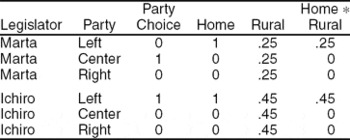
These models are straightforward and widely used outside political science, but have a few unique features that deserve some attention. First, each row in the data set is an individual-choice, or for our application, the legislator-party. That is, for each legislator there will be n rows in the data set—one for each party. The dependent variable, party choice, is a binary variable coded 1 if legislator i joined that party, and 0 if he or she did not. Consider two legislators in a system with three parties, Left, Center, and Right, as shown in Table 1. Marta and Ichiro both start in the Left Party. Marta switches to the Center Party, and Ichiro stays put in the Left Party. For Marta, there are three rows—one for Left, one for Center, and one for Right. The dependent variable is coded 1 for Center, the party she joined, and 0 for Left and Right. For Ichiro, there are also three rows—one for each party he could have joined. For Ichiro, the dependent variable is coded 1 for the Left party that he stuck with, and 0 for the Center and Right parties that he did not join.
Sample Dataset

Because the data from Brazil cover an extended time period, and because state and national cabinets realigned several times during that period, we separately consider affiliation decisions under each cabinet period. In other words, each row in the data set is a distinct combination of individual candidate/party/cabinet period. For example, rows 1 through 3 might list Marta for the Left Party during cabinet period 1.
A second unique feature is that to estimate the impact of individual legislators' characteristics on party affiliations, they must be interacted with choice-specific variables. The model only allows direct estimation of choice-specific attribute effects, not of individuals. In our application, this means that we can easily estimate the impact of parties' characteristics on their attractiveness to legislators, but we cannot directly estimate the impact of an individual's characteristics on his or her choices. One way to understand this is that the conditional logit is in fact identical to a fixed-effects logit model, with a dummy variable for each individual. For example, imagine a variable called Rural that measures the ruralness of a legislator's district. The value of Rural is the same for all three rows of data for Marta (.25) and for all three rows for Ichiro (.45).Footnote 4
The result is that individuals' characteristics can only enter the model through interactions with choice set characteristics. We interact legislator-specific characteristics, such as Rural, with a dummy variable, Home. Home identifies legislators' initial party—it is coded 1 for their party at the beginning of the period and 0 for all others. The coefficient on Home captures a baseline intercept-like propensity to stay in one's current party, and interactions with Home show how legislators' characteristics affect their decisions to stay or change party. For example, if Rural*Home is negative, it means that, all else equal, legislators with rural constituencies are less likely to stay put than those with urban constituencies.Footnote 5
The Home variable also serves another purpose: it controls for parties' initial size in affiliation decisions. Without it, any variable correlated with party size would be suspect. For example, we might wonder whether governing parties are more attractive to legislators, or whether they are just bigger! The Home variable distinguishes between legislators' current and potential destination parties, and thus controls for the potential correlation between party size and party affiliation patterns. With this control, the variables indicating access to pork will only be significant if legislators prefer membership in pork-controlling parties.
Data for Brazil and Japan
We construct models and data sets that are as similar as possible, but there are some differences that reflect variation in data availability and the specific context of each case.
For Brazil, we examine party affiliation for all national-level legislators in the entire Chamber of Deputies and all state legislators from two Brazilian states, from 1991 to 1998. In Brazil, legislators left and joined almost every one of over 20 parties, creating substantial variance in the choice set. We collected data on party affiliation and switching by all legislators from the national Chamber of Deputies and from the State Assemblies of Bahia and São Paulo, from 1991 to 1998. Unfortunately, similar data from state assemblies is extremely difficult to obtain, and often poorly documented, restricting our sample to these two subnational legislatures. Fortunately, these cases are two of Brazil's largest and most important states: Each is geographically larger than most countries, and their combined population is over 50 million. Further, the two states capture much of Brazil's economic, cultural, and political diversity, with all major social sectors present and active in politics. They also represent different typologies of Brazil. São Paulo is easily Brazil's most developed state. It has the bulk of the country's industrial base, and is the financial center and the most populous state, with more than 20% of the country's population. Bahia is part of Brazil's Northeast region—arid, less developed, with higher levels of inequality than the rest of Brazil.Footnote 6
For Japan, we examine party choice for all legislators who began 1993 as LDP members in the national HR and all (subnational) prefectural assemblies during 1993 and 1994. Party switching was much rarer in Japan,Footnote 7 where the LDP had held a one-party lock on the national government for decades. However, in 1993, angry over the LDP government's inability to enact electoral reform, more than four dozen legislators left the ruling party. Most of the switchers joined two brand-new parties (although some also chose to become independents). After the summer 1993 elections, these defectors joined with the former opposition to create an anti-LDP coalition government (ending the longtime ruling party's grip on power). In the months that followed, subnational politicians also switched parties, mirroring the patterns at the national level.
In the period studied in Japan (1993–94), all defectors came from the LDP and joined one of two new parties or became independents. During the period under investigation in Japan, there was no switching into or out of the traditional opposition parties. For this reason, we do not include the traditional opposition parties in our Japanese national and subnational legislator data sets.Footnote 8
Defectors from the LDP had substantial incentives to create new parties and almost none to join the traditional opposition: Joining new parties meant that they would be likely to be able to form part of a coalition government with either the LDP or the traditional opposition camp, in either case maintaining their easy access to pork. In addition, the groups supporting most LDP politicians had a long history of personal antagonism to the traditional opposition parties, making it extremely difficult for LDP politicians to actually join them. Meanwhile, members of the traditional opposition had little incentive to switch parties. After the realignment, the traditional opposition parties (except the Communist Party) formed the new government coalition, and all (former) opposition legislators remained in their parties and gained greater access to pork. If anything, excluding the traditional opposition provides a harder test for our model, and including them would only increase the significance of our results.
The data sets differ slightly in operationalization. In Brazil, presidential coalitions changed more than 10 times during the period studied, so we analyze each cabinet period separately. The National Chamber contained 503 seats in the first term (1991–95) and 513 in the second term (1995–99). For the São Paulo and Bahia assemblies, there were, respectively, 94 and 63 seats during each period. Switching was most frequent in the Chamber of Deputies, with .52 switches per seat in the first term, and .41 in the second.Footnote 9 In São Paulo, there were .32 switches per seat in both terms and in Bahia there were .40 switches per seat in the first term and .43 in the second.
In Japan, there was only one major realignment, so the data are analyzed as a single period. For the national HR, there were 267 LDP legislators, with 38 (14.2%) joining the new party Shinsei, 10 (3.8%) joining the new party Sakigake, and 22 (8.2%) becoming independents. At the prefectural assembly level, there were 1,605 LDP legislators, with 77 (4.8%) joining Shinsei, 9 (0.6%) joining Sakigake, and 26 (1.6%) becoming independents.
INDEPENDENT VARIABLES
As we noted above (see also note 4), the conditional logit models include two kinds of explanatory variables. Many of our variables measure characteristics of parties—what they offer members. For these variables, positive coefficients indicate characteristics of parties that politicians are more likely to join (or stay in). But we also include some individual characteristics of legislators that the literature suggests affect a baseline propensity to switch or stay put. We interact these variables with Home, and denote each of these variables by placing an asterisk (*) at the end of its name. For these variables, positive coefficients indicate individual characteristics of politicians that make them more likely to stay put; negative coefficients indicate individual characteristics that make politicians more likely to switch to a different party. This approach is a typical use of conditional logit, discussed by (Long Reference Long1997).
We focus on two core independent variables: links to national-level leaders and links to subnational-level leaders. Our Pork variables all indicate attributes of the choices available to legislators, so coefficients on these variables indicate the likelihood of politicians affiliating with parties with such links. For Japan our theory predicts that national pork access will affect party affiliation decisions for both subnational and national actors (β1 > 0) and subnational pork access will not affect any legislators (β2 = 0). For Brazil, we expect both national and subnational coalition politics to affect national legislators (β1 > 0, β2 > 0), and only subnational party arrangements to influence subnational legislators (β1 = 0, β2 > 0).
Links to National Leaders and National Pork
For our Brazil models, we create President's Coalition, a dummy variable coded 1 for parties forming part of a president's coalition and 0 otherwise, as our measure of links to the national government. Politicians should be more likely to affiliate with parties that control national pork, but, for reasons that we outlined above, in Brazil only national legislators should prioritize national coalition politics. President's Coalition, therefore, should have a positive coefficient only for the national Chamber of Deputies.
For Japan, our measure of links to the national government must take a different form. We do not include a National Government Coalition variable that would be analogous to the Brazilian President's Coalition variable. As discussed above, for the national level in Japan, LDP defectors knew that they were likely to be a part of the new government—in short, they would determine who would be in the national government coalition. For subnational politicians in Japan, the principal tie to pork was not simply through the party that controlled the budget, but through a national politician who might access that budget. Simply indicating what parties were part of the national government does not help identify the likely party affiliation of subnational politicians. Instead, we expect local politicians to follow their patrons' leads, staying put if their patron stays put or following their patron into a new party if he switches.
To determine the likely affiliation of subnational politicians, it is necessary to know the party of their national patrons. It is impossible to determine precisely each patron–client relationship, but most are founded principally on shared geography: Subnational politicians tend to represent electoral districts that overlap at least in part with the electoral districts of their national-level patron. We use this intuition to create our measure of links to the national government, Pipeline Switch, which is coded 1 if a national legislator from the same district as the subnational legislator switched to party j (and coded 0 otherwise). If the national legislator—the national pipeline source for pork—switches to a different party, the client in the prefectural assembly should switch to the same party. In other words, Pipeline Switch should have a positive coefficient.
Links to Subnational Leaders and Subnational Pork
For our Brazil models, we create Governor's Coalition, a dummy variable coded 1 for parties forming part of a governor's electoral coalition, and 0 for other parties. In Brazil, both national and state legislators should prefer to join the state ruling coalition, giving this variable a positive coefficient. For our Japan models, we use an identical Governor's Coalition variable to identify the party or parties of the prefectural governor for each legislator.Footnote 10 We expect that ties to the prefectural governor should not matter much and do not expect Governor's Coalition to have a statistically significant effect on either national or subnational legislators' party affiliation in Japan.Footnote 11
Control Variables
We control for individual and party covariates as suggested in the literature on party switching. We include Electoral Strength to control for legislators' degree of personal electoral security. Because Brazil and Japan use different electoral rules, this variable is calculated in different ways for each country. In Brazil, at both the national and subnational level, party electoral characteristics are also important to legislators' ability to get elected. For Brazil's OLPR system, our measure of Electoral Strength (a choice-attribute variable), is coded 1 if the legislator would have been elected in party j, and 0 otherwise (see Desposato Reference Desposato2006). This variable assesses a legislator's chances for electoral success in a new party, given the strength of the party list and its candidates.Footnote 12 Legislators should avoid difficult-to-win parties, and should join parties where election is easier, giving this variable a positive coefficient.Footnote 13
Under Japan's SNTV system, in use during the period studied here, each national and subnational legislator's ability to get elected was entirely dependent upon the number of votes he or she individually received. Therefore, for both national and subnational politicians, we measure Electoral Strength* (a variable indicating an individual characteristic of the candidate) as equal to V i − D q, where V i is the legislator's vote share in the previous election and D q is the Droop quota (see Reed and Scheiner Reference Reed and Scheiner2003).Footnote 14 The Droop quota represents the minimum number of votes that guarantees the candidate a seat, so Electoral Strength* measures how close to defeat the candidate came in the last election. Higher numbers indicate larger margins of victory and, presumably, greater electoral security. We hypothesize that legislators who are electorally most “at-risk” should be more willing to risk leaving their party to enhance their electoral position. Therefore, Electoral Strength* should have a positive coefficient—greater electoral safety should lead to staying put.
For Brazil, we include PRN, a dummy variable coded 1 for the National Renewal Party (PRN) and 0 otherwise. President Collor, a member of the PRN, was forced to resign amid corruption allegations in 1992. The stigma of that event made the PRN a party to avoid. This variable should have a negative coefficient.Footnote 15
We also include additional controls to be consistent with previous analyses of party switching in Brazil and Japan. Excluding them does not alter our results for our National and Subnational Pork variables, so we only touch on them briefly here and offer greater detail and a discussion of their results in the Appendix. We include controls for the ruralness of legislators' districts (Rural*) and the length of time the legislator had served in office (Terms*).Footnote 16
We note that in both Brazil and Japan, a minority of the legislature remained in parties without access to pork, so one might wonder, why don't all legislators join the pork-rich parties? There are several reasons. First, governments face budget constraints, so every additional member of a government party slightly reduces all other legislators' access to pork. At some point, a party may refuse new members, when the marginal gain from a larger coalition is less than the cost of sharing more pork. Similarly, potential switchers at some point might not consider the transaction cost of switching worth the small amount of pork available in a large, hungry coalition. Second, many legislators have other reasons to stay put. Legislators might be planning a run for a different office, and see nomination and victory as more likely in their current opposition party than a government party with pork access. Some legislators may have stronger ideological or partisanship ties that make switching unlikely. Even the most pork-oriented systems usually have some ideological or more issue-based component as well.
For Brazil, we address this component by including a variable that controls for the ideology of the parties that legislators might choose to affiliate with. That is, for Brazil we include Ideological Distance, the absolute distance between the ideological position of a legislator's current party and possible destination party. We obtain estimated party ideal points as the mean first-dimension WNOMINATE score for legislators in the Chamber of Deputies (Poole and Rosenthal Reference Poole and Rosenthal1997). If legislators use parties for any ideological purposes, switching should be constrained to close parties, giving this variable a negative coefficient. For the national-level Japan model, we address the issue-based component by including a variable that controls for legislators' support for reform. “Reform” was the dominant political issue of the early 1990s in Japan, and previous analysis of party switching at the national level demonstrated that support for electoral reform was central to legislators' willingness to leave the LDP (Reed and Scheiner Reference Reed and Scheiner2003). In our national-level Japan model, we therefore include Reformer*, a dichotomous dummy variable coded 1 if the legislator in question had signed a petition indicating support for electoral reform, used in this earlier analysis. We do not have available for Japan an Ideological Distance variable and we do not have for Brazil or for the Japanese subnational-level models measures of legislators' support for reform. Nevertheless, we also run additional versions of the models without Ideological Distance and Reformer* and their exclusion has no substantial impact on our pork-related variables (results not shown).
RESULTS
National and Subnational Level Party-switching in Brazil
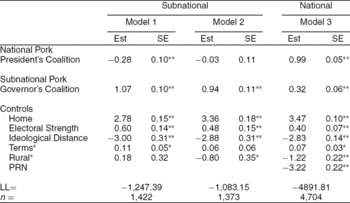
Table 2 shows results from estimating our Brazil models of party membership for national and subnational legislators.Footnote 17 Both sets of results match our expectations. For state legislators, state coalitions figure prominently in party affiliation decisions; thus the coefficient on Governor's Coalition is consistently positive and significant. Also as expected, national pork coalitions do not attract state legislators and so the sign on President's Coalition is negative in both subnational models that we estimated.
Conditional Logit Models of Party Choice in Brazil

*=.05, **=.01.
This last result deserves some additional comment. In Model 1, the coefficient on President's Coalition has a negative and significant sign, suggesting that state legislators avoid national pork coalitions. There is no theoretical reason to expect such a result, and it turns out that it is driven by a unique political event that is consistent with our theory, but misleading in its impact on our results. In December of 1993, in the state assembly of São Paulo, members of the Liberal Party Front (PFL), a party in the president's coalition, were involved in a disagreement over the upcoming gubernatorial election. Ultimately, almost every PFL deputy in the state assembly left the party, most joining the Liberal Party (PL; a party not in the president's coalition). Their behavior is consistent with our hypotheses: State deputies are organizing around state coalition politics. When in conflict with national directives, they simply abandoned the party. Although their leaving a national governing party may, at first glance, appear somewhat unexpected, it is in fact consistent with our argument. The difference is that their behavior was prospective—they were anticipating the coming (1994) gubernatorial election, not responding to the current coalitional environment. When we drop the São Paulo state PFL deputies, the results are as predicted: The coefficient on President's Coalition is nonsignificant and the coefficient on Governor's Coalition is positive and significant (Model 2).
For national legislators, both gubernatorial and national coalitions are important; coefficients on President's Coalition and Governor's Coalition are both positive and significant (Model 3). Brazilian national legislators pay attention to both national and subnational coalition politics when choosing between parties.
An easy way to understand the coefficients is by comparing a legislator's choice between two parties that differ in some relevant way—for example, one having pork and one without such access. Consider a hypothetical member of a state assembly that is switching and choosing between two parties that are identical except that one is in the state ruling coalition and the other is not.Footnote 18 Using Model 3 from Table 2, the predicted probability of choosing the governing party is almost three times that of choosing an opposition party (.72 versus .28). The formation of governors' governing coalitions also appears to affect national legislators' party affiliation decisions: A national legislator choosing between two otherwise identical parties picks a party in the governor's coalition almost three-fifths of the time (p = .58) and an opposition party two-fifths of the time (p = .42). National-level politics have no significant impact on state legislators' behavior, but do shape the strategies of federal deputies. When choosing between two identical parties that differ only in that one is in the president's coalition and the other is not, national legislators are almost three times more likely to choose the national ruling party than the opposition party (p = .73 versus p = .27).
The strong impact of national (president's) coalitions deserves additional comment. Although Brazil is heavily decentralized, national politics and coalitions still matter. Indeed, for national legislators, presidential coalitions are more powerful predictors of behavior than are gubernatorial coalitions. We would have expected only gubernatorial politics to shape behavior only if presidents were essentially powerless and politics was completely decentralized.
Together, these results conform to our hypotheses: Gubernatorial coalition politics have an impact on party affiliation strategies at both the state and national levels, as expected given Brazil's decentralization of resources. National coalition politics has a significant impact on national legislators' behavior, but not on subnational politics.
National and Subnational Party Switching in Japan
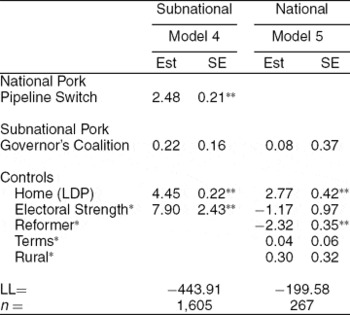
Table 3 shows results for national and subnational models of party affiliation. For national data, the results are consistent with our predictions. There is no evidence that subnational political actors affect party choice for national legislators; The estimated coefficient on Governor's Coalition is small and not statistically significant (see Table 3, Model 5).
Conditional Logit Models of Party Choice in Japan

*=.05, **=.01.
As discussed previously, we do not include an equivalent National Coalition variable to measure the influence of national pork because of estimation problems. Every legislator that left the LDP to affiliate with another party joined one of two new parties that were the kingmakers in the new coalition government, and were assured access to government resources. None who changed parties went to the traditional opposition parties.Footnote 19
The events following the split of the LDP in 1993 further demonstrate the importance of access to national-level resources for party switching. After the original split of the LDP in 1993, party switching away from the longtime ruling party and toward the new (now-government) parties continued. It was widely expected that a mass exodus from the LDP to the new parties in the coalition government was highly likely (Curtis Reference Curtis1999), as LDP members recognized that they would need to leave their once-dominant party in order to maintain power and access to resources. Indeed, many believed that the draw of central governmental resources would lead to a new one-party monopoly on power (Jameson Reference Jameson1999). The LDP was therefore desperate to return to the government. In 1994, tactical errors led to the downfall of the anti-LDP coalition and, in order to return to power and regain control over state resources, the LDP went so far as link up with its longtime enemy, the Socialist Party, and in the bargain even gave the longtime opposition party the prime ministership in an LDP-Socialist Party government. Further highlighting the importance of access to state control, despite the odd LDP-Socialist Party government, many of the LDP defectors returned to the party in droves after the following election when it became clear that the LDP's grip on the government had returned. A desire for pork certainly did not drive politicians away from the LDP; after all, a dominant LDP controlled access to pork. But, if anything, this desire for pork access probably kept many legislators in the party even when they wanted to leave. And when anger toward the LDP emerged, politicians were willing to leave the party in large numbers only once there were viable options that could maintain their access to pork.
In short, national data from Japan are consistent with our hypotheses. There is no evidence that subnational politics shaped party affiliation by national legislators. However, continued pork access at the national level appears to have been a prerequisite to migration away from the LDP, and later helped drive moves back to the longtime ruling party.
Our theory predicts that subnational party affiliation should follow national-level patterns, without regard for subnational politics. One implication is that during the long period of LDP dominance, there should have been little or no party switching, regardless of changes in the party of the subnational governor. In fact, looking at a data set of all prefectural assembly legislators in Japan between 1987 and 1992, we find no cases of LDP members leaving the LDP to join another party (although some became LDP-affiliated independents). Leaving the LDP would cut off their primary pipeline to the center.
In 1993–94, however, party switching away from the LDP at the national HR level left subnational politicians with a difficult choice to make. The LDP had typically dominated subnational politics, controlling or acting in a coalition in most governorships and holding majorities in most prefectural assemblies. In the 1990s, though, the national pipeline source for many subnational LDP members switched away from the LDP to one of two new parties (Shinsei or Sakigake, along with some LDP members who became independents) that under the new, anti-LDP national coalition government maintained control over national pork. We have argued that for subnational politicians, it was in their interest to consider shifting with their national-level patron because the patron provided their main tie to the central government.
The results of our conditional logit models of subnational politician party affiliation match our expectations (Table 3, Model 4). The coefficient on Pipeline Switch is positive and statistically significant. Subnational legislators followed the lead of their national pipeline sources, staying put or switching as the case may be. Practically, the results mean that an LDP subnational legislatorFootnote 20 whose pipeline did not switch had a .97 probability of staying in the LDP. In contrast, when a national legislator switched out of the LDP, the probability that a subnational politician would follow him out of the LDP increases to .14. Further, a legislator that is leaving the LDP has a .86 probability of joining the same party as his national pipeline versus .14 for joining a different party. These results demonstrate the power of the patron–client ties and centralized pipelines in pushing prefectural assembly party affiliation.
We find no evidence that subnational political alignments influenced subnational party affiliation. In our subnational model for Japan (Model 4), the coefficient on Governor's Coalition is nonsignificant. Subnational politicians in Japan remained focused on their national pipelines and effectively ignored regional coalitional politics.
Personal ties undoubtedly played some part in the patterns we see, but state resources were also very important. Interviews with Japanese national-level party switchers and local-level newspaper political reporters conducted during 1999 indicate that some prefectural assembly politicians did not leave the LDP, even when their patron did because they lacked confidence in the ability of the non-LDP parties to remain in power and feared falling out of favor with an LDP that could return to power and take away their funding. Indeed, once the LDP returned to power at the national level in 1994, even though politicians were still willing to switch from the party at the national level, subnational LDP members were reluctant to switch to the new parties (Kataoka Reference Kataoka, Jain and Inoguchi1997, 210).Footnote 21
In short, the results are consistent with our hypotheses: In 1993–94, LDP legislators switched parties only when they could retain access to central governmental pork. Subnational legislators typically stayed with the party of their national patron and only switched parties in order to maintain ties to this patron who provided their central pipeline. And, exactly the opposite of Brazil, subnational political party arrangements appeared to play no part in the decision by legislators at either level of government.
DISCUSSION
Political scientists and would-be reformers commonly argue that having the “right” institutions is essential to the success, stability, and strength of democracies. However, arguments of this kind are founded on institutional theories that are only as accurate as their assumptions allow them to be. Most of the formal literature is built around wealthy and fairly issue-driven democracies. But most democracies are poorer, with less experience with democratic institutions, and, in many, pork is a natural substitute for policy proposals. Moreover, even in wealthy countries like the United States that contain substantial programmatic components, pork is still an important part of politics (see, e.g., Kim Reference Kim2007).
We have argued that in systems where pork is an important part of electoral outcomes, the extent of budget decentralization can fundamentally shape the party system. Using new data from 2 national and 49 subnational legislatures in Japan and Brazil, we find statistically and substantively significant support for our argument.
The results of our research suggest a powerful interaction between institutions and the presence of pork as a dominant electoral strategic tool. We focus on one important institution: the level of centralization of government resources. Looking at heavily centralized Japan, we find the existence of centralized pipelines, which lead both national and subnational politicians to organize around national political arrangements. In contrast, faced with decentralized pipelines in Brazil, both subnational and national legislators organize around subnational politics, with only national politicians also showing concern for national coalitions.
Ignoring the distinction between more programmatic and pork-oriented systems leaves analysts with at best an incomplete picture of the impact of the level of resource decentralization. Analyses of developing democracies frequently place heavy emphasis on the role of economic factors such as economic liberalization as playing an important role in shaping the party system. But analysis of such broad issues overlooks how politicians often focus their strategies at least as much on being connected to those that control governmental resources. Such strategic moves by politicians cannot help but shape the party system more broadly.
We make a number of case-specific and broader contributions through this analysis. For Japan, most recent examinations of Japanese politics over the past two decades have given short shrift to the importance of the locus of resource control in shaping the party system. For example, in considering the changes that have occurred in the Japanese party system since the 1980s, the bulk of attention has been given to factors such as national elite-level bargaining (e.g., Curtis Reference Curtis1999), the individual characteristics of national politicians and their districts (see, e.g., Cox and Rosenbluth Reference Cox and Rosenbluth1995; Kato Reference Kato1998; Reed and Scheiner Reference Reed and Scheiner2003) and social and economic divisions (e.g., Pempel Reference Pempel1998; Rosenbluth Reference Rosenbluth, Keohane and Milner1996). These factors have all certainly been important, but it is critical to highlight that a need to maintain access to the national budget has undoubtedly shaped legislators' strategies. Defection from the ruling party only occurred when it appeared less likely to threaten switchers' access to governmental resources. And, shocking to scholars and pundits alike, a desire to regain access to the government helped drive the LDP to create a coalition government with its longtime enemy, the Socialist Party. For Brazil, this paper also makes a number of contributions to work on federalism and legislatures. It extends and synthesizes our understanding of the role of state actors in national politics with their influence in state spheres. Previous work has emphasized the important and influential role of governors in state politics (Abrúcio Reference Abrúcio1998); this study provides quantitative support to those case studies. This study is also the first to examine party switching at the state level, using new data to illustrate the structure of state party systems.
An additional contribution is the emphasis on subnational politics. Most comparative studies focus exclusively on national politics, and leave subnational politics for case studies. Our models of centralized and decentralized pipelines make different predictions for the likely behavior of national and subnational politicians and we therefore pay at least as much attention to the affiliation patterns that resources inspire in subnational legislators. There have been very few cross-national analyses of individual-level party affiliation patterns among legislators. And to the best of our knowledge, we are the first to offer cross-national, individual-level analysis of subnational legislators—as well as comparing the behavior of subnational and national legislators—thereby permitting us to introduce more institutional variation and consider more widely the impact of resource control on individual legislator behavior.
More broadly, our findings suggest some rethinking of previous work on centralization and party politics. For example, Chhibber and Kollman (Reference Chhibber and Kollman1998, Reference Chhibber and Kollman2004) link the relative authority of national and subnational governments to the formation of national party systems. They argue that in systems where resources are centralized, “voters develop national policy preferences, and candidates associate themselves with certain national policy positions. As a result, local party systems and national party systems begin to resemble each other” (1998, 335). However, by highlighting the distinction between programmatic and pork-oriented politics, our analysis shows the extreme result that obtains when combining centralization and an emphasis on pork. Rather than simply leading to close ties between national and subnational party systems, the combination leads to a greater bias favoring the national ruling party. All else equal in such systems, voters and politicians will be more likely to affiliate with those that control the national budget and therefore can provide them with pork. The implication is that the combination of centralization and pork politics reinforces the power principally of those already controlling the national budget.
To be certain, we should be careful not to overstate the meaning of our findings. Our analyses are snapshots of behavior from particular times in both of our country cases. In Japan, there have been other cases of party switching, especially at the national level, that fit less neatly into our resource-based framework: In a few cases, centrist members of the Japanese Socialist Party left the party to form new alternatives. These defections led to the creation of the fairly small (less than 4% of all seats) Democratic Socialist Party (DSP) in 1960, the tiny (only a few seats) Social Democratic League in 1977, and the modest (10% of all seats) Democratic Party of Japan (DPJ) in 1996.Footnote 22 In 1976, angry over corruption within the LDP, six (mostly urban) members of the ruling party left to form the New Liberal Club (NLC). Finally, in 1994, Shinsei joined with other members of the anti-LDP coalition government to form the New Frontier Party (NFP). The cases of defection away from the Socialist Party were essentially founded on issues of ideology and organization. As we discussed earlier, given that these politicians were members of an opposition party in the first place, it should not be surprising that ideology, and not resource access, was central to their decision making. The case of the NLC also indicates the importance of issues—in this case, the issue of corruption—in driving some politicians in Japan, especially in urban areas where pork is less important. The creation of the NFP indicates something quite different: the importance of building a large party in the new single-member-district-based electoral system instituted in 1994.Footnote 23 Ultimately, we do not think that these cases contradict our findings about the importance of access to central resources for most mainstream politicians in Japan, but our model does not provide a universal theory of party switching and cannot predict these cases of switching systematically.
Although most of Brazil's democratic history fits well with our model—frequent switching driven by national and state coalition politics—there are a few exceptions. One is during the most recent transition to democracy. In the late 1980s, almost 25% of the president's party switched into other parties, most of them opposition parties that did not have access to pork (Mainwaring and Liñán Reference Mainwaring and Liñán1997). This incident appears to be in direct contradiction to our argument, but must be understood in the unique context of that period. The president's party, the Brazilian Democratic Movement Party (PMDB), was a diverse opposition party created by the military regime as the only outlet for opposition during the authoritarian period. Although unified in opposition to the military, the party was wrought with factions and splintered upon democratization.Footnote 24 Further, the president, Jose Sarney, was not really a member of “his” party. He was a longstanding member of the National Renewal Alliance/Democratic Social Party, and had only joined the PMDB so that he could run as vice president with Tancredo Neves in an indirect election decided by a vote in the National Congress. Sarney eventually left the PMDB and joined the PFL, an offshoot of his original party. Finally, the period was one of economic and political crisis, as inflation soared to nearly 1,000%, with Sarney and the PMDB receiving most of the blame. In addition, leaving the president's party itself is not entirely inconsistent with our argument. Some of these switchers joined parties that were part of the governing coalition, and many others joined parties that were part of governing subnational coalitions.Footnote 25
Looking more comparatively, a cursory look at other cases suggests initial support for our model. For example, in the highly centralized Philippines, political observers note that party switching at both national and local levels has been linked to national pork politics (Hicken n.d.) Prior to elections, local politicians, including governors and city politicians, try to identify and align with the strongest presidential candidate. After elections, politicians aligned with losing candidates move quickly to the winning candidate's party. This pattern is so strong that it can transform a minority president facing divided government into a majority president in a few weeks (Hicken n.d. 207–8). Mayors and local politicians change party affiliation in response to national realignments. Similar patterns have been observed in other centralized cases, including Thailand and India.
More important, the broader implications of our model are not limited to countries with frequent party switching. Our findings may also be meaningful for studies of party organization and hierarchy. Party switching provides a window on legislators' priorities, but the core structural incentives should still be at work in systems with no switching: Political agents will naturally orient around and bargain with actors that control state resources. When switching is not possible, we may see party-level bargaining, or preelection selection into the right party by agents. For example, in Mexico under the dominance of the Institutional Revolutionary Party (PRI), subnational politicians knew that the only way to obtain resources was through the national PRI. So nearly all subnational legislative candidates self-selected into the PRI and the national opposition parties were very weak at the subnational level as a result (Greene Reference Greene2007). Similarly, since full democratization in Mexico, governors have come to wield increasing political influence. Decentralization of resources plus no reelection for legislators means that Mexico's decentralization may start to look more like Brazil's, with national legislators paying increasing attention to directives from their state leaders rather than national party leadership (Cantú and Desposato Reference Cantú and Desposato2008). Indeed, recent work suggests that party switching may increase in Mexico, and that it is tied at least partly to subnational politics (Barrow Reference Barrow2007).
Nevertheless, our analysis remains suggestive, rather than definitive. We encourage future work to consider the implications more systematically, as well as consider more fully the role of ideology, organization, and electoral system calculi in politicians' decisions both to join a party in the first place and then leave to join others. Regardless, our results demonstrate the importance of adapting institutional frameworks to local context. Spatial theories of politics give power to pivotal players and/or agenda setters, and rarely incorporate national–subnational interaction. But where politics is less-spatial and more distributive, theories should be built around the actors that control purse strings. Recent cross-national work emphasizes the role of institutions in shaping growth, redistribution, and even corruption, with limited predictive success. We find powerful institutional effects, when results are adapted to local context. Future work on institutions would benefit from a similarly adaptive approach.
APPENDIX: ADDITIONAL CONTROL VARIABLES
Based on previous analyses of party switching in Brazil and Japan, we include a number of control variables.
For Brazil, we interact two measures with Home to see how they affect legislators' likelihood of leaving their party. Terms* captures the impact of experience on switching. We predict that more senior legislators—those who have served more terms in office—will be more likely to stay put than political novices, implying a positive coefficient. Rural* measures how rural a legislator's constituency is. We predict that more rural legislators are less likely to stay put, as pork is more important in less-developed areas (see Desposato Reference Desposato2001). We include similar variables for our national-level Japan model. Terms* is a count of previous terms, as in Brazil. Rural* is a dichotomous variable coded 1 for legislators from rural districts.
For our subnational Japan model, we were unable to acquire data equivalent to our Rural* or Terms* variables that we used in our national-level model. However, there is no reason to expect these variables to bias our National and Subnational Pork variable results, and we note, again, that excluding those variables from our national-level model has little effect on our variables related to pork access (results not shown).
The control variables in Brazil are almost all significant with expected signs. Legislators avoid ideologically distant parties (negative coefficient for Ideological Distance), and all else equal, prefer to stay put (positive coefficient for Home). Deputies from more rural areas are less likely to stay put, and after the scandals associated with the PRN, deputies avoid that party. Several results were unexpected. The estimated coefficient for Terms* was positive, as predicted: more senior legislators are more likely to stay put. This result was not significant in every model. Nonsignificance at the subnational level might reflect the smaller sample size, or the state legislature may be less professionalized, with many members aspiring to higher posts.
For Japan, the coefficient on Home is also positive, indicating that, all else equal, legislators prefer to stay put. The key control variable for the national-level Japan model largely matches the results from previous analysis. The coefficient on Reformer* is negative and statistically significant: Politicians who supported electoral reform were less likely to remain in the LDP. For the subnational model, Electoral Strength* was, as predicted, positive (and statistically significant). Electorally secure prefectural assembly members were more likely to stay put in the LDP.






Comments
No Comments have been published for this article.