Since the first direct elections to the European Parliament in 1979, European election campaigns have been fought primarily at national level, organized and led by national parties. This is not surprising, considering that national parties put together the lists of candidates, formulate election manifestos and fund the campaigns. One of the consequences is that European Parliament elections are used as mid-term contests for national parties to win national government office. There is an extensive literature focusing on the lack of ‘Europeanness’ of European elections.Footnote 2 Another body of literature analyses national election campaign strategies in different member states of the European Union (EU) because electoral campaigns work differently in each member state.Footnote 3 Indeed, ‘to speak about an “election campaign” in the singular when referring to European Parliament elections is an audacious choice’, as Gerstlé points out.Footnote 4 The fact that most national political parties are members of ‘Europarties’ has received far less attention.Footnote 5 A Europarty can be defined as an institutionalized form of party organization at the EU level that has seen a partial transfer of sovereignty from national member parties.Footnote 6 However, the question of whether Europarties are political parties or not is contested. In the past, parties have only existed at the domestic level, where they fulfil specific roles: vote-seeking, office-seeking and policy-seeking. Some scholars argue that Europarties cannot be regarded as parties in the traditional sense but as loose coalitions of national parties,Footnote 7 while others believe that Europarties need to be interpreted within the context of the EU.Footnote 8
The reason for campaign literature focusing on the national level is that in the past, Europarties had neither the financial nor organizational means to organize large-scale pan-European campaigns. They depended financially and organizationally on their party group in the European Parliament, which brings together the members of the Europarties' national member parties and can be viewed as the parliamentary party. Although linked to their party group in the European Parliament, Europarties such as the Party of European Socialists (PES) are distinct entities.
This article analyses the 2009 European election campaign of one of the two biggest Europarties, the PES, in connection with three of its member parties: the British Labour Party, the German Social Democratic Party (SPD) and the French Socialist Party (PS). The three parties have been selected for several reasons. Being the dominant left-wing parties in the three biggest EU member states puts them in a comparable political context. Yet, considerable ideological differences exist between them, and this is expected to affect their campaigns and the interaction with the PES. Last but not least, at the time of the European elections in 2009, Labour and the SPD were both in office, while the PS was in opposition, which has a considerable impact on its interaction with the PES.
The aim of this article is to contribute to the analysis of European election campaigns as a complex interplay between the national and European levels. Applying the concept of Europeanization to the 2009 campaign, it creates an ideal type of Europeanized election campaign. It relies on existing academic literature, the press, party activists' blogs, official party documents and original interviews with party officials and politicians at the national and European level.Footnote 9
THEORETICAL FRAMEWORK
Europeanization has never been systematically applied to European election campaigns, and at first sight this idea might seem paradoxical: would an election campaign to the European Parliament not be Europeanized by nature?
This article relies on the definition given by Radaelli, who defines Europeanization as:
processes of (a) construction (b) diffusion and (c) institutionalization of formal and informal rules, procedures, policy paradigms, styles, ‘ways of doing things’ and shared beliefs and norms which are first defined and consolidated in the making of EU decisions and then incorporated in the logic of domestic discourse, identities, political structures and public policies.Footnote 10
However, the interactive, multidirectional aspect of Europeanization needs to be added to this definition. It is argued here that national political parties actively seek to shape and influence institutions, processes and policies by shifting issues to the European level. Börzel sees Europeanization as a two-way process that entails a bottom-up (uploading) and top-down (downloading) dimension at the same time.Footnote 11
It is only in the last 10 years that the notion of Europeanization in its relation to national political parties and party systems has begun to be systematically researched. Scholars such as Robert Ladrech,Footnote 12 Thomas Poguntke et al.Footnote 13 and Peter MairFootnote 14 have carried out pioneering work. LadrechFootnote 15 proposes five areas of investigation for evidence of Europeanization in parties and party activity: (1) policy/programmatic content; (2) organizational aspects; (3) patterns of party competition; (4) party–government relations; and (5) relations beyond the national party system. Some of these areas have received increased scholarly attention. Peter Mair demonstrates that the Europeanization of national party systems remains limited because ‘Europe’ is often depoliticized in domestic politics and becomes a matter for governing politicians and their bureaucracies. This argument is confirmed by Poguntke et al., whose cross-national study shows that party organizational change induced by European integration has been limited and patchy. The parties' EU specialists have not become more influential, whereas the power of party elites seems to have been enhanced.
With its focus on European election campaigning in 2009, this article aims to contribute to the literature analysing the Europeanization of national parties. In this context, two of the areas identified by Ladrech will be examined: the Europeanization of policy/programmatic content and relations beyond the national party system. ‘Programmatic content’ refers to the national parties' use of the common European election manifesto and the question of whether programmatic convergence has taken place between them. ‘Relations beyond the national party system’ include cooperation between national parties and Europarties.
If we apply Radaelli's definition and add the multidirectional aspect, a Europeanized election campaign would be a complex, multidirectional process in which national parties upload their national and European policy paradigms, values, knowledge and campaigning experience to the Europarties. The latter, in turn, download their ‘European’ campaigning experience and policy expertise to the national level, while also providing national parties with ‘relations beyond the national party system’. A Europeanized election campaign would entail a constant dialogue between Europarties and their national member parties; an exchange of information, ideas and experience in all directions.
Putting this concept into practice, it is argued that the interlinked prerequisites of a Europeanized election campaign would be: increased campaign funding; a campaign focusing on European topics; a widely supported and used common European election manifesto; close cooperation between the Europarties and their member parties at different levels of the party organization and a common candidate for the presidency of the European Commission.
THE 2009 EUROPEAN PARLIAMENTARY ELECTIONS: THE CASE OF THE PARTY OF EUROPEAN SOCIALISTS
Campaign Funding
If Europarties and their national member parties want to fight a successful, modern, awareness-raising campaign, they need to have adequate resources and funding. The quality of campaigning is certainly linked to voter turnout, which in European elections is continually decreasing. For the Europarties, the funding situation has changed fundamentally over recent years. The fact that in 2009 the PES was able to lead an election campaign independently from its group in the European Parliament is a new and important development that is the result of the Europarties' lobbying for constitutional recognition and funding regulation.
The European Parliament (EP) has achieved constitutional recognition of the Europarties in the Treaty as well as binding regulations on party funding. This has been a long, still ongoing process, starting in the 1990s with the inclusion of the Party Article into the Maastricht Treaty. The latter, however, specified neither the funding of Europarties nor their role in European elections, particularly in the nomination procedures, and can therefore be interpreted as an ‘incomplete contract’.Footnote 16 Ever since, the Europarties kept up the pressure for a revision of the article. In 2003, the European Commission presented a proposal for a regulation that would lay out the rules for Europarty funding. This binding regulationFootnote 17 entered into force before the European elections in June 2004 and the rules of party funding applied from the date of the opening of the first session of the newly elected EP, although it took until October for the EP to distribute the funds.Footnote 18 The regulation defines political parties at the European level and gives clear rules for party finance. The amount of money Europarties receive each year is now set from the general budget of the European Parliament. Therefore, the EP can increase the amount without Council approval.
The clarification of their financial situation had an important impact on the activities of the Europarties and their internal organization. In the past, the PES's organizational and logistical infrastructure was very slight, which was an index of the party's ‘weak institutionalization’.Footnote 19 The secretariat depended on the parliamentary group. The regulation's requirement that the Europarties obtain a legal basis in an EU member state meant that they had to move into an office outside the European Parliament buildings and could no longer ‘borrow’ staff from the parliamentary group. All Europarties now have a permanent salaried staff, and this break with the European Parliament has significantly increased the number of professional party workers. All the staff currently working for the PES have only been employed since the adoption of the regulation. In 2007, the regulation was amended to clarify one crucial aspect: from the EP election campaign in 2009 onwards, Europarties could use the money from the EP budget to fund their election campaigns. In the past, party regulation specifically banned EP funds from being used to fund national election campaigns.
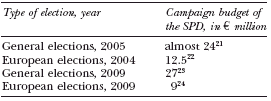
The funding situation is transparent because Europarties need to publish their accounts at the end of each year.Footnote 20 Not so surprisingly, the grant given by the European Parliament has increased over the years, from €2,580,000 in 2006 to €3,100,000 in 2009; approximately a 17 per cent increase in a period of three years. All Europarties rely heavily on this grant, which is their biggest source of income. The PES spent €188,521 on the 2009 election campaign, which compared to some of the PES' member parties is a very low budget. However, compared to general elections, European campaign budgets tend to be much lower, as the case of the SPD illustrates (see Table 1).
Campaign Budgets of the SPD in 2004, 2005 and 2009

The PES secretariat had a permanent staff of 20, which increased during the electoral campaign 2009 to around 34 (including trainees and volunteers). This is a significant change, but still a very small number of people compared to some national party headquarters. For example, in 2009 the German SPD employed a total of around 180 people in its headquarters (while in government), and the Labour Party employed 80 people.
Most striking is the fact that in 2009 – the ‘Superwahljahr’– when local (in some regions only), European and federal elections all took place – the SPD spent three times more on its federal campaign than on the European campaign. As Maier and Tenscher point out, all German parties have reduced their campaign expenditure radically for European elections in the past, which has had various consequences for the organization and conduct of the campaigns.Footnote 25 This clearly indicates that European elections continue to be treated as the ‘poor cousins’ of federal elections.
It could be argued that €9 million is a surprisingly high budget for second-order elections, given that a federal election was in the offing. Yet in the case of the SPD, the European elections on 7 June were treated as a ‘warm up’ for the general elections on 27 September.
The UK Labour Party spent a total of £2,302,244 on its European election campaign, thus less than a third of the SPD's budget.Footnote 26 While it was the party leadership's strategy to lead a low-key European campaign with little focus on EU issues, the comparatively low campaign budget must also be interpreted in the context of Labour's general financial difficulties.
To sum up, the PES could for the first time lead an independent campaign in the 2009 European elections, although its campaign budget was very low compared to those of its biggest member parties. It amounted to approximately 2 per cent of the SPD's budget. Under those conditions, top-down Europeanization is difficult to imagine. Rather, the ‘richer’ member parties such as the SPD and Labour relied on their own budgets, manifestos, slogans and branding.
A Campaign Focusing on European Topics
A Europeanized election campaign would focus on ‘European’ topics, that is, topics which are or should be in the sphere of control of the European institutions. At least, these topics should have a European dimension. It is obvious, however, that a ‘European debate’ every five years and only during the election campaign cannot lead to a Europeanized campaign. After the electoral defeat, PES President Rasmussen concluded on his blog that the voters ‘simply didn't see the relevance of these elections. They did not see the political choices at European level – perhaps not surprising since these elections were mainly fought over national political disputes.’Footnote 27
An analysis of the content of the three campaigns can only confirm Rasmussen's statement. Indeed, most of the debates were not Europeanized. Neither did the three parties share the same views and concerns, which led to three very different campaigns. Ideological divergence within the PES is hardly a new phenomenon, and PES manifestos traditionally represent continental social democracy.Footnote 28 In the 1994 EP election campaign, Labour had to drop the PES manifesto as its commitment to the 35-hour week was attacked by the Conservative Party and the press.Footnote 29 In 2009, trying to avoid this situation, the Labour Party negotiated the PES manifesto ‘with greatest attention to the detail’.Footnote 30
Labour's local and European election campaign lacked funding and visibility, and a European debate was missing. Party officials and MEPs blamed this lack of Europeanness on an expenses scandal among MPs in the House of Commons, which overshadowed the campaign. Labour, as the party of government, was under attack. The Guardian newspaper reported that during the EP campaign launch event, in private, ‘cabinet ministers admitted their two major campaign themes – the need to end isolation in Europe and the government success in limiting the recession's impact – were going to be lost in the noise’.Footnote 31 In an interview, one MEP stated: ‘Unfortunately, the Westminster expenses scandal dominated the debate. We wanted to talk more about European economic issues and European structural funds. But well, we did talk about the economy, about investment in education and the environment.’Footnote 32 All Labour MEPs interviewed stated that the Westminster expenses scandal dominated the debate. The party leadership did nothing to Europeanize the campaign, which led to an invisible, defensive campaign. While a party-wide EP campaign was absent, MPs and MEPs arranged their own local campaign activity around PES campaign days or independently. As usual during election campaigns in the UK, MEPs and activists knocked on doors, organized telephone canvassing and distributed leaflets. The Labour Party hosted a PES campaign exchange and an ECOSY (Young European Socialists) campaign session. Mostly, MEPs and MEP candidates campaigned together with local party activists and politicians, who ‘are often closer to the people in their constituency’.Footnote 33
The SPD's European election campaign was from the beginning perceived as a warm-up for the federal elections on 27 September 2009. The European, federal and in some regions even regional and local election campaigns were fought at the same time, which is one of the main reasons why the debate was not Europeanized. Another part of the problem was the slogan ‘Social Europe’. One MEP stressed: ‘For the first time it wasn't a purely national election […]. We preached social Europe, so the debate was necessarily European […]. However, it looked as if we had a social Germany, but no social Europe. And with hindsight, the idea was quite abstract.’Footnote 34 The point is that ‘Social Europe’ has always been a vague and abstract slogan; one that is difficult to discuss with the voters because of its diffuse meaning. It had been chosen by the PES to ‘take refuge in rhetoric’ as Moschonas remarks.Footnote 35 The SPD's credibility as a supporter of a social Europe had suffered in the past years. In government between 1998 and 2005, the SPD under Gerhard Schröder's pragmatic chancellorship was very hesitant to support social legislation at the EU level, which caused major rifts with the PS.Footnote 36 In 2009, as the junior partner in a great coalition with the Christian Democrats, selling ‘Social Europe’ to the voters was no easy task for the SPD, which had lost many of its core voters due to labour market and pension system reforms. It is hence not surprising that ‘Social Europe’ did not dominate the SPD's election campaign. A number of the MEPs interviewed stressed that the debates during the campaign were more Europeanized than in 2004, when purely national issues such as unemployment benefits dominated the debate. However, none of the interviewees labelled it a Europeanized campaign. As in the case of Labour, the SPD leadership did little to Europeanize the debate, and focused instead on national issues.
The fact that Martin Schulz, leader of the socialist group in the European Parliament, was head of the SPD's list and played a more prominent role as top candidate was evaluated positively by most MEPs, one stating: ‘We tried to Europeanize the campaign by appointing a real front-runner.’Footnote 37 Another MEP said: ‘Whenever I joined the campaign with Martin [Schulz] the discussions were very much Europeanized,’Footnote 38 but this seems to be the exception. The SPD's campaign television spot and posters were far more provocative than usual. ‘Funny and polemic’, this campaign was meant to mobilize the voters, as campaign manager Kajo Wasserhövel underlined.Footnote 39 The SPD openly attacked the opposition parties as well as the co-governing Christian Democrats in this cartoon-like spot, which is a very unusual strategy for a German campaign. No European message or policy commitments were brought across, and a link to ‘Social Europe’ was clearly missing.
The French Socialist Party, relying on the PES manifesto, wanted to lead a campaign on ‘Social Europe’. Since the 1970s, the PS has been one of the most ardent advocates of social legislation at EU level, even though the Jospin government (1997–2002) took a more pragmatic approach than many activists had hoped.Footnote 40 Party leader Martine Aubry, very pro-European in her outlook, was certainly engaged in this campaign and supported the pledges of the PES manifesto – after all, the PS relied exclusively on the PES manifesto. From the beginning, however, the campaign focused on attacking incumbent conservative president Nicolas Sarkozy; even the term ‘Anti-Sarkozysm’ was coined when Aubry called for a ‘sanction vote’ against the president. When this strategy proved unsuccessful and the PS did not score well in surveys, Aubry called for a ‘useful vote’ and then for an ‘efficient vote’ in favour of the PS, trying to appear more ‘proposing rather than opposing’.Footnote 41 In the end, the PS did not manage to get its European message across, although some long-standing MEPs interviewed stated that their campaign was more about European issues than previous campaigns had been.
To sum up, for a variety of reasons, none of the three parties led Europeanized debates during the 2009 election campaign. The processes of up- and downloading policy issues between the PES and the three member parties was almost invisible, as the three campaigns had a strong national focus. In neither France nor Germany did the message of a ‘Social Europe’ come across. The Labour Party did not even use the slogan, knowing how controversial EU social legislation was among the party and the general public. It failed to give any European message in its invisible campaign. Hence, a programmatic convergence among the three parties did not take place in 2009.
A Common European Election Manifesto
In every campaign, manifestos are the documents that candidates can refer to when selling their parties' past achievements and future commitments. Manifestos are important documents with ‘a special standing as the only collective policy statement that parties as such ever make, and no other resource represents the combined views of the party as an organisation’.Footnote 42 Moreover, manifestos support party mobilization before elections. In a Europeanized campaign, European, national and subnational manifestos would be distributed and discussed on an equal footing by candidates, voters and the media. The Europarties' manifestos can be seen as a symbol of transnational values and policy commitments, while national and regional manifestos break down European topics to the national electorate in each member state, focusing on national and regional concerns and priorities.
All Europarties have common election manifestos, formally agreed by all member parties. Yet, considering that Europarties are broad churches with member parties of very different historical origin and political outlook, their election manifestos tend to represent the lowest common denominator. In the past, they were written in very general and vague terms. For the 1999 PES manifesto, any issues that might have given rise to disagreement (such as measures to promote employment or the reform of the EU budget) were either avoided or dealt with in extremely vague terms. The result was a minimalist document that could not be transformed into an instrument of action or an authentically European campaign.Footnote 43
For the 2009 manifesto, the PES decided to launch an open consultation process. Instead of drafting the manifesto among party leaders behind closed doors, the PES decided to launch an open consultation process between October 2007 and July 2008, allowing for both online consultations and meetings across Europe. The PES collected contributions not only from the national member parties, but also from trade unions, NGOs, affiliated political foundations and PES activists. This consultation process could be interpreted as a means to empower the PES indirectly. While the leadership of member parties had been the sole actors involved in manifesto-writing before, the PES has taken away this monopoly and opened up the process to other actors, trying to create a direct link with the electorate. It is still too early to tell whether this has led to a centralization of power for President Rasmussen and the PES in general. The PES has no interest in circumventing its member parties, and, after all, the parties were heavily involved in the manifesto-writing and drafting the chapters. Moreover, the ratification of the manifesto is consensus based, meaning that the national parties have the final say. Nevertheless, the consultation process can be interpreted as a sign to member parties that the PES is now capable of maintaining a direct link to the grassroots level. It is a weak link, but it has the potential to grow stronger.
‘Yourspace’– the campaign website, had 300,000 visitors, 500 posts, 100 videos, and the Facebook group had 1,350 members. There were more than 60 written contributions from PES member parties, NGOs, foundations and activists.Footnote 44 Overall, 3,000 activists from a cross-section of the PES joined the process, which involved much organizational effort that in previous years the PES could not have made.
Interviews with PES activists in Paris, Berlin and London show that at grassroots level, the consultation process was much appreciated. In Britain, PES activists together with Compass YouthFootnote 45 organized several meetings to collect written contributions to the manifesto. On their blog they appreciate ‘this creative space’ and the ‘great opportunity and a great responsibility – to engage those around us […] to join the debate so that we can build support across the European electorate because we will have reflected the needs of all our citizens’.Footnote 46 Even if the contributions of the activists were small, they could not be ignored by national parties.
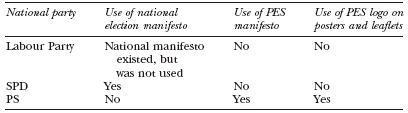
According to a party official, Labour's amendments to the PES manifesto were ‘reductionist in nature’ as the party approached the text ‘thinking that anything we give would be picked up and used against us’.Footnote 47 The PES manifesto practically played no role in Labour's 2009 election campaign (see Table 2), and one party official stated that, after the PES manifesto negotiations, ‘You end up with a deal to the left of Labour but you can use it to reassure the left of the party of our commitments on this side. It acts as a signifier to the trade unions and the Social Europe side of the party.’Footnote 48 Labour would have preferred a ‘values-based’ text to the PES manifesto's policy commitments, which were more left wing than the Labour leadership had wanted them to be.
Use of election manifestos and campaign material in 2009

As a consequence, Labour fought its campaign on the basis of its own manifesto.Footnote 49 Finding the manifesto on the party's website was, however, a challenge and it was only added after a complaint by the European Parliamentary Labour Party (EPLP).Footnote 50 Labour's manifesto addressed most of the issues tackled by the PES manifesto but put greater emphasis on the party's political achievements at the EU level and on the benefits to Britain of EU membership. As in the past, Labour's manifesto drew on the PES manifesto, picking up many of its themes and pledges, even if during the campaign it did not play a role. Asked why the PES manifesto was not used, a Labour official pointed out that the material provided by the PES was often ‘not helpful’ in the British context as it did not break European issues down to the local level. Labour activists, the official stressed, do not feel the need to discuss European integration in general, but focus on local issues such as funding provided by the EU.Footnote 51 Yet, while the PES's campaign material was criticized, Labour's own manifesto was not used either. A MEP candidate explained: ‘There were only very few printed copies of Labour's European manifesto. While in theory, manifestos are important, they don't play a big role during the election campaign, at least not when you speak to people at their doors. In that case, short leaflets are more useful.’Footnote 52 A long-standing MEP explained that he hardly ever used any manifesto during the campaign, stating: ‘Well, you don't hand out manifestos very much during the campaign, but when people ask you for Labour's policies you refer to it, and also when the press asks you.’Footnote 53 Hence, Labour hardly used its own manifesto – not to mention that of the PES.
Like Labour, the SPD used its own manifesto.Footnote 54 Party leader Franz Müntefering in 2008 praised the PES manifesto, saying ‘The manifesto is good, Europe is good.’Footnote 55 All MEPs interviewed were aware of the PES's manifesto and had a positive attitude towards it – yet none of them used it. Instead, they referred exclusively to the SPD's manifesto. The content of the two manifestos is similar; calling for a ‘Social Europe’, a stricter regulation of the financial markets and steps to combat climate change, the only difference was that the SPD highlighted some topics of national concern, such as the principle of subsidiarity.
One MEP said that during his campaign, the PES manifesto did not play a big role. However, ‘for the internal mobilization of the party, it did play a role because for the first time a manifesto has been discussed […]; at least to a certain extent. It [the PES manifesto] was more than the bulletins we used to have.’Footnote 56 The SPD used its own branding for the campaign, a red cube, which nevertheless resembled the PES cube (see Table 2). As an official put it: ‘With the federal elections approaching, the SPD did not want to confuse its voters by using different logos and brandings. […] Also, the SPD did not see the added value of putting the PES's logo on its posters because the voters would not notice it. Who would travel across Europe and compare?’Footnote 57
The PS's campaign relied exclusively on the PES manifesto, and the party put the PES logo on posters, campaign material and the voting bulletins (see Table 2). For the first time, the PS did not produce a separate manifesto. A long-standing MEP commented: ‘I don't see how we could have been more European in our approach to this campaign […]. The PES was very present in our campaign. Unfortunately this did not translate into better election results.’Footnote 58 A French PES activist said that, within the Paris federation of the PS, more than 200 party activists contributed to the PES manifesto, and expectations were high. ‘That's why we are frustrated to see that many party leaders in other European parties have not used the manifesto,’ the activist stressed.Footnote 59
There remains the question of why the PS was the only party of the three to have used the PES manifesto. A MEP stated that the PS used the PES manifesto to stress the difference between the left and right. Especially after the PS's internal division over the EU Constitutional Treaty and the national referendum on the same matter in 2005,Footnote 60 ‘Europe was a politically very sensitive topic’ and the ‘use of the PES manifesto seemed to be the most European thing to do’.Footnote 61 After all, a study by Gabel and Scheve shows that intra-party dissent on European integration has an effect on party supporters, and even pro-EU parties such as the PS can cause a substantial part of their supporters to adopt anti-EU opinions.Footnote 62 Hence, the PS was cautious about the message it sent to its supporters, trying to avoid further dissent.
Perhaps more importantly, the PS has always been ideologically much closer to the PES than Labour. For example, it wholeheartedly supported the PES's commitments to the regulation of the financial markets – which were contested among the Labour Party. Moreover, as a party of opposition, the PS could commit itself to the PES's policies more easily. Last but not least, being in opposition, the PS had a lower budget for campaigning and fewer staff working at its headquarters. The use of the PES manifesto and logo therefore seemed to be a rational and straightforward strategy.
Johan HellströmFootnote 63 shows that national parties' stances on European integration are largely determined by their ideology, measured by the locations of the parties within party families and their general orientation along the left–right ideological continuum. National factors are still crucial in determining parties' positions towards the EU. Hellström writes: ‘Parties seem to take note of their own constituents or potential electorate when adopting their positions.’Footnote 64 This explains the ideological divergence between Labour, the SPD and PS, who are all members of the PES, but led very different election campaigns in 2009.
To summarize, the 2009 PES manifesto, created in an open consultation process, had the potential to Europeanize national election campaigns through the mobilization of a larger part of the electorate. However, top-down Europeanization has its limits, and the PES cannot enforce the use of its manifesto by its member parties. It has been demonstrated that for ideological and practical reasons, both Labour and the SPD showed little enthusiasm for the use of the common manifesto. The PS, as a party in opposition that is ideologically closer to the PES, could commit itself more easily to the PES's policies and exclusively relied on the PES manifesto.
Common Campaigning
A Europeanized election campaign would be an integrated one: Europarties and their national member parties would campaign together at all levels of the party organization. In practice, this would mean that PES officials, MEPs, MPs, local politicians and activists from European sister parties would together attend campaign rallies, television shows, debates and online chats to name but a few.
In 2009, PES President Rasmussen campaigned in almost all 27 member states alongside party leaders or MEP candidates. At the local level, there is a tradition of campaign exchanges, most notably in border regions. The most interesting development, however, has been the introduction of a kind of individual PES membership, the ‘PES activists’ in 2006. In the past, ordinary members of national parties did not feel that they belonged to an organizational arena extending beyond national borders, as contacts in the PES occurred in the intimacy of a narrow circle of international affairs specialists in the national parties and thus remained an ‘elite exercise’.Footnote 65 The PES tried to change this through the introduction of the ‘PES activists’. Every member of a PES member party is automatically a PES activist, but needs to register online with the PES. In 2009, there were over 70 PES activist city groups across Europe.Footnote 66 On the occasion of the PES activists' forum in 2009, President Rasmussen said: ‘I see our activists as the bridge-builder between the national and the European scene.’Footnote 67 For the PES, individual membership can foster increased legitimacy and contribute to the Europeanization of national party organizations. The concept of individual membership is not new to the PES. During the 1990s the PES set up local associations, an example being the PES-London-Association, although it failed to become officially recognized as a component part of the PES; moreover, it did not receive funding from either Labour or the PES.Footnote 68 It remains to be seen whether the PES activists will become an integral part of the PES and be embraced by its member parties. Generally, the national parties' fear of ‘capture’ by the Europarties still needs to be addressed.Footnote 69
During the election campaign, the PES provided the activist groups with information, while giving them the freedom to organize original campaign events. Most of the activists' activities were coordinated online. In France, Germany and the UK, PES activists supported the election campaign, albeit to different extents. The PS has fully embraced the concept and has integrated the PES activist groups into its party structure at regional level through a statute defining the cooperation between the PES activists and the PS. It is hence not surprising that in the beginning, the majority of PES activists were French. In the meantime the situation has diversified, and there are city groups all over Europe, but mainly in capitals and bigger cities. In France, there are currently almost 30 ‘Commissions Europe’ (European committees at regional level) and overlapping PES city groups. The question is why the PS has been most enthusiastic about the introduction of the PES activists. A PS member stressed that since the PS had been strongly divided over the EU Constitutional Treaty in 2004/5, many activists now want to ‘demonstrate their pro-Europeanness’, and the PES activists offer a platform to express these feelings.Footnote 70
In the beginning, the SPD leadership regarded the PES activists with suspicion, worrying about parallel structures outside the party organization. In the meantime, at least at local level, attitudes seem to have shifted to a certain extent. PES activists supported the election campaign in 2009 either as city groups or alongside the Young Social Democrats (Jusos). However, the number of people involved is still limited and the SPD has not yet formally integrated the PES activists into their party structure.
The British Labour Party tolerates a somewhat loose cooperation with the PES activists who are affiliated with the Labour Movement for Europe (London and South East branch) and Compass Youth. As in Germany, the number of activists is still low, the organization is very loose and the activities seem to be focused exclusively on London and the south-eastern region of the UK. Moreover, as a MEP candidate explained, PES activists from other European countries are not used to the British campaigning style, knocking on doors and telephone canvassing, and it was not easy to involve them in those activities.Footnote 71 Efforts to include PES activists in the campaign were very low, despite Labour's predictable defeat.
To sum up, during the election campaign, an exchange took place between the PES, the leaders of its member parties and the international departments of the member parties. As a PES official explained, smaller member parties, in particular from the new EU member states, tend to rely more on the PES as a platform of exchange and expertise than parties from the EU 15.
The SPD, Labour and the PS are part of the institutionalized dialogue with the PES. However, it cannot contribute much to the Europeanization of the election campaign alone, as it does not reach activists at local level. To fill this gap, the PES has introduced the PES activists as bridge-builders between the European and national level. During the 2009 campaign their number was still limited, especially in Germany and the UK. PES activists still rely on national parties' willingness to integrate them and provide them with funding and membership lists. Both Labour and the SPD have been indifferent, if not hostile, towards PES grassroots activism.
A closer cooperation between the PES and its member parties could contribute to the Europeanization of the campaign by raising awareness of European issues and the exchange of knowledge and information. The PES activists are a well-connected network of campaigners, working at grassroots level, offering European policy and campaigning expertise and therefore feeling comfortable discussing European issues. Many of them come from different EU member states, providing contacts and speaking several languages. They could strengthen national party members' awareness of the PES and contribute to their Europeanisation.
A Common Candidate for the Commission Presidency
Vote-seeking is one the goals of parties alongside office- and policy-seeking. In the past, the PES was not seen as vote-seeking because European elections did not designate an executive at EU level.Footnote 72 However, the situation has changed with the increasing powers of the EP regarding the investiture of a new Commission. The selection of a common candidate for the European Commission presidency could contribute to the PES becoming a vote-seeking party – even if the direct link to the electorate remains weak.
If Europarties could agree on a common candidate for the European Commission presidency there would be more rivalry during the election campaign. More would be at stake and the top candidate would give politics a face. Modernization of election campaigns goes hand in hand with personalization, whereby the campaign focuses on personalities rather than issues.Footnote 73 Simon HixFootnote 74 posits that the EU needs a contest for political leadership, which could also lead to a personalization of the campaign. If the Europarties could each agree on a candidate for the presidency of the European Commission, their campaigns could be better coordinated with the campaigns of their member parties. Confronted with a European top candidate, voters would become aware of the ‘Europeanness’ of the elections, which could lead to a more Europeanized debate.
In the case of the PES in 2009, there was no common candidate to compete with the EP's incumbent Commission president, José Manuel Barroso. The PES failed to nominate a common candidate due to internal disagreements between PES President Rasmussen and the influential parliamentary group leader Martin Schulz, which shows that the party group exerts considerable influence on the PES. In addition, influential party leaders such as Gordon Brown and Franz Müntefering openly backed Barroso. The PS, under Martine Aubry, on the other hand, supported the idea of a common socialist candidate very strongly, and as her campaign manager Jean-Christophe Cambadélis stated, a common candidate could have contributed to the bipolarization of the campaign.Footnote 75 All French MEPs interviewed for this study regretted very much the fact that the PES did not have a common candidate for the Commission presidency. One said: ‘We [the PS] did not manage to make our voice heard within the PES when we called for a common candidate. I am absolutely convinced that our campaign suffered from that.’Footnote 76 The attitude among German MEPs was more diverse; most stated that in the future a common candidate would be a positive development, leading to a more personalized campaign. However, one MEP argued that ‘a European top candidate can impossibly speak all EU languages which would make campaigning abroad quite difficult’Footnote 77 – a statement that shows how low expectations are when it comes to European elections. Some German and most British MEPs interviewed saw no value in a common candidate for their campaign.
Stated simply, the PES, including national party leaders could not agree on a common candidate for the presidency of the European Commission. As a result, national politicians continued to be at the centre of the campaigns. A European top candidate, however, could lead to a top-down and bottom-up Europeanization of the campaign. Campaigning in 27 member states, the candidate would automatically bring in the ‘European’ perspective and discuss European topics. At the same time, he or she could engage with the electorate and strengthen the direct links between voters and the PES.
After the 2009 elections, the PES committed itself to select a common candidate for the European Commission presidency for the next European elections. This could raise the European profile of future campaigns and politicize the debate; as a result, the media and voters might pay increased attention to European politics, which is currently not the case.
CONCLUSION
This article has examined the 2009 European election campaigns of the PES and three of its member parties, the British Labour Party, the SPD and the PS. It has established an ideal-type model of Europeanization, arguing that a Europeanized campaign would imply increased campaign funding, the use of a common pan-European manifesto, a debate on topics with a European dimension, a close cooperation between Europarties and national parties, and the selection of a common candidate for the presidency of the European Commission.
The Europeanization of election campaigning cannot be achieved in a top-down manner; it can only happen when Europarties and national parties work together at all levels and exchange values, policy expertise and campaigning experience. It means, in Ladrech's terms, that national parties need to extend their relations beyond the national party systems. Moreover, European topics would have to be on the agenda of national parties at all levels at all times and not just during the election campaigns. As Day and Shaw argue, the development of linkages between Europarties and party members at the national level is seen as the sine qua non for enhancing the Europarties' legitimacy, which may facilitate an enhanced pan-European role for Europarties.Footnote 78 For this to happen, Europarties will need to enhance their significance at the European and national level.
The case of the Party of European Socialists demonstrates that, thanks to new funding regulations, Europarties can enhance their role as campaigners during European elections. PES secretary general Philip Cordery stated that before 2004 the PES was ‘really a coordination body between European social democrats, full stop. Now it has become much more of a party, we've had a real sort of common work to get a programme.’Footnote 79 Does this imply, in Ladrech's terms, the Europeanization of programmatic content? Do the 2009 European elections signal programmatic convergence among the PES member parties? The answer is negative. Only the PS – as a party in opposition that is ideologically close to the PES – used the PES manifesto, while Labour and the SPD fought their campaigns relying on their own manifestos. The debates remained national in all three cases.
By creating their 2009 manifesto in a more bottom-up approach through an open consultation process, the PES has demonstrated the willingness and need to involve a more diverse group of actors and provide the grassroots level with a sense of political ownership. The introduction of the PES activists follows the same trend: the establishment of a direct link between the PES and party activists at national level. So far, only national parties have a direct link with the voters, and ‘genuine Europarty development has suffered as a result’.Footnote 80 The role of the activists has been strengthened after the European elections, as the PES has decided to recognize their role in the PES statutes, which implies a formal recognition. These developments can certainly enhance the Europeanization of future election campaigns. The underlying question remains one of whether national parties see a benefit in Europeanizing their election campaigns. In 2009, this was not the case.