In the first seven decades of the twentieth century the British state viewed political assassination as a problem tied to its empire. Accordingly, assassination conspiracies in Britain itself were not often accorded a high priority.Footnote 1 British policy-makers assumed that the threat of assassination for Britain was different in kind, cause, and consequence to that endured by European powers: Britain's burden was empire not anarchy.Footnote 2 A spokesman for the Heath government described assassination conspiracies in British overseas territories as the ‘antithesis’ of modern terrorism.Footnote 3
The assumption that assassination would fade into imperial memory proved to be wrong. In the late 1970s, British politicians, civil servants, policemen, and intelligence officers rethought – and abandoned – many of their long-standing assumptions. The need to respond to the threat of imminent and deadly violence caused significant changes in policy whilst laying bare more visceral responses.Footnote 4
Political science studies of assassination rightly insist that the importance of assassination rarely lies with specific assassinations but rather the reaction of the state to assassination conspiracies. It is the study of patterns of assassination and state response that yields analytically valuable results. The political science studies of assassination reveal, however, the challenge of quantifying the effect of political assassination. Repeated analyses have established that it is possible to tie the frequency of political assassination to failing or fragile states. They also suggest that the impact of assassination in such fissile political environments might be measurable, although not always agreeing whether the direction of change is likely to be towards democratization or more extreme autocracy. The political scientists have been less interested in stable democratic states, not least because it is hard for them to quantify change caused by political assassination. Political science hypothesizes that stable democratic states will be ‘burdened’ by assassination, but admit that burdens will be less visible than in failing states.Footnote 5
Cultural sociologists also direct us towards how the pattern of assassination is framed.Footnote 6 Most notably, Ron Eyerman has argued that assassination in ‘constitutional monarchies’ caused ‘trauma’. In particular, patterns of assassination – even if not linked in a direct causal manner – could be reframed into a specific narrative. The manner in which the ‘trauma’ of democratic states was manifested depended on how their assassination conspiracies were ‘framed’; and that ‘framing’ took place retrospectively. Such framing could stretch from dismissing the existence of any conspiracy, by blaming assassinations on ‘lone wolves’, through identification of specific groups, killing for defined political ends, to the implication of broad communities in murder. Framing involved choice: conspiracies were rarely self-evident.Footnote 7
Sociologists conventionally analyse framing in a broad societal context, concentrating on public discourse.Footnote 8 However, in the case of assassination framing can be employed usefully also as a means of thinking about the more focused issue of ‘meaning making forces’ within the state apparatus. This approach takes a cue from the classic literature on framing, that describes it as the ‘micromobilization of tasks and processes’ and a ‘revision in the manner in which people look at some problematic condition’.Footnote 9 A frame is merely a quick way of stating the question: ‘what is going on; what should be going on?’Footnote 10 It was not the case that the state easily understood what was going on with regards to assassination. Groups within the state apparatus had to build a shared framework of understanding to enable them to make sense of the empirical evidence they were gathering.
In a parallel, but affinitive, development ‘Copenhagen School’ international relations theorists have argued that the governing apparatus of modern states has habitually framed the threat of political violence, including assassination, too widely in order to enhance its own status and power. Notably, the very concept of ‘securitization’ first evolved during the terrorism boom of the late 1970s and early 1980s. The ‘Copenhagen School’ maintains that the invocation of deadly threats empowered 1970s political leaders to move security out of the democratic process into a special ‘sphere of security’.Footnote 11
The ‘Copenhagen School’ case-study of counter-terrorism in Britain concentrated on ‘second order frames’ to reinforce the basic point of all securitization literature: ‘official discourses’ produce an ‘intrinsic essence’ of ‘terrorism’ when no such essence existed. The case-study was explicitly ‘not history’. Assassination was considered mainly in the context of rhetorical references to the ‘The Assassins’, the heterodox medieval sect.Footnote 12
On the other hand, the increasingly assertive ‘historical turn’ in terrorism studies argues that the deployment of detailed archival research is vital for the study of political violence, not least because of the very types of ahistorical analysis that have been imported into history from other disciplines.Footnote 13 Merely because changes were subtle does not mean they were unimportant; just because theorizing has taken place on the basis of limited empirical evidence does not mean that such evidence is not recoverable. It is merely that sophisticated historical investigation is required to unearth evidence and identify change.
The available evidence is both complex and fractured, and historians should unravel it with care. Historians of earlier periods of British history have made this point strongly in recent years.Footnote 14 Rachel Hoffman, in her synoptic review of assassination across nineteenth-century Europe, including Britain, argued that ‘since the 1950s, historians have focused on particular assassination attacks’, thus unwittingly leaving the analysis of patterns to non-historians. Hoffman concluded that there was a yawning historiographical gap that made it hard to trace ‘how these experiences [of assassination] changed over time’. This gap was particularly acute for the twentieth century.Footnote 15
The archival study of the state and assassination in 1970s and 1980s Britain is wholly possible. The archival record is, however, a glass both half full and half empty. As might be expected, government files related to assassination have received particularly rigorous scrubbing during the declassification of archives.Footnote 16 Retained, weeded, and redacted files litter the historical record. What has reached the public domain is incomplete and fragmented. This state of affairs has significant consequences for how historical investigation must proceed. There are limits to how far it can go as a step-by-step history of decision-making. First, sometimes decisions are made ‘off stage’ in the record. The general direction of travel and the reverberations of decisions are observable, but the moment of decision itself can be cloaked. Second, it is not always possible to identify key change-agents within the bureaucracy. Third, the agencies releasing records do not necessarily represent the importance of those agencies in policy-making. There is relatively little material from the files of SIS, the Security Service, the Metropolitan Police Special Branch (MPSB), the Home Office, the Northern Ireland Office, the Ministry of Defence, or the Department of Environment. Fourth, the records for any particular assassination case are rarely complete. Most of the case-histories contain dry wells.
On the other hand, it is the collectivity of cases that yields the important trends. There are thousands of pages of available government records on assassination. In terms of bulk, by far the richest source is the Foreign and Commonwealth Office (FCO). The FCO was not always the lead department in policy-making, but many of its departments took a close interest in assassination. The FCO also acted as a clearing-house for relevant information from other ministries. The other rich seam of information is the paperwork sent to and from successive prime ministers. These files are much more episodic and general than the departmental archives but they take us into high-level decision-making.
More archival sources will become available in the future. One purpose of the current article is to propose a way of interrogating the fragmentary evidence that reaches the public domain. A close reading of the archival evidence enables us to build a nuanced account of the British state's response to assassination.
I
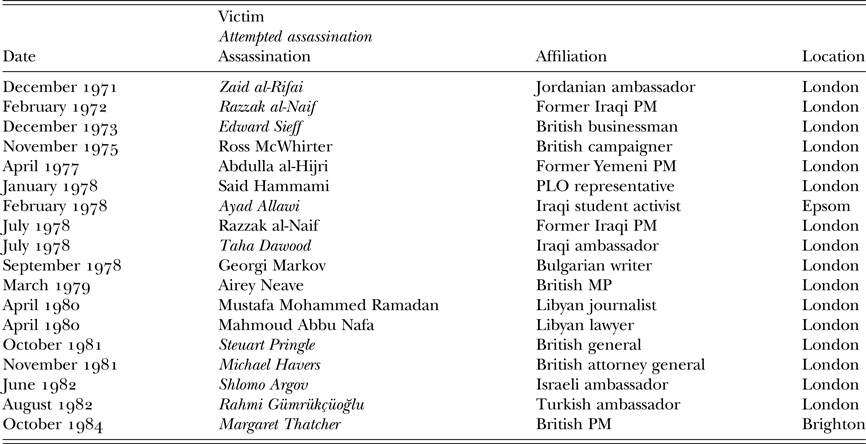
In the 1970s, assassination became a pressing issue within Britain. At least six major assassination communities – Iraqi, Libyan, Palestinian, Israeli, Irish, and Armenian – converged on London in the 1970s (see Table 1).
Significant assassination attempts in mainland Britain, 1971–84

A coup in Iraq brought the Ba'ath Party to power in July 1968.Footnote 17 A new Iraqi intelligence service was created around Saddam Hussein's Ba'ath assassination squad. Saddam emerged as the dominant figure in the Ba'ath in the 1970s, and formally succeeded to the leadership in 1979. Iraqi intelligence remained firmly under the control of his Tikriti relatives.Footnote 18 In September 1969, Colonel Gaddafi seized power in Libya. From the beginning, Gaddafi harnessed a jihadist ideology to the actual extirpation of opponents.Footnote 19 In the 1970s, the existing Palestinian militant movement splintered into murderously hostile factions after the triple shock of Black September in 1970, the Munich Massacre in 1972, and the Yom Kippur War in 1973. Assassination was a major feature of Palestinian factional struggles. At the same time, the Israelis began a campaign of assassination aimed at the Palestinian Munich murderers.Footnote 20 A new leadership took over the Provisional IRA (PIRA) in the mid-1970s with an avowed preference for the murder of ‘high-value’ targets beyond Northern Ireland as part of the ‘long war’.Footnote 21 ASALA, the Armenian Secret Army for the Liberation of Armenia, began assassinating Turkish government officials in 1975.Footnote 22
Assassination was peculiarly a problem for London. Whitehall had conceptualized cosmopolitan London as the powerhouse of Britain after the end of formal empire.Footnote 23 The open city of the 1970s, however, came with unanticipated costs. Immigration and visa rules introduced in 1971 left the state nearly powerless to prevent the ingress of assassins.Footnote 24 Prevention of terrorism law introduced in 1974 applied only to cases linked to Northern Ireland, and was thus inapplicable to the majority of assassination conspiracies.Footnote 25 The rights of political dissidents undermined the extradition or expulsion of assassins from the early 1970s onwards.Footnote 26 The expansion of higher education in the 1960s allowed assassins to merge into the wave of overseas students.Footnote 27 Long-range jet travel to Heathrow facilitated both the rapid arrival and the quick escape of assassins.Footnote 28 The reform of firearms laws in 1968 denied guns to those who wished to protect themselves, but proved of little hindrance to assassins. Terrorist groups ‘favoured operations in London, partly because British police officers were usually unarmed’.Footnote 29 London's status as a hub for the ‘international press corps’ guaranteed publicity for all assassins, ‘irrespective of cause’.Footnote 30 The Palestine Liberation Organization (PLO) said that, ‘as far as London was concerned it should be considered a good place for assassinations’.Footnote 31 In 1978, a leader in The Times declared that London had become ‘a high risk city’.Footnote 32
The British state's framing of assassination conspiracies evolved in three distinct phases beginning in 1971, 1978, and 1984. Between 1971 and 1977, it treated assassinations as almost random acts of violence. It did not establish many links between individual murders. The links between assassinations remained obscure. The state apparatus did not change to accommodate the possibility of multiple assassination conspiracies.Footnote 33
The second phase in the evolution of British assassination policy began in 1978. The Callaghan government attempted to impose some kind of pattern on the London assassination conspiracies. Assassination was reframed as occasional acts of violence that the state nevertheless needed to discuss and plan for. Some changes were made in the ‘hidden wiring’ in Whitehall. In February 1978, the Home Office, the FCO, the Metropolitan Police, and the Security Service convened a conference to analyse the broader meaning of assassination plots in London. Importantly, they agreed to re-convene on a regular basis.Footnote 34 The conference began to retrofit previous assassinations, reaching back to the Heath government, into a conspiratorial pattern.Footnote 35
The phase initiated by Callaghan in 1978 only really ended in 1984. In May 1984, Mrs Thatcher finally ordered a significant alteration to the treatment of assassination. Assassination was re-classified as an endemic threat involving a large number of related conspiracies.Footnote 36 The formal assessment framework within the Joint Intelligence Committee (JIC) was reformed: from the spring of 1984, the prime minister was presented with constant updates on assassination conspiracies, conspirators, the interaction of conspiracies, and the potential geopolitical impact of the assassination complex.Footnote 37 These new attitudes were hard-wired into the system by the major assassination conspiracies of the autumn of 1984.
II
In retrospect, the new age of assassination was deemed to have begun for Britain in 1971. There were a series of notable assassinations and attempted assassinations in London from the end of 1971 onwards. The investigation of each assassination was, however, terminated as soon as possible.
In December 1971, an assassin machine-gunned the car of Zaid al-Rifai, the Jordanian ambassador, near his diplomatic residence in Kensington. The would-be assassin was arrested in Lyons in January 1972.Footnote 38 The British did not know which radical Palestinian faction he represented. They assumed he was an agent of either the Popular Front for the Liberation of Palestine (PFLP) or the Popular Democratic Front for the Liberation of Palestine (PDFLP), both part of the wider PLO.Footnote 39
The British hoped that they would not need to find out much more. Without an extradition from France there could be no further investigation. ‘The unworthy thought occurs’, David Gore-Booth at the FCO wrote, ‘that this could in fact be the best solution so far as we are concerned.’Footnote 40 Obligingly, France was unwilling to extradite an assassin for a ‘political crime’.Footnote 41 The British state was only too relieved to have had its scope for investigation curtailed. The senior investigating officer was asked ‘not to disturb a dog which we had every reason to think was sleeping’. The police agreed to ‘keep quiet’ and that seemingly brought ‘this unhappy affair to an end’.Footnote 42
By the time Rifai's attacker left France, however, British suspicion had shifted away from the PFLP and the PDFLP to Black September. Black September was the main terrorist group formed by Yasser Arafat's Fatah faction of the PLO.Footnote 43 In September 1972, the prime minister returned to the Rifai case in the wake of Black September's massacre of Israeli Olympians in Munich.Footnote 44 Heath demanded to know what had been the underlying nature of the Rifai conspiracy. He received a very lukewarm answer cobbled together by the Foreign Office, the JIC, and MI5, and written up by Percy Cradock. The Rifai assassination attempt had been, Cradock concluded, ‘the work of Black September’. But the evidence was ‘not necessarily conclusive’.Footnote 45
Thanks to the 1972 Munich Massacre, Black September – and by extension the PLO – became the most notorious terrorist group of the early 1970s. The Rifai investigation, even before its premature termination, had, however, suggested two further threads of conspiracy: one leading to the Gaddafi dictatorship in Libya – the source of the assassination weapon – and the second to the Ba'ath regime in Baghdad, which had publicly claimed precise knowledge of the attack.Footnote 46
The Libyan dimension received more attention than the Iraqi, not least because of Colonel Gaddafi's outspoken support for the PIRA. The PIRA leaders that seized power during the mid-1970s believed that targeted assassinations were more effective than constant low-grade sectarian murders. In November 1975, the PIRA murdered the Unionist celebrity Ross McWhirter in Enfield. Yet at the moment the PIRA entered the London assassination arena, Colonel Gaddafi himself began to signal to the British government that he would scale down his support for the ‘revolutionary struggle’. In September 1976, he publicly announced that ‘the IRA chapter is behind us’. The British state was inclined to believe Gaddafi's protestations.Footnote 47
There was, however, at least one influential figure in the 1970s British establishment who was unwilling to let go of the idea that Gaddafi was the main root of assassination conspiracies. The Sieff family was a dynasty of Anglo-Jewish businessmen, outspoken Zionists, and major donors to the Conservative party. In December 1973, an assassin attempted to murder Teddy Sieff in his London home. The PFLP claimed responsibility for the attack. In 1975, MI5 identified the assassin as ‘Carlos the Jackal’.Footnote 48 Teddy Sieff's nephew, and successor at Marks & Spencer, Marcus Sieff, commissioned a private study of Libyan links with Palestinian terrorism.Footnote 49 In January 1974, Marcus Sieff met Edward Heath to present his findings. Sieff ‘told Mr. Heath that the Libyans were already attempting to carry our murders overseas and that Britain should give a lead and break off diplomatic relations with the Libyans’. Heath was polite but entirely unwilling to explore the danger of Libyan assassination conspiracies. According to Sieff, a ‘private secretary caught him on his way out to tell him he was “wasting his time”’.Footnote 50
The unwillingness to ‘waste time’ on wider assassination conspiracies in London was continued by the Labour governments that succeeded Heath. In September 1977, Callaghan's secretary of state for Northern Ireland, Roy Mason, announced that he would attend a reception at the Libyan embassy in London to celebrate the eighth anniversary of Colonel Gaddafi's seizure of power.Footnote 51 Those who protested were told that, ‘naturally, he would not have done so had there been any indication in recent years that Libya is involved in providing material support for any terrorist organisation in Northern Ireland’.Footnote 52
The same logic was also applied to Saddam Hussein.Footnote 53 British officials met Iraqi-sponsored Palestinian terrorists in Baghdad. Zaid Haider of the Arab Liberation Front assured them that he, and Abu Nidal of Black June, ‘had been told to clear their lines with the Iraqi authorities before engaging targets other than Israel’.Footnote 54 British diplomats concluded that Palestinian terrorists in cahoots with Iraqi intelligence would ‘not scruple’ to engage in ‘assassination by bomb or bullet’.Footnote 55 The diplomats merely hoped that the assassinations would not happen in London.Footnote 56
In April 1977, however, Abdulla al-Hijri, the former prime minister of North Yemen, was assassinated outside the Royal Lancaster Hotel in Bayswater. A fingerprint enabled the police to identify the assassin as ‘a PFLP supporter and a Fedai’.Footnote 57
The assassin, Akache, was a member of the PFLP.Footnote 58 But the PFLP ‘could not have launched this operation without Iraqi complicity at some level’.Footnote 59 Special Branch and MI5 went further and concluded that the Iraqis were responsible and ‘quite probably have turned to the Haddad faction, based in Baghdad, to provide the assassin’.Footnote 60
Soon thereafter, however, the ‘steam’ was taken out of the investigation by two events. First, the president of the Yemen Arab Republic, Ibrahim al-Hamdi, was himself assassinated, ending any Yemeni government interest in the case.Footnote 61 Second, Akache was killed in Mogadishu having hijacked a Lufthansa airliner over the Mediterranean in October 1977.Footnote 62 In December 1977, the Home Office once more asked the Metropolitan Police to ‘let sleeping dogs lie’.Footnote 63
III
The second phase began in 1978. The hopes of 1977 were rapidly falsified. On 4 January 1978, Said Hammami, the PLO's representative in London was assassinated. The nature of the conspiracy was, once again, unclear.Footnote 64 After discussions with Fatah, however, Special Branch concluded that Abu Nidal of Black June had organized the assassination. Abu Nidal was then still a shadowy figure. He emerged slowly from the pack of Palestinian militants as the leader of the terrorist group most likely to carry out assassinations.Footnote 65
Roger Hervey of the Permanent Under Secretary's Department (PUSD) – the department of the Foreign Office that oversaw the intelligence agencies – made the first attempt at a synoptic long-term view. In July 1978, Hervey concluded that the assassination gangs were not ‘rogue’ splinter groups but were intertwined with the intelligence services of hostile states – notably Iraq and Libya. State intelligence services not only tasked terrorist groups with assassination but also operated with them on missions.Footnote 66 Hervey's review had an appreciable impact on those ministers that read it. The foreign secretary, David Owen, wrote to the home secretary, Merlyn Rees, and the prime minister that he now believed that ‘earlier assassinations of Arabs in London’ were part of a wider pattern, a network of state-sponsored assassination.Footnote 67
The conclusion that Britain faced a potent set of conspiracies had barely begun to percolate Whitehall, however, when it was tested by another assassination. In July 1978, General Razzak Abdul al-Naif was assassinated in the Intercontinental Hotel, Hyde Park. The unique feature of the Naif assassination was that the conspiracy was very clear from the outset.Footnote 68 The assassin was arrested as he tried to reach a flight to Baghdad from Heathrow airport. MI5 had a ‘batting order’ of Iraqi intelligence in the UK.Footnote 69 The Security Service could even identify the individuals who had organized the conspiracy.Footnote 70
The assassin and his Iraqi case officer were charged with murder. British officials realized they had reached a Rubicon. For the first time since the 1940s, there was likely to be a trial in London that would reveal the true nature of an assassination conspiracy. Britain would be ‘in the situation that almost all Western governments finding themselves with alien terrorists on their hands have tried desperately to avoid’.Footnote 71 Ministers decided not to reveal the full extent of the Iraqi state assassination apparat.Footnote 72 The prime minister, Jim Callaghan, and the foreign secretary, David Owen, agreed to expel the intelligence officers. They also decided to act without publicity.Footnote 73 Their line was that there was ‘strong circumstantial evidence’ that the Naif killing was planned and carried out by Iraqi intelligence, ‘but to say this publicly could prejudice the trial’.Footnote 74
Immediately thereafter, a Fatah squad attempted to assassinate ‘the wretched Taha Dawood’, the Iraqi ambassador in London, in revenge for the Hammami murder.Footnote 75 On 4 August 1978, Khloud Moghrabi – a female assassin – was charged with conspiracy to murder. The Moghrabi case forced officials to confront an assassination conspiracy that they normally did their best to avoid. Moghrabi was living proof that the Fatah faction of the PLO was actively involved in assassination. The usual line was that ‘Fatah, the dominant PLO group, has not mounted terrorist operations since 1974.’Footnote 76
Ministers were equally keen to minimize the role of Iraq in assassination conspiracies – despite their expulsion of Iraqi intelligence officers for directly procuring an assassination in London. The Callaghan government used the Fatah attempt to assassinate Dawood to smooth over relations with Iraq.Footnote 77 In mid-October 1978, the Foreign Office's minister of state, Frank Judd, took a snap decision to allow Dawood's successor to present his credentials to the queen. The irritated permanent under secretary of the Foreign Office, Sir Michael Palliser, allowed himself the rare observation that Her Majesty ‘will not like it’.Footnote 78
The Callaghan government was sensitive to criticism in the press.Footnote 79 However, ministers and officials did not accept that the press had any superior insight into the threat of assassination. They believed that public commentary was merely another means of getting at a government that was struggling politically. A newly appointed opposition spokesman, Leon Brittan, repeatedly used press reports to expose what he portrayed as the Callaghan government's dishonesty over the al-Hijri assassination.Footnote 80 The Conservative opposition was engaged in a relentless political offensive to undermine Callaghan's tenuous grip on power. The breakdown of the Lib–Lab pact in October 1978 occurred as the decisions on Iraq were being made.
To make matters worse, in September 1978, just as the government was wrestling with the Iraq question, Georgi Markov, a Bulgarian émigré, was assassinated in London. The murder weapon was unusual: a poisoned umbrella. The Markov assassination generated more column inches than any of the other London killings of the 1970s. It took the British state by surprise. In 1971, the Heath government had expelled over 100 Soviet intelligence officials, a major Cold War gambit. Since then, the government had assumed that the Soviets, unlike the Iraqis and Libyans, were bound by a ‘code of conduct’ in Western cities.Footnote 81 This was a misapprehension, as post-Cold War studies of Soviet operations have demonstrated.Footnote 82 The KGB preferred to use ‘cut outs’ for assassinations. The investigation into the Markov case concluded that the Soviets had franchised assassination to the Bulgarians.Footnote 83 Despite a great deal of speculation, limited progress was made in understanding what had gone on, either in secret or in public. When Margaret Thatcher asked for hard facts she received very little.Footnote 84
The last assassination in London under the Callaghan government was also the most shocking to political opinion. In March 1979, the Irish National Liberation Army (INLA) – a small Irish republican terrorist group – assassinated the Conservative MP Airey Neave in the House of Commons car park.Footnote 85 Despite the high profile of the victim, the immediate treatment of the assassination was of a piece with what had gone before. The intelligence services resisted any attempt to widen the Neave conspiracy.Footnote 86
In May 1979, the Conservative party won the general election. Many MPs were understandably roiled by the death of one of their own. Margaret Thatcher thought that a continuing Whitehall attachment to ‘splinter groups’ and ‘rogue factions’ as an explanation for assassination was fatuous and ‘riddled with inconsistencies’.Footnote 87 Thatcher sometimes ‘appalled’ officials with her blood-curdling contempt for those who failed to give due attention to the assassination of her personal friends.Footnote 88
Mrs Thatcher and her advisers were much more likely to use press investigation to challenge officials. The Sun claimed, for instance, that the Russians had trained the assassins of Airey Neave, forcing the Home Office to admit that ‘neither we, nor MI5, know – although it is plausible speculation’.Footnote 89 MI5 had to answer some awkward questions from the prime minister when the BBC's Panorama suggested that the Security Service had turned a blind eye to ex-CIA agents supplying weapons to the Libyans for assassinations in London.Footnote 90 Panorama seemed rather more determined to understand the activities of Abu Nidal than did the Foreign Office.Footnote 91
Yet Thatcher's Conservative government did not develop a new approach to assassination during her first term. Rather, it continued the trajectory of the Callaghan government.Footnote 92 If one pays too much attention to campaigning rhetoric, or even Margaret Thatcher's acid asides, the essential continuity between the Callaghan government and the first Thatcher administration, when it came to security, can be obscured. Both acted within a strong Cold War context. Nigel Ashton, for instance, has shown that Thatcher's forays into Middle Eastern politics were still ‘framed…in the context of the Cold War, in which bolstering pro-Western Arab leaders might thwart the advance of Soviet influence’.Footnote 93 The Heath, Wilson, Callaghan, and Thatcher governments all promised the USA that they would keep out of the way when the Americans engaged with the Soviet Union on Middle Eastern issues. Each of those governments realized that their main challenge was dealing with the blowback from the US–Soviet–Arab–Israeli struggle, not in sorting it out.Footnote 94 This was part of the process by which security policy became more technical and defensive.
This is not say that the strategic context did not change for the first Thatcher government. In September 1980, Iraq invaded Iran. Britain became a potentially important arms supplier to Iraq, either directly or via Jordan. In December 1979, a precipitous decline in US–Libyan relations began when a mob stormed the US embassy in Tripoli. The United States broke off diplomatic relations with Libya in May 1981 when a Libyan dissident in Chicago was assassinated.Footnote 95
Renewed interest in Libya as a source of assassination conspiracies was a hallmark of the first Thatcher administration.Footnote 96 The prime minister demanded to know if the PIRA cell that murdered Lord Mountbatten in Ireland on 27 August 1979 had any Libyan links. However, after long enquiries, the Security Service could find ‘no evidence that any member of this team has visited Libya’.Footnote 97
In the same month as the Mountbatten assassination, a so-called Revolutionary Committee took over the Libyan embassy in London. In November 1979, Libya went on the offensive. Its new representatives claimed that it was the British who were harbouring dissidents with plans to assassinate Colonel Gaddafi. They produced a list of dangerous men.Footnote 98 On 11 April 1980, an assassin murdered Mustafa Mohammed Ramadan at Regent's Park Mosque. Ramadan's name had been one of those featured on the November 1979 list.Footnote 99
The head of the Libyan People's Bureau (LPB), Musa Kusa, ‘categorically denied’ that the LPB had been involved in murder when he was questioned by British officials.Footnote 100 The British government, once again, faced defining a conspiracy, in the glare of publicity, with limited information, and hindered by a disinformation campaign by the presumed guilty parties. Willie Whitelaw, the home secretary, and Peter Carrington, the foreign secretary, were in no doubt that the assassination of Ramadan had been ‘instigated by the Libyan authorities through their mission here’. The question was whether to try and pin the order for murder on Musa Kusa. They shied away from that step. Instead, Carrington proposed a plan whereby Britain would despatch a ‘special emissary’ to see Gaddafi with a warning to stop the assassinations.Footnote 101
Margaret Thatcher approved the Whitelaw–Carrington plan on 25 April 1980. On the same day, the Libyans assassinated a second dissident in London, Mahmoud Nafa.Footnote 102 Sir Antony Acland, the chairman of the JIC, was sent to Tripoli with a personal message from Thatcher to Gaddafi. Her definition of the conspiracy was feeble. ‘There have recently been a number of incidents in London involving Libyan citizens, two of whom have been shot dead’, Thatcher wrote. ‘Unfortunately’, she continued, ‘evidence has also come to our attention that members of the People's Bureau in London have been associated with those who have been detained and have provided them with assistance.’ ‘I do not wish to expel these persons as long as I have any alternative’, she assured Gaddafi. Instead, she requested him voluntarily to withdraw four officials.Footnote 103 The attempts to pin blame on Gaddafi were half-hearted.Footnote 104 In private, Thatcher bewailed the pusillanimity of her own response.Footnote 105
It was Musa Kusa, not the British government, who asserted that the Libyan regime was a procurer of assassination.Footnote 106 Thatcher and Carrington agreed that they now had no choice but to declare him persona non grata.Footnote 107
Whilst the Thatcher government was wrestling with the Libyan problem, the Iraqi assassination conspiracy recrudesced. In June 1982, a Black June assassin shot the Israeli ambassador in London, Shlomo Argov, at the Dorchester Hotel. Argov's Special Branch bodyguard captured the assassin. The arrest of the assassin did not, however, enable the British government to make an immediate statement on the nature of the conspiracy.Footnote 108 Only in October 1982 did the Security Service conclude that Abu Nidal ‘organised the assassination attempt on Mr Argov’ and that ‘the assailants were given backing by the Iraqi Embassy’.Footnote 109 The problem with defining the conspiracy so baldly was that Britain's allies might expect the British government to take action against those suborning murder in London: ‘Ministers might reasonably argue…we should do something about it.’Footnote 110
In January 1983, the director of public prosecutions reassured the Foreign Office that ‘no evidence will be presented which in any way implicates the Iraqi Embassy’. The DPP said that his strategy was to establish that the assassination conspiracy was organized by the ‘Abu Nidal group’ but to go no further in open court.Footnote 111 A London jury found three men, the leader, the assassin, and the armourer, guilty in early March 1983.Footnote 112
A few days after the trial concluded, the prime minister was briefed on the assassination and the court case. She was due to meet King Hussein in London, and the foreign secretary was to visit the Middle East. The prime minister was asked not to overstate the Iraq–Black June assassination link. British intelligence officers believed that they had established a secret British back channel to Saddam Hussein: Barzan Tikriti, Abu Nidal's patron. Any attempt to establish better relations with Saddam via the head of the intelligence apparatus could be undermined if the British stated their actual belief that Barzan Tikriti and Iraqi intelligence were co-conspirators in the Argov assassination. The Israelis had made the assassination attempt the casus belli for their invasion of Lebanon in June 1982.Footnote 113
When Mrs Thatcher met King Hussein, she did not make a major issue of Iraqi intelligence's relationship with Abu Nidal, confining herself to asking him to suggest to Saddam Hussein that Iraq's search for allies in the Iran–Iraq war was being undermined by his support for Abu Nidal.Footnote 114 The Iraqis closed Black June's offices and training camps in November 1983.Footnote 115 The British readily conceded, however, that this change in apparent policy owed more to the American decision to move against Abu Nidal, and their threat to choke off arms supplies to the Iraqis, than any British actions.Footnote 116
IV
Libya provided the catalyst for the shift into the third phase.Footnote 117 In February 1984, a Committee of Revolutionary Students took over the LPB in London. Within days, ‘Intelligence reports [were] received of possible attacks on opponents of Gaddafi.’Footnote 118 The most likely risk was believed to be a re-run of the 1980 assassinations.Footnote 119
The stand off between the LPB and the British government in London notoriously degenerated into murder rather than assassination. In April 1984, a Libyan official shot and killed WPC Yvonne Fletcher whilst she was policing a dissident demonstration outside the LPB. Yvonne Fletcher's murder prompted a great deal of soul-searching about how the British state had dealt with conspiracies in London.Footnote 120
As part of the review of the Fletcher murder, some MI5 counter-terrorism specialists concluded that Libya had started to supply the PIRA with ‘money and/or weapons’ once more.Footnote 121 On 12 October 1984, the PIRA attempted to assassinate Margaret Thatcher by means of a bomb planted in the Grand Hotel in Brighton. Mrs Thatcher asked herself whether she had been tough-minded enough on assassination. Despite what her intelligence services had been telling her for years, she now wondered whether ‘they…received assistance and training from Libya’. The technique ‘of attempted assassination of Heads of Government was characteristically an Arab one’.Footnote 122 As her private secretary remarked, ‘we are in a different world following the Brighton bomb’.Footnote 123 This conclusion was reinforced by the assassination of Indira Gandhi a few days later.Footnote 124 Assassinations were not isolated from one another: they ‘demonstrated the onset of a phase of violence in world affairs’.Footnote 125 London was at the centre of that violence.Footnote 126
V
Britain viewed assassination very differently in 1984 than it had a decade-and-a-half previously. The state reformed its own security in parallel with its changed understanding of assassination conspiracies. Callaghan and Thatcher erected a ‘permanent counter-assassination state’, no longer relying on insouciance in the face of fear, or insisting on the temporary nature of any elevated security measures.
The change towards security was palpable. Although Special Branch, for instance, had a long-standing role in providing bodyguards for the prime minister, MPSB officers were overwhelmingly deployed on intelligence and political work in the early 1970s.Footnote 127 Counter-assassination security under the Heath government had been, literally, a joke. On 22 January 1972, a well-known crank drenched the prime minister in ink in Brussels. Heath had a Special Branch bodyguard. Unfortunately, that bodyguard had lost the prime minister in a press scrum.Footnote 128 A subsequent review revealed that the individual Special Branch protection officers assigned to the prime minister, the foreign secretary, and home secretary never bothered to prepare overseas trips. They merely travelled with their minister and trusted that the local authorities had everything under control. Preparatory security visits to foreign capitals were a direct consequence of the Brussels debacle. It emerged also that foreign security officers rarely did any preparatory visits to London.Footnote 129
The real world of Middle Eastern politics forced Whitehall into something beyond humorous notes about the prime minister's pratfalls.Footnote 130 The review of the Brussels incident coincided with that of the Rifai assassination.Footnote 131 Rifai received a Special Branch bodyguard in the wake of the assassination attempt.Footnote 132 The Metropolitan Police deployed armed officers outside the Jordanian embassy in London.Footnote 133 The British government, reluctantly, accepted the importation of Jordanian military police embassy guards.Footnote 134 The police, however, regarded these steps as temporary emergency measures. The guards were withdrawn in September 1972.Footnote 135
The timing of this decision was unfortunate. It coincided with the massacre of Israeli athletes at the Munich Olympic Games in September 1972. In the wake of Munich, there was a rushed re-deployment of uniformed guards. The police were faced with a flood of demands for protection, most of which they turned down.Footnote 136 A senior official commented that in an ‘ideal world’ Britain would give the London embassies some protection; but in an ideal world the state would provide ‘better protection’ for ministers and judges, ‘but few get it’.Footnote 137
In November 1972, an interdepartmental working party began investigating how best to protect foreign diplomats in London. The working party recommended that the Met should create a specialized 275-man armed Diplomatic Protection Group (DPG). ‘Panic buttons’ were to be the key element of this new system. Although there would be guard posts outside a few diplomatic buildings, the bulk of the DPG would be mobile. Ambassadors could summon armed protection with their ‘panic button’. The allocation of Special Branch bodyguards to ambassadors would be a rare step of last resort.Footnote 138 The plan was finalized under the Heath government.Footnote 139 It was implemented by the Wilson government, and announced to foreign governments in September 1974.Footnote 140
The focus changed in 1975. In November 1975, when the PIRA assassinated Ross McWhirter, the police discovered a target list that included details of Edward Heath's address and the registration number of his car.Footnote 141 Margaret Thatcher had replaced Heath as leader of the opposition in February 1975. In April 1976, Harold Wilson retired as prime minister. Thus, two recent former prime ministers ceased to enjoy high office and the protection it entailed. Until 1976, former prime ministers had expected relatively few post office privileges. The state only protected serving prime ministers, the leader of the opposition, and very senior ministers because ‘until very recently ex Ministers were not regarded as at risk’. Wilson, however, demanded, on security grounds, that he – and Heath – should keep his government car, his chauffeur, his security detail, and have all his security organized and paid for by the state.Footnote 142 Callaghan agreed to Wilson's demands. Heath and Wilson also got official ‘panic buttons’ on the same model as ambassadors.Footnote 143
Initially, officials hoped that the extension of counter-assassination security would be little more than a short-term response to an immediate threat.Footnote 144 But when the police tried to withdraw protection, the two prime ministers objected.Footnote 145 They argued that high-value individuals should be protected from the general threat of assassination at all times and in perpetuity.Footnote 146 Once more, Callaghan agreed. Assassination protection became a permanent feature of the British political system.Footnote 147 As soon as it did so, the security apparatus was faced with demands from other dignitaries.Footnote 148
The government's immediate response was the purchase of armoured cars, more armed guards, and more panic buttons.Footnote 149 Yet VIPs demanded something more glamorous.Footnote 150 The armed DPG officer guarding the Iranian embassy in London cut a pathetic figure when it was stormed by terrorists in April 1980.Footnote 151 Armoured cars could provide some protection against pistols but not against the kind of car bomb that killed Neave. What many wanted was ‘mobile personal security’, preferably provided by the SAS.Footnote 152
The use of bodyguard teams was increased because of the ‘need for additional protection, as a result of the assassination of Mr Airey Neave’.Footnote 153 The Callaghan government hired a commercial firm of former SAS soldiers to protect British officials overseas.Footnote 154
Margaret Thatcher decided to go a step further and adopt a system of military ‘mobile personal security advisers’ for British VIPs overseas.Footnote 155 She made this decision after being briefed that it would have consequences in the UK. Other countries would demand reciprocity in London.Footnote 156 Some nations already ‘routinely armed’ their diplomats and staff.Footnote 157
It was illegal for foreign bodyguards to carry weapons and ammunition in London under the terms of 1968 Firearms Act. However, the Americans had made it clear that if their Secret Service teams were disarmed there would be no visits to London by senior US politicians.Footnote 158 The Secret Service was let in with some – extra-legal – rules of engagement. It ignored both the law and the rules. In 1984, three American agents were stopped and searched at Heathrow: they were not only illegally armed under the terms of the act, but casually carrying live ammunition in contravention of the rules. At the same time, two members of President Mitterand's security detail were stopped and searched and found to be carrying illegal loaded semi-automatic pistols.Footnote 159
In September 1984, the foreign secretary proposed that the whole system should be changed. It was now public knowledge that the British government had been playing favourites. The government had pleaded the law to most governments, and only done a deal with those powerful or bloody-minded enough to refuse to obey.Footnote 160
Margaret Thatcher's initial response was that President Reagan was ‘an exception…after all he's the only who has actually been shot’.Footnote 161 The prime minister, the foreign secretary, and the cabinet secretary quickly agreed, however, that having been caught out, American exceptionalism was not a defensible line. The second option was to ‘seal off’ the range of exceptions. The trouble with the ‘seal off’ option was that it would involve telling soon-to-visit-London leaders – presidents Mobuto, Mugabe, and Banda – that they were too dangerous to have gun-toting guards. The prime minister's group plumped for ‘strict practical conditions’ instead.Footnote 162 The new bodyguard system was agreed before the attempt to assassinate Margaret Thatcher in Brighton in October 1984. The prime minister signed off on its ‘immediate implementation’ a few days after the assassination attempt.Footnote 163
The first leader to visit Thatcher in London after the Brighton assassination attempt was the Italian prime minister, Bettino Craxi. Britain, he remarked, now had an assassination problem little different from that of Italy, and other European countries.Footnote 164 Together they rolled out of Downing Street with their armed security teams in nine armoured cars.Footnote 165
In November 1984, the head of the prime minister's private office – Robin Butler – gave evidence to the police inquiry into the Brighton bombing. Butler identified himself as the prime minister's principal security adviser, relying in turn on the Special Branch chief protection officer for specialist knowledge. Butler said that prime ministerial security had not changed much under Thatcher. The prime minister had a ‘need to be seen and meet people’. There had been a culture in place that stressed ‘the general standard of what is acceptable by way of security arrangements in this country’. That would have to change. Her security team had known there were ‘several ways in which the PM was vulnerable to an assassination attempt at Brighton which the security arrangements would not have been adequate to prevent (in addition to the one which actually occurred)’. Now ‘more rigorous security arrangements will need to be made’. Such arrangements would insulate the prime minister from the people in a way that would not ‘have been acceptable before the Brighton bomb occurred’.Footnote 166
The home secretary subsequently announced that the army, which already had responsibilities overseas, would be a more important counter-assassination force in mainland Britain. Members of the cabinet and others ‘at particular risk’ would receive more protection. He had made ‘difficult decisions’ about security. These decisions would limit the ‘extent and manner of public access’ to government ministers and high officials. This would involve, he said, ‘changes to established democratic traditions’.Footnote 167
VI
London was now recognized as a major global site for political murder. Although the government was sometimes reluctant to point the finger at specific procurers of assassination, by 1984 few politicians, civil servants, policemen, or intelligence officers doubted that London was at the heart of an assassination web. This belief was incorporated into the standard assumptions made by British state officials well before the mass immigration of Islamist radicals from 1993 onwards.
Indeed, there is some suspicion that the routine management of assassination conspiracies in London – based on some good MI5 penetration operations in London and the radical tightening of security for the upper political elite – might have lulled British officials into a false sense of security. This was a frequent accusation levelled at Britain by foreign leaders beginning with Rajiv Gandhi in 1984.Footnote 168 French intelligence officers later coined the phrase ‘Londonistan’ to express their disgust with Britain's selfish and insular approach to the new Islamic threat.Footnote 169 Pre-9/11–7/7 Britain had developed a specific approach to security. The late 1970s and early 1980s was a moment of important change, but the late twentieth century differed significantly from both what came before and after.
The adaptation to new assumptions about assassination was nevertheless traumatic. It involved acknowledging Britain's lack of power to act effectively in the international arena. The analysis of assassination conspiracies involved the explicit, if reluctant, admission that Britain had become a vulnerable and penetrated society. Sir Anthony Parsons famously remarked to Margaret Thatcher, in the context of Black June transferring from Baghdad to Damascus, that ‘our principal liability is that we have no leverage over any of the parties to any of the disputes which bedevil the Middle East’.Footnote 170
The British state was a reluctant conspiracy-monger. There is little evidence that the state overstated the assassination problem in either its internal or external discourse. If anything, it understated the assassination problem: against the expectation of the ‘securitization’ thesis. There is equally little evidence that 1980s British politicians welcomed ‘securitization’ in London. Willie Whitelaw, the home secretary, stated the normative position after the pope's visit to Britain in May 1982. ‘Protection arrangements’ could be accounted ‘admirable’ if they paid ‘the greatest attention to the needs of security, without in any way inhibiting or damaging the rapport’ between leaders ‘and the public’.Footnote 171 Leon Brittan, Whitelaw's successor, re-stated the position after the PIRA nearly succeeded in assassinating Margaret Thatcher in 1984: ‘Total security is impossible in a free, democratic society. Political and other leaders are vulnerable because they must be accessible.’ ‘We will not’, Brittan concluded, ‘be bombed into boltholes by terrorists.’Footnote 172
Nevertheless, the security process did evolve into an explicit acceptance that politicians and foreign dignitaries were a protected separate caste. Mrs Thatcher was forced into ‘boltholes’ for key meetings with the prime minister of Ireland.Footnote 173 VIPs were hived off from the rest of the population. As Brittan went on to say, ‘everything which can be done will be done to prevent such outrages and to protect their targets’.Footnote 174
After her own brush with assassination, Mrs Thatcher personally oversaw reforms that made targets of assassination a ‘special category’ with more rights than other government officials.Footnote 175 The new ‘special category’ covered someone ‘specifically selected to be the victim of assassination…because of his status as a representative or servant of Her Majesty's Government, and as a political gesture against Her Majesty's Government or the British people’. The concept of the ‘specialness’ of the victims, or potential victims, of assassination had been rejected as recently as 1981.Footnote 176
The reformers of 1984 recognized that a change in the practice of security was bound to have an effect on broader political culture. There would be a significant difference between a state in which everyone endured a low, if appreciable, threat and one in which the population of the capital was threatened by mass terrorism, but the higher political, official, and diplomatic elite felt increasingly safe from assassination.Footnote 177
For the rest of the 1980s, there was very little public commentary on the realignment of this elite with wider British society. Counter-assassination remained, however, an important intra-elite concern. As some had expected in 1984, there was persistent mission creep as VIPs sought to define themselves as such by moving within the iron ring. By the early 1990s, experts agreed that British VIP security was becoming costly, manpower intensive and byzantine. The suggested solution of more flexible security – some forms of which were just as useful for preventing wider terrorism – met opposition: the permanent deployment of security teams had become a core signifier of VIP status.Footnote 178
The permanent possession of state police, intelligence, or military security was the defining mark of the higher elite, placing them on the same level as royalty. The development of royal security in the 1870s and the 1880s had significantly altered the relationship between ‘rulers and subjects’.Footnote 179 There was no reason to believe that the development of political security would do anything other in the 1970s and 1980s. Harold Macmillan wrote amusingly in his diary of the perils of an ex-prime minister getting around London unaccompanied. He was the last prime minister permanently to undergo reintegration into society. The elite would not re-enter unprotected private life after 1984.