Introduction
Between 50 and 90% of the older population have problems with their feet.Reference Munro and Steele1–Reference Clarke3 Although not all these problems are painful, approximately one-third of the older population experience foot pain as a result of these conditionsReference Black and Hale4–Reference Menz, Tiedemann, Kwan, Plumb and Lord6 as opposed to one-fifth of the more general population.Reference Menz, Tiedemann, Kwan, Plumb and Lord7
In 2009, the United Kingdom (UK) population was 61,792,000.8 This therefore suggests that the total population affected by painful foot conditions would be in the order of approximately 12,358,400. The proportion of the UK population over 65 years old is reported to be 16%9 (9,887,000 people) and one could expect a third of this population, or 3,296,000 people, to be experiencing painful foot problems. With the population over 65 projected to increase to 23% by 2034,9 the burden of those experiencing painful foot conditions would also be expected to rise.
Non-painful foot conditions are also problematic. Of primary concern are neuropathic conditions, typically associated with diabetes mellitus. In the UK, there are currently 2.6 million people with diabetes, projected to rise to 4 million by 2025.Reference Diabetes10 Many of those with diabetes will have foot problems, with approximately one in twenty of those with diabetes developing foot ulceration per year.Reference Abbott, Vileikyte, Williamson, Carrington and Boulton11
Given the number affected and the tight financial climate within which the health economy is operating in the UK, a review of foot problems and their management through podiatry services is timely. This will consider the different levels of risk that these foot conditions present and approaches to dealing with them. Central to this will be a consideration of podiatry services, which focus solely on the treatment and management of foot conditions, despite other professional and non-professional groups also having a strong working interest in this area.
In undertaking this review, searches were made of the podiatric literature from the UK, United States (US) and Australia. These were carried out electronically, but also a manual search of UK podiatry literature was undertaken because much of this is still not available electronically, or listed under Index Medicus. Population data were obtained via national sources of population statistics.
Definitions of podiatry
A number of definitions have been offered to describe podiatry. In the US, it has been said that ‘a podiatrist is a specialist who studies foot pathology from a structural and functional standpoint and who treats medical problems dealing with the foot’. Reference DiMaggio12 A current statement from the main UK professional body for podiatrists describes the function of podiatrists in the following manner: ‘Podiatrists work to improve the mobility, independence and the quality of life for their patients by providing preventative care, diagnosis and treatment of a wide range of problems affecting the feet, ankles and lower limbs’. Reference Munro and Steele1 Although both are different, the definitions cover the consideration and treatment of the functional foot and this, in its broadest sense, is what podiatry is concerned with.
FarndonReference Farndon14 has provided a more in-depth definition of ‘core podiatry’, which is more applicable to practices involving care of an older person's foot: ‘Core podiatry involves the assessment, diagnosis and treatment of common and more complex lower limb pathologies, many of which are painful. These foot problems can affect mobility and be associated with the toenails, soft tissues and musculoskeletal system. At its most basic level, simple foot care is sometimes required for people unable to do this for themselves due to increasing age, reduced mobility or other medical problems. Core podiatry also deals with more complex conditions requiring professional and expert care. A wide variety of treatment modalities are used (manual debridement; applying medicaments or padding, using thermal and surgical techniques and the manufacture of orthoses) to reduce pain and preserve or improve foot health, but the effects are often short-term. There is a holistic view to the care, incorporating screening and surveillance to prevent the development of future foot problems and using health promotion to increase self-care where possible. Some of those who receive core podiatry, especially older people, assign it a degree of emotional value and perceive their foot health would deteriorate if it were no longer provided.’Reference Munro and Steele1
There is a wide range of treatment options for the management of foot problems. At the most basic, these involve self-care and for those with foot problems, proprietary over-the-counter remedies are available at chemist shops and supermarkets including basic insoles, padding materials and implements, and topical medicaments to facilitate the removal of corns and callus. Where individuals are unable to care for their own foot conditions, trained volunteers and assistants can help with simple foot care. At the professional level, interventions can be divided into specialist and non-specialist approaches and can be sub-divided into preventative,Reference Moore, Farndon, MacMillan, Walker, Storey and Vernon15 conservativeReference Farndon, Vernon and Parry16 and surgical.Reference Borthwick17 Podiatry, by definition, represents specialist approaches to the prevention and management of foot conditions and covers all levels of professional input.
The history and development of podiatry
There is evidence of the existence of foot care practices as far back as the ancient cultures.Reference Dagnall18 In the 13th century, ‘corn cutters’ practised their trade, and although in England some texts assert that these belonged to the Guild of Barber Surgeons,Reference Levy, Levy and Hetherington19 formal organization as a distinct profession did not evolve until much later. Various authors suggest that the first ‘professional’ foot care practitioners were identified through the standing and prestige of their eminent clients.Reference Seelig20 Although not quite the ‘gentlemanly professions’ of medicine, law or architecture, association with aristocratic or royal patrons undoubtedly raised the profile and social status of those involved, and some practitioners developed strong reputations in the field,Reference Seelig20 then known as ‘chiropody’.
Considerably later, professional bodies, systems of accreditation and codes of conduct were establishedReference Larkin21 with the first national professional bodies in ‘chiropody’ being inaugurated in 1912 in both the UK and US.Reference Dagnall22 As government in the UK became more involved in the provision of healthcare, the health professions increasingly became employees of the state, where decisions on how, and to whom, health services were to be dispensed rested with officials outside the professions themselves. This shifted gradually from partial involvement via the National Insurance Acts (1911) towards full control via the National Health Service (1948).Reference Larkin21 For podiatry, inclusion within legitimate, mainstream (state-recognized) healthcare initially meant registration with the British Medical Association's Medical Auxiliary scheme (in 1938). This had the effect of limiting the professional scope of practice and ensured subordination to the medical profession. This was followed later by formal state registration in 1960Reference Larkin21 whereby the Professions Supplementary to Medicine Act acknowledged the medical ‘auxiliaries’ which included chiropody as professions, albeit in a ‘supplementary’ role to medicine.Reference Lorimer23
Local authorities were granted authority to provide ‘chiropody’ services in 1959, and priority was given to older people, physically handicapped and pregnant womenReference Welshman24 (a system which continued until the mid-1990s, when treatment on the basis of clinical need began to predominate). Within podiatry, professional roles were largely limited to the management of corns, calluses and nail problems, with some foot ‘appliances’ also being involved.
As healthcare provision in the UK moved towards a market-oriented system during the Thatcher era, opportunities arose for the non-medical professions to assume wider roles and greater responsibilities in clinical care.Reference Borthwick17 Later still, as demographic imperatives began to weigh heavily on health service resource allocation, further need for workforce flexibility enabled a deeper reconfiguration of professional roles and boundaries.Reference Sibbald, Shen and McBride25
Real change in the skill range of podiatrists was probably most evident with the advent of local anaesthesia, which enabled more invasive procedures to be carried out by podiatrists. The Medicines Act (1968) had placed a legal obstacle to the right for podiatrists to access and use such medicines, and the regulatory body at the time (the Chiropodists Board), did not favour the technique, refusing to acknowledge it as a legitimate part of practice.Reference Borthwick, Short, Nancarrow and Boyce26 When the Board relented in 1972, surgical techniques became possible via local anaesthesia, and the speciality rapidly developed. In spite of these advances, medical opposition remained a constant feature.Reference Borthwick17
Another contentious issue is the prescribing of medicines.Reference Borthwick, Short, Nancarrow and Boyce26 Whilst access to a restricted list of medicines has long been possible for some of the non-medical professions, it is only in recent years that the authority to prescribe has been granted to the allied health professions including podiatry.27 ‘Supplementary’ prescribing has been available to podiatrists since 2005 and has established a limited but useful role designed to enable faster, more effective care and provide choice for patients, as well as transfer of work from doctors. It does not permit independent practice, but does allow access to medicines throughout the British National Formulary and a right to hold and use a prescription pad.Reference Borthwick, Short, Nancarrow and Boyce26 The Department of Health is now working towards enabling independent prescribing powers for physiotherapists and podiatrists, despite some medical opposition.28
Research and evidence-based practice in podiatry
As practices have developed, evidence to support their cost effectiveness is proving increasingly necessary and podiatry must be able to demonstrate its worth more explicitly than in the past.Reference Pickstone, Nancarrow, Cooke, Vernon, Mountain and Boyce29 Whilst this is less problematic for podiatric surgery,Reference Kilmartin30–Reference Tagoe, Brown and Rees32 it is much more taxing for podiatric therapies involving ‘biomechanical’ interventions, where good evidence is lacking.Reference Menz33 Establishing a wide evidence base to inform treatment remains one of the key challenges facing all of the healthcare professions, including podiatry, and will require further effort to realize. As a result, research activities have increased considerably in podiatry over the past 15 years with a number of keen and interested podiatry researchers now driving a research agenda for the profession.Reference Rome34
The autonomy, role and scope of podiatrists has therefore widened considerably and with these developments, the term ‘podiatry’ has become favoured to reflect that changed nature of the professionReference Borthwick35 and to bring it in line with the term used in other westernized countries including the US and Australia.
Foot problems: the hierarchical functional perspective
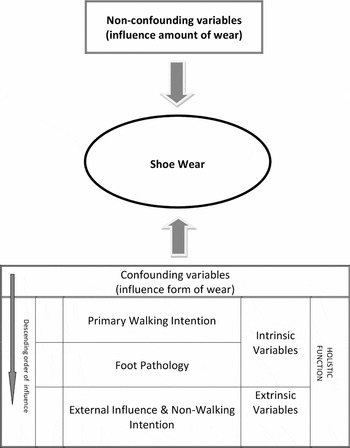
Foot problems are diverse, affect all age groups and can, when associated with certain systemic conditions, cause the sufferer to become at risk of serious complications. Viewed from a wider podiatric perspective, the problems affecting the foot can be shown hierarchically. A model has been created to explain factors which represent influences affecting the wear pattern of a shoe outsole (Figure 1).Reference Vernon36 Although created in the context of shoe wear, the central thesis of this model also provides a logical argument to explain podiatric considerations of foot function and influence. This argument is that if shoe outsole wear represents a history of the functioning foot which has been contained within that particular shoe, and as podiatrists are primarily concerned with the functioning foot, then the three tiers of influence presented within the model also represent a means of understanding and approaching podiatry practice.
Model of shoe wear pattern influenceReference Vernon36

The highest level of influence within that model is the concept of primary walking intention, that is the intention of the individual to walk from A to B with a manner of walking pertinent to themselves. At the next level of influence is the effect of foot-related pathology. Less powerful in their influence over foot and lower limb movement than the above functional considerations, problems of foot-related pathology can serve to confound intended function where the effect of the foot-related pathology amends the chain of events attempted during primary walking function. Foot-related pathology is placed lower on the hierarchy of influence because its presence may, or may not, amend overall foot function, depending on how such features interact with an individual's primary walking intention. The lowest tier of the model concerns external influences and non-walking function. These are considerations external to the individual and their ambulatory function. As in the example of foot-related pathology, external influences affecting the foot would potentially interfere with ambulatory lower limb function as can function which does not involve walking. The research involved demonstrated that such influences would need to be present to a very high degree in order to exert their effect on the foot or lower limb.Reference Vernon36 Examples of such influences would include footwear, occupational activity and trauma.
Primary walking intention
Problems at this level are inherent to the overall function of the individual during walking. They suggest that when such problems are encountered and which are causing detrimental symptoms to the individual, the podiatrist would need to be concerned with functional control of the foot and lower limb. Here, biomechanical considerations would be utilized and the treatment modalities employed would include the use of orthotics to manage foot and lower limb function, strapping techniques for the same purpose and, in the short term, padding techniques to adjust localized function in the foot. While the range of functional problems affecting the foot and lower limb is wide, such problems are of much less concern in extreme old age, where function has become restricted and other foot-related matters predominate.
Foot-related pathology
The level of foot-related pathology would cover localized conditions affecting the foot. Conditions which could be classified as pathological foot type (pes cavus, pes planus, ankle equinus) would fit into this category. Similarly, more minor deformities of the foot such as hallux valgus, hallux rigidus and hammer toes would be also be included. Conditions at this level would be seen in the older population (as well as others) and if problematic to the individual, may require intervention from the podiatrist. Typical podiatric approaches to care would be based around local management of that pathology (albeit with overall function also being considered). Conservative options would involve dealing with any associated lesions (e.g. corns, callus) through palliative scalpel removal, or chemical ablation, protection of the areas through padding interventions and the use of orthotics to protect the area, or redirect pressure away from any painful or problematic associated sequelae. Where the minor deformities are at risk of exacerbation through associated shoe fitting problems, management can also involve footwear considerations, particularly basic fitting, local adaptations, or whether modular or bespoke footwear would be beneficial.
It is at this level that surgical interventions could also be considered, from a podiatric surgeon, or orthopaedic surgeon specializing in foot surgery. Here, the objective would be, through surgical intervention, to correct or realign the deformity and through this, improve function, appearance, associated symptoms, and/or shoe fit. In the much older population, surgical interventions are less commonly considered for this class of problem due to the attendant risks of surgery, and conservative podiatry management with advice is the approach of choice.
External influences and non-walking function
Given that such conditions by definition are external, or do not relate to the usual walking function, they should be preventable. As such, the management of such problems would typically be based around the notion of prevention and advice, with consideration also being given to the use of short- or medium-term hands-on treatment to improve or eradicate any associated lesions. The nature and type of problems that would be encountered at this level would include the need for nail cutting assistance and basic skin care28 and skin lesions that have preventable origins and which should therefore improve once the cause has been isolated and removed.
‘Podiatry empowerment’ has become a commonly used phrase in relation to this level of podiatric consideration. Here, the focus of patient management is to raise awareness in the individual or their carer of any preventable factors that may be directly causing or exacerbating their foot condition, then through education and direct dialogue, to give that person the knowledge, confidence and skills to be able to manage that condition themselves where possible and advisable.
Studies have shown that a number of the foot problems encountered in podiatry practice are likely to be preventable.Reference Munro and Steele1 One small survey reported that up to 85% of patients attending a podiatry clinic wore footwear which fitted incorrectly in terms of length alone.Reference Yapp37 It is therefore the task of the podiatry empowerment team to show those with preventable conditions how their problems can be self-managed or even eradicated through change. Empowerment does, however, need to be used with care. It has been shown that where patients are discharged inappropriately, deterioration of low-risk patients to medium or high risk may occur soon after their discharge.Reference Campbell38, Reference Campbell, Bradley, Milns, White, Turner and Luxton39 Such inappropriate discharge can bring about additional cost to the NHS as well as the risk of further complications to the individual. This is particularly important in older age groups with their associated increasing prevalences of the more severe (foot) conditions and greater dependence with respect to mobility indicators.Reference Campbell, Patterson and Gregory40 This study also determined that ‘those initially categorised as low risk under the discharge criteria used’ were later found to have a number of foot pathologies that required treatment or monitoring.Reference Campbell, Patterson and Gregory40
Empowerment and discharge should therefore only follow careful assessment in which the patients’ level of vulnerability, their ability to self-care safely and the availability of non-professional support has been considered. In advanced old age, self-care may not be appropriate or possible and volunteers or carers could then be utilized instead of professional care. Recommendations in this area have been made by the Department of Health, which recognized the value of foot care in older people, while at the same time recognizing that the need for foot care does not necessarily imply that professional intervention is necessary.28
It is at this level that footwear considerations are of particular importance, with shoes needing to be safe, stable and appropriate28 as well as being of the correct fit for their wearer. To assist in raising awareness of appropriate footwear and to help the public make informed choices when purchasing new footwear items, a scheme of recognition has been devised in which footwear that meets eleven pre-defined criteria for being healthy can carry a symbol of identification (Figure 2). Once such footwear items have been recognized, the task is simply to ensure that these are fitted correctly.
Healthy footwear guide (© Healthy Footwear Guide 2009)

Complications
The above considerations of foot problems have focused on those individuals who are considered physically healthy. Unfortunately, while in the healthy person the effects of these problems are localized to the foot and to functional movement in the body, where certain co-morbid conditions are present they can become systemically serious. Many such complications can occur as the sufferer ages. It is known, for example, that the prevalence of diabetes in the UK population rises with age, affecting one in 20 people over the age of 65, and one in five people over the age of 85 years.41 Stresses leading to the formation of simple corns and callus can, in the individual with diabetes mellitus, lead to infection, ulceration, necrosis, or frank gangrene.
Although diabetes is classically associated with increased risk in the foot, risk can similarly be increased through a range of other conditions including vascular and neurological disease, immunosuppression, arthritides, other metabolic diseases, oedema, haematological disorders, nutritional deficits and psychosocial problems including depression.Reference Wall, Lorimer, French, O'Donnell and Burrow42 The prevalence of many of these conditions increases with age.
In the frail ambulant person, disturbances in function, or painful foot conditions can potentially lead to an increased risk of falls. In those aged 75 and over in the UK, falls are a major cause of disability and the leading cause of mortality through injury.Reference Scuffham and Chaplin43 It has been estimated that one-third of those aged 65 years and over have at least one fall each yearReference Tinetti, Speechley and Ginter44 and the National Service Framework (NSF) for Older People notes that ‘problems with balance, walking and mobility’ are an intrinsic risk factor in relation to falls in older people.45 The relationship between foot problems and falling is supported by some research studies which have linked various foot pathologies to an increased risk of fallingReference Tinetti, Speechley and Ginter44, Reference Koski, Luukinen, Laippala and Kivela46 and the report of an increased risk of falling in those with decreased foot function and increased foot pain.Reference Menz, Morris and Lord47
It is in relation to such complications that monitoring and preventative measures should be considered routinely. In dealing with foot conditions that are complicated by other factors which place the individual at risk, the podiatrist would no longer appropriately work in isolation and multidisciplinary approaches are required with the constitution of such teams reflecting the more complex needs of the population under consideration. In the case of diabetes, guidelines state that such teams should include podiatrists, orthotists and foot care specialists, nurses with training in dressing diabetic foot wounds and diabetologists with expertise in lower limb complications, depending on the level of complication encountered.48 In relation to falls, frameworks again suggest the need for multidisciplinary teams specializing in falls made up of consultants in old age medicine, nurses, physiotherapists, occupational therapists, social workers and pharmacists, in addition to podiatrists.45
Conclusions
Older people are subject to the same classes of foot problems as the general population, although larger numbers are affected. These problems can be compounded by the presence of other conditions, such as diabetes, which place the foot at greater risk; such conditions are also more predominant in the older person. Podiatrists are highly specialized health care professionals with an interest exclusively in the human foot, including management of the foot of the older person. There is an increasing evidence base which demonstrates podiatrists’ effectiveness and efficiency and, as the profession has developed considerably over the past 30–40 years, the depth and scope of practice and treatment options has widened considerably.
Limitations in practice are centred on two main areas. Firstly, survey data clearly show that podiatry services can never realistically reach all members of the population with a foot problem (although this has served to galvanize the profession into developing valuable preventative programmes). The second limitation concerns the profession's lack of medical status. A branch of the Allied Health professions, podiatry does not share the full privileges of the medical profession. This means that, in some circumstances, the podiatrist still does not have the professional autonomy to handle a patient's wider needs, thereby needing to refer on for assistance, as opposed to managing the foot condition independently.
The podiatry evidence base has widened considerably. Given the current trend towards more preventative work, future research is suggested in relation to podiatric empowerment programmes. More effective approaches to encouraging more self-involvement in foot care would be beneficial and the relationship between foot health and footwear also needs to be explored and understood further.
Podiatry has a valuable role to play in the care of older people, particularly in foot health, education, maintaining quality of life and mobility, and the prevention, monitoring and treatment of at-risk foot conditions. The role of podiatrists could be exploited more in geriatric practice, particularly in relation to closer involvement in relevant multidisciplinary teams. The evidence base is still relatively limited in the particular field of geriatric patient care and there is much potential to initiate research programmes in this very specific area to improve overall patient care and efficiency.
Conflicts of interest
None of the authors has any interests that may conflict with publication of this review.
Acknowledgements
Grateful thanks are offered to Professor Jackie Campbell for providing information on her foot care project and falls in older people.