

Introduction
Cowpea (Vigna unguiculata subsp. unguiculata (L.) Walp.) is an important food for some 200 million people in Africa, and it is cultivated on approximately 9.5 million ha. The West African countries of Nigeria and Niger account for over 75% of the world cowpea production (FAOSTAT, 2008). However, numerous abiotic and biotic stressors reduce cowpea production, including Maruca vitrata Fabricius (Lepidoptera: Pyraloidea: Crambidae, commonly known as legume pod borer; LPB), which is one of the key insect pests of cowpea (Singh et al., Reference Singh, Jackai, Dos Santos, Adalla and Singh1990).
Recent advances in cowpea biotechnology have resulted in transgenic cowpeas incorporating a Bacillus thuringiensis (Bt) gene expressing the Cry1Ab endotoxin (Popelka et al., Reference Popelka, Gollasch, Moore, Molvig and Higgins2006). To ensure a long life for the new technology, an insect resistance management (IRM) strategy needs to be developed prior to the introduction of Bt-cowpea. Currently, IRM plans are based on a high-dose strategy using one or more independently acting toxins coupled with the use of a refuge (Roush, Reference Roush1998). The refuge acts as a source for susceptible (not selected for resistance) insects that can mate with any potential survivors emerging from the Bt-transgenic crop. To a large extent, this strategy has effectively prevented the development of field resistance to Bt-toxins in the USA (Siegfried et al., Reference Siegfried, Spencer, Crespo, Storer, Head, Owens and Guyer2007), but not in Africa (Van Rensburg, Reference Van Rensburg2007; Kruger et al., Reference Kruger, Van Rensburg and Van den Berg2009; Tabashnik et al., Reference Tabashnik, Van Rensburg and Carrièr2009). Development of an effective resistance management plan requires basic empirical knowledge of the target pest and its receiving environment. These include the following: (i) the pest population density; (ii) the insect's allelic resistance frequency; (iii) baseline susceptibility of the target pest; (iv) migration dynamics of the insect population including voltinism; (v) the in planta expression level of the Cry toxin(s); (vi) other crops that can serve as alternative hosts; (vii) wild alternative host plants and (viii) refuge size, structure, and temporal and spatial distribution (Glaser and Matten, Reference Glaser and Matten2003). Knowledge of the distribution, diversity and abundance of wild alternative hosts that may serve as natural refugia is critical.
In September and October of 2006 (during the cowpea-growing season), we conducted a survey for wild alternative host plants of LPB in three ecological zones in the main cowpea-growing areas of West Africa (two in Nigeria and one in Niger). Our objective was to obtain information on the (i) distribution, (ii) diversity and (iii) abundance of known wild alternative host plants of LPB during the cowpea flowering stage. Here, we report the results of our surveys and also discuss the implications of our finding for IRM strategies for Bt-cowpea if the results hold true for subsequent years.
Materials and methods
Study period
Our study was conducted between 20 September and 7 October 2006 during peak cowpea flowering. We surveyed a total of 67 sites in three regions of sub-Saharan Africa. These regions represented the three ecological zones of the Northern Guinea Savannah (Zaria, Nigeria, 22 sites), the Sudan Savannah (Kano, Nigeria, 21 sites) and the Sahel Savannah (Maradi, Niger, 24 sites). Wild alternative hosts of LPB were identified based on the literature (Tamò et al., Reference Tamò, Arodokoun, Zenz, Tindo, Agboton, Adeoti, Fatokun, Tarawali, Singh, Kormawa and Tamò2002; Arodokoun et al., Reference Arodokoun, Tamò, Cloutier and Adeoti2003). We assessed the presence, diversity and the frequency of these wild hosts at each site.
Specimen identification
Samples of all plants were compared with the collections at Ahmadu Bello University, Zaria, Nigeria. For surveys in Niger, the plants were first identified by their local name (in Hausa), and later using a plant guide of the region (Plant Lexique; Peyre de Fabregues and Lebrun, Reference Peyre de Fabregues and Lebrun1976), the corresponding scientific names were confirmed.
Area and site selection
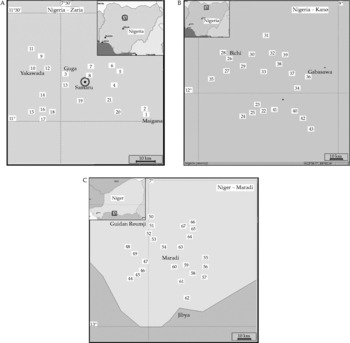
Surveys were conducted within a radius of 30–50 km of the three sites. Within each locality, survey sites were further classified as (i) grazing lands (adjacent to cropped areas), (ii) cultivated land or (iii) forest plantation. Survey sites were necessarily chosen non-systematically in locations that were in proximity to cowpea fields. Geographical co-ordinates were recorded using a Magellan SporTrak GPS unit (MiTAC International Corporation, Fremont, CA, USA). Survey sites are shown in Fig. 1 (A–C).
A, sites surveyed in the Samaru-Zaria region of Nigeria. A total of 21 sites were surveyed with two quadrants taken at each site. The numbers given beside each point (1–21) correspond to the number of the site given in Table 1(A). B, sites surveyed in the Kano region of Nigeria. A total of 22 sites were surveyed with two quadrants taken at each site. The numbers given beside each point (22–43) correspond to the number of the site given in Table 1(B). C, sites surveyed in the Maradi region of Niger. A total of 24 sites were surveyed with two quadrants taken at each site. The numbers given beside each point (44–67) correspond to the number of the site given in Table 1(C)

Quadrants
At each survey site, two 60 × 60 m2 quadrants were laid out using flags. The quadrants were then surveyed for plant species along the circumference and the diagonals. Plant species present in the quadrants were recorded. The most common species in a given quadrant was designated as predominant.
Light trap studies
To assess the occurrence of LPB during these surveys, light trap studies and scouting of cowpea fields were performed in parallel with the wild alternative host surveys. Light traps were set up at the Maradi field station in Niger (the northernmost site of the three survey regions) and at the Institute for Agricultural Research station, Samaru-Zaria, Nigeria. The light traps utilized a 500-W mercury-vapour white incandescent bulb positioned above a wire mesh cage (1.38 m width × 1.93 m height; based on original design by O. Youm at the ICRISAT Sahelian Centre, Niger), which rested on a metal support set 2.43 m above ground level. At each location, the traps were checked daily, and all LPB adults were collected and put into plastic vials containing 70% ethanol.
Results
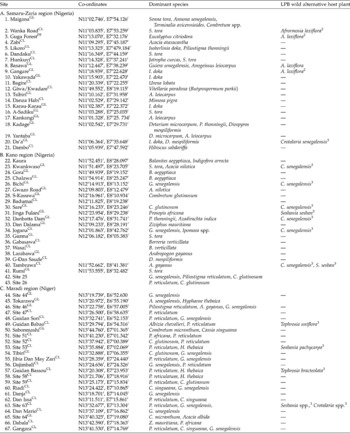
The predominant plant species found in each quadrant in the surveyed sites, their geographical location (co-ordinates) and presence or absence of wild alternative LPB hosts are presented in Table 1. The overwhelming majority of the observed plants were not known hosts of LPB.
Sites surveyed in the three geographical regions of northern Nigeria and southern Niger1

LPB, legume pod borer; GL, grazing land; PF, plantation forest; CL, cultivated land.
1 Their location, dominant species observed and occurrence of Maruca vitrata wild hosts.
2 Stumps of trees with young shoots (could not serve as host).
3 Plant belonging to the genus suspected to serve as wild alternative host, but no LPB larvae were found in the flowers.
At four locations in the Northern Guinea Savannah (Zaria), we observed the wild alternative host Afrormosia laxiflora Benth. (Leguminosae, Fabaceae). We did not observe any flowers on these plants because the main tree trunks had been cut and only young shoots were present. Plant species of the genera Tephrosia, Crotalaria and Sesbania, all belonging to Fabaceae (Leguminosae) and known to host LPB, were found at some of the sites, but none of the plants was infested with LPB larvae, even though LPB was present in the nearby cultivated cowpea plots (V. Margam, personal communication).
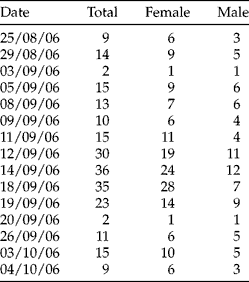
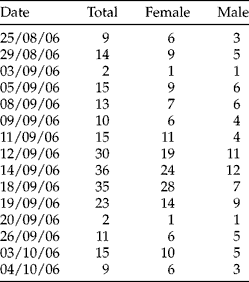
Data pertaining to light trap catches of LPB at Maradi, Niger (the northernmost region surveyed) are presented in Table 2. Similar observations at the Zaria, Nigeria site (M. Ishiyaku and V. Margam, unpublished data) during the period of this study confirmed the presence of LPB in the region.
Light trap data for adult Maruca vitrata captured during the year 2006 at Maradi field station, Niger
Discussion
Wild alternative host plants for LPB were scarce or absent at most of the sites in all the three locations surveyed. In places where alternative host plants were found, they were either distributed in small patches (mostly Sesbania spp. and Crotalaria spp. (Leguminosae)) or had been cut down (Afrormosia laxiflora) for firewood or lumber. None of the small patches where flowers were present had any LPB infestation, although the cowpea fields adjacent to these specific fields were infested with LPB larvae.
Previous surveys of wild alternative host plants of LPB suggest that there is an abundance of wild hosts in parts of West Africa (Atachi and Djihou, Reference Atachi and Djihou1994; Tamò et al., Reference Tamò, Arodokoun, Zenz, Tindo, Agboton, Adeoti, Fatokun, Tarawali, Singh, Kormawa and Tamò2002; Arodokoun et al., Reference Arodokoun, Tamò, Cloutier and Adeoti2003). Arodokoun et al. (Reference Arodokoun, Tamò, Cloutier and Adeoti2003) conducted their studies in southern and central Benin, and found several alternative hosts; three of them were considered to be hosts during the long rainy season and one of them was considered as the major host during the shorter wet season. These studies were conducted in the moist southern parts of West Africa where LPB is present throughout the year. By contrast, no studies have been conducted on wild hosts of LPB in the drier main cowpea-growing zones further north. To our knowledge, ours is the first study conducted in the heart of the cowpea-growing regions of Nigeria and Niger to document the status of wild hosts of LPB in sub-Saharan Africa.
The scattered distribution or absence of wild alternative hosts in our survey areas suggests that LPB populations would find it difficult to survive when cowpea is harvested at the end of the rainy season. This hypothesis is supported by light trap studies (Bottenberg et al., Reference Bottenberg, Tamò, Arodokoun, Jackai, Singh, Youm, Singh, Mohan-Raj, Dashiell and Jackai1997; Ba et al., Reference Ba, Margam, Binso-Dabire, Sanon, McNeil, Murdock and Pittendrigh2009), which suggest that LPB is present throughout the year on a variety of legume hosts in the moister southern regions, and migrates to the north during the rainy season, switching hosts when cowpeas are available. These studies further indicate a single LPB generation in the northern region. This evidence, combined with the fact that LPB needs a humid environment for mating (Jackai et al., Reference Jackai, Ochieng and Raulston1990), suggests that it would have difficulty in surviving in the off-season in the region. The forest and moist savannah regions in the southern part of West Africa with regions abundant in wild host plants throughout the year act as a reservoir for LPB (Tamò et al., Reference Tamò, Arodokoun, Zenz, Tindo, Agboton, Adeoti, Fatokun, Tarawali, Singh, Kormawa and Tamò2002). If this hypothesis is substantiated, then introduction of Bt-cowpea into the northern regions is not likely to lead to the selection of resistant populations of LPB. Further extensive studies are needed to gain greater understanding of the following aspects: wild host abundance, LPB survival in off-season and its migration.
Acknowledgements
We thank Dr Musa Mohammed (Ahmadu Bello University, Zaria, Nigeria) and Mr Yaou Dan Barmo (INRAN, Maradi, Niger) for their help in identifying plant species. This project was funded by the US Agency for International Development (USAID) Biotechnology Risk Assessment grant to Larry L. Murdock, Joseph E. Huesing and Barry R. Pittendrigh, and by the USAID Bean/Cowpea Collaborative Research Support Program (CRSP) grant to Larry L. Murdock, Barry R. Pittendrigh, Ibrahim Baoua and Mohammad F. Ishiyaku. This publication was also made possible by the support provided to the Dry Grain Pulses CRSP by the Bureau for Economic Growth, Agriculture and Trade, USAID, under the terms of grant no. EDH-A-00-07-00005 (Barry R. Pittendrigh, Ibrahim Baoua and Mohammad F. Ishiyaku). The opinions expressed herein are those of the authors, and do not necessarily reflect the views of the USAID or the US government.