INTRODUCTION
The Ampharetidae (Annelida: Polychaeta) are marine benthic, deposit feeding worms, which frequently burrow through the substrate or build sandy or muddy tubes in which they live, from shallow waters to the deep sea. The systematics of the family is still far from being well defined; the number of valid genera is different depending on the authority (e.g. 21 according to Jirkov (Reference Jirkov2011) or 73 and 71 according to Salazar & Hutchings (Reference Salazar-Vallejo and Hutchings2012) and Reuscher et al. (Reference Reuscher, Fiege and Wehe2009), respectively). Since papers by Hartley (Reference Hartley1985) and Holthe (Reference Holthe1986a, Reference Holtheb), knowledge of this family has had significant contributions, from Mackie & Pleijel (Reference Mackie and Pleijel1995), Jirkov (Reference Jirkov2001, Reference Jirkov2008) and Parapar et al. (Reference Parapar, Helgason, Jirkov and Moreira2011, Reference Parapar, Helgason, Jirkov and Moreira2012) for European waters, and from Hilbig (Reference Hilbig, Blake, Hilbig and Scott2000), Holthe (Reference Holthe2000), Jirkov (Reference Jirkov2008), Schüller (Reference Schüller2008), Reuscher et al. (Reference Reuscher, Fiege and Wehe2009) and Imajima et al. (Reference Imajima, Reuscher and Fiege2012, Reference Imajima, Reuscher and Fiege2013) for other oceans.
The contribution of the study of deep-sea benthic fauna to the knowledge of the taxonomy and ecology of the marine environment is currently increasing. In recent years, a number of studies have been conducted on the Atlantic coast of the Iberian Peninsula focused on deep-sea invertebrates, which are discovering new species to science and producing new reports of polychaetes (e.g. Moreira & Parapar, Reference Moreira and Parapar2007; Parapar & Moreira, Reference Parapar and Moreira2009; Lucas et al., Reference Lucas, San Martín and Parapar2012).
The Capbreton Canyon is a submarine valley located on the continental shelf and slope of the Bay of Biscay. The latter is divided in two zones, the northern Aquitanian continental shelf and the southern Cantabrian shelf. From 1987 to 1990, four oceanographic cruises were conducted on board the RV ‘Côte d'Aquitaine’ as part of the Franco–Spanish Capbreton research project led by Dr J.C. Sorbe from the Laboratoire d'Océanographie Biologique (LOB) of the Centre National de la Recherche Scientifique (CNRS). During these cruises, samples of benthic macrofauna were taken at 37 stations situated along the continental slope from 480 to 1113 m depth, on both sides of the Capbreton Canyon.
Some of the results obtained from the study of the polychaetes collected by the Capbreton programme have already been published in Rallo et al. (Reference Rallo, García-Arberas and Isasi1993), San Martín et al. (Reference San Martín, Ceberio and Aguirrezabalaga1996), Aguirrezabalaga et al. (Reference Aguirrezabalaga, San Martín, Petersen and Ceberio1999, Reference Aguirrezabalaga, Ceberio and Fiege2001, Reference Aguirrezabalaga, Ceberio and Paxton2002), Núñez et al. (Reference Nuñez, Aguirrezabalaga and Ceberio2000), Aguirrezabalaga & Carrera-Parra (Reference Aguirrezabalaga and Carrera-Parra2006), Aguirrezabalaga & Ceberio (Reference Aguirrezabalaga and Ceberio2003, Reference Aguirrezabalaga and Ceberio2005a, Reference Aguirrezabalaga and Ceberiob, Reference Aguirrezabalaga and Ceberio2006) and Aguirrezabalaga & Gil (Reference Aguirrezabalaga and Gil2009). Rallo et al. (Reference Rallo, García-Arberas and Isasi1993) reported five species of Ampharetidae from depths between 100 and 450 m: Melinna palmata Grube, Reference Grube1870, Amphicteis gunneri (Sars, Reference Sars1835), Ampharete sp., Anobothrus gracilis (Malmgren, Reference Malmgren1866) (as Ampharete) and Auchenoplax crinita Ehlers, Reference Ehlers1887.
This paper includes ten ampharetid species belonging to six genera, of which one is a new species to the genus Glyphanostomun Levinsen, Reference Levinsen1884.
MATERIALS AND METHODS
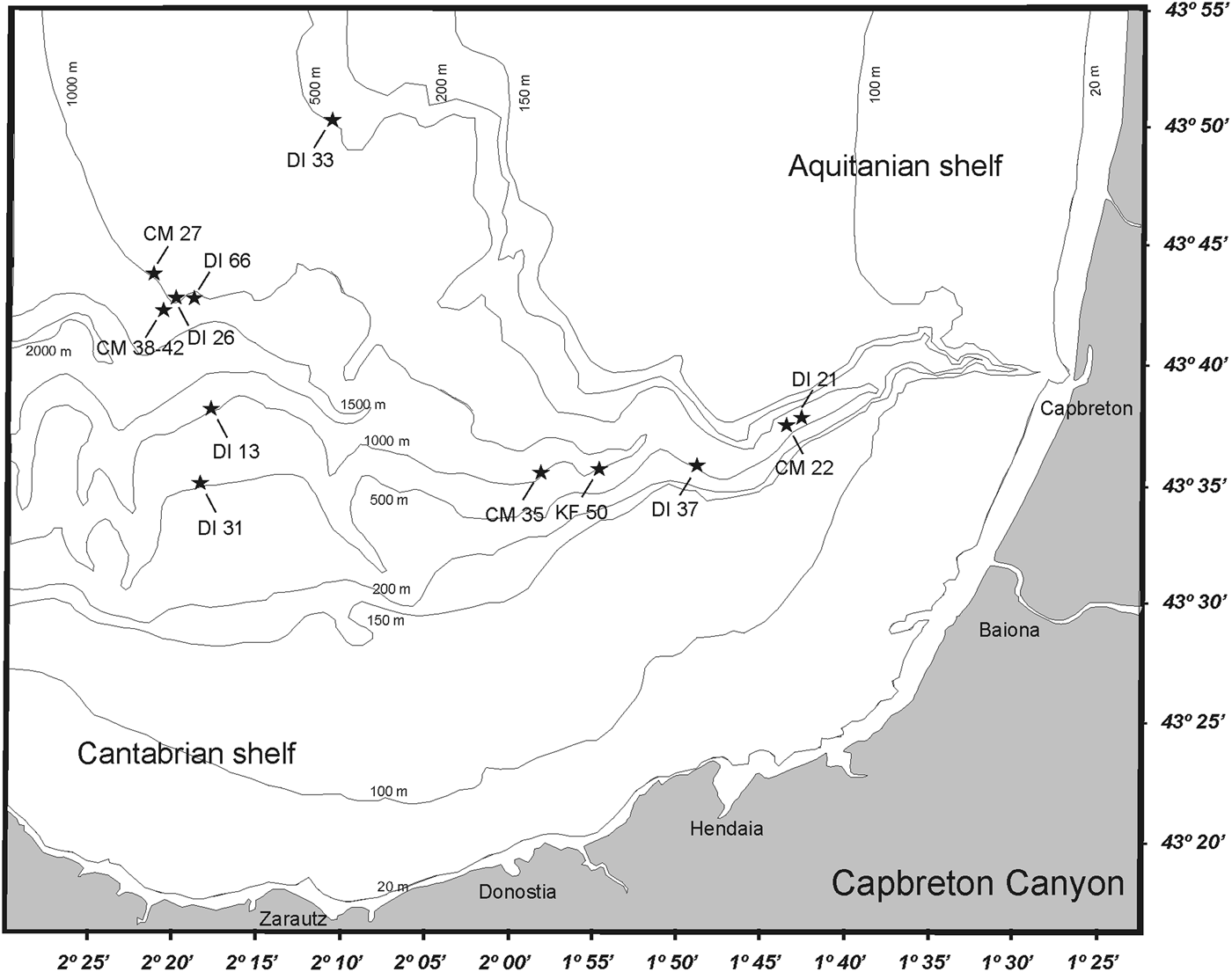
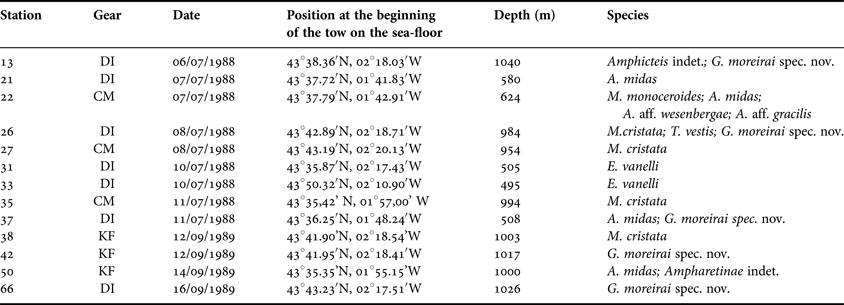
The specimens, belonging to the family Ampharetidae Malmgren, Reference Malmgren1866, were collected in the Capbreton Canyon at 13 stations, mostly located in the Cantabrian shelf, covering a depth range from 495 to 1113 m (Figure 1 and Table 1). Three different types of gear were used: a Sanders–Hessler epibenthic dredge (DI), a Flusha box-corer (KF) and a Marinovitch trawl (CM). Samples obtained with DI and KF were sieved through a 0.5 mm mesh size; samples from CM were not sieved.
Capbreton Canyon (Bay of Biscay) showing sampling stations where species of Ampharetidae were found.

Main characteristics of the sampling stations in the Capbreton Canyon, with ampharetid specimens. Date format is day, month, year. Abbreviations: DI, Sanders-Hessler dredge; CM, Marinovitch trawl; KF, Flusha box-corer.
Specimens were fixed in 10% formalin buffered with borax, and preserved in 70% ethanol. Material examined, including the type series of the new species, was deposited in the collections of the Museo Nacional de Ciencias Naturales, Madrid (MNCN); Sociedad Cultural de Investigación Submarina, Donostia (INSUB) and personal collection of J. Parapar, Departamento de Bioloxía Animal, Universidade da Coruña (UDC).
Specimens of all species were stained with methyl green (MG) and staining pattern of each species were documented following the methodology proposed by Schüller & Hutchings (Reference Schüller and Hutchings2010).
Illustrations were made using a camera lucida attached to a light microscope. Specimens used for examination with a scanning electron microscopy (SEM) were prepared by critical point drying, covered with gold in a BAL-TEC SCD-004 evaporator, and examined and photographed under a JEOL JSM-6400 scanning electron microscope at the Servicios de Apoio á Investigación (SAI), University of A Coruña-UDC, Spain.
For comparison purposes, type material of Amphicteis wesenbergae Parapar et al., Reference Parapar, Helgason, Jirkov and Moreira2011 and other specimens from selected species were studied by authors during several research stays in the Sandgerdi Marine Centre, Iceland (IMNH) and the Zoological Museum, University of Copenhagen, Denmark (ZMUC). Species descriptions and terminology follow Hartley (Reference Hartley1985), Holthe (Reference Holthe1986a, Reference Holtheb), Jirkov (Reference Jirkov2008), Reuscher et al. (Reference Reuscher, Fiege and Wehe2009), Parapar et al. (Reference Parapar, Helgason, Jirkov and Moreira2011, Reference Parapar, Helgason, Jirkov and Moreira2012) and Imajima et al. (Reference Imajima, Reuscher and Fiege2013).
The term ‘intermediate uncinigers’ proposed by Imajima et al. (Reference Imajima, Reuscher and Fiege2012) was used for those segments without notopodia and notochaetae but with neuropodia formed as ‘tori’ (thoracic neuropodia) and not as ‘pinnules’ (abdominal neuropodia). Accordingly, these segments are included in the following descriptions as an ‘intermediate region’ between thorax and abdomen. Consequently, the abdomen may have a lower number of segments compared to traditional descriptions, because only those segments that bear neuropodial pinnules are considered abdominal. Schematic drawings of branchiae arrangement proposed by Reuscher et al. (Reference Reuscher, Fiege and Wehe2009) are included for several species of Ampharetinae, and nomenclatural recommendations on some body structures (e.g. prostomium, uncinigers, uncini) proposed by Jirkov (Reference Jirkov2008, Reference Jirkov2011) and Imajima et al. (Reference Imajima, Reuscher and Fiege2012, Reference Imajima, Reuscher and Fiege2013) are used in species descriptions.
Abbreviations: CH for chaetiger, TU for thoracic unciniger and SG for segment.
RESULTS AND DISCUSSION
Species richness and abundance
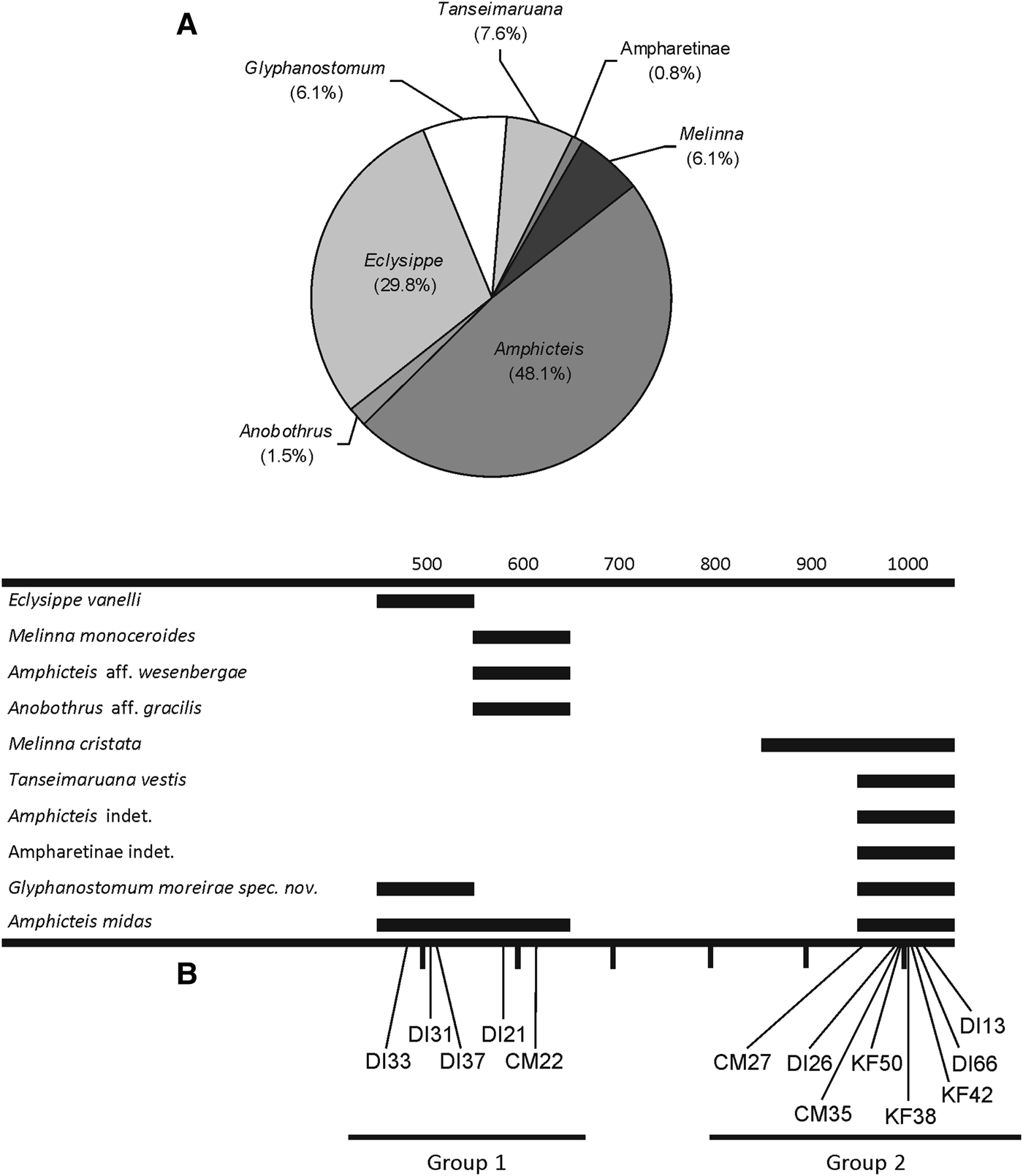
A total of 131 ampharetid specimens of polychaetes belonging to six genera and ten species were collected. Most specimens belong to the genera Amphicteis Grube, Reference Grube1850 (3 spp.; 63 specimens; 48.1% total abundance) and Eclysippe Eliason, Reference Eliason1955 (1 sp.; 39 specimens; 29.8%), while Tanseimaruana Imajima, Reuscher & Fiege, Reference Imajima, Reuscher and Fiege2013 (1 sp.; 10 specimens; 7.6%), Glyphanostomum Levinsen, Reference Levinsen1884 (1 sp.; 8 specimens; 6.1%), Melinna Malmgren, Reference Malmgren1866 (2 spp.; 8 specimens; 6.1%), Ampharetinae (1 sp., 1 specimen; 0.8%) and Anobothrus Levinsen, Reference Levinsen1884 (2 spp.; 2 specimens; 1.5%) are of minor quantitative relevance (Figure 2A; Table 1). No specimens of Ampharete were found. These results are in accordance with those found by Rallo et al. (Reference Rallo, García-Arberas and Isasi1993) in the same area, but at shallower depths (100–450 m). These authors also report Amphicteis gunneri and Anobothrus gracilis (as Ampharete) (both species were probably present in our study, but their identification is not fully confirmed yet), an unidentified Ampharete species, and two species not found in our cruises: Melinna palmata and Auchenoplax crinita. Melinna palmata is a common shallow-water species in the Iberian Peninsula (Ariño, Reference Ariño1987; Parapar et al., Reference Parapar, Besteiro and Urgorri1996) and A. crinita was also reported by Parapar & Moreira (Reference Parapar and Moreira2009) at similar shelf depths (200–400 m) from the Galician littoral (north-west Atlantic coast of Spain).
(A) Relative abundance of each ampharetid genus in the Capbreton Canyon; (B) depth distribution ranges of each ampharetid species and position related to depth of each sample (bottom).
According to depth, samples could be sorted in two groups (Figure 2B):
• Group 1, upper slope stations (495–624 m depth): DI21, DI31, DI33, DI37 and CM22.
• Group 2, deep slope stations (954–1040 m depth): DI13, DI26, DI66, CM27, CM35, KF38, KF42 and KF50.
Ampharetidae species appear to cluster in these two bathymetric groups, with M. monoceroides, A. aff. wesenbergae, E. vanelli and A. aff. gracilis being characteristic for Group 1, and M. cristata, Amphicteis indet., Ampharetinae indet. and T. vestis being characteristic for Group 2. Amphicteis midas and G. moreirai sp. nov. appear to be present throughout the entire slope.
SYSTEMATICS
Family AMPHARETIDAE Malmgren, Reference Malmgren1866
Subfamily MELINNINAE Malmgren, Reference Malmgren1866
We follow Salazar-Vallejo & Hutchings (Reference Salazar-Vallejo and Hutchings2012) who propose Malmgren (Reference Malmgren1866) instead of Chamberlin (Reference Chamberlin1919) as the author of this subfamily.
Genus Melinna Malmgren, Reference Malmgren1866
Melinna cristata (Sars, Reference Sars1851)
(Figure 3)
Sabellides cristata Sars Reference Sars1851: 205–206, pl. 2, figs 1–7.
Melinna cristata: Fauvel, Reference Fauvel1927: 237–239, fig. 83 i–n; Holthe, Reference Holthe1986a: 81–83, fig. 34, map 33; Mackie & Pleijel, Reference Mackie and Pleijel1995: 104–111, fig. 1–3, tab. 1; Hartmann-Schröder, 1996: 503.
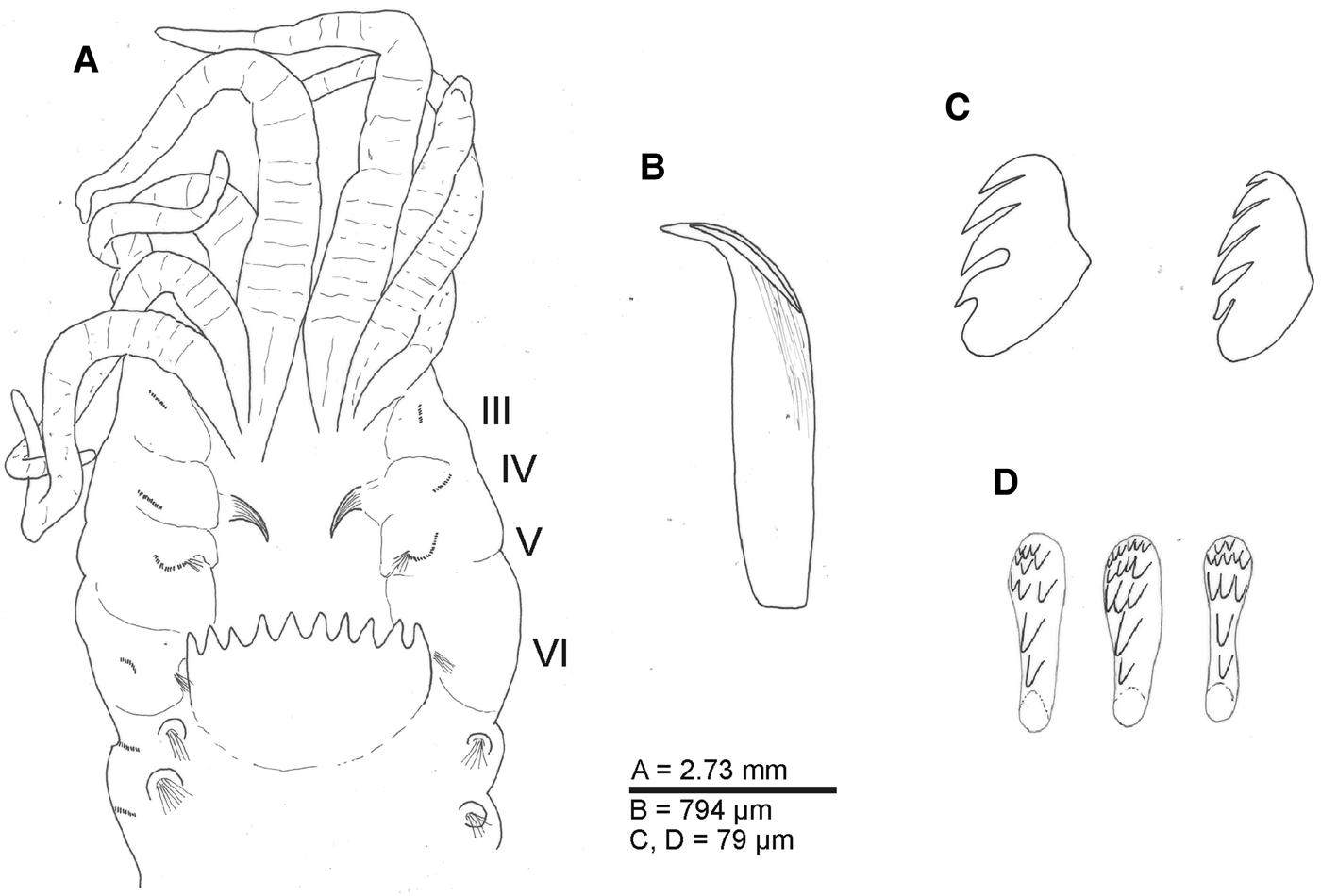
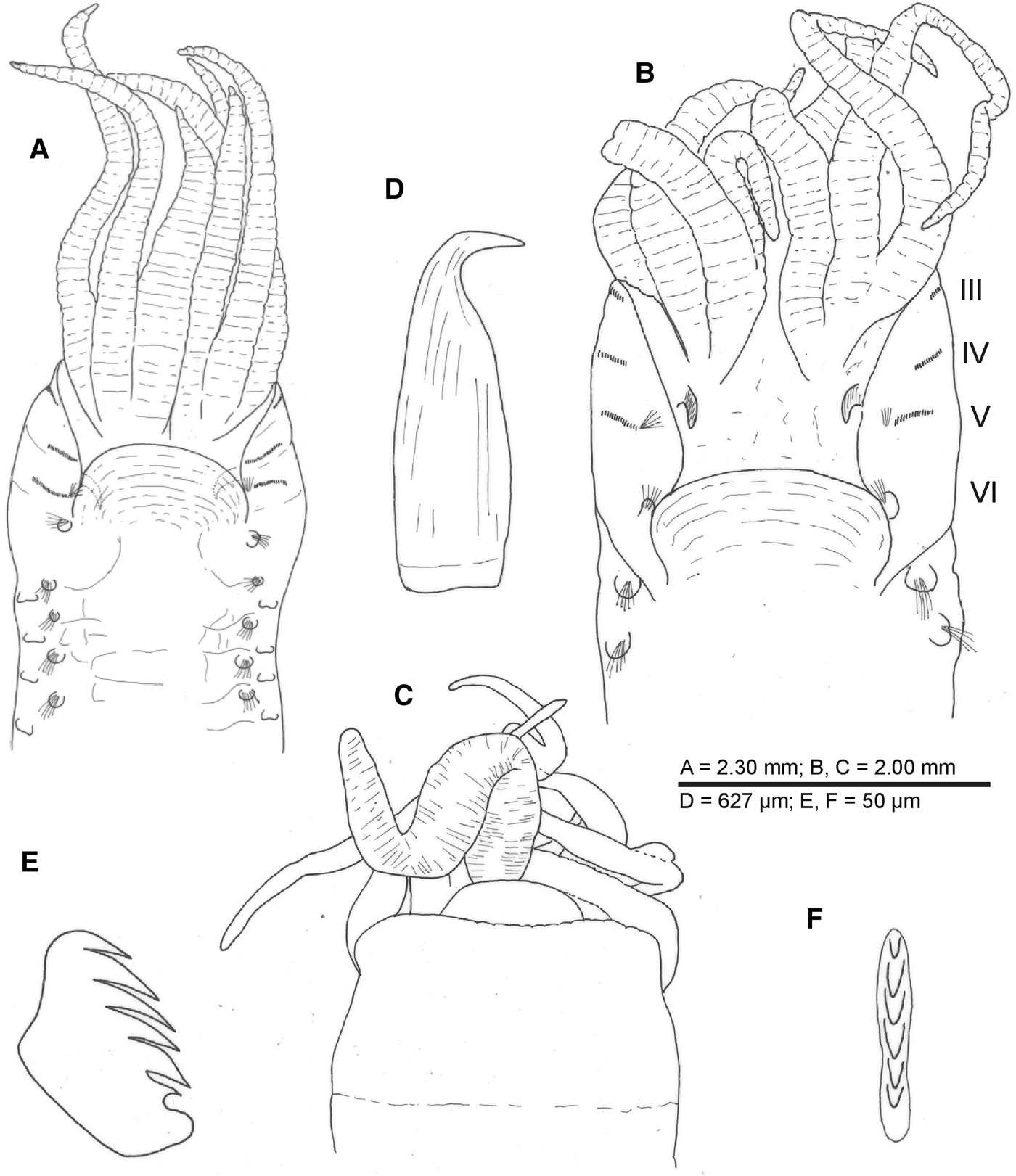
Melinna cristata: (A) anterior end, dorsal view; (B) postbranchial hook; (C) thoracic uncini, lateral view; (D) abdominal uncini, frontal view. Segments indicated by Roman numerals.
MATERIAL EXAMINED
MNCN 16.01/15230 (DI26, 1 specimen); POL425 (KF38, 1); POL426 (CM27, 1) and MNCN 16.01/15231 (CM35, 3).
OCCURRENCE
Capbreton Canyon (Bay of Biscay), 954–1113 m depth.
DESCRIPTION
Largest specimen incomplete, 33.5 mm long (without branchiae), 2.75 mm wide for 46 chaetigers. Body long, maximum width in postbranchial region, tapering posteriorly. Eighteen thoracic chaetigers and 40 abdominal chaetigers in one complete specimen. Prostomium wider than long, U-shaped, without eyes or glandular ridges. SGI and SGII achaetous, dorsally covered by branchiae, ventrally forming lower margin of mouth. SGIII–V with characteristic longitudinal dorsolateral ridges. Ventral anterior margin of SGIII crenulated. Two groups of four branchiae in dorsal region of SGIII (CH1) (Figure 3A). Three dorsalmost branchiae of each group basally connected by a membrane and forming an oblique row; fourth branchiae located in front of the middle one of the three. A pair of big postbranchial hooks situated on dorsum of SGIV (CH2); hooks with narrow base and gently curved tip, having internal canal (Figure 3B). Dorsum of SGVI (CH4) covered by membranous fold forming anteriorly open pocket. Anterior margin of fold serrated, with 10–12 triangular, sharp points (Figure 3A). SGIII–VI with fine acicular neurochaetae. Starting in SGVII (CH5), fourteen thoracic uncinigers with neuropodia provided with uncini arranged in a single vertical row; last two uncinigers with neuropodia of abdominal type (pinnules). Thoracic uncini with a single vertical row of 3–4 teeth above rostral tooth (Figure 3C). From SGV (CH3), 16 thoracic segments with notopodial limbate capillary chaetae; those of CH3 very small. No intermediate segments. Abdomen with uncinigers provided with pinnules; rudimentary notopodia absent. Abdominal uncini with one tooth and two horizontal rows of 3 and 5 teeth each above rostral tooth, in frontal view (Figure 3D). Pygidium without anal cirri.
MG STAINING PATTERN
Anterior dorsal region from prostomium to CH6 heavily stained. Branchiae gently stained. Membranous fold not stained, except in basal part (dorsum of CH5 and CH6). From CH7 to CH16 only lateral parts of segments (parapodia) stained. From CH17 to end of the body dorsal part not stained. Ventral region from anterior end to CH16 heavily stained; CH17 gently stained, CH18 and whole abdominal region not stained.
REMARKS
The study of our specimens corroborates the observation of Jirkov (Reference Jirkov2011) that in the genus Melinna the last two thoracic uncinigers have neuropodia of abdominal type (pinnules instead of tori). These two chaetigers may be also some kind of ‘intermediate segments’ (see above in Materials and Methods), but not strictly in the sense of Imajima et al. (Reference Imajima, Reuscher and Fiege2012).
DISTRIBUTION
Portugal, Bay of Biscay, English Channel, south-west of British Isles (Holthe, Reference Holthe1986a).
Melinna monoceroides Fauvel, Reference Fauvel1936
(Figure 4)
Melinna monoceroides: Fauvel, Reference Fauvel1936: 93–95, fig. 12; Day, Reference Day1967: 687, fig. 35.1.a–b.
Melinna monoceroides: (A,B) anterior end, dorsal view; (C) anterior end, ventral view; (D) postbranchial hook; (E) thoracic uncinus, lateral view; (F) abdominal uncinus, frontal view. Segments indicated by Roman numerals.
MATERIAL EXAMINED
MNCN 16.01/15232 (CM22, 2 specimens).
OCCURRENCE
Capbreton Canyon (Bay of Biscay), 624–652 m depth.
DESCRIPTION
Both specimens incomplete. Largest specimen 35.75 mm long (without branchiae), 2.1 mm wide for 48 chaetigers. Body long, maximum width in postbranchial region, tapering posteriorly. Eighteen thoracic chaetigers. Prostomium U-shaped, without eyes or glandular ridges. SGI and SGII achaetous, dorsally covered by branchiae and ventrally forming a lower margin of mouth. SGIII-V with characteristic longitudinal, dorsolateral ridges (Figure 4A, B). Two groups of four branchiae in dorsal region of SGIII (CH1). Three dorsalmost branchiae of each group basally connected by a membrane. Fourth branchiae in front of the middle one of the three. A single greatly enlarged tentacle arising from upper lip (Figure 4C). A pair of big postbranchial hooks situated on dorsum of SGIV (CH2). Hooks with broad base, abruptly tapering, tip bent at right angle, lacking internal canal (Figure 4D). Dorsum of SGVI (CH4) covered by membranous fold forming anteriorly open pocket. Anterior margin smooth, complete, rounded (Figure 4A, B). SGIII–V with fine acicular neurochaetae. SGVI without neurochaetae. Starting in SGVII (CH5), 14 thoracic uncinigers with uncini arranged in a single row; last two uncinigers with neuropodia of abdominal type (pinnules). Uncini with one single row of five teeth above the rostral tooth (Figure 4E). From SGV (CH3), 16 thoracic segments with notopodial limbate capillary chaetae; those of CH3 very small. No intermediate segments. Abdomen with uncinigers provided with pinnules; rudimentary notopodia absent. Abdominal uncini similar in shape and arrangement to those of thorax (Figure 4F). Pygidium not seen.
MG STAINING PATTERN
Staining pattern similar to that of M. cristata. Anterior dorsal region heavily stained. Latero-ventral part of CH3 and CH4 white, slightly stained. Branchiae not stained. Membranous fold not stained. From CH5 to CH16, only lateral parts of segments stained. From CH17 to end of body dorsal part not stained. Ventral part of the body heavily stained from anterior end to CH16; CH17 gently stained, CH18 and whole abdominal region not stained.
REMARKS
Our specimens agree well with the detailed description provided by Fauvel (Reference Fauvel1936) who also discusses the affinities and differences of this species with similar species such as Melinna palmata Grube, Reference Grube1870 and Melinnopsis arctica (Annenkova, Reference Annenkova1931), both East Atlantic species, and Melinnopsis monocera (Augener, Reference Augener1906) from the Antilles. Day (Reference Day1967) reproduced a shortened translation into English from the original French description of Fauvel (Reference Fauvel1936).
DISTRIBUTION
The species has been recorded only in the Mediterranean Sea—Morocco, at 224 m depth (Fauvel, Reference Fauvel1936); Adriatic Sea (Katzmann, Reference Katzmann1983, as M. cf. monoceroides, at 60 m depth), Aegean Sea (Arvanitidis, Reference Arvanitidis2000), Italy (Castelli et al., Reference Castelli, Bianchi, Cantone, Çinar, Gambi, Giangrande, Iraci Sareri, Lanera, Licciano, Musco, Sanfilippo and Simonini2008) and Egypt (Abd-Elnaby, Reference Abd-Elnaby2009)—and the Atlantic (Day, Reference Day1967) in shallow waters (1–99 m depth). This is the northernmost record of the species.
Subfamily Ampharetinae Malmgren, Reference Malmgren1866
Genus amphicteis Grube, Reference Grube1850
Amphicteis indet.
MATERIAL EXAMINED
MNCN 16.01/15236 (DI13, 1 specimen).
OCCURRENCE
Capbreton Canyon (Bay of Biscay), 1040 m depth.
DESCRIPTION
One small and incomplete specimen 4.0 mm long, 0.5 mm wide. Prostomium U-shaped, with two longitudinal ridges on middle lobe and a pair of transversal nuchal slits (Amphicteis-type). Buccal tentacles not seen. Four pairs of very long and thin branchiae arranged in two well separated groups. Tip of longest branchia reaching thoracic CH14. Long and thin paleae, evenly tapered in a fine tip; around 15 per fascicle. Posterior to paleae, 17 thoracic chaetigerous segments with notopodia with limbate capillary notochaetae and last 14 with uncinigerous tori. Only two abdominal uncinigers with pinnules. No intermediate uncinigers.
REMARKS
Although the specimen is very small and incomplete, following Jirkov (Reference Jirkov2011) and Parapar et al. (Reference Parapar, Helgason, Jirkov and Moreira2011) the combination of absence of intermediate uncinigers (genus character), and presence of evenly tapered paleae, point to a group of three species: A. gunneri (Sars, Reference Sars1835), A. sundevalli Malmgren, Reference Malmgren1866 and A. wesenbergae Parapar, Helgason, Jirkov & Moreira, Reference Parapar, Helgason, Jirkov and Moreira2011 (see key to Arctic and Boreal species of Amphicteis in Parapar et al., Reference Parapar, Helgason, Jirkov and Moreira2011). Amphicteis sundevalli is a high Arctic species and A. wesenbergae has long dorsal cirrus in the abdominal neuropodia. These facts clearly point to A. gunneri, a species already reported in the area (see below). Parapar et al. (Reference Parapar, Helgason, Jirkov and Moreira2011) give a detailed SEM study of different characters of the species from Icelandic material, providing relevant information on some other diagnostic characters of the genus Amphicteis, namely the clavate papilla present in thoracic notopodia, the shape of the prostomium, thoracic and abdominal uncini and nephridial pori.
DISTRIBUTION
Rallo et al. (Reference Rallo, García-Arberas and Isasi1993) report A. gunneri in the Capbreton Canyon. Due to actual problems in the delineation of A. gunneri, Parapar et al. (Reference Parapar, Helgason, Jirkov and Moreira2011) propose a restricted distribution for this taxon from Arctic and North Atlantic European waters with a southern boundary probably located in the English Channel.
Amphicteis midas (Gosse, Reference Gosse1855)
(Figure 5)
Crassostoma midas Gosse, Reference Gosse1855: 310–313, figs 7–12, pl. 8.
Amphicteis midas Hartley, Reference Hartley1985: 309–311, figs 1–2, tab. 1; Holthe, Reference Holthe1986a (in part): 56–57, fig. 21, map 20; Hartmann-Schröder, 1996: 495–496, fig. 241.
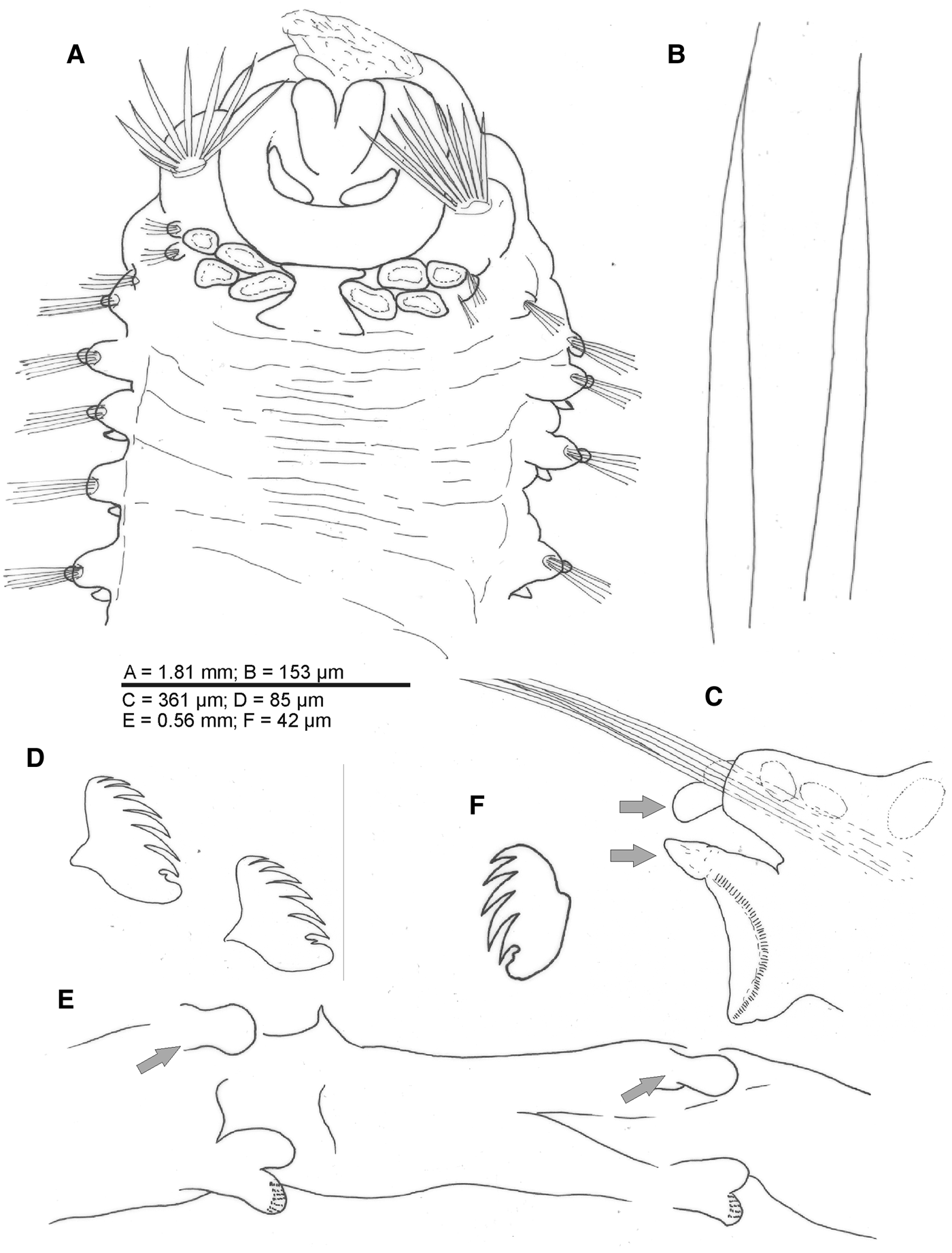
Amphicteis midas: (A) anterior end, dorsal view; (B) two paleae; (C) thoracic chaetiger; showing rounded ventral cirrus on notopodia and triangular dorsal cirrus on neuropodia (arrows); (D) thoracic uncini, lateral view; (E) abdominal chaetigers, lateral view showing papilla-shaped rudimentary notopodia (arrow); (F) abdominal uncinus, lateral view.
MATERIAL EXAMINED
MNCN 16.01/15233 (DI21, 22 specimens); POL427 (DI37, 2); POL428 (CM22, 36) and MNCN 16.01/15234 (KF50, 1).
OCCURRENCE
Capbreton Canyon (Bay of Biscay), 508–1000 m depth.
DESCRIPTION
Complete specimen 27.5 mm long, 3 mm wide. Body long, wider anteriorly, and tapering posteriorly towards pygidium. Prostomium Amphicteis-type (Figure 5A). Paleae and 17 thoracic chaetigers with notopodial limbate capillary chaetae; last 14 with uncinigerous tori. SGI and SGII fused, produced into lower ventral lip. Four pairs of branchiae arranged in two well-separated groups; the four branchiae of each group arranged in two rows of two pairs (one pair beside first thoracic notopodium, and the other one beside second thoracic notopodium). Tip of longest branchia reaching thoracic CH8. SGII with long paleae, abruptly tapering in a fine tip; 7–10 per fascicle (Figure 5A, B). Posterior to paleae, 17 thoracic chaetigerous segments with notopodia provided with limbate capillary notochaetae. Thoracic notopodia with ventral rounded cirrus (Figure 5C). Fourteen thoracic neuropodia with a triangular cirrus in dorsal part of neuropodium (Figure 5C). Thoracic uncini in a single vertical row, each one with 5–6 teeth above rostral tooth (Figure 5D). No intermediate uncinigers. Fifteen abdominal uncinigers with papilla-shaped rudimentary notopodia (Figure 5E). Neuropodial pinnules provided with rounded dorsal cirrus and a single row of uncini (Figure 5E). Abdominal uncini similar to those of thorax (Figure 5F). Pygidium with a pair of long, slender, filiform anal cirri.
MG STAINING PATTERN
Anterior region heavily stained. Interbranchial area heavily stained as well as two small areas each one situated behind basal part of each inner branchia of second row. Branchiae not stained. Notopodia of thoracic region heavily stained. Rest of thoracic dorsal region less stained but with a characteristic pattern of very fine transversal segmental rows; this pattern extending dorsally to pygidium. Rudimentary notopodia of abdominal region heavily stained. Thoracic ventral region from anterior end to CH7 heavily and uniformly stained. From CH8 glandular ridge heavily stained, fading in following segments. In CH15 glandular ridge gently stained and from CH16 almost not stained. Edges of thoracic neuropodia markedly stained. In abdominal region, only mid-ventral groove and areas next to neuropodia stained, in a similar pattern to that of dorsal region. Anal cirri slightly stained at their base.
REMARKS
Our specimens agree well with main characters provided by Hartley (Reference Hartley1985) in the redescription of A. midas: 5–10 paleae abruptly tapering and large area between branchial groups.
DISTRIBUTION
Hartley (Reference Hartley1985) characterizes A. midas as a shallow water (0–27 m) species in the British Isles and suggests that it is present in the west coast of Sweden and the Mediterranean Sea. Our findings confirm the presence of this species in the deep continental slope of the Bay of Biscay.
Amphicteis aff. wesenbergae Parapar, Jirkov, Helgason & Moreira, Reference Parapar, Helgason, Jirkov and Moreira2011
(Figure 6)
Amphicteis wesenbergae Parapar et al., Reference Parapar, Helgason, Jirkov and Moreira2011: 1493–1494, figs 9–10.
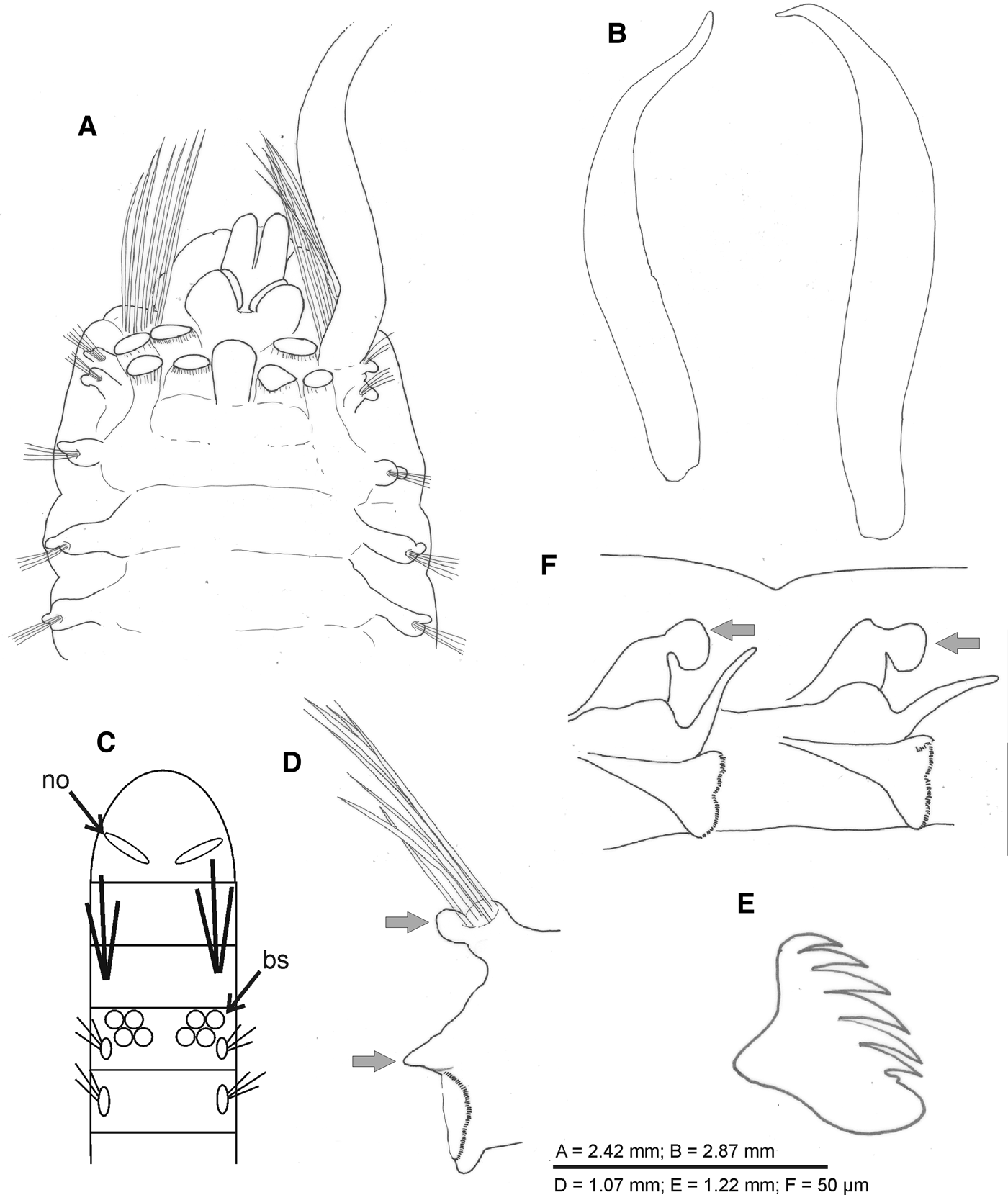
Amphicteis aff. wesenbergae: (A) anterior end, dorsal view; (B) two branchiae; (C) schematic drawing showing arrangement of branchiae and chaetae in first thoracic segments; (D) thoracic chaetiger showing rounded ventral cirrus on notopodia and triangular dorsal cirrus on neuropodia (arrows); (E) thoracic uncinus, lateral view; (F) two abdominal uncinigers; showing papilla-shaped rudimentary notopodia (arrows). Abbreviations: bs = branchial scars; no = nuchal organs.
MATERIAL EXAMINED
MNCN 16.01/15235 (CM22, 1 specimen).
ADDITIONAL COMPARATIVE MATERIAL
Type material of Amphicteis wesenbergae. Holotype. Zoologisk Museum: ZMUC-POL-1871. ‘Ingolf’ Expedition Station 117 at east Norwegian Sea (69°13′N 08°23′W), 1889 m depth.
Icelandic Museum of Natural History. IMNH 24087 (BIOICE Station 2776, 15 paratypes).
OCCURRENCE
Capbreton Canyon (Bay of Biscay), 624–652 m depth.
DESCRIPTION
One incomplete specimen, 27 mm long, 2.9 mm wide for 31 chaetigers. Body long, wide anteriorly, tapering posteriorly. Paleae and 17 thoracic chaetigers with notopodial limbate capillary chaetae; 14 thoracic uncinigers. Prostomium Amphicteis-type (Figure 6A). Four pairs of branchiae arranged in two well separated groups. Four branchiae of each group arranged in two rows of two pairs, posteriormost pair slightly shifted dorsally (Figure 6A). Branchiae long, curled, flattened; progressively increasing width from base to middle part and then decreasing rapidly to its distal end in a fine tip (Figure 6B). SGI and SGII fused, produced into lower ventral lip. SGII provided with long and slender paleae, progressively tapering to fine tip; 9–10 per fascicle (Figure 6A, C). First notopodia reduced, gradually increasing in size to CH5. Thoracic notopodia cylindrical with small, rounded ventral cirrus (Figure 6D). Fourteen thoracic uncinigers with triangular dorsal cirrus on torus (Figure 6D). Thoracic uncini with a single vertical row of 5–6 teeth above rostral tooth (Figure 6E). No intermediate segments. At least 14 abdominal uncinigers with rudimentary papilla-shaped notopodia (Figure 6F). Abdominal pinnules with long and cirriform dorsal cirrus (Figure 6F). Abdominal uncini similar in shape to those of thoracic region. Pygidium not seen.
MG STAINING PATTERN
Anterior body region and interbranchial area heavily stained. Basal part of branchiae not stained. Notopodia of thoracic region heavily stained. Rest of thoracic region more gently stained in its dorsal part but with very fine transversal segmental rows arranged in a characteristic pattern, extending dorsally to end of body. Ventral region of thorax to CH10 heavily and uniformly stained being the glandular area progressively less stained from CH11 to CH16 in which staining almost disappearing. Edges of thoracic neuropodia markedly stained. In abdominal region, only mid-ventral groove and areas next to neuropodia stained, in similar pattern to dorsal region.
REMARKS
Even though the specimen is incomplete and poorly preserved, it is still possible to recognize the two main characteristics proposed by Parapar et al. (Reference Parapar, Helgason, Jirkov and Moreira2011) for A. wesenbergae: slender, progressively tapered paleae and abdominal uncinigers provided with a long and cirriform dorsal cirrus. However, the flattened branchiae present in this specimen are different from those described by Parapar et al. (Reference Parapar, Helgason, Jirkov and Moreira2011) as ‘long and tapering’ for this species. Species identification is tentative until more specimens are found in the area.
DISTRIBUTION
South-western deep slope of Iceland (Parapar et al., Reference Parapar, Helgason, Jirkov and Moreira2011). This is the first report of the species after the original description.
Genus anobothrus Levinsen, Reference Levinsen1884
Anobothrus aff. gracilis (Malmgren, Reference Malmgren1866)
(Figure 7)
Ampharete gracilis Malmgren, Reference Malmgren1866: 365, pl. 26, fig. 75.
Anobothrus gracilis: Fauvel, Reference Fauvel1927: 229–230, fig. 80 l–p; Holthe, Reference Holthe1986a: 50–51, fig. 18, map 17; Hartmann-Schröder, 1996: 497–498, fig. 242; Jirkov, Reference Jirkov2001: 475–476 with textfig.; Jirkov, Reference Jirkov2008: 122–124, figs 7, 8.
Anobothrus aff. gracilis: (A) anterior end in dorsal view; (B) branchial cirrophores; (C) first three thoracic chaetigers; (D) first reduced chaetiger; (E) detail of first thoracic chaetae; (F) last three thoracic notopodia. Arrow showing dorsal transverse ridge at thoracic CH11.
MATERIAL EXAMINED
MNCN 16.01/15237 (CM22, 1 specimen); JP personal collection (CM22, 1 in SEM stub).
OCCURRENCE
Capbreton Canyon (Bay of Biscay), 624–652 m depth.
DESCRIPTION
Two specimens; both without abdominal region. Longer one with oocytes in body cavity, broken at first abdominal segment; smaller one broken at thoracic CH13.
Prostomium U-shaped, with middle lobe delimited by incision, without glandular ridges (Ampharete-type); buccal tentacles and eyespots not seen. Paleae much longer than most developed notochaetae, gradually tapering towards distal end and ~14 in number. Four pairs of deciduous branchiae, only basal part (branchiophores) remaining. First three branchiophores of each side forming a straight transversal line (no gap between innermost branchiophores of each group) and defining a high fold; fourth situated behind and between two innermost branchiophores of each side (Figure 7A, B). Fifteen thoracic chaetigers provided with notopodia with capillary chaetae; first notopodia very small (Figure 7C–E), located laterally of outermost branchiophore of each side. Twelve thoracic uncinigers. A transversal pigmented band is present anterior to the third thoracic unciniger. Eleventh thoracic notopodia slightly elevated, but not transformed, connected by a low dermal transversal ridge (Figure 7F). Thoracic uncini with two vertical rows of six teeth above rostral tooth. Only first abdominal unciniger is observed in the more complete specimen, which is of thoracic type. Pygidium not seen.
MG STAINING PATTERN
Anterior body region heavily stained. Basal part of branchiae (branchiophores) not stained. Dorsal part of thoracic region (including transversal ridge) slightly stained; ventral thoracic region heavily and uniformly stained to CH9, then in a striped pattern.
The stain allows seeing the connection between the fourth branchiophore and the second thoracic notopodium, as previously described by Jirkov (Reference Jirkov2008).
REMARKS
Jirkov (Reference Jirkov2011) states that the genus Anobothrus, as other genera in Ampharetidae, has first two abdominal neuropodia of thoracic type (tori instead of pinnules), representing the ‘intermediate uncinigers’ of Imajima et al. (Reference Imajima, Reuscher and Fiege2012).
Following the key to species of Anobothrus provided by Jirkov (Reference Jirkov2008), the lack in our specimens of most part of abdominal segments makes that they can be identified both as A. gracilis (13 abdominal segments), as well as Anobothrus mironovi Jirkov, Reference Jirkov2008 and Anobothrus glandularis (Hartmann-Schröder, Reference Hartman1965) (both with 12). The geographic distribution of A. glandularis (south-east Pacific and Antarctica) and A. mironovi (North and south-east Pacific) (see Jirkov, Reference Jirkov2008) makes very unlikely to correspond to such species, being more likely to be A. gracilis which is a species previously reported in waters near Capbreton (see below). The lack of a complete abdomen makes species identification tentative until more specimens are found in the area.
DISTRIBUTION
Anobothrus gracilis is a widely distributed species in Arctic and North Pacific waters at shelf and slope depths (Jirkov, Reference Jirkov2008). Rallo et al. (Reference Rallo, García-Arberas and Isasi1993) report A. gracilis from the Capbreton Canyon which represented the first finding of the species in the Iberian Peninsula and the southernmost record of the species in the Atlantic Ocean.
Genus eclysippe Eliason, Reference Eliason1955
Eclysippe vanelli (Fauvel, Reference Fauvel1936)
(Figures 8–10)
Lysippe vanelli Fauvel, Reference Fauvel1936: 96–98, fig. 13.
Eclysippe vanelli Eliason, Reference Eliason1955: 10–14, fig. 3; Holthe, Reference Holthe1986a: 64–65, fig. 25, map 24; Kirkegaard, Reference Kirkegaard1982: 257; Hartmann-Schröder, 1996: 498.
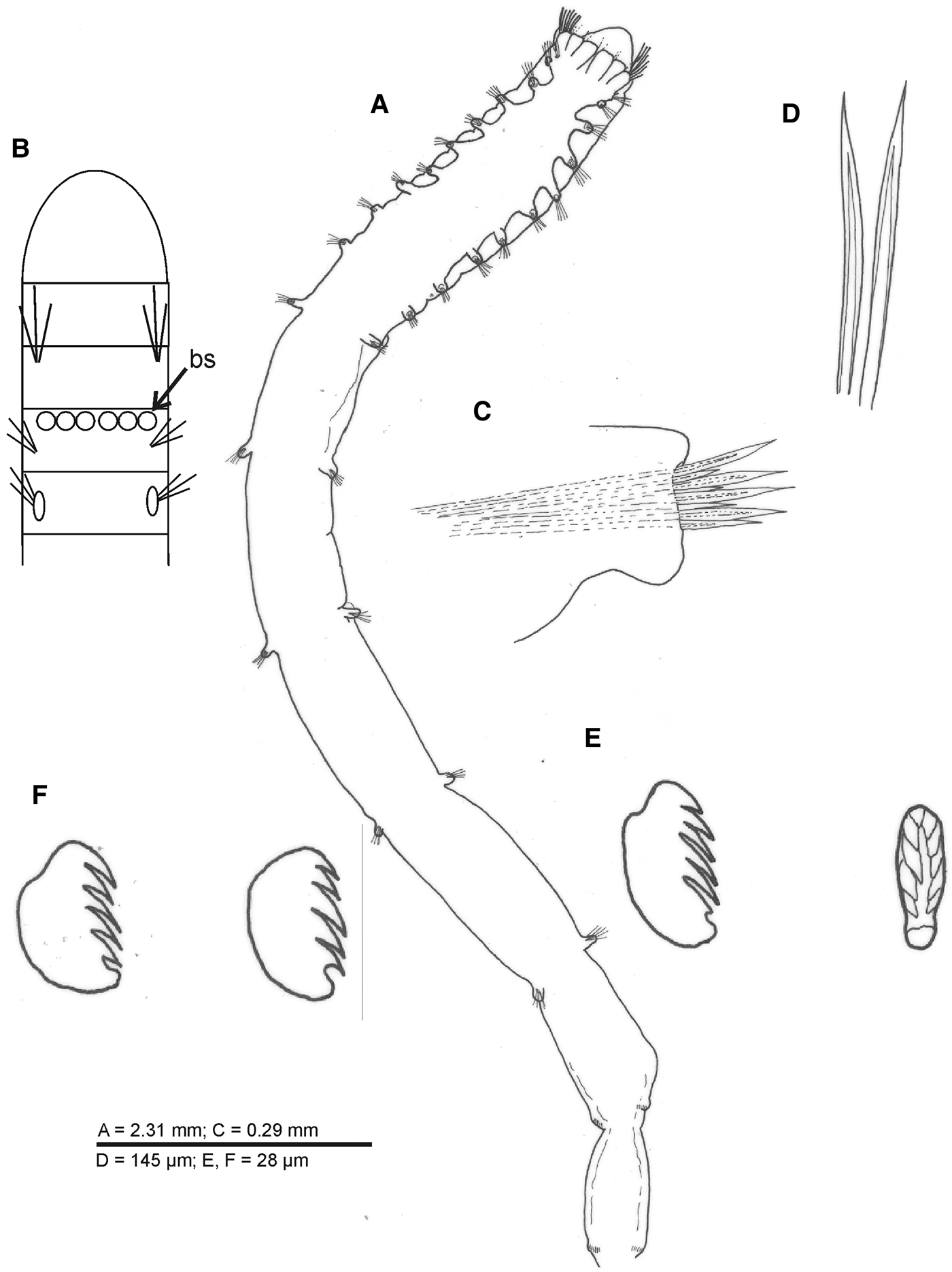
Eclysippe vanelli: (A) semi-complete specimen, dorsal view; (B) schematic drawing showing arrangement of branchiae and chaetae in first thoracic segments; (C) first thoracic notopodium; (D) thoracic chaetae; (E) thoracic uncini, lateral and frontal view; (F) abdominal uncini, lateral view. Abbreviations: bs, branchial scars.
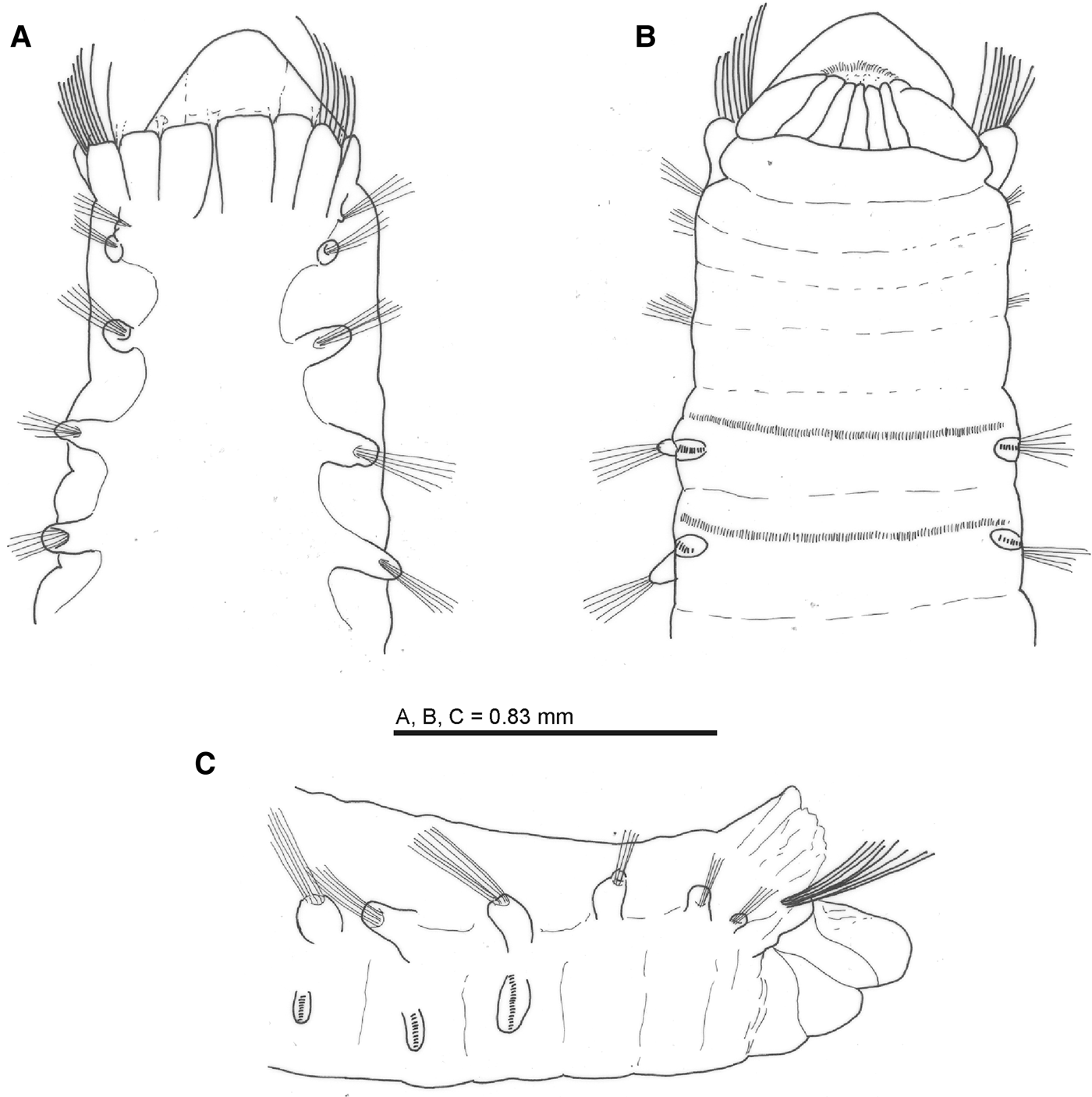
Eclysippe vanelli: anterior end in dorsal (A), ventral (B) and lateral (C) view.
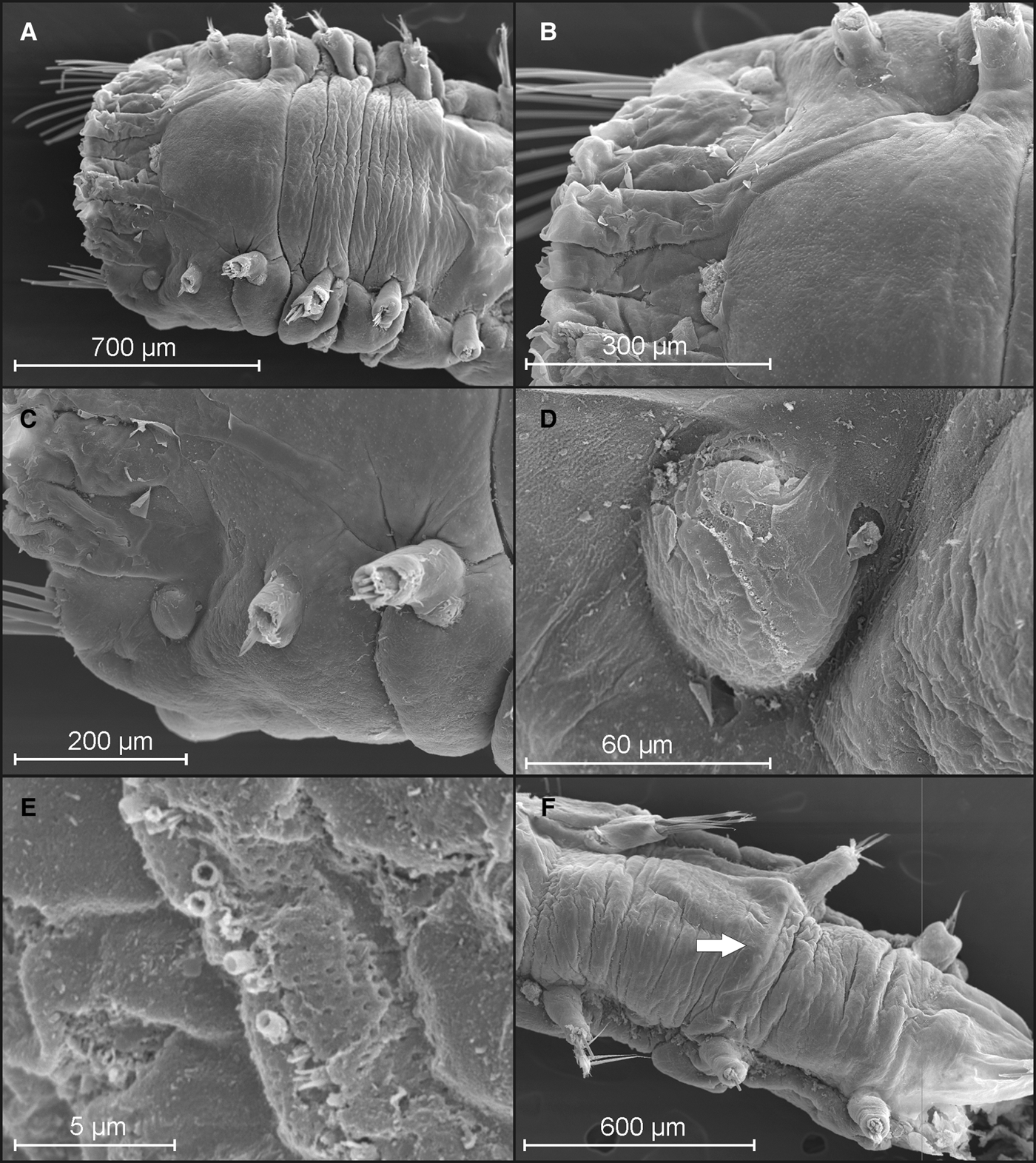
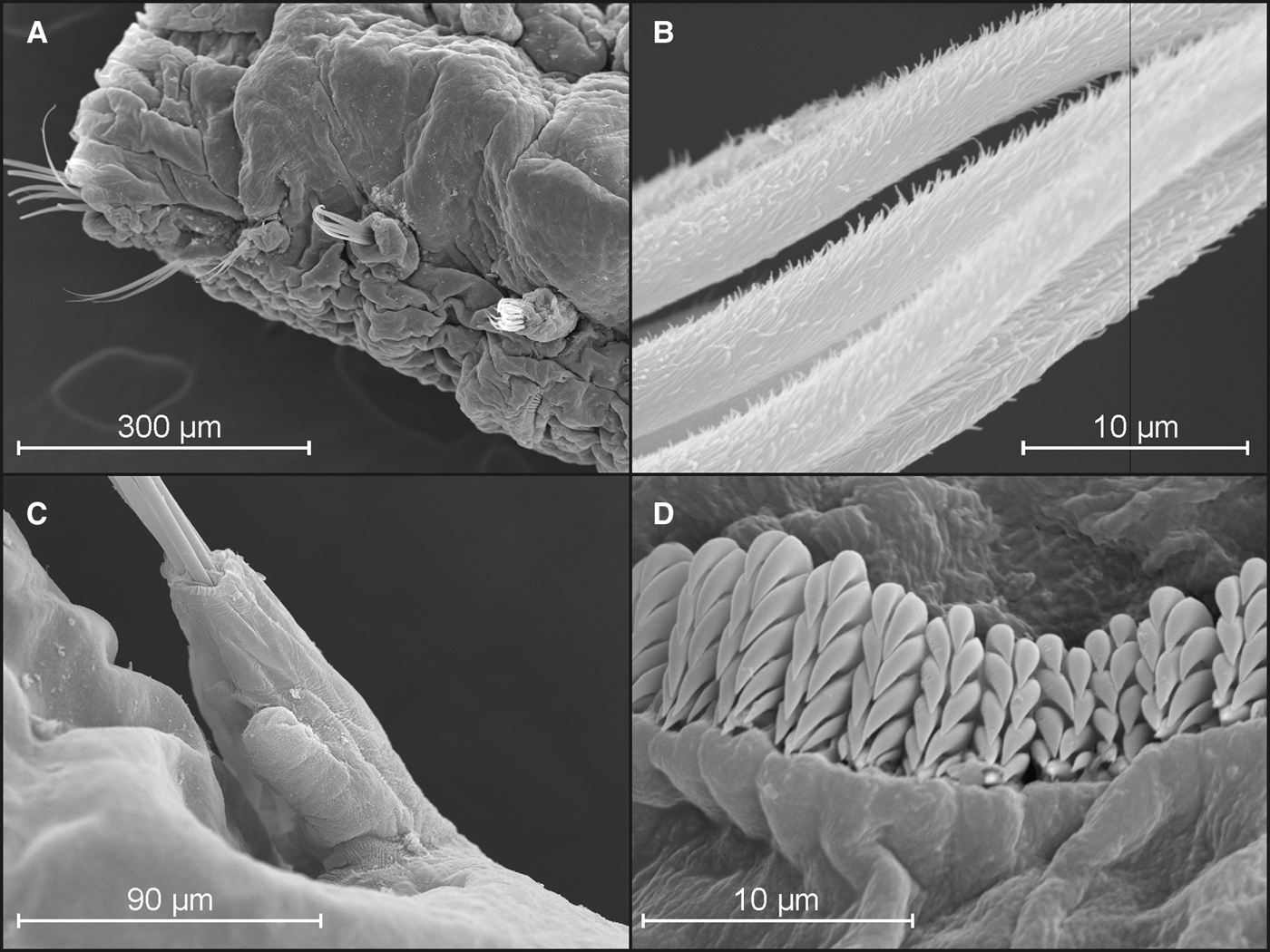
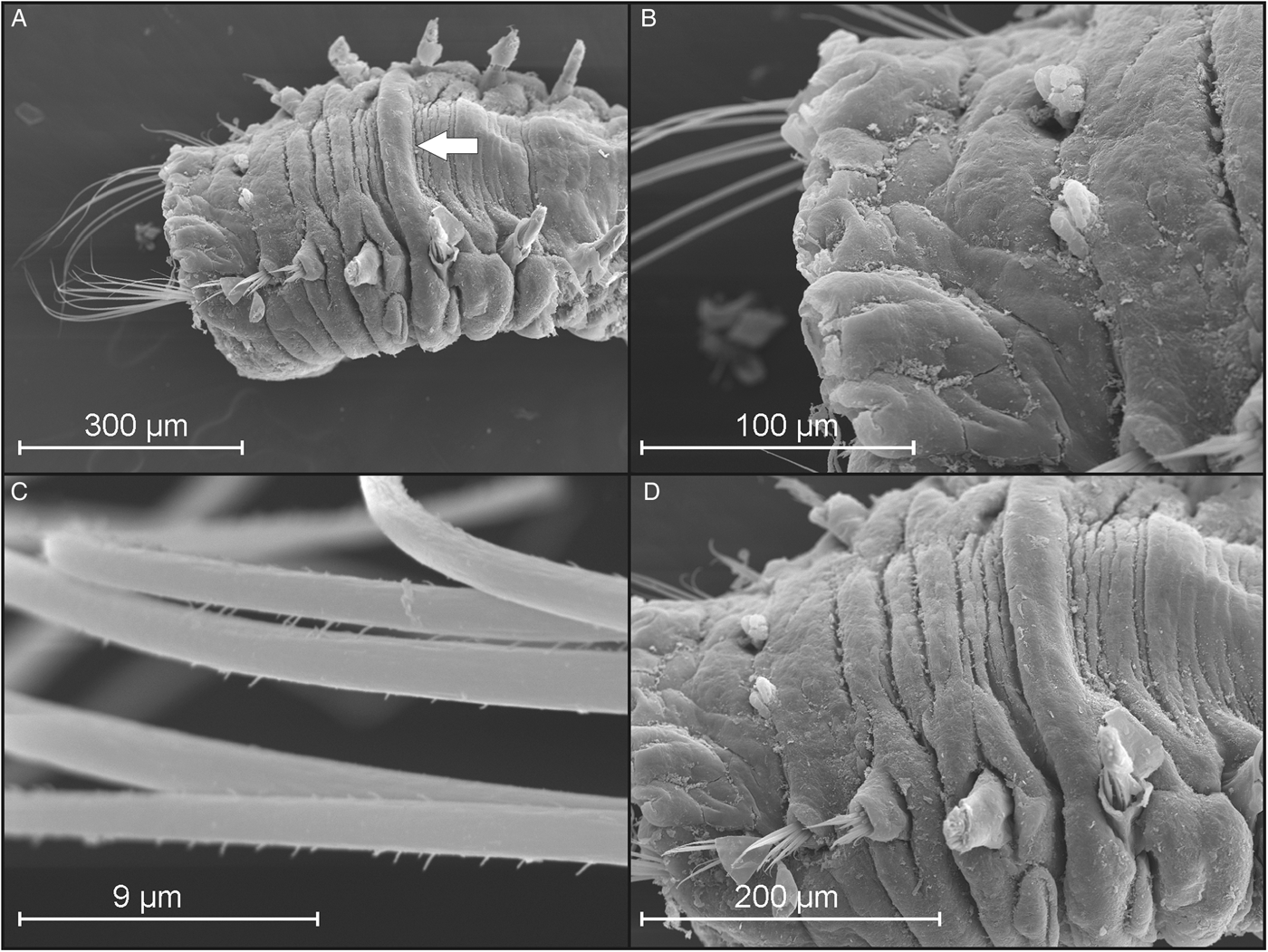
Eclysippe vanelli: (A) anterior end, in dorso-lateral view; (B) detail of thoracic notochaetae; (C) thoracic notopodia 13; (D) thoracic uncini in frontal view.
MATERIAL EXAMINED
MNCN 16.01/15238 (DI31, 3 specimens), POL429 (DI33, 35) and JP personal collection (DI33, 1 in SEM stub).
ADDITIONAL COMPARATIVE MATERIAL
Icelandic Museum of Natural History. Several specimens of Eclysippe vanelli from BIOICE samples 2311 and 2459.
OCCURRENCE
Capbreton Canyon (Bay of Biscay), 495–505 m depth.
DESCRIPTION
All specimens incomplete. Body elongate, wider in thoracic region. Prostomium triangular, with rounded end (Figures 8A, 9A–C). Eyes not seen. Ventral buccal lip formed by seven longitudinal folds, lateral two wider (Figure 9B). SGII provided with conspicuous paleae, longer than thoracic notochaetae and pointed forwards (Figures 9A–C, 10A). SGIII provided with two groups of three branchiae arranged in transverse row; both groups separated by a narrow space (Figures 8A, B, 9A, 10A). Branchiae connected by a high membrane reaching the paleae (Figure 9A, B). Fifteen thoracic chaetigers with notopodia provided with limbate capillary chaetae starting on SGIII (Figures 8C, D, 10B); the posterior 12 also with neuropodia with uncini. First two thoracic chaetigers slightly shorter than following; last four clearly longer than the preceding ones (Figure 8A). Papilla visible in dorsal part of thoracic notopodia under the SEM (Figure 10C). Thoracic uncini with two vertical rows of 4–5 teeth each above rostral tooth (Figures 8E, 10D). First two abdominal neuropodia of thoracic type (‘intermediate uncinigers’); following neuropodia with typical abdominal pinnules, abdominal uncini similar to thoracic ones (Figure 8F). Pygidium and tube not seen.
MG STAINING PATTERN
Anterior region heavily stained, both dorsally and ventrally. Branchiophores not stained. Dorsally, from paleal segment to CH11, only parapodia stained, mid-dorsal region not stained. Ventral region to CH11 heavily stained. From CH12, both dorsal and ventral regions not stained.
REMARKS
Our specimens agree with descriptions and drawings provided by Eliason (Reference Eliason1955), Holthe (Reference Holthe1986a) and Jirkov (Reference Jirkov2001) for E. vanelli. Therefore we do not follow Hansson (Reference Hansson1998) who proposed that the Arctic and the North Sea material reported as E. vanelli should be Eclysippe eliasoni (Day, Reference Day1973), a species described by Day (Reference Day1973) from the Beaufort Sea.
DISTRIBUTION
East Atlantic Ocean from the Barents Sea to the Great Meteor Bank and Guinea (Holthe, Reference Holthe1986a; Jirkov, Reference Jirkov2001). The species was previously reported from the Iberian Peninsula including the Capbreton area by Martinez et al. (Reference Martínez, Adarraga and Ruiz2007) as Eclysipe vanelli.
Genus glyphanostomum Levinsen, Reference Levinsen1884
Glyphanostomum moreirai sp. nov.
(Figures 11–13)
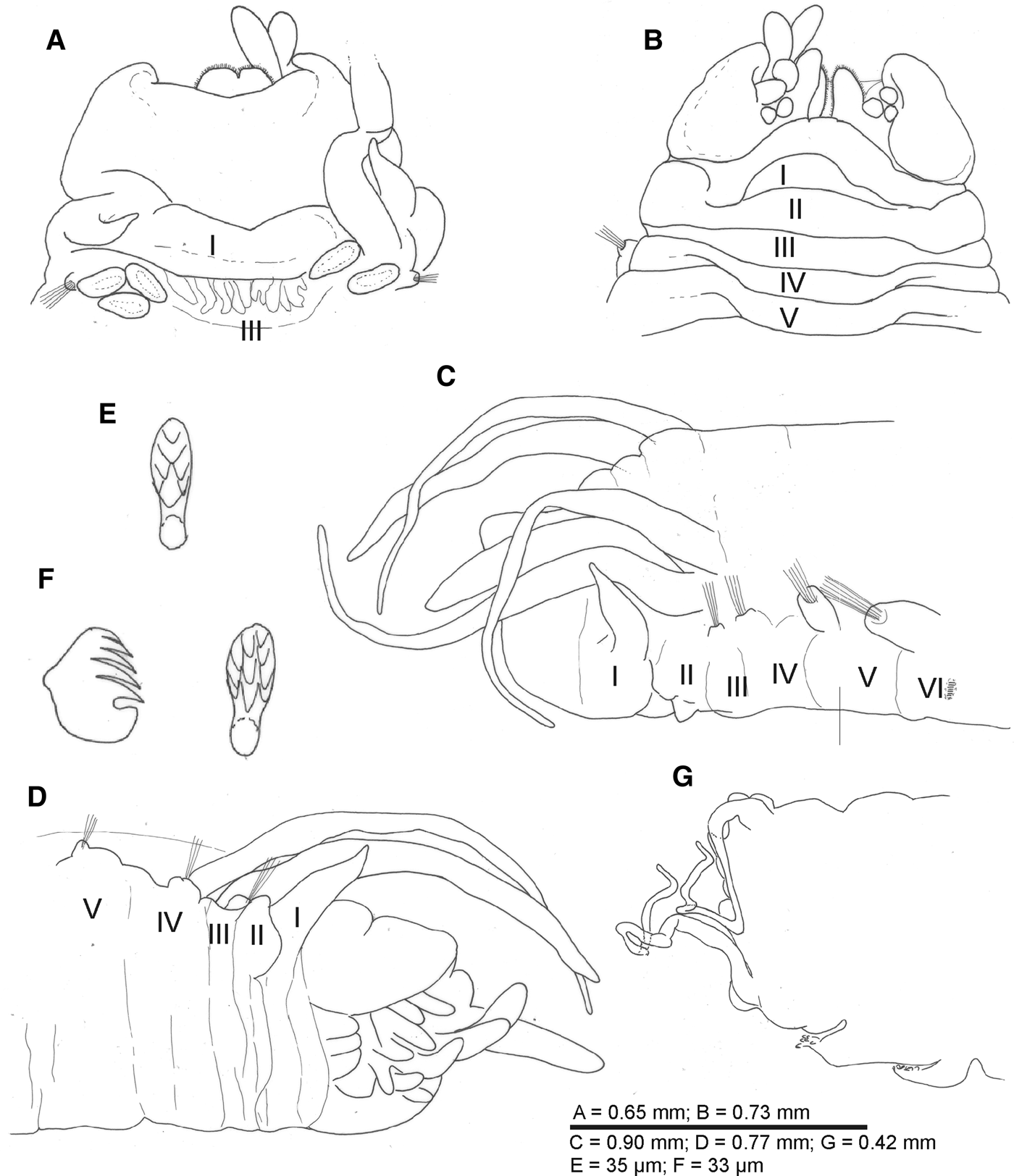
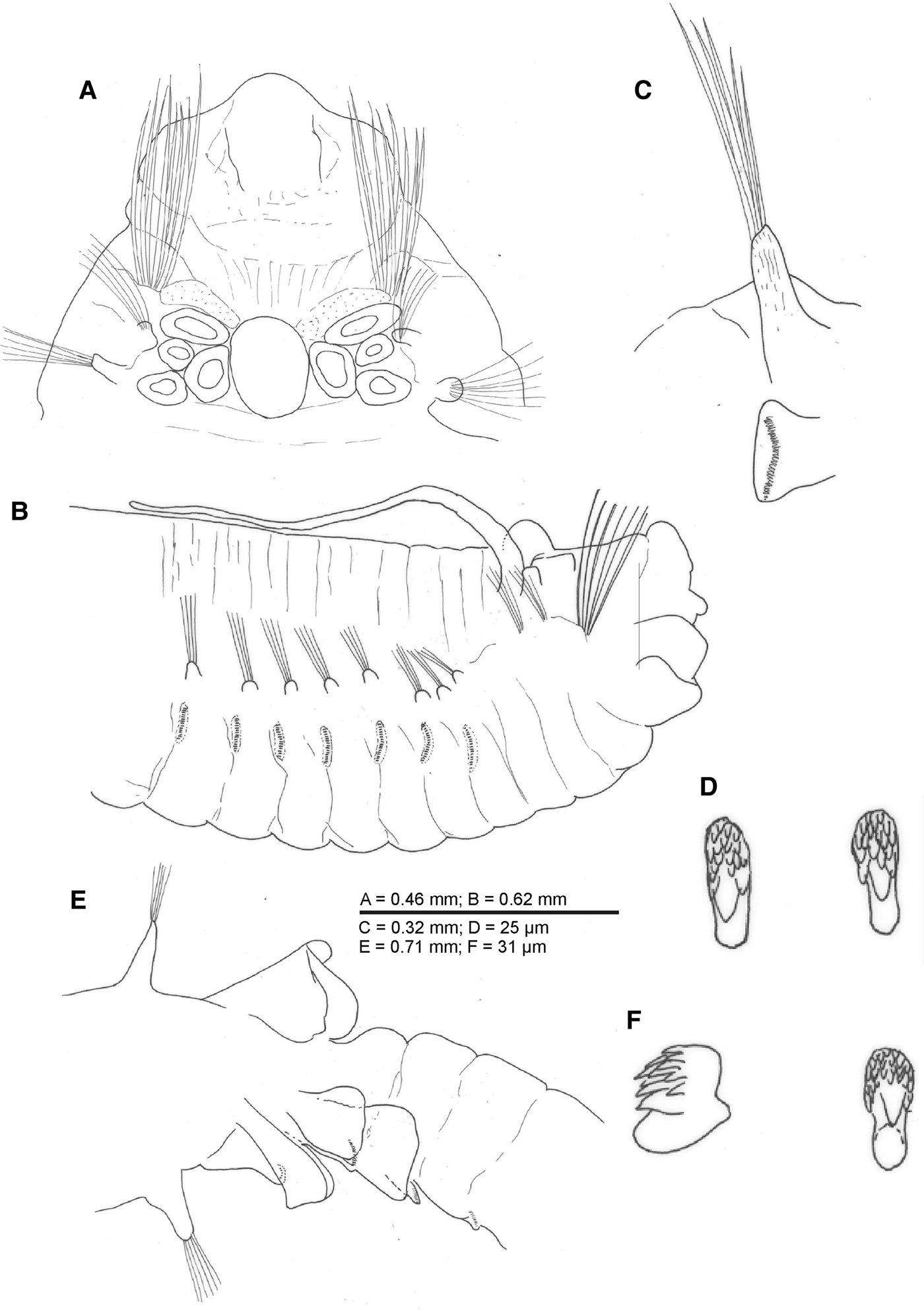
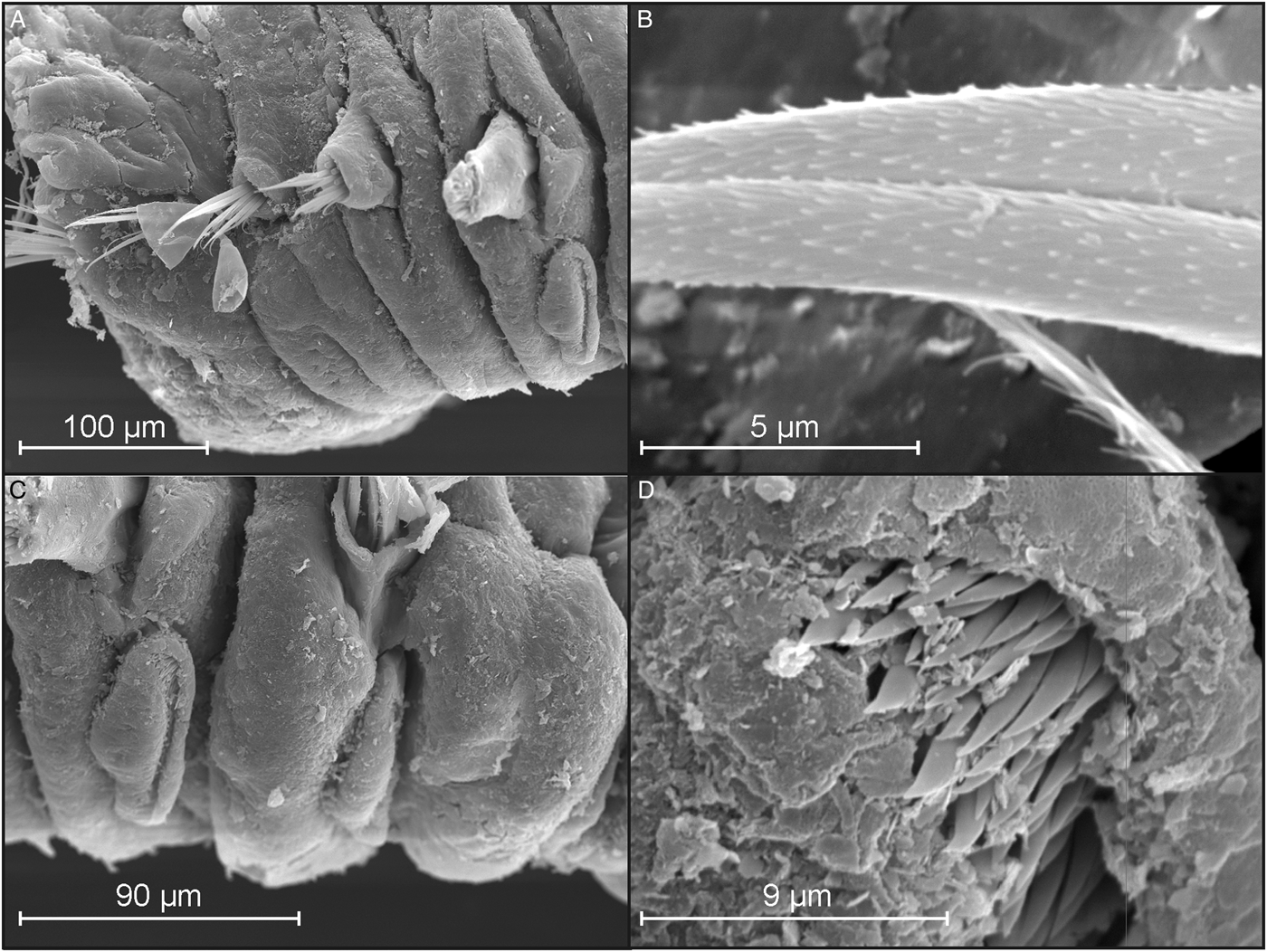
Glyphanostomum moreirai sp. nov.: (A) anterior end in dorsal view; (B) anterior end in ventral view; (C, D) anterior end in lateral view; (E) thoracic uncinus in frontal view; (F) abdominal uncini in lateral and frontal view; (G) posterior end in ventral view. Segments indicated by Roman numerals.
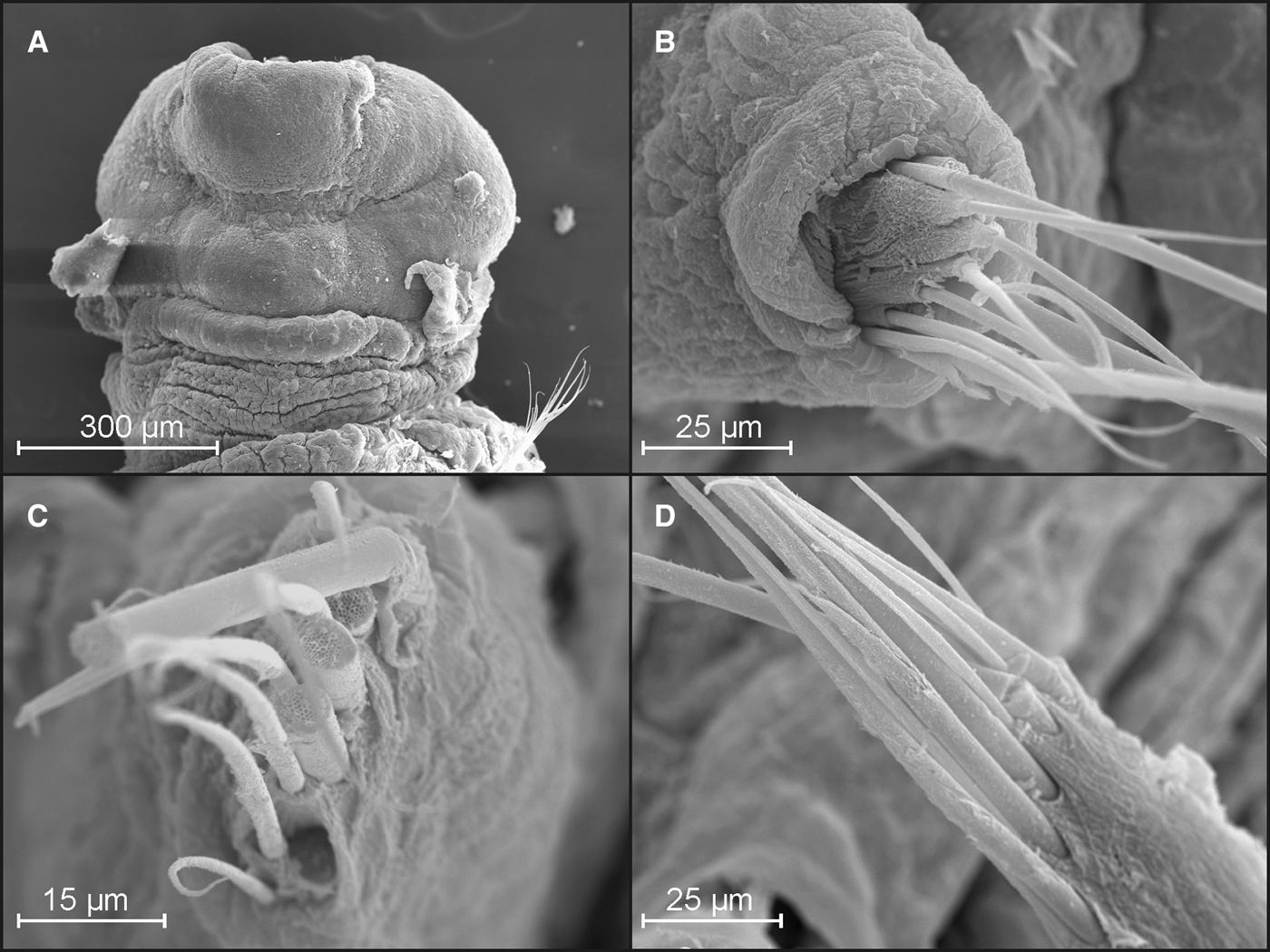
Glyphanostomum moreirai sp. nov.: (A) anterior end, dorsal view; (B) chaetiger 6, anterior view; (C) chaetiger 7; (D) chaetiger 8, posterior view.
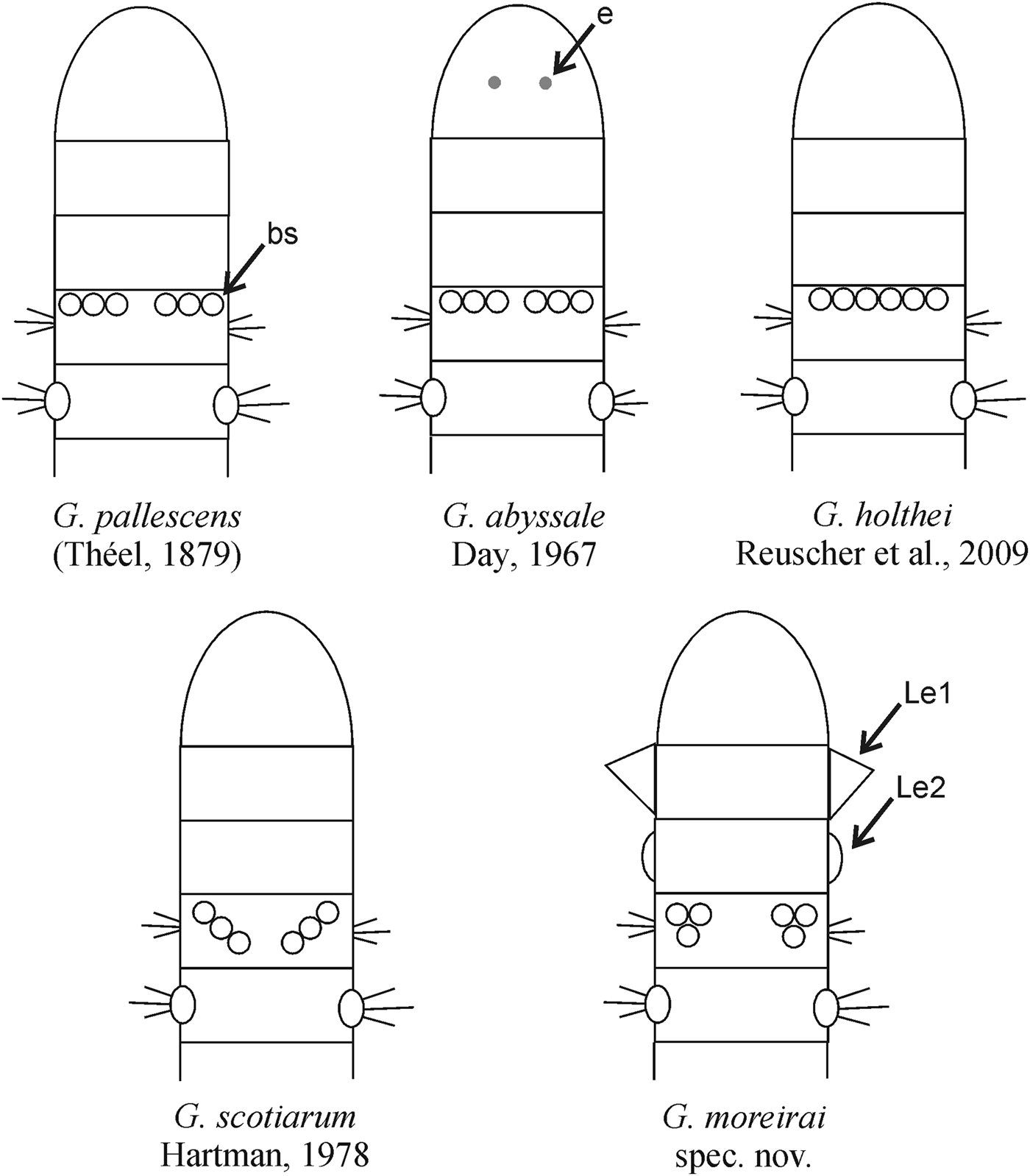
Schematic drawings showing arrangement of branchiae and chaetae in first thoracic segments of all known species of genus Glyphanostomum. Abbreviations: bs, branchial scars; e, eyes; le-I, lateral expansion of segment I; le-II, lateral expansion of segment II.
TYPE MATERIAL EXAMINED
POL430 (DI26, 2 paratypes); MNCN 16.01/15239 (KF42, holotype); MNCN 16.01/15240 (KF42, 2 paratypes); JP personal collection (DI13, 1 in SEM stub); JP personal collection (DI37, 1 in SEM stub); JP personal collection (DI66, 1 in SEM stub).
ADDITIONAL COMPARATIVE MATERIAL
Icelandic Museum of Natural History. Several specimens of Glyphanostomum pallescens (Théel, Reference Théel1879) from BIOICE samples 2642 and 2591.
OCCURRENCE
Capbreton Canyon (Bay of Biscay), 508–1040 m depth.
DESCRIPTION OF HOLOTYPE
Specimen complete, 10.44 mm long and maximum width of 0.78 mm. Body long and slender; anteriorly enlarged and tapering posteriorly. Prostomium scoop-shaped (Figures 11A; 12A), dorsally and laterally surrounding large mouth opening, fused with first two segments forming lower lip (Figure 11B). Eye-spots not seen. Numerous smooth buccal tentacles (Figure 11D). SGI and SGII each provided with a pair of dorsolateral conical lappets. Lateral expansion of SGI large, foliose and distally pointed; lateral expansion of SGII shorter, low and distally rounded (Figures 11A, C, D; 12A). SGII without paleae, ventrally forming transversal fold (Figure 11B–D). Three pairs of cirriform, distally pointed, slender branchiae located in SGIII (CH1). Left and right group of branchiae widely separated (Figure 11A, C). First two branchiae of each group in a transverse row; third pair located behind. (Figures 11C, 13). Chaetae starting on SGIII. Fourteen thoracic chaetigers provided with notopodial limbate capillary chaetae organized in two rows; an anterior row of fine chaetae (Figure 12B, C) and a posterior row of larger ones (Figure 12C, D). First two thoracic chaetigers slightly reduced. From thoracic CH4 (SGVI), 11 thoracic chaetigers provided also with low tori. Each torus with 10–12 uncini arranged in a single row. Thoracic uncini with two vertical rows of two teeth each above rostral tooth and two uppermost teeth (Figure 11E). Thoracic chaetigers ventrally provided with a transversal glandular ridge conspicuous from CH 3–4. Abdomen narrower than thorax and approximately half of its length. Eleven abdominal chaetigers provided with neuropodial pinnules; no rudimentary notopodia. First abdominal segment ventrally provided with a transversal glandular ridge as in thorax; absent in remaining abdominal segments. Abdominal uncinigerous pinnules with ~10 uncini arranged in a single row. Abdominal uncini with two vertical rows of four teeth each and a median row of two teeth above rostral tooth (Figure 11F). Pygidium provided with a pair of long, slender, filiform lateral anal cirri (Figure 11G). Tube unknown.
MG STAINING PATTERN
Anterior dorsal region heavily stained. Dorsal part of CH1 and interbranchial region heavily stained. Branchiae and buccal tentacles not stained. Rest of dorsal region to pygidium gently stained with very fine striped pattern. Thoracic notopodia more heavily stained. Anterior ventral region to CH4 heavily and uniformly stained. From CH5 to last thoracic chaetiger, a wide transversal band heavily stained in each chaetiger giving to the thoracic ventral region a characteristic striped aspect. Abdominal ventral region heavily stained. Pygidium and anal cirri not stained.
REMARKS
Following Reuscher et al. (Reference Reuscher, Fiege and Wehe2009) in the subfamily Ampharetinae only two genera have three pairs of branchiae and 11 thoracic uncinigers: Ampharana Hartman, Reference Hartman1967 and Glyphanostomum Levinsen, Reference Levinsen1884. Since the branchiae are not segmentally arranged, as in Ampharana, but grouped in one segment (SGIII, CH1), our specimens are being described in the genus Glyphanostomum; the genus is also characterized by lacking chaetae in SGII, three pairs of branchiae, and thorax provided with 14 chaetigerous segments, 11 of them uncinigers.
Four species of Glyphanostomum have been described: G. pallescens (Théel, Reference Théel1879) (widely distributed in North Atlantic Ocean, Arctic and Pacific Ocean to California), G. abyssale Day, Reference Day1967 (South Africa), G. scotiarum Hartman, Reference Hartman1978 (Antarctica) and G. holthei Reuscher, Fiege & Wehe, Reference Reuscher, Fiege and Wehe2009 (Aleutian Trench, North East Pacific).
Nevertheless, there are several significant differences between the new species and all known Glyphanostomum. For instance, the prostomium is more similar to that of the genera Ampharete or Amage, instead of being simple as expected in the genus; on the other hand, the presence of lateral expansions in SGI and SGII also clearly distinguish the new species from any other Glyphanostomum species. Moreover, the number of abdominal chaetigers and shape of uncini are different. Number of abdominal uncinigers is 11 in the new species, much lower than in any Glyphanostomum species (30 in G. pallescens, 32 in G. abyssalis and 33 in G. scotiarum); all type material of G. holthei are incomplete specimens but with at least 11 abdominal chaetigers. The shape of the uncini in G. moreirai spec. nov., while very different from that of G. abyssalis (see Day, Reference Day1967, fig. 35.5. k, l), G. pallescens (see Ushakov, Reference Ushakov1965, fig. 138 k; Jirkov, Reference Jirkov2011, fig. 5) and G. scotiarum (see Hartman, Reference Hartman1978, fig. 34e), is similar to that of G. holthei (Reuscher et al., Reference Reuscher, Fiege and Wehe2009, fig. 5d, e).
Reuscher et al. (Reference Reuscher, Fiege and Wehe2009) used the arrangement of the gills as the main character to differentiate species in this genus. Based on this arrangement, three groups of species can be now defined (Figure 13): branchiae arranged in a transverse row (G. pallescens, G. abyssale, G. holthei), in an oblique row (G. scotiarum), or grouped (G. moreirai sp. nov.).
Jirkov (Reference Jirkov2011) reviewed the taxonomic value of some characters traditionally used in ampharetid taxonomy, denying the value of certain meristic and qualitative characters (number of segments and branchiae, number of TU, presence/absence of paleae, and so on.) in the delimitation of genera and proposing alternative characters (shape of prostomium, branchial arrangement, types and position of neuropodia along the body) in a new key. Following Jirkov's new generic classification, the erection of a new genus for our specimens seems justified. We believe, however, that this would bring more confusion to a family with an already high number of genera described, many of them monotypical (Holthe, Reference Holthe2002). Only in the frame of a worldwide revision of the family, including careful rethinking of diagnoses and delimitation of genera, this might be justified.
ETYMOLOGY
This species is dedicated to Dr Juan Moreira (Universidad Autónoma de Madrid, Spain) for his help and friendship.
KEY TO SPECIES OF GENUS GLYPHANOSTOMUM LEVINSEN, 1884
The following key is based on that given by Reuscher et al. (Reference Reuscher, Fiege and Wehe2009) in which the arrangement of the gills was used as the distinguishing feature between species.
1. Median gap between left and right group of branchiae absent ................ G. holthei
— Median gap between groups of branchiae present ................................ 2
2. Branchiae of each group forming a row ................ 3
— Branchiae of each group not forming a row ................ G. moreirai sp. nov.
3. Branchiae of each group in oblique row ................ G. scotiarum
— Branchiae in straight row across dorsum ................ 4
4. Narrow median gap between groups of branchiae; eyes present ................ G. abyssale
— Wide median gap between groups of branchiae; eyes absent ................ G. pallescens
Genus Tanseimaruana Imajima, Reuscher & Fiege, Reference Imajima, Reuscher and Fiege2013
Tanseimaruana vestis (Hartman, Reference Hartman1965)
(Figure 14)
Tanseimaruana vestis Imajima et al., Reference Imajima, Reuscher and Fiege2013: 158.
Amphicteis vestis Hartman, Reference Hartman1965: 215–216, fig. 46; Parapar et al., Reference Parapar, Helgason, Jirkov and Moreira2011: 1487–1493, figs 6–8.
Tanseimaruana vestis: (A) anterior end, dorsal view; (B) anterior end, lateral view; (C) thoracic chaetiger; (D) thoracic uncini, frontal view; (E) thorax-abdomen transition, lateral view; (F) abdominal uncini, frontal and lateral view.
MATERIAL EXAMINED
MNCN 16.01/15241 (DI26, 10 specimens).
ADDITIONAL COMPARATIVE MATERIAL
Icelandic Institute of Natural History. Several specimens of Tanseimaruana vestis from BIOICE sample 2983.
OCCURRENCE
Capbreton Canyon (Bay of Biscay), 984–1040 m depth.
DESCRIPTION
Length 3.5–5.5 mm, maximum width 0.6–0.9 mm. Body wide anteriorly, tapering posteriorly. Prostomium roughly pentagonal (Figure 14A), with a pair of deep lateral grooves. Four pairs of long and slender branchiae arranged in two well separated groups; in each group scars of anteriormost and innermost branchiae larger than other two (Figure 14A). First pair of branchiae located behind paleae, second and third pairs beside first thoracic notopodium, and fourth pair beside second thoracic notopodium (Figure 14A). First pair of branchiae longer, reaching last thoracic chaetigers; three remaining pairs half of their length. Both groups of branchiae separated by an elevated rounded area (Figure 14A, B). Thorax with paleae and 17 thoracic chaetigers provided with notopodial limbate capillary chaetae. Paleae and two following thoracic notopodia more dorsally located than rest of notopodia (Figure 14B). Sixteen to 17 long and slender paleae per paleal fascicle, pointing forwards. Fourteen thoracic uncinigers; starting from thoracic CH4 (excluding paleae) and each torus provided with 30–40 uncini arranged in a single row (Figure 14C). Thoracic uncini with one large rostral tooth and a capitium of several transversal rows of small teeth (Figure 14D). Intermediate uncinigers absent. Thirteen abdominal uncinigers with pinnules. First abdominal unciniger with dermal bilobed folds (one specimen with dermal folds in first two abdominal chaetigers in one side; Figure 14E). Abdominal rudimentary notopodia absent; pinnules with 14–16 uncini arranged in a single row, similar in shape to those of thoracic region but smaller (Figure 14F). Pigidium with one pair of cirriform anal cirri. Some specimens with oocytes in body cavity.
MG STAINING PATTERN
Anterior dorsal region and interbranchial area heavily stained. Branchiae not stained. Rest of thoracic dorsal region slightly stained. Abdomen not stained. Anterior ventral region heavily stained to CH11, specially the glandular ridge, CH12 and CH13 less stained and fading in CH14. Thoracic parapodia slightly stained.
REMARKS
The most conspicuous character of T. vestis is the presence of a double fanlike neuropodial structure in the first abdominal chaetiger (Hartman, Reference Hartman1965; Parapar et al., Reference Parapar, Helgason, Jirkov and Moreira2011). All species of the genus Jugamphicteis Fauchald & Hancock, Reference Fauchald and Hancock1981 (J. sibogae (Caullery, Reference Caullery1944), J. sargassoensis (Hartman & Fauchald, Reference Hartman and Fauchald1971), J. paleata Fauchald & Hancock, Reference Fauchald and Hancock1981 and J. galatheae Holthe, Reference Holthe2000), Ampharete vega Wirén, 1883 and T. vestis (Hartman, Reference Hartman1965) share a similar character. Nevertheless, T. vestis has bilobed foliose neuropodia in the first abdominal segment and not medially fused notopodial valve-like structures (Fauchald & Hancock, Reference Fauchald and Hancock1981) or with the fan-like notopodial structure connected at middorsum (Holthe, Reference Holthe2000) which characterizes the genus Jugamphicteis. Moreover, T. vestis differs from genus Jugamphicteis by the absence of prostomial glandular ridges and the characteristic nuchal organs of this genus (see Holthe, Reference Holthe2000). Tanseimaruana vestis differs from A. vega in the number of thoracic chaetigers—14 in A. vega and 17 in T. vestis—in the shape of the expanded abdominal notopodia—lobate in A. vega and bilobed foliose in T. vestis—and in the presence of 2–3 abdominal segments with rudimentary notopodia in A. vega, absent in T. vestis.
Our specimens agree with all the generic features of Tanseimaruana provided by Imajima et al. (Reference Imajima, Reuscher and Fiege2013) and characteristics of T. vestis provided by Hartman (Reference Hartman1965) and recently by Parapar et al. (Reference Parapar, Helgason, Jirkov and Moreira2011) (as Amphicteis): prostomium without glandular ridges or nuchal organs, number and arrangement of branchiae, paleal segment and 17 thoracic notopodia provided with limbate capillary chaetae and without cirri, 14 thoracic uncinigers, absence of abdominal notopodial rudiments and double fan-like notopodial structure in the first abdominal chaetiger.
DISTRIBUTION
Tanseimaruana vestis was originally described off New England (western Atlantic) by Hartman (Reference Hartman1965) and recently reported in north-eastern Atlantic waters by Parapar et al. (Reference Parapar, Helgason, Jirkov and Moreira2011). The north-east Pacific record by Kucheruk (1976) may correspond to the recently described Japanese species T. boninensis Imajima, Reuscher & Fiege, Reference Imajima, Reuscher and Fiege2013. Tanseimaruana vestis was also reported in Antarctica by Schüller and Ebbe (ANDEEP-SYSTCO preliminary resuls on-line), but it may correspond to a different species. This is the first report of the species in the Iberian Peninsula and the southernmost from the eastern Atlantic Ocean.
Ampharetinae indet.
(Figures 15, 16)
Ampharetinae indet.: (A) anterior end in dorsal view; (B) branchial cirrophores; (C) paleae; (D) first five thoracic chaetigers. Arrow showing dorsal transverse ridge at thoracic CH5.
Ampharetinae indet.: (A) anterior end in lateral view; (B) notochaetae; (C) first three biramous thoracic chaetigers; (D) thoracic uncini in frontal view.
MATERIAL EXAMINED
JP personal collection (KF50, 1 specimen in SEM stub).
OCCURRENCE
Capbreton Canyon (Bay of Biscay), 1000 m depth.
DESCRIPTION
One specimen, incomplete, broken at thoracic CH9. Prostomium Ampharete-type; buccal tentacles not seen. Eyespots absent. Three pairs of deciduous branchiae, only branchiophores remaining and forming a straight transversal row (no gap between innermost branchiophores of each group) forming a high fold. Paleae much longer than the most developed notochaetae, but of similar width and ~14 in number (Figures 15A, B); paleae provided with hispid surface (Figure 15C). First notopodia small, provided with only 1–4 hispid notochaetae (Figure 16B), and located posterior to the outermost branchiophores of each side. Second thoracic notopodia larger than first but smaller than following. From fourth thoracic chaetiger, uncinigerous tori also present (Figures 15D, 16A). A transversal glandular ridge across the dorsum present before second thoracic unciniger (Figure 15A, D). Thoracic uncini almost hidden between neuropodial lobes (Figure 16C), with a capitium composed by one horizontal row of four large teeth above rostral tooth and several uppermost smaller teeth (Figure 16D).
MG STAINING PATTERN
Anterior body region heavily stained. Branchiophores not stained. Notopodia and neuropodia of thoracic region not stained. Dorsal part of thoracic region (including transversal ridge) not stained; ventral thoracic region heavily stained in a striped pattern.
REMARKS
Despite only one incomplete specimen is available, general appearance is highly consistent with the original description of Anobothrus laubieri (Desbruyères, Reference Desbruyères1978) (see descriptions in Holthe, Reference Holthe1986a; Jirkov, Reference Jirkov2001, Reference Jirkov2008; and table 6 in Reuscher et al., Reference Reuscher, Fiege and Wehe2009). Nevertheless, the specimen lacks the posterior part of the thorax that has a dorsal ridge at eighth thoracic unciniger, which is a highly characteristic feature of the genus. Anyway, more specimens are needed to confirm the presence in Capbreton of this deep-water (>2000 m depth) Arctic species.
ACKNOWLEDGEMENTS
Thanks are due to Départment de Géologie et Océanographie (DGO, Talence) for the loan of the Flusha box-corer, to Laboratoire de Biologie des Invertébrés Marins (BIMM-MNHN, Paris) for the loan of the sieving equipment, to the French Comité Interrégional Manche Atlantique (CIRMAT-CNRS) for logistical support and the loan of an epibenthic dredge, to the crew of the RV ‘Côte d'Aquitaine’ for their assistance at sea, and to A. Urzelai, I. Esteban and I. Zabala (INSUB, San Sebastian) for their helpful contribution to the sorting of samples. This Franco–Spanish Co-operative Research Programme was partly supported by the French CIRMAT-CNRS (Capbreton cruises 1988 and 1989). We wish to thank G. Gudmundsson (IMNH) and G.V. Helgason (University of Iceland), and D. Eibye-Jacobsen and M.T. Tøttrup (ZMUC) for making available specimens from selected species. Special thanks are due to J.C. Sorbe, director of the CAPBRETON research programme. A. Castro and C. Sueiro (SAIN, UDC) assisted with the preparation of specimens and the use of the SEM, Igor Jirkov (Moscow State University, Russia), Juan Moreira (Universidad Autónoma de Madrid, Spain) and E. Martínez-Ansemil (Universidade da Coruña, Spain) provided valuable comments on different aspects of the manuscript. Two anonymous referees are greatly acknowledged for their constructive comments on the manuscript.
FINANCIAL SUPPORT
This Franco–Spanish Co-operative Research Programme was partly supported by the French CIRMAT-CNRS (Capbreton cruises 1988 and 1989).