The media landscape has changed dramatically in the last several decades. Technologies have diversified, access is vastly improved, and there has been an explosion in media choice, to name only a few of the most striking shifts. Political scientists are breaking ground investigating changes such as the decline in news audiences,Footnote 1 the resurgence of partisan media,Footnote 2 and the emergence of “soft news” mixing elements of news and entertainment.Footnote 3 Yet significantly less attention has been paid to the lion’s share of contemporary media consumption: fiction and entertainment.
The relative lack of emphasis on fiction is striking for three reasons. First, by any metric, be it preferences, money, or audience, and across modalities, consumption of fiction and entertainment dwarfs that of news and other nonfiction media.Footnote 4 Second, there are strong reasons to think that ideas contained in fiction may have just as strong an impact on people’s beliefs and attitudes as nonfictional content, given that people tend to incorporate “facts” they learn regardless of whether the source is labeled fiction or nonfiction,Footnote 5 and the narrative structure typical of fiction is known to be exceptionally powerful in shaping cognition and persuasion.Footnote 6
Finally, a great deal of fictional media today is political media in the sense of containing themes and storylines pertaining to the exercise of power, the organization of society, and the ethics of political action. Consider the struggles over political power and authority in hugely popular television shows such as Game of Thrones and The Walking Dead, the prominence of government conspiracies in The X-Files and Scandal, the threat of totalitarianism in The Handmaid’s Tale and The Man in the High Castle, and the ethics of vigilantism in top-grossing movies like Captain America: Civil War and Batman v. Superman: Dawn of Justice. The political implications of such messages are largely uncharted territory.
We argue here that our understanding of political media will remain incomplete as long as the political impacts of fiction remain under-studied and inadequately theorized in political science. Drawing from communications scholarship, we argue that applying a genre-based approach to the attitudinal effects of fiction offers a stronger foundation for generalizability than the prevailing topical approach in political science, which has examined effects driven by specific topics within idiosyncratic storylines. We focus on the totalitarian-dystopian genre due to its massive popularity and obvious political content. We define as totalitarian-dystopian any fictional work that portrays a dark and disturbing world dominated by an overwhelmingly powerful government or other controlling entity that acts to undermine core values such as freedom and justice. With the explosive rise of dystopian fiction in recent years, a number of “folk” hypotheses have arisen about the impact of this trend, making it an excellent test case for the study of fictional genre effects on political attitudes.
To explore these effects, we conducted focus groups and designed and carried out three experiments that extend and replicate our main effects. Our results demonstrate that the totalitarian-dystopian genre can affect real-world political attitudes in compelling ways. Across all three experiments, we find evidence that exposure to dystopian media made people more willing to justify radical—and particularly violent—forms of action against injustice by political elites. Moreover, by incorporating both control groups (no media exposure) and comparison groups (exposed to similarly themed nonfiction media or non-narrative violent imagery), we provide evidence that this effect is driven by core features of dystopian narratives, rather than by mere exposure to scenes of collective protest or violence.
The research should interest scholars of political communication, political psychology, and pop culture and politics, while the substantive findings also suggest implications for theories of radicalization. First, we offer the first systematic investigation of the effects of the highly popular dystopian genre on political attitudes, which has accounted for billions in box office receiptsFootnote 7 and at least 60 million books sold in the United States alone.Footnote 8 Second, we move beyond identifying effects toward investigating which features of fiction are driving observed effects and what the underlying causal mechanisms may be. In so doing, we contribute to knowledge about the role of narrative in political understanding and persuasion,Footnote 9 providing further evidence that narrative—even fictional narratives—may have profound political implications. Third, we respond to recent calls in the study of pop culture and global politics to, as Charli Carpenter urges, treat “assumptions about popular culture’s relationship to politics as hypotheses to explore, rather than interpretations to assert.”Footnote 10 Finally, we demonstrate the value of a genre-based approach for studying fiction effects in a more systematic and generalizable way.
The Political Effects of Fiction
In political science, research on fiction effects has been relatively limited in comparison to the extensive literature on nonfiction media, in part due to doubts about whether such media matter for politics. For example, Bennett and Iyengar suggest that these media lack political content, or that if political content is present it is too scattered to be meaningful. However, these are assumptions unsupported by empirical content analyses and recent interpretive work, which illustrate that politics is often deeply embedded within fiction and popular culture in different countries.Footnote 11
Even so, one might reasonably hypothesize that, when people form and adjust their political attitudes, they disregard fiction, knowing it to be “made-up.” Yet the evidence increasingly suggests that people do not process fiction and nonfiction in fundamentally different ways, rationally “toggling” between the two.Footnote 12 Rather, they incorporate information from both fiction and nonfiction into their real-world knowledge structures, emotional commitments, and subsequent behaviors.Footnote 13 Moreover, a variety of studies have offered compelling evidence linking fiction to attitudes—and yet these existing approaches have been limited in several respects, making it difficult to draw broader conclusions about fiction effects.
First, a substantial portion of the existing literature focuses narrowly on the few television shows and movies that revolve around American government, centered on topics such as presidential leadership,Footnote 14 war and foreign policy,Footnote 15 and famous American historical figures.Footnote 16 Yet the fiction landscape is far more diverse: important political content can be found in fiction—such as totalitarian-dystopian fiction—that falls outside the bounds of television shows and movies about American government per se. Restricting our focus to fiction about American government and history rests on unduly narrow assumptions about what may be considered “political” and could influence political attitudes, in the United States as elsewhere.
Secondly, a number of prior studies, particularly within the cultivation research tradition, rely on observational designs that limit the extent to which strong causal inferences can be drawn. For example, some intriguing research has linked the Harry Potter book series to openness to diversity and toleranceFootnote 17 and general election preferences.Footnote 18 Another study found that watching science fiction television shows, such as The X-Files, was linked to reduced trust in government.Footnote 19 The patterns identified by these studies offer valuable insights about the potential effects of fiction; however, since they are correlational in nature, it is difficult to rule out the possibility of omitted variable bias or selection effects.
Last but not least, many previous studies in political science focus primarily on a single idiosyncratic movie or television show, examining effects driven by the specific topic and particular storyline of a given episode or feature film. This makes it difficult to identify whether and when effects might generalize to other stories and contexts, a key challenge that is widely recognized in broader communications scholarship.Footnote 20 Hence, scholars have found that the individual movie The Cider House Rules fosters more pro-choice attitudes toward abortion in the case of incest;Footnote 21 exposure to particular episodes of Law and Order and other television dramas shapes attitudes toward the death penalty and the criminal justice system;Footnote 22 and the film Wag the Dog increases support for conspiracy theories.Footnote 23 Although these studies are extremely valuable, important questions remain about the generalizability of effects beyond the specific media content examined.
Genre in Fictional Media
Building on an approach more common in communications scholarship, we argue that genres offer a valuable way to systematize the study of fictional media in political science and to substantially extend the portion of the media landscape that can be studied. Genres are traditionally defined as sharing some common “repertoire of elements,” drawing from the ancient categories of tragedy and comedy.Footnote 24 Hence, in studies that touch on genre, the genre categories used often echo these broad categories, while adapting them to contemporary trends in television programming. For example, intriguing observational work has uncovered correlations between opinions toward women’s rights and exposure to “traditional drama,” “progressive drama,” and “situation comedy.”Footnote 25 Holbert has also proposed a thoughtful typology that includes additional genre categories such as “traditional satire.”Footnote 26
We suggest that a more specific and narrative-centric definition of genre will better serve the needs of political scientists seeking to study fiction and entertainment in systematic ways. Thus, we define genre here not in terms of broad thematic categories but rather as specific types of narrative, inspired particularly by the work of Bilandzic and Busselle.Footnote 27 Narrative is defined as possessing a set of widely agreed-upon structural elements, including a setting; characters; a story arc involving human agency, temporality, and causality; and overarching story morals or norms.Footnote 28 Genres are specific types of narrative in that they are standardized means of “filling in” narrative structure with common—or “generic”—content.
A narrative-based notion of genre is useful for political scientists for two reasons. First, it encourages us to specify the narrative content characteristic of genres with greater precision, allowing opportunities to clarify which features of narrative stimuli may be driving observed effects. Second, it builds on a growing body of work showing that narrative, be it in fiction or nonfiction, is fundamental to human cognition and persuasion. People remember and understand more from narrative presentations of information;Footnote 29 are more persuaded by them;Footnote 30 and are more moved to political action by them.Footnote 31 A narrative-based concept of genre is therefore consistent with broader research showing that narratives are powerful drivers of attitudes and behavior, providing a useful groundwork for systematizing fiction effects.
To illustrate, we focus here not on the broad genre categories of “speculative fiction” or “science fiction” which may encompass a variety of different types of narrative, but rather on the more narratively unified dystopian genre, and more specifically the totalitarian-dystopian genre. This allows us to specify with greater precision what must be present in a narrative to “count” as part of a genre, building on the prototypes-based approach suggested by Jackson and Jacobs.Footnote 32 In the totalitarian-dystopian genre, the prototypical narrative content elements—e.g., setting, character, plot, and story morals—are relatively clear and consistent; thus, they are “filled in” according to widely shared genre conventions.
Indeed, as figure 1 shows, the narratives typical to the totalitarian-dystopian genre have clear political content involving citizens struggling with excessive government power in a dark and disturbing alternative world setting. As Hintz and Ostry observe in defining the genre, “the ideals for improvement have gone tragically amok.”Footnote 33 As a result, totalitarian-dystopian narratives also guide the reader toward certain story morals, or what Bilandzic and Busselle call “grand lessons,” most commonly to recognize and condemn major value violations by the overwhelmingly powerful entities in the world of the story. Acts of resistance and rebellion are portrayed as admirable (even when not or only partially successful) and readers are expected to empathize with the protagonist and even imagine how they themselves might fight such value violations.
Genre elements

It is important to recognize that storylines in a given book or show can and do vary in their specifics, potentially yielding more idiosyncratic topical effects. To take a few popular examples, torture and government surveillance feature in 1984; organ harvesting in the Unwind series; plastic surgery in the Uglies series; mind control in The Giver; gender inequality in The Handmaid’s Tale; government-arranged marriage in the Matched series; and environmental disaster in The Maze Runner series. Nevertheless, each of these popular narratives also conforms to the totalitarian-dystopian genre conventions defined in figure 1, containing an unjust and powerful governing entity at its core that is placing limits on individuals’ freedom in the context of a dark and fictional story world, with protagonists seeking to free themselves or others.
To be clear, if a narrative does not contain such a powerful governing entity at its core violating widely shared standards of right and thus justifying resistance, it would not count as totalitarian-dystopian according to our narrative-based definition. For example, while post-apocalyptic works (including narratives about zombies) may also be considered “dystopian” in popular parlance, the standard setting—involving chaos and the collapse of social order—is politically quite different and may have significantly different attitudinal effects than those we discuss later. It is also possible that the relatively rare totalitarian-dystopian narratives in which resistance is presented as futile—such as in 1984—will have different effects, and future researchers may wish to test this hypothesis. However, drawing particularly from our focus groups as discussed later, we see the unacceptable ethical violations by totalitarian governments at the center of these stories as the key to their impact, regardless of the outcome of resistance efforts. (Even in 1984, resistance by the main characters—albeit ultimately futile—is portrayed as ethically right.)
Finally, why focus on this genre? Not only do the narratives typical to this genre have undeniable political content, involving citizens struggling with excessive government power, but the genre is massively popular, especially but not only among young adults. Totalitarian-dystopian narratives are in wide circulation, having become even more popular since the election of President Trump.Footnote 34 The genre can legitimately be described as a pop culture phenomenon, with even a Hunger Games theme park having opened in Dubai last year.Footnote 35 In addition, the genre’s popularity has also raised important “folk hypotheses” about its political origins and implications. For instance, some wonder if the dystopian boom reflects and reinforces “the increasing anger Americans feel towards political authority.”Footnote 36 Such suspicions have yet to be empirically tested.
Hypotheses
In formulating hypotheses, we draw from several theoretical traditions. The majority of our hypotheses flow from the nature of the content shared across dystopian narratives. We take each theoretical tradition in turn.
Narrative Persuasion
Scholars in the narrative persuasion tradition distinguish narrative from rhetorical persuasion, where the latter is characterized by advocacy of a position through arguments, reasoning, and evidence (e.g., newspaper editorials and political speeches). By contrast, narrative persuasion involves attitude change driven by cognitive and emotional engagement with a story.Footnote 37 As Slater et al. explain, when people are immersed in a narrative, “counterarguing should be almost eliminated as critical scrutiny of a message is incompatible with the suspension of disbelief associated with processing [the narrative].”Footnote 38
While any narrative may incorporate a variety of specific messages, stories that fit well within a genre (or subgenre) and hence conform well to genre conventions are likely to promote genre-consistent messages. In the case of totalitarian-dystopian fiction, the message of justified resistance to elite injustice—especially of the illegal and radical kind valorized by these narratives—is most genre-typical. Indeed, even when endings are not “happy” and protagonists fail to accomplish their goals, as in the classic 1984, the ethical violations by the powers that be are front and center, and readers are expected to empathize with the struggle of main characters against them, seeing their radical resistance efforts as legitimate whether or not they ultimately succeed.
Importantly, both our manipulation checks and focus groups show that readers and viewers see these messages as central.Footnote 39 For example, in an open-text manipulation check question in Study 1, subjects described justified resistance to injustice as one of the top three themes in both dystopian fiction treatments (see figure A1 in online Appendix A). Focus group participants also emphasized the totalitarian-dystopian genre’s themes of violence and rebellion, rarely mentioning more peaceful forms of resistance. Thus, we predict that exposure to totalitarian-dystopian fiction will increase the perceived legitimacy of radical, and particularly violent, responses to unjust governments (H1).
Agenda-Setting
Second, we look for agenda-setting effects. The standard theory is that media increase the salience of the particular topics featured, heightening public concern about them. Research supporting this hypothesis in news media is considerable, and several studies find that fictional television shows and movies can also increase concern about particular topics, such as race relations,Footnote 40 nuclear war,Footnote 41 and crime.Footnote 42 Thus, we hypothesize that exposure to totalitarian-dystopian fiction will increase the extent to which subjects are concerned about the issues central to many totalitarian-dystopian narratives—excessive government power and individual freedom (H2).Footnote 43 If totalitarian-dystopian fiction has an agenda-setting effect, we would expect to see the importance of these issues increased by exposure, while the importance ascribed to less-relevant issues (such as immigration, climate change, and health care) remains constant. Of course, other topics may be emphasized in specific dystopian narratives (e.g., torture and government surveillance in 1984, plastic surgery and mind control in the Uglies series, etc.), but we focus here on broader agenda-setting effects linked to the overall genre.
Folk Theories
Finally, we test two key folk hypotheses, loosely connected to cultivation theory.Footnote 44 First, the popularity of totalitarian-dystopian fiction, especially among young adults, has triggered worries that the dark and disturbing nature of the content could both reflect and contribute to an epidemic of political mistrust, cynicism, and apathy.Footnote 45 For example, in 2010 the New York Times hosted a debate revealing significant anxiety about the “dark side” of young adult fiction and negative implications for the rising generation. Such concerns even led to The Hunger Games being on the top ten list of books most frequently targeted for removal from school libraries.Footnote 46 If it is true that people come to view the oppressive, corrupt, dystopian governments portrayed as a reasonably accurate reflection of what real-world politics is like, as some fear, then it could be that those exposed to dystopian fiction will become less politically trusting and less inclined to engage politically (H3).
Second, and more optimistically, some have also speculated that the frequent presence of ass-kicking heroines in specific examples of dystopian fiction may cultivate a greater sense of feminism. For instance, a critic at the LA Times wrote, “Katniss, with her bow and arrow, has inspired a generation to lift up their weapons, both literally (the surge in archery lessons) and otherwise.”Footnote 47 Scholars have argued that viewership of certain television genres and programs can shape attitudes towards gender rolesFootnote 48 and offered suggestive evidence for such an effect.Footnote 49 This leads to our second speculative folk hypothesis, which unlike our other hypotheses is based on idiosyncratic narrative features rather than being genre-based: exposure to totalitarian-dystopian fiction with female protagonists will increase support for women in leadership and combat roles (H4)
Both of these folk hypotheses illustrate how popular expectations can diverge from scholarly ones in important ways. For example, while some scholars in political science have claimed that fiction is unlikely to have real-world consequences, parents, educators, and other citizens have not typically shared that view. Moreover, specific folk hypotheses can articulate very different predictions than academic theories would support. For instance, the first of our two folk hypotheses—predicting lowered trust and efficacy—diverges markedly from the narrative persuasion hypothesis. Yet that is because the two flow from differing genre elements. While the folk hypothesis is based on the dark and disturbing alternative world setting in which an excessively powerful government violates norms of justice, the narrative persuasion hypothesis emphasizes the centrality of the plot and story morals, in which characters are presented as justified in resisting such injustice, including with radical methods of contestation. The next section tests these competing hypotheses.
Research Design and Results
To test how dark and dystopian themes in pop culture shape politically relevant attitudes, we designed and ran three experiments, after conducting focus groups with high school- and college-age youth to help clarify and initially test our hypotheses. Given that individuals have access to a wide variety of entertainment options—and choices about which media to consume are likely linked to a number of personal characteristics and beliefs that may themselves shape attitudes—it is difficult for observational studies to disentangle whether attitude differences are due to media exposure or to those other characteristics that led to media selection. An experimental approach is therefore appropriate.
Three key features of our overall design are particularly noteworthy: (1) the use of three iterative studies, including two examples of the dystopian genre in our first study, to replicate the effects we see and explore competing hypotheses; (2) the consistent inclusion of a no-media control group, which allows us to capture baseline attitudes across several studies; and (3) the use of two comparison media packages that allow us to comment on the genre’s distinctive effects relative to other types of media exposure. These design features allow us to draw broader conclusions than many earlier studies are able to do.
Dependent Variables
In all three studies, to assess our narrative persuasion hypothesis—belief in the legitimacy of radical political action—subjects were asked a question adapted from the World Values Survey (WVS), “To what extent do you think the following actions are justified, if a government is perceived as unjust?”, and then they rated on a 100-point slider (from “Never” to “Always” justifiable) five illegal actions ranging from less to more radical forms of contention: “civil disobedience (e.g., nonviolently occupying a government building),” “damaging government property,” “cyberattacks on government websites,” “violent protest,” and “armed rebellion.”Footnote 50 For ease of interpretation, we created an index for damaging action (averaging ratings for “damaging government property” and “cyber-attacks on government websites,” Cronbach’s alpha .83) as well as an index for violent action (averaging ratings for “violent protest” and “armed rebellion,” Cronbach’s alpha .82).Footnote 51 In addition, in a separate battery (which included questions on gender and foreign policy), subjects were asked to rate their agreement with the statement, “Under some conditions, violence is necessary to obtain justice.”Footnote 52
For agenda-setting, we asked subjects how concerned they were about eight different political issues, including two issues central to the totalitarian-dystopian genre, “excessive government power” and “individual freedom.” To assess the folk theories described earlier, we tapped attitudes toward democracy, politicians, and participation as well as women in leadership and combat roles. For example, a “trust in politicians” index included items such as “Politicians generally have good intentions,” and for feminism, we included items such as “Women have the same capacities for leadership as men.” Full question wording and answer scales can be found in table notes.
Study 1: Assessing the Effects of Two Dystopian Treatments
We first tested our hypotheses on a sample of U.S.-based adults (n=272).Footnote 53 Subjects were randomly assigned to one of three groups: a no-media control group, or one of two dystopian treatment groups. Because of our focus on the totalitarian-dystopian genre, a key goal was to ensure that our dystopian stimuli presented narrative content typical of the genre (refer to figure 1), allowing us to distinguish between general genre effects and effects due to the particularities of a given story. To that end, we constructed two different dystopian treatments, both recognizably dystopian but involving different story elements.
One treatment comprised selections from The Hunger Games series—an archetype of the kinds of dystopian narratives that have taken off in recent years—in which the authoritarian Capitol yearly forces all the districts of “Panem” to send two individuals to enter the Arena, where contestants fight on national TV until just one remains alive. Another treatment was composed of selections from the Divergent books and movies, set in a futuristic America where society has split into factions dedicated to distinct values, and those whose capabilities cross faction lines are viewed as a threat. To enhance immersion and match real-world media consumption patterns, which increasingly occur across multiple platforms and formats,Footnote 54 each dystopian treatment began with a brief textual excerpt of about 1,700 words from the first book in the series, which introduces the main character and sets the stage for the events to come, and then proceeded to a 16–18 minute package of movie clips selected to highlight key themes and features of each series.Footnote 55
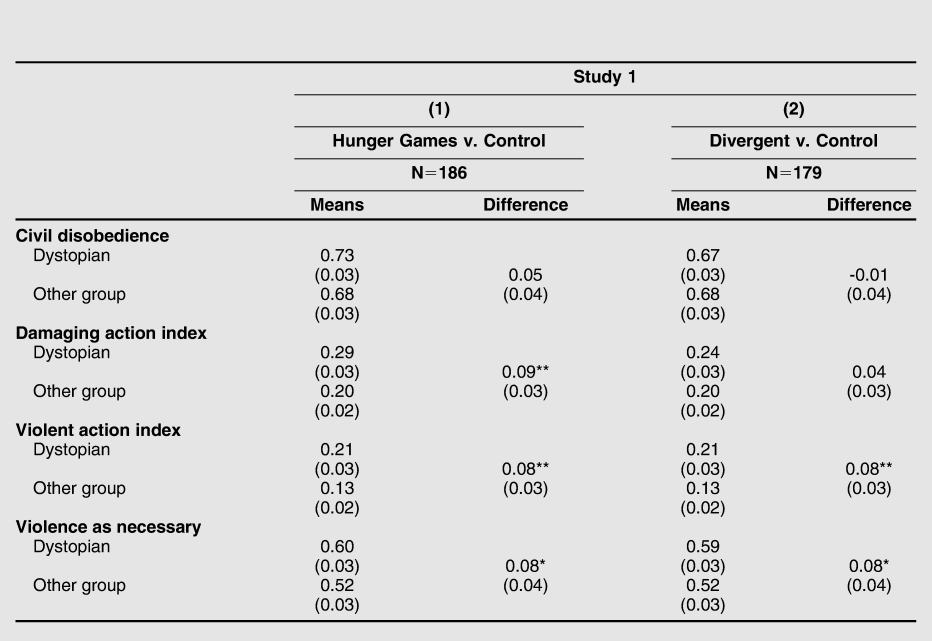
To what extent is dystopian fiction persuasive on one of the core messages of the genre—the idea that it is justifiable to confront governments seen as unjust with radical forms of resistance (H1)? As shown in table 1, we find that the Hunger Games dystopian treatment, relative to the no-media control group, had a statistically significant effect on the means of all three dependent variables tapping belief in the justifiability of radical political action: damaging action, violent action, and violence as necessary to pursue justice.Footnote 56 Moreover, the alternative dystopian treatment, Divergent, also heightened such beliefs in the case of violent action and violence as necessary to pursue justice. Strikingly, then, both examples of dystopian fiction intensified comfort with radical political action, pointing toward a genre effect that transcends individual storylines, and providing strong general support for H1. At the same time, and consistent with H1, neither treatment appeared to influence attitudes toward the not-so-radical form of resistance we included—“civil disobedience”—which is unsurprising given that the genre does not valorize conventional forms of contestation.
Impact of dystopian treatments on perceived legitimacy of radical political action in Study 1

Note: The table shows differences in means in justifiability attitudes in Study 1, comparing both dystopian treatments to the no-media control.
Standard errors are shown in parentheses.
Responses were recoded on 0 to 1 scale, so that positive differences of means between a treatment group and a control group can be interpreted as the percent-increase (or decrease) in a given variable caused by the treatment.
Respondents who skipped any of the justifiability measures were dropped.
Since hypotheses were directional in nature, t-tests are one-tailed.
Asterisks indicate levels of significance: *** = p<.001, ** = p<.01, and * = p<.05.
Studies 2 and 3: Assessing the Effects of Violent Imagery and Mass Protest
The central finding from Study 1 was support for the narrative persuasion hypothesis (H1). Yet an experimental manipulation involving an entire story narrative can be difficult to unpack and interpret. As a result, in both Studies 2 and 3, we sought to probe which features of the dystopian genre may be responsible for the striking and previously unrecognized effects that we found surrounding belief in the legitimacy of radical political action. Our strategy was to do so through the use of comparison media packages. Because of the complex nature of narrative stimuli, comparison media packages can be challenging to design, yet can also offer valuable pay-offs in clarifying what may be driving experimental results.
First, in Study 2, we sought to explore the possibility that the violence within dystopian fiction is responsible for the effects we observed in Study 1. This possibility is suggested by experimental research showing that exposure to media violence produces short-term increases in aggressive cognitions, emotions, and behavior. For example, college students randomly assigned to view violent film segments exhibited more aggressive behavior toward an opponent compared to students who saw nonviolent film segments.Footnote 57 Findings concerning links between longer term exposure and actual aggressive behavior and criminal violence are not consistent and are more difficult to assess, since experiments are not feasible. However, meta-analyses and triangulation of different types of studies point to such exposure as one risk factor, among many others, for actual aggressive behavior. A key mechanism is believed to be desensitization, with exposure to media violence reducing individuals’ normal negative responses to violence.Footnote 58
Thus, in Study 2, subjects were randomly assigned to one of three groups: the Hunger Games dystopian treatment, a no-media control, or a comparison media treatment drawn from another blockbuster fiction franchise: The Fast and the Furious.Footnote 59 Importantly, this treatment lacked a narrative story, yet contained violent action scenes of roughly the same duration and type as the violent action scenes that appeared in our Hunger Games treatment (refer to online Appendix D). Thus, like the Hunger Games treatment, the Fast and Furious treatment portrayed property destruction as well as trespassing and violence carried out by people. If media violence in itself makes subjects more comfortable with radical political action, then we should see significant effects on our outcome measures for both the Hunger Games as well as the Fast and Furious treatment.
For Study 3, we turned to another important question: might the heightened support for radical political action we observed in Study 1 be generated by any vivid portrayal of mass collective resistance on the part of citizens, be it in dystopian fiction or elsewhere in the media? In Study 3, we therefore included another comparison media treatment in addition to our no-media control group—a nonfiction and news-based treatment. Subjects in this group read two real news reports and watched real news footage about a conflict in Thailand pitting about a hundred thousand Thai protesters against an executive widely seen as autocratic and unjust.Footnote 60 The news treatment followed the efforts of citizens protesting violently against a government perceived as unjust, touched on classic dystopian tropes (e.g., individuals defying the government, claims of government illegitimacy, a frustrated populace, significant barriers to change, etc.), and included roughly the same amount and type of violent imagery as our Hunger Games dystopian treatment.Footnote 61 (Refer to online Appendix D for a detailed summary of the parallels in content among all treatments.)
In addition, as recommended by Druckman and Kam and Krupnikov and Levine,Footnote 62 in our latter two studies we turned from adults to student samples, not only for ease of access but also for good theoretical reasons: youth represent an important target population for our research, given that they consume entertainment media at high rates and are still experiencing political socialization.Footnote 63 Thus, we ran Study 2 (N=408) on a geographically diverse U.S. sample of undergraduates at a variety of higher education institutions in December–January 2015, and Study 3 (N=293) on an undergraduate sample at an East Coast university in April 2016.Footnote 64
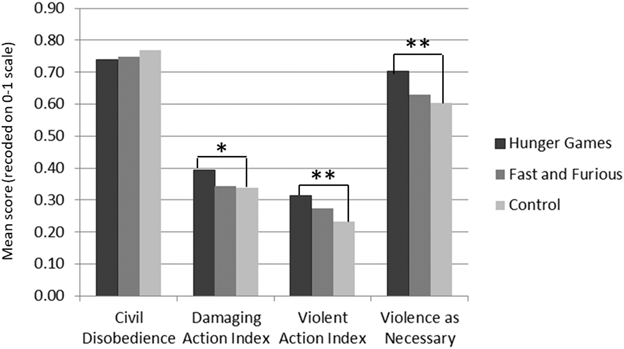
Narrative persuasion results for Studies 2 and 3 are shown in figures 2 and 3, respectively. In Study 2, the Hunger Games treatment again increased belief in the legitimacy of radical political action, successfully replicating the effects observed in Study 1. Figure 2 shows significant effects on all three dependent variables, and effect sizes were similar across this and Study 1, ranging from 0.26 to 0.39 (Cohen’s d).Footnote 65 Yet the Fast and Furious media treatment had no such effects, relative to the no-media control group. Thus, Study 2’s results suggest that media violence alone cannot explain the intensified support for radical political action we observed in Study 1 and subsequently replicated in Study 2.
Study 2. Assessing the effects of violent imagery
Notes: The graph shows the means for each treatment on dependent variables, and connector lines indicate significant differences (one-tailed).
Asterisks indicate levels of significance: *** = p<.001, ** = p<.01, and * = p<.05.
Means and standard errors for each dependent variable for Hunger Games, Fast and Furious, and Control (in order) are as follows:
Civil Disobedience .74(.03), .75(.02), .77(.02);
Damaging Action Index .39(.03), .34(.03), .34(.02);
Violent Action Index .31(.02), .27(.02), .23(.02);
Violence as Necessary .70(.03), .63(.03), .60(.03).

Study 3. Assessing the effects of scenes of mass protest
Notes: The graph shows the means for each treatment on dependent variables, and connector lines indicate significant differences (one-tailed).
Asterisks indicate levels of significance: *** = p<.001, ** = p<.01, and * = p<.05.
Means and standard errors for each dependent variable for Hunger Games, Nonfiction, and Control (in order) are as follows:
Civil Disobedience .74(.03), .78(.03), .78(.03);
Damaging Action Index .35(.03), .33(.02), .32(.03);
Violent Action Index .30(.03), .23(.02), .25(.03);
Violence as Necessary .68(.03), .60(.03), .63(.03).

Results for Study 3 also suggest that images of mass protest alone cannot explain the key results either. Here we see that the nonfiction treatment package did not affect any of the dependent variables surrounding support for radical political action. Although in the hypothesized direction, the impact of the Hunger Games treatment relative to the no-media control appears to have been slightly suppressed in Study 3, which, unlike the first two studies, took place in a less natural lab setting in which subjects were notably less attentive.Footnote 66 Yet the Hunger Games treatment did have a statistically significant effect on two of the three dependent variables—support for violent action and violence as necessary to pursue justice—relative to the alternative media exposure, with effect sizes falling in a similar range to that described earlier.Footnote 67
Although not perfect, these comparison media packages allow us to generate further insights about which features of dystopian fiction are responsible for heightening support for radical political action. The first helps assess the possibility that the portrayal of violence—in and of itself—makes subjects more comfortable with radical political action. If that were true, then there is nothing distinctive about dystopian narratives that leads to these effects; rather, it is their violence “doing the work.” Likewise, the second helps assess the possibility that any portrayal of masses of citizens taking up arms against a government perceived as unjust—be it in narrative fiction or in an evening news format—makes subjects more inclined to justify radical political action. By including this treatment, we explore whether this dystopian story element alone, occurring in the real world and stripped of its fictional narrative trappings, could account for the effects we found.
This is not to say that these two experiments can completely rule out either of these possibilities. For example, were there an extreme Hunger Games-like dystopian narrative in the real world, especially one closer to home that was featured in news reports, then this might produce the effects we found in Study 1. But there is no such analog: unsurprisingly, dystopian fiction tends to magnify and exaggerate the stuff of real world politics, making the design of comparative media packages a challenge, yet also hinting at why fiction—and propaganda, conspiracy theories, rumors, etc.—may hold a certain power.
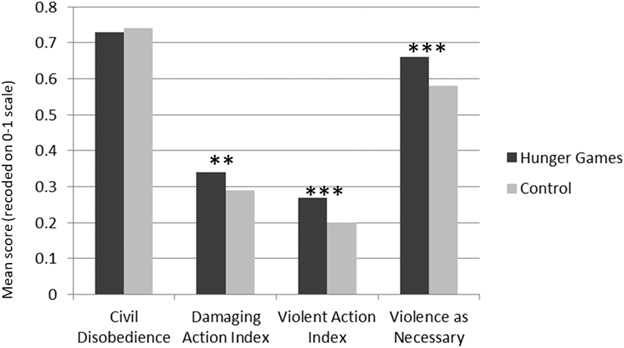
Figure 4 visually shows the pooled results for the four dependent variables from the three studies, comparing means for the Hunger Games treatment to the no-media control. Taken together, as the figure shows, there is compelling support for H1, that exposure to totalitarian-dystopian fiction increases the perceived legitimacy of radical—and particularly violent—responses to unjust governments. There is no indication that such exposure affects attitudes toward conventional, nonviolent resistance through civil disobedience.
Pooled results for Hunger Games treatment vs. control
Notes: The graph shows means pooled for Hunger Games treatments and control in Studies 1, 2 and 3.
Asterisks indicate levels of significance (one-tailed): *** = p<.001, ** = p<.01, and * = p<.05.
Means and standard errors for each dependent variable for pooled Hunger Games and Control (in order) are as follows:
Civil Disobedience .73(.02), .74(.01);
Damaging Action Index .34(.02), .29(.01);
Violent Action Index .27(.02), .20(.01);
Violence as Necessary .66(.02), .58(.02).

Agenda Setting and Folk Theories
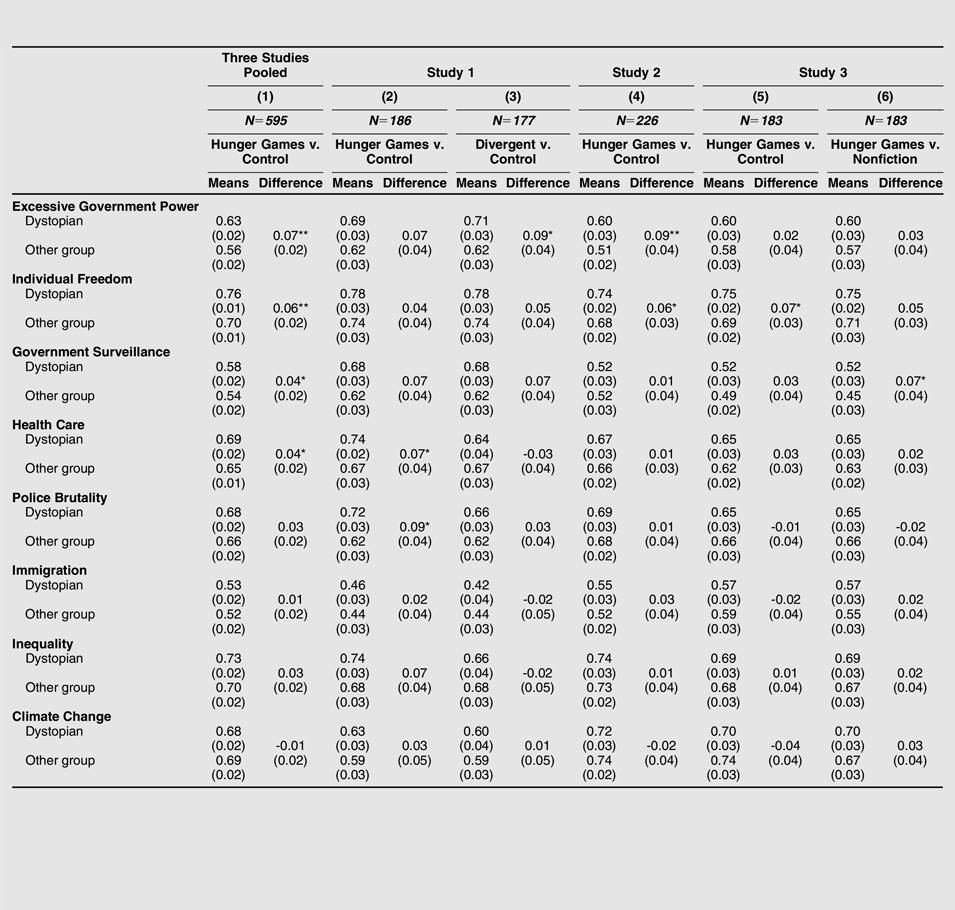
The pattern of results also offers some support for the agenda-setting hypothesis (H2). As shown in table 2, consistent with prior work on fictional agenda-setting,Footnote 68 we see that dystopian fiction increases the importance ascribed to the two issues most central to the totalitarian-dystopian genre—excessive government power and individual freedom—and the impact for both is significant in Study 2 and when pooling across all three studies. However, results are more mixed in Studies 1 and 3, in which dystopian fiction appears to increase the importance of only one or none of the two “dystopian” issues. Thus, the evidence supporting agenda-setting is less consistent than the evidence for a narrative persuasion effect on belief in the legitimacy of radical political action.
Impact of dystopian treatments on agenda-setting

Notes: The table shows differences in the means in issue importance by condition in each study and pooled across all three studies.
Standard errors are shown in parentheses.
Respondents were asked, “How concerned are you about each of the following issues on a scale from 0 (Not at all concerned) to 100 (Very concerned)?”and shown a 100-point slider.
Responses were recoded on 0 to 1 scale.
Since hypotheses were directional in nature, t-tests are one-tailed. Asterisks indicate levels of significance: *** = p<.001, ** = p<.01, and * = p<.05.
Given the wide support that agenda-setting has received elsewhere,Footnote 69 this finding is surprising, and may point to the need for further research on the conditions under which narrative persuasion is likely to outperform agenda-setting, and vice versa, within fictional media genres. For example, communications scholars have suggested that entertainment consumption may be driven by different types of motivations. While escapist (“hedonic”) motivation may lead to one kind of emotional involvement driven by less in-depth cognitive processing—perhaps enhancing the likelihood of narrative persuasion—truth-seeking (“eudemonic”) motivation may lead to another, fostering reflection on important issues (including political ones) and thus a greater potential for agenda-setting.Footnote 70 Taken together, the results also suggest that narrative-specific and broader genre-wide agenda-setting effects may compete; for example, in Study 1, the Hunger Games treatment enhanced concern about “police brutality”—heavily featured in that narrative’s specific storyline—but not “excessive government power,” even though the former issue is logically related to the latter.
Finally, we turn to the dystopian folk theories. Strikingly, despite significant popular anxiety surrounding the possibility for dystopian fiction to foster a deeply cynical generation, we again found no support for the notion that it reduces trust in politicians, intent to participate in politics, or efficacy (H3). We also found little evidence for effects on attitudes related to gender equality (H4). Although these are non-effects, they are substantively important, since they suggest that the main effects of dystopian fiction are not what is popularly anticipated.Footnote 71
Additional Results
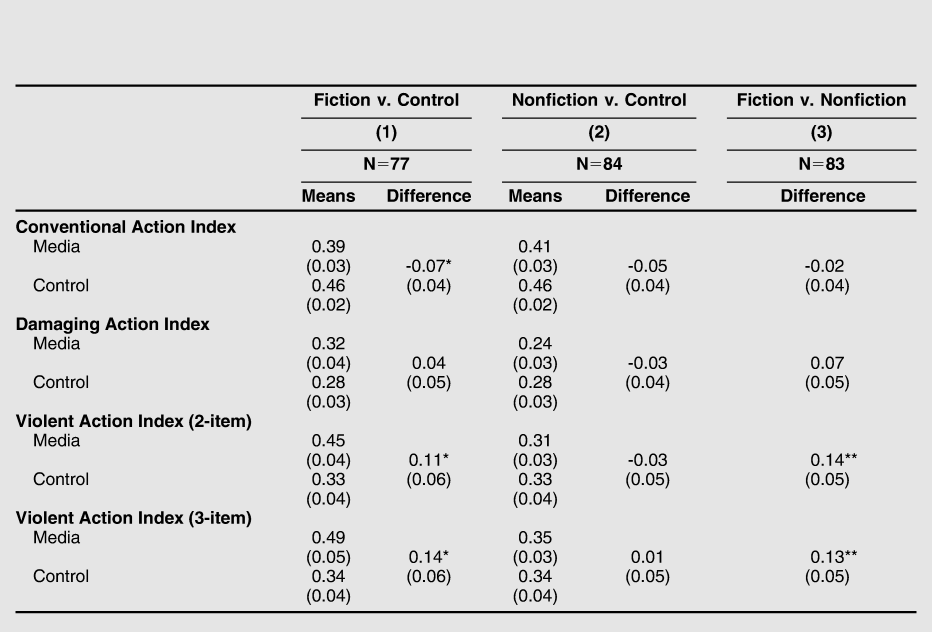
Does narrative persuasion work differently for the most attentive subjects? Study 3 afforded an opportunity to build on the justifiability results found earlier (H1) by asking respondents not only how justifiable but also how effective they consider radical methods of contestation. Subjects were asked “How effective do you think each of the following actions are, as a way of responding to injustice?” and provided with an expanded list of possibilities including more conventional and more radical actions (refer to the table 3 notes). As table 3 shows, totalitarian-dystopian fiction led the most attentive subjects to see conventional and nonviolent political action as significantly less effective, and violent political action as significantly more effective, compared to those in the no-media control group.Footnote 72
Impact of dystopian treatments on perceived effectiveness of action among attentive respondents (Study 3)

Notes: The table shows mean difference in effectiveness beliefs by condition in Study 3, limiting the sample to only those respondents who got all three quiz questions correct. Standard errors are shown in parentheses.
Respondents were asked, “How effective do you think each of the following actions are, as a way of responding to injustice?”
Responses were given on a 100-point slider anchored by “Not effective at all” at one end and “Very effective” at the other end, and responses were recoded on 0 to 1 scale.
Conventional action items were: signing a petition, writing a letter, posting a comment on social media, voting for a particular candidate, donating to a particular candidate, donating to an activist group, and participating in a nonviolent protest or march (Cronbach’s alpha=.84). Damaging action items were: engaging in cyber-attacks against those responsible and destroying the property of those responsible (Cronbach’s alpha=.80). Violent action items for the 2-item index were participating in a violent protest and participating in an armed rebellion (Cronbach’s alpha=.83), while the 3-item index added overthrowing the government as well (Cronbach’s alpha=.86).
Those who skipped any of the effectiveness measures were dropped. Since hypotheses were directional in nature, t-tests are one-tailed.
Asterisks indicate levels of significance: *** = p<.001, ** = p<.01, and * = p<.05.
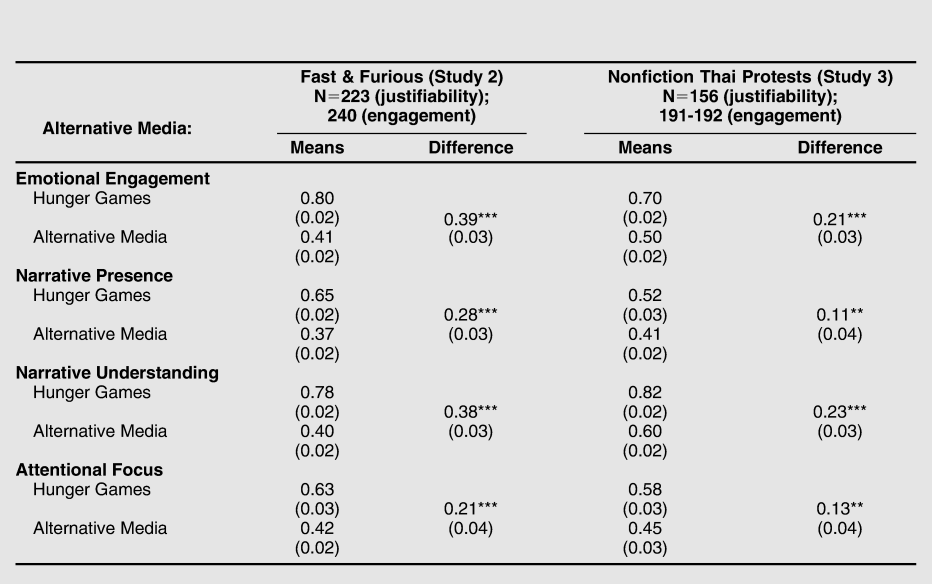
In addition, we included several items in Studies 2 and 3 to begin probing what may mediate the effects of dystopian fiction, and we found evidence suggestive of causal mechanisms posited in the narrative persuasion literature. Drawing from this literature, we measured subjects’ degree of affective and cognitive engagement with both dystopian and alternative media treatments. As table 4 shows, compared to those exposed to the Fast and Furious and nonfiction media treatments, those receiving the dystopian fiction treatment were more emotionally engaged and immersed in the story and were more focused on and better understood the unfolding events.Footnote 73 This is characteristic of narrative fiction, relative to decontextualized scenes of violence and to news media reporting: fictional narratives are appealing precisely because they are designed to be emotionally compelling and immersive, suggesting why they may be so persuasive even though they are fictional. Indeed, certain genres of stories likely become popular in part because readers and viewers find them especially engaging.
Impact of Hunger Games relative to alternative media treatments on narrative engagement

Notes: The table shows differences in means for a modified 8-item narrative engagement scale with four sub-indices (Busselle and Bilandzic Reference Busselle and Bilandzic2009), comparing engagement with the Hunger Games treatment to engagement with the two alternative media treatments.
All items were on a 7-point Likert scale (strongly disagree to strongly agree), recoded 0 to 1 so that higher numbers indicated greater engagement. Emotional engagement items were: “During the program, when a main character succeeded, I felt happy, and when they suffered in some way, I felt sad.” and “The story affected me emotionally.” Narrative presence items were: “At times during the program, the story world was closer to me than the real world.” and “During the program, my body was in the room, but my mind was inside the world created by the story.” Narrative understanding items were: “My understanding of the characters is unclear.” and “I had a hard time recognizing the thread of the story.” Attentional focus items were: “While the program was on I found myself thinking about other things.” and “I had difficulty keeping my mind on the program.”
T-tests are two-tailed.
Asterisks indicate levels of significance: *** = p<.001, ** = p<.01, and * = p<.05.
We specifically eliminated the narrative element from the Fast and Furious treatment, but the reduced engagement for the nonfiction treatment may reflect genuine differences between news reporting and fictional narratives: journalistic norms of objectivity and impartiality typically discourage “taking sides,” while narrative fiction draws readers to empathize with protagonists and blame antagonists, further underscoring the need to experimentally test the impact of fictional narratives on political attitudes. Of course, to the extent that nonfiction writing or film takes on some of the features found more commonly in fiction, such as a gripping narrative, vivid characterizations, portrayals of “heroes” and “villains,” and a clear moral message, we would expect that impacts on attitudes might be correspondingly similar (e.g., Funt et al. 2016)—although it is also worth keeping in mind that nonfiction reporting rarely matches fiction in these respects given the ambiguity and complexity of most real-world situations, and when it does, it is often judged to be propaganda.
Given these differences, it is also worth noting that nonfiction may be less powerful and mobilizing—and perhaps even deactivating—in comparison to fiction in ways that are not yet well understood. In Study 3, our nonfiction treatment with dystopian themes had no significant impact relative to the no-media group on subjects’ beliefs about the effectiveness of radical political action. Yet it bears note that three of the four differences in means, as shown in table 3, are in the negative direction, suggesting that if there were such an effect, it would be towards viewing all forms of political action as less effective. Insofar as traditional news media highlight the complex and uncertain effects of political actions and decisions—as reporting about the anti-government protests in Thailand certainly did—such media may lessen the public’s confidence in the prospects of any particular mode of political engagement being successful.Footnote 74 Whether or not regular news media generally shape beliefs about political effectiveness, the contrast with dystopian fiction is notable, as we find more evidence for people drawing “political life lessons” from a narrative about an imaginary political world than from fact-based reporting about the real world.
Discussion and Implications
Our central finding is that totalitarian-dystopian fiction heightens belief in the justifiability of radical political action, among youth (Studies 2–3) as well as adults (Study 1). This effect generally holds across multiple studies, multiple variables, and multiple examples of the genre. This finding is striking, and far from inevitable. Subjects might have reasonably dismissed our fiction treatments as just that—fiction—and shown little inclination to incorporate lessons from the narrative into their general political attitudes. Importantly, too, our stimuli were evidently not so overpowering as to generate wide-scale treatment effects across all variables with potential relevance to the narrative; we did not find consistent evidence for theoretically better-established agenda-setting effects, and we found no support for folk hypotheses about political efficacy and trust or women in leadership and combat.Footnote 75
The main findings surrounding belief in the justifiability of radical action are especially notable given the relatively conservative nature of our tests, as we exposed subjects to only a small slice of a dystopian narrative and gave them no choice in exposure. The impact may be larger among an audience that self-selected into dystopian fiction out of interest in the thematic material and experienced a more extended engagement with the fictional world (such as reading an entire book or series or viewing a multi-hour movie). This possibility highlights the need for further research into potential interactions between audience characteristics and the nature of the narrative message, as such an investigation may well uncover differences in the way these effects unfold among different audiences.
Moreover, the effect sizes, while not large, were not trivial. For example, for the violent action index, across the three studies, we see a mean increase of .07 on a 0 to 1 scale, about one-third of a standard deviation. Similarly, for the violence as necessary item, there is a mean increase of .08, which is about 28% of a standard deviation. To place the magnitude of these effects in context, they are comparable to those found in the larger literature on violent media effects.Footnote 76 Yet they are also particularly noteworthy because our questions focus on attitudes towards extreme political actions—such as armed rebellion—which one might not prima facie expect to be highly susceptible to influence in a survey experiment.
How lasting are these effects likely to be? This is an important question that the experimental studies cannot answer directly. However, we see good reason to expect these effects to manifest and persist outside of experimental conditions. First, the research here is not limited to our experiments; we also conducted focus groups with youth, and their comments as readers and viewers of dystopian narratives suggest that the effects we identified and replicated are not mere experimental artifacts. Focus group subjects emphasized how the “really rebellious feel” of dystopian fiction made them angry and ready for action, and reminded them that even ordinary people “can challenge the status quo” and “rebel against the system.” These comments also align with recent observations of bookstore managers; as one observed, “What we’ve seen … is these classic dystopian books are actually leading people to buy books in our activism section . . . . It’s taken people from going, ‘Okay, we know we’re in this dystopian frightening world,’ to going ‘Okay, what do we do about it?’ We’re seeing a lot of sales going to our activism/politics section.”Footnote 77 Such effects would also be congruent with meta-analyses of the literature on media violence, one of which finds that “violent media increased aggression both inside and outside the laboratory.”Footnote 78
In addition, the effects’ persistence would be consistent with recent experiments suggesting a “sleeper effect” in which fictional narratives, due to their immersive qualities and the suspension of counterarguing involved in mechanisms of narrative persuasion, can produce persuasive effects that are more lasting than those of nonfiction.Footnote 79 The fact that one of our experiments (Study 1) focuses not on youth but on adults also suggests that effects can emerge or persist well into adulthood.
Nevertheless, even if one-shot exposure effects did turn out to be relatively transitory, such effects may still result in real-world consequences. First, the potential for repeated exposure is high, given the continued popularity of dystopian themes in pop culture.Footnote 80 Repeated exposure, moreover, is likely to facilitate narrative persuasion, rather than desensitize subjects, because of the immersive and enjoyable nature of fiction. Our focus group evidence certainly suggests as much: repeated exposure to the dystopian genre did not inure subjects to its themes, but rather underscored their relevance. Not only is repeated exposure likely to cause more lasting effects, but it also increases the quantity of “post-exposure” time and thus the likelihood that such attitudinal shifts could coincide with real-world opportunities for action.Footnote 81
Our own data further point to the likelihood of repeated exposure over time. We found that 76.4% of subjects in the three studies reported that they had seen or read more than one book or movie in the dystopian genre. Those subjects consumed an average of 4 out of the 8 examples we asked about, further suggesting that exposure is not typically limited to a single event. In contrast, only 16.7% reported seeing or reading only one example.
To further assess repeated exposure, we turned to the Goodreads.com website, a community of over 65 million readers who rate and recommend books based on their own experiences. Readers can create and place books on digital “shelves” to categorize them in various ways, including the genre to which the reader thinks the book belongs. One such shelf is “dystopia,” and The Hunger Games earned the largest number of placements to this shelf of any book, along with an overall rating of 4.33 out of 5. The next ten books with the most “dystopia” placements were, in order, Divergent, Mockingjay, Catching Fire, Insurgent, Allegiant, 1984, The Maze Runner, Matched, The Handmaid’s Tale, and Delirium, all of which meet our own definition of totalitarian-dystopian. Footnote 82 Using Goodreads’ API and search capabilities, we analyzed the reading patterns of a sample (n=600)Footnote 83 of readers who rated Hunger Games a 4 or 5 to determine the extent to which these readers were exposed to these other ten books, and found an average of 5.33 (sd=2.63) books out of the 10 in their personal lists. Indeed, 97% had included at least one of those other books.Footnote 84 Thus, an examination of actual reading patterns suggests considerable repeated exposure for readers who enjoyed one popular book in the genre.
We also investigated whether prior exposure to the Hunger Games series, age, and gender moderated the effects of our treatment (table A3, in online Appendix A). Consistent with our expectations, prior exposure to Hunger Games was associated with being significantly more willing to justify violence. (Interacting prior exposure and an indicator for the Hunger Games treatment resulted in coefficients that were consistently positive but not statistically significant.)
Our results also suggest important implications for the broader study of radicalization. Although fiction may seem a far cry from real-world radicalism and political violence, stories and narratives of varying truth (e.g., propaganda, conspiracy theories, excessively partisan news, rumors) can be key mechanisms of radicalization; narrative videos released by ISIS provide only the latest example.Footnote 85 By valorizing radical over conventional contestation of injustice, dystopian narratives in particular may allow individuals to bypass earlier expected stages of radicalization.Footnote 86 Moreover, the fact that dystopian narratives heightened subjects’ openness to radical political action—without activating them politically in more conventional ways—suggests that radicalism itself may evolve in more latent or contingent ways than is commonly recognized. In short, openness to radicalism may be quietly cultivated by narratives in wide circulation, including not only narratives propounded by political actors and news organizations, but also dystopian and other fictional narratives circulating in pop culture.Footnote 87 This would be consistent with recent work suggesting that support for political violence is more common than is typically believed.Footnote 88
Conclusions
Our research not only reinforces past work showing that people often fail to distinguish between fact and fiction in learning about the world, but also illustrates that the lessons of fiction may not be what they seem. While much ink has been spilled lamenting the darkness of the world presented through dystopian books and movies and analyzing the implications of Katniss as a feminist heroine, the actual impact of dystopian fiction like The Hunger Games and Divergent appears to be far afield from these anxieties. Rather than creating political cynicism in readers and viewers or showing them that girls can be powerful too—both lessons that are at this point probably amply supplied by the American news media and lived experience—dystopian fiction seems to be teaching them a more subtle and perhaps more concerning message: that violence and illegal activities may be both legitimate and necessary to pursue justice. Dystopian fiction appears to subtly expand the political imagination of viewers and readers to encompass a range of scenarios outside the normal realm of democratic politics, and what people then consider reasonable and thinkable appears to expand accordingly.
These results should also highlight the peril for political scientists in assuming that fiction is just entertainment. The stories we tell ourselves have profound implications for how we think about political ethics and political possibilities, and as scholars of politics, we can and should do more to map out the effects of politically-inflected fiction and entertainment.
Supplemental Materials
Appendix A. Supplementary Figures and Tables
Appendix B. Description of Focus Groups
Appendix C. Media Treatments
Appendix D. Content Comparison of Action, Destruction, and Violence Portrayed in Treatments
Appendix E. Subject Recruitment Procedures
Appendix F. Checking for Demand Effects