

Ballot measures are often decided by narrow vote margins and can have significant impacts on social policy and public welfare. In 2014, voters in 42 states considered 159 statewide ballot measures.Footnote 1 These measures addressed a wide range of topics, including hydraulic fracking, LGBT rights, marijuana use, public pensions, sports team subsidies, and minimum wage. Many of these measures were decided by narrow margins, with 19 ballot measures passing with less than 55% of voters in favor. As such, even the smallest aspects of electoral rules, voter participation, ballot wording, and campaign strategy can have significant consequences.
California's Proposition 8 in 2008 illustrates the perceived impact of ballot wording. The proponents of Proposition 8 had originally circulated the measure for signatures saying that it would “provide that only marriage between a man and a woman is valid or recognized in California.” Once the initiative had received enough signatures to be placed on the ballot, the Attorney General of California changed the wording that would appear on the ballots to say that Proposition 8 seeks to “eliminate the right of same-sex couples to marry,” a sentence that he believed better reflected the true effect of the law. Proponents of the law sued Brown over the wording change, and “Yes on 8” campaign lawyer Andrew Pugno stated that the new wording was “calculated to encourage people to vote against the measure.”
This initiative highlights the potential role that status quo bias can play in the outcome of a ballot measure. Status quo bias is the tendency for an individual to choose the status quo because the “disadvantages of leaving [the status quo] loom larger than advantages” (Kahneman et al., Reference Kahneman, Knetsch and Thaler1991). Status quo bias has been documented in many settings, including choosing residential electrical services (Hartman et al., Reference Hartman, Doane and Woo1991), deciding whether to become an organ donor (Amir et al., Reference Amir, Ariely, Cooke, Dunning, Epley, Gneezy, Koszegi, Lichtenstein, Mazar, Mullainathan, Prelec, Shafir and Silva2005), and selecting employer contribution retirement plans (Thaler and Benartzi, Reference Thaler and Benartzi2004). In ballot wording, status quo bias describes the potential of voters to make their decision based on the status of the current policy. This may especially be the case for policies about which the voter is undecided, indifferent, or uninformed (Magleby, 1984). In these cases, familiar cues, such as the partisanship of a legislative candidate, are unavailable to the voter (Lupia, 1994). In the case of Proposition 8, the “eliminate same-sex marriage” wording may have reminded voters that the state currently recognized same-sex marriages, whereas the alternative wording contained no such prompting. This could possibly have biased voters to vote “no” on the proposition, even if they would have otherwise voted “yes.”
In this study, we test the prevalence and magnitude of the status quo bias in a controlled survey experiment where subjects are asked to “vote” on five currently relevant policy areas. Each respondent receives a randomly assigned wording of each ballot measure that either varies the status quo imbedded in the text of the question or provides a neutral wording. We find that including a status quo framing changes the percent of voters that approve a new policy by 5–8 percentage points. This effect is moderated by the level of information that voters have about the issue, where those who are least informed are most affected by the status quo bias.
BACKGROUND
Past research has found that small changes in the presentation (or frame) of a ballot question can change the expressed opinion of voters. These biases can depend on specific word choices (Schuldt et al., Reference Schuldt, Konrath and Schwarz2011), the graphic design and presentation of ballots (Kimball and Kropf, Reference Kimball and Kropf2005), and the complexity of ballot wordings (Reilly and Richey, Reference Reilly and Richey2009; Zimmerman, 2014). The magnitude of these framing effects is also influenced by the knowledge and information the individual already has about the issue (Hobolt, Reference Hobolt2009). Much of the status quo literature attaches the bias to risk aversion or uncertainty, where voters are hesitant to approve a change in policy that they have little information about, or that has uncertain consequences for the voter or society at large. Chong and Druckman (Reference Chong and Druckman2007) further argue that the influence of framing effects is dependent on the strength and repetition of the frame, individual motivations, and the amount of information and risk involved in the decision.
EXPERIMENTAL DESIGN
One of the challenges with using naturally occurring variation in the wording of different ballot measures is that it is heavily influenced by the political culture of the state and incumbent government. Differences in election outcomes across wording choices may reflect differences in unobserved characteristics across states rather than a causal effect of the wording choice. Since randomly assigning ballot wording is infeasible in real elections, we instead approximate the voting experience through a randomized survey experiment.
Our experiment includes five questions that cover a variety of issues that have appeared on state election ballots in the past 5 years, including legalization of medical marijuana, voting rights for people who are mentally disabled, same-day voting registration, Indian gaming laws, and same-sex marriage. Each respondent is asked about all five ballot initiative topics, and the wording of each question randomized for each subject into one of the three following conditions: the first does not indicate the status of the current law, the second indicates that the right is not currently granted, and the third that the right is currently granted. In each case, the voter decides whether or not the minority group should have the given right. Table A1 in the supplemental materials shows the exact wording of each treatment condition, and Table A2 shows the overall fraction of subjects who report that they would vote to extend the rights to the group for each of the treatment conditions.
All of our subjects were recruited through the Amazon Mechanical Turk (MTurk) online marketplace. MTurk was developed as a resource for employers or individuals that want to “crowdsource” certain tasks that can be completed anonymously online. Many social scientists have used MTurk to collect survey responses (Grose et al., Reference Grose, Malhotra, Parks and Houweling2014; Healy and Lenz, 2014; Tomz and Weeks, Reference Tomz and Weeks2013). Berinsky et al. (Reference Berinsky, Huber and Lenz2012) provide a good description of the benefits and drawbacks of MTurk and show that replications of published work using MTurk subjects often lead to similar results as those that use more traditional probability samples.
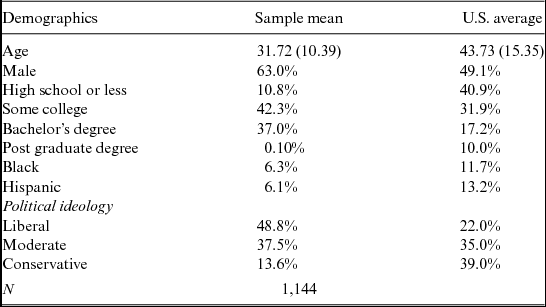
One of the potential drawbacks of our sampling technique is that our sample is not randomly selected. The cross-section of the population that regularly uses MTurk tends to be slightly younger, more liberal in political opinion, and more likely to be female than the average American (Berinsky et al., Reference Berinsky, Huber and Lenz2012). The summary statistics of our sample population displayed in Table 1 are based on demographic questions asked at the end of the experiment. We compare these measures to the average adult in the United States using data from the American Community Survey and a recent Gallup poll. We find that our respondents are in fact younger and more liberal than the national average, but are 60% male, a higher proportion than either the national average or the typical MTurk sample. To account for this, we introduce weights based on the general American population as well as the likely electorate to bring the sample in line with national averages. Figures A1 and A2 in the supplemental materials show the distribution of these weights. We find that our results are very similar when we include these weights in our analysis. These results are displayed in Table A4 of the supplemental materials.
Summary Statistics
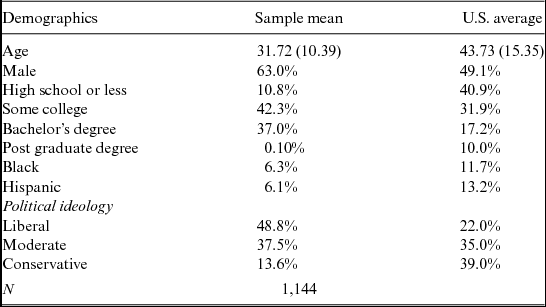
Notes: The demographic information is based on adults from the American Community Survey (2012) and the data on political ideology is based on a Gallup poll (2013) of U.S. adults. Standard deviation of age reported in parentheses.
RESULTS
Our dependent variable is a dichotomous variable indicating whether the respondent favors granting the particular right to the minority group. We present results from a linear probability model; however, the results are very similar in terms of the estimated marginal effects and statistical significant when using a logistical regression model. In each model, we cluster the standard errors by individual since each respondent has five observations, one for each of the policy areas we asked them to consider.
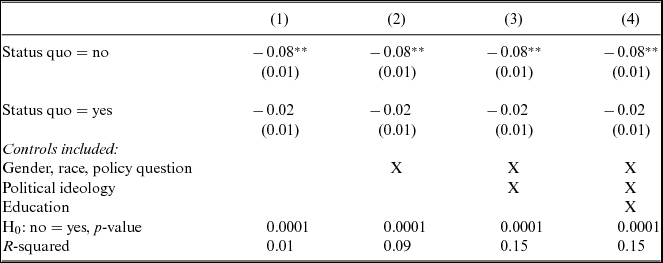
Table 2 reports the results in which we compare the effect of the two status quo treatments relative to the neutral condition. Column 1 provides the simple bivariate relationship, and each of the subsequent columns includes additional covariates in the regression. Column 2 includes controls for race/ethnicity and gender. Column 3 adds controls for political ideology.Footnote 2 Finally, column 4 adds controls for level of education.
OLS Regression of the Effect of Ballot Wording on Share of Individuals Supporting Rights for the Minority Group
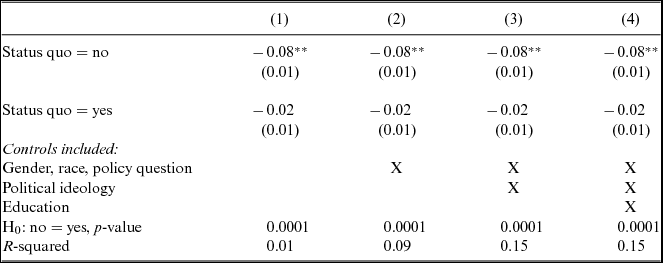
Notes: N = 5,720 (five questions each for 1,140 respondents). The omitted group is the neutral condition (no status quo mentioned) and the average support for all policy questions is 0.743. ** and * indicate statistical significance at the 1% and 5% levels, respectively. Standard errors are provided in parentheses.
Across all specifications, there is a significant difference in response between the control and “no” status quo groups. In comparison to the control group, respondents were nearly eight percentage points less likely to support a policy if existing laws prohibited it. In other words, voters that were told that the state currently did not provide the right (e.g. medical marijuana is currently illegal) were eight percentage points less likely to vote “yes” on the issue (legalizing medical marijuana) than respondents who were asked their opinion of the policy without knowing the current status quo. The treatment effect remains constant and statistically significant at the 1% level, even after including various controls. In contrast, we find that setting the status quo to “yes” (e.g. medical marijuana is currently legal) led to no significant difference in the probability of respondents voting to maintain/extend the right than when respondents were presented the question without reference to the status quo.
In addition to the main results presented in Table 2, we hypothesize that a voter's response to the framing of a question may only represent one factor in determining his or her voting decision. Voters often have pre-defined beliefs and opinions about an issue that affect their vote. Since these determinants will likely be stronger for voters who are well informed about an issue, we expect that status quo bias will most heavily influence uninformed or otherwise indecisive voters.
We identify the relationship between information and framing bias in two different ways. First, we interact the treatment terms with the level of information a voter has for each issue. Following the ballot questions, each respondent was asked to rate on a scale of 1–10 their knowledge of each issue (where 1 was low information and 10 was high information). Respondents indicated very low levels of information about high-stakes gambling on tribal land (mean = 3.21) and voting rights of individuals with mental illness (mean = 3.60). They reported slightly higher levels of information about same-day voter registration (mean = 5.26), medical marijuana use (mean = 6.82), and same-sex marriage rights (mean = 7.24). By interacting this measure with each treatment, we test whether information affected the magnitude of the bias. In order to improve the interpretation of the interactions, we normalized the scale by subtracting the mean and dividing by the standard deviation. Therefore, the coefficient on the information variable represents the change in the probability of supporting the policy when moving one standard deviation above the mean along the distribution of voter information.
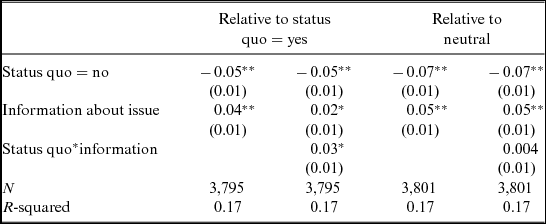
Table 3 is simplified to compare one treatment group at a time. The first two columns of Table 3 show the difference between the “status quo = no” treatment and the “status quo = yes” treatment. The third and fourth columns compare the “status quo = no” treatment to the neutral control condition. The comparisons are done separately to make the interaction variable easier to interpret. We see that a voter's information has a significant and non-trivial effect on his or her likelihood of supporting a policy when compared to the “status quo = yes” condition, but not to the neutral condition. One possible concern with these results is that uninformed voters are less likely to vote than voters who possess more information on the ballot measure. As such, the treatment is especially weak among those who are most likely to decide the outcome of any particular ballot measure. We address this potential concern in two ways. First, while uninformed voters may individually be less likely to turn out to vote, in the aggregate, low propensity voters still make up a large share of the electorate in any particular election (Barber et al., Reference Barber, Mann, Quin Monson and Patterson2014). Thus, we suggest that the larger treatment effect among uninformed voters still holds substantive significance for the practical question of how ballot wording may affect the outcome of an election.
OLS Regression of the Effect of Ballot Wording on Share of Individuals Supporting Extending Rights to the Minority Group, Interacted with Respondent Level of Information
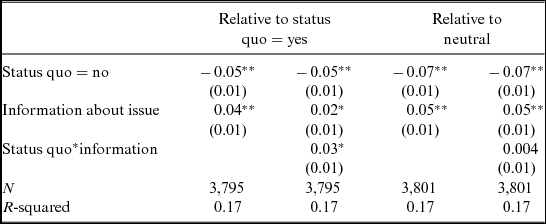
Notes: All columns use control variables from column 4 of Table 2. ** and * indicate statistical significance at the 1% and 5% levels, respectively. Standard errors are provided in parentheses.
Secondly, we reweight the sample using a propensity to vote score and find that after giving greater weight to likely voters that the results are consistent with those presented in Table 3. Footnote 3
The second column of Table 3 provides results from a regression that includes the interaction between the treatment and how informed the voter is. The magnitude of this interaction shows the change in treatment effect among voters who are one standard deviation higher in how informed they report being on that particular issue. The baseline estimate of the difference between the “yes” and “no” treatment condition is five percentage points while the interaction term has a coefficient of three percentage points. These results indicate that the status quo bias is strongest among those individuals who are least informed about the particular issue and that the most informed voters experience very little, if any, status quo bias.
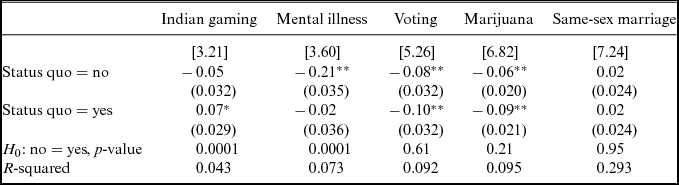
The second way in which we account for information is by analyzing the results separately for each issue area and comparing the magnitude of the results by the aggregate level of information voters have about each issue. Table 4 shows these results. Each column shows the effect of status-quo framing for a different issue area. The columns are ordered by the aggregate level of information voters have, beginning with Indian gaming as the issue for which voters have the least information and ending with gay marriage, for which voters have the most information. The results align with Table 3 in that the treatment effect is smaller and statistically insignificant for the issue of same-sex marriage where participants report being the most informed about the issue.
Results by Issue
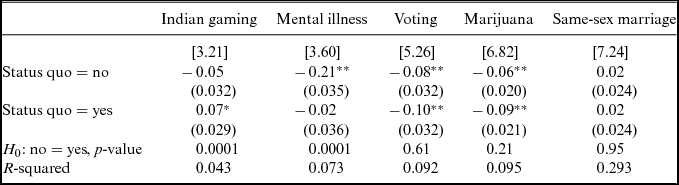
Notes: Each regression has a sample size of 1,144. The omitted group is the neutral condition (no status quo mentioned). Controls include gender, race, political ideology, and education. ** and * indicate statistical significance at the 1% and 5% levels, respectively. Standard errors are provided in parentheses. The numbers in brackets are the average reported level of being informed on the topic across subjects (based on a 10-point scale).
DISCUSSION AND CONCLUSION
Were proponents of Proposition 8 correct to worry that the alteration of the ballot wording may have hurt the prospects of Prop 8’s passage? Our results suggest that in some ways the concern was accurate. Our experiment suggests that the inclusion of the existing status quo on ballot language can dramatically affect the likelihood of voters to extend or removing rights from minority groups. However, on the specific issue of same-sex marriage, it appears as though the high-information context of this particular issue mutes the impact of status quo bias. Nevertheless, many more ballot measures involve issues on which voters are minimally informed, and thus, our results suggest that the wording of the ballot language could dramatically affect the outcome of a number of ballot decisions.
The construction of this survey experiment presents some limitations that should be noted. Our research hypotheses required that we frame the questions with a status quo that may not accurately represent the current laws of the respondent's state. Since the participants in the experiment came from across the United States, we notified the subjects that similar questions had actually appeared as ballot initiatives in various states in the past 5 years. We asked the subjects to vote as they would if the ballot initiative were to appear on their state's ballot. Although it may be the case that respondents were influenced by the current status quo in their state and not the stated status quo that we provided in our survey, we find that the results in this paper are similar whether or not we control for the actual policy in place in the state where the subject lives. In the supplemental materials, we also exclude observations in which the treatment condition does not match the current law in a person's state. These results are presented in the supplemental materials as Table A5 and align with the main results presented in Table 2.
We also account for potential invalid responses through mechanisms built into our survey. Since each question includes a timestamp, we can discard or control for question responses that were submitted in a time that seemed unreasonable for reading the questions fully before giving an answer. These restrictions do not significantly affect the results. We also built in a manipulation check at the beginning of the survey. An early question asked respondents to answer in a specific way that would be unclear unless the subject read the entire paragraph carefully. If the subject provided an incorrect response, the survey produced an error message and re-prompted the question until it was answered correctly.
Using a randomized survey experiment of political issues, we find that voters are affected by small changes in the framing of ballot initiatives. We find that status quo bias can change the share of voters supporting a policy by up to eight percentage points and this effect is concentrated among less informed voters. Since many elections are decided by narrow margins, the estimated magnitude of the effect in this paper could potentially be enough to change the outcome of ballot initiatives. Therefore, policy makers and issue advocacy groups should consider carefully the ballot language and the amount of information that is presented to voters at the polls.
SUPPLEMENTARY MATERIALS
For supplementary material for this article, please visit Cambridge Journals Online: https://doi.org/10.1017/XPS.2017.9.