The theory of minority political incorporation (Browning,
Marshall, and Tabb 1984; 2001)
addressed the rise of African Americans and Latinos in urban politics
through coalitions that combined the mobilization of African-American
communities and White liberals (Sonenshein 1993)
and, at times, Hispanics. While Hispanics were important to the theory of
political incorporation, their role was neither consistent nor central in
coalitions for minority advancement during the 1970s, 1980s, and early
1990s. However, Latinos; impressive demographic strength is now translating
into major voter registration and turnout gains, and Latinos increasingly
are taking the lead in minority incorporation in some cities and states.
There is, perhaps, no better example of Latinos; increasing political clout
than City Councilman Antonio Villaraigosa's smashing electoral victory to
become the first Latino mayor of Los Angeles in more than 130 years.
Villaraigosa;s election attracted national and international attention, and
energized Latino activists around the country.
As Latinos (and potentially other groups) move toward center stage, the
dynamics of coalition-building in urban politics will inevitably change.
John Mollenkopf (2001, 136) notes that: “Forming a
dominant political coalition will depend on who can construct broader and
more complex coalitions than the relatively simple biracial ones.” The
coalitions that Latinos form, and the opposing coalitions that they face,
are likely to shape and reshape urban politics for years to come. The Latino
political experience is both like and unlike that of African Americans. More
diverse politically, Latinos may have less unified power, but more coalition
options. Like Latinos in the earlier era, African Americans are increasingly
on the outside looking in, sometimes allying with and sometimes opposing the
leading group.
Contemporary scholarship has isolated areas of conflict and coalition among
the main groups in today's diverse cities (Browning,
Marshall, and Tabb 1984; 2001; Jones-Correa 2001; Warren and
Moreno 2001; Grenier and Castro 2001;
Kaufmann 2003; 2004;
McClain and Karnig 1990; Sleeper 1993; Sonenshein, Schockman, and
DeLeon 1996; McClain and Tauber 1998;
Johnson and Oliver 1989; Park and Park 2002). Several coalition possibilities might
structure a new Latino incorporation: 1) Liberal coalitions with White
liberals against conservative Whites; 2) Coalitions of color with African
Americans and/or Asian Americans; and 3) Conservative alliances with Whites
against African Americans and/or liberal Whites.
The dynamics of Villaraigosa's election may help illuminate the prospects for
Latino mayoral candidates, and for further Latino political success. The
effects of recent decades of immigration dominated by Hispanics continue to
reshape urban politics. More broadly, the wider political involvement of
Latinos is influencing the calculations of the national political
parties.
This article relies on polls taken by the Los Angeles Times between
1993 and 2005, including regular surveys and Election Day exit polls (see
Appendix), to analyze which models describe the historic election of Los
Angeles's Latino mayor.
Background of the 2005 Mayoral Election
The context for the 2005 Los Angeles mayoral election was the breakdown
of the interracial (mostly Democratic) liberal coalition led by Mayor
Tom Bradley that held power at city hall from 1973 to 1993 (Sonenshein 1993). Following Bradley's departure,
Republican businessman Richard Riordan won the mayoralty in 1993.
Re-elected in 1997, Riordan represented a last hurrah of White
Republicans in Los Angeles (Sonenshein
2004).
Los Angeles emerged as an important site in shifting demographics and new
coalition opportunities. Immigration was radically changing the city's
electorate. In 1994, California voters approved Proposition 187 to deny
public services to undocumented residents. Prop. 187 and limits on
benefits for legal immigrants set by the Republican Congress in 1996 led
to a massive upsurge of Latino citizenship and voter registration. In
the 1990s, more than one million Latinos registered to vote in
California for the first time (Field Poll
2000). As a result, a new ethnic cleavage in urban politics
emerged, overlapping with the prevalent race-based divide.
Latino participation powered the Democrats to a commanding majority in
the California Legislature. Los Angeles politics were rapidly becoming
less White, less Republican, more liberal, and more diverse (Table 1).
Share of the Vote Cast by Key Groups, 1993–2005
The share of White voter participation in Los Angeles decreased
significantly from 68% of the 1993 primary vote to just over half in the
2001 and 2005 races. The Republican share of the vote fell from about a
third in 1993 to a fifth in 2005. Among White voters, Jews remained a
consistent bloc of between 14–19% of the vote. More liberal and much
more Democratic than Whites as whole, Jews now represent a larger share
of the overall White vote than before. As the White electorate becomes
both smaller and more Jewish, it trends more Democratic and more
liberal.
In the 2001 mayoral election, a new pattern of Los Angeles politics
emerged. For the first time in modern Los Angeles, the two runoff
candidates were both Democrats. James K. Hahn, a White politician whose
family had deep roots in the African-American community, defeated former
Assembly Speaker Antonio Villaraigosa. Hahn ran a harsh law-and-order
campaign against Villaraigosa, marked by a television commercial showing
drug paraphernalia and attacking the Latino candidate for having written
a letter to President Bill Clinton seeking a pardon for a convicted drug
dealer.
The 2001 election not only revealed no evidence of a coalition of color,
but suggested the possibility of a competitive relationship among
African Americans, Asian Americans, and Latinos (Sonenshein and Pinkus 2002). A majority of Asian Americans
opposed the Latino candidate. Meanwhile, Villaraigosa built a liberal
coalition that joined Latinos to White liberals. Hahn, on the other
hand, put together an odd alliance of African Americans and White
Republicans, perhaps united by a fear of unsettling change in the
demography of Los Angeles.
The divide along color lines also played out in the world of organized
labor. With the decline of the downtown business establishment,
organized labor emerged as the best organized electoral force in the
city. But labor was divided between the city employee unions, with
strong African-American representation, and the County Federation of
Labor, which was organizing immigrant, mostly Latino, private-sector
unions. In 2001, the city employee unions backed Hahn, while the County
Federation, led by Miguel Contreras, supported Villaraigosa. After
Hahn's election, Contreras made amends with Hahn and brought his union
forces to Hahn's side in 2005.
Even though Villaraigosa suffered a devastating defeat in 2001, Latino
electoral success in Los Angeles continued apace. Rocky Delgadillo was
elected by the same citywide electorate on the same ballot to the
position of city attorney. Alex Padilla became City Council president.
Latinos held one-third of the City Council's 15 seats. But the highest
executive office, the center of the city's leadership, remained out of
reach.
The 2001 election revealed how eclectic the coalitions behind Latino
political success might be in comparison to the stable alliances that
emerged around the electoral rise of African Americans. Delgadillo, a
moderate Democrat, was elected city attorney by gaining the votes of
most Latinos and a majority of African Americans (Sonenshein and Pinkus 2002; Abrajano,
Nagler, and Alvarez 2005). In other words, any fixed
assertions about African-American attitudes toward Latino candidates
would obviously have to be tested over several elections. The electoral
context, such as the fact that Delgadillo's opponent was a White
liberal, might easily restructure the coalition lines that would develop
in the electorate.
How, then, did Villaraigosa go from a too-narrow liberal base in 2001 to
a broad majority far beyond his own supporters; expectations in
2005?
The Collapse of the Hahn Coalition
The coalition of African Americans and White Republicans that Hahn rode
to victory in 2001 had little history and precious little trust behind
it. Trust is a critical element of coalition formation and stability
(Hinckley 1981). As voters in city, state,
and national elections, Blacks and White Republicans are far apart.
Immigration issues did, however, close some of the distance between them
(Meyerson 2001; Ramirez
2002; Tolbert and Hero 1996).
In 2002, Hahn made two decisions that drastically weakened his
re-election coalition. First, Hahn took steps to deny reappointment to
African-American Police Chief Bernard Parks, citing Parks's resistance
to civilian oversight and poor relations with rank-and-file officers.
The rejection of Parks generated a firestorm of protest from Black
leaders, who believed that Hahn had indicated during the campaign that
he would at least consider rehiring Parks. According to a Times
poll taken in early 2002, Hahn's support among Black voters had dropped
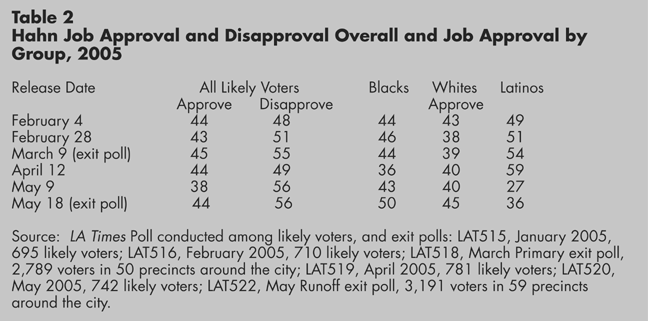
dramatically, to 29% approval. Once his firmest base, Blacks had
suddenly become his severest critics, although he had recovered some of
this support by 2005 (Table 2).
Hahn Job Approval and Disapproval Overall and Job Approval by
Group, 2005
Second, and also in 2002, Hahn fought a formidable secession movement in
the San Fernando Valley. The principal support for Valley secession came
from the same White conservatives and moderates in the Valley who had
been central to Hahn's 2001 victory. Many of these voters were angered
at Hahn's aggressive stance against secession and turned against
him.
As if these blows were not enough, Hahn confronted allegations of
improper influence in his administration: charges of over billing of the
city by a private public relations firm closely tied to the mayor, and
of “pay to play” preferences in the awarding of city contracts. In 2003,
elected City Controller Laura Chick issued a blistering report charging
malfeasance, then transmitted her findings to the L.A. County district
attorney for possible prosecution. In a May 2005 Times poll, a
quarter of likely voters said that these allegations would make them
less likely to vote for the mayor. Among them, three out of four
supported Villaraigosa.
Thus, by the end of the first half of his term, Hahn was bleeding in two
key constituencies and facing serious ethics charges. Yet he could still
argue that he had been a solid mayor who had made tough choices that had
turned around the police department and kept the city together. Hahn
remained the incumbent with a record of winning citywide elections. In
his own words, he was “underrated and undefeated.”
Having fired Parks, Hahn recruited New York City's former chief William
Bratton for the Los Angeles position. Using the same approach that had
worked in New York City, Bratton made a major dent in local crime,
giving Hahn a powerful re-election issue. Sixty-five percent of voters
in an early 2005 Times poll, including 45% of Black voters,
approved of the way Bratton was doing his job. Credit for the drop in
crime, however, did not transfer to Hahn, whose edge on the crime issue
over Villaraigosa was actually smaller in 2005 than it had been in
2001.
Villaraigosa ran in 2003 for a seat on the City Council and beat the
incumbent. In the same year, Bernard Parks won an open Council seat. Two
of Hahn's leading rivals were now in positions to challenge him.
Hahn's job approval ratings throughout 2005 were anemic, never exceeding
50% (Table 2). Ironically, his highest
approval came from Latinos until late in the campaign. Times
polls showed that large majorities in all groups thought the city was
going in the wrong direction. A similar sentiment had driven California
voters in 2003 to recall another stolid, competent, but uninspiring
Democrat, Governor Gray Davis, and to replace him with a more exciting
leader, Arnold Schwarzenegger.
The 2005 Mayoral Primary
Richard Alarcón, a state senator and former city councilmember from the
San Fernando Valley, was the first major candidate to enter the race.
Former Assembly Speaker Bob Hertzberg came next, and was soon joined by
Parks. Finally, Villaraigosa joined the fray, immediately emerging as
the front-runner to challenge Hahn.
Hertzberg represented a serious threat both to Hahn and Villaraigosa.
Popular in the San Fernando Valley and among Republicans and Jewish
voters, Hertzberg had made a name as a government reformer while speaker
of the state assembly. He effectively focused on the weaknesses in
Hahn's lackluster leadership style in clever television commercials that
showed him striding across Los Angeles like a giant. Hertzberg, a
Democrat, had helped organize a Mod Squad of centrist legislators, and
later became Schwarzenegger's friend and ally. For many White voters,
Hertzberg provided a comfortable alternative both to Hahn and
Villaraigosa in the primary.
The field had much in common with the 2001 primary: two Latinos (then it
was Xavier Becerra instead of Alarcón); a Jewish candidate with Valley
appeal (then it was Steven Soboroff, now Hertzberg), Hahn, and
Villaraigosa. The difference was Parks, a Black candidate who could
strike at the heart of Hahn's electoral strength. Some even wondered if
Hahn would make the two-person runoff, as pre-election polls showed him
in jeopardy of finishing third behind Hertzberg. But, near the end of
the primary campaign, Hahn unleashed a barrage of negative commercials
against Hertzberg that he was not well known enough to surmount.
Villaraigosa was an exceptionally strong candidate, popular with a wide
range of voters even including sizeable pluralities of moderate
Republicans. When he was speaker of the assembly, he was an effective
bridge-builder. Despite his liberal ideology and close ties to organized
labor, he worked effectively across party and ideological lines. In Los
Angeles, he was known as a Latino leader who did not play the “ethnic
card” in local disputes (such as during conflicts over the removal of a
Latino school superintendent) that could have easily polarized the
community. Finally, his energetic and engaging personality attracted
great interest and enthusiasm.
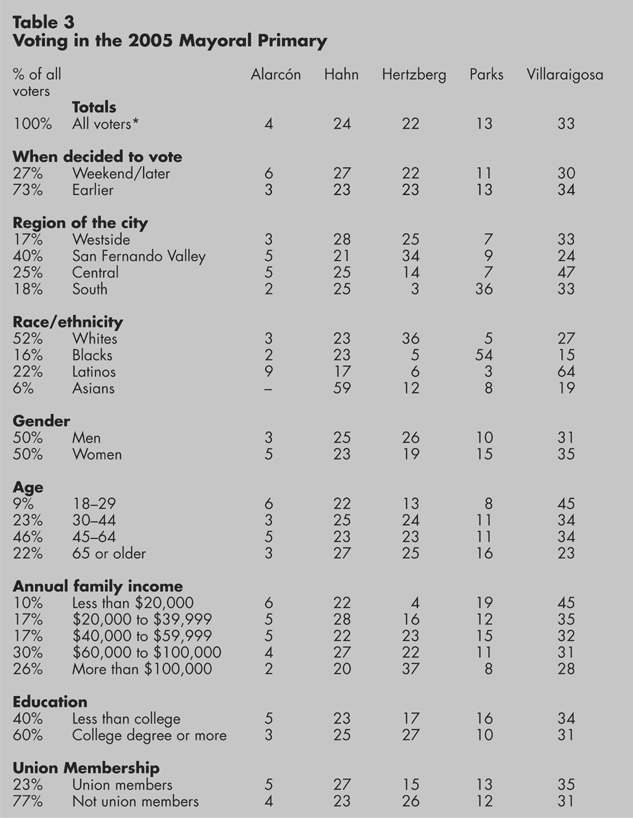
The 2005 primary results were remarkably similar to those of the 2001
primary. Villaraigosa finished first, with 33% of the vote. Hahn managed
to edge out Hertzberg for the second spot, 24% to 22%. Parks finished
with 13%. The composition of the vote, however, showed that Parks had
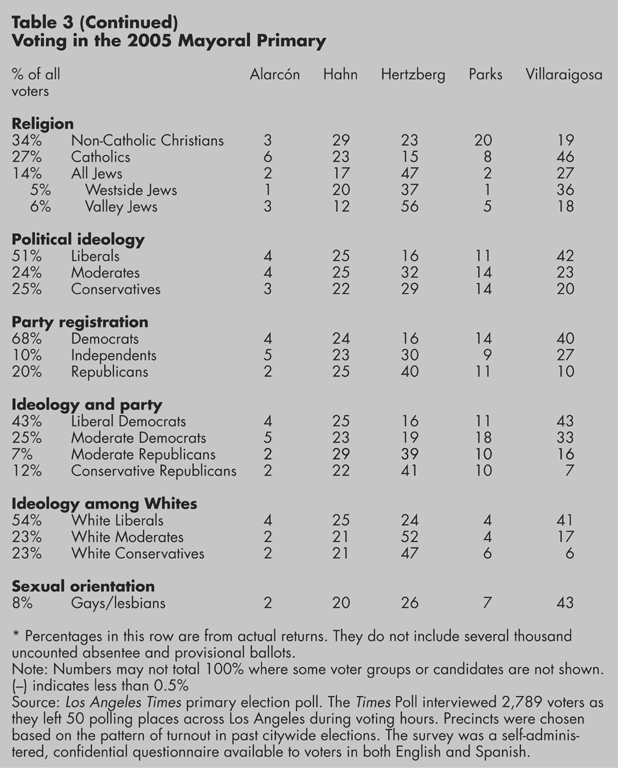
badly hurt Hahn in the Black community (Table
3). Parks carried 54% of the Black vote to Hahn's 23%.
Voting in the 2005 Mayoral Primary
Voting in the 2005 Mayoral Primary (continued)
Hahn was in a much weaker position in 2005 than he had been in 2001,
despite having received a similar share of the vote in both primary
elections. The Times asked voters which candidate would be
their second choice. The answers favored Villaraigosa, especially among
voters whose first choice was the most conservative candidate. In 2001,
only 9% of Soboroff voters had picked Villaraigosa as their second
choice. In 2005, 44% of Hertzberg voters picked Villaraigosa as their
backup.
The 2005 Mayoral Election Compared to 2001
The 2005 Mayoral Election Compared to 2001 (continued)
The Runoff Election
In the campaign for the runoff election set for May 17th,
things went from bad to worse for Hahn. Hahn already had the major labor
endorsements, although with Villaraigosa in the runoff there was
considerable question whether labor would enthusiastically back the
incumbent. Miguel Contreras; sudden death near the end of the campaign
deprived Hahn of one of his few leading endorsers and one of the most
popular and influential labor leaders in California. Three out of five
rank and file union members ultimately voted for Villaraigosa.
Villaraigosa ran the endorsement table. He gained the backing of both
major newspapers, the Times and the Daily News, which
are normally at odds with each other. He was backed by the three leading
African-American political voices: Congresswoman Maxine Waters and
businessman Earvin “Magic” Johnson (each of whom had backed Hahn in
2001), and then by Bernard Parks. Virtually all Latino elected officials
supported Villaraigosa, including City Council President Alex Padilla,
who had backed Hahn in 2001. Hertzberg endorsed Villaraigosa, as did a
number of Valley activists from the secession movement and former Mayor
Richard Riordan. Controller Laura Chick announced her endorsement as
well.
The three issues uppermost in the voters; minds were, in order of
importance, education, crime, and traffic congestion. On education, half
of all voters said that Villaraigosa would do a better job of improving
the city's public schools, while only 22% thought that about the mayor.
Villaraigosa also led on dealing with traffic congestion, a major issue
in the largely White Westside and in the San Fernando Valley. Voters
believed that Hahn would do a better job on crime, but not nearly by the
margin Hahn had enjoyed over his challenger four years earlier.
Villaraigosa also enjoyed a major financial edge over the mayor. By the
end of the campaign he had more than twice as much money on hand as
Hahn, and it was difficult for the incumbent mayor to get the air time
to campaign effectively (Rabin and McGreevey
2005).
All through the primary and runoff campaigns, the charismatic and
energetic Villaraigosa had very high favorability ratings compared to
Hahn, 71% favorable in the primary and 64% in the runoff. Hahn was just
below 50% favorable in both elections.
On Election Day, Villaraigosa swamped Hahn, winning by 18 percentage
points. He won 84% of Latinos, 50% of Whites, 55% of Jews, and 48% of
African Americans; he took 67% of Democrats, 59% of independents, and
27% of Republicans (compared to 21% of Republicans in 2001). Hahn won a
majority of conservatives (58%), Republicans (73%), Asian Americans
(56%), and conservative Republicans (80%). More than four out of five
Latinos supported the challenger, and they made up a record 25% of the
vote. In 2001, union members had supported Hahn (52% to 48%), but in
2005 they shifted their vote 12 points, to 60% for Villaraigosa.
Clearly, the Parks firing had a devastating effect on Hahn's support
among African-American voters. In 2001, Hahn won the vast majority of
Black voters. The small slice of African-American votes that went to
Villaraigosa included a disproportionate share of younger voters. In
2005, Blacks split their vote between the two candidates. The core of
Hahn's Black support came from older Black women compared to
Villaraigosa's strong showing among younger Black men. Young Black men
were a startling 22 percentage points more likely to support
Villaraigosa than older Black women.
In 2001, Hahn had won 59% of White voters. In 2005, Whites split their
vote evenly between the two candidates. Liberal White voters were
solidly behind the challenger, while similar shares of moderate and
conservative White voters stood behind Hahn.
Jewish voters, a distinctive subset of White voters, moved decisively
toward Villaraigosa. In 2001, a majority of Jews had backed Hahn,
especially in the San Fernando Valley. Hertzberg had won the most Jewish
votes in the 2005 primary, especially among the plurality of Jews who
live in the more moderate San Fernando Valley rather than on the liberal
Westside. In 2005, a clear majority of Jews went for Villaraigosa, with
the challenger winning this group in both the Valley and on the
Westside. A Latino-Jewish coalition, quietly cultivated for several
years at the leadership level, and sustained by Villaraigosa's long
history of coalition building (Sonenshein
2001), seemed to be a real possibility.
Ethnic Factors in the Voting
Students of racial voting have long struggled with how to measure racial
and ethnic factors in voting. Voters are reluctant to admit to attitudes
that might appear racist. As a result, indirect questions often elicit
information much more relevant to voting behavior. For example, voters
who report that they believe that the government does too much for
minorities are likely to vote against a minority candidate.
In modern urban politics, attitudes toward immigration may be useful not
only on the issue of immigration but also on the likelihood of voting
for a Latino candidate. Of course, attitudes may be correlated with
ideology and also with racial attitudes in the first place. A study by
Sears et al. (1995) found a close correlation
between attitudes about race and immigration.
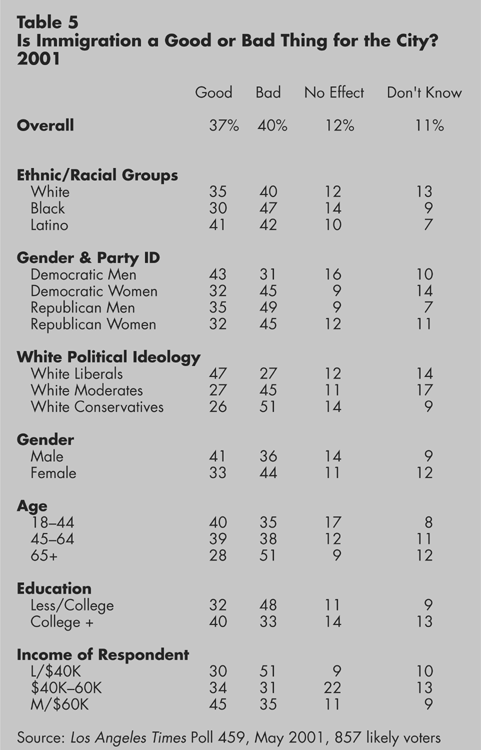
Is Immigration a Good or Bad Thing for the City? 2001
Times polls have occasionally used questions that can help plumb
voter attitudes regarding race and ethnicity. In the 2001 election, the
Times poll of likely voters just before the primary
election included a question about whether immigration had been good or
bad for the city. In a 2005 pre-election poll and in the 2005 exit poll,
voters were asked whether Villaraigosa would be likely to favor Latinos
or would be fair to all communities. On the first question, in 2001, the
poll found that two out of five voters believed that immigration was bad
for the city, while almost two out of five thought it was good. The
differences among White, Latino, and African-American voters on this
question were small. Social class and White divisions by ideology were
more pronounced. Since this question was not asked in the 2001 Election
Day exit poll, we cannot make reliable observations from the small
sample about the connection to voting behavior, but the question shows
how ideology and class affect attitudes that might underlie some aspects
of voting behavior.
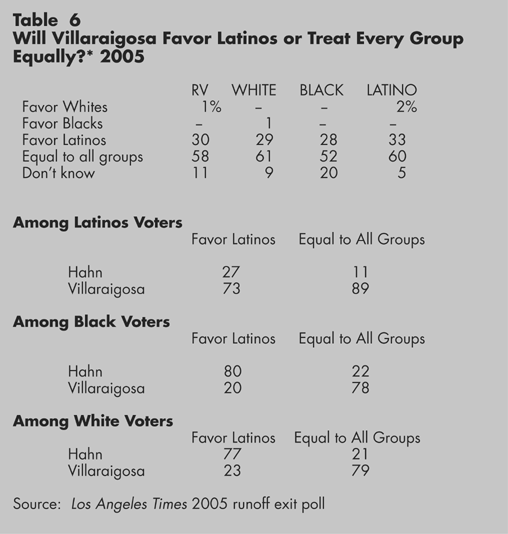
Will Villaraigosa Favor Latinos or Treat Every Group Equally?
2005
Nearly half of Republicans thought immigration was bad for Los Angeles.
White liberals were nearly twice as likely as White conservatives to see
immigration as a positive for the city. Voters in the highest
socioeconomic group believed that the immigrant population was good for
the city, while those in the lowest socioeconomic group believed the
opposite.
In an April 2005 Times poll, 58% of likely voters thought that
if Villaraigosa were elected mayor, he would give equal attention to all
racial and ethnic groups, while 30% thought that he would pay more
attention to Latinos than any other racial or ethnic group. Among voters
who thought Villaraigosa would pay more attention to Latinos, 62% said
they would vote for Hahn, Among the nearly three-fifths of voters who
said Villaraigosa would pay equal attention to all groups, 73% said they
would vote for the challenger, while 19% would support Hahn. In the 2005
Election Day exit poll, the Times asked the same question. The
answers were only moderately useful in determining voting behavior when
applied to the overall vote. The results became more illuminating when
the survey answers and voting choice of White and Black voters were
examined.
Among those African-American voters who believed that Villaraigosa would
favor Latinos, 80% voted for Hahn. Among those who thought he would be
fair to all groups, 78% voted for Villaraigosa. Of course, these
relationships do not prove causation. Those who had decided for other
reasons to support their candidate might have attached positive or
negative perceptions to the candidates. But the results do suggest that
a soft spot in Villaraigosa's support in the African-American community
exists on the issue of potential ethnic favoritism.
Among White voters, Republicans were far more likely than Democrats to
believe that Villaraigosa would play ethnic favorites, and they were
much more likely to vote for Hahn. Nearly half of Republicans, 41% of
conservatives, and 45% of conservative Republican voters believed that
Villaraigosa would pay more attention to Latinos than to other racial or
ethnic groups. In the case of White voters, this connection appears, on
the surface at least, to be mediated by ideology. While there was
abundant celebration in Los Angeles over the breadth of Villaraigosa's
electoral victory, these numbers suggest some caution and point to
obstacles for the new mayor to overcome.
Further research and detailed statistical analysis will help reveal
whether this preliminary evidence about a connection between attitudes
about immigration and ethnic preference and vote for Villaraigosa is
significant (Sonenshein and Drayse 2005).
Clearly there were numerous other issues that had a major impact on the
result.
In 2001, the Los Angeles mayoral election came down to a struggle among
two new coalitions: a Latino-White liberal alliance behind Villaraigosa
and a Black-White conservative bloc behind Hahn. Had Hahn enjoyed a more
successful first term as mayor those coalition lines might have
solidified, with important consequences for the long-term relationship
between communities of color in Los Angeles. Villaraigosa might have won
a very narrow victory with his original coalition, much as Tom Bradley
did against Sam Yorty in his 1973 rematch, or narrowly lost. Instead, it
was a blowout. Yet even blowouts have patterns. The core of
Villaraigosa's winning coalition was the liberal alliance between
Latinos and White liberals. He extended his support among Jewish voters
from 2001, and dominated among white liberals. He enjoyed a larger
proportional turnout of Latinos than in 2001, and won the overwhelming
majority of their votes. He also was able to pull a fairly sizeable
share of union members away from Hahn.
The evidence suggests that if immigration and ethnicity supplement race
as mobilizing issues, ideology among White voters will continue to play
an important role. In attitudes about immigration, and in voting for the
Latino candidate, White liberals may continue to differ substantially
from White conservatives. Writing about race more than two decades ago,
Browning, Marshall, and Tabb (1984, 248),
could be writing about the rise of Latinos in today's era of
immigration: “Liberals on race issues are very different from
conservatives, and ideology has an important influence on the nature and
outcome of the minority struggle for access to local government.” The
difference between a narrow victory (or loss) and the landslide
Villaraigosa enjoyed, however, was the widening support he received from
African Americans and from non-liberal Whites.
Half of African-American voters (led by younger men) placed themselves in
the Latino candidate's column in 2005. This shift from 2001 and the
overall popularity of Villaraigosa open the door to the possibility of a
coalition of color in Los Angeles. But the causes of the shift in Black
support mark these prospects as tentative. One Hahn decision—to not
rehire Police Chief Parks—likely accounted for much of the movement in
African-American voting preferences and certainly explained the shift of
the Black leadership to Villaraigosa. Tensions remain between African
Americans and Latinos, particularly in the public schools.
Thus far, the Black-Brown relationship is more marked by political
interest than durable ideology, and interests can change
(Sonenshein 1993; Austin, Wright, and Middleton 2004). Black leaders wanted to
punish Hahn for his apostasy on Parks, and they succeeded in doing so.
African Americans managed to stay in a game that has been moving away
from them demographically, first by backing Hahn in 2001, and then by
edging toward Villaraigosa in 2005. If the African-American relationship
with Latinos can be enhanced by a coalition-oriented mayor like
Villaraigosa, then the prospects for a class coalition across racial
lines (one that did not occur during the era of Black mobilization)
might brighten. Latinos already comprise the bulk of Los Angeles;
working class, and are increasingly becoming the majority of the working
class in a number of other cities. With Villaraigosa's victory, the
divided local labor movement is now united. Allied with Blacks, both in
politics and in the union movement, Latinos might well put working-class
economic issues back on the urban agenda. Yet conflicts of political and
economic interest between African Americans and Latinos will continue to
pull in the other direction.
Hahn had greater success keeping his White Republican base together than
he had with his long-standing Black constituency. Many Republicans saw
the city's politics moving in an ideological and demographic direction
that they could not easily embrace. Yet key Republicans like Richard
Riordan enthusiastically backed Villaraigosa, giving him the opportunity
to maintain the beachhead he established with these voters. While
Riordan was roundly disliked in the African-American community, he was
popular among Latinos. Latino candidates are more likely than African
Americans to have the option of forming alliances with some White
conservatives.
Villaraigosa's victory could be seen as a triumph of the city's
progressive forces. But an ideological win would have been much narrower
than what actually occurred. A landslide requires more than unified,
coherent ideology; it must be both broader and less coherent.
Villaraigosa remained vague about specific solutions in the campaign,
presented few ideological rough edges, and focused on the need for
change. He emphasized not ethnic assertion, but broad coalitions.
Villaraigosa now has the opportunity to ride the winds of change and the
expectations that go with them. Those who supported him because of
specific decisions made by Hahn may complain unless different decisions
are made. Competition between African-American and Latino political
aspirations may yet derail an emerging coalition of color. Meeting the
expectations of liberal Whites and cautious but interested White
moderates, Republicans, and even some conservatives creates prospects
for broad support but may also muddy the ideological waters.
Implications
Latino activists and political strategists in both parties have tried to
learn from the Villaraigosa election. Symbolic of this interest, Mayor
Michael Bloomberg of New York City, and one of his potential Democratic
challengers, Fernando Ferrer, joined the throng at Villaraigosa's
inauguration. The presence of New York City''s Republican incumbent and
his major Democratic rival at this event testified to a critical
difference between the politics of African-American empowerment and the
emerging experience of Latinos. In today's highly competitive partisan
politics, Latinos are “in play” in a way that Black voters have not been
for many decades. Latino political participation will be a central
factor not only in urban politics, but also on the national scene. The
relationship between the Latino rise and ideology is still evolving.
Unlike the politics of race, there is a nascent competition between the
parties for Latino support.
Villaraigosa had great success in both mobilizing Latino voters and in
avoiding a backlash against Latino assertion from White conservative and
African-American voters. These political strengths were immeasurably
aided by the severe political problems of the incumbent mayor. As
ethnicity in an age of immigration continues to emerge as a political
factor, Latino candidates will undoubtedly face the challenge of meeting
the aspirations of Latinos for upward economic and political mobility
and unpredictable public attitudes on issues involving growing and more
participatory communities.
Author Bios
Raphael J. Sonenshein is professor of political science at California
State University, Fullerton, where he has taught since 1982. He has
written two books on the politics of Los Angeles, and is currently
studying the relationship between immigration and urban electoral
behavior. He served as Election Day political consultant to the Los
Angeles Times exit poll in the 1997, 2001, and 2005 city elections. He
can be contacted at rsonenshein@fullerton.edu.
Susan H. Pinkus has been the director of the Los Angeles Times Poll since
1997. She has written articles on the 2001 mayoral race, multilingual
populations, presidential elections, and current social issues. She is
on the Executive Council of the American Association for Public Opinion
Research (AAPOR), a trustee of the National Council on Public Polls
(NCPP), and a board member of the Roper Center at the University of
Connecticut at Storrs. She can be contacted at
susan.pinkus@latimes.com.