1. Introduction
Economic globalisation has significantly accelerated the growth and success of multinational corporations (MNCs) (Heller Reference Heller2010). However, as multilingual settings, MNCs represent complex language environments with all their associated challenges (Sanden Reference Sanden2020). Corporate language policy usually promotes English as the common business language seeking to optimise communication efficiency (Boussebaa and Brown Reference Boussebaa and Brown2017; Neeley Reference Neeley2017; Sanden and Lønsmann Reference Sanden and Lønsmann2018). However, this English monolingual strategy often creates substantial linguistic hurdles for employees, including declining communicative efficiency, leading to message misinterpretation and work delays (Fairbrother Reference Fairbrother, Sherman and Nekvapil2018; Kim and Angouri Reference Kim and Angouri2023; Sun et al. Reference Sun, Qiu and Zheng2021). In fact, an English-only environment has been shown to elevate the status of native English speakers, while those with insufficient English skills may face restricted opportunities for advancement (Piller et al. Reference Piller, Butorac, Farrell, Lising, Motaghi–Tabari and Tetteh2024; Shin and Park Reference Shin and Park2016), potentially leading to frustration and isolation (Takino Reference Takino2020). In such an environment, individuals lacking English proficiency in daily work constantly face challenges of adaptability, relocation, and job insecurity (Piller et al. Reference Piller, Butorac, Farrell, Lising, Motaghi–Tabari and Tetteh2024).
The emotional struggles and conflicts, while primarily perceived as language-related, have deep-rooted connections to socioeconomic factors, as the way language is used and perceived is always tied to its market value, the power of its speakers, and their impact in specific local situations (Heller and McElhinny Reference Heller and McElhinny2017; Piller Reference Piller2016). Market-driven neoliberalism ‘as a regime of truth and as a practice of governance’ dominates language-related activities (Martín Rojo and Del Percio Reference Martín Rojo and Percio2019). In the neoliberal agenda, English is often perceived as the global lingua franca, critical for enabling cross-cultural communication (Holborow Reference Holborow2015). This perspective has affected institutions’ language policies and individuals’ language practices. English-centered neoliberalism has been applied to research on English as the academic language in higher education, particularly regarding the language-in-education policy of English as the medium of instruction (Codó and Patiño–Santos Reference Codó and Patiño–Santos2018; Qiu et al Reference Qiu, Liu and Zheng2023; Zheng and Qiu Reference Zheng and Qiu2024).
Notwithstanding the fruitful findings, this research adopts an alternative line of inquiry and aims to broaden the conversation by exploring the role of English as the common business language in multinational corporations. Utilising neoliberalism as a sociopolitical framework, it seeks to examine how fundamental principles of neoliberalism in the terrain of language – specifically, the commodification of language (Heller Reference Heller2010) and linguistic entrepreneurship (De Costa et al. Reference De Costa, Park and Wee2021) – influence both MNC's and local employees’ understanding and negotiation of the corporate language policy of using English as the common business language across various stages of a company's language management. By exploring the intricate interplay between language policies and individuals’ neoliberal ideologies in day-to-day experiences in global business environments, this study aims to further our understanding of how social actors and institutions (re)configure the role of language in the inherent contradictions and increasing fissures of neoliberal governance.
2. Neoliberal ideology as the lens to explore language conflicts
Neoliberalism is commonly defined as ‘a theory of political economic practices that proposes that human well-being can best be advanced by liberating individual entrepreneurial freedoms and skills within an institutional framework characterized by strong private property rights, free markets, and free trade’ (Harvey Reference Harvey2005, 2). Within neoliberal discourse, individual language skills are perceived as part of their capital, with economic values (Cho Reference Cho2021; Piller and Cho Reference Piller and Cho2013; Qiu et al. Reference Qiu, Liu and Zheng2023). This reconfiguration of language into a marketable asset is known as the commodification of language (Heller Reference Heller2010). Despite distinctions in historical, socio-political, and economic development paths, neoliberalism features a similar system in different countries, including transnational locales. One area most affected by neoliberal ideology is MNCs that rely on flexible and decentralised labor resources. As multilingual sites, MNCs often adopt English monolingual policies (Boussebaa and Brown Reference Boussebaa and Brown2017; Neeley Reference Neeley2017; Sanden and Lønsmann Reference Sanden and Lønsmann2018). These policies not only reinforce the commodification of language but also create daily participatory environments that strengthen neoliberal governance through the power of language.
Neoliberalism's all-encompassing regimes of power not only influences institutions but also individuals. This controlling power, in Foucault's view, operates as a form of governmental rationality that exerts control over individuals through the imposition of market logic, not only as social norms but also a mechanism for self-regulation (Foucault Reference Foucault, Burchell, Gordon and Miller1991; Gershon Reference Gershon2011). Language is imbricated with neoliberal governmentality across various domains, including education (Urciuoli Reference Urciuoli2008), workplaces (Codó and Patiño–Santos Reference Codó and Patiño–Santos2018), and even non-governmental organisations (Del Percio Reference Del Percio2016). Under neoliberal governance, individuals may generate ‘specific ways of understanding the self, that affect the ways in which individuals exert control on their own (linguistic) conduct and monitor that of others’ (Martín Rojo and Del Percio Reference Martín Rojo and Percio2019, 3), termed as neoliberal subjectivity. One significant manifestation of this subjectivity is linguistic entrepreneurship – a concept describing the expectation that individuals treat language learning as ‘a moral imperative’ (De Costa et al. Reference De Costa, Park and Wee2021, 139). In workplaces, linguistic entrepreneurship frames language learning as the responsibility of the ideal neoliberal worker, aiming for self-improvement and gaining a competitive advantage in the global market. Individuals, as neoliberal subjects (Martín Rojo Reference Martín Rojo, Rojo and Del Percio2019), are thus driven to enhance their employability through language improvement as entrepreneurial selves (De Costa et al. Reference De Costa, Park and Wee2019; Del Percio and Flubacher Reference Del Percio, Flubacher, Del Percio and Flubacher2017).
However, despite the ‘voluntary’ embrace of linguistic entrepreneurship, neoliberal subjectivity yields unequal outcomes for different groups of individuals. For instance, disparities in material and immaterial resources are often found between local and migrant workers; migrant workers often suffer from insecurity and discrimination, with their professional skills frequently overlooked (Piller et al Reference Piller, Butorac, Farrell, Lising, Motaghi–Tabari and Tetteh2024). In the field of education, Codó and Patiño–Santos (Reference Codó and Patiño–Santos2018) observed that in a state secondary school, the ways in which teachers participate in content and language integrated learning (CLIL) programmes are diverse and unequal. Non-permanent teachers are forced to become flexible and ‘happily’ embrace the CLIL mode as they believe they can gain more job opportunities by maximally utilising their language skills. In contrast, this burden is lessened for permanent teachers.
Although previous studies have emphasized that neoliberal ideology leads to ideological and practical conflicts in both education and business contexts (e.g. Kim and Angouri Reference Kim and Angouri2023; De Costa et al. Reference De Costa, Park and Wee2021; Qiu et al. Reference Qiu, Liu and Zheng2023), there is a lack of research on how neoliberal factors contribute to these conflicts at various stages, especially in multilingual business settings. Investigating the role of language, particularly English, in neoliberal conflicts in daily language management and practices in the multilingual workplace would contribute a further layer to the discussion of how neoliberal ideology is constructed, disseminated, and reproduced in global scenarios. To this end, this study utilises neoliberal ideology as an analytical tool to elucidate the mechanisms underlying conflicts within an MNC. Furthermore, it examines how local employees adjust their subjectivities by leveraging and accumulating language skills and capital to navigate a competitive environment characterized by increased productivity.
The context of this study is a Shanghai-based branch of a German multinational company, in which conflicts are investigated at different stages of language management. Specifically, the study is guided by the following research question:
What conflicts arise in language management during the recruitment process, daily business communication, and language support in a German multinational company?
3. Methodology
3.1 Research context
This study is part of a larger project of language policy and planning in a multinational company. This study is situated in GIT, a Shanghai-based subsidiary of the German multinational, HQ-GIT, a business software sector leader with 10,000 employees across 83 offices globally. GIT employs over 1,500 employees, of which over 75% are Chinese, with the remainder from Germany, the U.S., and other Asian countries like India and Japan, all contributing to a diverse linguistic environment. The specific focus was on the GIT-SF team, a 10-member software development group – all native Chinese speakers – within a larger 100-employee department.
3.2 Data collection
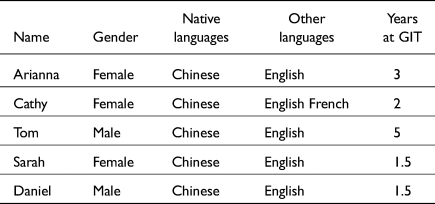
An ethnographic approach was adopted to gain hands-on knowledge about the communication practices in the workplace. Following the principles of ethnographic research (Johnson Reference Johnson2011), one researcher conducted seven months of fieldwork as a short-term intern at GIT. Data collected included publicly available documents; meeting records from 98 meetings totaling over 82 hours, primarily in English with Chinese speakers and a multilingual audience; semi-structured interviews, and field notes. Additionally, five interviews with team members were conducted, recorded and transcribed; these explored their views on the company's language policy, work challenges, and coping strategies. Interviews were conducted in Chinese, lasting 50 minutes each. Participant details were anonymised for confidentiality (Table 1).
Semi-structured interview participants

For Sarah and Daniel, recent graduates with intermediate English (IELTS 5.5-6), GIT was their first job. Cathy, also a recent graduate, had had prior internship experience at GIT, enabling her to have a better understanding of the company's language environment. Arianna had been at GIT for three years, before which she worked for another leading foreign software company in China. Finally, Tom, the most experienced among the interviewees, had been with GIT for five years following his work at a smaller private company in China.
3.3 Data analysis
A thematic data analysis approach was adopted (Rose et al. Reference Rose, McKinley and Baffoe–Djan2019). All scripts were first transcribed into English. QDA Miner 4.0 was used to code the three kinds of data, with a primary focus on the conflicts arising in the language management. We adopted an iterative process of inductive and deductive reasoning to analyze the data (Merriam Reference Merriam1998). Initially, we conducted open coding to identify phrases and concepts related to language conflicts. This was followed by axial coding to establish relationships between these open codes (Miles et al. Reference Miles, Huberman and Saldana2014), leading to the final categories: ‘High language expectations vs. Low interview requirements,’ ‘Monolingual language policy vs. Local multilingual reality’, and ‘Eagerness for language enhancement vs. Inadequate language support.’ A Kappa's alpha of .78 was achieved for inter-rater congruence.
Particular attention was then paid to how employees made sense of the language management and what they did to resolve the conflicts. Email records were not analysed in detail due to content confidentiality and fragmentation, rather descriptive analysis of the basic characteristics of language use was undertaken. Similarly, ethnographic notes were not coded, since they were not the main data source for this study. Nevertheless, the ethnographic notes provided an understanding of the participants’ practices of negotiation, given that their actions can be the embodiment of their thoughts (Blommaert and Jie Reference Blommaert and Jie2010).
Relevant requirements of ethnographic research ethics were strictly adhered to (Hult and Johnson Reference Hult and Johnson2015). The third author undertaking the internship was transparent about her role and purpose, used public data from GIT's website, and ensured confidentiality and anonymity with sensitive information. There was no active intervention in participants’ language use, and data analysis was validated with participants for accuracy and transparency.
4. Findings
This section first describes the conflicting language management in GIT, and thereafter discusses how neoliberal constructs may account for these conflicts.
4.1 High language expectations vs. low interview requirements
In job advertisements, GIT has a relatively high requirement for English and a low requirement for other languages (e.g. Chinese and German) for most roles. Of the positions collated (33/50) required applicants to be at least fluentFootnote 1 in English (Appendix II), with only a few positions (10/50) having requirements for Chinese.
However, although the job descriptions stipulate significant language requirements, English in the actual recruitment process is needed much less, as Cathy explained:
(1) I introduced myself in English when I was interviewed. I memorised the self-introduction content in advance, so the English part was easy. Then I was required to answer two questions about technology in English. Luckily, it was not too difficult. I don't think I was fluent in English, but I passed. (Cathy, Female employee, 2nd year at GIT, Native language: Chinese, Other languages: English, French)
As shown above, the interview process seems to feature minimal English assessment, with only a self-introduction and several simple questions conducted in English. The discrepancy between the language requirements in the job descriptions and interview might be due to shortages of local candidates equipped with both strong technical skills and sufficient English proficiency (Sanden Reference Sanden2020). When deciding between technical abilities and English proficiency, companies might prefer the former. This is supported by Sarah, a developer, who pointed out that mastery of English was not crucial for her position.
(2) My interview was just an English self-introduction. It was very simple. They didn't pay much attention to my English skills. I am a developer, as long as I know technology, I am fine. (Sarah, Female employee, 1.5th year at GIT, Native language: Chinese, Other language: English)
Through a neoliberal perspective, GIT's English proficiency requirement for the recruitment process underscores the neoliberal ideology that an individual's language skills are seen as part of their personal capital (Heller Reference Heller2010). However, the inconsistency between the language prerequisites outlined in job descriptions and those required for the interview suggests that, within transnational workplaces, the neoliberal concept of viewing individuals as skill bundles (Urciuoli Reference Urciuoli2008) may be subject to variations and controversies. Gershon (Reference Gershon2011) highlights that neoliberal governmentality adapts to local contexts. In recruitment, institutions subtly shift this mentality, prioritising technical skills over English proficiency, exposing cracks in the neoliberal system. This discrepancy extends beyond recruitment, impacting the company's broader language management approach.
4.2 Monolingual language policy vs. local multilingual reality
In daily business communication, English emerged as the implicit language standard within the multilingual organisation. Employees are very much aware of this expectation for English-only communication, as Tom explained.
(3) All emails, including personal requests, should be written in English. For example, even when we ask for leave, we should use English. (Tom, Male employee, 5th year at GIT, Native language: Chinese, Other language: English)
From a total of 1441 emails collected, 90% were composed in English. This aligns with the company's implicit language policy, reinforcing English as the default language in the workplace communication despite this being a German corporation in China. English has permeated the language-using landscape of the entire company and become the first choice for employees. However, not every employee possesses the necessary proficiency to comfortably engage in daily business communication in English. Those without sufficient English proficiency encountered considerable linguistic challenges. The following excerpt from Arianna's interview provides a clear illustration of this.
(4) Every time I have to give a speech, I remember the logic in Chinese and then translate it into English. This process is quite time-consuming and exhausting… I understand the meaning in Chinese, but I struggle to express it in English. It's challenging. I'd be better off speaking in Chinese. I am afraid of making another mistake. It's embarrassing. (Arianna, Female employee, 3rd year at GIT, Native language: Chinese, Other language: English)
Arianna's account of the ‘exhausting’ nature of the translation and her fear of ‘embarrassing’ errors illustrates the emotional burden that the monolingual English expectation imposes on non-native speakers. This neoliberal monolingual expectation can place a huge burden on the emotional well-being of employees (De |Costa et al. Reference De Costa, Park and Wee2019, Reference De Costa, Park and Wee2021), potentially limiting their ability to effectively respond to the demands of their roles (Takino Reference Takino2020). Additionally, the monolingual expectation may constrain employees’ participation to a more fundamental level, evidenced by Sarah's comments below.
(5) I am afraid to talk to foreign colleagues because of my poor English, so I never volunteer to do work which requires high English proficiency. Many important projects require high English proficiency, and I just don't participate. I know it's not good for me. (Sarah, Female employee, 1.5th year at GIT, Native language: Chinese, Other language: English)
Notably, Sarah initially thought ‘as long as I know technology, I am fine.’ However, in reality, her limited English proficiency constrained her participation in company affairs, leading to her silence during business discussions. This suggests that when neoliberal monolingual policies encounter the multilingual realities of the workplace, some employee groups may become marginalised or ‘invisible’ (Lønsmann and Kraft Reference Lønsmann and Kraft2018). However, it is important to acknowledge that Sarah's personality may influence her language performance, demonstrating that subjective and affective dimensions, such as personality, are an indispensable part of understanding individuals’ negotiation of neoliberal demands (Highet and Nyssen Reference Highet and Nyssen2024).
Contrasting with Sarah's sense of disempowerment, Daniel exhibited a more positive approach towards language and communication.
(6) I simply speak the words that come to my mind. For instance, I might say ‘我们 team 在 localisation 上做得蛮好的’ (Our team is doing great in localisation). (Daniel, Male employee, 1.5th year at GIT, Native language: Chinese, Other language: English)
Contrary to Arianna and Sarah, Daniel effectively utilised his full linguistic resources to create a communicative environment where multiple languages collectively contribute to efficient communication (Sun et al. Reference Sun, Qiu and Zheng2021; Zheng and Qiu Reference Zheng and Qiu2024). His strategy demonstrates a flexibility in navigating the complex landscape shaped by neoliberal language ideologies (Gonçalves Reference Gonçalves2020). The successful deployment of diverse linguistic resources can empower him with a sense of ownership, which subsequently boosted his confidence and proficiency in language use, liberating him from the limitations imposed by the monolingual expectation.
4.3 Eagerness for language enhancement vs. inadequate language support
Confronted with the significant demand for English proficiency in their daily work communication, our interviewees demonstrated their eagerness for self-improvement and actively engaged in language learning for personal growth. An example of this came from Arianna.
(7) Now that the United States is so strong and is leading our industry, we must speak English. If I want to be promoted in the future. I must be good at English. (Arianna, Female employee, 3rd year at GIT, Native language: Chinese, Other language: English)
Arianna fully acknowledges the increasing importance English proficiency plays in her professional progression. The use of assertive words such as ‘important’ and ‘I must’ symbolises her commitment to enhancing her English capabilities. This ideological submission exemplifies the impact of linguistic entrepreneurship (De Costa et al. Reference De Costa, Park and Wee2019), acting as an affective regime that compels individuals to perceive language improvement as a core responsibility of an ideal employee.
However, these employees’ aspirations for language improvement are often thwarted by the lack of effective language support from GIT. While the company initiated an online language course comprising over 50 hours of lessons in English, German, French, and other European languages in 2015, the course content has not been updated since then. Figure 1. presents a screenshot depicting some of the available course titles.
Screenshot of some of the language training courses.
(source: Success Map in GIT).

Some language courses were available to GIT employees. However, these courses were provided by a commercial language provider rather than as language for specific purposes courses, which would be tailored to these specific learners. Additionally, these courses required personal payment and had to be undertaken in the employees’ own time. This likely contributed to the negative perceptions surrounding these courses, as Arianna questioned.
(8) There are indeed some training courses for English. However, it seems that we have to pay for them from the boss's budget. I haven't heard anyone attending. I think it is boring. I find it hard to hold on to it. And I have to pay extra. (Arianna, Female employee, 3rd year at GIT, Native language: Chinese, Other language: English)
According to Arianna, not only were these courses costly, but there was also a lack of engagement among employees. Of the five interviewees, Arianna was the only person aware of the availability of such courses, despite not participating in them herself. She expressed limited enthusiasm for the programme, deeming them ‘boring’. She also perceived them as challenging to remain interested in and committed to, describing it as ‘hard to hold on to’. This excerpt highlights how neoliberal governmentality is reconstructed in translocal contexts. Although individuals may internalise neoliberal subjectivity, their involvement can be impeded by affective factors and economic conditions.
Notably, GIT does employ a translation team for company information, product descriptions, and promotional material. However, the team primarily service GIT's clients, rather than its employees. Furthermore, initiating a translation request requires navigating a complex and lengthy administrative process, as shown in Figure 2.
Translation Process Flow in GIT (source: How Translation Works At GIT).

The fact that employees seldom use this service could be largely due to its laborious administrative procedures. GIT does not offer appropriate resources for enhancing employees’ English skills, rather has shifted this responsibility onto the employees themselves. Within the neoliberal ethos of the company, local employees become neoliberal subjects (Shin and Park Reference Shin and Park2016), shouldering the responsibility of enhancing their language competencies to boost their own professional value.
In a neoliberal context, the inability to improve English proficiency can lead to missed work opportunities and hinder career progression, a reality illustrated by Arianna's experience.
(9) I know English is important, but it's hard for me to improve myself, so I can only accept domestic projects. I also know it's a problem. In the future, I can only say that I have to make progress every day. (Arianna, Female employee, 3rd year at GIT, Native language: Chinese, Other language: English)
As reflected by Arianna, limited English proficiency restricts her access to international projects, thereby limiting her engagement with the company's global business initiatives. This highlights that in workplaces dominated by neoliberal values, language proficiency, particularly in English, can become both a tool for personal advancement and a barrier to it. By influencing career paths and personal development, language proficiency can play a crucial role in accentuating disparities in individual career achievements. From this perspective, English as a common business language is not a natural phenomenon or everyone's best choice, rather a neoliberal mandate imposed on individuals through the concept of linguistic entrepreneurship (De Costa et al. Reference De Costa, Park and Wee2021), perpetuating existing power dynamics and inequalities within the global marketplace.
5. Discussion
This study uses neoliberal ideology to explore the complexities of language management within an MNC, revealing key conflicts: a mismatch between high language expectations and low recruitment requirements, tensions between a monolingual policy and the multilingual reality of daily communication, and a gap between employees’ language aspirations and institutional support. By examining these issues through a neoliberal lens, this study contributes to discussions on how socio-political factors shape workplace language policies (Kim and Angouri Reference Kim and Angouri2023; Lønsmann and Kraft Reference Lønsmann and Kraft2018; Weiss and Morrison Reference Weiss and Morrison2019). It is contended that the commodification of language under neoliberalism creates communication challenges and reinforces unequal power dynamics, reflecting the juxtaposition of top-down English-only neoliberal expectations and bottom-up internalisation of the neoliberal values. Therefore, it is argued that in MNCs, neoliberal values emphasising market-driven principles and minimal regulation, catalyse conflicts across multiple stages of language management by promoting English as the common language in communication.
Previous research indicates that language management in MNCs often confronts communication barriers among employees with diverse linguistic backgrounds (Sanden Reference Sanden2020; Sanden and Kankaanranta Reference Sanden and Kankaanranta2018). This study further revealed that these barriers may begin at the recruitment phase. During this phase, primary challenges in language management may arise from the way influential policy-making groups assess the skill bundles of potential employees (Urciuoli Reference Urciuoli2008). Consistent with prior studies, GIT, in accordance with the neoliberal approach, used English proficiency as a measure of job applicants’ global competitiveness (Piller Reference Piller2016; Piller and Cho Reference Piller and Cho2013). However, when faced with a scarcity of candidates possessing both language skills and technical expertise, GIT modified its evaluation criteria in practice, prioritising technical prowess over linguistic proficiency. Thus, this research showcases a flexibility in the neoliberal assessment of individuals’ language skills in the transnational job market. It suggests that institutions’ language policy and language management can be potentially shaped by the ‘double truths’ of neoliberalism – ‘publicly proclaiming one thing while doing something very different’ (Mirowski Reference Mirowski2013, 68).
Instead of boosting efficiency, this study indicates that a neoliberal stance on English dominance may lead to communication barriers and marginalisation (Qiu et al. Reference Qiu, Liu and Zheng2023). This is demonstrated by Sarah's continuing disengagement in business meetings due to her limited English proficiency. As a result, the workplace environment could become less conducive to fostering a sense of purpose and fulfillment among employees, thereby impacting their overall contribution and satisfaction. Having shown that employees’ voices can result in higher status evaluations (Weiss and Morrison Reference Weiss and Morrison2019), local employees’ persistent silence due to inadequate language skills may exacerbate disparities in human capital and further intensify workplace inequalities. In this regard, this study illustrates English, when intertwined with neoliberalism, evolves into an instrument of exacerbating neoliberal disparities.
This study diverges from previous research that merely outlines the dichotomy between groups possessing disparate linguistic skills. Instead, it uncovers how this power imbalance originates from the collective internalisation of the concept of linguistic entrepreneurship (De Costa et al. Reference De Costa, Park and Wee2019) by both the corporation and its local employees. It further shows how neoliberal thinking subtly motivates local employees to enhance their language skills while relieving the company of its obligations to support their language development. As a result, the weight of success or failure largely falls on the individuals (Shin and Park Reference Shin and Park2016). However, despite their willingness to self-improve, local employees like Arianna may withdraw from language improvement efforts due to constraints such as limited time and resources. She described the required English course as both ‘boring’ and a strain on her boss's budget. Her negative attitude towards language training highlights that multiple factors, such as personality, attitudes, and material conditions, play an essential role in how individuals navigate neoliberal demands (Highet and Nyssen Reference Highet and Nyssen2024; Martín Rojo Reference Martín Rojo, Rojo and Del Percio2019). By not fully utilising the linguistic diversity and cultural insights of multilingual staff, companies may miss opportunities for enhancing problem-solving, expanding business markets and fostering innovation. The overarching dominance of English therefore jeopardises the efficiency and profitability that are hallmarks of the neoliberal approach. This contradiction suggests that conflicts in language management in multinational corporations reflect the ‘distortions, inconsistencies, and vulnerabilities’ of neoliberalism itself (Holborow Reference Holborow2015, 94).
Drawing on previous research on language and neoliberal governmentality (Heller and McElhinny Reference Heller and McElhinny2017; Highet and Nyssen Reference Highet and Nyssen2024; Martín Rojo and Del Percio Reference Martín Rojo and Percio2019), we further believe that transnational contexts, such as MNCs, are sites where inherently contradictory forms of neoliberal governance emerge. In these translocal and multilingual environments, neoliberal subjectivity, especially in relation to language use and learning, may be paradoxically shaped. Instead of being suppressed by neoliberal monolingualism, individuals may reshape their neoliberal subjectivity via a multilingual approach to increase productivity. Daniel's flexible mobilisation of linguistic resources serves as an example of individuals’ transformative embrace of neoliberal subjectivity. Thus, the conflicts inherent in neoliberalism create fissures that offer opportunities for the reinterpretation of neoliberal governmentality and the reconfiguration of language and power in daily practices.
6. Conclusion and Implications
This study highlights how neoliberalism, as a political and economic ideology, generates conflicts in language management in a German multinational company's subsidiary. The company's neoliberal flexibility during the recruitment stage fails to prevent an English-centric policy from restricting local employees’ prospects for career advancement and limiting their active participation in company matters. It is argued that the arising conflicts in language management in the company are the result of an interaction between top-down neoliberal expectations and the employees’ bottom-up subordination of these values. Consequently, when individuals and MNCs embrace neoliberal values, emphasising language as economic capital and individual responsibility for language improvement, this can lead to power imbalances, coercion, and mediocrity within the multilingual corporate setting.
While English as the common business language offers global advantages, it is crucial to critically assess its role in reinforcing neoliberal ideology and promote alternative discourses supporting linguistic and cultural diversity. In transnational and multilingual contexts, ambivalence toward neoliberal governance reveals cracks in the system. Addressing these challenges requires corporations to reinterpret the neoliberal agenda and individuals to creatively leverage their linguistic resources.
Accordingly, this study has several practical implications. Firstly, this study calls for MNCs to develop flexible language policies that acknowledge and leverage their workforce's linguistic diversity. Specifically, during the recruitment process, companies should clearly state language requirements and assess candidates’ language abilities in real-world scenarios, while gathering their views on language improvement to inform effective language training programmes. Furthermore, in daily operations, multilingualism can be encouraged in brainstorming and internal communications to foster epistemic diversity (Zheng and Qiu Reference Zheng and Qiu2024) and innovative solutions. Additionally, MNCs are encouraged to invest in tailored language training, such as conducting surveys to identify employees’ linguistic needs, and address emotional barriers by offering support such as counselling, peer groups, and confidence-building workshops.
In his book The Three Ecologies, Guattari describes neoliberalism as a false world composed of symbols and references that simulate reality but trap us in its fragmented and fabricated clutches (Guattari Reference Guattari2000). Consistently, this study reveals how individuals are ensnared in neoliberal values that prioritise market orientation. However, the identified cracks in neoliberal governmentality also suggest possibilities for reconfiguring neoliberal subjectivity. By reshaping accountability, institutions and individuals can collaboratively create a new space for productivity that emphasises creativity and humanity. Ultimately, it is not technology or language themselves, but the human beings who utilise them in their daily lives, that drive this transformation. Therefore, further studies may continue exploring neoliberal subjectivity and agency in multilingual and multicultural settings, particularly the nuances in the interrelationship between political-economic structures, institutional rationalities, and individuals’ affective orientations towards language practices. As for limitations, this study was confined to a small team within an MNC. Widening the research scope by examining more employees at different positions within the company might help to further establish the reliability of this study and gain a more holistic understanding of the company's language management.
Appendix I. Scale for skills

Appendix II. Job descriptions of some positions at GIT

 YIXI (ISABELLA) QIU is currently an assistant professor at the School of Foreign Studies, Tongji University, Shanghai, China. Her research interests include research methods, educational and sociolinguistic aspects of multilingualism in higher education, language policy and planning. Her recent works focus on epistemic (in)justice in the context of English medium instruction. Email: yxqiu@tongji.edu.cn
 YONGYAN ZHENG is Professor of Applied Linguistics at Fudan University, China, where she teaches English academic writing and applied linguistics. Her research interests include second-language development, bilingual and multilingual education, and academic literacy practices. She is the Editor-in-Chief of Language, Culture and Curriculum, and also the Co-Editor-in-Chief of System. Email: yongyanzheng@fudan.edu.cn
WEN SUN is a graduate of Fudan University, China, with a master degree in Applied Linguistics. Her research interests include language policy and planning in multilingual workplaces.