


In Layering and directionality, Brett Hyde presents a fully articulated theory of metrical stress in Optimality Theory (OT) that rests on three subcomponents: Relation-Specific Alignment, a theory of constraints on parsing directionality, Weak Bracketing, a theory of prosodic layering, and Optimal Mapping, a theory of the relationship between the categories of the prosodic hierarchy and the metrical grid.* From now on, I will refer to Hyde's theory as a whole as Weak Bracketing. The main goal of the book is to compare the predictions which Weak Bracketing makes about the typology of quantity-insensitive binary stress systems with the typological predictions derived from previous OT accounts of metrical stress which utilise ‘Weak Layering’, including Symmetrical Alignment (McCarthy & Prince Reference McCarthy and Prince1993), Iterative Foot Optimisation (a version of Symmetrical Alignment in Harmonic Serialism; Pruitt Reference Pruitt2010, Reference Pruitt2012), Asymmetrical Alignment (Alber Reference Alber2005) and Rhythmic Licensing (Kager Reference Kager2001, Reference Kager2005). On the basis of an exhaustive exploration of the factorial typologies that derive from the constraint sets assumed in each of these approaches, it is demonstrated that Weak Layering accounts suffer from a series of undergeneration and overgeneration problems, and therefore fail to produce an accurate typology of quantity-insensitive binary stress systems. It is shown that Weak Bracketing performs much better in terms of the attested typology of binary stress systems. The empirical coverage of the book is also extended to account for patterns of trisyllabic stress windows.
Hyde's book is the result of a remarkably solid and constant research programme developing the theory of Weak Bracketing, and the material presented in this monograph builds on prior work, published as journal articles (Hyde Reference Hyde2002, Reference Hyde2007a, Reference Hydeb, Reference Hyde2012a, Reference Hydeb, Hyde & Husic Reference Hyde and Husic2012). The book is a milestone in the study of metrical stress in OT, not only because of the presentation of the theory of Weak Bracketing and the new research perspectives it opens up, but also because of the detailed survey of the most influential Weak Layering approaches to metrical stress in OT. The book is not only an obligatory reference for metrical phonologists but also suitable for those who want to approach the topic of metrical stress in OT for the first time, especially as the author's style is very precise and engaging throughout, and the content of the book is clearly organised.
This review is divided into two parts. The first part offers a brief summary of the content of the book, highlights its basic contributions and presents the theory of Weak Bracketing. The second part critically assesses Weak Bracketing in the light of two case studies: (i) ternary stress systems, and (ii) stress assignment in Munster Irish, which offer challenges for the theory.
1 General overview of Weak Bracketing
The book has seven chapters. In Chapter 1, layering irregularities are discussed and the basics of Relation-Specific Alignment and Weak Bracketing are laid out.
In odd-parity forms, perfect binary alternation cannot be achieved, and therefore layering irregularities emerge in the form of either a monosyllabic foot, in which case exhaustive parsing is achieved at the expense of foot binarity, or an unfooted syllable, where foot binarity is achieved at the expense of exhaustive parsing. Layering irregularities indicate parsing directionality, as in (1), and are ultimately responsible for the location of stress clashes and lapses.
-
(1)


The exact position in which a layering irregularity might appear yields a specific stress pattern. However, not every position yields an attested pattern. That is, the distribution of clashes and lapses is not symmetrically attested: final lapses are attested, but not initial lapses, and initial clashes are attested, but not final clashes. The basic descriptive generalisation of attested patterns (p. 25) is given in (2).
-
(2)

The complete set of attested quantity-insensitive binary stress patterns is illustrated in (3).
-
(3)

The set of unattested patterns is given in (4).
-
(4)

The symmetrically attested binary systems are the minimal alternation patterns found in leftward trochees (3d) and rightward iambs (3e), on the one hand, and the maximal alternation patterns found in rightward trochees (3a) and leftward iambs (3c), on the other. The asymmetrically attested patterns are those with either clash or lapse, in which only one of the two members of the mirror-image patterns is attested: rightward trochees with final lapse are attested (3b), but not leftward iambs with initial lapse (4a); leftward trochees with initial clash are attested (3h), but not rightward iambs with final clash (4e); rightward iambs with final lapse in even-parity forms are attested (3i), but not leftward trochees with initial lapse in even-parity forms (4b); rightward iambic reversal patterns with internal clash near the right edge in even-parity forms are attested (3j), but not leftward trochaic reversal patterns with internal clash near the left edge in even-parity forms (4f). With respect to bidirectional systems, only trochaic patterns with a lapse adjacent to the initial syllable (3f) or the penultimate syllable (3g) are attested, whereas their iambic mirror-image patterns with a lapse adjacent to the final syllable (4c) or the peninitial syllable (4d) are unattested.
Relation-Specific Alignment, developed in Chapter 2, assumes a set of directional parsing constraints with the following attributes: (i) they are always evaluated categorically, (ii) they can be distance-sensitive or not and (iii) they refer directly to specific configurations of misalignment. As opposed to Generalised Alignment constraints, Relation-Specific Alignment constraints determine (i) the locus of violation, i.e. the two aligned categories and, optionally, a separator category (in which case the constraints are distance-sensitive), and (ii) the specific configuration of misalignment that is prohibited. Relation-Specific Alignment constraints are defined in terms of category containment or precedence, and therefore come in three different schemas (p. 51), as in (5). One of the advantages which Hyde claims for Relation-Specific Alignment is that it avoids the midpoint pathology, which consists in dragging a foot to the middle of a form, without abandoning distance-sensitivity (see Chapter 2 for a more extended discussion of the midpoint pathology).
-
(5)
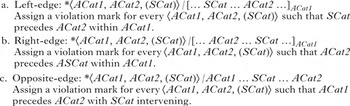
In Chapters 2–4, the Weak Layering accounts of Symmetrical Alignment, Iterative Foot Optimisation, Asymmetrical Alignment and Rhythmic Licensing are shown to undergenerate attested patterns and to overgenerate unattested patterns of binary stress alternation. Furthermore, in Chapters 3 and 4, all these approaches to metrical stress are shown to predict a set of pathologies that fall under the Odd-Parity Input Problem. The Odd-Parity Input Problem covers two subproblems: the Odd Heavy Problem and the Even Output Problem. On the one hand, the Odd Heavy Problem refers to a situation in which a heavy syllable is parsed into a monosyllabic foot in order to meet exhaustive parsing if and only if the heavy syllable occupies an odd-numbered position in odd-parity forms. This pattern of quantity-sensitivity in an otherwise quantity-insensitive system is unattested. On the other hand, the Even Output Problem refers to a situation in which an odd-parity input maps onto an even-parity input by either deleting or inserting a syllable. Such systems are also unattested, and all Weak Layering accounts predict such pathological systems. A careful report of the specifics of these findings is beyond the scope of this review, and the reasons why each of those accounts fail to produce an accurate typology of quantity-insensitive binary stress patterns will not be reviewed here. It is important to note, however, that Chapters 2–4 present the results of an exhaustive exploration of the factorial typologies derived from the constraint set assumed by each of the Weak Layering accounts in a very comprehensive way.
The crucial differences between Weak Layering and Weak Bracketing accounts are that, in the latter, (i) prosodic categories are never skipped, meaning that all syllables must be parsed into feet (Strict Succession, i.e. unfooted syllables cannot be generated, so that parsing is always exhaustive), and (ii) feet can overlap (i.e. proper bracketing is not an inviolable condition). Given these properties, an odd-parity form can be parsed exhaustively by means of overlapping feet, as in (6).
-
(6)

The relationship between prosodic categories and the metrical grid is not isomorphic, i.e. there is no one-to-one correspondence between prosodic categories and grid entries. The relationship between prosodic and metrical structure is regulated by the constraint Map-to-Grid in (7) (p. 15), which ensures that every foot receives a stress (i.e. a foot-level gridmark).
-
(7)

Because Map-to-Grid is a violable constraint, feet can be stressless, as in (8).
-
(8)

Weak Bracketing assumes three more mapping constraints, adaptations of classic constraints in metrical studies (*Clash, InitialGridmark, Non-finality).
In principle, the stress patterns in (9) might emerge from this. Besides Strict Succession (i.e. exhaustive parsing), the other non-violable principles of Weak Bracketing (the universal properties encoded in Gen) are Headedness, which establishes that every foot has a syllable-head (note that being a foot-head does not correlate with being stressed) and that a foot-level gridmark is only permissible on head syllables, Unique Head, whereby a syllable cannot be the head of two overlapping feet, Foot Maximum, restricting the size of feet to two syllables, and Head Gap, which stipulates that one of any two adjacent syllables must be the head of a foot. Any representations violating one or more of these principles are simply not generated by Gen. These representations constitute the entire set of all possible metrical configurations involving overlapping feet.
-
(9)

Directional parsing in Weak Bracketing results from satisfying Relation-Specific constraints that refer to syllable heads. General directional orientations are the result of satisfying the distance-sensitive constraints in (10a) and (b). Exceptional orientations, which are responsible for bidirectional patterns, are the result of satisfying the distance-insensitive constraints in (10c) and (d).
-
(10)

Not only are these constraints responsible for footing directionality, but they also select the type of foot, trochee or iamb. For instance, if All-σHd-L dominates All-σHd-R, leftward trochees will be preferred over rightward iambs, and if All-σHd-R dominates All-σHd-L, rightward iambs will be preferred over leftward trochees.
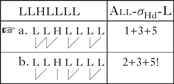
Hyde argues in favour of Weak Bracketing on the basis of two important facts. First, Weak Bracketing avoids the Odd-Parity Input Problem completely; there is no way in which a heavy syllable can be parsed as a monosyllabic foot in an odd-parity form when it is odd-numbered in an otherwise quantity-insensitive system, i.e. a system in which light and heavy syllables behave in the same way. This is because potential candidates showing the effects of the Odd-Parity Input Problem are harmonically bounded by candidates in which the odd-numbered heavy syllable in the odd-parity form is not footed on its own. Consider the tableau in (11), adapted from page 212. The constraint All-σHd-L is responsible for producing leftward trochees. The crucial aspect of this tableau is that candidate (b), in which the heavy syllable absorbs a whole foot, is harmonically bounded by (a), because the latter performs better on the head-syllable distance-sensitive alignment constraint.
-
(11)
The second crucial advantage of Weak Bracketing over Weak Layering lies in its empirical adequacy; Weak Bracketing accounts for all ten attested patterns of quantity-insensitive binary stress systems in (3), and excludes all the unattested patterns in (4). It does, however, predict one more unattested pattern, as acknowledged by the author: the iambic double lapse pattern, a variation of iambic maximal alternation, triggered by the satisfaction of Non-finality (p. 235). Overall, Weak Bracketing does not undergenerate any of the attested patterns of quantity-insensitive binary stress systems, and only overgenerates one unattested pattern, while avoiding all six unattested patterns in (4). For the sake of illustration, I will show how two of the unattested patterns are avoided by Weak Bracketing. These two patterns are repeated in (12); both are leftward trochees, the latter with an internal clash near the left edge in even-parity forms caused by foot reversal, and the former with an initial lapse in even-parity forms.
-
(12)

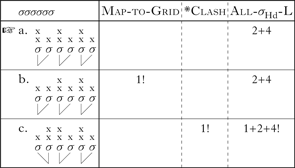
In order to create a minimal alternation pattern of leftward trochees in the odd-parity forms in (12), All-σHd-L must dominate All-σHd-R. Furthermore, in order to avoid initial clash in odd-parity forms or a lapse after the initial syllable, the constraints *Clash and Map-to-Grid must dominate InitialGridmark. The problem with such a system lies in even-parity forms. The tableau in (13) shows that both unattested patterns of an even-parity form (candidates (b) and (c)) are harmonically bounded by the perfectly alternating candidate (a), because the latter violates only a proper subset of all the violations incurred by the other two candidates. This means that the two parsings in (12) can never be selected as optimal under any ranking of the constraint set, and therefore the predictive power of Weak Bracketing is adequate.
-
(13)
The theory of Weak Bracketing is extended to account for some stress window systems in Chapter 6, namely Macedonian, Maithili, trisyllabic shortening in English and Latin, and tonal accent placement in Ancient Greek. In my view, Hyde's account of stress windows is superior to other accounts, in that the window is not imposed arbitrarily (why are stress windows restricted to the first or the last three syllables in a word, not for instance, four?), but follows directly from opposite-edge, distance-sensitive Relation-Specific Alignment constraints. These constraints prevent either a word-level gridmark with an intervening syllable or mora preceding a head syllable for final windows, or a head syllable with an intervening syllable or mora preceding a word-level gridmark for initial windows. These opposite-edge alignment constraints are satisfied by candidates in which the word-level grid entry is not further left or further right than the last or first three syllables of a word. Therefore, opposite-edge distance-sensitive Relation-Specific Alignment is enough to capture the effects of stress windows, without the need to postulate a specific constraint that imposes an initial or final window without any independent motivation.
2 Extended discussion
The purpose of this section is to explore the ability of Weak Bracketing to account for ternary stress systems, on the one hand, and stress assignment in Munster Irish, on the other. Both empirical domains seem to offer challenges for Weak Bracketing.
2.1 Ternary stress systems
Ternary stress systems represent a unique challenge to constraint-based metrical stress theories. The problem is how ternary rhythm should be modelled without the use of ternary feet or without ternary-specific constraints that prohibit adjacent feet.
Cayuvava (isolate, Bolivia; Key Reference Key1967) is the most representative of the few languages that display a ternary alternation of stress (other languages displaying ternary rhythm are Chugach Alutiiq, Estonian, Tripura Bangla and Gilbertese). In Cayuvava, stress falls on every third syllable counting from the right word edge, with main stress falling on the rightmost stressed syllable. Traditionally, the stress system of Cayuvava has been accounted for by assigning leftward trochees with syllable final extrametricality under weak local parsing (Hayes Reference Hayes1995). It is worth noting that up to two syllables are left unstressed at the opposite edge of directional footing. Some schematic examples of Cayuvava, from Key (Reference Key1967), are given in (14). For clarity, structures are parsed into non-adjacent binary feet; there is no distinction between primary and secondary stress.
-
(14)

Cayuvava exemplifies a case of a quantity-insensitive ternary stress system, which one would expect it to be easily modelled in Weak Bracketing. Here I will show that, using the set of constraints proposed by Hyde, Weak Bracketing fails to derive this pattern.
Because the position of stresses (i.e. grid entries in the metrical dimension) is already known, the analyst must first identify the set of output foot structures that is compatible with the position of those stresses, while producing a total grammar, i.e. a grammar with no ranking paradoxes. By comparing all possible candidates with divergent footing in which the position of stress is kept the same, the set of output prosodifications in (15) is the only one compatible with a ranking of the proposed set of Weak Bracketing constraints.Footnote 1
-
(15)

The constraint ranking compatible with the prosodifications in (15) is illustrated in (16). The constraints after the semi-colon are undominated.
-
(16)

The partial ranking All-σHd-L ≫ All-σHd-R, σHd-R, however, is also the ranking that corresponds to left-oriented trochees, with overlapping feet at the left edge. If clashes are avoided and stressless feet are allowed (*Clash ≫ Map-to-Grid), as in (15), the competing set of input-output mappings in (17), with lapse after the stressed initial syllable of the word (InitialGridmark ≫ Map-to-Grid), beats those in (15).
-
(17)

When the system with the output prosodifications in (17) is evaluated against (15), the former wins, and there is no possible grammar compatible with the prosodifications in (15), corresponding to Cayuvava. To briefly illustrate why, compare the final candidates in (15) and (17), for instance. The representation in (15) always violates a proper superset of the violations incurred by the representation in (17). This is exemplified in the tableau in (18), in which (a), the binary pattern, harmonically bounds (b), the intended candidate with ternary rhythm.
-
(18)

Thus the Weak Bracketing account suffers from an undergeneration problem with respect to ternary rhythm.
In cases of harmonic bounding like the one illustrated in (18), the only solution is to postulate an extra constraint, on which the intended winner performs better than the candidate that harmonically bounds it. Given that Weak Bracketing assumes that the metrical and the prosodic planes of representation are autonomous, nothing prevents the theory from referring to foot-level gridmarks. A constraint such as All- x F-L in (19) selects the candidate with ternary rhythm as optimal, if it is top-ranked.
-
(19)

The effect of All- x F-L is to minimise the number of stressed syllables; the ternary candidate violates it three times, but the binary candidate violates it six times. However, once we include a six-syllable candidate with only one stress, this candidate will harmonically bound the ternary candidate with two stresses. The addition of All- x F-L is too powerful. In order to solve this problem, a further constraint is needed. This could be *Lapse, as defined by Elenbaas & Kager (Reference Elenbaas and Kager1999). If *Lapse outranks All- x F-L, the ternary stress system can be derived, because the candidate with only one initial stress violates *Lapse three times; of the five weak beats included in a six-syllable form with initial stress, only the third, fourth and fifth syllables counting from the left are not adjacent to either a strong beat (i.e. the first syllable) or the word edge (i.e. the last syllable).
Any modification of Con which adds these two new constraint families, stressed syllable alignment and a new rhythm constraint, *Lapse, can have multiple, possibly undesirable effects on the factorial typology. Any move in this direction must always be taken with caution.
I conclude that ternary stress cannot be accounted for by Weak Bracketing unless new alignment and rhythm constraints are added to the constraint set, thus increasing the risk of overgenerating unattested stress patterns.
2.2 Stress assignment in Munster Irish
The second case study is stress assignment in Munster Irish, spoken in the Dingle peninsula in Ireland (Ó Sé Reference Ó Sé2008).
Words in Munster Irish which begin with up to three light syllables have initial stress in the unmarked case (20a–c). If a heavy syllable follows the first three light syllables of the word, the heavy syllable receives secondary stress (d). Stress on an initial light syllable preceding a heavy syllables is not allowed (e), i.e. syllable weight attracts stress (undominated Weight-to-Stress). If a word begins with two heavy syllables, the second receives primary stress (f, g). Similarly, if a heavy syllable follows an initial pair of light syllables, primary stress falls on the heavy syllable, and the first light syllable has an optional secondary stress (h).
-
(20)

It is clear from (a), (b) and (d) that Munster Irish has left-oriented trochees, as in (21a). The problem with this analysis, however, is its incompatibility with (20f–h), in which the primary stress is not initial. Weak Bracketing has no special mechanism to explain why initial stress is not possible in these forms; why, for instance, (21b) should be more optimal than ungrammatical (21c), taking into account that word-level gridmarks are in all other cases initial.
-
(21)
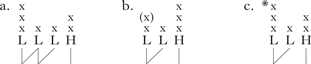
Descriptively, we can observe that the distance between an initial primary stress and a secondary stress cannot be just one mora, but this generalisation finds no explanation in either the Weak Bracketing or the Weak Layering accounts.
Torres-Tamarit & Hermans (Reference Torres-Tamarit and Hermansforthcoming) propose a solution for Munster Irish, claiming that it supports a model in which the constituents of the prosodic hierarchy and the grid entries of the metrical plane are conflated on a single dimension. This idea of conflation is extended to the level of the syllable, thus eliminating the syllable as a prosodic constituent that mediates between moras and the metrical plane. This implies that the relationship between what one might call phonetic syllables (i.e. segments organised around a peak of higher sonority, usually vowels) and phonological syllables (which in this model become lowest-level gridmarks) is not necessarily isomorphic.
If metrical prominence and constituency are conflated, it follows that grid entries are themselves constituents, and that every constituent is either a head or an optional dependent. On this view, a pair of two light phonetic syllables can be parsed in two different ways; every mora can project its own lowest-level gridmark (i.e. phonological syllable) (22a), or the second mora can be parsed as the dependent of a single lowest-level gridmark (b). Only the representation in (b) illustrates a one-to-many relation between lowest-level gridmarks, or phonological syllables, and phonetic syllables.
-
(22)
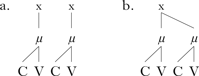
These arboreal metrical grids are evaluated in this model by branchingness constraints. Branchingness constraints come in two types: those which prohibit non-branching heads, and those which prohibit branching dependents. Only heads license structural complexity, where complexity means branching structures.
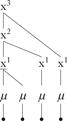
An analysis based on branchingness constraints together with representations in which two light syllables might be absorbed by only one lowest-level grid entry is straightforward. In Munster Irish, the head of the head foot (i.e. the stressed ‘syllable’) must branch, the word-level gridmark must be right-aligned and the head foot must be left-aligned. These requirements account for (20d) (ĹLLH̀), as shown in (23), where the underlined gridmark is the head of the head foot. The branching requirement forces us to parse the first two light syllables into one lowest-level grid mark, and the last light syllable can be parsed as the dependent of the word-level grid entry, therefore satisfying right-alignment (Exhaustivity can be violated). Dots represent vocalic root nodes.
-
(23)
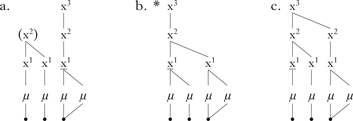
The reason why stress must shift in LLH inputs is illustrated in (24). The representation in (a) is the occurring form. Here the word-level gridmark is right-aligned, as expected, but its head is not left-aligned. Misalignment of the head foot is enforced by the satisfaction of two other more relevant constraints, the prohibition of branching dependents (violated in (b)) and of non-branching heads of head feet (violated in (c)). The fact that these two requirements take precedence over left-alignment of the head foot explain the stress shift in both LLH and HH inputs.
-
(24)
Weak Bracketing does not allow for such asymmetries between syllables and lowest-level gridmarks, which is why a representational solution of this sort cannot in principle be implemented in Hyde's theory.
3 Final remarks
Hyde's Weak Bracketing theory is framed within the tradition of metrical stress theories in which prosody and metrics occupy different dimensions. Weak Bracketing goes a step further, in permitting both overlapping feet that can share a stress and stressless feet, thereby relaxing the standard assumption of a one-to-one correspondence between the prosodic and the metrical dimensions. Hyde's book demonstrates the advantages that Weak Bracketing offers with respect to predicting an accurate typology of quantity-insensitive binary stress systems. I have here considered challenges to the theory by addressing two potentially fruitful empirical domains: ternary rhythm and the assignment of primary and secondary stress in Munster Irish, a puzzling weight-sensitive system. Weak Bracketing might offer interesting solutions to these problems, and future research may be able to reveal them.
I expect that Hyde's book will contribute to establishing a profitable dialogue between Weak Bracketing and other emerging approaches in metrical theory that also question the relationship between prosodic categories and metrical prominence (e.g. Hermans & Torres-Tamarit Reference Hermans, Torres-Tamarit, Kingston, Moore-Cantwell, Pater and Staubs2014, Torres-Tamarit & Hermans forthcoming; see also Iosad Reference Iosad2013 for a theory that contemplates recursive prosodic categories and mismatches between prosody and metrics, Martínez-Paricio Reference Martínez-Paricio2013 and Martínez-Paricio & Kager Reference Martínez-Paricio and Kager2015 for a theory of the continuum between binary and ternary rhythm that makes use of layered feet and Ulfsbjorninn Reference Ulfsbjorninn2014 for a grid theory of stress within CVCV phonology that rejects prosodic constituency outright).
It is clear that Layering and directionality illustrates the robustness of metrical stress theory within theoretical phonology. Hyde offers a profound study of how prosodic/metrical representations and constraints (i.e. computation) inform each other. At a general level, the current book reinforces the validity of OT as a framework that allows the analyst to address both the formal basis of representations and their relation with computation, the two necessary components for any formal theory of the faculty of language.


