Introduction
Many important agricultural insect pests across diverse orders show predictable diel periodicity of sexual communication (Bergh et al. Reference Bergh, Harris and Rose1990; Rodriguez et al. Reference Rodriguez, Madden and Nault1992; Knight et al. Reference Knight, Weiss and Weissling1994; Groot Reference Groot2014; Mori and Evenden Reference Mori and Evenden2015). Circadian clocks govern the schedules of pheromone release by females, male response to pheromone, and copulation in insects (Saunders Reference Saunders1997; Groot Reference Groot2014; Gadenne et al. Reference Gadenne, Barrozo and Anton2016). Pest managers can take advantage of species-specific reproductive diel patterns when using pheromone mating disruption, which involves the release of high doses of female pheromones, preventing males from finding receptive females by masking their pheromone plumes, attracting males away from females, causing male habituation, and other mechanisms (Welter et al. Reference Welter, Pickel, Millar, Cave, Van Steenwyk and Dunley2008). By understanding when pest species are receptive to mating, pest managers can limit the release of pheromones to the times of day when insects are most actively mating. Modern pheromone mating disruption dispenser types commonly used for lepidopteran pests, such as aerosol dispensers, can be programmed to release pheromones exclusively at particular times of the day. For example, identifying the nocturnal mating schedules of moth pests has led to synchronised nighttime pheromone release, which has been successful in disrupting mating, providing crop protection, and/or limiting unnecessary pheromone inputs when the insects are not active (Rama et al. Reference Rama, Reggiori and Pratizzoli2002; Stelinski et al. Reference Stelinski, Gut, Haas, McGhee and Epstein2007; Higbee and Burks Reference Higbee and Burks2008; Casado et al. Reference Casado, Cave and Welter2014; Mori and Evenden Reference Mori and Evenden2015).
Swede midge (Contarinia nasturtii (Kieffer); Diptera: Cecidomyiidae) is a challenging invasive pest of Brassica Linnaeus (Brassicaceae) crops in North America, including B. oleracea Linnaeus (broccoli, cabbage, cauliflower, and kale) and B. napus Linnaeus (canola). A member of the family Cecidomyiidae, which contains several challenging agricultural pests, swede midge is uniquely difficult to manage because of its ability to distort plant growth. Since its introduction to North America from Europe in the 1990s, swede midge has been responsible for serious economic losses of canola and broccoli crops in Ontario and Québec, Canada and the northeastern United States of America (Hallett and Heal Reference Hallett and Heal2001; Chen et al. Reference Chen, Shelton, Hallett, Hoepting, Kikkert and Wang2011). Larvae cause plant damage by feeding within the meristem of their host plants and distorting growth, causing leaves, heads, and other plant parts to become unmarketable. Because they are enclosed within the newly forming meristematic leaves of their host plants, feeding larvae are protected from contact with foliar insecticides. As a result, foliar insecticides are largely ineffective for this pest (Chen et al. Reference Chen, Shelton, Hallett, Hoepting, Kikkert and Wang2011).
Alternative management practices are needed to prevent adult midges from ovipositing on host plants. Only a single swede midge larva per plant can render a cauliflower head unmarketable (Stratton et al. Reference Stratton, Hodgdon, Zuckerman, Shelton and Chen2018). Because of this extremely low damage threshold, pheromone mating disruption is a promising tactic for this pest because it prevents mating and subsequently provides crop protection from feeding larvae. Although pheromone mating disruption has been tremendously successful for lepidopteran pests (Welter et al. Reference Welter, Pickel, Millar, Cave, Van Steenwyk and Dunley2008; Witzgall et al. Reference Witzgall, Kirsch and Cork2010; Miller and Gut Reference Miller and Gut2015), it has not yet been developed for dipteran pests. The use of cecidomyiid and other dipteran pheromones in pest management is problematic, as they are structurally complex and particularly costly to synthesise (Hillbur et al. Reference Hillbur, Celander, Baur, Rauscher, Haftmann, Franke and Francke2005; Hall et al. Reference Hall, Amarawardana, Cross, Francke, Boddum and Hillbur2012; Samietz et al. Reference Samietz, Baur and Hillbur2012). However, for difficult to manage pests such as swede midge, pheromone mating disruption may present an alternative to calendar sprays of conventional insecticides, which is currently the most widely used tactic for this pest (Chen et al. Reference Chen, Shelton, Hallett, Hoepting, Kikkert and Wang2011). Although Samietz et al. (Reference Samietz, Baur and Hillbur2012) demonstrated that pheromone mating disruption was successful in providing crop protection from swede midge in Europe, they reported that their system was likely not economically feasible at the commercial level due to prohibitive costs of swede midge pheromone synthesis. Timed pheromone-releasing devices could allow for mating disruption to be economically viable by reducing pheromone inputs. However, far fewer studies have described the chemical ecology and diel patterns of cecidomyiid behaviours compared with Lepidoptera due to their small size, difficulty to rear in laboratory conditions, and sometimes immeasurably small amounts of pheromone that they produce compared with other insect pests (Hall et al. Reference Hall, Amarawardana, Cross, Francke, Boddum and Hillbur2012).
A better understanding of the diel reproductive behaviour of swede midge and other cecidomyiids can aid in the development of more economical pheromone mating disruption systems for these pests. Many economically important cecidomyiids display sexually dimorphic emergence and pheromone-releasing “calling” behaviours that are governed by circadian clocks (Modini et al. Reference Modini, Page and Franzmann1987; Bergh et al. Reference Bergh, Harris and Rose1990; Pivnick and Labbé Reference Pivnick and Labbé1992; Heath et al. Reference Heath, Zhang, Roelofs and Smith2005). Because most midges are very short lived, synchronisation of reproductive behaviour between males and females must be precise. Female midges emerge from the soil, mate shortly after eclosion, locate host plants, oviposit, and die shortly thereafter (Gagné Reference Gagné1989; Hall et al. Reference Hall, Amarawardana, Cross, Francke, Boddum and Hillbur2012). Male swede midge and other male cecidomyiid sibling cohorts typically emerge on average one to two days before females (Gagné Reference Gagné1989; Bergh et al. Reference Bergh, Harris and Rose1990; Hillbur et al. Reference Hillbur, Celander, Baur, Rauscher, Haftmann, Franke and Francke2005). While females begin releasing pheromones and are receptive to males almost immediately after eclosion, male cecidomyiids require additional time to be able to fly in search of mates, presumably to allow for sufficient cuticle sclerotisation (Gagné Reference Gagné1989; Bergh et al. Reference Bergh, Harris and Rose1990; Hillbur et al. Reference Hillbur, Celander, Baur, Rauscher, Haftmann, Franke and Francke2005). Newly emerged cecidomyiid females are highly attractive to males for mating (Gagné Reference Gagné1989; Bergh et al. Reference Bergh, Harris and Rose1990). While some species call during an extended period from morning until evening (apple leaf midge, Dasineura mali (Kieffer)), others call during a shorter window of time, primarily during the end of scotophase through early morning hours (Contarinia sorghicola (Coquillett), and Hessian fly, Mayetiola destructor (Say)) or during the evening only (wheat midge, Sitodiplosis mosellana (Géhin)) (Modini et al. Reference Modini, Page and Franzmann1987; Bergh et al. Reference Bergh, Harris and Rose1990; Pivnick and Labbé Reference Pivnick and Labbé1992; Heath et al. Reference Heath, Zhang, Roelofs and Smith2005). While Hillbur et al. (Reference Hillbur, Celander, Baur, Rauscher, Haftmann, Franke and Francke2005) and Boddum et al. (Reference Boddum, Skals, Wirén, Baur, Rauscher and Hillbur2009) observed calling and mating for swede midge shortly after the onset of photophase, they did not formally test their observations.
Here, we studied the diel periodicity and sex-based differences of emergence and reproductive behaviour of swede midge in laboratory and field settings to determine when adults are sexually active. Specifically, we tested the following research questions: (1) do diel emergence patterns differ by sex, (2) do newly-emerged females display diel patterns of calling, and 3) do males show diel patterning in their response to pheromones?
Materials and methods
Swede midge colony rearing
We used two laboratory colonies for the study, one at the University of Vermont in Burlington, Vermont, United States of America and the second at the University of Guelph in Guelph, Ontario, Canada. The “Swiss colony,” maintained at the University of Vermont since 2014, originated predominantly from the Swiss Federal Research Station for Horticulture in Wädenswil, Switzerland, with an input of 122 field-collected midges from northwestern Vermont to increase genetic diversity of the colony in 2015. The “Ontario colony” consisted solely of midges collected from fields in Ontario in 2016 and 2017. We reared the Swiss colony at 22.4 ± 1.2 ºC temperature and 40.7 ± 11.4% relative humidity with a 16:8 (light:dark) photoperiod. With the following exceptions, we reared midges in the Ontario colony under similar conditions: the relative humidity in the rearing room was on average 50–70%, and the photoperiod was shifted one hour later. Because our experiments with each colony were temporally and spatially separate due to their rearing locations, we did not include population as a variable in the statistical analyses of experiment results described in later sections and analysed our data for both populations separately.
We used cauliflower, B. oleracea group Botrytis Linnaeus (Brassicaceae) “Snow Crown” (Harris Seeds, Rochester, New York, United States of America), for rearing because of its large bud size and high susceptibility to swede midge (Hallett Reference Hallett2007). We seeded cauliflower in Fafard 3B soilless potting medium (Sun Gro Horticulture, Agawam, Massachusetts, United States of America), and transplanted the seedlings into 10 or 15 cm pots at approximately four weeks after seeding. Plants received synthetic fertiliser application thrice weekly following transplanting at a total rate of 150 ppm consisting of two parts 21-5-20 and one part 15-0-14 with supplemental magnesium. We introduced plants to the swede midge ovipositional rearing cages after approximately 8–12 weeks of age, when buds began to form but were less than 1 cm in diameter. The plants were exposed to adult midges for 24–72 hours in the main oviposition cages. We then transferred the exposed plants to separate cages for larval development for 10–14 days. When ready to pupate, midge larvae vacate the meristem by crawling or jumping onto the soil, pupating within the top few centimetres of the soil surface (Readshaw Reference Readshaw1961). To facilitate larval movement into the potting medium, we cut the top 5 cm of the cauliflower apical meristems and inserted them into the potting medium. We placed the pots with pupae into the ovipositional rearing cages, where they would then emerge as adults.
Sex-based differences in diel emergence
We tested whether male and female adults differ in diel patterns of emergence by conducting 24-hour observational trials. To set up the emergence trials, we grew single 8–12-week-old cauliflower plants and exposed them to adult midges in the ovipositional cages 20–22 days before the trials. We counted the numbers of midges emerging from pupae-infested potting media in plant pots from the Swiss and Ontario colonies in separate experiments in June–September 2015 and June–August 2017, respectively. Each experiment consisted of three 24-hour observational periods. To capture midges emerging from the soil during each hour, we removed the potting media containing cauliflower roots and swede midge pupae from the plant pots and placed them into one-quart (946 mL) deli containers (Swiss), or left them in pots (Ontario) fitted with insect netting. At the end of each hour for 24 hours, we counted the number of male and female midges that had emerged in each container. To observe midge emergence during the scotophase without disturbing midge behaviour with bright artificial lighting, we used 25 W red incandescent light bulbs because flies are less sensitive to light in this wavelength range (Fingerman and Brown Reference Fingerman and Brown1952).
To test if the numbers of emerging male and female midges differed at each hour, we used generalised linear mixed models because they can account for repeated measures and multiple predictors and are robust to non-normally distributed data (Bolker et al. Reference Bolker, Brooks, Clark, Geange, Poulsen, Stevens and White2009). The number of midges emerging each hour followed Poisson distributions. Using separate generalised linear mixed models with repeated measures frameworks for each colony, we tested whether the total number of midges and the numbers of males and females emerging were equal at each hour of the day. Within each model, individual deli containers or pots containing potting media from individual host plants were considered the subjects or units of replication (n = 8 pots from the Swiss colony and n = 34 pots from the Ontario colony) and hour within day was specified in the repeated measures field. We specified hour, day of the experiment, sex, and the interaction term hour × sex as predictors. In this model and generalised linear mixed models for subsequent datasets, we used Satterthwaite’s approximation to generate degrees of freedom due to small sample sizes and/or the unbalanced structures within our data. We used SPSS statistical software version 24 (International Business Machines Corporation, Armonk, New York, United States of America) and α = 0.05 for these and all subsequent statistical analyses, where descriptive statistics are displayed as standard error of the mean.
Diel patterns of female calling
We tested whether midges display diel patterns of pheromone-releasing behaviour by observing female calling over three 24-hour experiments for each colony separately in laboratory settings in June–September 2015 (Swiss) and June–August 2017 (Ontario). We aspirated unmated female midges as they emerged from potting media during morning peak periods of female emergence for each colony (Fig. 1), and began our experiment approximately one hour following the peak emergence period to ensure that the midges were of the same age. We placed females singly in 20-mL glass scintillation vials covered with insect netting containing 1 cm2 pieces of white filter paper moistened with distilled water from which the midges could drink.
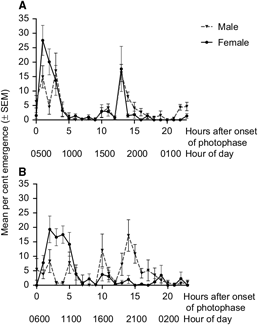
Mean per cent emergence of total male and female adult swede midge from soil over three 24-hour periods. A, Swiss population; B, Ontario population. The values of “0” on the upper x-axes indicate artificial dawn (lights on). Both generalised linear mixed models of calling using hour, sex, and hour × sex as predictors were statistically significant at P < 0.001. SEM, standard error of the mean.

We categorised calling behaviour using a binary scoring system for whether or not midges exhibited the characteristic cecidomyiid pheromone-releasing posture described by Harris et al. (Reference Harris, Galanihe and Sandanayake1999): terminal segments of the abdomen protracted to expose the pheromone gland and ovipositor extended. We observed midges for calling twice per hour, on the hour and half hour, using a 20× hand lens. A score of 1 was given when midges were observed calling either once or twice per hour, and a score of 0 was given when no calling was observed. We excluded midges that died or did not call (non-callers) during each 24-hour period from further analysis. Non-callers may have mated prior to capture, or called while unobserved. Our final sample size consisted of n = 107 (Swiss) and n = 91 (Ontario) calling midges.
For each colony, we used separate generalised linear mixed models to analyse the relationship between hour of day and the probability of female calling to test the null hypothesis that the probability of midge calling was equal throughout the 24-hour period. For each model, we used hour and day of experiment as predictors, individual midges coded as subjects, and hour within day specified as the unit of repeated measures. Calling behaviour followed a binomial distribution.
Diel periodicity of male response to pheromone traps
Because female calling patterns represent the reproductive behaviour of only half of the population, we also tested for diel patterns of male mate seeking. We tested whether the number of males caught in pheromone traps each hour, our proxy for response to pheromone and mate searching, followed diel patterns at a commercial vegetable farm in New Hamburg, Ontario, Canada, at which we previously measured very high levels of swede midge infestation (> 30 males per pheromone trap per day; Hallett et al. Reference Hallett, Chen, Sears and Shelton2009). Using cardboard Jackson (delta) traps with commercial pheromone lures (Solida Distributions, Saint-Ferréol-les-Neiges, Québec, Canada), we counted numbers of males trapped on sticky cards once each hour for 24 hours. For each 24-hour observation period, we used four traps set up in each of four different vegetable fields with emerging swede midge populations. Fields contained either living or mowed crop residues from Brassica vegetable crops, including broccoli, cauliflower, kale, collard greens, and daikon radishes (Raphanus sativus var. longipinnatus Bailey). We placed traps at least 100 m apart within the fields, which is twice the recommended spacing for avoiding trap interference (Allen et al. Reference Allen, Fraser and Hallett2009). We placed new lures in each trap at the start of each set of trials, which was repeated three times, on the 17–18 and 27–28 July, and 17–18 August 2016, for a total of 16 replicates per 24-hour observation period (a total of 48). Due to the lack of males caught in 11 traps over the 24-hour periods, our final dataset consisted of counts from n = 37 traps. During the second and third 24-hour periods, we measured temperature, relative humidity, and wind speed in each field at every hour. Using individual traps as experimental units, we used a generalised linear mixed model with repeated measures and Poisson distribution to examine whether trap counts differed significantly by hour of day and by day of the experiment.
Results
Sex-based differences in diel emergence
We found that both male and female adults from both populations emerged according to a diel pattern (Swiss: F 47,1547 = 4.488, P < 0.001 and Ontario: F 49,334 = 4.712, P < 0.001). Over the three 24-hour periods, we observed a total of 383 Swiss and 287 Ontario midges emerging from the colony potting media. Females from both colonies emerged predominantly in the morning, with a smaller peak in emergence in the late afternoon in the Swiss colony (Fig. 1). Emergence of males was split primarily between the morning and late afternoon (Fig. 1).
In the Swiss colony, hour was a significant predictor of emergence (P < 0.001) and the interaction term hour × sex was significant (P = 0.013), indicating that males and females emerged at different times of the day. The majority of Swiss females (63% of the total) emerged within the first three hours after dawn (0500–0800; Fig. 1A). During the same time period, only 36% of Swiss males emerged. More males emerged in the late afternoon and evening compared with females, with 36% of total emerging males eclosing between 1500 and 2100, whereas only 10% of total females emerged during this time period.
Similarly to the Swiss colony, Ontario midges exhibited diel sex-based differences in emergence, as hour and the interaction term hour × sex were both statistically significant predictors of emergence in the final model (P < 0.001). The female emergence peak occurred within the first six hours of the photophase (0600–1200), when 75% of females emerged (Fig. 1B). Females from the Ontario colony, unlike those from the Swiss colony, did not emerge in the afternoon. The majority of males (63%) emerged between four peaks throughout the photophase, with the highest peak in the afternoon at 1400.
Diel patterns of female calling
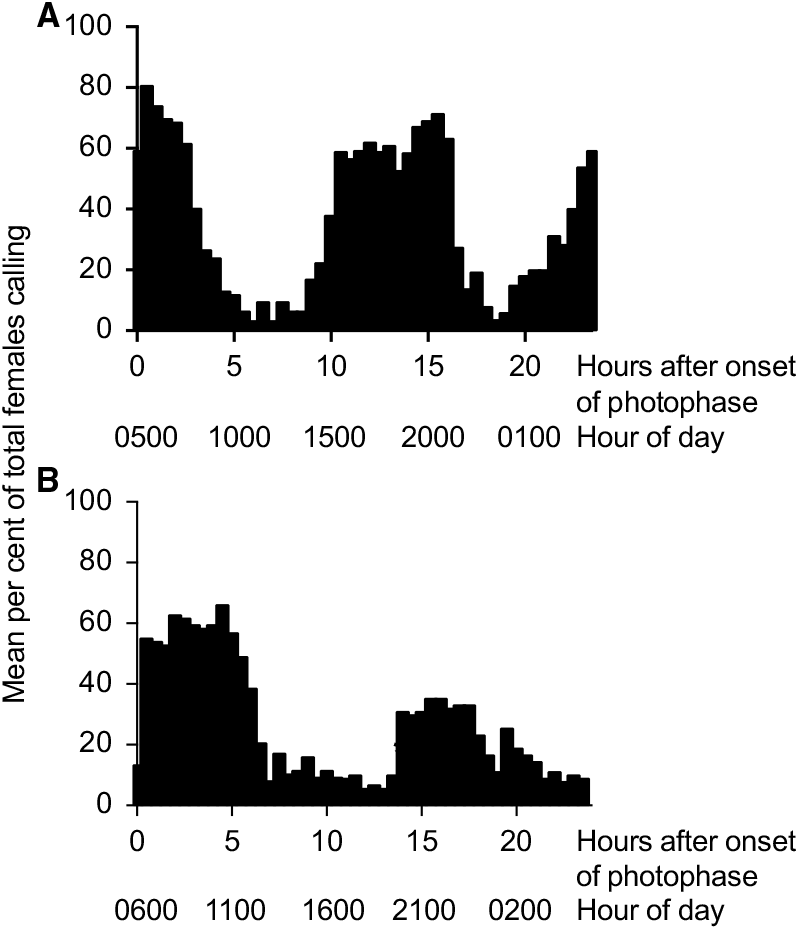
The majority of both Swiss and Ontario females (> 50%) called in the morning (Fig. 2). In both colonies, the calling patterns were very similar to the emergence patterns, indicating that females are most receptive to males shortly after they emerge (Fig. 1). We observed many females with protruding ovipositors as they were emerging from the soil. Hour of day was a significant predictor of female calling (P < 0.001) for both the Swiss and Ontario colonies within the overall models (F 25,2541 = 22.626, P < 0.001 and F 25,2152 = 13.714, P < 0.001, respectively). Consistent with the characteristic calling behaviours of other cecidomyiids (Gagné Reference Gagné1989), the females were stationary while calling in the vials, extruding and sometimes waving their ovipositors. Occasionally, we observed small droplets of pheromone at the end of the ovipositors, and some females wiped their ovipositors onto the sides of the vials leaving a visible trail of pheromone. A small portion of midges (two Swiss and 13 Ontario individuals) did not call during the experimental period and were excluded from analyses.
Mean per cent of total females calling each half-hour. A, Swiss population; B, Ontario population. The values of “0” on the upper x-axes indicate artificial dawn (lights on). The generalised linear mixed models for both populations using hours as predictors were statistically significant (P < 0.001). SEM, standard error of the mean.

The Swiss colony showed a bimodal pattern of calling at dawn and dusk (Fig. 2A). Over 80% of all Swiss midges called at 0500, the peak of calling. On average, 70% of all midges called during the first two hours of the photophase (0500–0700). A smaller peak in calling activity occurred in the late afternoon, with 60% of midges calling between 1500 and 2100. Groups of midges calling during the morning and afternoon were not exclusive; the same midges called during both periods. The number of calling midges dropped by 49% after the onset of the scotophase at 2100. Fewer than 20% of midges called between 1000–1400 and 2200–0000.
In the Ontario colony, the peak calling time occurred four hours after the onset of photophase (1030), when 66% of midges called (Fig. 2B). During the first five hours of the photophase (0600–1100), an average of 54% of midges called at each time point, and most midges stopped calling at 1200. Similar to the Swiss colony, calling in the Ontario population was bimodal with a small peak in activity in the evening. During the evening peak in calling, 31% of females called between 2000 and 0000.
Diel periodicity of male response to pheromone traps
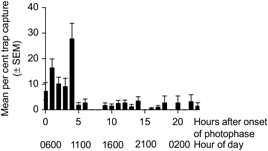
We found evidence that males show diel periodicity in their attraction to the female sex pheromone. The number of males caught in the pheromone traps varied significantly throughout the day (F 19,939 = 3.656, P < 0.001). We captured 73% of males in pheromone traps within the first five hours after dawn (0600–1100; Fig. 3).
Mean per cent of total males caught in traps at each hour per day in Ontario field trial. The value of “0” on the upper x-axis indicates natural dawn. The generalised linear mixed model with hour of day as a predictor of trap captures was significant at P < 0.001. SEM, standard error of the mean.

Despite variation in weather, phases of the moon, sunrise, and sunset, the day of the experiment was not a significant predictor within the model. The weather during our three 24-hour experimental periods was variable, with periods of sun and clouds throughout each day and two brief periods of rain in the evening and night during two of the three 24-hour periods. Temperature averaged 27.8 ± 4.4 ºC with 56.7 ± 14.4% relative humidity during the photophase, and 22.0 ± 2.2 ºC with 76.8 ± 8.3% relative humidity during the scotophase. Wind was highly variable, with the strongest gusts observed from 1000 to 1300, ranging from 0 to 69 m/s. We observed virtually no wind (< 1 m/s) from 1900 to 1000. Sunrise and sunset occurred at approximately 0600 and 2100, respectively.
Discussion
Swede midge show clear diel and sex-based patterns of adult emergence and mating behaviour. Despite testing our research questions across different populations in varying geographical locations, the patterns we observed were remarkably consistent. Our study is the first comprehensive test for diel periodicity of swede midge behaviour, offering information that may be used in future management programmes for this challenging pest.
We observed our largest peak in emergence of females within the first five hours after dawn. However, Readshaw (Reference Readshaw1961) observed peaks in emergence of females later in the day, from approximately 1000–1200 until 1800 in the field and from 1400 to 2200 in laboratory settings with varying temperature regimes. In both settings, he observed more males emerging in the morning prior to females. Although these findings appear to contradict our results, in both field and laboratory experiments, Readshaw (Reference Readshaw1961) did not observe emergence from 2200 until 0800, and may have missed emergence of midges around dawn. Hillbur et al. (Reference Hillbur, Celander, Baur, Rauscher, Haftmann, Franke and Francke2005) observed emergence of swede midge primarily during the night and first hour of photophase, outside of the Readshaw observation window. In our Swiss colony, the secondary peak in emergence of males and females, from 1500 to 2000, more closely matches with the Readshaw (Reference Readshaw1961) findings. However, in our Ontario colony, we observed many males but few females emerging during this time period. These differences may be due to the origin of the colonies, where the Swiss colony primarily represents a European population, while the Ontario colony was initiated from North American insects.
We found that the times of female emergence and calling were synchronised, and that females began calling almost immediately after eclosing in the morning, suggesting that swede midge mate at their emergence sites. One of the major challenges surrounding implementing a pheromone mating disruption system within annual systems is complex crop rotation practices. Unlike perennial cropping systems, pheromone mating disruption dispensers may be more effective in annual cropping systems for midges at the sites of midge emergence, rather than within the current crop. Many annual crops are rotated between fields from year to year, which could separate emerging midges from where their host plants are grown in the current year. In other midge species that infest annual crops, such as Dasineura brassicae (Winnertz) and the wheat midge, overwintering individuals emerge in fields where their host crops were grown in the previous year (Williams et al. Reference Williams, Martin and Kelm1987; Smith et al. Reference Smith, Wise and Lamb2007). Males emerging first linger at the emergence site and mate with females after they eclose and begin calling. The mated females then migrate to other fields to lay their eggs on their host plants if hosts are not already present at the emergence site (Williams et al. Reference Williams, Martin and Kelm1987; Smith et al. Reference Smith, Wise and Lamb2007). In the future, experiments to directly test where swede midge mate will aid in determining where to install pheromone mating disruption dispensers.
We found that female calling behaviour and male responsiveness to pheromone followed a similar timeline. Our data suggest that midges mate primarily within the first five hours after dawn. Although the majority of adults were synchronised in their reproductive behaviour, we found a noticeable difference in the reproductive activity between males and females during the late afternoon and early evening. While a large number of females called during the late afternoon hours in the Swiss colony, Ontario females in the laboratory and males in the field were less active in the field during these times. Calling periods from our Ontario colony more closely match our results from the males in the field, as these populations are of similar origin. However, the calling periods of the Ontario females are slightly longer than the periods of time when we captured males. Perhaps males are more likely to search for females under differing seasonal environmental conditions not represented during our warm summer experiments. Otherwise, releasing pheromones while males are not responsive may incur a seemingly unnecessary fitness cost to females.
Overall, we observed more variations in periodicity of activity in the Ontario midges versus the Swiss midges. The Swiss population had been exposed to the selective pressures of colony rearing for many more years than the Ontario colony, which was initiated more recently from field populations. Laboratory rearing conditions can impose bottlenecking and selection pressures unlike those in the wild within very few generations (Hoffman and Ross Reference Hoffman and Ross2018). However, bottlenecking during the introduction of swede midge to North America may have occurred as well, limiting the genetic diversity of the wild population in Ontario. Studies on the population genetics of swede midge would be necessary to determine differences between European and North American populations. Despite differing origins and exposure to potentially different bottlenecking pressures, our results indicate that the Swiss colony has retained diel behavioural patterns generally similar to the Ontario colony.
In addition to differences in colony age, our two swede midge colonies were established from wild individuals from different geographical locations. Our Swiss colony originated from Europe, closer to the origin of the species, while our Ontario colony represents the invasive North American population. Geography is known to play a role in influencing differences in diel patterns across insect populations of the same species found in different locations. Geographical differences in calling and mate-seeking patterns can be due to the presence of multiple strains of the insect and/or due to climatic differences in their environments. Differences in local photoperiods, temperature, humidity, and wind introduce variation in the timing of behaviours (Delisle and McNeil Reference Delisle and McNeil1986; Blackwell Reference Blackwell1997; Rund et al. Reference Rund, Lee, Bush and Duffield2012; Pellegrino et al. Reference Pellegrino, Peñaflor, Nardi, Bezner-Kerr, Guglielmo, Bento and McNeil2013; Groot Reference Groot2014). Had we tested midges from both populations during the same experiments and included population origin in our models, we would have more confidence making comparisons between the two colonies. Because we found similar patterns across the colonies, the use of both populations strengthen our conclusion that swede midge primarily mate in the morning.
Our data provide a timeline of daily reproductive events that may be useful for designing more efficient pheromone mating disruption systems and potentially other management practices. The diel reproductive behaviour of swede midge presents an opportunity to turn off mating disruption dispensers at the times of the day when the insects are not active, primarily between a five-hour period midday, and during a three-hour nighttime period. During these time periods, less than 20% of males were captured and less than 20% of females called. Turning off dispensers during these eight hours would reduce the cost of pheromone inputs by 33%. With these cost savings, pheromone mating disruption could be a more viable commercial pest management strategy for swede midge in the future.
A predicted increase in the threat of invasive agricultural pests (Paini et al. Reference Paini, Sheppard, Cook, De Barro, Worner and Thomas2016), paired with a growing market for organic produce in Canada and the United States of America (Agriculture and Agri-Food Canada 2017, United States Department of Agriculture Economic Research Service 2017), creates an imminent need for continuing research and development of more economical ecologically based pest management strategies. Although pheromone mating disruption is not a new pest management technique, its use for dipteran pests is novel and may require additional design considerations compared with those used for lepidopteran pests. Species-specific knowledge of life cycles, ecology and natural history for introduced species in their new environments will be necessary for exploiting their behaviour for future pest management strategies.
Acknowledgements
We acknowledge funding from a United States Department of Agriculture National Institute of Food and Agriculture Crop Protection and Pest Management grant (2014-70006-22525), the Vermont Agency of Agriculture Specialty Crop Block Grant Program (02200–SCBGP-9-1), and the Ontario Ministry of Agriculture, Food, and Rural Affairs – University of Guelph Partnership. We thank the following people for technical support at the University of Guelph and University of Vermont: Jamie Bauman, Jarrett Blair, Raina Brot-Goldberg, Charles-Étienne Ferland, Paolo Filho, James Heal, Kathryn Jacobs, David Laurie, Kate Lindsay, Charlotte MacKay, Ted Marois, Cameron Ogilvie, Ross Pillischer, Elizabeth Porter, Rebecca Roman, Justine Samuel, Leah Slater, Jonathan Williams, and Samuel Zuckerman. We also thank Pfenning’s Organic Vegetables, for allowing us to conduct our field experiments at their farm; the University of Vermont campus greenhouses for swede midge colony plant production; Alan Howard from the University of Vermont Statistical Consulting Services for assistance with statistical analysis; and Scott Merrill, Kimberly Wallin, David Conner, and Marion Harris for advice on experimental designs and data interpretation. Lastly, we thank Charles-Étienne Ferland and Vincent Martineau for their assistance with French translation of our abstract.