Introduction
Lowbush blueberry is a native, perennial berry species in Nova Scotia, Canada (Vander Kloet Reference Vander Kloet1988). Commercial fields are developed on cleared woodland or abandoned agricultural land where native blueberry stands already exist (AAFC 2005). These stands are composed of distinct and variable clones that spread by rhizomes (Glass and Percival Reference Glass and Percival2000). Commercial fields are managed predominantly on a 2-year production cycle in which fields are pruned to ground level in the first year (nonbearing year) to stimulate new shoot growth, and berries are harvested in the second year (bearing year) after bloom and fruit set (AAFC 2005; Jensen and Yarborough Reference Jensen and Yarborough2004). Weed management is a challenge due to the perennial life cycle of the crop and lack of management options such as tillage and crop rotation. Weeds, therefore, are a major yield-limiting factor in lowbush blueberry production (Jensen and Yarborough Reference Jensen and Yarborough2004; Yarborough Reference Yarborough2009).
The weed flora of lowbush blueberry fields consists primarily of herbaceous and woody perennial species (Jensen and Yarborough Reference Jensen and Yarborough2004; McCully et al. Reference McCully, Sampson and Watson1991), with several species of goldenrods among the most common species of herbaceous perennial weeds (Jensen and Kimball Reference Jensen and Kimball1985; Lapointe and Rochefort Reference Lapointe and Rochefort2001; McCully et al. Reference McCully, Sampson and Watson1991; White et al. Reference White, Boyd and Van Acker2016). Goldenrods reproduce sexually through seeds and asexually by rhizomes (Werner et al. Reference Werner, Gross and Bradbury1980) and rapidly colonize sites by vegetative reproduction from rhizomes after establishment (Hartnett and Bazzaz Reference Hartnett and Bazzaz1985). These plants are common in sites lacking tillage (Blackshaw Reference Blackshaw and Inderjit2005; Kapusta and Krausz Reference Kapusta and Krausz1993) and are a natural component of early successional plant communities associated with lowbush blueberry fields (Hall Reference Hall1959). The tall stems of most goldenrod species impede fruit-harvest operations (Jensen and Specht Reference Jensen and Specht2002), and shading from other tall weeds, such as spreading dogbane (Apocynum androsaemifolium L.) and brackenfern [Pteridium aquilinum (L.) Kuhn], reduces yields (Yarborough and Marra Reference Yarborough and Marra1997). Management of weeds such as goldenrods is therefore important in lowbush blueberry fields.
Goldenrods were traditionally controlled by broadcast PRE hexazinone applications in the nonbearing year (Jensen Reference Jensen1985; Lapointe and Rochefort Reference Lapointe and Rochefort2001; Yarborough and Bhowmik Reference Yarborough and Bhowmik1989), but incomplete control of these weeds by hexazinone has been reported (Boyd and White Reference Boyd and White2010). Recent grower reports in Nova Scotia also indicate reduced hexazinone efficacy on goldenrods, potentially due to increased occurrence of narrowleaf goldenrod (Lyu and White, unpublished data), which is not adequately controlled by hexazinone (White et al. Reference White, Boyd and Van Acker2016). Goldenrods, therefore, are currently managed primarily by broadcast POST mesotrione applications in the nonbearing year (Anonymous 2017; Boyd and White Reference Boyd and White2010). One mesotrione application per year is permitted under the current registration for lowbush blueberries in Canada, but single applications of this herbicide do not provide complete control of goldenrod (Boyd and White Reference Boyd and White2010) and plant recovery usually occurs in the year after application. Management of other perennial weeds with mesotrione, however, has been improved by using sequential mesotrione applications. For example, sequential application of mesotrione improved control of the perennial weeds horsenettle (Solanum carolinense L.) (Armel et al. Reference Armel, Wilson, Richardson and Hines2003) and black bulrush (Scirpus atrovirens Willd.) (Boyd and White Reference Boyd and White2010) compared with single mesotrione applications. Sequential applications of mesotrione, or use of mesotrione in conjunction with other POST herbicides, therefore, could improve goldenrod control if registered for use in lowbush blueberries. In addition, goldenrods often occur in distinct patches in lowbush blueberry fields (McCully et al. Reference McCully, Sampson and Watson1991) and may be more economically managed with directed spot applications of mesotrione or other herbicides in some fields.
The objectives of this research were to (1) compare efficacy of single versus sequential nonbearing-year POST mesotrione applications on goldenrod (2) identify the optimal interval between sequential POST mesotrione applications (3) evaluate nonbearing-year POST bicyclopyrone applications on goldenrod, and (4) evaluate nonbearing-year summer and fall herbicide spot treatments on goldenrod.
Materials and Methods
Study Sites
Experiments were conducted in four commercial lowbush blueberry fields in Nova Scotia between 2016 and 2017 (Table 1). The dominant species at each site was narrowleaf goldenrod, although some patches of Canada goldenrod (Solidago canadensis L.) were interspersed among the narrowleaf goldenrod at the Londonderry site. All results reported are for narrowleaf goldenrod, hereafter referred to as goldenrod.
Study sites used for evaluation of broadcast and spot herbicide applications on goldenrod in lowbush blueberry fields in Nova Scotia, Canada.

Effect of Sequential Mesotrione Applications on Goldenrod
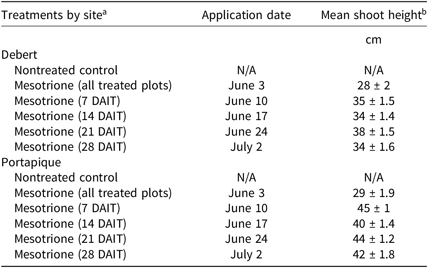
Experiments were conducted in two commercial lowbush blueberry fields located in Debert and Portapique, Nova Scotia (Table 1) in 2016 and 2017 to evaluate broadcast herbicide applications for goldenrod management. The first experiment was designed to evaluate sequential mesotrione (Callisto herbicide; Syngenta, Platsville, ON, Canada) applications for goldenrod management. The experiment was arranged as a randomized complete block design with eight blocks at Portapique and nine blocks at Debert. Plot size was 2 m by 4 m, with a 1-m buffer between each block. Treatments consisted of (1) nontreated control; (2) mesotrione application at 30-cm shoot height; (3) mesotrione application at 30-cm shoot height followed by a sequential mesotrione application at 7 d after initial treatment (DAIT); (4) mesotrione application at 30-cm shoot height followed by a sequential mesotrione application at 14 DAIT; (5) mesotrione application at 30-cm shoot height followed by a sequential mesotrione application at 21 DAIT; and (6) mesotrione application at 30-cm shoot height followed by a sequential mesotrione application at 28 DAIT. Initial applications targeted the 30-cm shoot height stage, owing to previous reports of mesotrione efficacy at this application timing (Boyd and White Reference Boyd and White2010). Mesotrione was applied at a rate of 144 g ai ha−1 in 200 L ha−1 water with 0.2% vol/vol nonionic surfactant using a CO2 pressurized research-plot sprayer equipped with four Teejet® XR8002VS nozzles (TeeJet Technologies, Spraying Systems Co., Springfield, PA) and operated at a spray pressure of 275 kPa. The mean goldenrod height at the time of treatment applications for each site is reported in Table 2.
Application dates and mean goldenrod shoot height at the time of sequential mesotrione herbicide applications at Debert and Portapique, Nova Scotia, Canada, in 2016.

a Abbreviations: DAIT, days after initial treatment; N/A, not applicable.
b Values represent the mean ± 1 SE.
Effect of Bicyclopyrone on Goldenrod
This experiment was designed to compare POST mesotrione applications with POST bicyclopyrone (Syn-A16003 herbicide; Syngenta) applications on goldenrod. The experiment was arranged as a randomized complete block design with six blocks at Debert and eight blocks at Portapique. Plot size was 2 m by 4 m, with a 1-m buffer strip between blocks. Treatments consisted of (1) nontreated control, (2) mesotrione, (3) bicyclopyrone, and (4) mesotrione plus bicyclopyrone. Herbicide applications were made at the floral bud initiation stage in the nonbearing year. Mesotrione and bicyclopyrone were applied at a rate of 144 and 50 g ai ha−1, respectively, in 200 L ha−1 water with 0.2% vol/vol nonionic surfactant. Herbicide applications were made using a CO2 pressurized research-plot sprayer equipped with four Teejet® XR8002VS Teejet nozzles operated at a spray pressure of 275 kPa. The mean ± SE goldenrod height at the time of treatment applications was 40 ± 0.8 cm and 52 ± 1.6 cm at Debert and Portapique, respectively.
Evaluation of Summer and Fall Herbicide Spot Applications on Goldenrod
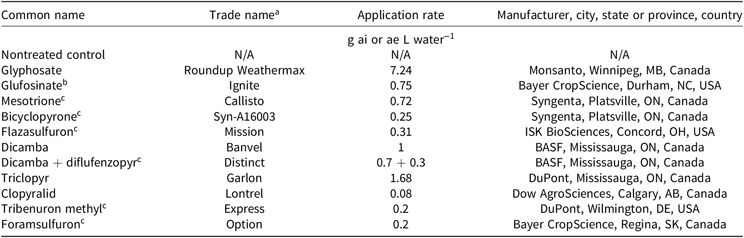
Experiments were conducted in 2016 and 2017 to evaluate nonbearing-year summer and fall herbicide spot treatments to goldenrod (Table 3). Glyphosate, dicamba, triclopyr, clopyralid, and tribenuron methyl were chosen because of current use for spot applications in lowbush blueberry. Mesotrione and bicyclopyrone were chosen to assess potential for spot applications of carotenoid-inhibiting herbicides in lowbush blueberry. Glufosinate and foramsulfuron were chosen because of increased use of these herbicides in lowbush blueberry and grower interest in potential for spot applications of these materials. Flazasulfuron was chosen because of recent identification of efficacy of this herbicide on other important weeds in lowbush blueberry (Zhang et al. Reference Zhang, White, Randall Olson and Pruski2018), and dicamba plus diflufenzopyr was chosen to assess potential improvements in perennial weed control with this product relative to dicamba.
POST herbicides evaluated as summer and fall spot applications to goldenrod in lowbush blueberry fields located at Debert, Portapique, Farmington, and Londonderry, Nova Scotia, Canada.

a Abbreviation: N/A, not applicable.
b Glufosinate was only applied in the summer spot application experiment.
c Foramsulfuron was applied with 28% urea-ammonium nitrate at a rate of 12.5 mL L−1 water; flazasulfuron, mesotrione, dicamba + diflufenzopyr, tribenuron methyl, and bicyclopyrone were applied with nonionic surfactant at a rate of 0.2% vol/vol.
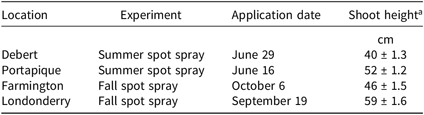
The summer spot herbicide application experiment was conducted at Debert and Portapique, and the fall spot herbicide application experiment was conducted at Farmington and Londonderry, Nova Scotia (Table 1). Experiments were arranged as a completely randomized design with 12 and 11 treatments in the summer and fall experiments, respectively (Table 3). Plot size was 1 m by 1 m, and plots were established in various goldenrod patches scattered across each site. There were nine and eight replications at Debert and Portapique, respectively, and five replications at each location for the fall spot-spray experiment. Herbicides were applied to the 1-m by 1-m plots when goldenrod stems were at the floral bud stage and at the post-seed set stage in the summer and fall experiments, respectively. Herbicides were applied with a CO2 pressurized research plot sprayer equipped with a single Teejet® 8002VS nozzle operated at a spray pressure of 275 KPa. Goldenrod stems were sprayed just until herbicide solution runoff from the leaves in all applications. Mean goldenrod shoot heights at the time of herbicide applications at all sites are reported in Table 4.
Application date and mean shoot height at the time of herbicide spot applications at Debert, Portapique, Farmington, and Londonderry, Nova Scotia, in 2016.

a Values represent the mean ± 1 SE.
Data Collection
Data collection in all experiments included goldenrod shoot density and shoot height measurements and visual injury ratings for each treatment. Goldenrod shoot densities in the broadcast and summer spot-application herbicide experiments were determined at the time of treatment applications at the end of the nonbearing year (October 13, 2016, and October 20, 2016, at Portapique and Debert, respectively) and in early summer of the bearing year (June 21, 2017). Goldenrod shoot density in the fall herbicide spot-application experiment was determined at the time of treatment applications and in early summer of the bearing year (June 6, 2017).
Goldenrod shoot density was determined in two 1-m2 quadrats in all broadcast experiments and on a whole-plot basis for summer and fall spot-application experiments. Goldenrod shoot height was determined on 30 randomly selected shoots in each plot and was determined before all treatment applications. Visual injury ratings were collected in all experiments except the fall herbicide spot-application experiment at 7, 21, and 35 days after treatment (DAT). Visual injury ratings were made on a scale from 0 to 100, where 0 meant no plant damage and 100 was complete plant death. All visual injury ratings were conducted by the same person (M.H.F.) on each evaluation date to ensure consistency.
Statistical Analysis
All statistical analyses were performed using SAS®, version 9.4 (SAS Institute, Raleigh, NC). Goldenrod shoot density and height were analyzed using ANOVA in PROC MIXED in SAS®. Treatments were fixed effects and blocks were random effects in the analysis. All sites were analyzed separately because of differences in initial goldenrod shoot density and height across sites. Means were determined using the LS MEANS statement, and mean separation, where necessary, was conducted using the Tukey honestly significant difference multiple means comparison test with significance set at P = 0.05. Assumptions of normality, constant variance, and independence were tested using PROC UNIVARIATE. Differing data transformations (i.e., square root, log) were used when needed to meet the normality and constant variance assumptions, and transformations used are indicated in results tables. Subjective data (e.g., damage ratings) were analyzed using nonparametric analysis in PROC NPAR-1-WAY, and treatment effects were determined using the Kruskal-Wallis test.
Results and Discussion
Effect of Sequential Mesotrione Applications on Goldenrod
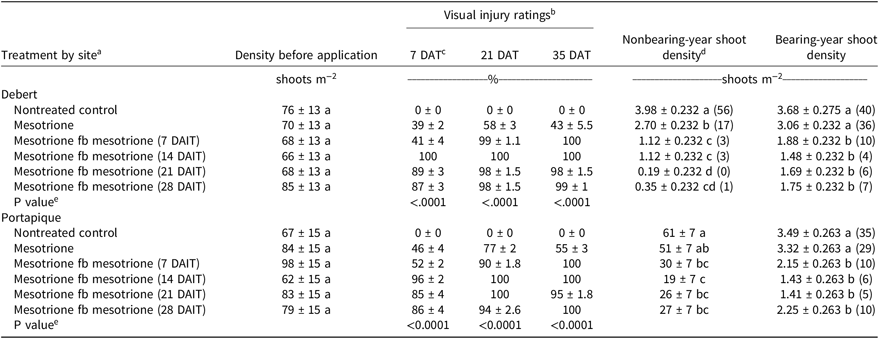
Initial goldenrod shoot density did not vary across treatments at either site (Table 5). Mesotrione treatments had a significant effect on goldenrod visual-injury ratings (P < 0.0001), nonbearing-year goldenrod shoot density (P ≤ 0.0002), and bearing-year goldenrod shoot density (P < 0.0001) at each site. A single mesotrione application caused 39% to 58% injury to goldenrod and reduced goldenrod shoot density relative to the nontreated control at the end of the nonbearing year at Debert (Table 5). Visual injury was similar at Portapique, but nonbearing-year goldenrod shoot density was not reduced by single mesotrione applications at this site (Table 5). Goldenrod also recovered from this treatment in the bearing year and shoot density was similar to the nontreated control at each site (Table 5). Boyd and White (Reference Boyd and White2010) also indicated that mesotrione applications in nonbearing years did not reduce bearing-year goldenrod shoot density, and our results further confirm that single mesotrione applications provide suppression in the year of application only.
Effect of sequential mesotrione application timings on goldenrod visual injury ratings and shoot density at lowbush blueberry fields in Debert and Portapique, Nova Scotia, Canada, in 2016 and 2017.

a Nonbearing-year shoot density at Debert and bearing-year shoot density at Debert and Portapique were LOG(Y) transformed before analysis to meet the assumptions of the ANOVA analysis. Transformed means are presented for means comparisons and variance estimates, and back-transformed means are presented in parentheses.
b Visual damage ratings were estimated on a 0-to-100 scale, where 0 meant no plant death and 100 meant complete plant death.
c Abbreviations: fb, followed by; DAT, days after treatment; DAIT, days after initial treatment.
d Means within columns with different letters are significantly different at P < 0.05 according to the Tukey honestly significant difference multiple means comparison test. Values represent the mean ± 1 SE of the mean.
e P value associated with Kruskal-Wallis test conducted in PROC NPAR 1WAY in SAS.
Sequential mesotrione applications caused greater than 90% injury to goldenrods by 35 DAT at each site and significantly reduced goldenrod shoot density at the end of the nonbearing year relative to the nontreated control and the single mesotrione application at Debert (Table 5). Sequential applications made 21 DAIT gave the greatest reduction of goldenrod shoot density at Debert (Table 5), although acceptable reduction in shoot density was achieved in all sequential treatments at this site. Sequential mesotrione applications made 7, 21, and 28 DAIT were less effective at Portapique, with the most consistent reductions in nonbearing-year goldenrod shoot density across sites occurring when sequential applications were made at 14 DAIT (Table 5). This suggests that two applications of mesotrione provided better goldenrod control than a single application, and our results are generally consistent with results of sequential mesotrione applications on horsenettle (Armel et al. Reference Armel, Wilson, Richardson and Hines2003), black bulrush (Boyd and White Reference Boyd and White2010), creeping bentgrass (Agrostis stolonifera L.) (Jones and Christian Reference Jones and Christian2007), and annual bluegrass (Poa annua L.) (Skelton et al. Reference Skelton, Sharp and Branham2012).
Bearing-year goldenrod shoot density was reduced in all sequential treatments at each site (Table 5), indicating long-term suppression of goldenrods after sequential mesotrione applications. Reductions in bearing-year goldenrod shoot density suggest damage to rhizomes or reduction in rhizome biomass by these treatments, although these data were not collected. POST mesotrione applications significantly reduced the number and weight of new tubers of volunteer potato (Solanum tuberosum L.) in sweet corn (Zea mays L.) (Boydston et al. Reference Boydston, Collins and Alva2008), indicating potential for injury from this herbicide to reduce biomass allocation to below-ground plant organs such as rhizomes. Sequential mesotrione applications caused greater visual injury and density reductions than did single applications (Table 5), so reductions in rhizome growth during the year of application are plausible and should be measured in future research. Boydston and Al-Khatib (Reference Boydston and Al-Khatib2008) also reported that up to 15% of foliar-applied mesotrione was translocated to developing roots and tubers of potato. Sequential mesotrione applications to goldenrods may therefore increase the amount of mesotrione translocated to roots and rhizomes, likely contributing to the increased control observed in the bearing year. Lowbush blueberry growers in Maine are using sequential mesotrione applications (Yarborough and D’Appollonio Reference Yarborough and D’Appollonio2009), and a similar registration was recommended for Canada (Boyd and White Reference Boyd and White2010). Our results support this recommendation and indicate growers should use sequential mesotrione applications that are spaced at least 14 d apart to improve both nonbearing- and bearing-year goldenrod control with this herbicide in lowbush blueberry.
Effect of Bicyclopyrone on Goldenrod
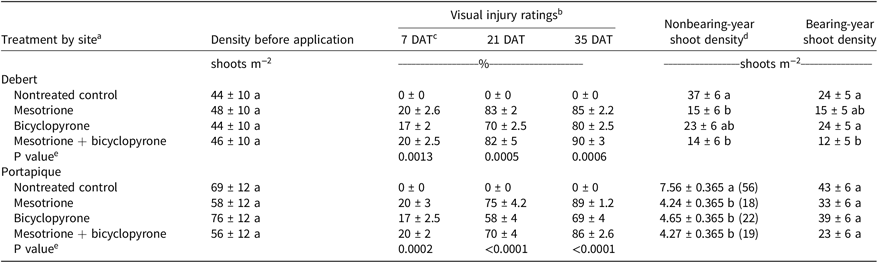
Goldenrod shoot density before herbicide applications was not significantly different across treatments at either site (Table 6). There was a significant effect of herbicide treatment on goldenrod shoot density in the nonbearing year at each site (P < 0.0001), but only on bearing-year goldenrod shoot density at Debert (P < 0.0073). Mesotrione caused greater than 80% injury to goldenrod by 35 DAT and reduced goldenrod shoot density relative to the nontreated control at each site in the nonbearing year (Table 6). Goldenrod recovered in the bearing year, however, and shoot density was not reduced relative to the nontreated control (Table 6). These results are similar to those from the sequential mesotrione applications evaluated in the preceding experiments (Table 5) and further indicate single-season goldenrod suppression from single mesotrione applications.
Effect of POST bicyclopyrone and mesotrione applications on goldenrod visual-injury ratings and shoot density at lowbush blueberry fields in Debert and Portapique, Nova Scotia, Canada, in 2016 and 2017.

a Nonbearing-year shoot densities at Portapique were SQRT(Y) transformed before analysis to meet the assumptions of the ANOVA analysis. Transformed means are presented for means comparisons and variance estimates, and back-transformed means are presented in parentheses.
b Visual damage ratings were conducted on a 0-to-100 scale, where 0 meant no plant damage and 100 meant complete plant death.
c Abbreviation: DAT, days after treatment.
d Means within columns with different letters are significantly different at P < 0.05 according to the Tukey honestly significant difference multiple means comparison test. Values represent the mean ± 1 SE of the mean.
e P value associated with Kruskal-Wallis test conducted in PROC NPAR 1WAY in SAS.
Bicyclopyrone caused 69% to 80% injury to goldenrod by 35 DAT and reduced nonbearing-year goldenrod shoot density relative to the nontreated control at Portapique (Table 6), but goldenrod recovered in the bearing year and shoot density was similar to that of the nontreated control and mesotrione in the bearing year at each site (Table 6). Bicyclopyrone, therefore, appears to provide similar suppression of goldenrod as mesotrione and could be useful for achieving sequential applications of carotenoid-inhibiting herbicides on goldenrods if available for use in lowbush blueberry. The tank mixture of mesotrione and bicyclopyrone caused similar levels of visual injury and goldenrod shoot-density reductions as mesotrione in the nonbearing year (Table 6), and this tank mixture therefore appears less effective than sequential mesotrione applications. Bearing-year goldenrod shoot density, however, was reduced by this tank mixture at Debert (Table 6), and potential for this tank mixture to provide longer-term goldenrod suppression should be evaluated across a wider range of sites.
Evaluation of Summer Herbicide Spot Applications
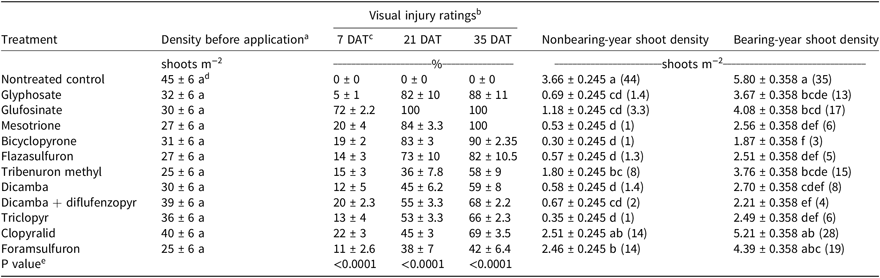
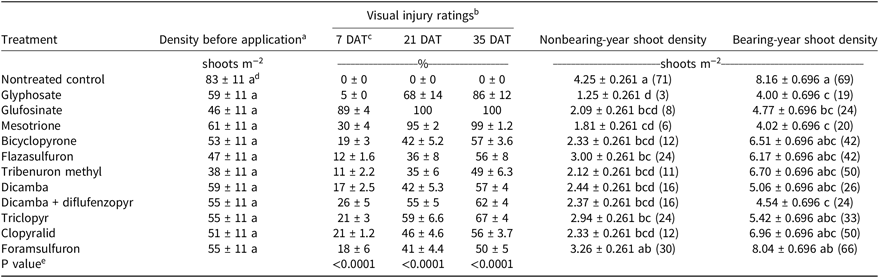
Initial goldenrod shoot density did not vary across treatments at either site in the summer spot-application experiment (Tables 7 and 8). There was a significant effect of herbicide treatment on visual injury ratings (P < 0.0001) on all rating dates and on nonbearing- and bearing-year goldenrod shoot density (P < 0.0001) at each site. Glyphosate, glufosinate, mesotrione, and bicyclopyrone caused greater than 85% damage to goldenrod by 35 DAT and reduced goldenrod shoot density relative to the nontreated control at the end of nonbearing year at Debert (Table 7). These treatments also reduced goldenrod shoot density at the end of the nonbearing year at Portapique (Table 8), although visual injury resulting from bicyclopyrone was lower at this site relative to Debert. Glyphosate, glufosinate, and mesotrione also reduced goldenrod shoot density in the bearing year at each site (Tables 7 and 8), indicating rhizome injury after spot application of these herbicides. Glyphosate reduced biomass of vegetative reproductive structures in perennial weeds such as Canada thistle [Cirsium arvense (L.) Scop.] (Sprankle et al. Reference Sprankle, Meggitt and Penner1975), quackgrass [Elymus repens (L.) Gould] (Claus and Behrens Reference Claus and Behrens1976), and yellow nutsedge (Cyperus esculentus L.) (Nelson et al. Reference Nelson, Renner and Penner2002), and this may explain reductions observed in bearing-year goldenrod shoot density. Similar reductions in bearing-year shoot density in the glufosinate and mesotrione treatments, however, were unexpected. Glufosinate generally provides variable control of established perennial weeds (Bradley and Hagood Reference Bradley and Hagood2002; Nelson et al. Reference Nelson, Renner and Penner2002; Pline et al. Reference Pline, Hatzios and Hagood2000) but does exhibit phloem mobility and translocation to roots in some weed species (Pline et al. Reference Pline, Wu and Hatzios1999; Steckel et al. Reference Steckel, Wax, Simmons and Phillips1997) that may have contributed to additional rhizome injury when used as a spot application. Root translocation of mesotrione can also occur (Boydston and Al-Khatib Reference Boydston and Al-Khatib2008), suggesting this herbicide may have also caused damage to rhizomes. Reductions in bearing-year shoot density after spot applications also indicate spot applications of mesotrione are more effective than single broadcast applications (Tables 5 and 6), likely due to improved coverage of target plants with spot applications relative to broadcast applications. Spot applications of mesotrione would also pose less injury risk to lowbush blueberry than spot applications of glyphosate and glufosinate, and this use pattern for mesotrione should be considered for lowbush blueberry. Bicyclopyrone did not reduce bearing-year goldenrod shoot density at Portapique (Table 8), indicating that spot applications of this herbicide are less effective on goldenrods than mesotrione.
Effect of various summer herbicide spot treatments on goldenrod shoot density and visual injury ratings at Debert, Nova Scotia, Canada, in 2016 and 2017.

a Nonbearing- and bearing-year shoot density data were LOG(Y) and SQRT(Y) transformed, respectively, before analysis to meet the assumptions of the ANOVA analysis. Transformed means are presented for means comparisons and variance estimates, and back-transformed means are presented in parentheses.
b Visual damage ratings were done on a 0-to-100 scale, where 0 meant no plant death and 100 meant complete plant death.
c Abbreviation: DAT, days after treatment.
d Means within columns with different letters are significantly different at P < 0.05 based on the Tukey honestly significant difference multiple means comparison test. Values represent the mean ± 1 SE of the mean.
e P value associated with Kruskal-Wallis test conducted in PROC NPAR 1WAY in SAS.
Effect of various summer herbicide spot treatments on goldenrod shoot density and visual injury ratings at Portapique, Nova Scotia, Canada, in 2016 and 2017.

a Nonbearing- and bearing-year shoot density data were LOG(Y) and SQRT(Y) transformed, respectively, before analysis to meet the assumptions of the ANOVA analysis. Transformed means are presented for means comparisons and variance estimates, and back-transformed means are presented in parentheses.
b Visual damage ratings were done on a 0-to-100 scale, where 0 meant no plant death and 100 meant complete plant death.
c Abbreviation: DAT, days after treatment.
d Means within columns with different letters are significantly different at P < 0.05 based on the Tukey honestly significant difference multiple means comparison test. Values represent the mean ± 1 SE of the mean.
e P value associated with Kruskal-Wallis test conducted in PROC NPAR 1WAY in SAS.
Flazasulfuron and tribenuron methyl caused 58% to 82% injury by 35 DAT at Debert and significantly reduced both nonbearing- and bearing-year goldenrod shoot density at this site (Table 7). Injury from these herbicides, however, was lower at Portapique, and goldenrod shoot density was only reduced in the nonbearing year (Table 8). Spot applications of these herbicides, therefore, may provide single-season control of goldenrod only, although results with tribenuron methyl at Debert warrant additional investigation of this herbicide as a spot treatment for goldenrod, given the current use of tribenuron methyl as a spot treatment for several other weed species in lowbush blueberry (Jensen and Specht Reference Jensen and Specht2004; Yarborough and Hess Reference Yarborough and Hess1995). In addition, flazasulfuron is effective on other weeds in lowbush blueberry (Zhang et al. Reference Zhang, White, Randall Olson and Pruski2018), and potential efficacy on goldenrod, although variable, provides an additional basis for research with this herbicide.
Goldenrod damage after dicamba and dicamba plus diflufenzopyr applications ranged from 57% to 68% by 35 DAT, and nonbearing-year goldenrod shoot density was reduced by these treatments at each site (Tables 7 and 8). Goldenrod shoot density remained low in these treatments in the bearing year at Debert (Table 7), although recovery occurred in the dicamba treatment at Portapique (Table 8). Dicamba controlled tall goldenrod (Solidago altissima L.) in fescue hayfields (Payne and Bradley Reference Payne and Bradley2010) and spot applications of dicamba are recommended for spreading dogbane control in lowbush blueberry fields (Wu and Boyd Reference Wu and Boyd2012). The application rate used for spreading dogbane control, however, is higher than that used in our study (1.92 g ae L−1 vs. 1 g ae L−1), and additional research with this higher dicamba rate on goldenrod is warranted given the efficacy observed in our study.
Triclopyr caused greater than 60% injury to goldenrod by 35 DAT and reduced goldenrod shoot density relative to the nontreated control at the end of the nonbearing year at each site (Tables 7 and 8). Goldenrod shoot density remained low with this treatment in the bearing year at Debert, but recovery occurred at Portapique and density was not reduced (Tables 7 and 8). Triclopyr spot applications control spreading dogbane (Wu and Boyd Reference Wu and Boyd2012), and this herbicide is generally effective on wide range of broadleaf weeds (Cox Reference Cox2000; Nelson et al. Reference Nelson, Ezell and Yeiser2006; Olson and Mackasey Reference Olson and Mackasey1989). However, this herbicide seems variable on goldenrod and additional research would be required to refine use of this herbicide for spot treatment of goldenrod in lowbush blueberry.
Clopyralid and foramsulfuron caused greater than 40% injury at each site but did not consistently reduce goldenrod shoot density (Tables 7 and 8). Clopyralid controls perennial weeds such as Canada thistle (Miller et al. Reference Miller, Libbey and Maupin2012) and perennial sow thistle (Zollinger et al. Reference Zollinger, Penner and Kells1992), and both clopyralid and foramsulfuron have efficacy on other broadleaf weeds in lowbush blueberry (Anonymous 2017; White and Webb Reference White and Webb2018). Our results, however, indicate these herbicides did not aid control of narrowleaf goldenrod.
Evaluation of Fall Herbicide Spot Applications
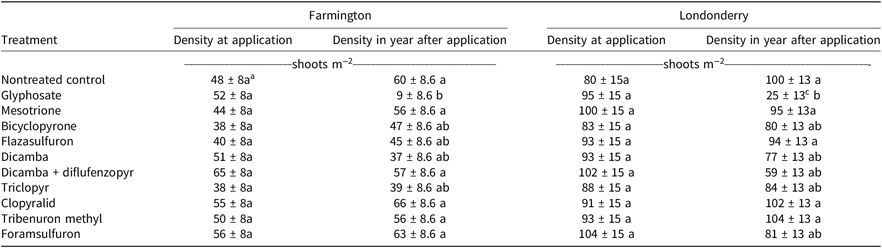
Goldenrod shoot density at the time of herbicide applications did not vary across treatments (Table 9). There was a significant effect of herbicide treatment on goldenrod shoot density in the year after application at Farmington (P < 0.0015) and Londonderry (P < 0.0035), although glyphosate was the only herbicide that reduced goldenrod shoot density in the year after application relative to the nontreated control at each site (Table 9). Fall glyphosate applications give good control of rhizomatous perennial weeds (Ivany Reference Ivany1981; Jeffery et al. Reference Jeffery, English and Connell1981) and other perennial weeds (Carlson and Donald, Reference Carlson and Donald1988), so these results were somewhat expected, especially when considering glyphosate efficacy in the summer spot-application experiment (Tables 7 and 8). Lack of efficacy from the other evaluated herbicides was generally unexpected, particularly given efficacy associated with summer applications of many of these herbicides (Tables 7 and 8). Initial onset of leaf chlorosis was observed at the time of treatment applications, which can reduce efficacy of fall herbicide applications (Whaley and VanGessel Reference Whaley and VanGessel2002), and may have affected uptake and/or translocation of other herbicides evaluated. According to regional weather stations, minimum air temperatures had also begun to fall below 5 C in the nights preceding and following herbicide applications at Londonderry, and temperatures below 0 C were recorded before herbicide applications at Farmington, which also may have affected herbicide efficacy. Fall dicamba applications after the first frost, however, gave good control of dandelion (Taraxacum officinale F. H. Wigg.) and Canada thistle (Wilson and Michiels Reference Wilson and Michiels2003), so it is unclear why this and the other synthetic auxin herbicides evaluated were ineffective at this application timing. Fall applications of acetolactate synthase/acetohydroxyacid synthase–inhibiting herbicides provide good control of other perennial weeds as well (Shaw and Mack Reference Shaw and Mack1991; Zuris et al. Reference Zuris, Wilson and Nelson1987), including other perennial weeds in lowbush blueberry (White, unpublished data). Although fall mesotrione applications have been evaluated for annual bluegrass control in Kentucky bluegrass (Poa pratensis L.) turf (Reicher et al. Reference Reicher, Weisenberger, Morton, Branham and Sharp2011; Skelton et al. Reference Skelton, Sharp and Branham2012), we are unable to find similar reports of mesotrione use for fall management of other perennial weeds. Given that injury from mesotrione and bicyclopyrone occurs through a series of reactions that result in carotenoid depletion (Mitchell et al. Reference Mitchell, Bartlett, Fraser, Hawkes, Holt, Townson and Wichert2001) and chlorophyll degradation (van Almsick Reference Van Almsick2009), it is likely that fall applications after initiation of senescence and leaf chlorosis would have limited effects on shoot density in the following season. Future work should examine a range of fall application timings, perhaps beginning earlier in September, to assess the utility of herbicides other than glyphosate for fall goldenrod management in lowbush blueberry in Nova Scotia.
Effect of fall herbicide spot treatments on goldenrod shoot density at Farmington and Londonderry, Nova Scotia, Canada, in 2016 and 2017.

a Means within columns with different letters are significantly different at P < 0.05 based on the Tukey honestly significant difference multiple means comparison test. Values represent the mean ± 1 SE of the mean.
In conclusion, sequential mesotrione applications beginning at the 30-cm goldenrod stem-height stage and spaced at least 14 d apart provided greater reductions in nonbearing- and bearing-year goldenrod shoot density than did single mesotrione applications. These results are consistent with other research in which sequential mesotrione applications improved perennial weed control, and this use should be considered for registration in lowbush blueberry. Bicyclopyrone provided similar suppression of goldenrod as mesotrione and could provide an additional opportunity for achieving sequential applications of carotenoid-inhibiting herbicides in lowbush blueberry, if registered for use in this crop. Glyphosate, glufosinate, and mesotrione were the most effective herbicides evaluated in the summer spot-application experiment and consistently reduced both nonbearing- and bearing-year goldenrod shoot density across sites. Mesotrione, therefore, should be considered for use as a summer spot treatment for goldenrod in lowbush blueberry because of reduced risk of crop injury relative to glyphosate and glufosinate. Results with other herbicides evaluated were more variable, but several additional herbicides also show promise as summer spot treatments for goldenrod. Glyphosate was the most effective herbicide evaluated in the fall spot-application experiment and is the only herbicide that can be recommended for fall spot applications to goldenrods at this time.
Author ORCIDs
Scott N. White https://orcid.org/0000-0001-8658-4024
Acknowledgements
We would like to acknowledge Joe Slack, Tom Rudolph, and Bragg Lumber Company for providing lowbush blueberry fields for this research. We acknowledge assistance with field work from Qiming Lyu and Lienna Hoeg. This research was funded by the Wild Blueberry Producers Association of Nova Scotia and the Natural Sciences and Engineering Research Council through a Collaborative Research and Development Grant (CRDPJ 500615-16). No conflicts of interest have been declared.