INTRODUCTION
Toxoplasma gondii is an apicomplexan protozoan parasite capable of infecting all warm-blooded animals, members of the family Felidae being its definitive hosts (Dubey, Reference Dubey2004). Transmission occurs by ingestion of sporulated oocysts released with the feces of infected cats and other felids, or of cysts present in the tissues of an infected animal. Transplacental passage of the tachyzoites can also occur, which may cause embryonic death and reabsorption, abortion, fetal death and mummification, stillbirth, and neonatal death; thus, T. gondii is responsible for great losses to the livestock industry and a gyneco-obstetric problem (Montoya and Liensefeld, Reference Montoya and Liesenfeld2004; Dubey and Lindsay, Reference Dubey and Lindsay2006). Sheep kept on pasture are most likely infected by oocysts shed with the feces of infected cats; thus, these animals can also be sentinels for soil or water transmission studies (Blewett and Watson, Reference Blewett and Watson1983). Since the 1970's, a great number of studies on T. gondii prevalence in sheep of all continents have been reported (Sharma and Gautam, Reference Sharma and Gautam1972; O'Donoghue et al. Reference O'Donoghue, Riley and Clarke1987; Pita et al. Reference Pita Gondim, Barbosa, Ribeiro Filho and Saeki1999; Lundén et al. Reference Lundén, Näsholm and Uggla1994; van der Puije et al. Reference van der Puije, Bosompem, Canacoo, Wastling and Akanmori2000). Data concerning risk factors in sheep such as age, farm location, feeding, sex, flock handling, presence of felines, race, size of flock, type of housing or water sources have been previously evaluated, with variable results (Skjerve et al. Reference Skjerve, Waldeland, Nesbakken and Kapperud1998; Klun et al. Reference Klun, Djurković-Djaković, Katić-Radivojević and Nikolić2006; Vesco et al. Reference Vesco, Buffolano, La Chiusa, Mancuso, Caracappa, Chianca, Villari, Currò, Liga and Petersen2007).
In Mexico, 2 studies performed during the 1990's revealed prevalence values from 20% to 55% in 3 central States of Mexico as determined by IFAT (García Vázquez et al. Reference García-Vázquez, Rosario-Cruz and Solorzano-Salgado1990; Cruz-Vázquez et al. Reference Cruz-Vázquez, García-Vázquez, Rosario-Cruz and Solorzano-Salgado1992). We recently found a quite high frequency of toxoplasmosis among sheep of an experimental farm located close to the Gulf of Mexico coast, with an estimation of 2 new cases every year (Caballero-Ortega et al. Reference Caballero-Ortega, Quiroz-Romero, Olazarán-Jenkins and Correa2008). The frequency found in sheep is geographically concordant with that found in humans some years ago (Velasco-Castrejón et al. Reference Velasco-Castrejón, Salvatierra-Izaba, Valdespino, Sedano-Lara, Galindo-Virgen, Magos, Llausas, Tapia-Conyer, Gutiérrez and Sepúlveda1992). Each year, more than 40 000 tons of ovine meat are produced in the States of the central belt of Mexico (De Lucas-Tron and Abiza, Reference De-Lucas-Tron and Arbiza-Aguirre2005; www.sagarpa.gob.mx); thus, ovine toxoplasmosis is probably causing economical losses; besides, it is a risk for humans who eat this type of meat.
The State of Colima is located on the Pacific coast of Mexico, 19°31′N, 18°41′S, 103°29′E, 104°41′W. The weather of Colima is warm-moist mainly along the coast, where the annual mean temperature and humidity are 25·3°C and 67%, appropriate conditions for T. gondii transmission. A recent study revealed 29% positive pet cats in the capital city, which correlated with low socio-economical level of the owners and consumption of raw meat by cats (García-Márquez et al. Reference García-Márquez, Gutiérrez-Díaz, Correa, Luna-Pastén and Palma2007).
The aim of this study was to determine the frequency of T. gondii infection in sheep from 5 farms of the State of Colima, Mexico, and to relate it with the altitude of the farm and the size of the flock, as well as the animals' age and sex, as risk factors.
MATERIALS AND METHODS
Sheep
A total of 351 sheep (all of the race ‘Pelibuey’) from 5 farms of the state of Colima were studied during 2007. These farms corresponded to those for which owners complied to participate after an informative talk during a session of the statal Association of Ovine Producers. Ten percent of the total ovine population from farms 1, 2 and 3 located in the coastline at sea level, were randomly selected, while the total populations of farms 4 and 5 were studied. The later two are located at 527 and 1200 meters above sea level, respectively. Animals were classified into 2 groups according to age: <1 year and ⩾1 year old. Five ml samples of peripheral blood were taken from the jugular vein; after clotting, the serum was separated by centrifugation at 2000 g for 10 min, aliquoted and stored at −20°C until use.
ELISA
A previously standardized indirect ELISA was used to detect anti-T. gondii IgG antibodies in sheep (Caballero-Ortega et al. Reference Caballero-Ortega, Quiroz-Romero, Olazarán-Jenkins and Correa2008), which presents sensitivity and specificity of 92% and 88%, respectively. Briefly, polystyrene ELISA plates (Maxisorp, Nunc) were incubated with 2 μg/ml of an RH strain crude extract dissolved in 15 mm carbonate buffer, pH 9·6, overnight at 4°C. Non-specific binding sites were blocked with 1% bovine serum albumin in PBS-0·05% tween 20. The serum samples were used at a dilution of 1:1000 and developed with a donkey anti-sheep IgG peroxidase conjugate (Sigma-Aldrich Corp., St Louis, MO, USA, product A3415) diluted 1:10 000 in PBS-T, followed by O-phenylenediamine/H2O2 in citrate buffer as chromogen-substrate solution. Absorbance reading was at 492 nm; the average of the serum duplicates was divided by the cut-off to establish the reactivity index (RI). Any sample with a RI⩾1·0 was considered positive.
Statistical analysis
All data were analysed using the SPSS 12.0 software (SPSS Inc., Chicago, IL, USA). Correlations between altitude of the farms and reactivity index or infection frequency were assessed by the Pearson test. Comparison of reactivity index among farms was made by Kruskal-Wallis followed by the Mann-Whitney U-test. Associations between frequency of infection and some variables, like location of the farm, flock size, sex and age were determined by odds ratio with 95% confidence interval, and Chi-square as statistical significance test. The presence of domestic cats, the race and the type of food provided were the same in all farms, Even though there is information regarding the presence of wild cats, mainly in the mountain, no farm informed of having seen these animals in the proximity. Thus, none of these aspects were used as risk variables for association studies. A P⩽0·05 was considered significant. A logistic regression analysis was applied to variables showing a P⩽0·10.
RESULTS
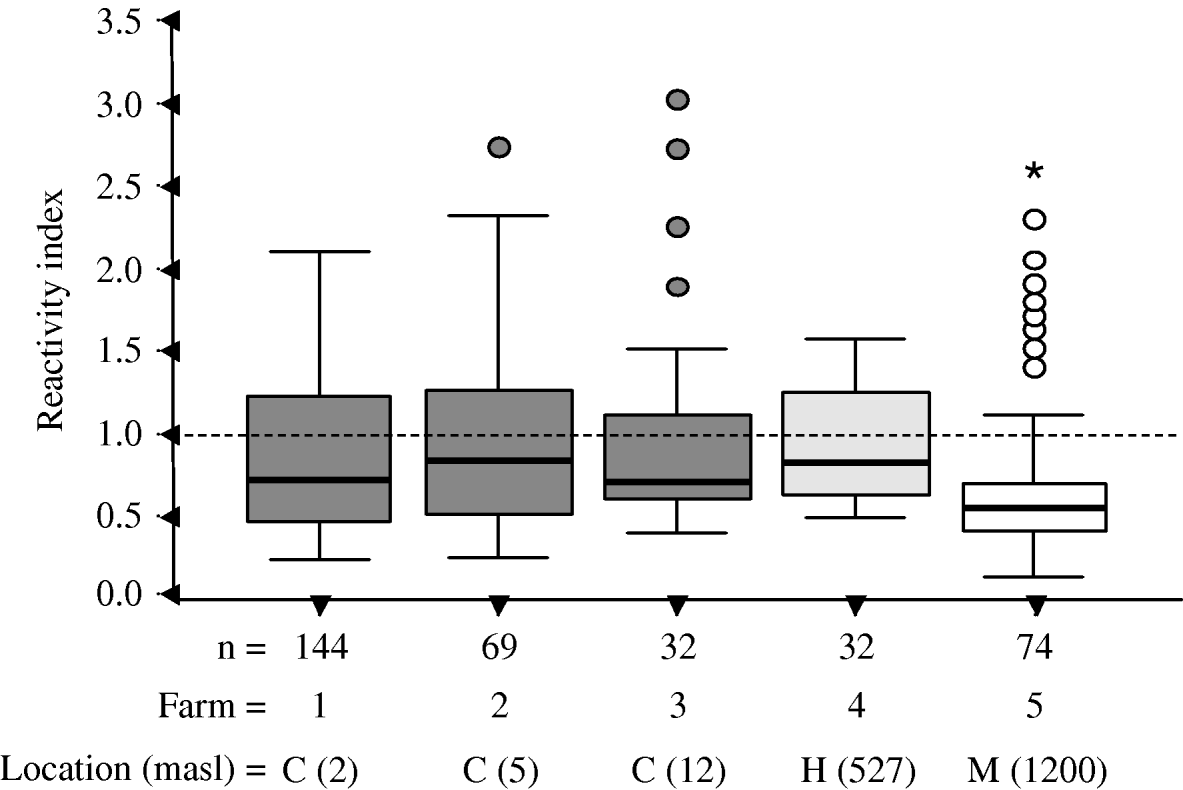
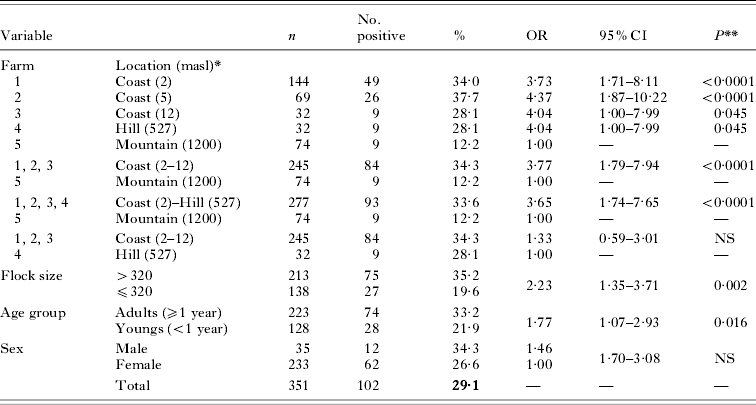
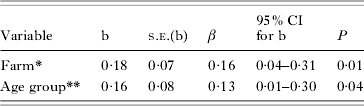
Three of the five farms are in the coastal zone of Colima with an annual mean precipitation from 1700 to 3900 mm and temperature from 24°C to 26°C, while in the hill and mountain farms have 1190 and 1330 mm of annual precipitation respectively, and 20°C to 22°C. From the 351 sheep sampled 102 (29·1%) had antibodies against T. gondii (Table 1). Three of the four risk factors studied were related to infection (Table 2), the first being the location of the farm: those animals living in the mountain (at 1200 m above sea level), presented the lowest frequency (12·2%), while the highest values were found in the coastal zone (up to 37·7%). A 3-fold risk of infection was shown for sheep from the coastal compared to the mountain farms. In fact, a negative correlation between the altitude and the frequency was observed (r=0·92, m=−0·013, b=29·8; P=0·027). Also, the reaction intensity was significantly lower in the farm located at 1200 m above sea level as compared to all others (P<0·02, Fig. 1). Large flocks (⩾320 animals) presented higher frequency of toxoplasmosis than small ones (Table 2). A significant difference in the frequency of positive animals between adult and young sheep was found, but the sex was not related to T. gondii infection frequency. The logistic regression model showed that both the age and the farm contributed to T. gondii infection (Table 3). When the flock size was introduced into the model a negative impact on the association between age and seropositiviy was observed. Thus, this variable is independently associated to toxoplasmosis.
Boxplots of the reactivity index of anti-Toxoplasma gondii of each farm. C=Coast; H=Hill; M=Mountain. Altitude is presented in metres above sea level (masl). The dashed line represents the cut off value. * Differences between farm 5 and all others: P<0·02 by Mann-Whitney U-test.

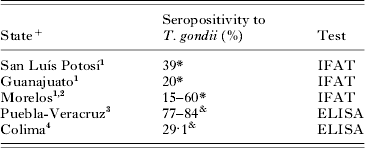
States of Mexico where Toxoplasma gondii antibodies have been searched in sheep, including the present study

+ Data from studies included in the table are from García-Vázquez et al. (1), Cruz-Vázquez et al. (2), Caballero-Ortega et al. (3) and the present report (4). * Prevalence; & Frequency.
Frequency of ovine toxoplasmosis in 351 sheep from Colima, Mexico and different risk factors associated

* masl=metres above sea level; OR=odds ratio, 95% CI=95% confidence interval; ** Chi-square test; NS=Not significant.
Regression model for farm and age group contribution to seropositivity

b, Unstandardized coefficients. s.e.=standard error. β, standardized coefficients. 95% CI=95% confidence interval.
* Farms 1 to 4 (at 1 to 527 masl) were grouped and compared to farm 5 (1200 masl).
** Adults vs young animals.
DISCUSSION
Toxoplasma gondii infection has been recognized as a significant cause of ovine perinatal mortality for at least 50 years (Hartley and Marshall, Reference Hartley and Marshall1957). Production of sheep is an important economic activity in Mexico, but epidemiological data regarding toxoplasmosis are really scarce; for this reason, we are mapping T. gondii infection in different regions of the country. The frequency range seems to be quite broad, i.e. from 12% (in this study) to 83%, depending on the technique employed and other variables (García-Vázquez et al. Reference García-Vázquez, Rosario-Cruz and Solorzano-Salgado1990; Cruz- Vázquez et al. Reference Cruz-Vázquez, García-Vázquez, Rosario-Cruz and Solorzano-Salgado1992; Caballero-Ortega et al. Reference Caballero-Ortega, Quiroz-Romero, Olazarán-Jenkins and Correa2008; Table 1). This is the first report on serum frequency of T. gondii in sheep from the State of Colima, Mexico, where significant differences between coast-hill and mountain farms were found. This was expected because the climate is variable within the State. It was confirmed that the weather is of relevance to acquire toxoplasmosis in sheep, since T. gondii oocysts survive longer in warm-moist than in cold-dry atmospheres, as shown by Fleck (Reference Fleck1972) and Fayer (Reference Fayer1981). In this regard, we recently found a quite high frequency of toxoplasmosis (77% to 82%) among ewes of a tropical zone of the country (Caballero-Ortega et al. Reference Caballero-Ortega, Quiroz-Romero, Olazarán-Jenkins and Correa2008). Within Colima, an impact of altitude was documented, probably reflecting variations in climate, although the effect of different wild species among regions has to be considered as well, since the domestic cats were present in all farms. In another report from Mexico, a prevalence range from 17% to 62% was also observed within a Municipality of Morelos located at 2200 m above sea level, where the presence of cats correlated with the zones of highest frequency (Cruz-Vázquez et al. Reference Cruz-Vázquez, García-Vázquez, Rosario-Cruz and Solorzano-Salgado1992). Skjerve et al. (Reference Skjerve, Waldeland, Nesbakken and Kapperud1998) also reported that sheep from different farms of Norway situated at an altitude >100 m above sea level have higher risk to be infected by T. gondii than those living in lower altitudes, which is in disagreement with the results of this survey, but the authors suggested this was probably due to the Norwegian climate, which is more stable in areas at altitudes over 100 m above sea level.
The age of the animals was also significantly associated with T. gondii-infected animals on the farm, which is comparable to the data obtained by Clementino et al. (Reference Clementino, Souza and Neto2007) and which has been extensively demonstrated for other species, including humans. No significant difference of anti-T. gondii antibodies between male and female was observed. Our results agree with those reported by Romanelli et al. (Reference Romanelli, Freire, Vidotto, Marana, Ogawa, De Paula, Garcia and Navarro2007). However, two reports suggested that female sheep are more susceptible than male (van der Puije et al. Reference van der Puije, Bosompem, Canacoo, Wastling and Akanmori2000; Clementino et al. Reference Clementino, Souza and Neto2007). It would be interesting to study in detail whether there is a difference in the susceptibility to this protozoan between male and female sheep and, if it is so, what causes it. Some factors like the genetics of the host (race) or the parasite strain also influence the extent of the susceptibility to T. gondii. The common variants of T. gondii isolated from human and animal cases in Europe and the United States of America are classified as I, II or III, although recombinant and atypic strains have been reported (Ajzenberg et al. Reference Ajzenberg, Bañuls, Su, Dumètre, Demar, Carme and Dardé2004; Dardé, Reference Dardé2004). In recent years, evidence from South America suggests that the variants present are more aggressive, disperse much more and cause higher prevalence rates, both in humans and animals (Peyron et al. Reference Peyron, Lobry, Musset, Ferrandiz, Gomez-Marin, Petersen, Meroni, Rausher, Mercier, Picot and Cesbron-Delauw2006; Pena et al. Reference Pena, Soares, Amaku, Dubey and Gennari2006, Reference Pena, Gennari, Dubey and Su2008). In this regard, Mexico is located in an interesting situation, since it is in North America, but presents variable climates, from deserts to tropical forest. Also, it is a country with endemic species of wild mammals and birds, which could present different infection dynamics from those shown for Europe/North America or South America and among subregions.
In conclusion, Toxoplasma gondii is transmitted to sheep in Colima with geographical variations related to altitude, flock size and age. This is relevant in terms of the infective pressure for humans and other animals.
DANISCO, S. A. de C. V. partially financed the study.