Introduction
It was commonly accepted that animal species with small brain and short lifespan need to avail mainly or exclusively to naïve intelligence (Fabre et al., Reference Fabre, Teixeira de Mattos and Miall1918). However, during the last century a huge amount of literature revealed that learning abilities may be a suitable and valuable resource also for parasitoids, improving their efficiency for host, food and mate foraging (Dukas, Reference Dukas2008), or enhancing avoidance behaviour for predators and threats (Benelli et al., Reference Benelli, Stefanini, Giunti, Geri, Messing and Canale2014). Indeed, parasitic wasps may exploit several memory formation pathways, implying different stability and energetic cost, to adaptively profit from previous experience (Hoedjes et al., Reference Hoedjes, Kruidhof, Huigens, Dicke, Vet and Smid2011). Among parasitic wasps, short-term memory (STM, i.e. a labile memory form) may evolve to consolidated memory forms, as anaesthesia-resistant memory (ARM) or long-term memory (LTM), which involves protein synthesis (Smid & Vet, Reference Smid and Vet2016).
Currently, most efforts have been carried out to highlight the implications of olfactory learning and memory dynamics on host-searching behaviour of female parasitic wasps (Giunti et al., Reference Giunti, Canale, Messing, Donati, Stefanini, Michaud and Benelli2015b ). On the other hand, little is known about the consequences of experience on the behavioural responses of male parasitoids when foraging in their host-microhabitat (Baeder & King, Reference Baeder and King2004; Takasu et al., Reference Takasu, Rains and Lewis2007; Villagra et al., Reference Villagra, Vasquez and Niemeyer2005, Reference Villagra, Vásquez and Niemeyer2008). Male wasps encounter host-related cues during food or mate location, and they may acquire information to increase their responsiveness and searching skills (Godfray, Reference Godfray1994; Godfray & Cook, Reference Godfray, Cook, Choe and Crespi1997).
Parasitoids sense olfactory cues arising from a broad range of organisms, including those from their host-plant complex. Since the 1990s, it has been demonstrated that volatiles induced by insect feeding could be used as foraging cues by parasitoids attacking phytophagous insects (Hare, Reference Hare2011; Kaplan, Reference Kaplan2012b ). In the latest years, a large number of laboratory and field trials were performed to investigate the attractiveness of herbivorous induced plant volatiles (HIPVs) toward carnivorous arthropods, and to assess their implications in Integrated Pest Management (Shiojiri et al., Reference Shiojiri, Takabayashi, Yano and Takafuji2002; Kaplan, Reference Kaplan2012a ). Among braconid parasitic wasps of tephritid flies, olfaction has a pivotal role in steering essential lifetime behaviours (Messing et al., Reference Messing, Klungness, Jang and Nishijima1996; Henneman et al., Reference Henneman, Dyreson, Takabayashi and Raguso2002; Carrasco et al., Reference Carrasco, Montoya, Cruz-lopez and Rojas2005; Ero et al., Reference Ero, Neale, Hamacek, Peek and Clarke2010). The females of generalist parasitoid Psyttalia concolor Szépligeti (Hymenoptera: Braconidae) can exploit volatile organic compounds (VOCs) arising not only from tephritid-infested fruits (Benelli et al., Reference Benelli, Revadi, Carpita, Giunti, Raspi, Anfora and Canale2013), but also from its host-microhabitat (Giunti et al., Reference Giunti, Benelli, Flamini, Michaud and Canale2016b ). Moreover, the ability of male wasps to profit from olfactory cues has been rarely investigated, even if responsiveness to food and mate related stimuli could enhance male searching ability (Benelli & Canale, Reference Benelli and Canale2013).
Bactrocera oleae (Rossi) (Diptera: Tephritidae) is a major pest in olive groves and it is a suitable host for P. concolor. In this trophic context, the inter–specific interactions are routed by olfactory stimuli that could change across generations, according to the seasonal variations (Wäckers & Lewis, Reference Wäckers and Lewis1999; Segura et al., Reference Segura, Viscarret, Carabajal Paladino, Ovruski and Cladera2007), the host-plant complex genetic (Giunti et al., Reference Giunti, Benelli, Conte, Mele, Caruso, Gucci, Flamini and Canale2016a ), the associated microbiota (Malacrinò et al., Reference Malacrinò, Schena, Campolo, Laudani and Palmeri2015, Reference Malacrinò, Schena, Campolo, Laudani, Mosca, Giunti, Strano and Palmeri2016) and the environmental factors (Benelli et al., Reference Benelli, Caruso, Giunti, Cuzzola, Saba, Raffaelli and Gucci2015). In this scenario, parasitic wasps need to integrate their innate preferences with the acquired ones, to maximize their fitness. Indeed, P. concolor females showed the ability to associatively learn a wide range of stimuli (Canale et al., Reference Canale, Geri and Benelli2014; Giunti et al., Reference Giunti, Benelli, Messing and Canale2015a ), including danger-related ones (Benelli et al., Reference Benelli, Stefanini, Giunti, Geri, Messing and Canale2014).
In this research, we investigate the naïve and learned preferences of P. concolor males toward VOCs related to B. oleae microhabitat. Previous studies demonstrated the presence of tephritid-induced plant volatiles (TIPVs), which are produced by Olea europaea L. varieties in response to B. oleae larval feeding activity, along with the emission of several VOCs typical of the olive plants (Benelli et al., Reference Benelli, Caruso, Giunti, Cuzzola, Saba, Raffaelli and Gucci2015; Malheiro et al., Reference Malheiro, Casal, Cunha, Baptista and Pereira2015; Giunti et al., Reference Giunti, Benelli, Conte, Mele, Caruso, Gucci, Flamini and Canale2016a ). Here, we evaluate the innate preferences of P. concolor males for VOCs differentially emitted by olive fruits (cv. Ascolana) under different infestation status (Giunti et al., Reference Giunti, Benelli, Flamini, Michaud and Canale2016b ), to investigate the putative kairomonal effect of olive VOCs. Furthermore, we evaluate the associative learning occurrence for unattractive olive VOCs when virgin males concurrently experience mate-related rewards, differentiating for their reinforcement value. Lastly, we investigate memory dynamics of learned VOCs to estimate the persistence of the acquired preferences and to clarify the role of learned VOCs as integrative signals routing male mate-searching.
Material and methods
Insect colony
P. concolor colony was maintained as described by Benelli et al. (Reference Benelli, Revadi, Carpita, Giunti, Raspi, Anfora and Canale2013). The original colony was obtained from infested olives in Sicily, and refreshed three times with wild wasps collected in olive groves in Tuscany (1995 and 1998) and in Calabria (2004). P. concolor wasps were reared on third instar Ceratitis capitata (Wiedermann) (Diptera: Tephritidae) larvae, grown on an alfalfa-based artificial diet. Adult parasitoids, ca. 1500 per cage (percentage of females: 50–70%), emerged inside a cylindrical Plexiglas cage (50 cm height × 40 cm diameter) closed with a fine mesh textile, to permit air exchange. P. concolor colony was kept inside these cages at 21 ± 1°C, 48 ± 10% R.H. and 16:8 (L:D) photoperiod.
To obtain virgin P. concolor males, parasitized C. capitata pupae were stored singly in clean glass vials. Immediately after adult emergence, males were selected and held in a Plexiglas cage (about 20 males per cage) for successive bioassays. Similarly, newly emerged females were put in an analogous cage, devoid of any mating and host experience opportunity, until they were used in associative learning training procedure. Before bioassays, parasitoids were held at 21 ± 1°C, 48 ± 10% R.H. and 16:8 (L:D) photoperiod and were fed ad libitum with a sucrose solution (20% w/w), supplied on cotton wicks renewed each day.
Olfactometer assays
All pure chemicals used for bioassays [α-pinene (≥98%), β-pinene (≥99%), limonene (≥99%), β-elemene (≥98%), (E)-β-ocimene (≥98%)] were purchased from Sigma Aldrich (Munich, Germany).
The attractiveness of solutions of synthetic VOCs diluted in hexane was valued vs. pure hexane using a Y-tube olfactometer. Y-tube system consists in a Plexiglas unit (200 × 190 × 15 mm3) containing two lateral arms (75 × 15 mm2 diam.), which conjoin in a single central arm (90 × 15 mm2 diam.) terminating with a round-shaped release chamber (30 mm diam). Two Drechsel bottles (250 ml), containing the odour sources, were connected to the lateral arms by Teflon tubes provided with screen inserts, which prevented insect escape and served as end point of each lateral arm. For each trial, a filter paper (1.5 × 1.5 cm2 Whatman no. 1), wet by 5 µl of tested VOC solutions, was placed inside a Drechsel bottle after solvent evaporation (i.e. 20 s), while a similar filter paper with 5 µl of pure hexane was used as control in the other Drechsel bottle. Previously humidified and purified air was pumped into the Drechsel bottles and, through the Teflon connections, reached the Plexiglas unit at 0.5 ml min−1 constant pressure. Y-tube olfactometer was placed horizontally at 80 cm from the ground and the illumination was provided by a cold lamp (20 W, 250 lux) positioned 60 cm above the unit. All bioassays were conducted at 22 ± 1°C and 45–55% R.H.
Tested parasitoids were 2–4 days old P. concolor virgin males, which had not previous direct or indirect interaction with females. To prevent any positional effect and daily variability, the location of the cues was reversed after every assay and several replicates were conducted over different days. The olfactometer unit was cleaned with moisture of mild soap and warm water (35–40°C) and then washed twice with hot and distilled water after every replicate.
Innate preferences for synthetic olive VOCs
The attractiveness of five VOCs [α-pinene, β-pinene, limonene, β-elemene, (E)-β-ocimene], emitted either by healthy or B. oleae-infested olive fruits (Giunti et al., Reference Giunti, Benelli, Flamini, Michaud and Canale2016b ) was evaluated in two-choice bioassays. According to the method described by Benelli & Canale (Reference Benelli and Canale2013), two different concentrations (1 and 10 µg µl−1 VOC concentrations) were tested vs. hexane in Y-tube bioassays, to check for male innate olfactory preferences.
Each virgin male was gently introduced in the released chamber and observed for 6 min. Unresponsive males, who remained immobile more than 5 min were discarded. In contrast, active males were observed and the below mentioned parameters were recorded: (i) latency (time spent before entering in one of the arms), (ii) first choice (the selected odour source on which firstly, specimen performed searching behaviour) and (iii) choice duration (time spent inside the arm actively searching for mates). Choice was considered effective when a specimen spent more than 20 s inside a given arm. In total 30 virgin males were tested for every assay.
Associative learning trials for unattractive VOCs
Learning trials consisted in two main phases: first, a training procedure and then a testing phase. During the training procedure, P. concolor virgin males were exposed to a conditioned stimulus (CS: the unattractive VOCs) in presence of an unconditioned stimulus (US: a virgin female), to investigate the ability of virgin males to learn a preference for this kind of reward. Virgin males (2–4 days old), with no previous contact with females, were stored in glass vials singly for 1 h before training procedure. Training was carried out in the still-air arena (50 mm diameter × 30 mm height) described by Canale et al. (Reference Canale, Geri and Benelli2014). A P. concolor virgin female (4–7 days old) was inserted in the arena containing a filter paper disc (10 mm diameter) treated with 2 µl of evaporated hexane solution containing 10 µg µl−1 of the unattractive VOC (β-pinene or β-elemene). Then, females were allowed to acclimate for 3 min, achieving also the vapour equilibrium inside the training chamber. After the acclimation period, a P. concolor virgin male was gently transferred inside the still-air arena and observed for 10 min. Each wasp was conditioned in a new arena with renewed chemical samples and a different virgin female. Male parasitoids remaining still or showing no interaction with the female were discarded. Male wasps that successfully reached the copula within 10 min were removed from the arena at the end of the sexual intercourse and considered as ‘mated males’. Conversely, males who started actively searching for female and performed peculiar courtship behaviours (i.e. wing fanning and/or mounting attempts), but failed in copulation attempts within 10 min, were considered as ‘courting males’.
For both courting and mated males, the latency time (i.e. time elapsed between release inside the arena and inception of courtship behaviour) was recorded, while copula duration was reported only for mated males. These behavioural parameters were compared with those reported by Benelli et al. (Reference Benelli, Bonsignori, Stefanini and Canale2012), to ensure that VOC presence did not alter female receptivity or male responsiveness.
A sensitization control was also set up, to investigate the influence of previous exposition to odorous stimulus alone. Thus, a virgin male wasp was introduced in the same still-air arena described above, and allowed to experience the olfactory stimuli alone for 10 min.
Acquired preferences of trained and sensitized virgin males were tested in Y-tube apparatus. In two choice bioassays, the odour used as CS during training phase was tested against pure hexane. A filter paper (10 mm diam.) wet with 5 µl of VOC solutions (10 µg µl−1) was inserted in a Drechsel bottle of the Y-tube olfactometer, while a similar filter paper wet with 5 µl of hexane was introduced in the other Drechsel bottle. To examine memory retention, olfactory preferences of trained wasps were tested after 5 min, 1, 5 and 24 h, using a random order (Ngumbi et al., Reference Ngumbi, Jordan and Fadamiro2012). Specimens were released inside the central chamber and observed for 6 min. Similarly to bioassays for innate preferences, (i) the latency time (s), (ii) the first choice (the first odour source on which males spent more than 20 s) and, (iii) the choice duration (s) were recorded. Wasps, which remained unresponsive for more than 5 min were discarded from further analyses. For each tested VOC and every memory retention time, 30 virgin males were tested, while for sensitization control 20 replicates were performed.
Data analysis
Statistical analyses were performed using JMP 7®. Binary choice-test data were analysed by likelihood χ2 test with Yates correction (α = 0.05). Latency time and the time spent in a chosen arm of the apparatus were analysed using a weighted generalized linear model with one fixed factor: y = Xß + ε where y is the vector of the observations (i.e. latent period), X is the incidence matrix, ß is the vector of fixed effects (the treatment) and ε is the vector of the random residual effects (α = 0.05). For trained wasps, the same data analysis was also settled accordingly to wasp training experience (mated and courting males).
To clarify the influence of different learning experiences on wasp behavioural parameters (as latency time during training, latent period and the time spent on a given cue in testing phase), we arranged a similar weighted generalized linear model with one fixed factor, with training experiences as fixed effects.
Results
Innate preferences for synthetic olive VOCs
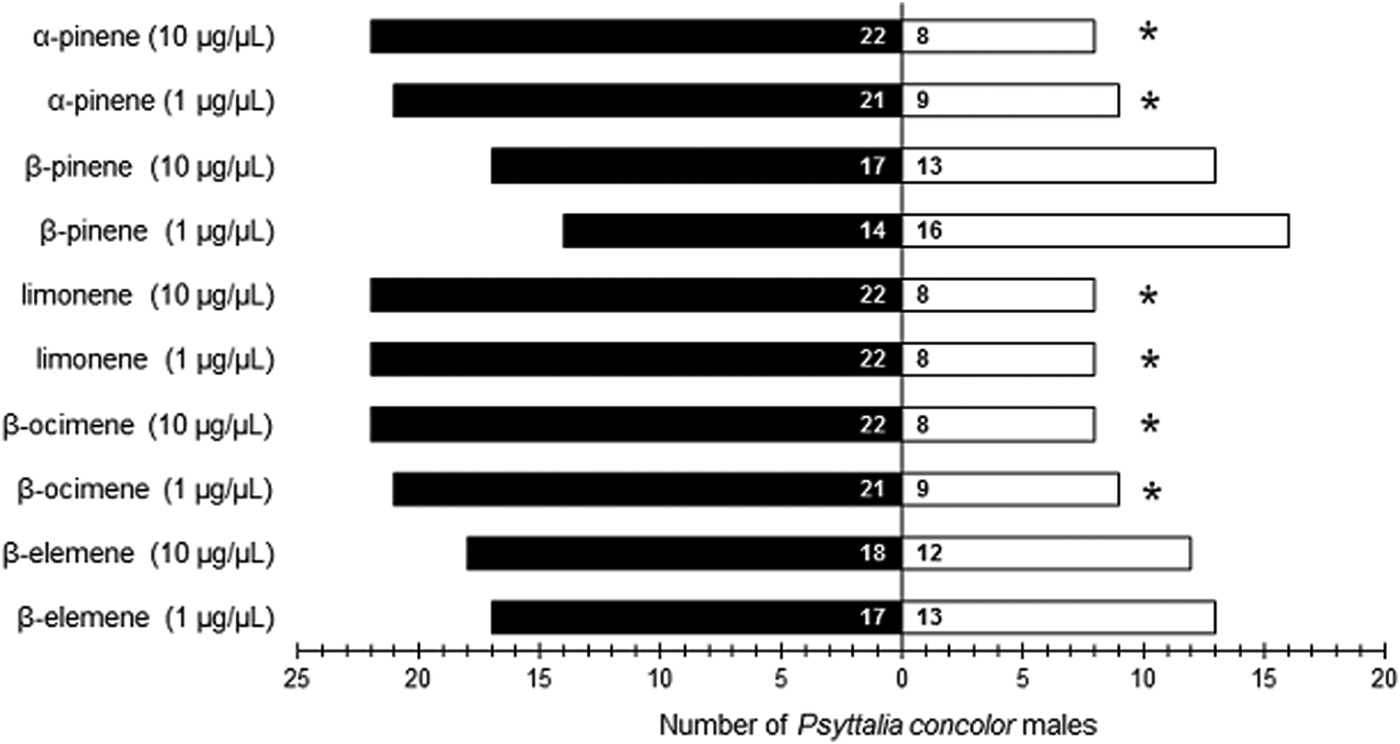
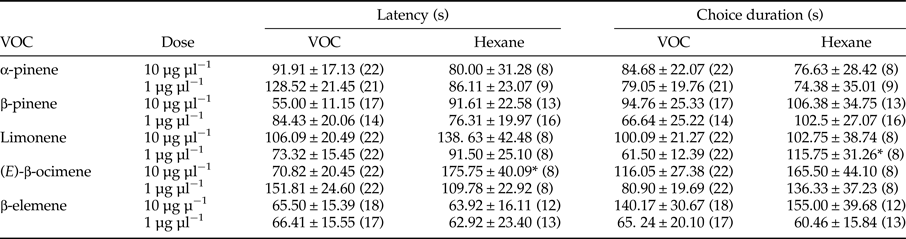
P. concolor virgin males showed to be attracted by the HIPV (E)-β-ocimene at both tested dosages (10 µg µl−1: χ2 1 = 6.57, P = 0.010; 1 µg µl−1: χ2 1 = 4.83, P = 0.028). However, also some volatiles associated with suitable host microhabitat were attractive for P. concolor males (fig. 1). Both concentrations of α-pinene (10 µg µl−1: χ2 1 = 6.57, P = 0.010; 1 µg µl−1: χ2 1 = 4.83, P = 0.028) and limonene (10 µg µl−1: χ2 1 = 6.57, P = 0.010; 1 µg µl−1: χ2 1 = 6.57, P = 0.010) were innately attractive to virgin male wasps, while no preference was recorded for β-pinene (10 µg µl−1: χ2 1 = 0.57, P = 0.452; 1 µg µl−1: χ2 1 = 0.17, P = 0.683) and β-elemene (10 µg µl−1: χ2 1 = 1.23, P = 0.267; 1 µg µl−1: χ2 1 = 0.57, P = 0.452). Over preferential orientation toward several VOCs, virgin P. concolor males showed also shorter latent period or resident time inside the chosen arm in presence of (E)-β-ocimene (10 µg µl−1: χ2 1,28 = 6.16, P = 0.013) and limonene (1 µg µl−1: χ2 1,28 = 3.86, P = 0.049), respectively (table 1).
Innate attraction of virgin Psyttalia concolor males to VOCs emitted by Bactrocera oleae-infested olives. Different doses (1 or 10 µg µl−1) of selected VOCs vs. pure hexane (control) were tested in two-choice bioassays conducted in Y-tube olfactometer. Black bars represent males choosing the VOC and white bars indicate the males choosing the control. Asterisks indicate significant differences (χ2 test with Yates’ correction, P < 0.05).

Mean (±SE) latency (s) and choice duration (s) of Psyttalia concolor virgin males on different odour sources. Numbers within brackets refer to the number of observations for each mean. Different doses (1 or 10 µg µl−1) of VOCs were tested versus pure hexane (control) in two-choice bioassays conducted in Y-tube olfactometer. In total 30 males were tested for each two-choice comparison.

For each row, asterisks indicated significant differences (generalized linear model with one fixed factor, P < 0.05).
SE, standard error.
Associative learning trials for unattractive VOCs
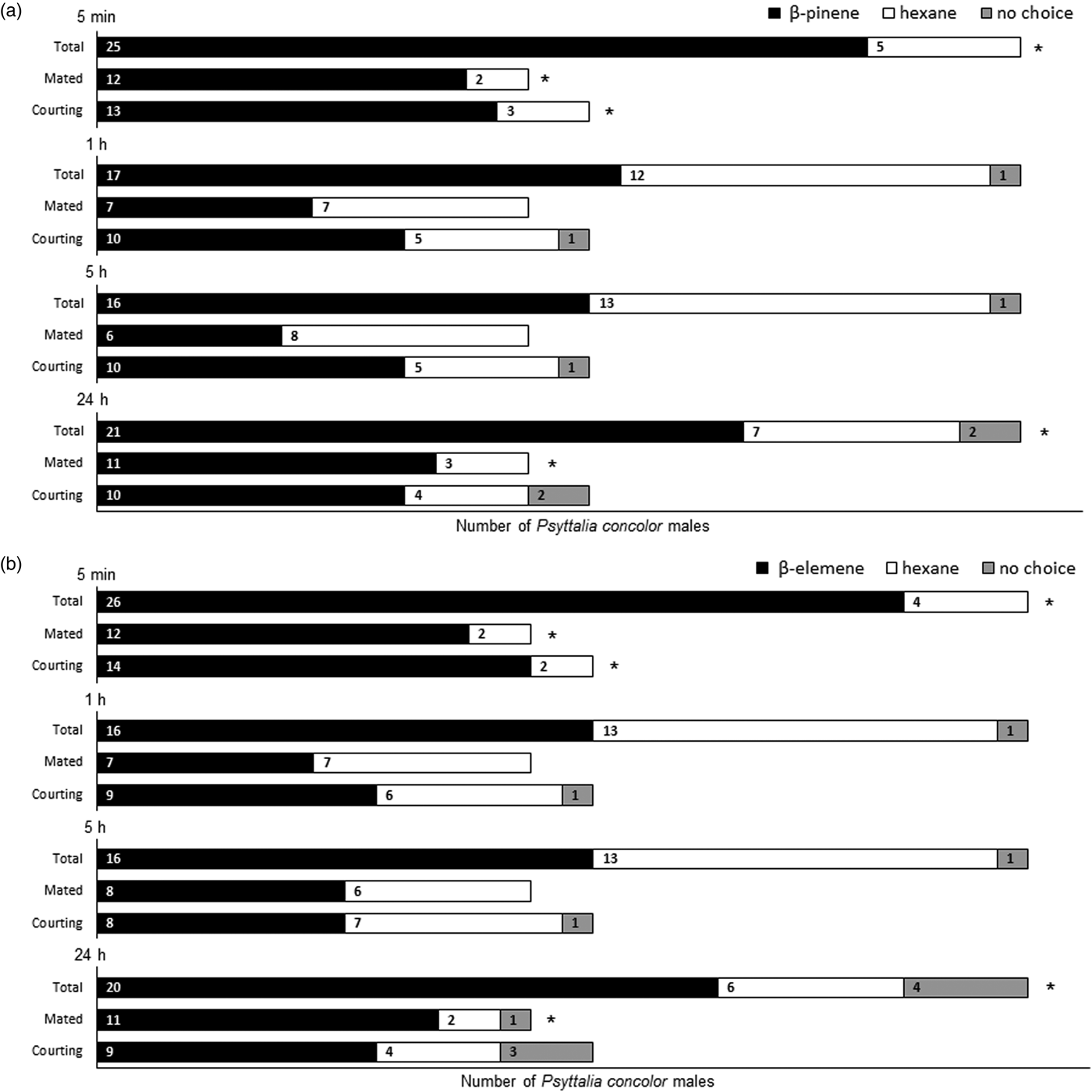
Trained P. concolor males exhibited positive chemotaxis for the learned VOC (fig. 2). Indeed, volatile-trained males preferred the reward-associated odour to hexane filter paper when tested after 5 min or 24 h in trials with β-pinene (5 min: χ2 1 = 13.37, P < 0.001; 24 h: χ2 1 = 7.04, P = 0.008) and β-elemene (5 min: χ2 1 = 16.17, P < 0.001; 24 h: χ2 1 = 8.37, P = 0.004). Conversely, no preference was recorded 1 h or 5 h after training for both tested cues: β-pinene (1 h: χ2 1 = 0.90, P = 0.344; 5 h: χ2 1 = 0.34, P = 0.557) and β-elemene (1 h: χ2 1 = 0.34, P = 0.557; 5 h: χ2 1 = 0.34, P = 0.557). No significant differences were recorded for latent periods or choice durations of all treatments. Furthermore, no preference or alteration of behavioural parameters was recorded in olfactometer bioassays involving sensitization control wasps (β-pinene: χ2 1 = 0.25, P = 0.617; β-elemene: χ2 1 = 0.05, P = 0.823).
Psyttalia concolor male preferences for two innately unattractive olive VOCs after associative learning trials with different mate rewards. Tested VOCs: (a) β-pinene and (b) β-elemene. During the training phase virgin males were exposed to a given odour source in presence of a virgin female. Males starting active searching behaviour (total males) were divided in two groups according to their training (mated males: the ones who reached a successful copula during training; courting males: the ones who just performed active courtship behaviour, without copulation). In the testing phase, the acquisition of memory was verified through two-choice bioassays in Y-tube arena at four different retention times (5 min, 1, 5 and 24 h). Asterisks indicate significant differences between VOC and control choices (χ2 test with Yates’ correction, P < 0.05).

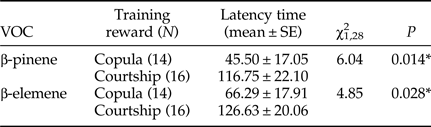
Training experience impacted male olfactory orientation. Usually, males experiencing copula during the training phase, readily exhibited searching activities toward the learned VOCs. Indeed, latency was shorter for mated males over courting ones for both β-pinene and β-elemene (table 2).
Time (s) spent by Psyttalia concolor virgin males before starting active searching activities for virgin females (i.e. latency time) during associative learning training, testing different conditioned (i.e. VOCs) and unconditioned stimuli (i.e. training rewards). In total 30 males were observed for each VOC.

Asterisks indicated significant differences between different training experiences for the same VOC (generalized linear model with one fixed factor, P < 0.05).
N, number of replicates; SE, standard error.
If the performances of courting and mated males were analysed as different treatments, the training experience influenced the male learning ability (fig. 2). Males which achieved copulation (n = 14) showed positive association with the tested VOC both 5 min (β-pinene: χ2 1 = 7.21, P = 0.007; β-elemene: χ2 1 = 7.21, P = 0.007) or 24 h (β-pinene: χ2 1 = 4.64, P = 0.031; β-elemene: χ2 1 = 6.31, P = 0.012) after the training. Moreover, even if mated males were not able to orient toward the given VOC after 1 h (β-pinene: χ2 1 = 0.07, P = 0.789; β-elemene: χ2 1 = 0.07, P = 0.789) or 5 h (β-pinene: χ2 1 = 0.36, P = 0.550; β-elemene: χ2 1 = 0.36, P = 0.550), males trained with β-elemene showed higher responsiveness (i.e. shorter latent period) toward this VOC (28.00 ± 12.12s) over to control (102.29 ± 26.51s) in 1 h experiment (χ2 1,12 = 6.05, P = 0.014).
Courting males (n = 16) similarly gained VOC-related preferences just after 5 min from the testing phase (β-pinene: χ2 1 = 6.31, P = 0.012; β-elemene: χ2 1 = 9.06, P = 0.003), but could not positive orient toward the experienced VOC in subsequent experiments, either when trained with β-pinene (1 h: χ2 1 = 1.73, P = 0.188; 5 h: χ2 1 = 1.73, , P = 0.188; 24 h: χ2 1 = 2.64, P = 0.104) or β-elemene (1 h: χ2 1 = 0.67, P = 0.414; 5 h: χ2 1 = 0.13, P = 0.715; 24 h: χ2 1 = 2.00, P = 0.157).
Discussion
Our hypothesis that VOCs from healthy and infested fruits may be used as short-range attractants by male parasitoids is supported by the behavioural responses recorded for three of the five olive VOCs tested in this study. Similar to P. concolor mated females (Giunti et al., Reference Giunti, Benelli, Flamini, Michaud and Canale2016b ), virgin males showed innate preferences for (E)-β-ocimene, a well-known kairomone for many other braconid species (Du et al., Reference Du, Poppy, Powell, Pickett, Wadhams and Woodcock1998; Röse et al., Reference Röse, Lewis and Tumlinson1998; Han & Chen, Reference Han and Chen2002). In the presence of this HIPV, males displayed shorter latency times, in agreement with previous findings by Benelli & Canale (Reference Benelli and Canale2013) on C. capitata-induced volatiles. Furthermore, P. concolor males are innately attracted by VOCs peculiar of healthy olives, as α-pinene and limonene. Both these volatiles are used as kairomones by the close related species Diachasmimorpha longicaudata Ashmead (Hymenoptera: Braconidae) (Carrasco et al., Reference Carrasco, Montoya, Cruz-lopez and Rojas2005) and are reported as pheromones of several tephritid flies (Mazomenos & Haniotakis, Reference Mazomenos and Haniotakis1985; Rocca et al., Reference Rocca, Nation, Strekowski and Battiste1992; Raptopoulos et al., Reference Raptopoulos, Haniotakis, Koutsaftikis, Kelly and Mavraganis1995; Lima et al., Reference Lima, House and Do Nascimento2001). Conversely to females (Giunti et al., Reference Giunti, Benelli, Flamini, Michaud and Canale2016b ), P. concolor males are more prone to perceive and to exploit olfactory stimuli from their trophic microhabitat, since they can increase mating chances by identifying trophic niches on which they could find newly emerged females. VOCs attractive to P. concolor males could be classified as sexual kairomones, since males probably exploit these volatiles for sexual purposes, either by synergistically enhancing male responsiveness toward female sex pheromones or directly routing mate location (Ruther et al., Reference Ruther, Meiners and Steidle2002a , Reference Ruther, Reinecke and Hilker b ). However, the attractiveness of healthy fruit chemicals to virgin males may indicate that some attractive volatiles are common to infested and healthy fruits, as noted for other tri-trophic contexts (Eben et al., Reference Eben, Benrey, Sivinski and Aluja2000; Carrasco et al., Reference Carrasco, Montoya, Cruz-lopez and Rojas2005).
P. concolor virgin males also showed to acquire positive chemotaxis for unattractive VOCs when provided in associative learning trials with a mate reward. Learning skills of parasitic wasp males have been rarely investigated for either visual (Baeder & King, Reference Baeder and King2004) or olfactory cues (Villagra et al., Reference Villagra, Vasquez and Niemeyer2005, Reference Villagra, Vásquez and Niemeyer2008). For P. concolor males a single associative experience leads to STM formation, lasting less than 1 h and consolidating into LTM within 24 h. Although consolidated memory forms usually occur after more than a single associative learning experience (Hoedjes et al., Reference Hoedjes, Kruidhof, Huigens, Dicke, Vet and Smid2011), other hymenopteran species develop LTM after an isolated conditioning trial (Bleeker et al., Reference Bleeker, Smid, Steidle, Kruidhof, Van Loon and Vet2006).
Memory dynamic generally depends on the value of the reward provided during the training procedure (Kruidhof et al., Reference Kruidhof, Pashalidou, Fatouros, Figueroa, Vet, Smid and Huigens2012; Hoedjes et al., Reference Hoedjes, Kralemann, Van Vugt, Vet and Smid2014), even if the perception of the reward value by parasitic wasps is not always ascertainable. According to the reward value hypothesis, P. concolor males learned differently the unattractive VOC cues when coupled with a complete mating experience or just with a restricted interaction with suitable mates. Male wasps, which reached the copula during the training phase, presented a peculiar memory dynamic consisting firstly in STM formation, then followed by a refractory period (lasting less than a day), which preceded the consolidation into LTM form. In accordance with Smid & Vet (Reference Smid and Vet2016), this kind of fast-consolidated memory is not unusual among parasitic wasps. However, mainly residential species benefit from this memory dynamic pathway, unlike migrating populations, which forage in extremely heterogeneous habitats where the acquired information becomes readily obsolete (Smid & Vet, Reference Smid and Vet2016).
Learning may be helpful to maximize fitness outcomes. Since learning involves energetic expenses, the balance cost-benefits may be carefully considered by parasitoids to prevent maladaptive behaviours. In this context, it is not surprising that P. concolor virgin males, which experienced only courtship during the training procedure, presented only STM formation, which disappeared after just 1 h. It can be argued that the lower value of the reinforcement obstructed the energetic costs associated with memory consolidation pathways. However, copula seems not fundamental to affect a real short-term associative learning. Indeed, the behavioural responses recorded immediately after the experience can be ascribed to associative over non-associative learning, since no preferences were noted during the sensitization control bioassays. The acquisition of short-term preferences may be helpful to encourage searching behaviour of virgin male wasps, which recently experienced an unsuccessful mating.
The strong naïve and learned responses, displayed by P. concolor males toward the tested olive VOCs, support our hypothesis that olfactory cues are key stimuli also for male wasps. Our findings add useful information to basic knowledge on P. concolor chemical ecology, highlighting the hypothesis that HIPVs play a pivotal role routing males towards tephritid-infested fruits, thus increasing their fitness outcomes. Indeed, the mating success is influenced by the spatial distribution of conspecifics and hosts. Solitary parasitoid males usually locate females near feeding or oviposition sites (Godfray & Cook, Reference Godfray, Cook, Choe and Crespi1997), and for protandrous species the early mate detection is fundamental to ensure minimal wastes of time (Danci et al., Reference Danci, Inducil, Schaefer and Gries2011). Furthermore, learning for cues from the foraging habitat potentially increases host-plant complex fidelity (König et al., Reference König, Krimmer, Brose, Gantert, Bruschluter, König, Klopfstein, Wendt, Baur, Krogmann and Steidle2015). Indeed, learned preferences for mate-microhabitat stimuli have been already proposed as key cues for sympatric specialisation (Berlocher & Feder, Reference Berlocher and Feder2002; Forbes et al., Reference Forbes, Powell, Stelinski, Smith and Feder2009). Recognition of host-microhabitat VOCs may also reflect on more immediate advantages, optimizing resource localization in a diversified foraging environment. Although female pheromones remain the key short-range attractant to male parasitoids (Godfray & Cook, Reference Godfray, Cook, Choe and Crespi1997), VOCs from mate-microhabitat may be highly detectable and easily act as long-range attractants (Glinwood et al., Reference Glinwood, Du and Powell1999).
Acknowledgements
Dr Suk Ling Wee and two anonymous reviewers improved an earlier version of our manuscript. The authors would like to thank R. Canovai and A. Loni for mass rearing assistance.
Funding
G. Giunti is funded by AGRIFOODTECH PON03 PE_00090_2 ‘Modelli sostenibili e nuove tecnologie per la valorizzazione delle olive e dell'olio extravergine di oliva prodotto in Calabria’ (Grant ID: 14/2016/Agraria). G. Benelli is sponsored by PROAPI (PRAF 2015) and University of Pisa, Department of Agriculture, Food and Environment (Grant ID: COFIN2015_22). Funders had no role in the study design, data collection and analysis, decision to publish, or preparation of the manuscript.
Disclosure
The Authors declare no competing interests.
Compliance with ethical standards
All applicable international and national guidelines for the care and use of animals were followed. All procedures performed in studies involving animals were in accordance with the ethical standards of the institution or practice at which the studies were conducted.