Introduction
CHD, which is caused by anatomical or functional defects in the heart and blood vessels, is a serious condition that can threaten the lives of children of all ages.Reference Bektas, Kır, Yıldız, Genç, Bektas and Ünal1 Early detection of CHD, which is one of the most life-threatening conditions in the first years of life, and the application of the necessary medical procedures can increase the survival rate of children and make a positive contribution to their growth and development.Reference Go, Mozaffarian and Roger2 For this reason, it is important to assess children’s heart function. Reference Varal, Köksal and Özkan3,Reference Wijesingha and White4
Angiography, one of the methods used to assess heart function, is widely used to determine the arterial anatomy of the heart, monitor defects, and treat a wide range of diseases.Reference Demir and Arslantaş5,Reference Twycross, Finley and Latimer6 However, in addition to being an invasive procedure, angiography is also an application that requires more than one invasive intervention for the child.Reference Twycross, Finley and Latimer6,Reference Yun, Kim and Jung7 This can cause severe pain in children.Reference Twycross, Finley and Latimer6,Reference Ünver and Yildirim8 In addition, the course of the illness and hospitalisation may involve unpleasant experiences that can frighten, disturb, and cause anxiety in children.Reference Ünver and Yildirim8 For this reason, relieving children’s pain before and after the procedure, informing children and their parents about the procedure, identifying possible risks, taking the necessary measures, etc., can speed up children’s healing processes. In this process, paediatric nurses, who spend the most time with children, have important roles to play, such as clinical treatment, care, follow-up, and management of any symptoms that may develop, such as pain.Reference Lumsden, Smith and Wittkowski9,Reference Rempel, Ravindran, Rogers and Magill-Evans10
Paediatric nurses can use many non-pharmacological as well as pharmacological treatments to comfort children in the clinical setting. Akgün Kostak and SemerciReference Akgün Kostak, Kutman and Semerci11 noted that therapeutic play can be effective with children in the hospital setting, according to the American Academy of Pediatrics.12
Therapeutic play is a type of play structured by a trained professional to reduce children’s fear and anxiety in situations of unusual experience.Reference Silva, Santos, Floriano, Damião, Campos and Rossato13 Therapeutic play supports children’s physical, cognitive, emotional, and social development and provides effective communication skills.Reference Yayan and Zengin14 It has been reported in the field that therapeutic drama reduces anxiety and fear in hospitalised children, prepares them for medical procedures by developing a sense of control and confidence, enables them to express their emotions, and provides them with coping skills.Reference Buyuk and Bolişik15,Reference Caleffi, Rocha, Anders, de Souza, Burciaga and da Silva Serapião16 It has also been reported to be effective in reducing pain, fear, and anxiety in children before and after surgery.Reference Roshanzadeh, Tajabadi and Mohammadi17,Reference Kurt and Seval18 However, although there are a limited number of studies investigating the effects of therapeutic play on angiography,Reference Tuncay and Günay19 as it is an invasive procedure that can cause severe pain, fear, and anxiety in children and requires hospitalisation, studies to help children cope with the process seem to be lacking. Various studies are needed to help clinicians intervene in this process. It is thought that paediatric nurses should support children in their angiography processes in clinical practice. For this reason, our study was conducted to investigate the effect of therapeutic play training on children’s ability to manage angiography processes and their pain and anxiety.
Research questions
-
– Could children in the therapeutic play group experience less pain during angiography than children in the control group?
-
– Could children in the therapeutic play group report less anxiety during angiography than children in the control group?
-
– Could children in the therapeutic play group experience less fear during angiography than children in the control group?
Material and method
Study type
This randomised controlled experimental study was conducted in children who underwent angiography at the paediatric cardiology clinic of a university hospital in eastern Turkey between 1 January 2022 and 31 August 2022.
Study population and sample
The population of this study consisted of children who underwent angiography at the Paediatric Cardiology Clinic between 1 January 2022 and 31 August 2022. Children aged 5–8 years who met the study criteria from the identified population and agreed to participate in the research formed the sample of the study. The sample size for the study was calculated using G*Power 3.1.9.4. Considering a medium effect size (d = 0.25), a 5% error margin (α = 0.05) and 80% power (1−β = 0.8), the required sample size was found to be 70 children: 35 in the experimental group and 35 in the control group, for a two-group design.Reference Cohen, Jarsey and Erlbaum20
Randomisation
In this trial, block randomisation was used to ensure a balanced distribution of participants between the experimental and control groups. This method involved assigning patients to one of the two groups on a 1:1 basis. The creation of the experimental and control groups was done by patient numbering and randomisation, facilitated by an online tool (www.randomizer.org). Block randomisation is a technique commonly used in clinical trials to minimise bias and ensure comparability between groups. By randomly assigning participants to groups within blocks, any potential confounding variables are evenly distributed, increasing the validity of the study’s results. In this trial, the use of randomisation via an online platform further ensured the transparency and rigour of the process, reducing the risk of systematic error or manipulation in group allocation.Reference Kanik, Taşdelen and Erdoǧan21
Inclusion criteria
-
• Children aged 4 to 10 years,
-
• Children who agreed to take part in the study,
-
• Children undergoing a planned (elective) diagnostic angiography (cardiac catheterisation) procedure,
-
• Children who did not receive extra pain relief or sleep medication as per the usual clinical protocol before and after the procedure,
-
• Children who did not have any health problems (other congenital health problems (such as Down syndrome)),
-
• Chronic health problems (such as coeliac disease) that could affect therapeutic play.
Exclusion criterion
-
• Children who urgently need an unplanned angiography,
-
• Children with complications related to angiography,
-
• Children undergoing interventional cardiac catheterisation (balloon valvuloplasty, stent placement, device closure, etc.) other than diagnostic angiography,
-
• Children with conditions that may cause chronic pain, such as juvenile idiopathic arthritis and migraine,
-
• Children who regularly use analgesics.
Data collection tools
Child Information Form, Wong–Baker Faces Pain Rating Scale, Children’s Fear Scale, Children’s Anxiety Meter-State, and Doll Model were used to collect research data.
Child information form
This form, prepared by the researcher, contains information about the children (age, sex, disease diagnosis, vital signs, number of movements in bed, etc.).
Wong–Baker facial pain rating scale
This scale rates pain based on facial expression. A score of 0 on the scale indicates no pain and 10 indicates severe pain.Reference Okyay and Ayoğlu22 In our study, the Cronbach’s alpha coefficient of the scale was determined to be 0.82.
Children’s Fear Scale: The Turkish validity of the scale, which was developed by McMurtry et al. in 2011, was conducted by Gerçeker et al.Reference Gerçeker, Ayar, Özdemir and Bektaş23 in 2018. The scale includes five facial expressions and is scored between 0 and 4. A score of 0 indicates no anxiety; 4 indicates the highest fear. The Cronbach’s alpha coefficient of the scale was determined to be 0.78.
Children’s Anxiety Meter-State: The scale is designed as a bulb chamber at the bottom and horizontal lines at the top. The bulb chamber is scored between 0 and 10 points. As the score increases, so does the level of anxiety.Reference Gerçeker, Ayar, Özdemir and Bektaş23 The Cronbach’s alpha coefficient of the scale was determined to be 0.83.
Doll Model: A doll was used on which the heart and vascular structure could be drawn (Figure 1).
Doll Model.

Data collection
In the present study, children undergoing angiography at the paediatric cardiology clinic between 1 January 2022 and 1 December 2022 and their parents were informed in detail about the aim of the study and the therapeutic play to be performed, and their informed consent was obtained. Information about the children included in the study (age, sex, diagnosis, etc.) was extracted from the patient records by the researchers and recorded on the child information form. The angiography unit in the hospital where the study was conducted is located outside the clinic where the children are treated. The angiography team consists of a doctor and a nurse, and the angiography was performed by the same team for all the children in our study. The sedation procedures carried out on the children included in our study were in accordance with the standard clinical protocol used in the hospital’s paediatric angiography unit. Sedation was only administered to children during the procedure, and no analgesic/sedative medication was given as part of routine care before or after the procedure. The sedation dose was determined by the physician and adjusted according to the children’s weight. To ensure seamless continuity of care, the nurses responsible for the children’s care have not only been trained but actively encouraged to support the study. This collaborative effort underlines the commitment to maintaining a high standard of care throughout the research process (Figure 2).
Participant flow diagram of the randomized controlled trialsource: Prepared by the authors based on the study data.

Nursing interventions
Experimental group
The stages that the children who met the criteria for inclusion in the study and who were included in the experimental group went through are listed below. The therapeutic play training took place in the clinic where the child was monitored, before, during, and after the play, and lasted approximately 30–45 minutes.
Before the therapeutic play
-
– Information about therapeutic play (what therapeutic play is, how long it lasts, its benefits, etc.) was given to the children and their parents in pre-interviews.
-
– The appropriate time frame was determined with the children and their parents as part of the clinical routine.
-
– The “Child Information Form,” “Wong-Baker Faces Pain Rating Scale,” “Children’s Fear Scale,” and “Children’s Anxiety Meter-State” were completed.
-
– Angio-doll was prepared by the researchers.
-
– The prepared Angio-doll was presented to the children and parents.
-
– The children were allowed to play freely with the Angio-doll for a while.
During the therapeutic play
-
– The angiography procedure was explained by the researchers as a play through the doll.
-
– The children were allowed to try out the angiography procedure on the doll.
-
– After the angiography procedure, the children’s educational processes were explained in a playful way, using therapeutic play to regulate the child’s behaviour, such as staying calm and not moving.
-
– The children were accompanied to the angiography unit with the doll.
After therapeutic play
-
– After the angiography, the children with the doll were taken out of the angiography unit.
-
– After the necessary medical procedures had been carried out and the children had calmed down, they were asked to tell about the therapeutic experience with the puppet.
-
– The “Child Information Form,” “Wong-Baker Faces Pain Rating Scale,” “Children’s Fear Scale,” and “Children’s Anxiety Meter-State” were completed.
Control group
The stages that the children who agreed to take part in the study and were included in the control group went through are listed below:
-
– Information about the research was given to the children and their parents in pre-interviews.
-
– The “Child Information Form,” “Wong-Baker Faces Pain Rating Scale,” “Children’s Fear Scale,” and “Children’s Anxiety Meter-State” were completed before and after the angiography procedure.
-
– The children were supported to continue with their clinical routine.
Data analysis
Descriptive statistics (number, percentage, and mean) were used to evaluate continuous and numerical variables. The Chi-square test was used to determine whether there were differences between the groups in terms of demographic data (so as not to affect the research findings—fear and anxiety). Normality of data was assessed by Kolmogorov–Smirnov. Percentage, mean, Pearson’s correlation, and ANOVA tests were used to evaluate the data.
Ethical considerations
The necessary institutional and ethical approvals for our study from the Ethics Committee for Non-Interventional Clinical Research at Inonu University for our study have been obtained (approval number: 2021/2885). Prior to the study, the purpose of the study and the procedures to be followed were explained in detail to the children and their families. Verbal informed consent was obtained, and only children who voluntarily agreed to participate were included in the study.
Results
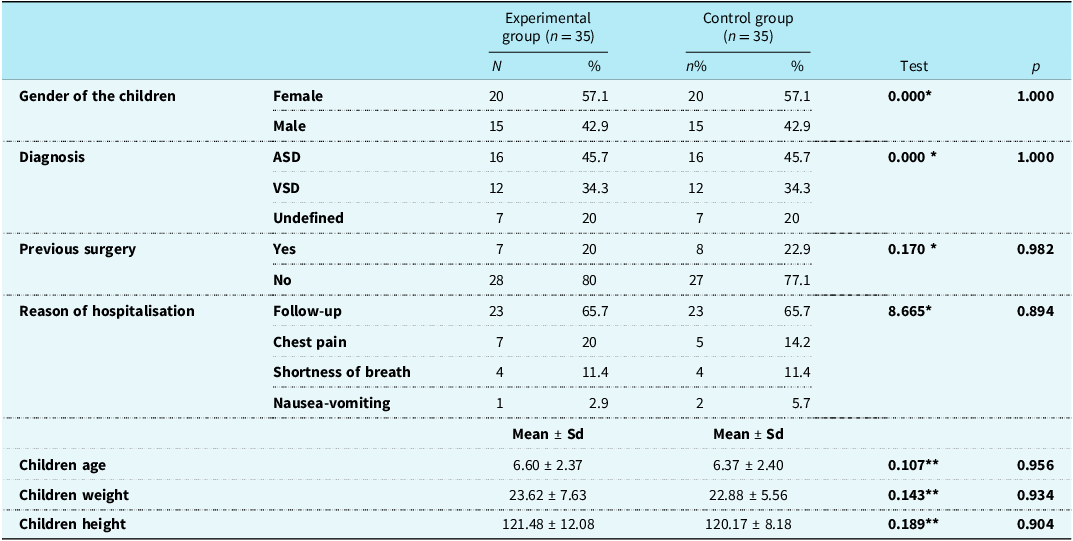
To assess the homogeneity of the children’s sociodemographic characteristics, a comparison was first made between the experimental and control groups. The children in the control and experimental groups were homogeneous in terms of age, sex, height, weight, diagnosis, and complaints on admission (p > 0.05) (Table 1). In both groups, the majority of children (57.1%) were female, and the majority were hospitalised for follow-up (65.7). The mean age of the children was 6.37 ± 2.40 years in the control group and 6.60 ± 2.37 years in the intervention group (Table 1).
Comparison of sociodemographic characteristics of children by group

*Pearson Korelasyon.
**ANOVA Table.
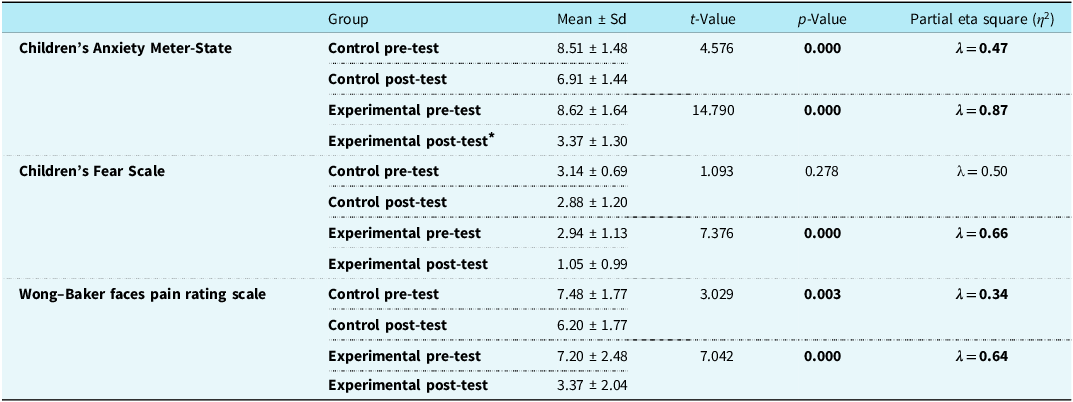
The mean anxiety, fear, and pain scores of the children in the experimental and control groups were examined. For the children in the control group, the mean pre-test anxiety score was 8.51 ± 1.48, the mean post-test anxiety score was 6.91 ± 1.44, the mean pre-test anxiety score was 3.14±0.69, the mean post-test anxiety score was 2.88 ± 1.20, and the mean pre-test pain score was 7. Mean pre-test fear score was 3.14±0.69, mean post-test fear score was 2.88 ± 1.20, mean pre-test pain score was 7.48 ± 1.77, mean post-test pain score was 6.20 ± 1.77, and there was a significant difference between the children’s pre-test and post-test scores in terms of their anxiety and pain scores (p < 0.05). For the children in the experimental group, the mean pre-test anxiety score was 8.62 ± 1.64, the mean post-test anxiety score was 3.37 ± 1.30, the mean pre-test fear score was 2.94 ± 1.13, the mean post-test fear score was 1.05 ± 0. 99, the mean pre-test pain score was 7.20 ± 2.48, the mean post-test pain score was 3.37 ± 2.04, and there was a significant difference between the children’s pre-test and post-test scores (p < 0.05) (Table 2).
Mean anxiety, fear, and pain scores of children in experimental and control groups

SD = standard deviation; η² = effect size.
Discussion
For children, illness and hospitalisation are frightening and unpleasant experiences. Children also undergo painful invasive procedures necessary for diagnosis, treatment, and care.Reference Silva, Santos, Floriano, Damião, Campos and Rossato13,Reference Litzelman, Catrine, Gangnon and Witt24,Reference Li, Lopez and Lee25 As well as being painful and exhausting for children,Reference Uman, Chambers, McGrath and Kisely26 medical procedures can have a negative impact on children’s participation in treatment and care processes.Reference Marasuna and Eroğlu27,Reference Cáceres-Matos, Castillo-García, Magni and Pabón-Carrasco28 As nurses are the health professionals closest to children and their families, they can make a significant contribution to the healing process of children by minimising the trauma caused by hospitalisation and associated painful procedures.Reference de Freitas Lapa and de Souza29Recent studies in the literature have emphasised that approaches involving children in their care processes can significantly improve their coping skills and emotional well-being during hospital admissions and invasive procedures.Reference Segers30,Reference Spatora31 Consistent with these findings, it can be said that therapeutic play, as an effective intervention, can contribute to more positive healthcare experiences by supporting emotional regulation in children.
It has been emphasised in the literature that therapeutic play is an educational nursing initiative that facilitates children’s understanding of surgical procedures and reduces high anxiety levels, allowing children to have a positive experience.Reference Coşkuntürk and Gözen32–Reference Zheng, Li, Zhuang, Chen, Wu and Hu34 In our study, we found that the pain, fear, and anxiety levels of children undergoing angiography were quite high before the procedure and that there was a significant reduction in the pain, fear, and anxiety levels of the children after the therapeutic play programme. Several studies have shown the importance of preparing and informing children before painful procedures such as catheterisation.Reference Cohen, Lemanek and Blount35–Reference Hughes37Orhan and YıldızReference Orhan and Yildiz38 used therapeutic play during peripheral catheterisation in paediatric oncology patients and showed that using therapeutic play reduced children’s anxiety and pain before catheterisation. Coşkuntürk et al.Reference Coşkuntürk and Gözen32 found that interactive therapeutic play programmes applied to children undergoing surgery for CHD were effective in reducing post-operative anxiety in children and their mothers. In their study investigating the effect of a therapeutic play/play therapy programme on fear and anxiety levels in children hospitalised after liver transplantation, Zengin et al.Reference Zengin, Yayan and Düken39found that children’s fear and anxiety of medical procedures decreased and that fear of medical procedures was an important predictor of anxiety levels prior to therapeutic practice. İşler and Kuzlu AyyıldızReference İşler and Kuzlu Ayyıldız33 found that therapeutic play training involving two different distraction techniques, carried out prior to peripheral vascular access procedures, reduced anxiety levels in children aged 3–12 years who were receiving treatment at paediatric surgery clinics. Zheng et al. concluded that digital picture books are an effective intervention for alleviating pre-operative anxiety and pain in children undergoing cardiac catheterisation.Reference Zheng, Li, Zhuang, Chen, Wu and Hu34 In this regard, integrating therapeutic play interventions into the clinical care routines of paediatric patients can contribute to a more positive healthcare experience by encouraging cooperation between patients, their parents and healthcare professionals.Reference Cáceres-Matos, Castillo-García, Magni and Pabón-Carrasco28–Reference Anderoğlu and Çağlar40 Therefore, increasing the use of therapeutic play interventions in hospital processes, alongside training healthcare professionals to implement these programmes, could be an important step towards improving the quality of clinical care for children.
In our study, a significant difference was found between the pain and anxiety scores of the children in the control group in terms of pre- and post-test scores. Children’s previous experiences may influence their pain or anxiety. Therefore, it was expected that the children in our study would not experience pain or anxiety as expected. However, when the effect size and power were examined, it was found that the effect sizes were low and medium (λ=0.30–0.50) in the control group, while the effect sizes were high (λ=0.60–0.87) in the children who received therapeutic play. This situation showed the importance and usefulness of therapeutic play in our study. In addition, these results can be explained by the fact that the end of the procedure may lead to a decrease in the children’s anxiety or with the decrease in the children’s symptoms.
Practice implications
Nurses play a key role in the advancement of health care. It is essential to assess patients holistically and to apply holistic nursing in their clinical practice. Reducing pain, fear, and anxiety in children, especially in paediatric clinics, is the first step in holistic care. For children, hospitalisation is a source of great anxiety. Addressing this is critical as it can have a significant negative impact on the recovery process of many children. Therefore, therapeutic play is an appropriate and effective method for paediatric nurses’ practice. CHD is a condition that often causes symptoms in children and often leads to invasive tests such as angiography and hospitalisation. This can lead to increased levels of pain, anxiety, and fear in children. Therefore, children undergoing angiography can reduce their pain, fear, and anxiety with the therapeutic play programme.
Limitations
Fear, anxiety, and pain pose significant limitations to a study because of their cultural characteristics; however, sociocultural characteristics were not considered in the sample selection for this study. Another important limitation of our study is that blinding was not possible in our study due to hospital procedures, and children who had not previously undergone an interventional procedure could not be included in the study due to the limited number of cases.
Conclusion
Our study found that the therapeutic play programme reduced pain, anxiety, and fear in children during angiography procedures. Therefore, effective interventions should be implemented in children during angiography procedures and guidelines for nursing interventions should be developed. It is also recommended that various studies are carried out to improve the quality of care. In order to strengthen the level of evidence for therapeutic play interventions, it is recommended that studies are conducted with different and larger sample groups. Furthermore, developing evidence-based clinical guidelines and implementing them in clinical care practices will improve the quality and consistency of care for children.
Data availability statement
None.
Acknowledgements
None.
Author Contributions
Concept—YSD and EHY; Design—YSD ; Supervision—ÖE; Resources—EA and CK; Materials—YSD; Data Collection and/or Processing—EA; Analysis and/or Interpretation—YSD, EHY; Literature Search—YSD; Writing Manuscript—YSD and EHY ; Critical Review—YSD and EHY; Other—ÖE and CK.
Financial support
This study was supported by the 2209-A—University Students Research Projects Support Program (grant no: 1919B012109746).
Competing interests
The authors declare no conflicts of interest.