The human hand fashions works from lifeless matter according to the same formal principles as nature does. All human art production is therefore at heart nothing other than a contest with nature.Footnote 1
FIRST THOUGHTS
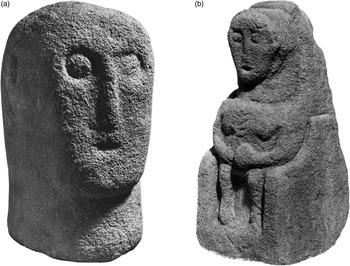
In 1976, George Boon published a paper in which he re-examined the well-known Romano-British stone sculpture of a disembodied head from Caerwent ( fig. 1a).Footnote 2 In his essay, he discussed the curious context of this image, noting that it was found mounted on a platform in a chamber (probably best-interpreted as a private shrine, or fanum) within a yard belonging to a wealthy fourth-century Roman house (XI.7S) in the town. Boon suggested that the building was the home of a Christian, explaining the presence of such a pagan icon as the human head in terms of ownership by a tenant or servant of the householder.
(a) The sandstone disembodied head from the garden of a Late Roman house at Caerwent. Height 0.225 m; (b) Sandstone statuette of a seated female from Caerwent. Height 0.27 m. (Photos: © courtesy of Newport Museum and Art Gallery)

Boon came to the view of the house's Christian ownership on account of the presence in the house of a mosaic pavement whose iconography of the Seasons, allegedly with an Orpheus roundel in its centre, would have been allegorically appropriate to a Christian household.Footnote 3 He also alludes to other evidence of Christians living in the town (most notable of which is the pewter bowl marked on its base with a chi-rho monogram).Footnote 4 In view of current approaches to Roman-period iconography,Footnote 5 it might be timely to blow the dust off the old chestnut of the ‘Caerwent head’ once more, together with one of its iconographic companions in the Silurian civitas-capital (the stone statuette of a seated woman), in order to attempt to situate these cultic testaments within current iconographical research and theoretical perspectives.
THE HEAD AND THE ‘GODDESS’: OBSERVATIONS ON SOMATIC TREATMENT
Image-making involves the production and use of ‘intentionally expressive objects’.Footnote 6 This means that the viewer engages with images in a way that is different from his/her engagement with a tool or a pot, which can be used almost mechanically, without the need for conceptual interaction between the user and the object that is used. By contrast, the very nature of images — whether monumental statues or tiny figurines — necessitates thinking and the establishment of relationships, by means of gaze and touch, between the spectator and what is seen and felt. Both the images from Caerwent contain unsettling, ‘unreal’ elements that force the viewer to be other than purely passive and to ask questions. Where is the Caerwent head's body? Why are the torso and limbs absent? Why has the seated figure such a large head in relation to her limbs? What is she wearing on her head? What is she carrying?
A range of issues relating to the Caerwent headFootnote 7 repays fresh scrutiny, in respect of both its provenance and stylistic treatment. If the house did belong to a Christian, as Boon suggested,Footnote 8 the toleration of an object so apparently charged with pagan meaning as the disembodied head in his or her back garden presents a conundrum. Unless the householder was hedging his bets (as, indeed, did Constantine, the first ‘Christian’ emperor), it is feasible that the head was the focus of a different and ‘retro’ cult followed by lowly or servile members of the owner's establishment who had not embraced the new monotheistic faith.Footnote 9 But alternative interpretations for the presence and situation of the Caerwent head are offered later in this paper.
Three physiognomic features on this head are of particular note: the asymmetry in the treatment of the eyes, the open mouth, and the large, deeply indented ears. Interestingly, all these elements are likewise discernible on another distinctive sculpture from Caerwent, the small stone image of a woman ( fig. 1b), whose overlarge head and diminutive limbs appear to betray what was possibly a conscious lack of attention to mimetic detail — in terms of the way the human body is represented — and the schematic approach taken to image-making by a local sculptor. This figure may also have been associated with a holy place, for it was found close to the late Romano-Celtic temple that was built next to the forum-basilica complex.Footnote 10 Once again, this pagan symbol, perhaps linked with a pagan religious building, existed within a milieu that was probably at least nominally Christian.
APPLYING THE ‘ICON IMPERATIVE’ TO THE CAERWENT SCULPTURES
In her studies of Bronze Age Aegean iconography, Janice CrowleyFootnote 11 set out what might be termed rules of engagement for the systematic study of figurines and other depictions, for example on seals and ceramics. She lists a range of criteria that can be used to ‘interrogate’ each image: they include ‘theme’, ‘icon’, ‘element’ and ‘syntax’. It is worth considering whether such principles might be broadly applicable to the Caerwent images, to see if they throw light on grammars of production, display and meaning. Application of these principles will also help in comparative study of the two pieces. Following Crowley's frameworkFootnote 12 for scrutiny of the more visually complex figure (the seated female), we may define the characteristics of the sculpture thus:
Theme = seated female figure made of local sandstone.
Icon (organisation of subject matter) = schematic, minimalist stylistic treatment; asymmetry of physiognomy; subverted internal dimensionalities (overlarge head and diminutive limbs).
Element (the constituent parts of the icon) = female body; chair; hooded head; attributes (such as palm-branch, sphere and lituus); open mouth; deep-set ears; asymmetrical eyes.
Syntax (the relationship between elements) = the framing of the body by the chair, and of the head by the hood that shrouds all but the front of the head, though revealing the ears; the holding of the palm-branch, globe and lituus in the hands.
Application of these criteria to the stone head presents more challenges, but here is an attempt:
Theme = disembodied human head made of local sandstone.
Icon = schematic, minimalist stylistic treatment; asymmetry of physiognomy; presence of the head as sole representative of the human body.
Element = hooded head; open mouth; deep-set ears; asymmetrical eyes.
Syntax = framing of the head by the hood, which is set back revealing the front of the head and the ears. The head and neck are also framed by the clearly defined line of severance, indicating that no body was ever attached to it.
There would appear to be merit, therefore, in applying Crowley's methodology to the two Caerwent sculptures. The main feature to which attention is drawn by comparing the results of the two images is the striking similarities of detail between them. This supports the notion that the two carvings were broadly coeval and, perhaps, made by the same sculptor, or that one craftsperson was closely copying another's work (see below).
MATERIAL, MAKING AND MEANING
The open mouths, distinctly-defined ears and asymmetry of both the Caerwent carvings are each perhaps significant in terms of the intention to portray nuances of meaning associated with the perception of the image as an artefact. But before following this route, the role of the oft-neglected sculptor(s) needs to be flagged up. In her research into the technologies of ancient glass-working, Frances LiardetFootnote 13 has drawn attention to the close connections between technology, craft, product and meaning. By experimenting, as an apprentice, with various techniques in the processes involved in the manufacture of handles for ancient eastern Mediterranean flasks known as aryballoi, Liardet has turned previous typologies on their heads, arguing with conviction that form and shape are enmeshed within praxis and tradition rather than chronologically unilinear fashion or evolution. Glass-working is, of course, very different from stone-carving. Working with fire, heat and a substance with molten, plastic and solid properties presents demands and opportunities peculiar to hot-working (ably explored in the context of iron-working by the KellersFootnote 14 ), whilst stone-carvers were engaged with an ‘inert’, sometimes intractable, substance. However, lessons may still be learned from Liardet's apprenticeship, for her work demands that we pay particular regard to the individuals involved in iconographic production and the distinct circumstances surrounding the process of making artefacts. Similarly, Aloïs Riegl (see opening quote) draws attention to the close relationship between the making of ‘art’ objects and their materials, and speaks of the tensions and negotiations involved in giving static substances — whether stone, metal or wood — an active voice.Footnote 15
In considering issues of materiality and meaning in relation to the Caerwent sculptures, it is striking that the sculptor(s) involved in the production of both pieces chose to use the local yellow quartz sandstone ‘rather than the more easily carved and finer-grained Bath stone’Footnote 16 that would have been both readily available and, perhaps, aesthetically more pleasing. It is necessary, therefore, to explore notions of materiality, conscious challenge and the highly intimate relationship between the producer, his or her material and the idiosyncratic emerging image.
The connection between the choice of local stone and the use to which it was put is perhaps further supported by the sparse, but important assemblage of inscriptions from Caerwent. The public monument known as the ‘Paulinus Stone’, set up in c. a.d. 220, is an official dedication by the local senate, the ordo, of a statue to an imperial legate, Tiberius Claudius Paulinus, and the surviving statue-base was carved from Bath stone.Footnote 17 By contrast, another statue-base and an altar, both expressing the veneration of a Gallo-British deity Mars Lenus/Ocelus Vellaunus,Footnote 18 were made from local sandstone, like the disembodied head and the female figure from the town.Footnote 19 Put at its simplest, there is an apparent connection between the choice of local material and the ‘Silurian’ nature of the product. It is as if it were deemed important for highly localised expressions of cult or identity to continue to be grounded in the very land of that vicinity.
British prehistorians have long argued for close connections between, for instance, Neolithic stone axe-factories, such as Graig Lwyd in north Wales and Great Langdale in Cumbria, and their products. Alison SheridanFootnote 20 has spoken of the way that these axes may have acted within the communities that used them as representative of the mountains that provided the stone. Is there a sense in which such ideas chime with the Caerwent images and the selection of local stone for their production? Linkages between landscape and materials, if real and meaningful, have a possible relevance to Romano-British stone iconography, particularly in instances — as at Caerwent — when deliberate choices were made to quarry and carve particular types of stone.
THE IMMERSIVE BODY
Direct comparisons between the two Caerwent pieces reveal striking similarities in physiognomic treatment. In each face, the right eye is incised much more firmly and deeply than the left, thereby making this eye more prominent, while the left eye — more slightly treated — appears sunk into the head. Alternatively, what may be represented is one eye open and the other closed. Such asymmetry is likely to have been deliberate rather than the unintentional result of artistic incompetence. Lopsidedness in human iconography has been discussed by the author elsewhere,Footnote 21 noting its occurrence in several British and Western European pieces of Iron Age and Roman date and making a tentative connection between this kind of facial distortion and expressions of spiritual possession or transcendence, perhaps within the context of shamanic trance, the ingress of spirit force into the human body or the evocation of a sacred being. But asymmetry has other properties: it is unstable, unresolved, open-ended, requiring sense to be made of it by the person looking at it and thus involving the viewer as an interactive partner in a dialogue between image and spectator. Asymmetry encourages us to ‘think outside the box’, denying ideas of framing, and invoking notions of freedom and absence of coercive, ‘normative’ parameters of expression.
The mouths of both the Caerwent images are of virtually identical form: a sub-rectangular aperture, each without lips. It is clear, too, that the stone-carver was keen to give prominence to the ears. Lipless open mouths typically represent speaking or singing but, conversely, they may reflect not simply outward production of sound or air but also inward absorption from outside. Thus, the porosity and permeability of boundaries between inside and outside might be expressed in these images. These stones might have been carved in order to depict perceptions of two-way conduits, the indrawing and exhalation of breath and the production of sound. In the same way, the prominence given to the ears on each of the Caerwent sculptures may reflect either or both the ability of the spirit being to hear, receive and answer prayers and for the shaman or ritualist to hear the inner voice of the spirit world as it spoke to its earthly intermediary. Such porosity is enhanced by the rough and granular nature of the stone's surface, which resembles ‘open pored’ skin.
In addition to the sensory dimension to the meaning of facial orifices, their prominence on these two images contains other significances for interpreting their possible meaning and how they might be read as ‘texts’. Mouths, ears, noses and, to a degree, eyes present notions of inside-out, the revelation of inner parts of the body and the compromise of skin. Thus lips, eyelids and nostrils, in particular, consist of membranes that are neither true outer skin nor inner body. These liminal zones should not simply be understood as gateways to the body but as membranes with their own nuanced identities, just as shorelines are not merely places where land and sea meet but their own spaces with contingent topographies, life-forms and sets of meanings. The colour and texture of these facial membranes are distinctive, setting them apart from surrounding skin tissues and drawing the gaze towards them.
In another archaeological context, that of Neolithic clay figurines in the Balkans, Douglass Bailey has included a chapter in his book Prehistoric Figurines entitled ‘Visual Rhetoric: Truth and the Body’.Footnote 22 Such a phrase may be tentatively applied to the Caerwent images, particularly the first two words of the chapter-title. The spectator is beckoned, even summoned, into the very heart of the faces, drawn in by the open orifices; one might even surmise that the relationship between seer and seen is designed to be merged so that they can become mirror-images of each other and the spectator may appear to be the object of the image's gaze. Thus, the sculptor may have intended immersiveness, inversion and fluidity of boundaries.
Mention has already been made of the rough texture of the stone from which both the Caerwent images are carved. The pitted skin of both faces draws attention to itself in other ways too, namely in ideas of wrapping, containment, concealment and controlled revelation, the latter enhanced by the open mouths and eyes, as well as the open pores of the ‘skin’. The female, seated figure evokes further notions of wrapping or framing, in the presence of what appears to be a hood or cowl that shields the cranium and her hair from gaze. Indeed, her high-backed chair also serves to contain her body and, to an extent, to conceal it. It is as if she is emerging from some kind of chrysalis or birth-caul.
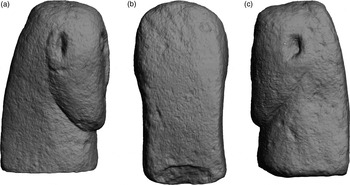
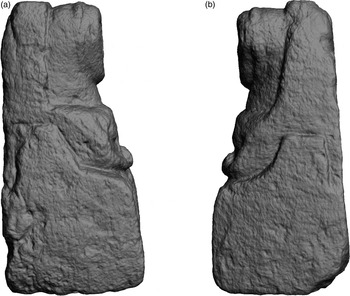
Newport Museum has recently produced a 3D animation of both Caerwent images, enabling full visual access to the sculptures in high definition and at every angle ( figs 2–3).Footnote 23 The tilting of each image reveals extra similarities between them, particularly in the treatment of the head and neck. For example, the three-quarter view of the stone head ( fig. 2a), with its very thick neck, clearly shows that the face is itself framed by a kind of hood, thrown back so that it is just visible as a line at the very back of the cranium, slightly before the downward angle to the back of the skull. Also the jawline to the side of the face travels upward behind the ears and at the back is a mass that seems to represent a hooded neck ( fig. 2b). The other features of the head displayed in dramatic relief by the 3D animation are the deep and massive orifices of the ears ( fig. 2c). Observation of the seated ‘goddess’ is also considerably enhanced by the Newport animation project ( fig. 3). Two features spring out as the angle of the image is tilted. One is the ‘triple framing’ of the head, by a ridge marking the edge of the hood, the hood itself and the chair-back/back-board. The second is the nature of the chair, for it is clearly designed to contain the body quite rigidly: the chair-arms serve to enclose and follow the line of the figure's own arms and the chair sweeps down to frame and imprison the legs.
Stills from a 3D animation of the Caerwent head, by Toby Jones. (Photos: © courtesy of Newport Museum and Art Gallery)

Stills from a 3D animation of the female statuette from Caerwent, by Toby Jones. (Photos: © courtesy of Newport Museum and Art Gallery)

It is possible, and perhaps even likely, that the two images were designed as a pair, and that the head represents the revealed self while the hooded, seated figure reflects containment, partial concealment and self-reflection. Conversely, the apparent nakedness of the female figure and the hairlessness of both might evoke vulnerability, the shrugging off of wrapping and thus exposure both to the gaze and to risky knowledge. This vulnerability and risk might be dual: for the images themselves (or what they represent) and for the spectator. Karin Sanders has partially explored this theme in recent discussions of bog-bodies: their emergence from the ‘skin’ of the bog, their placement within marshes often unclothed, and their vulnerability in terms both of the modern gaze and the penetration of secret body-orifices by forensic scientists.Footnote 24
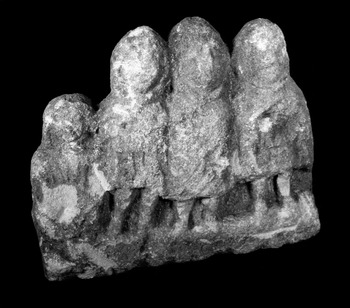
Might it be appropriate to apply these seemingly paradoxical principles of concealment and revelation to other cognate Romano-British imagery? It is possible that similar tensions may be identified, for instance, in iconography not so very far away from Caerwent, at Corinium (Glos.), ‘county-town’ of the Dobunni (we know that the two polities, of the Silures and Dobunni were in close contact, for example in the presence of Dobunnic coinage in the Late Iron Age in Silurian territory).Footnote 25 In terms of imagery, one particular piece at Corinium stands out: a carving of three standing, hooded figures beside a seated, unhooded person ( fig. 4).Footnote 26 Differentiation between the three and the one is clear: as well as their triadic state, the three figures are hooded and standing, with no apparent emblems or attributes; the single figure is seated, bare-headed and carries what is usually interpreted as a patera, but which the author considers possibly to be a drum or tambourine. It has been suggested by the author elsewhere,Footnote 27 that such a percussive instrument could have been intended to perform a role for the inducement of a transcendent state, akin to the shamanic drums of modern northern (and other) traditions.Footnote 28 If the ‘drum’ is a transformative object, might it be that the standing figures, shrouded in hoods, represent one phase of being, while the seated revealed figure depicts another? Could we apply this contrapuntal principle to the hooded ‘goddess’ and the stone head from Caerwent? The theme of possible paired images is revisited below.
Limestone relief of three standing hooded figures accompanying a seated ?woman holding what may be a drum, from Cirencester. Height 0.215 m. (Photo: © Corinium Museum)

FRAGMENTATION, DISAGGREGATION AND DIMENSIONALITY
What else might the two Caerwent images have to say to us, in terms of representation and ‘corporeality’?Footnote 29 In considering the seated female image first, something very striking is the static nature of the figure. Not only is she seated in a chair that wraps around her, but study of the back of the carving also reveals something reminiscent of a spinal board that projects upwards from the back of the chair to support the back of her hooded head. Furthermore, her limbs, especially her legs, appear atrophied and malformed, as if she were suffering from polio or another paralytic disorder. Is this merely a veering away from realism or, indeed, incompetent life-copying? Might it reflect concepts of immobility, or is it simply that the limbs and torso are present merely to provide a background against which the all-important head stands out as if spot-lit? In his study of the Neolithic Hamangia figurines of south-east Romania and north-east Bulgaria, Bailey comments that ‘cropping of the body and focusing the viewer's attention on particular body-parts isolate those parts and invite a scopophilic consumption’.Footnote 30 ‘Cropping’ an image, then, creates relative values: the large head is seen against the backdrop of diminutive other body-parts and thus springs into especially sharp and uncluttered focus.
A further possibility is that the figure actually represents a disabled person, in which case the statuette is likely to have been a depiction of a living individual rather than that of a deity or an abstract concept. Indeed close scrutiny of the figure's legs would seem to endorse such an idea: one leg is distinctly shorter than the other and the feet are turned inwards, as if to reflect deformity and reinforce perceptions of (enforced?) immobility. In a different, though broadly coeval context, it is notable that a statistically significant number of Iron Age and Roman-period bog-bodies from North-West Europe appear to have been singled-out for sacrifice and/or formal, non-normative interment in marshes because of a marked physical impairment that affected mobility.Footnote 31 Set against the notion that the Caerwent statuette reflects disability is the whole package of issues that needs to be grasped concerning dimensionality and the significance of size. BaileyFootnote 32 rightly argues that humans perceive the world in relation to their own size and so decisions about how large or small an artefact is should relate either to convenience of use (a house or an axe, say) or to some other reference point such as conscious difference or the need to be able to pick up and handle an object. Thus the small ceramic figurines of the Neolithic Balkans were designed to be held, to be enclosed in the hand, stroked, kissed, fondled and carried about. Furthermore, their miniature size involved both compression of the human form and its abstraction or separation from the real and complex corporeality of humankind. In a broadly analogous manner, what the makers of the Caerwent statuette may have been doing was to fashion an image that emphasised difference from the ‘default setting’ of humanitas, and played with different dimensionalities within the figure itself in order to express such divergence.
The sculptor of the Caerwent statuette manipulated the human form by shrinking some body-parts and exaggerating others. The overlarge head and disproportionately small limbs set up tensions for the viewer, because they contravene the norm and evoke conflicting, contradictory dimensional messages. In a sense, the image has been taken apart, disaggregated, and then put back together again in an ill-assorted manner; it is as if the body-parts had once belonged to different complete beings. Take that a stage further and the other image — the disembodied head from its Late Roman context — swims into focus. Is this stone head another example of disaggregation or fragmentation? Does the lone head evoke notions of incompleteness, of disintegration? Do spectators have to work with the image in order to ask questions concerning its role as a part-body? Are they expected to imagine the rest of the body, to enquire as to its location or to ponder on its unfinished state? As humans, we have a tendency to compensate for incompleteness and to fill in the spaces. A disembodied head is unsettling, setting up instabilities and uncertainties, just as the female figure raises quandaries concerning divergent dimensionalities, and thus expresses tensive conflict.
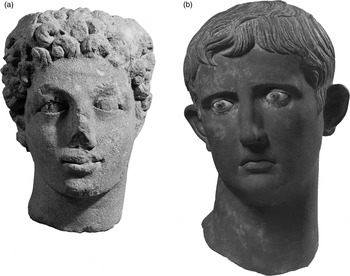
Other issues arise from the ‘management’ of body-parts, in this instance the separation of the head from its body — even though the Caerwent head was designed to be a bodiless head rather than part of a statue. In working towards a greater understanding, two other heads should be considered: one belonging to the great limestone statue of Mercury from the Romano-British temple complex at Uley (Glos.) and the other a bronze head of Augustus from ancient Meroë, in the Sudan. Both heads were intentionally removed from their statue-bodies: the Uley Mercury-head ( fig. 5a) was carefully and (?)reverentially deposited, while the emperor's head ( fig. 5b) began its biography as an expression of imperial authority and ended as an object of contempt. Ben Croxford's detailed critique of the Uley statueFootnote 33 leads to consideration of deliberate and partial fragmentation. The great limestone cult statue that once dominated the sanctuary was deconstructed probably at the same time that the temple-building itself was demolished in the early fifth century a.d. But whilst some parts of the statue were re-used as packing in the post-holes of a timber structure erected on the temple-site, the head was not so placed. Instead it ‘was deposited, apparently with care, in a small pit, on what is thought by that time to have been a Christian site, possibly some time in the sixth century’.Footnote 34 Is it justifiable, then, to suggest broad affinities between the deposition of the heads at Late Roman Caerwent and early post-Roman Uley? Both appear to have been reverentially treated, whatever the religious affiliations of their depositors.
(a) Limestone head from a monumental statue of Mercury, from the temple-complex at Uley, Glos. Height 0.35 m; (b) Copper-alloy head of the young Augustus, inlaid with alabaster, glass and coral, from Meroë, near Kabushia Sudan. Height 0.477 m. (Photos: © Trustees of the British Museum)

The head of Augustus from Meroë reflects the antithesis of the reverence attributed to the head of Mercury from Uley. This bronze head, with its arresting glass-inlaid eyes, comes from an over-lifesize statue of the young emperor, set up at Syenê (Aswan) on the border between Egypt and Sudan, in what Classical writers called Ethiopia, in the later first century b.c. In 25 b.c. the famous one-eyed Meroitic queen, whose title was ‘Candakê’,Footnote 35 commanded a vigorous campaign against Roman forces.Footnote 36 Before her defeat, she raided and plundered the city of Syenê, hacked off the head from the statue of the Roman emperor and bore it home in triumph to Meroë. In a supreme act of contempt, she had it interred beneath the steps of her temple dedicated to Victory, so that visitors to the holy place would invariably tread on it on their way in. Study of the head (all that remains of the statue) has revealed grains of sand bitten deep into the metal.Footnote 37 Given the well-documented reverence accorded the human head in ancient Gaul and Britain,Footnote 38 the Caerwent head is unlikely to have been fashioned as an object of shame, but it is not impossible that its later deposition at the bottom of an early Roman Christian's garden was not the result of a new interpretation of the head in Christian terms, but a contrapuntal message of pagan denial.
TWO OF A KIND: PAIRED IMAGES?
Bearing in mind application of the ‘icon imperative’ principles outlined earlier in this paper, the author considers it highly likely that the two sculptures from Caerwent were produced by the same person, and may even have been meant originally to represent the same being, whether deity, priest, worshipper or another, ‘secular’, individual. The stone head comes firmly from a fourth-century context, while the ‘goddess’ is from the bottom of a deep pit containing material of second- to third-century date. However, it is perfectly legitimate to suggest that the stone head was already old when deposited on its plinth, and that it may well have had a biography going back at least a century or more. Indeed, the antiquity of the image might have added considerably to its value as a religious artefact. Richard BrewerFootnote 39 has even put forward the idea that the stone head may itself represent a female being (although it has always been assumed to be male and has very short cropped hair, if any) in which case it would be even more likely that the same individual was represented by the two sculptures. The ‘goddess’ image is not only similar to the disembodied head in terms of material and facial features, but its own head is emphasised, further connecting the two sculptures.
Stone images of Roman date (and before) are rare in Wales; Brewer's Reference Brewer1986 inventory lists two ‘Romano-Celtic deities’, of whom one is the Caerwent ‘goddess’ (the other a small pebble incised with the stick-like figure of a warriorFootnote 40 that is probably, though not certainly, of genuine antiquity). In considering the reason for such paucity of iconography here, we may simply be dealing with an absence of stone-working traditions. However, it is equally possible that image-making was deemed something only to be engaged upon in special circumstances, perhaps because it was ‘risky’. The idea of danger now needs to be explored.
DANGER SIGNALS: ICONOGRAPHIES OF STRESS?
The sermon delivered at a service of evensong on 10 January 2010 at All Saint's Penarth, the author's local church, was about baptism, the theme chosen because, in the Church Calendar, early January is the time that Christ's own adult baptism by John the Baptist, in the River Jordan, is celebrated. The theme of baptism does not, itself, seem particularly to be associated with risk, but the preacher, Helen Rees, spoke of a lecture recently given by an eminent theological scholar on this subject to a group of teenagers. Most of them did not react, but one intelligent young man introduced the notion of danger to the post-lecture discussion, arguing that the descent of the Holy Spirit to earth during Christ's baptism meant that a spirit-force, fraught with peril, was at large in the earthly world. The idea that the mixing of the spiritual and material world carried risk was a recurrent one in the ancient world. We have only to read Book 6 of Virgil's Aeneid, where the poet describes the dangers of which the Sibyl warns Aeneas, as a living man, going down into the world of the dead to search for his father Anchises.Footnote 41
So how is this relevant to a study of Silurian iconography in the Late Roman period? It is suggested that the two Caerwent images might indeed present a multi-layered galaxy of risk, particularly within a supposedly (or officially) Christian milieu. The term Silurian is used advisedly because it should not be forgotten that the epigraphic evidence, even in later Roman Britain, shows that the population of south-east Wales retained (or re-invented) their local identity. As previously mentioned, the inhabitants of Venta Silurum set up in the early third century a.d. a statue to honour Tiberius Claudius Paulinus — who was to become the Roman governor of Britannia Inferior — as a patron of the city. Significantly, the inscription on the statue-base refers specifically to the tribal council that ruled the ‘Republic of the Silures’.Footnote 42 Furthermore, at least one of the dedications to Mars Ocelus Vellaunus dates to the mid-second century and, as we have seen,Footnote 43 the meaning of these Silurian epithets (‘The Avenger’ or ‘The Victor’) suggests perceptions of local dominance and assertive identity. In discussing the deposition of ‘Celtic art’ objects in the Roman period, Jody JoyFootnote 44 builds on work by Mary Davis and Adam GwiltFootnote 45 and Fraser HunterFootnote 46 in their argument that the emergence of new art-styles in metalwork in previously ornament-poor areas might reflect a reaction (not necessarily a negative one) to the encroachment of romanitas. Stempel's translation of the Ocelus Vellaunus inscription from Caerwent chimes with the ‘prominence of martial artefacts’, and I would suggest that decorated metalwork, inscriptions and stone iconography all contribute to statements of independence and resistance.
The continuance of Silurian identity into the Late Roman period is of particular note given the vigorous resistance that had been offered by at least one faction of this polity to absorption into the Roman Empire in the later first century a.d. Although the passing of 150 years is a long time, memories, too, are long, and doubtless Silurian children were entertained by repeated stories of local independence and the heroic battles fought by their ancestors. Of course by the early third century a.d., tensions between Rome and the Silures would have been largely an irrelevance because of the melding of cultural traditions and populations, yet the preservation of the Iron Age tribal name on the Paulinus stone is telling in expressing the persisting or reinforced importance of local identities.Footnote 47
Culturally, the period of Roman dominance over Britain and, perhaps particularly in the far west and north, was one of constant transition, change and renegotiation. David Mattingly has argued that ‘the material culture of Britain under Roman rule provides a vivid example of the unmaking of pre-existing cultures in the face of imperial military and cultural power and the construction of new and highly varied identities as a result’.Footnote 48 If we are to believe the sentiments expressed on the Paulinus stone, the civitas of the Silures had renegotiated and remade its identity in a manner suggesting that the old political name still had resonance or had been resurrected as a new local focus for its citizens.Footnote 49
Change, of whatever kind, involves risk-taking, for the unknown is threaded through with physical, emotional or spiritual perils. We can imagine that, between the old Silures of Tacitean literature and the Silures that present themselves to us in c. a.d. 220 on the Paulinus stone, many configurations of Silurian-ness had worked their way through into the fabric of Caerwent and its neighbouring settlements. Was the ordo who commissioned the statue of the polity's patron taking any kind of risk in alluding to themselves and their citizens as Silures? Is it possible that the sculptures that form the focus of this paper were coeval with the dedication and part of the same re-identification with the old cultural tradition? If so, it may be possible to read ‘risk’ into the sculptures themselves, in so far as their divergence from mimesis might bestow tensions and ambiguities upon them, those who made them, and those who gazed at them. Could an added-in risk factor have been the emergence of Christianity as a challenge to paganism? Asymmetry and distortion convey restlessness and instability on visual culture. The surrealists of the early twentieth century knew this very well, as did the earlier Spanish painter Goya, who used visionary, sometimes nightmare, imagery to work through the turmoil of the political situation in Spain and the angered bewilderment caused by the development of his own profound deafness.Footnote 50
ORACULAR IMAGES?
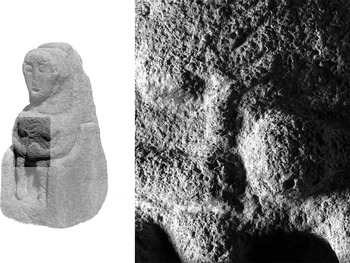
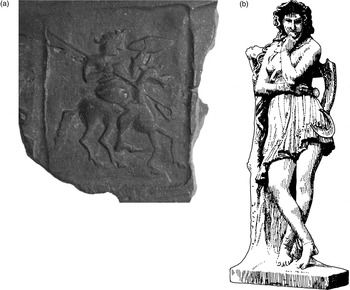
Sitting on a shelf in my office at Cardiff University is a replica of the Caerwent ‘goddess’ made many years ago by the conservation staff at the National Museum Wales. It is part of the furniture, as it were, and I have always taken for granted that I know what is depicted on the image. She holds a sphere in her left hand and some kind of tree or palm-branch is carved between her breasts. Although it is difficult to be certain, in some lights it appears as though her thumbs are prominent on otherwise rudimentarily-carved hands. But there is something else. I recently had cause to have her photograph taken (with me) by the digital photographer in the Department of Archaeology. Under the strong lights, something I had never seen before suddenly jumped out at me: in her right hand, she grasps a curved object, not unlike a small hockey-stick ( fig. 6). If I am right in my reading of the symbol, this adds considerably to the interpretative value of the figure, for the object appears to represent a lituus, a Roman augur's staff. John Creighton has identified these strange objects on Late Iron Age British coinage minted by the South-East British dynastic rulers Verica and Cunobelin.Footnote 51 Similar implements have been identified in Late Iron Age and Romano-British ceramic iconography, notably on a fragment of local late pre-Roman greyware from Kelvedon (Essex) that depicts a Trinovantian mounted warrior, with a lituus and shield ( fig. 7a),Footnote 52 and on Romano-British Nene Valley castor-ware vessels from Kettering and Stibbington (Northants.).Footnote 53 It is significant, too, that a lituus formed part of the iconographic decoration of a ceremonial headdress from the Romano-British sanctuary at Hockwold-cum-Wilton (Norfolk).Footnote 54
Close-up of the Caerwent female statuette showing the central section with thumbs and lituus. (Photo: © Cardiff University)

(a) Image of a mounted lituus-bearer, on a Late Iron Age greyware sherd from Kelvedon, Essex. Length c. 0.07 m. (Photo: © The Castle Museum, Colchester); (b) Nineteenth-century stone statue of the Batavian prophetess Veleda, carved by Etienne-Hippolyte Maindron; in the Luxembourg Gardens, Paris. Approx. lifesize. (Image: © Paul Jenkins)

In the Roman State religious system, the augures were the priests who divined the will of the gods by divinatory procedures that included scientific observation of the heavens and interpreting the behaviour of birds in flight.Footnote 55 An augur would mark out a space (templum) within which such observations would take place, divide it into quadrants and calculate divine will according to which quadrant was favoured by these birds.Footnote 56 The division of space in this manner appears to resonate with the presence of pairs of bronze spoons, the inside of one of which was roughly scored into quadrants, found in Late Iron Age/earlier Romano-British contexts, and interpreted as divination instruments.Footnote 57 The precise purpose of the augur's lituus is uncertain, but it was probably used in the marking out of templa. The tentative connection between the augur's lituus, the Caerwent figure and quadranted spoons may be taken a stage further, in respect of the possible pouces-levées (raised thumbs) identified on the image. During a contribution in 2010 to a BBC 2 film series entitled ‘Ancient Britain’, the author had occasion to engage in an experiment with a replica pair of these spoonsFootnote 58 and handling these objects has kindled an idea. Like many La Tène-decorated objects,Footnote 59 the spoons have distinct zones of plain-ness and ornament and the decoration on the spoons is confined to the flat excrescences where they would have been held. Handling them myself made me realise that the thumbs would naturally rest on the decorated zone (on the original spoons this zone exhibits signs of wear from persistent use), and it is possible that, if these implements were used in divinatory practices, touching these special, motif-rich surfaces with the thumb might have sent spirit-power into the diviner. Conversely, if we run with Joy's comment concerning the use of art as protection,Footnote 60 the decoration on the spoon-handles may have acted as an antidote to the charge of power contained within the active part of the spoons. If the Caerwent figure truly had raised thumbs, such a feature might encourage her interpretation as a ritualist. Images of special people with pouces-levées were depicted in Late Iron Age iconography: they include the schematic, headless granite statue from Lanneunoc in southern BrittanyFootnote 61 and Breton gold coinage depicting a female charioteer.Footnote 62 Likewise, Hilda Davidson draws attention to the significance of raised thumbs in her studies of seers in Norse mythic literature.Footnote 63
If the interpretation of the Caerwent statuette's possession of a lituus has validity, it follows that — despite the sculpture's locus within indigenous British traditions (as suggested by the stone selected for the image and the style of the carving) — this very Roman instrument of augury had a meaning and resonance within late Romano-British religious tradition. It may well be that the presence of this distinctly Roman (actually Etruscan in origin) instrument of divinatory ritual on Romano-British iconography represents the deliberate appropriation of Italian religious equipment to serve a ritual purpose that owed more to a British than to a Roman cult. But whatever the precise meaning and function of the lituus within a Romano-British context, its presence on the Caerwent figure adds weight to her interpretation as some kind of oracular (even shamanic) individual. The similarity in physiognomy between the Caerwent female sculpture and the stone head from the same site (open mouth and asymmetrical treatment of the eyes) may allow a similar interpretation for this latter image. Is it possible that the arbitration skills of such pagan prophets were invoked at a time of particular stress or risk, such as that, perhaps, posed by Christianity in Late Roman Britain? And could the fana with which both the Caerwent images were supposedly connected have acted as the templa of Roman augures?
It is legitimate to suggest feasible connections between the possible identification of the Caerwent female image as a seeress and sequestration. We have noted that her somatic treatment (her hoodedness and the ‘wrapping’ of her chair) may suggest partial concealment and the contradiction between the hidden and the revealed suggested by the open mouth, the wide-open eyes and deep ear-orifices. So there is tension between public and private, between overt and covert, the visible and the invisible. The static pose of the body lends weight to the notion of limitation and control that contributes to the sequestered state. Tacitus provides us with just such a prophetess in the form of Veleda ( fig. 7b), a Batavian virgin whom the writer describes in the context of the rebellion of Civilis in a.d. 69. Veleda is presented in Tacitus' narrative as a paradoxical figure: endowed with awesome prophetic powers but, at the same time, kept immured in a tower, firmly away from the public gaze and unable to make direct communication with anyone but one of her male relatives.Footnote 64
Tacitus' description of Veleda includes the telling comment that her utterances were conveyed to her audience via an intermediary: one of her kinsmen. Does this suggest that she ‘spoke in tongues’ so that her words had to be interpreted and translated? For Oracles to be effective they have to speak, and a striking feature of both the Caerwent images is their wide-open mouths.Footnote 65 Carol ThomasFootnote 66 argues strongly for an association between Bronze Age Aegean art and poetry, stressing how heavily people relied upon verbal communication. She poses the question whether there is genuine analogy between art and speech, building on Janice Crowley's workFootnote 67 to suggest that Aegean images expressed ideals, essences or ideas rather than individuals. Thomas considers that ‘oral tradition was an attempt to impose order and discipline’.Footnote 68 According to Classical writers on ancient Gaul and Britain, the curation and expression of oral tradition was the remit of bards or druids and closely associated with religious and oracular power.Footnote 69 In both Bronze Age Aegean and late Western European Iron Age contexts, words and stories provided the fabric of a community's identity, its sense of its ancestral past and its cosmological backdrop. Its purveyors would have been perceived as powerful and authoritative persons. Seen in this light, the two images from Caerwent might assume a particular significance, one that chimed across pre-Roman past and Romano-British present.
CONCLUSION
Revisiting such well documented objects as the sculptures of the disembodied head and the seated woman from Caerwent, could be seen as taking a risk since they seem to be so well understood, and what new can be said about them? However, it could be considered that previous studies (including the author's own) have not grasped the nettle of corporeality with sufficient firmness. Images are objects but they are also bodies: ‘an object infused with the essence of the body’.Footnote 70 When you or I gaze at an image, we are, at the same time, looking at the familiar (ourselves) and something very different, and that difference arises not least because of the way the image-bodies have been manipulated to cause particular effects. If images are smaller than ourselves, we feel empowered in terms of dimensionalities, but unsettled by divergence from the ‘normal’ body. The seated female from Caerwent is considerably smaller than lifesize. Conversely, if an image is lifesize, like the disembodied stone head, that in itself sets up tensions, because it is more likely that the viewer will see the image as a reflection of self and, of course, it is not.
Issues concerning materiality and the specifics of iconographical representation are highly pertinent to such an enquiry. The Caerwent stone figures considered here display a grammatical distinctiveness that speaks of a highly personal interpretation of cult and ritual. If they are correctly read as oracle stones,Footnote 71 they have the capacity to speak — or sing — to their viewers in a manner that stimulates interrogative dialogue. The two carvings present elements of permeability and interaction that may be highly appropriate to their role as mouthpieces or voices for connectivity between the material and spirit worlds. Oracles and prophets are in the risk business, for interference between the realms of people and the gods carries with it the danger of instability and disruption of order. It is argued that such risk may be inherent in the style and manner of their representation. It may be possible to suggest that the risk involved in accessing ritual landscapes may be projected onto wider screens of stress, perhaps associated with new religious movements or some other phenomenon that served to cause unease in local communities. Perhaps it is time to search for more singing stones in other parts of Roman Britain.