INTRODUCTION
Reduced self-awareness is frequently identified as a significant problem following traumatic brain injury (TBI) (e.g., Prigatano, 2005; Sherer et al., 1998a). This impairment involves underestimating the severity and functional significance of injury-related changes and has been associated with worse clinical outcomes (Ezrachi et al., 1991; Sherer et al., 1998a). Numerous studies have investigated the clinical correlates and impact of awareness deficits in rehabilitation populations. However, the lack of a “gold standard” (Malec & Moessner, 2000; Sherer et al., 2003) for defining the limits of awareness and limited investigation of individuals not involved in rehabilitation or those with uncomplicated recoveries impacts our current understanding of the magnitude of this problem.
Although reduced self-awareness has been studied in numerous neurological and psychiatric conditions (Amador et al., 1994; Anderson & Tranel, 1989; McGlynn & Schacter, 1989; Prigatano & Schacter, 1991), it remains a complex concept that is difficult to quantify. Consequently, the literature is marked by inconsistent definitions and measurement approaches. Diverse methodologies have been used to try to capture the reduced awareness that is observed clinically, including self-report questionnaires, structured interviews, observation of behavioral change, spontaneous verbal reports of difficulties, performance prediction, and ability to detect and correct errors (e.g., Fischer et al., 2004; Fleming et al., 1996; Hart et al., 1998; Sbordone et al., 1998; Sohlberg et al., 1998). The most commonly used method is to compare the rating of injury-related difficulties completed by a person with TBI (PT) with ratings completed by a collateral source, such as a clinician or family member (Fleming et al., 1996). This method is based on the assumption that the collateral reporter has a more accurate perception of the person's current abilities, and a discrepancy in the direction of the patient reporting fewer problems is interpreted as reduced self-awareness. Although this method is widely used, there is no universally accepted standard for defining the extent of discordance that is required to categorize an individual as “unaware” of injury-related deficits. This finding has likely contributed to the inconsistent findings regarding both the magnitude of awareness difficulties among individuals with TBI and the relationship between awareness deficits and clinical variables such as neuropsychological functioning and injury severity (Allen & Ruff, 1990; Boake et al., 1995; Bogod et al., 2003; Prigatano & Altman, 1990; Prigatano et al., 1998; Sherer et al., 1998b).
This variability can be illustrated with the Patient Competency Rating Scale (PCRS) (Prigatano, 1986). This scale is a frequently used measure, but the definition of reduced awareness has varied across studies. For instance, Fischer et al. (2004) identified unaware participants based on a cutoff derived from discrepancies seen in an orthopedic control group, whereas Noe et al. (2005) used a discrepancy of 28 points to make this classification. Alternatively, Prigatano & Altman (1990) counted the number of questions in which the patient reported more, equal, or less competencies than their significant other (SO). In this approach, the most frequent response pattern was used to categorize the patients into one of three groups (e.g., overestimated, underestimated, or reported equal amounts of behavioral competencies). The mean difference score on individual items has also been considered (Wallace & Bogner, 2000).
Other measures, including the Awareness Questionnaire (Sherer et al., 1998c), the Dysexecutive Questionnaire (Wilson et al., 1996), the Katz Adjustment Scale (Katz & Lyerly, 1963), and methods such as dividing difference scores into thirds (Lanham et al., 2000) have also been used. Furthermore, some studies used the difference score as a continuous variable, and thus did not define the limits of reduced self-awareness more specifically than the PT reported fewer problems than the SO (e.g., Bogod et al., 2003; Sherer et al., 1998a, 2003). Thus, a critical question that remains unanswered with this approach to measuring awareness is when does the interrater discrepancy become clinically significant?
Another factor contributing to variable prevalence estimates of reduced self-awareness is sample selection. Most studies have used individuals involved in some aspect of rehabilitation (e.g., Fleming et al., 1998; Hart et al., 2004; Hoofien et al., 2004; Olver et al., 1996; Prigatano & Altman, 1990). In this type of sample, estimates of reduced self-awareness have ranged from approximately 30% to more than 90% of the sample (Prigatano & Altman, 1990; Sherer et al., 1998a). This high rate and wide range of estimates may be due to numerous sample selection factors, including the severity of injury, time since injury, or inclusion of those with complicated recoveries and problems of adjustment. To our knowledge, this phenomenon has not been studied in a nonselect sample of individuals with a TBI. Thus, there are no estimates of the magnitude of awareness deficits among the larger TBI population, including those who did not receive rehabilitation services or those who had uncomplicated recoveries. This information is important to understanding the full scope of this problem. Furthermore, although some authors have addressed the full spectrum of concordance, including those persons who report fewer problems than their SO and those who report more problems than their SO (e.g., Hoofien et al., 2004; Prigatano & Altman, 1990), the latter group has received much less attention in the literature. Finally, our knowledge of the temporal course of awareness has been largely derived from cross-sectional studies. Very little research to date has investigated the longitudinal course of awareness, which is needed to further our understanding of this impairment.
This study addresses some of these limitations in the literature. The primary aim is to investigate the magnitude of awareness deficits in a nonselect sample of individuals who were hospitalized for TBI. Specific research questions are as follows: (1) Do PTs and their SOs endorse different levels of TBI-related difficulties at 1 month and 1 year postinjury? (2) How does the criterion used to define reduced self-awareness impact estimates of the magnitude of this deficit? (3) How consistent is reduced self-awareness across domains of functioning and at different times since injury? For the purposes of this study, differential awareness refers to individuals who are either reporting more or less symptoms than their SOs. Under that heading, reduced self-awareness denotes individuals who report fewer problems than their SOs, whereas hyperawareness denotes those who report more problems than their SO.
METHODS
Participants
Participants were adolescents and adults with complicated mild to severe TBI who were consecutively admitted to a Level I trauma center between 1991 and 1995. They participated in a randomized, placebo-controlled, and double-blinded investigation of the efficacy of valproate in preventing posttraumatic seizures. Eligibility criteria have been published elsewhere; the trial found that valproate does not prevent late posttraumatic seizures and does not have any effect, positive or negative, on neuropsychological or psychosocial functioning (Dikmen et al., 2000; Temkin et al., 1999).
The present study included all PT–SO pairs (n = 120) in which both individuals completed the Sickness Impact Profile (SIP) at 1 and 12 months postinjury. The SOs were family members or friends who knew the PT well before and after the injury. This is a subsample of the 379 individuals who met all eligibility requirements and were enrolled in the clinical trial. Of these, 114 individuals were not eligible for the current study because they died (n = 36), had waived consent expire before a legal next of kin was found (n = 21), or were enrolled during a time period that follow-ups were not conducted beyond 6 months due to budgetary constraints (n = 57). Of the remaining 265 individuals, 105 did not have complete data at 1 month because they were too neurologically impaired to complete the SIP (n = 45), did not speak English well enough to complete the SIP (n = 6), did not complete the SIP for some other reason (n = 26), or did not have a SO who completed the SIP (n = 28). As expected, these 105 individuals were more severely injured than the included sample (Z = −4.6; p < .05), but the two groups did not differ on age, education, sex, or race (p > .05). An additional 40 PT–SO pairs had data at 1 month and were eligible at 1 year, but did not have complete SIPs at that time. There was a higher proportion of male PTs in this group than the included group (χ2 = 6.2; p < .05), but the two groups did not differ in terms of education, injury severity (as measured by Time to Follow Commands [TFC]), race, age, or 1-month awareness scores. The University of Washington Institutional Review Board approved this study.
Measures
Basic demographic information was collected at 1 month postinjury. Brain injury severity was evaluated with the Glasgow Coma Scale (GCS) (Teasdale & Jennett, 1974) in the emergency department and with TFC, operationally defined as time from injury to follow simple commands consistently (i.e., GCS motor scale score of 6).
Awareness measure
The Sickness Impact Profile (Bergner et al., 1976) consists of 136 items assessing health-related difficulties in 12 functional domains. This study used the Psychosocial Factor score (composed of Alertness Behavior, Emotional Behavior, Social Interaction, and Communication subscales), the Physical Factor score (composed of Body Care and Movement, Ambulation, and Mobility subscales), and the Total score (all 12 subscales; including the Home Management, Work, Eating, Recreation and Pastimes, and Sleep and Rest subscales that do not contribute to the factor scores). Items are endorsed as present or absent due to health or injury, and the summary scores for each subscale are a weighted percentage of maximal dysfunction, ranging from 0% to 100%. Thus, higher scores indicate more limitation. This measure was completed by both PTs (SIP–PT) and their SO (SIP–SO) as it applied to the PT.
The validity of proxy ratings on the SIP is supported by findings that such ratings were sensitive to differences in patient's functional health and were highly (Physical Factor) to moderately (Psychosocial Factor) correlated with the self-ratings of stroke patients (Sneeuw et al., 1997). In TBI, the report of both the PT and the SO on the SIP has been found to be highly correlated with a functional status measure (Functional Status Exam, r = .81 and .80, respectively), and the relationship between SOs report and severity indices was either similar to or stronger than the relationship between severity indices and the patients self-report at 6 months postinjury (Dikmen et al., 2001).
Data Analysis
Wilcoxon signed rank tests and Spearman correlations were calculated to examine the level and similarity of difficulties endorsed by the PTs and their SOs. Next, difference scores were calculated by subtracting the SO's score from that of the PT. Thus, negative scores indicate that the PT reports fewer problems than the SO (reduced self-awareness), whereas positive scores indicate the opposite (hyperawareness). Then, estimates of the magnitude of reduced self-awareness and hyperawareness were calculated based on four criteria: any difference in PT–SO score, a discrepancy greater than 1 standard error of measurement (SEM) of a difference, a 5-point difference, and a 10-point difference. Wyrwich et al. (2005) proposed the SEM as a means of determining the minimum difference between scores that is needed to be considered clinically significant. The SEM for this study was calculated from SIP test–retest data (2-week interval between completions) that was collected from 37 individuals at approximately 6 months postinjury. These individuals participated in the same clinical trial as the participants included in this study, but were enrolled during a time period when the 1-year follow-up was not conducted. Thus, there is no overlap between the two groups, but they have similar characteristics. The mean difference in scores between test and retest were as follows: Total score (M = 0.4; SD = 6.19), Psychosocial Factor score (M = −0.1; SD = 8.19), and Physical Factor score (M = 0.3; SD = 4.80). The SEM of a difference in the SIP score is the standard deviation of the test–retest difference for that score. Using this standard, one would expect approximately 16% of the differences to be beyond that cutoff in each direction because of the measurement error of this measure.
RESULTS
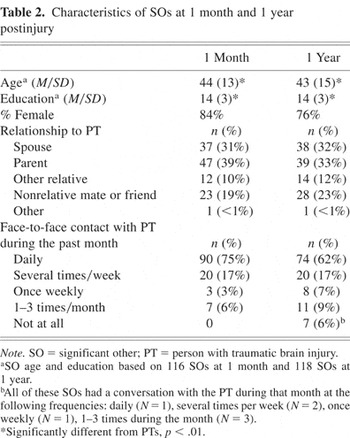
Demographic information is presented in Tables 1 and 2. As is typical for TBI, the sample consisted mostly of young males with a high school education. Most were Caucasian. SOs were older and more educated (p < .01). At both times, most SOs were relatives who saw the PT on a daily basis. At 1 year postinjury, 73% of the SOs were the same individuals who had completed the SIP at 1 month postinjury.
Injury severity and demographic data for persons with TBI

Characteristics of SOs at 1 month and 1 year postinjury

Injury severity based on depth of coma ranged from mild to severe. Most were in the milder range, because some individuals with more severe injuries were still too impaired to be tested at 1 month postinjury. However, all participants had computed tomography (CT)-confirmed brain abnormalities, so the individuals with high GCS scores have complicated mild injuries (Williams et al., 1990).
Reported Level of Dysfunction and Agreement Between PTs and their SOs
The SIP endorsement levels are presented in Tables 3 and 4. At 1 month, almost all PTs and their SOs reported some problems in each domain; at 1 year, more than 60% of that sample reported no problems (SIP score of 0) in the physical areas, whereas nearly 40% reported no problems in the psychosocial areas. As expected, PTs reported fewer problems at 1 year than 1 month postinjury on the Physical (Z = −8.0; p < .001) and Psychosocial (Z = −5.0; p < .001) Factor scores and the Total score (Z = −8.8; p < .001). A similar pattern was seen in the SOs ratings (Physical: Z = −8.3, p < .001; Psychosocial: Z = −5.2, p < .001; Total: Z = −8.6, p < .001).
Comparison of PT and SO scores on the SIP at 1 month postinjury

Comparison of PT and SO scores on the SIP at 1 year

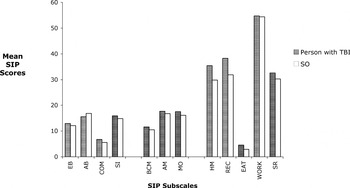
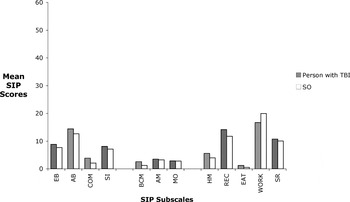
Examination of the mean scores revealed considerable consistency between the level of difficulties reported by the PTs and their SOs. Spearman correlations between their ratings revealed a moderate to high level of agreement (see Tables 3 and 4), with stronger agreement on the Physical Factor score and Total score. Furthermore, Wilcoxon signed rank tests showed no significant difference between the level of difficulties reported by the PT and their SO (p > .05) at either time point on the SIP. Figures 1 and 2 illustrate the similarity of the mean scores of the PT and their SOs on the individual subscales of the SIP. Noticeable (albeit nonsignificant) differences between the scores tended to be in the direction of the PT reporting more problems. Spearman correlations examining whether amount of face-to-face contact between the PT–SO pairs relates to their SIP discrepancy scores were not significant at either time point (p > .05).

Sickness Impact Profile (SIP) scores at 1 month postinjury. TBI = traumatic brain injury; SO = significant other; EB = Emotional Behavior; AB = Alertness Behavior; COM = Communication; SI = Social Interaction; BCM = Body Care and Movement; AM = Ambulation; MO = Mobility; HM = Home Management; REC = Recreation and Pastimes; EAT = Eating; WORK = Work; SR = Sleep and Rest.

Sickness Impact Profile (SIP) scores at 1 year postinjury. TBI = traumatic brain injury; SO = significant other; EB = Emotional Behavior; AB = Alertness Behavior; COM = Communication; SI = Social Interaction; BCM = Body Care and Movement; AM = Ambulation; MO = Mobility; HM = Home Management; REC = Recreation and Pastimes; EAT = Eating; WORK = Work; SR = Sleep and Rest.
Disagreement Between PT and SO Pairs
Despite the observed similarity in the average level of endorsed difficulties and the good agreement reflected in the correlations, there were differences in the level of endorsement within the PT and SO pairs. At 1 month, the variability of the difference scores on the Psychosocial and Physical Factors are similar, as indicated by the 25th and 75th percentile of the difference scores (see Tables 3 and 4). The median difference for both factor scores at both time points was zero, and slightly above zero (that is, the PT reporting slightly more) on the total score at both 1 month (median difference = 0.7) and 1 year (median difference = 0.2). However, at 1 year, the variability for the Physical Factor difference scores was much smaller, consistent with the lower number of physical symptoms being reported. At that time, more variability was seen on the Psychosocial Factor score, although it was reduced relative to the variability seen at 1 month postinjury.
Magnitude of Differential Self-Awareness
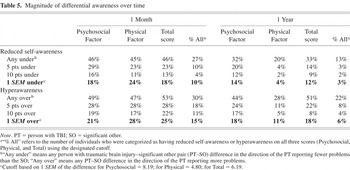
Table 5 provides estimates of the magnitude of reduced self-awareness and hyperawareness, depending on which of four different cutoff points is used. One cutoff is any difference between the limitations reported by the PT and the SO. Two other values, a 5-point and 10-point difference, were arbitrarily selected as additional cutoffs. The other cutoff is the SEM of a difference in scores obtained from the difference between test and retest scores when PTs completed the SIP 2 weeks apart at approximately 6 months postinjury.
Magnitude of differential awareness over time

As expected, the frequency of both reduced self-awareness and hyperawareness gets smaller as the stringency of the definition increases. For instance, 95% of the sample would be considered to either have reduced self-awareness or hyperawareness on the Psychosocial Factor score at 1 month postinjury if any difference between PT- and SO-reported limitations is used as the cutoff. This finding decreases to 39% when 1 SEM is the cutoff. Although not statistically significant, an interesting finding was that, with few exceptions, the percentage of PTs reporting more problems than their SOs (hyperawareness) was higher than the percentage who reported fewer problems (reduced self-awareness).
At 1 month postinjury, a slightly higher percentage of individuals demonstrate reduced self-awareness in the Psychosocial domain relative to the Physical domain, when the same cutoff (e.g., a 5-point discrepancy) is applied to both domains. However, a different pattern is seen when the SEM of the difference is applied as the cutoff. This value, a measure of the variability in self-report of physical and psychosocial symptoms over a relatively short period of time, was greater for the Psychosocial Factor score (SEM = 8.19) than the Physical Factor score (SEM = 4.80) or the Total score (SEM = 6.19). These numbers suggest that, when determining who has reduced self-awareness, a greater discrepancy between PT and SO should be needed to be considered clinically meaningful for the Psychosocial Factor score relative to the Physical Factor score. Using the SEM, 24% of the sample demonstrated reduced self-awareness of physical symptoms and 18% demonstrated reduced self-awareness of psychosocial symptoms at 1 month postinjury, while 28% and 21% are demonstrating hyperawareness on Physical and Psychosocial Factors, respectively.
At 1 year postinjury, the magnitude of both reduced self-awareness and hyperawareness declined, regardless of the definition used. This finding was especially evident in the Physical domain, as less than 5% of the sample was classified as having reduced self-awareness if any criteria other than “any difference” was used. Overall, very few physical problems were reported by 1 year postinjury. In contrast, level of endorsement of difficulties on the Psychosocial Factor stayed more consistent over time, as did the percentage of individuals classified as having reduced self-awareness (see Table 5).
Consistency of Reduced Self-Awareness Across Time and Domain of Functioning
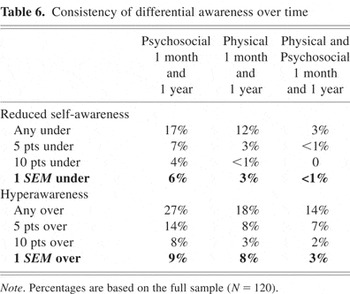
Information about the consistency of differential awareness over time and across functional domains is presented in Tables 5 and 6. The “% All” category in Table 5 refers to the numbers of individuals who were consistently classified as having reduced self-awareness or hyperawareness on the factor scores and the total score when each criterion was used. At 1 month, using SEM as the criterion for reduced self-awareness, only 10% of the sample were consistently underreporting symptoms relative to their SOs in all three of these categories. This rate is lower than the 18–24% of the sample that was listed as demonstrating reduced self-awareness in each Factor score independently at that time point, suggesting considerable variability of awareness across domains.
Consistency of differential awareness over time

Table 6 illustrates a similar pattern within the functional domains over time. In the Psychosocial domain, only 6% of the PTs reported fewer problems than their SOs at both 1 month and 1 year when using SEM as the cutoff. The percentage was even smaller on the Physical Factor (3%). These percentages are much smaller than those in Table 5, which describe the percentage of individuals who were considered to have reduced self-awareness in one domain at one point of time postinjury. Thus, in this sample, three patterns in the temporal course of awareness are observed. Some individuals demonstrate reduced self-awareness at both time points, some have reduced self-awareness at 1 month but not 1 year, whereas a third group has reduced self-awareness at 1 year but not at 1 month. This same pattern is observed across all of the criteria.
DISCUSSION
The purpose of this study was to examine the magnitude and characteristics of differential awareness using PT–SO discrepancy scores. To that end, a nonselect sample of individuals who were hospitalized for complicated mild to severe TBI was used. There were several key findings. First, relatively good overall agreement was found between the PTs and their SOs about the extent of injury-related difficulties. Second, if reduced self-awareness is defined as a PT reporting fewer problems than an SO, it is important to note that there is almost the same or an even greater proportion of the sample who are hyperaware. Third, this study highlights the difficulty in defining and measuring awareness. The magnitude of the problem obviously varies depending on the criteria used to define differential awareness. However, regardless of the defining criteria, awareness was inconsistent both across domains (Physical and Psychosocial) and over time (1 month and 1 year postinjury). Clearly, the range of difference scores observed in this study suggests that, although some PTs reported fewer problems than their SOs, reduced self-awareness is not as common a problem for PTs as some of the literature and clinical lore suggests. Although this range of concordance between PTs and a knowledgeable informant has been reported in previous studies (e.g., Hoofien et al., 2004; Lanham et al., 2000; Prigatano & Altman, 1990), the majority of research to date has focused on individuals who underreport problems.
Prior studies that examined more severely injured patients reported that the majority of the postacute patients in their samples lacked some level of awareness (e.g., Port et al., 2002; Sherer et al., 1998a). Other studies have found poor and/or nonsignificant correlations between the ratings of the PTs and their SOs (e.g., Sherer et al., 2003). Our study suggests that, although some individuals may demonstrate reduced self-awareness following TBI, it should not be assumed that all individuals, or even the majority, will have this difficulty at either 1 month or 1 year postinjury. In this sample, many PTs agreed with their SOs about health-related limitations or reported more problems than their SOs. This result reinforces the assertion made by Prigatano (2005) that awareness difficulties may not be common after mild or moderate TBI.
Although the investigation of reduced self-awareness has a long and rich history, many issues surrounding the operational definition and measurement of this concept persist. One critical question is how much of a discrepancy between the report of the PT and the knowledgeable informant represents a clinically meaningful difference; or conversely, what are the limits of normal concordance. Non-neurologically based factors, such as variable interpretation of questions across individuals and response tendencies may contribute to normal measurement error (Cavallo et al., 1992; McCrae et al., 1998) and should be considered when defining lack of awareness. Furthermore, PT scores may be influenced by factors such as depression and time since injury (Lanham et al., 2000; Malec & Moessner, 2000). Finally, although SO scores are thought to reflect a more accurate appraisal of the functioning of the PT, their scores may be influenced by variables such as depression, caregiver burden, personality traits, amount of contact with the PT, or some other unmeasured life situation (Clare, 2004; Fleming et al., 1996; Machamer et al., 2002; McKinlay & Brooks, 1984). Determination of the “normal” discrepancy that is seen between raters is critical to gaining a greater understanding of awareness and the prevalence of this phenomenon, as the stringency of criteria used to determine reduced self-awareness clearly impacts estimates of this phenomenon.
The SEM, which has been proposed as a means of determining clinically significant differences in quality of life measures (Wyrwich et al., 2005), is presented as an option for determining the minimum difference that is needed between a PT and the SO to be considered meaningful. As used in this study, this cutoff ensures that the difference between PT and SO scores is at least as large as the normal intrarater variability seen on a repeated administration of the SIP over a 2-week period. Using this criterion, as opposed to any difference in PT–SO scores, reduced the estimated magnitude of both reduced self-awareness and hyperawareness in this sample. Furthermore, it takes into account the normal variability in self-report of physical versus psychosocial symptoms, which may be a more accurate approach than using a single cutoff for all domains. The measurement error, not unexpectedly, is larger in the Psychosocial than Physical domains; thus, a given discrepancy in the Physical domain may be more meaningful than in the Psychosocial domain. This contributed to a higher percentage of individuals being classified as lacking awareness of their physical difficulties than psychosocial difficulties at 1 month postinjury. This finding stands in contrast to one of the more consistent findings in the literature, that PTs tend to more accurately estimate their physical difficulties than emotional, behavioral, or cognitive difficulties (Hart et al., 2004; Prigatano et al., 1990; Sbordone et al., 1998). This pattern does not exist when the same cutoff is applied to both Psychosocial and Physical Factors (e.g., cutoff of 5 points used for both), nor is it present at 1 year postinjury. Of note, physical complaints decrease considerably by 1 year, thus providing less opportunity for discrepant ratings. These findings reinforce the importance of considering both time since injury and understanding normal measurement error for different domains of functioning when defining the limits of concordance.
Another issue is the apparent inconsistency across time and domains of functioning among those who under- or overreport difficulties compared with their SO. Awareness is generally thought to improve over time, although some individuals continue to display reduced self-awareness for years postinjury (Prigatano, 1999). On the surface, our results appear consistent with that finding as the percentage of individuals with differential awareness decreased over time. However, closer examination revealed that a smaller percentage of individuals were classified as lacking awareness at both time points than were at 1 year alone. Taking the Psychosocial Factor as an example, 6% of the sample had reduced self-awareness at both time points, but 14% were categorized as having reduced self-awareness at 1 year. This pattern is perplexing, as it is not commonly believed that PTs develop poor awareness over time. It is possible that measurement error not accounted for by the SEM or other variables (e.g., change in depression, caregiver burden, amount of contact between PT and SO) are impacting the ratings. The SEM used in this study was based on intrarater reliability; variability based on the interrater differences may be larger than the value used in this study and, therefore, would reduce estimates of differential awareness even further. As such, the SEM of the difference based on repeated administration of the measure should be considered a minimum required difference. Another potential explanation for the above-noted inconsistencies is that some of the SOs changed between the 1- and 12-month assessment points. However, the results did not differ when analyses were re-run using only the individuals who had the same SO at both time points. Overall, it is apparent that, if discrepancies between patients and their SOs reflect impaired awareness, more research efforts need to be directed at understanding how to operationalize this illusive construct and the factors that influence it.
A factor that must be considered when interpreting the results of this study is sample selection. Our sample consists of individuals who were enrolled within 24 hours of the injury and on the basis of the characteristics of the injury rather than on the basis of their outcome or complicated recovery. The recruitment process yielded mostly individuals with complicated mild injury (i.e., GCS 13–15 with CT-confirmed abnormalities). This severity is considered to be similar to those with moderately severe brain injury (Williams et al., 1990). The injury severity of the individuals in our sample was further reduced by the inclusion requirement that patients needed to be able to complete the SIP at 1 month postinjury. This strategy resulted in the exclusion of 45 individuals who were too neurologically impaired to complete this measure. It is possible that these individuals would have had awareness problems. Thus, a higher magnitude of awareness problems may have been seen in a more severely injured sample. This assumption needs to be balanced with the possibility that previous findings may have overestimated the incidence of poor awareness following TBI by using more severely injured patients or potentially biased samples and liberal definitions of unawareness. Finally, 40 PT–SO pairs completed the first, but not the second, assessment. However, this finding is not thought to have had a significant impact on the results, as these 40 individuals did not differ from the included sample in terms of awareness discrepancy scores at 1 month or injury severity.
In summary, this prospective study, which involved cases more representative of PTs, provides evidence that “lack of awareness,” while a problem for some individuals following TBI, should not be generalized to all, or the majority, of individuals with TBI. Many PTs either agreed with their SOs about the level of impairments that they were experiencing or reported more problems than their SOs. Concordance between patients and SOs was found to be variable across time points and functional domains, highlighting the difficulty in assessing this phenomenon. We suggest the use of at least greater than 1 SEM of the difference be used when determining a discrepancy in reporting. Further research is needed to investigate the limits of agreement in nonclinical populations. This approach would provide a frame of reference against which concordance in pairs of PTs and their SOs can be compared. Finally, it will be interesting and important to study the characteristics and functional correlates of individuals who under- or overreport and those that seem to agree with their SOs.
ACKNOWLEDGMENTS
The authors thank Dan Hoofien, PhD, for his helpful comments and suggestions during the preparation of this manuscript. This research was supported by grants from NIH/NINDS (RO1 NS19643) and NIH/NCMRR (F32 HD048030).