Introduction
Kochia is one of the most troublesome, summer annual broadleaf weeds across the North American Great Plains (Friesen et al. Reference Friesen, Beckie, Warwick and Van Acker2009; Kumar et al. Reference Kumar, Jha, Jugulam, Yadav and Stahlman2019a). Early seedling emergence in the spring, C4 photosynthetic pathway, tolerance to abiotic stresses (cold, heat, drought, and salinity), prolific seed production (> 100,000 seeds per plant), and long-distance seed dispersal through wind-mediated tumbling are the key characteristics that make kochia a highly invasive weed species (Beckie et al. Reference Beckie, Blackshaw, Hall and Johnson2016; Friesen et al. Reference Friesen, Beckie, Warwick and Van Acker2009; Kumar et al. Reference Kumar, Jha, Jugulam, Yadav and Stahlman2019a; Schwinghamer and Van Acker Reference Schwinghamer and Van Acker2008). As a result of its protogynous flowering, kochia also displays a high degree of genetic diversity within and among field populations (Mengistu and Messersmith Reference Mengistu and Messersmith2002; Stallings et al. Reference Stallings, Thill, Mallory-Smith and Shafii1995). Season-long competition from kochia reduced soybean grain yields by more than 30% (Bell et al. Reference Bell, Nalewaja and Schooler1972; Wolf et al. Reference Wolf, Clay and Wrage2000). Kochia also manifests a high propensity to develop herbicide resistance (Kumar et al. Reference Kumar, Jha, Jugulam, Yadav and Stahlman2019a). Currently, it has evolved resistance to at least four herbicide sites of action (SOAs), including inhibitors of acetolactate synthase (ALS), photosystem II, 5-enolpyruvyl shikimate-3-phosphate synthase (EPSPS), and synthetic auxins (Beckie et al. Reference Beckie, Blackshaw, Low, Hall, Sauder, Martin, Brandt and Shirriff2013; Cranston et al. Reference Cranston, Kern, Hackett, Miller, Maxwell and Dyer2001; Godar et al. Reference Godar, Stahlman, Jugulam and Dille2015; Heap Reference Heap2019; Kumar et al. Reference Kumar, Jha and Reichard2014, Reference Kumar, Jha, Giacomini, Westra and Westra2015, Reference Kumar, Currie, Jha and Stahlman2019b). Furthermore, kochia populations with multiple resistance (two-, three-, or four-way) to these herbicide SOAs have also been reported (Beckie et al. Reference Beckie, Blackshaw, Low, Hall, Sauder, Martin, Brandt and Shirriff2013; Hall et al. Reference Hall, Beckie, Low, Shirriff, Blackshaw, Kimmel and Neeser2014; Heap Reference Heap2019; Kumar et al. Reference Kumar, Jha, Giacomini, Westra and Westra2015; Reference Kumar, Currie, Jha and Stahlman2019b; Varanasi et al. Reference Varanasi, Godar, Currie, Dille, Thompson, Stahlman and Jugulam2015).
The discovery of glyphosate-resistant (GR) kochia was first confirmed from wheat-fallow fields in western Kansas in 2007 (Heap Reference Heap2019; Waite et al. Reference Waite, Thompson, Peterson, Currie, Olson, Stahlman and Khatib2013). Since then, GR kochia has been reported from 10 US states and 3 Canadian provinces (Beckie et al. Reference Beckie, Blackshaw, Low, Hall, Sauder, Martin, Brandt and Shirriff2013; Godar et al. Reference Godar, Stahlman, Jugulam and Dille2015; Hall et al. Reference Hall, Beckie, Low, Shirriff, Blackshaw, Kimmel and Neeser2014; Heap Reference Heap2019; Kumar et al. Reference Kumar, Jha and Reichard2014, Waite et al. Reference Waite, Thompson, Peterson, Currie, Olson, Stahlman and Khatib2013; Wiersma et al. Reference Wiersma, Gaines, Preston, Hamilton, Giacomini, Buell, Leach and Westra2015). The widespread evolution of GR kochia across the Great Plains has escalated the use of dicamba (a synthetic auxin) in kochia control programs. This dramatic change in dicamba use pattern was also partly due to a significant decline in dicamba price over the years. Dicamba-resistant (DR) kochia was first reported from wheat-fallow fields in Montana in 1994 and then later from five other states: Colorado, Idaho, Kansas, Nebraska, and North Dakota (Cranston et al. Reference Cranston, Kern, Hackett, Miller, Maxwell and Dyer2001; Crespo et al. Reference Crespo, Bernards, Sbatella, Kruger, Lee and Wilson2014; Jha et al. Reference Jha, Kumar and Lim2015; Kumar and Jha Reference Kumar and Jha2016; Kumar et al. Reference Kumar, Jha, Jugulam, Yadav and Stahlman2019a, Reference Kumar, Currie, Jha and Stahlman2019b; Preston et al. Reference Preston, Belles, Westra, Nissen and Ward2009; Westra et al. Reference Westra, Nissen, Getts, Westra and Gaines2019). Despite the long-term (> 40 yr) use of dicamba, occurrence of DR kochia is geographically limited across the Great Plains (Kumar et al. Reference Kumar, Jha, Jugulam, Yadav and Stahlman2019a). A possible reason for this limited occurrence could relate to the complex SOA of dicamba and/or a fitness penalty associated with the resistance alleles in DR kochia (Kumar and Jha Reference Kumar and Jha2016; LeClere et al. Reference LeClere, Wu, Westra and Sammons2018; Mithila et al. Reference Mithila, Hall, Johnson, Kelley and Riechers2011).
The recent commercialization of GDR (Roundup Ready 2 Xtend®) crops will allow producers to use pre-plant, PRE, and/or POST applications of low-volatility formulations of dicamba (XtendiMax®, FeXapan®, Engenia®, and Tavium®) to control herbicide-resistant weeds, including GR kochia. This increased dicamba use may potentially enhance the risk of widespread evolution of kochia populations with multiple resistance to glyphosate and dicamba in the region. To avoid this risk, it is essential to develop effective and alternative herbicide programs (with multiple SOAs) in GDR soybean.
Several PRE soil-residual herbicides have previously shown mixed results for kochia control. For instance, Kumar and Jha (Reference Kumar and Jha2015) reported ≥ 91% kochia control at 12 wk after treatment in fallow with PRE-applied acetochlor + atrazine (260 + 210 g ha−1), S-metolachlor + atrazine + mesotrione (855 + 319 + 85 g ha−1), or sulfentrazone (210 g ha−1). Similarly, Kumar et al. (Reference Kumar, Engel, Currie, Jha, Stahlman and Thompson2019c) reported 85% to 95% kochia control for 3 to 4 mo in a fallow field with various spring-applied PRE atrazine-based mixtures, dicamba + pendimethalin + sulfentrazone (280 + 1,089 + 297 g ha-1), and metribuzin + sulfentrazone (227 + 151 g ha-1) in western Kansas. Although no field studies are evident in the literature, PRE-applied dicamba (350 or 420 g ha−1) provided 94% to 97% control of DR kochia in a greenhouse study (Ou et al. Reference Ou, Thompson, Stahlman and Jugulam2018). In contrast, 20% to 54% control has also been reported with PRE-applied pendimethalin (140 g ha−1), pyroxasulfone (420 g ha−1), or flumioxazin (280 g ha−1) at 10 wk after treatment in fallow or rights-of-way (Kumar and Jha Reference Kumar and Jha2015; Lloyd et al. Reference Lloyd, Johnson, Gover and Sellmer2011). Nevertheless, limited published information exists on the effectiveness of PRE herbicide mixtures or premixes labeled in soybean for controlling GR and DR kochia populations. The main objectives of this research were to (1) evaluate the effectiveness of various PRE herbicide mixtures or premixes applied alone or followed by a POST treatment of glyphosate + dicamba (two-pass programs) for controlling GDR kochia in GDR soybean, and (2) determine the ultimate effect of those herbicide programs on grain yields of GDR soybean.
Materials and Methods
Field Study in Montana
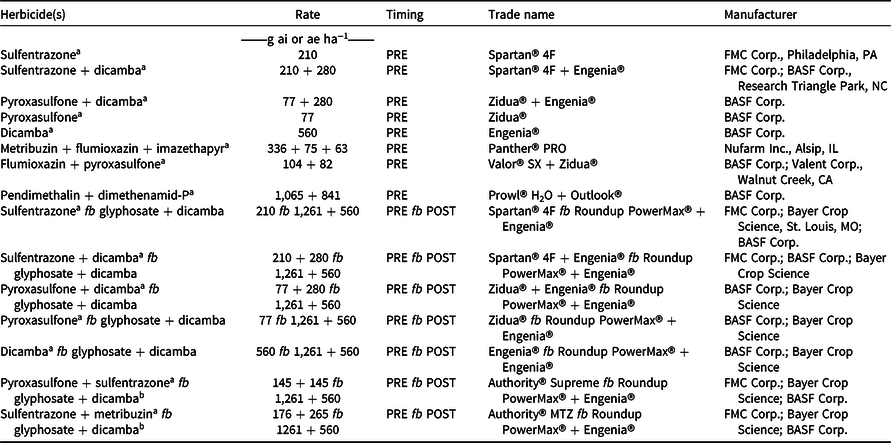
Field experiments were conducted in 2017 and 2018 at the Montana State University Southern Agricultural Research Center (MSU-SARC; 45.91°N, 108.24°W, elevation 921 m) near Huntley, MT. The soil at the study site was a silty clay loam, with 1.8% organic matter and a pH of 8.4. The experimental field was under barley–sugar beet rotation for > 5 yr prior to initiation of this study. Field preparation included ploughing, roller harrowing, and leveling in the fall and one cultivation in spring before soybean planting each year. The study site was fertilized according to the soil test report and MSU fertilizer recommendations for soybean production (Jacobsen et al. Reference Jacobsen, Jackson and Jones2005). A GDR soybean variety ‘DKB006-29’ (Bayer Crop Science DEKALB®, St. Louis, MO) was drilled in 15-cm rows using 420,070 seeds ha−1 on May 10, 2017 and May 7, 2018. The study was laid out in a randomized complete block design with four replications. Plots were 3 m wide by 9 m long and were irrigated four times in 2017 and three times in the 2018 growing season. Seeds of previously confirmed GR and DR kochia populations from Montana were mixed in equal amounts and uniformly spread over the test plots prior to soybean planting. The GR population used in this study had an 8-fold resistance to glyphosate, and the DR population had a 6.8-fold resistance to dicamba (Jha et al. Reference Jha, Kumar and Lim2015; Kumar et al. Reference Kumar, Jha and Reichard2014). Mean monthly air temperatures (C) and total precipitation (mm) in each growing season were collected from a weather station near the study site and are summarized in Table 1. Thirteen herbicide programs were evaluated, including PRE alone and PRE fb POST (Table 2). A nontreated control (weedy check) was included for comparison. Glyphosate at 1,261 g ha−1 was included with all PRE treatments for burndown weed control. All PRE treatments were applied 1 d after soybean planting using a CO2-pressurized backpack sprayer equipped with Turbo TeeJet® Induction nozzles (TTI 11004; Spraying Systems Co., Wheaton, IL) calibrated to deliver 374 L ha−1 at 276 kPa. POST treatments were applied when soybean plants had attained V3 to V4 growth stage. Percent soybean injury and kochia control were visually assessed at 4 wk after PRE (WAPRE), 7 WAPRE/2 wk after POST (WAPOST), and 10 WAPRE/5 WAPOST on a scale of 0 to 100 (where 0 = no injury/control and 100 = complete injury/control). Kochia plant density was recorded at 4 WAPRE and 7 WAPRE/2 WAPOST using three 0.5-m2 quadrats per plot. The aboveground kochia biomass was hand-harvested using a 1-m2 quadrat placed at the center of each plot to determine the shoot dry weight (after oven drying at 43 C for 7 d) and seed production at soybean maturity. Kochia shoot dry weights from treated plots were expressed as a percent shoot dry-weight reduction compared to the nontreated control using the following equation:
 $${\rm{Y = }}\left[ {\frac{{A - B}} {A}} \right]{\rm{ \times 100}}$$
where Y represents kochia shoot dry weight reduction (%), A is the shoot dry weight from weedy check treatment, and B is the shoot dry weight from a treated plot.
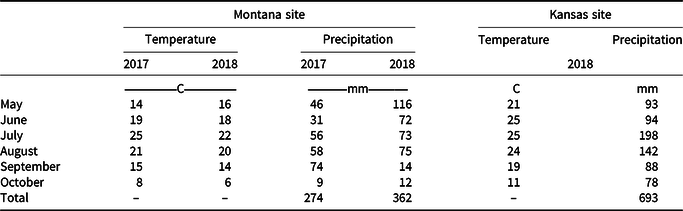
Monthly mean air temperatures (C) and total precipitation (mm) during the 2017 and 2018 growing seasons at the Montana State University Southern Agricultural Research Center near Huntley, MT, and during the 2018 growing season at the Kansas State University Agricultural Research Center near Hays, KS.

List of various herbicide programs tested to manage glyphosate/dicamba-resistant (GDR) kochia in GDR soybean at Montana State University Southern Agricultural Research Center near Huntley, MT, and at Kansas State University Agricultural Research Center near Hays, KS.
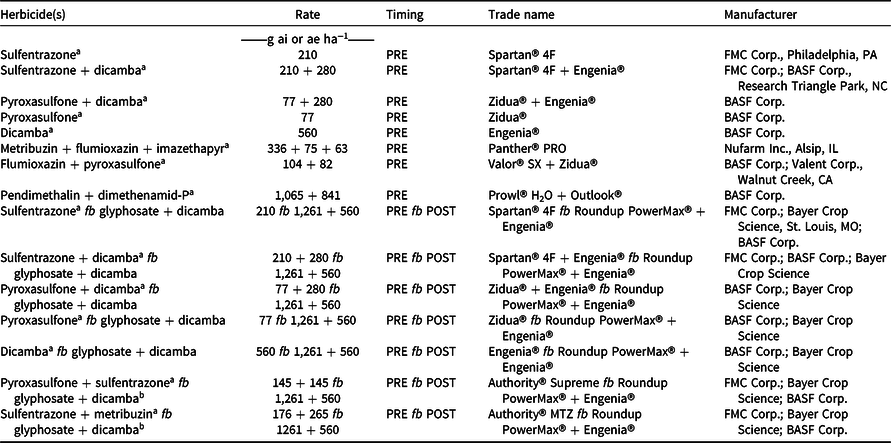
a Glyphosate (Roundup PowerMax®; Bayer Crop Science, St. Louis, MO) at 1,261 ae ha−1 was added to all PRE treatments.
b These herbicide programs were only tested at Kansas site.
Seed heads of kochia plants collected for shoot dry weights were hand-threshed and passed through two sets of hand-held sieves, and were subsequently cleaned with a seed blower (South Dakota Seed Blower, Seedburo Equipment Co., Des Plaines, IL) to determine kochia seed production. From each sample, 1,000 seeds were randomly counted and weighed to determine the 1,000-seed weight. Using 1,000-seed and total sample seed weights, the numbers of seeds in each sample were estimated. Soybean grain yields (kg ha−1) were determined by harvesting 10 rows at the center of each plot using a plot combine. Soybean grain yields were adjusted to 13% moisture.
Field Study in Kansas
A field experiment was conducted in 2018 at Kansas State University Agricultural Research Center (KSU-ARC; 38.51°N, 99.20°W, elevation 616 m) near Hays, KS, to evaluate the same herbicide programs listed in Table 2. The experimental field was historically under no-till (NT) dryland winter wheat–summer crop-fallow rotation for > 10 yr. Soil at the study site was silty clay with an organic matter content of 2.1% and a pH of 6.5. A GDR soybean variety ‘AG34X7’ was planted in NT wheat stubble on May 22, 2018, in 76-cm wide rows using 321,100 seeds ha−1. Treatments were arranged in a randomized complete block design with four replications. Each individual plot was 3 m wide and 9 m long. The study site was uniformly infested with a kochia population (segregating for resistance to glyphosate and dicamba) prior to soybean planting. This population was originally identified from KSU-ARC research fields with a 5.5-fold level of resistance to dicamba (Kumar et al. Reference Kumar, Engel, Currie, Jha, Stahlman and Thompson2019c). The same population also had survivors with glyphosate (1,740 g ha−1) treatment in a separate greenhouse study (data not shown), indicating multiple resistance to glyphosate and dicamba. Besides the herbicide programs tested at the Montana site, two additional PRE fb POST programs, including pyroxasulfone + sulfentrazone fb glyphosate + dicamba and sulfentrazone + metribuzin fb glyphosate + dicamba were also tested at the Kansas site (total of 15 treatments) (Table 2). All PRE treatments were applied at their recommended field-use rates on May 23, 2018, in combination with glyphosate at 1,261 g ha−1. All POST treatments were a mixture of glyphosate at 1,261 g ha−1 and dicamba at 560 g ha−1 and were applied on June 26, 2018 (at V3 to V4 growth stage of soybean). All herbicide treatments were applied with CO2-pressurized backpack sprayer equipped with Turbo Teejet Induction nozzles (TTI 110015 Spraying Systems Co., Wheaton, IL 60139), calibrated to deliver 140 L ha−1 spray solution. Soybean injury (%) and kochia control (%) were visually assessed at 3 WAPRE, and at 6 WAPRE /3 WAPOST and 9 WAPRE /6 WAPOST, using a rating scale similar to that described above. Percent kochia dry-biomass reduction relative to the nontreated weedy check was also determined from a 1-m2 quadrat in the center of each plot as previously described. Soybean grain yield (kg ha−1) was estimated by harvesting the middle two rows from each plot using a plot combine.
Statistical Analyses
Data were analyzed and presented by location to account for differences in environmental conditions, agronomic practices (field study in Montana was under sprinkler irrigation and conventional tillage, whereas field study in Kansas was under NT dryland production system), and kochia control evaluation timings between Montana and Kansas sites. Data were subjected to ANOVA using the PROC MIXED procedure in SAS® 9.3 (SAS Institute Inc., Cary, NC). For the Montana site, herbicide treatment, year, and herbicide treatment-by-year interaction were fixed effects in the ANOVA model. Replication and interactions involving replication were random effects in the model. Herbicide treatment-by-year interaction was nonsignificant (P ≥ 0.05) for any of the variables; therefore, data were pooled across years before final analysis for the Montana site. The fixed effect for the Kansas site was only herbicide treatment, whereas replication was the random effect in the model. Before analysis, data were checked for ANOVA assumptions (normality of residuals and homogeneity of variance) using PROC UNIVARIATE in SAS, and data met assumptions. Percent kochia control results from nontreated plots were excluded from the analysis for each site, and treatment means were separated using a Fisher’s protected LSD test (α = 0.05).
Results and Discussion
Monthly mean air temperatures during the 2017 and 2018 growing seasons at the Montana site ranged from 6 to 25 C (Table 1). Cumulative precipitation numbers during the study period were 274 mm in 2017 and 362 mm in 2018, respectively (Table 1). Monthly mean air temperatures at the Kansas site ranged from 11 to 25 C during the 2018 growing season. The total accumulated precipitation during the study period was 693 mm at the Kansas site.
Field Study in Montana
Kochia Control
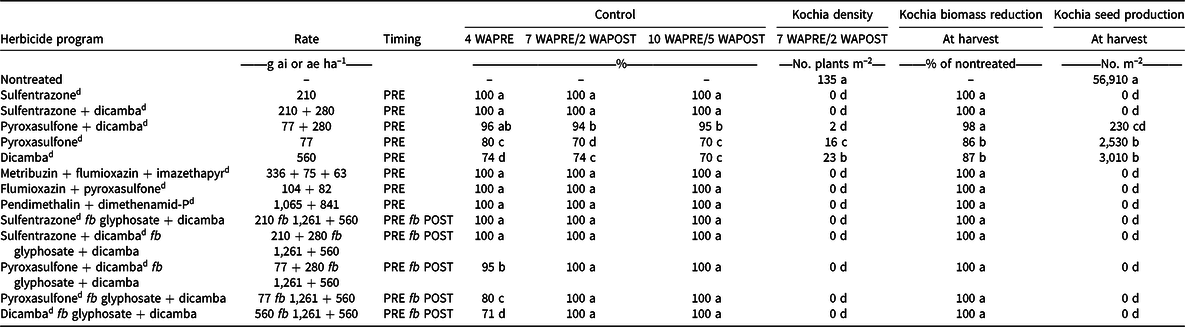
Averaged over 2 yr, PRE-applied sulfentrazone provided complete, season-long control of GDR kochia among all tested PRE-alone programs (Table 3). In contrast, control was 70% with PRE pyroxasulfone or PRE dicamba alone program at 10 WAPRE. These results are consistent with Kumar and Jha (Reference Kumar and Jha2015), who also reported ≥ 91% kochia control with PRE sulfentrazone in fallow. In the same study, only 36% and 60% kochia control was observed with pyroxasulfone and dicamba, respectively, at 10 WAPRE. In the current study, addition of dicamba to pyroxasulfone PRE greatly improved residual control of kochia (95%) at 10 WAPRE (Table 3). These results further indicate that the selected DR kochia (resistant to POST dicamba) population was moderately sensitive to PRE dicamba. Similarly, in a greenhouse study, Ou et al. (Reference Ou, Thompson, Stahlman and Jugulam2018) observed that PRE-applied dicamba (280 g ha−1) brought 75% control of DR kochia compared with only 10% control with dicamba (560 g ha−1) applied POST. All PRE fb POST programs or a sequential POST treatment of glyphosate + dicamba provided season-long control of GDR kochia in GDR-resistant soybean (Table 3).
Kochia control, density, biomass reduction, and seed production with various herbicide programs in glyphosate/dicamba-resistant soybean averaged across 2017 and 2018 at Montana State University Southern Agricultural Research Center, Huntley, MT.a–c

a Means within a column with similar letters are not significantly different based on Fisher’s protected LSD test (α = 0.05).
b Abbreviations: fb, followed by; WAPRE, wk after PRE; WAPOST, wk after POST.
c PRE herbicides were applied 1 d after soybean planting, and POST herbicides were applied at the V3 to V4 growth stage of soybean.
d Glyphosate at 1,261 g ae ha–1 was added to all PRE treatments.
Kochia Density, Biomass, and Seed Production
Kochia density in nontreated plots averaged 135 plants m−2 at 7 WAPRE /2 WAPOST (Table 3). Among all tested programs, only PRE-alone treatments of pyroxasulfone, dicamba, and pyroxasulfone + dicamba had kochia survivors at 7 WAPRE/2 WAPOST. The dicamba PRE-alone program reduced kochia density to 23 plants m−2, whereas the pyroxasulfone PRE-alone program had kochia density of 16 plants m−2 (Table 3). Consistent with the percent control, dicamba and pyroxasulfone applied as a mixture PRE reduced kochia density to only 2 plants m−2.
Consistent with percent control and density reductions, a majority of the tested programs prevented GDR kochia biomass production, except PRE-alone programs including pyroxasulfone, dicamba, or pyroxasulfone + dicamba (Table 3). Pyroxasulfone or dicamba PRE-alone program reduced kochia biomass ≥ 86% compared to the nontreated plots. The mixture of dicamba and pyroxasulfone PRE reduced kochia biomass by 98% (Table 3) at the end of the season, with no follow-up POST program.
Kochia plants in nontreated plots produced an average of 56,910 seeds m−2 at soybean harvest (Table 3). Kochia survivors from dicamba and pyroxasulfone PRE-alone treatments produced 3,010 and 2,530 seeds m−2, respectively. In contrast, kochia survivors in plots treated with a mixture of dicamba and pyroxasulfone PRE produced only 230 seeds m−2, a significant reduction. All other herbicide programs tested were effective in eliminating GDR kochia seed production in soybean.
Soybean Injury and Grain Yield
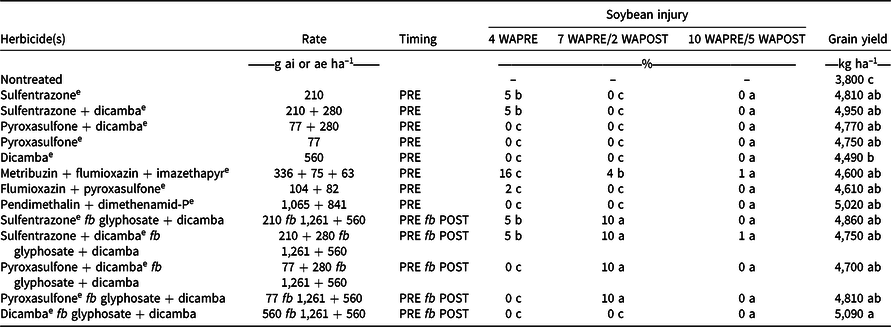
Among all tested programs, only PRE-applied sulfentrazone alone or mixtures/premixes of metribuzin + flumioxazin + imazethapyr, and flumioxazin + pyroxasulfone injured GDR soybean (Table 4). Averaged over 2017 and 2018, soybean injury was ≤ 5% with the sulfentrazone PRE or flumioxazin + pyroxasulfone PRE program at 4 WAPRE; however, no visible injury was observed at later evaluations. In contrast, up to 16% visible injury was observed with the metribuzin + flumioxazin + imazethapyr PRE program at 4 WAPRE. None of the herbicide programs showed any significant visible injury to soybean by 10 WAPRE/5 WAPOST.
Percent visual injury and grain yield of glyphosate/dicamba-resistant soybean treated with various herbicide programs at Montana State University Southern Agricultural Research Center near Huntley, MT.a–d

a Data were averaged across 2017 and 2018 growing seasons.
b Means within a column with similar letters are not significantly different based on Fisher’s protected LSD test (α = 0.05).
c Abbreviations: fb, followed by; WAPRE, wk after PRE; WAPOST, wk after POST.
d PRE herbicides were applied 1 d after soybean planting, and POST herbicides were applied at the V3 to V4 growth stage of soybean.
e Glyphosate at 1,261 g ae ha–1 was added to all PRE treatments.
Averaged over 2017 and 2018, all herbicide programs improved soybean grain yield compared to the nontreated plots (average yield of 3,800 kg ha−1) (Table 4). No significant differences in grain yield (ranging from 4,610 to 5,090 kg ha−1) were observed for the majority of herbicide programs tested. However, soybean yield in the dicamba PRE-only program was 4,490 compared to 5,090 kg ha−1 in the dicamba PRE fb glyphosate plus dicamba-POST program, indicating the need for a two-pass dicamba-based program to protect soybean yield loss.
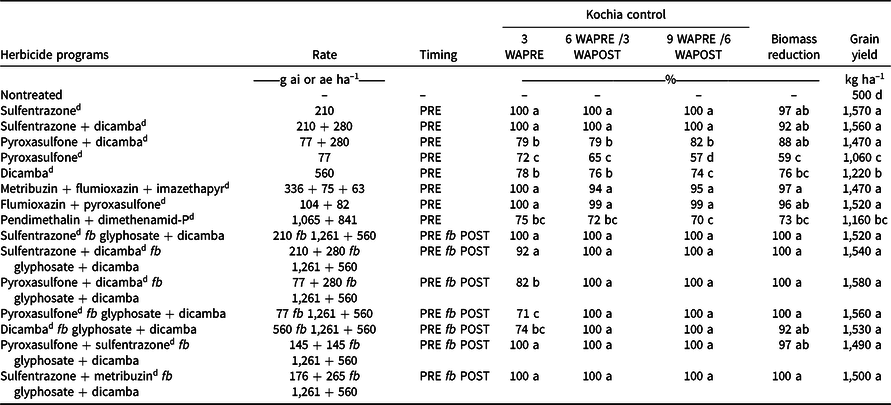
Field Study in Kansas
Kochia Control and Biomass Reduction
PRE-applied sulfentrazone alone or with dicamba, metribuzin + flumioxazin + imazethapyr, flumioxazin + pyroxasulfone, and all PRE fb POST programs provided ≥ 95% control of GDR kochia throughout the growing season (Table 5). In contrast, 57% to 74% control was observed with PRE-alone treatments of pyroxasulfone, dicamba, and pendimethalin + dimethenamid-P at 9 WAPRE. Much as with the Montana site, a mixture of pyroxasulfone + dicamba PRE had higher control (88%) of GDR kochia compared with the pyroxasulfone (57%) or dicamba (74%) PRE-alone program at 9 WAPRE. Consistent with percent control, kochia biomass reduction (% of nontreated) was > 92% with a majority of the treatments; exceptions were PRE treatments of pyroxasulfone alone (59% reduction), dicamba alone (76% reduction), or pyroxasulfone + dicamba (88% reduction) (Table 5).
Kochia control, biomass reduction, and soybean grain yield with various herbicide programs in glyphosate/dicamba-resistant soybean in 2018 at Kansas State University Agricultural Research Center near Hays, KS.a–c

a Means within a column with similar letters are not significantly different based on Fisher’s protected LSD test (α = 0.05).
b Abbreviations: fb, followed by; WAPRE, wk after PRE; WAPOST, wk after POST.
c PRE herbicides were applied 1 d after soybean planting, and POST herbicides were applied at the V3 to V4 growth stage of soybean.
d Glyphosate at 1,261 ae ha–1 was added to all PRE treatments.
Soybean Grain Yield
Soybean grain yield was higher for all tested herbicide programs compared with nontreated plots. Soybean grain yield for a majority of the tested programs did not differ, and ranged from 1,470 to 1,580 kg ha−1 (Table 5). A season-long interference of GDR kochia reduced the soybean grain yield by 68% in the nontreated plots compared with all top-yielding treatments. Soybean grain yield for pyroxasulfone, dicamba, and pendimethalin + dimethenamid-P PRE-alone treatments averaged 1,150 kg ha−1.
Practical Implications
Two-pass (PRE fb POST) herbicide programs tested in this study provided complete, season-long control of GDR kochia at both locations. Dicamba PRE can still be a viable option to control DR kochia, especially when applied with pyroxasulfone. Although a PRE-alone treatment of metribuzin + flumioxazin + imazethapyr or dicamba + pyroxasulfone provided 82% to 95% control, this study also suggested a need for late-season control of GDR kochia at the Kansas site. Although no differences exist in the soybean grain yield compared with two-pass programs, kochia survivors in the pyroxasulfone + dicamba PRE-alone program produced 230 seeds m−2, enough to cause replenishment of the GDR kochia seed bank. Preventing seed production from survivors during a growing season is key to minimize the risk of evolution and spread of resistant weed populations (Neve et al. Reference Neve, Norsworthy, Smith and Zelaya2011; Taylor and Hartzler Reference Taylor and Hartzler2000). In conclusion, PRE soil-residual herbicides investigated in this study will serve as a foundation for GDR kochia management and will aid in preserving the utility of dicamba in GDR soybean. Considering the evidence of kochia populations with four-way resistance to herbicides including glyphosate and dicamba, herbicides can no longer be a standalone practice for managing this weed. Future studies are needed to test the effectiveness of integrated kochia management tactics that include cover crops, use of PRE and POST herbicide premixes/mixtures with multiple modes of action, diverse crop rotations, rotational use of herbicide-resistant crop varieties with conventional crop varieties, strategic tillage, and harvest weed seed control technologies for managing GDR kochia seed banks in the soybean production systems of the US Great Plains.
Acknowledgments
The authors would like to thank Shane Leland at Montana State University and Rui Liu at Kansas State University for providing technical support in conducting the field experiments. This research received no specific grant from any funding agency, commercial, or nonprofit sectors. No conflicts of interest have been declared. This publication is contribution no. 20-080-J from the Kansas Agricultural Experiment Station, Manhattan, KS.