

Introduction
Stable isotope dietary studies have played a key role in developing our understanding of one of the most fundamental changes in European archaeology—the transition from hunting and gathering to agriculture (for a review, see Schulting, Reference Schulting, Pinhasi and Stock2011). The Balkan Peninsula has long been a key region for exploring the nature and pace of this technological and cultural transition as it spread across Europe (Chapman & Müller, Reference Chapman and Müller1990). This is because the Adriatic Sea and its coastal environs were a main artery for the movement of agricultural peoples and ideas northwards and westwards through south-eastern Europe (Tringham, Reference Tringham and Price2000; Zvelebil & Lillie, Reference Zvelebil, Lillie and Price2000; Forenbaher & Miracle, Reference Forenbaher and Miracle2005). In that context, a growing number of studies in the region have used stable isotope analyses, which can provide direct evidence of human diet, to document shifting subsistence regimes as an indicator of culture change from the Palaeolithic to the Neolithic (Richards et al., Reference Richards, Pettitt, Trinkaus, Smith, Paunović and Karavanić2000; Paine et al., Reference Paine, O'Connell, Miracle, McCartan, Schulting, Warren and Woodman2009; Lightfoot et al., Reference Lightfoot, Miracle, Radić, Šlaus and O'Connell2010, Reference Lightfoot, Boneva, Miracle, Šlaus and O'Connell2011, Reference Lightfoot, Šlaus and O'Connell2012; Richards et al., Reference Richards, Karavanić, Pettitt and Miracle2015).
These studies highlight significant shifts in human dietary adaptations between the Late Upper Palaeolithic (hunting and freshwater fishing; Richards et al., Reference Richards, Karavanić, Pettitt and Miracle2015), Mesolithic (hunting and marine fishing; Lightfoot et al., Reference Lightfoot, Miracle, Radić, Šlaus and O'Connell2010, Reference Lightfoot, Boneva, Miracle, Šlaus and O'Connell2011), and Neolithic (farming, hunting, and fishing; Lightfoot et al., Reference Lightfoot, Boneva, Miracle, Šlaus and O'Connell2011). Dietary evidence for the latter transition has important implications for competing theories about how indigenous and migrant populations and ideas interacted in this key region. However, a dearth of human stable isotope data from the Early Neolithic has left important questions unanswered about the pace and extent to which human lifestyles changed when new diets and associated cultural practices were introduced.
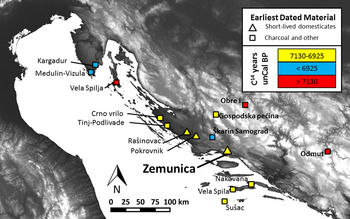
In this study we present stable isotope values and new AMS radiocarbon dates from ten human samples as well as stable isotope values from sixty-three animal samples recovered in the Zemunica cave site (Figure 1), not far from the central Adriatic coast of Dalmatia in Croatia. These individuals lived in the area around 8000 cal bp and are contemporaneous with the earliest reliable evidence for the introduction of Neolithic material culture (e.g. Impressed Ware pottery and domestic structures) and farming elements (domestic animals and plant cultivars) elsewhere along the eastern Adriatic coast and its hinterland. With other new radiocarbon evidence (McClure et al., Reference McClure, Podrug, Moore, Culleton and Kennett2014), these data suggest that the full transition to an agricultural way of life took place at a striking pace along the central eastern Adriatic region (i.e. in a single stage) and are in line with more recent models that have hypothesized a patchy but rapid appearance of farming (Forenbaher et al., Reference Forenbaher, Kaiser and Miracle2013; Forenbaher & Miracle, Reference Forenbaher and Miracle2014a, Reference Forenbaher, Miracle, Manen, Perrin and Guilaine2014b) aided by maritime transportation (Forenbaher & Perhoč, Reference Forenbaher and Perhoč2015; Kaiser & Forenbaher, Reference Kaiser, Forenbaher, Lillios and Chazan2015).
Map of the western Balkan Peninsula and eastern Adriatic Sea showing the location of the Zemunica cave and other radiocarbon-dated Early Neolithic cave sites (colour coded). Triangles denote sites with radiocarbon dates from materials that are well suited for detecting the arrival of agriculture (i.e. short-lived, domesticate species; Zilhão, Reference Zilhão2001). Sites with dates based on charcoal are marked by squares. Map made using CIAT-CSI SRTM (Reuter et al., Reference Reuter, Nelson and Jarvis2007; Jarvis et al., Reference Jarvis, Reuter, Nelson and Guevara2008).

Background
The site
Stratified deposits in the Zemunica cave site provide evidence for human occupation spanning the Late Upper Palaeolithic to the Early Bronze Age. The site's excavators (Šošić Klindžić et al., Reference Šošić Klindžić, Radović, Težak-Gregl, Šlaus, Perhoč, Altherr, Hulina, Gerometta, Boschian and Vukosavljević2015) have interpreted the Early Neolithic deposits from Zemunica as part of a settlement system connected with Bisko-Poljanice, a contemporary open-air farming settlement site in close proximity, to the south-east of the cave. The Bisko-Poljanice site is located on fertile soil and provides evidence for early agriculture, and has Impressed Ware pottery finds (Milošević, Reference Milošević1987). Together, the Zemunica cave and Bisko-Poljanice site provide evidence that the ‘full Neolithic package’ (i.e. plant cultivation, domesticated animal husbandry, pottery production and use, and polished stone tools; Chapman & Müller, Reference Chapman and Müller1990) was used by Early Neolithic peoples in the central Adriatic coastal region of Dalmatia (Šošić Klindžić et al., Reference Šošić Klindžić, Radović, Težak-Gregl, Šlaus, Perhoč, Altherr, Hulina, Gerometta, Boschian and Vukosavljević2015). Zooarchaeological evidence (NISP = 519; 409 taxonomically identifiable) from Early Neolithic deposits in the Zemunica cave are dominated by domesticated mammals (roughly 75 per cent). These bones belong mainly to sheep and cattle, but wild species such as red deer are also present (Šošić Klindžić et al., Reference Šošić Klindžić, Radović, Težak-Gregl, Šlaus, Perhoč, Altherr, Hulina, Gerometta, Boschian and Vukosavljević2015). Human remains were found throughout several archaeological contexts with a minimum of at least six individuals represented overall (Šošić Klindžić et al., Reference Šošić Klindžić, Radović, Težak-Gregl, Šlaus, Perhoč, Altherr, Hulina, Gerometta, Boschian and Vukosavljević2015). The presence of animal and human remains in the Zemunica cave has been taken to indicate that the site was used as a stable by mobile shepherds (a common interpretation of cave sites in the region, e.g. Chapman & Müller, Reference Chapman and Müller1990; Forenbaher & Miracle, Reference Forenbaher and Miracle2005) and also possibly as a ritual site by the inhabitants of the nearby settlement of Bisko-Poljanice (Šošić Klindžić et al., Reference Šošić Klindžić, Radović, Težak-Gregl, Šlaus, Perhoč, Altherr, Hulina, Gerometta, Boschian and Vukosavljević2015).
Environmental and Neolithic dietary context
The Zemunica cave site (Figure 1) is located in the Dalmatian hinterland at the eastern foot of the Mali Mosor Hills. A range of archaeological and palaeoecological indicators show that the local environment could have provided access to potentially diverse foodstuffs. Archaeological faunal remains from the wider region show that wild terrestrial and aquatic (freshwater and marine) resources were available locally during all periods dating back to at least the Late Upper Palaeolithic (Schwartz, Reference Schwartz, Chapman, Bintliff, Gaffney and Slapsak1988; Miracle et al., Reference Miracle, Galanidou and Forenbaher2000; Miracle, Reference Miracle2001; Komšo, Reference Komšo2008; Rainsford et al., Reference Rainsford, O'Connor and Miracle2014). Palaeoenvironmental analyses confirm that the relative sea level in the area during the Neolithic was roughly comparable with that of the present (van Andel, Reference van Andel1990; Šegota, Reference Šegota1991; Forenbaher, Reference Forenbaher2002; Benjamin et al., Reference Benjamin, Bekić, Komšo, Uhač, Bonsall, Benjamin, Bonsall, Pickard and Fischer2011). For this reason, the proximity of the Zemuncia cave to the current coastline (about 25 km away) suggests that Neolithic people could have had access to marine foods. A more convenient potential source of readily available aquatic foods (i.e. freshwater and anadromous fish) would have been the nearby River Cetina (less than 2 km away). A recent geoarchaeological survey of the wider Cetina valley (Smith et al., Reference Smith, Gaffney, Grossman, Howard, Milošević, Ostir, Podobnikar, Smith, Tetlow, Tingle and Tinsley2006) indicates that the region has remained hydrologically active throughout the Holocene, suggesting that the River Cetina could also have offered access to aquatic resources in the past. The region also offered excellent arable land for the development of farming communities. Botanical remains from Neolithic sites show that farmers cultivated a number of plants (e.g. einkorn, emmer, barley, lentils, peas, flax, and fruits) (Bass, Reference Bass1999, Reference Bass2004, Reference Bass2008; Borojević et al., Reference Borojević, Forenbaher, Kaiser and Berna2008; Legge & Moore, Reference Legge, Moore, Hadjikoumis and Viner2011; Reed, Reference Reed2015).
Thus, at different times in the past, the environs of the Zemunica cave site would have offered a potentially rich array of dietary possibilities including aquatic and terrestrial wild resources in addition to agriculturally produced plants and animals. The faunal and botanical evidence from other Neolithic sites in the area suggests that subsistence regimes focused primarily on domesticated animals, with apparently evidence also for fishing, hunting, and gathering foods from aquatic and terrestrial environments (Bass, Reference Bass1999, Reference Bass2004, Reference Bass2008; Miracle & Forenbaher, Reference Miracle and Forenbaher2005; Borojević et al., Reference Borojević, Forenbaher, Kaiser and Berna2008; Legge & Moore, Reference Legge, Moore, Hadjikoumis and Viner2011; Rainsford et al., Reference Rainsford, O'Connor and Miracle2014; Zavodny et al., Reference Zavodny, McClure, Culleton, Podrug and Kennett2014).
Previous stable isotope dietary evidence
Stable isotope analyses are based on the premises that: (1) biological tissues are constructed from proteins and other nutrients taken in from diet, and (2) different foods can have characteristic stable isotope compositions. Stable carbon (δ13C) and nitrogen (δ15N) isotope analyses are most often undertaken on bone collagen, as this material makes up the majority of the organic fraction of vertebrate bones. Bone collagen is renewed and repaired slowly over the life of an individual and thus can reflect up to twenty years, and sometimes more, of dietary intake (Hedges et al., Reference Hedges, Clement, Thomas and O'Connell2007). Stable isotope-based palaeodietary reconstructions are now well established and several review papers are available (e.g. Lee-Thorp, Reference Lee-Thorp2008). In the context of research on the European Mesolithic-Neolithic transition, many studies have taken place in coastal, estuarine, or riverine contexts, where isotopic indicators for marine, anadromous, and freshwater fish consumption can be used to determine relative consumption of aquatic protein as a proxy for the presence of wild foods in the human diet. The premise is that, in Neolithic contexts, isotopic signatures reflecting higher aquatic protein consumption (i.e. higher δ13C and δ15N values) (Chisholm et al., Reference Chisholm, Nelson and Schwarcz1982; Schoeninger et al., Reference Schoeninger, DeNiro and Tauber1983) indicate the degree to which the Neolithic package, which focuses on terrestrial plant and animal protein (i.e. lower δ13C and δ15N values), has been adopted (Richards & Hedges, Reference Richards and Hedges1999).
Previous stable isotope studies have not investigated the nature and extent to which the Neolithic package was embraced during the Early Neolithic on the western Balkan Peninsula. This is because human stable isotope data from the Mesolithic and Early Neolithic periods is scarce in the area relative to other regions of Europe. From the Mesolithic period, Paine and colleagues (Reference Paine, O'Connell, Miracle, McCartan, Schulting, Warren and Woodman2009) analysed four human samples from the Pupićina cave site in Istria, about 20 km from the Adriatic coast, and interpreted these values as reflecting a mainly terrestrial protein intake with a small aquatic dietary component. Lightfoot and colleagues (Reference Lightfoot, Miracle, Radić, Šlaus and O'Connell2010, Reference Lightfoot, Boneva, Miracle, Šlaus and O'Connell2011) analysed bone collagen from additional Mesolithic (n = 6) and Neolithic (n = 36) human bones. As expected, Mesolithic samples (n = 4) that come from sites closer to the coast had δ13C values indicative of aquatic protein consumption.
For Neolithic samples, Lightfoot and colleagues (Reference Lightfoot, Boneva, Miracle, Šlaus and O'Connell2011) found a shift away from aquatic foods which is consistent with a stronger commitment to farming, rather than hunting and gathering, but they emphasize that there is still some evidence for the use of wild aquatic resources at some Neolithic sites. However, Neolithic samples with stable isotope values that reflect aquatic protein intake come from later periods. It is therefore possible that these results point to a re-emergence of dietary diversity some time later in the Neolithic, a trend continuing in later periods (Lightfoot et al., Reference Lightfoot, Šlaus and O'Connell2012), rather than a phenomenon characteristic of the Neolithic as a whole in this area.
To summarize, the existing stable isotope dataset includes values from a small number of Early Neolithic humans. Additional data from this period is therefore essential to understand how human subsistence practices changed during the first decades and centuries of the Neolithic along the western Balkan Peninsula.
The Mesolithic to Neolithic transition along the eastern Adriatic Sea
Important debates in the prehistory of south-eastern Europe have focused on whether agriculture reached the eastern Adriatic region overland or by seafaring, and if the changes associated with the introduction of elements of Neolithic material culture and diet were achieved by a population replacement or the incorporation of local indigenous peoples (e.g. Forenbaher & Miracle, Reference Forenbaher and Miracle2005, Reference Forenbaher and Miracle2014a; Marijanović, Reference Marijanović2009; Bonsall et al., Reference Bonsall, Mlekuž, Bartosiewicz, Pickard, Conolly, Dobney, Manning and Shennan2013; Kaiser & Forenbaher, Reference Kaiser, Forenbaher, Lillios and Chazan2015; Hofmanová et al., Reference Hofmanová, Kreutzer, Hellenthal, Sell, Diekmann, Díez-del-Molino, van Dorp, López, Kousathanas and Link2016). The reliability of radiocarbon dates has played a central role in this debate (Bonsall et al., Reference Bonsall, Mlekuž, Bartosiewicz, Pickard, Conolly, Dobney, Manning and Shennan2013; Forenbaher et al., Reference Forenbaher, Kaiser and Miracle2013; McClure et al., Reference McClure, Podrug, Moore, Culleton and Kennett2014). The earliest reliably dated evidence for the appearance of agriculture in the wider eastern Adriatic region occurs at c. 6000 cal bc (sites of Rašinovac and Pokrovnik, see Figure 1; Forenbaher et al., Reference Forenbaher, Kaiser and Miracle2013; McClure et al., Reference McClure, Podrug, Moore, Culleton and Kennett2014). Following Zilhão (Reference Zilhão2001), recent criticisms have pointed out that the majority of older radiocarbon measurements are from samples (mainly charcoal) that were not suited for documenting the spread of agriculture and many should therefore be discounted for that purpose (Bonsall et al., Reference Bonsall, Mlekuž, Bartosiewicz, Pickard, Conolly, Dobney, Manning and Shennan2013). Newer radiocarbon dating projects (Forenbaher et al., Reference Forenbaher, Kaiser and Miracle2013; McClure et al., Reference McClure, Podrug, Moore, Culleton and Kennett2014) have selected materials that are short-lived and unequivocally Neolithic (i.e. domestic animals and plant remains) in order to avoid complications that can arise from the ‘old wood effect’ and stratigraphic mixing (Zilhão, Reference Zilhão2001).
For the eastern Adriatic region, agriculture is thought to have spread by different means in coastal and inland locations. Along the eastern Adriatic coast (Istria and Dalmatia), it has been hypothesized that Neolithic peoples and practices were spread by seafarers over the course of the first half of the sixth millennium cal BC; this is based on the presence of Early Neolithic materials—particularly Impressed Ware pottery—on islands around the Adriatic Sea (Forenbaher & Kaiser, Reference Forenbaher and Kaiser2005). Others have suggested that the Neolithic arrived in the inland region by an overland route at around the same time (Chapman & Müller, Reference Chapman and Müller1990).
There is some disagreement about how quickly the transition occurred and who was involved (Bonsall et al., Reference Bonsall, Mlekuž, Bartosiewicz, Pickard, Conolly, Dobney, Manning and Shennan2013). Based on the relative lack of archaeological evidence for a gradual transition to farming in the wider Adriatic region, some have argued in favour of a Neolithic spread through immigration and the establishment of Neolithic colonies (Legge & Moore, Reference Legge, Moore, Hadjikoumis and Viner2011), a process that may have included population replacement (Biagi, Reference Biagi, Ammerman and Biagi2003). In contrast to models that argue for the replacement of indigenous hunter-gatherers by immigrating Neolithic settlers, others have argued for a combination of population movement and indigenous adoption (Forenbaher & Kaiser, Reference Forenbaher and Kaiser2005; Forenbaher & Miracle Reference Forenbaher and Miracle2005, Reference Forenbaher, Miracle, Miracle and Forenbaher2006). Forenbaher and Miracle (Reference Forenbaher and Miracle2005; see also Fiedel & Anthony, Reference Fiedel, Anthony, Rockman and Steele2003) proposed a two-stage model in which, initially, Neolithic pioneers explored the length of the Adriatic coastal region, as evidenced by early dispersal of select elements of Neolithic material culture (especially Impressed Ware pottery), followed by a second phase of colonization accompanied by the full Neolithic package. This model has recently been revised in response to new evidence to suggest a more patchy but rapid appearance of farming (Forenbaher et al., Reference Forenbaher, Kaiser and Miracle2013; Forenbaher & Miracle, Reference Forenbaher and Miracle2014a, Reference Forenbaher, Miracle, Manen, Perrin and Guilaine2014b) aided by maritime transportation (Forenbaher & Perhoč, Reference Forenbaher and Perhoč2015; Kaiser & Forenbaher, Reference Kaiser, Forenbaher, Lillios and Chazan2015).
Materials and Methods
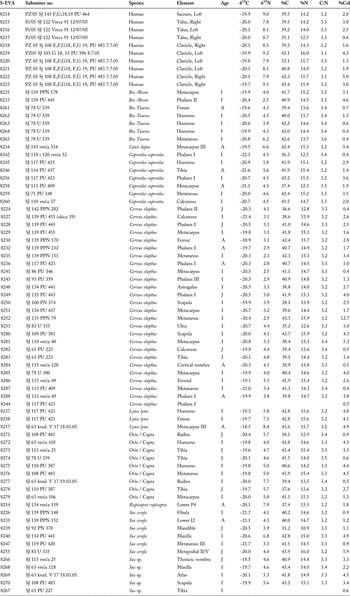
We used AMS radiocarbon and stable carbon and nitrogen isotope analyses of bone collagen to assess the age and diet of ten samples of human bone, representing a minimum of five individuals, from the Zemunica cave site (Table 1). Human samples include both subadults and adults. Determination of sex was possible for only one individual, a male (S-EVA 8214). As a dietary baseline for interpreting human data, stable isotopes were also measured for collagen samples from sixty-three animal bones (representing nine taxa; Table 1), mainly from Early Neolithic deposits. Animal taxa were identified by Siniša Radović (pers. comm.; Šošić Klindžić at al., Reference Šošić Klindžić, Radović, Težak-Gregl, Šlaus, Perhoč, Altherr, Hulina, Gerometta, Boschian and Vukosavljević2015). The relatively small size of this collection meant that we were not always able to exclude the possibility of sampling multiple bones from an individual. However, the relatively large size of the samples maximizes the potential for sampling separate individuals, thereby mitigating this issue.
Stable carbon and nitrogen isotope, elemental per cent, C:N, and collagen yield data for humans and animals from the Zemunica cave site.
A = adult, J = juvenile, I = Intermediate (Šošić Klindžić at al., Reference Šošić Klindžić, Radović, Težak-Gregl, Šlaus, Perhoč, Altherr, Hulina, Gerometta, Boschian and Vukosavljević2015).

Bone samples for radiocarbon and stable isotope analysis were pretreated at the Max Planck Institute for Evolutionary Anthropology following established methods (Talamo & Richards, Reference Talamo and Richards2011). Bones were first cleaned of surface contamination using a shot blaster. Bone powder samples (c. 500 mg) were then taken and decalcified in 0.5M HCl at room temperature until CO2 effervescence ceased, usually for about 4 hours. Samples were then treated with 0.1M NaOH for 30 minutes, to remove humics, followed by a final 0.5M HCl step for 15 minutes. The resulting solid was gelatinized at pH3 in a heater block at 75°C for 20 hours (Longin, Reference Longin1971). Gelatin samples were then purified using Eeze-Filters™ (Elkay Laboratory Products Ltd, UK), to remove small (<80 μm) particles, and Sartorius ‘VivaspinTurbo’ 30 KDa ultrafilters (Brown et al., Reference Brown, Nelson, Vogel and Southon1988). Prior to use, the ultrafilters were cleaned to remove carbon-containing humectants (Higham et al., Reference Higham, Jacobi and Bronk Ramsey2006; Brock et al., Reference Brock, Bronk Ramsey and Higham2007). Collagen preservation was assessed using C:N ratios (between 2.9 and 3.6) and a collagen yield (greater than 1 per cent) criteria (Ambrose, Reference Ambrose1990; Van Klinken, Reference Van Klinken1999). Stable isotopic analysis was carried out at the Max Planck Institute for Evolutionary Anthropology, Leipzig (Lab Code S-EVA) using a ThermiFinnigan Flash EA coupled to a Delta V isotope ratio mass spectrometer. Collagen samples (3–5 mg) meeting these quality criteria were weighed into pre-cleaned tin capsules and sent to the Mannheim AMS laboratory (Lab Code MAMS), where they were graphitized and dated (Kromer et al., Reference Kromer, Lindauer, Synal and Wacker2013).
Results
Radiocarbon
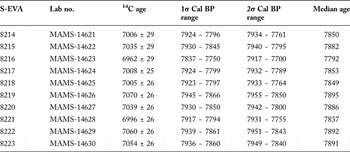
All samples analysed for radiocarbon produced acceptable C:N ratios and collagen yield values (Table 1). The AMS radiocarbon dates for humans, shown in Table 3, produce a tight cluster of ages between 6962 and 7070 14C BP. An χ 2 test (95 per cent confidence; Ward & Wilson, Reference Ward and Wilson1978) including all ten dates indicates that all but one sample (MAMS-14623/S-EVA-8216) could have come from the same distribution of 14C ages, indicating that these people had probably used the cave at the same time around 7024 ± 33 14C BP (average of all human dates, n = 10). These dates place the use of the Zemunica cave in the earliest phase of the Early Neolithic for the eastern Adriatic and could represent a first generation Neolithic population.
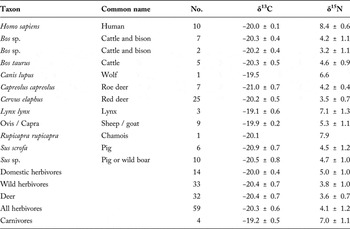
Stable carbon and nitrogen isotope data from the Zemunica cave site averaged by species and trophic group.

Calibrated and uncalibrated radiocarbon dates for humans from the Zemunica cave site.
Calibrated using OxCal v4.2.4 (Ramsey & Lee, Reference Bronk Ramsey and Lee2013) IntCal 13 atmospheric curve (Reimer et al., Reference Reimer, Bard, Bayliss, Beck, Blackwell, Bronk Ramsey, Buck, Cheng, Edwards, Friedrich, Grootes, Guilderson, Haflidason, Hajdas, Hatté, Heaton, Hoffmann, Hogg, Hughen, Kaiser, Kromer, Manning, Niu, Reimer, Richards, Scott, Southon, Staff, Turney and van der Plicht2013).

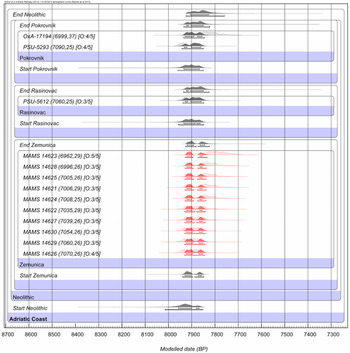
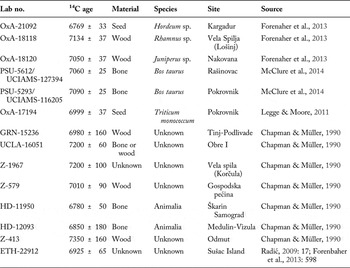
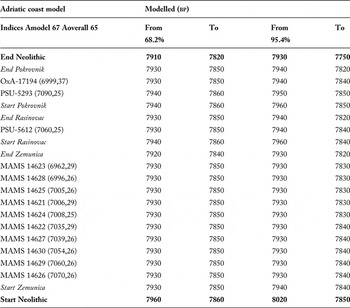
We used a Bayesian model to assess the distribution of ages among our new dates from Zemunica as well as recent dates from the sites of Rašinovac and Pokrovnik (Tables 4 and 5; Figure 2). Other available Early Neolithic dates from the region are not from short-lived domesticate samples (i.e. domestic plants and animals) and therefore are excluded in accordance with best practice (Zilhão, Reference Zilhão2001) as they cannot be used to identify the introduction of Neolithic materials with complete certainty. The radiocarbon dates were calibrated using OxCal 4.2.3 (Bronk Ramsey & Lee, Reference Bronk Ramsey and Lee2013) and the IntCal13 curve (Reimer et al., Reference Reimer, Bard, Bayliss, Beck, Blackwell, Bronk Ramsey, Buck, Cheng, Edwards, Friedrich, Grootes, Guilderson, Haflidason, Hajdas, Hatté, Heaton, Hoffmann, Hogg, Hughen, Kaiser, Kromer, Manning, Niu, Reimer, Richards, Scott, Southon, Staff, Turney and van der Plicht2013) (Table 5). Figure 2 shows human samples from the Zemunica site (in red) vs the Rašinovac and Pokrovnik sites (in black). The beginning of the Early Neolithic in Croatia, based on the Bayesian model we created, starts between 8020 and 7850 cal bp (2σ) and ends between 7930 and 7750 cal bp (2σ)(Table 5). The Zemunica site was used from 7930–7840 cal bp) (2σ) until 7930–7820 cal bp (2σ). The emergent pattern shows an extremely rapid spread of domestic plants and animals in this region of the Eastern Adriatic. In particular, the three earliest dates for the region, from two open-air sites (Rašinovac and Pokrovnik) and one cave site (Zemunica), which are spread out over a distance of 90 km, occur within a 20 radiocarbon year time window. The significant implications for this finding are explored further below.
Bayesian model comparing human radiocarbon dates from Zemunica with other reliable Neolithic materials (i.e. domestic plants and animals) from sites on the eastern Adriatic coast (Legge & Moore, Reference Legge, Moore, Hadjikoumis and Viner2011; McClure et al., Reference McClure, Podrug, Moore, Culleton and Kennett2014). Radiocarbon dates are calibrated in IntCal13 (Reimer et al., Reference Reimer, Bard, Bayliss, Beck, Blackwell, Bronk Ramsey, Buck, Cheng, Edwards, Friedrich, Grootes, Guilderson, Haflidason, Hajdas, Hatté, Heaton, Hoffmann, Hogg, Hughen, Kaiser, Kromer, Manning, Niu, Reimer, Richards, Scott, Southon, Staff, Turney and van der Plicht2013), the model and boundaries were calculated using OxCal 4.2 (Bronk Ramsey, Reference Bronk Ramsey2013).

Earliest dates (uncalibrated) for sites on the eastern Balkan Peninsula.

Modelled age boundaries for the earliest dates from reliable domestic and human materials for sites on the eastern Balkan Peninsula.

Stable isotope analysis
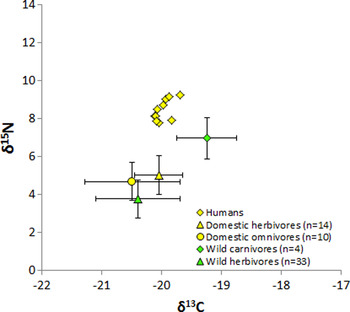
Human and animal stable isotope and elemental composition data are presented in Table 1 and Figure 3 and are summarized by group in Table 2. Collagen preservation at the Zemunica cave site was generally good. Aside from two specimens, which produced insufficient collagen, all samples had acceptable collagen quality criteria data.
Plot showing human and animal stable carbon and nitrogen isotope values from the Zemunica cave site.

Uniformly low δ13C values for both wild and domestic herbivores (n = 59, −20.3 ± 0.6 ‰) confirm that the area surrounding the Zemunica cave site was a C3 dominated environment. Wild herbivores, such as red deer and roe deer, indicate that local forest soils had low δ15N baseline values (n = 32, 3.6 ± 0.7 ‰). In this context the slightly higher δ15N baseline values (n = 14; 5.0 ± 1.0 ‰) for domestic herbivores may reflect anthropogenic influences on soil chemistry and plant communities on local farms (for a review, see Szpak, Reference Szpak2014). Based on the similarity between average δ15N values for domestic omnivores and herbivores (differing by <1 ‰), it appears that pigs mainly consumed plant foods. A wider range for pig δ15N values (n = 10, average = 4.7 ± 1.0 ‰, range = 3.5 ‰) suggests that some pigs had an appreciable amount of animal protein in their diets and that pig husbandry was a variable, and possibly non-standardized, practice. Although there are only a small number of samples, carnivores produced an average δ15N value 3.5 ‰ higher than their herbivorous counterparts, confirming their trophic relationship (Szpak et al., Reference Szpak, Orchard, McKechnie and Gröcke2012). A higher δ13C value (−18.5 ‰) for one lynx (e.g. S-EVA −8257) shows that this animal probably consumed some aquatic foods. It is not uncommon for archaeological lynx specimens in regions with access to aquatic animal foods to have elevated isotopic signatures, possibly owing to a preference for fish (Guiry & Grimes, Reference Guiry and Grimes2013), and these values indicate that aquatic animal protein was probably available locally.
Human δ13C values show remarkably little variation (n = 10; average = −20.0 ± 0.1 ‰; range = 0.4 ‰) and are consistent with a diet composed of foods from the local C3-dominated area. These values, which fall well within the range of domestic herbivores from the site, provide no evidence for consumption of aquatic (i.e. marine and anatropous) foods despite the site's proximity to the nearby River Cetina (less than 2 km away) as well as the Adriatic Sea (c. 25 km distant), both of which may have offered access to isotopically distinctive (e.g. anadromous or freshwater) fish species.
Human δ15N values also group closely (average = 8.4 ± 0.6 ‰; range = 1.5 ‰) and, in the context of local wild and domestic herbivores, provide a basis for some strikingly clear interpretations of Early Neolithic dietary practices at the Zemunica cave site. The average Δ δ15N value for Early Neolithic humans-herbivores is 3.4 ‰, roughly one trophic level (Szpak et al., Reference Szpak, Orchard, McKechnie and Gröcke2012), and it is therefore likely that human diets focused on terrestrial animal protein. Humans have a slightly higher average δ15N value than local obligate carnivores, a finding that might be taken as evidence for freshwater fish consumption in the absence of baseline data. However, the most parsimonious explanation for higher human δ15N values is that their livestock grazed in areas with a higher δ15N baseline. This is evidenced by the similarity in offsets between average human and carnivore δ15N values (i.e. values for humans are 1.4 ‰ higher than carnivores) and baseline data for their respective animal protein sources (i.e. values for domestic herbivores are 1.2 ‰ higher than their wild counterparts). We therefore believe that these data present a scenario in which Early Neolithic people mainly relied on terrestrial animals for their dietary protein and largely ignored aquatic, and also possibly wild terrestrial, fauna despite a potential for local abundance, particularly from the River Cetina.
Discussion and Conclusion
What are the implications for terrestrial human diets near the River Cetina and Adriatic at the onset of the Early Neolithic? Among the previously published stable isotope results, which include data from over fifty pre-Bronze Age human and hominin samples (Richards et al., Reference Richards, Pettitt, Trinkaus, Smith, Paunović and Karavanić2000, Reference Richards, Karavanić, Pettitt and Miracle2015; Paine et al., Reference Paine, O'Connell, Miracle, McCartan, Schulting, Warren and Woodman2009; Lightfoot et al., Reference Lightfoot, Miracle, Radić, Šlaus and O'Connell2010, Reference Lightfoot, Boneva, Miracle, Šlaus and O'Connell2011), there is very little data from Early Neolithic contexts, and none of these samples come from directly dated human bone. The dearth of well-dated human samples (Forenbaher et al., Reference Forenbaher, Kaiser and Miracle2013; McClure et al., Reference McClure, Podrug, Moore, Culleton and Kennett2014) has precluded the type of dietary study that has permitted researchers in other regions of Europe to assess the use or avoidance of wild resources by Neolithic peoples (Tauber, Reference Tauber1981, Reference Tauber1986; Richards & Mellars, Reference Richards and Mellars1998; Schulting & Richards, Reference Schulting and Richards2001, Reference Schulting and Richards2002a, Reference Schulting and Richards2002b; Richards et al., Reference Richards, Douglas Price and Koch2003; Schulting, Reference Schulting, Marchand and Tresse2005, Reference Schulting, Pinhasi and Stock2011; Fischer et al., Reference Fischer, Olsen, Richards, Heinemeier, Sveinbjörnsdóttir and Bennike2007; Price et al., Reference Price, Ambrose, Bennike, Heinemeier, Noe-Nygaard, Petersen, Petersen and Richards2007; Woodman, Reference Woodman, McCartan, Schulting, Warren and Woodman2009; Schulting et al., Reference Schulting, Fibiger, Macphail, McLaughlin, Murray, Price and Walker2013; Guiry et al., Reference Guiry, Hillier and Richards2015, Reference Guiry, Hillier, Boaventura, Silva, Oosterbeek, Tomé, Valera, Cardoso, Hepburn and Richards2016). Sites near marine and riverine environments provide a unique interpretive context because they offered inhabitants direct access to potentially attractive aquatic food resources (i.e. freshwater, anadromous, and marine aquatic animal protein) which are isotopically distinctive from the foods normally associated with the Neolithic package. In this context, our dataset from a site only 2 km from the River Cetina and 25 km from the Adriatic coast provides a well-dated window onto how the Neolithic transition occurred in this important region, which could have implications for wider understandings of the process of Neolithization in Europe (Tringham, Reference Tringham and Price2000; Zvelebil & Lillie, Reference Zvelebil, Lillie and Price2000; Forenbaher & Miracle, Reference Forenbaher and Miracle2005; Budja, Reference Budja and Dizdar2011). In particular, new data from Zemunica cave provide insights into two key processes involved in the spread of agriculture into the Balkan Peninsula.
First, we can refine previous reconstructions of temporal trends in human diet (Lightfoot et al., Reference Lightfoot, Boneva, Miracle, Šlaus and O'Connell2011, Reference Lightfoot, Šlaus and O'Connell2012; Richards et al., Reference Richards, Karavanić, Pettitt and Miracle2015). Figure 4 a and b show new and previously published human stable isotope values from the eastern Balkan Peninsula by period. Our results suggest that the shift between Mesolithic diets, which focused on wild terrestrial and aquatic foods (Lightfoot et al., Reference Lightfoot, Boneva, Miracle, Šlaus and O'Connell2011), to domestic animal foods was completed, for at least some people, during the Early Neolithic and was therefore relatively rapid. In contrast to the findings of Lightfoot and colleagues (Lightfoot et al., Reference Lightfoot, Boneva, Miracle, Šlaus and O'Connell2011), who found evidence for dietary diversity (i.e. a reliance on wild and domestic foods) among humans from Middle and Late Neolithic periods, we see evidence for a lack of aquatic resource consumption and, instead, a homogenously terrestrial diet that is consistent with a complete reliance on domesticated animals in the Early Neolithic. Although small, our dataset suggests a scenario in which Neolithic peoples initially relied more heavily on farming and animal protein consumption and later Middle and Late Neolithic peoples began to diversify their diets to incorporate some wild animals, including aquatic foods (Lightfoot et al., Reference Lightfoot, Boneva, Miracle, Šlaus and O'Connell2011). This interpretation, and its broader applicability, could be further explored through additional stable isotope analyses of Early Neolithic human remains from a wider geographical range of sites along the western Balkan Peninsula.
Plots of stable carbon (A) and nitrogen (B) isotope values vs timeline for humans on the eastern Balkan Peninsula. Humans from the Zemunica cave site and previously published studies (Paine et al., Reference Paine, O'Connell, Miracle, McCartan, Schulting, Warren and Woodman2009; Lightfoot et al., Reference Lightfoot, Boneva, Miracle, Šlaus and O'Connell2011, Reference Lightfoot, Šlaus and O'Connell2012) are shown in yellow and white respectively. Samples without radiocarbon dates are plotted in groups by period. Where data on age is available, infants have been removed to control for weaning-related trophic variability.

Second, the radiocarbon dates for humans from the Zemunica cave site are synchronous with the earliest directly dated evidence of the Neolithic on the eastern Adriatic coast (Table 4 and Figure 2) and, therefore, provide a new opportunity to consider the mechanisms for the introduction of the Neolithic package to the wider region. The oldest reliable radiocarbon analyses (i.e. on short-lived species from secure contexts; see Zilhão, Reference Zilhão2001) for other Early Neolithic contexts in Croatia are from domesticated animal and cultivated plant remains (slightly predating 7000 14C years bp; Chapman & Müller, Reference Chapman and Müller1990; Minichreiter & Krajcar Bronić, Reference Minichreiter and Krajcar Bronić2007; Forenbaher et al., Reference Forenbaher, Kaiser and Miracle2013; McClure et al., Reference McClure, Podrug, Moore, Culleton and Kennett2014), and are similar to our 14C measurements of humans at the Zemunica cave site. This comparison has two important implications. First, it indicates that Neolithic practices had arrived by roughly the same time, the first decades of the sixth millennium cal bc, at multiple sites over a relatively large area (within c. 90 km). Second, dietary signatures and other archaeological evidence (Šošić Klindžić et al., Reference Šošić Klindžić, Radović, Težak-Gregl, Šlaus, Perhoč, Altherr, Hulina, Gerometta, Boschian and Vukosavljević2015) suggest that at least some of these individuals used the full Neolithic package from the outset.
These new insights allow us to consider previous models proposed for the Neolithization of the eastern Adriatic region. If people with full Neolithic subsistence practices appear at the Zemunica cave site at the same time as other indirect dietary evidence (i.e. dates from cultivated seeds and bones of domesticates) at inland sites we can say that: (1) the colonization happened very quickly in at least some regions, and (2) it occurred as an encompassing transplant of agricultural practices. Therefore, in contrast to earlier hypotheses (Forenbaher & Miracle, Reference Forenbaher and Miracle2005) proposing that the region was first explored and then later settled, our data favour more recent models in which Neolithic people migrated to the area from elsewhere and brought with them the requisite ideas and tools to replicate their agricultural regime in a region that was inhabited by hunter-gatherers (i.e. a folk migration as suggested by Zvelebil & Lillie, Reference Zvelebil, Lillie and Price2000; Forenbaher & Miracle, Reference Forenbaher and Miracle2014a, Reference Forenbaher, Miracle, Manen, Perrin and Guilaine2014b). Moreover, the simultaneous appearance (in terms of radiocarbon dates), perhaps over only one or two generations, of Neolithic elements at seemingly unconnected places along the Adriatic coast indicates that this may have been part of a concerted and unified colonization effort (i.e. multi-fronted leapfrog colonization; see Zvelebil & Lillie, Reference Zvelebil, Lillie and Price2000; Forenbaher & Miracle, Reference Forenbaher and Miracle2014a, Reference Forenbaher, Miracle, Manen, Perrin and Guilaine2014b). We would like to emphasize that our findings do not preclude the appropriation of agricultural lifestyles by indigenous peoples in the region. While we believe our findings support a maritime route for the immigration of Neolithic peoples (Kaiser & Forenbaher, Reference Kaiser, Forenbaher, Lillios and Chazan2015) and ideas, the relative synchronicity of the earliest evidence for coastal and inland dates suggests that settlements could be established as quickly by a combination of seafaring or overland routes. These interpretations could be tested through further radiocarbon dating projects targeting domestic plants as well as human and domesticated animal bones from the earliest archaeological deposits at Early Neolithic sites along the Balkan Peninsula.
Acknowledgements
The rescue excavation of the Zemunica cave was funded by the Ministry of Culture of the Republic of Croatia. We thank Maria Hillier for her help preparing samples and Bryn Letham and Thomas J. Brown for their assistance with making Figures 1 and 2, respectively. We also thank Jim Ahern for help with information about human remains.