1. Introduction
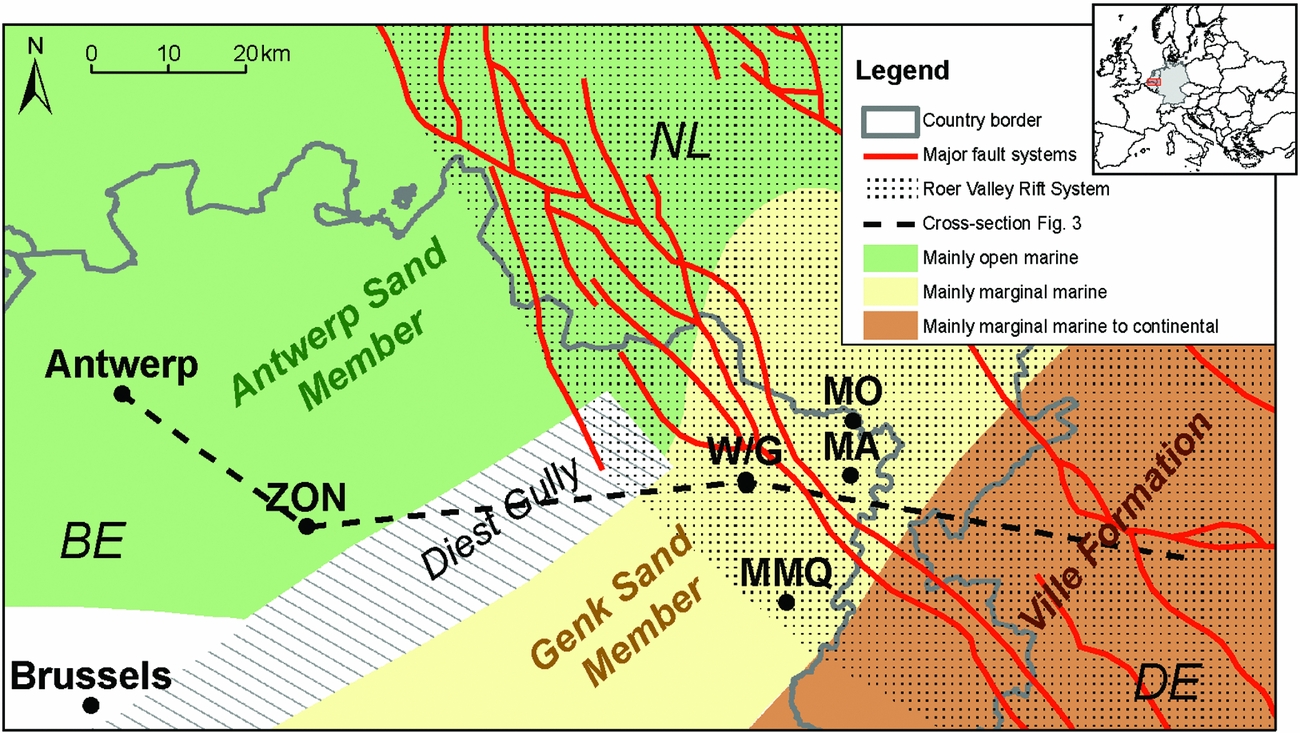
With the start of the late Oligocene rifting, sediment was transported in a northwesterly direction along the Roer Valley Rift System (RVRS; for location see Fig. 1) from the Rhenish Massif in the south towards the southern North Sea in the north. Consequently, a marginal marine to continental depositional regime was installed in the southern RVRS, characterized, among other things, by the deposition of thick peat layers of the Ville Formation (Schäfer et al., Reference Schäfer, Utescher, Klett and Valdivia-Manchego2005; Fig. 1). Simultaneously, the glauconitic fine sands of the Berchem Formation were deposited in a shallow, open marine environment along the western flank of the northwestern part of the RVRS (Louwye, Reference Louwye2005; Fig. 1). In the central part of the RVRS, the Bolderberg Formation represents the transition from the Ville towards the Berchem Formations, with glauconitic sands in the lower part (Houthalen Sand Member) and lignite-bearing glauconite-poor sands in the upper part (Genk Sand Member; Fig. 1). The lower Houthalen Sand Member is considered to be deposited in a shallow marine environment, while the upper Genk Sand Member was traditionally thought to have been deposited, at least partly, in a continental/fluviatile environment (De Meuter & Laga, Reference De Meuter and Laga1976).
Palaeoenvironmental reconstruction in the southeastern part of the Middle Miocene North Sea Basin across Belgium (BE), the Netherlands (NL) and Germany (DE). The location of the cross-section of Figure 3 is indicated. MA = Maaseik borehole; MO = Molenbeersel borehole; MMQ = Maasmechelen quarry; W/G = Wijshagen and Gruitrode boreholes; ZON = Zonderschot. Fault lines are modified after Schäfer & Utescher (Reference Schäfer and Utescher2014).

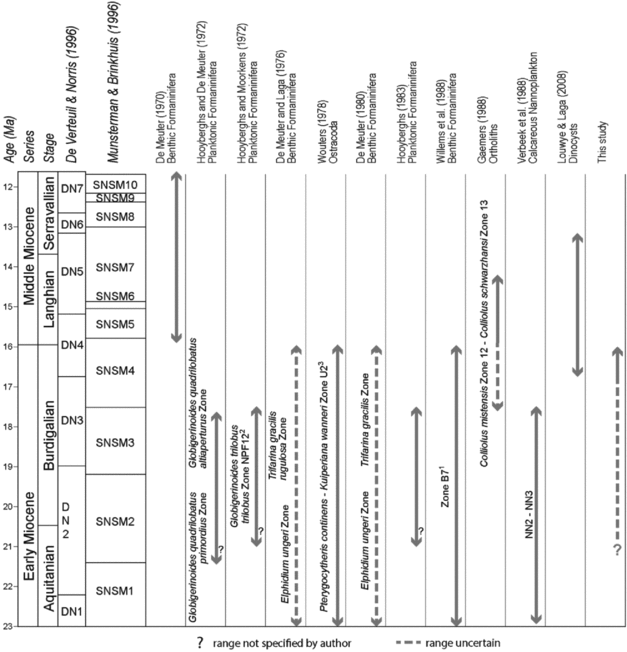
The Wijshagen borehole (Fig. 1) was drilled in the central part of the RVRS across the Bolderberg Formation, and the succession was analysed with marine palynomorphs (dinoflagellate cysts and acritarchs) by Louwye & Laga (Reference Louwye and Laga2008). The shallow marine components throughout the Bolderberg Formation made the latter authors assume, following the current stratigraphic definition, that only the lower Houthalen Sand Member was present in this borehole and not the superjacent Genk Sand Member. However, the lithology consists of pale grey to dark brown, lignite-rich sands with little or no glauconite, and suggests that most of the sampled section actually represents the Genk Sand Member. Louwye & Laga (Reference Louwye and Laga2008) proposed a late Burdigalian to early Serravalian age for the assumed Houthalen Sand Member in the Wijshagen borehole. This age assignment was, however, not consistent with the previous stratigraphic assignment of the Houthalen Sand Member to the Burdgalian, as based on biostratigraphic analysis with foraminifers (Hooyberghs & De Meuter, Reference Hooyberghs and De Meuter1972; De Meuter & Laga, Reference De Meuter and Laga1976; Hooyberghs & Moorkens, Reference Hooyberghs, Moorkens and Vinken1988; Willems, Laga & Moorkens, Reference Willems, Laga, Moorkens and Vinken1988), calcareous nanoplankton (Martini & Müller, Reference Martini and Müller1973) and ostracods (Wouters, Reference Wouters1978; Hooyberghs, Reference Hooyberghs1983) (Fig. 2).
Stratigraphic extent of the Houthalen Sand Member according to former micropalaeontological studies and as suggested by this study (rightmost column). Modified after Louwye & Laga (Reference Louwye and Laga2008).

In order to solve the inconsistency, we discuss here the criteria (lithology, stratigraphic position, depositional setting and geographic distribution) for the recognition of the Genk and Houthalen Sand Members of the Bolderberg Formation based on literature data, lithological descriptions and palynologic analyses by Louwye & Laga (Reference Louwye and Laga2008) in the Wijshagen borehole and their correlations with log data in the nearby (at 650 m distance) Gruitrode borehole.
The goals of this study lie in the reassessment of the stratigraphical position of the Genk Sand Member through stratigraphical reinterpretations and correlations, and the further elucidation of the early to middle Miocene marine palaeoenvironment along the southern margin of the North Sea Basin.
2. Geological setting and stratigraphy
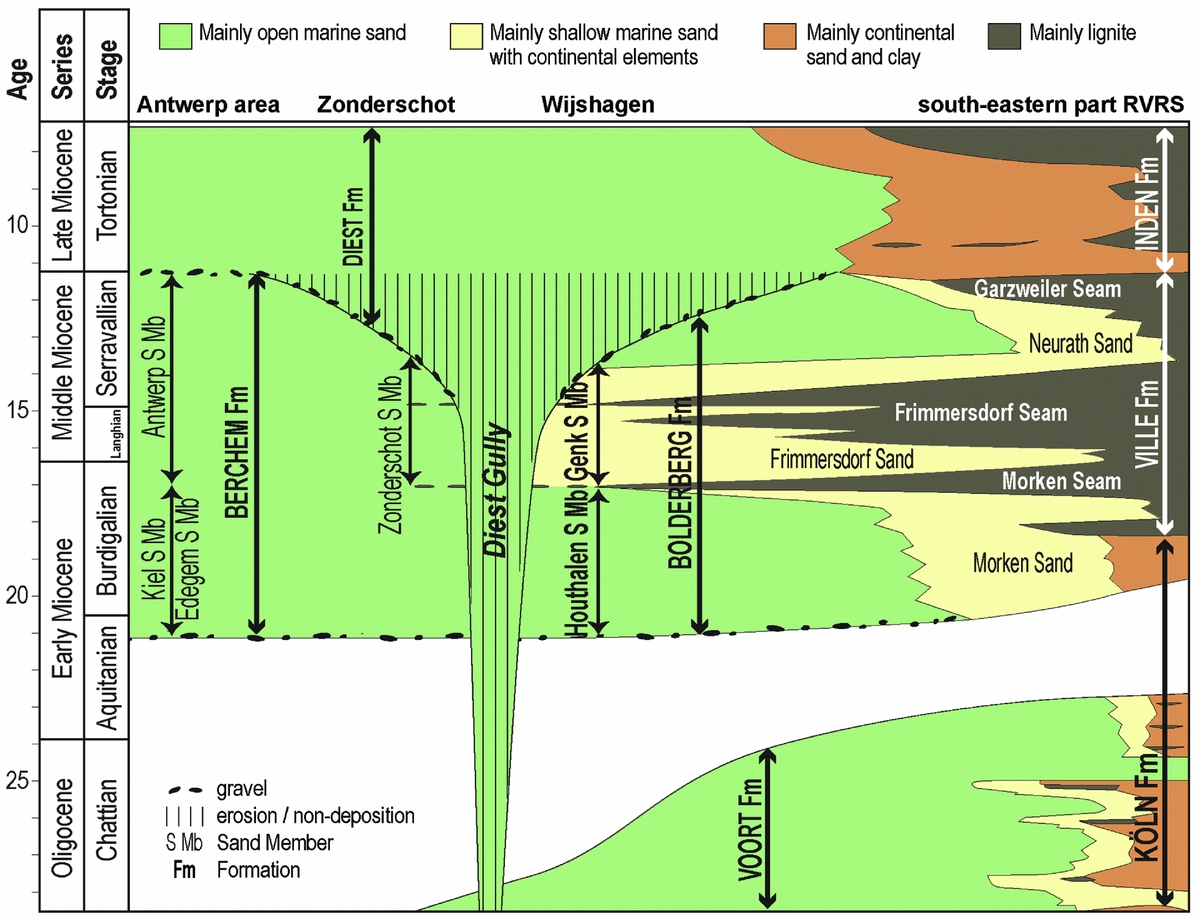
The North Sea constituted during early to middle Miocene times (for timing, see Fig. 3) a semi-closed basin. To the north an open marine connection existed between the North Sea Basin and the Norwegian–Greenland Sea, while in the southwest an uplift of the Wealden–Artois ridge prevented the marine connection between the southern North Sea Basin and the Channel Basins (Ziegler, Reference Ziegler1990). The southeastern margin of the North Sea Basin is composed of the differentially subsiding RVRS or Lower Rhine Graben (Fig. 1). During late Oligocene times, the glauconitic marine sands of the Voort Formation were deposited in the northern parts and flanks of the RVRS, while simultaneously marginal marine to continental sands and lignites of the Köln Formation were deposited in the southern part of the RVRS (Fig. 3). During the early to middle Miocene, the southern border of the North Sea Basin was transgressed and covered by the glauconite-rich shallow marine Berchem Formation (Louwye, Reference Louwye2005 and references therein; Fig. 3). Meanwhile the RVRS was progressively filled from the southeast to the northwest by northwest-prograding deltaic sediments (Schäfer et al. Reference Schäfer, Utescher, Klett and Valdivia-Manchego2005; Deckers, Reference Deckers2015). As a consequence, the continental elements such as lignite generally increase in thickness in a southeasterly direction in the RVRS up to the point where, in the southeasternmost parts, up to 100 m thick lignite seams of the Ville Formation were formed (Schäfer et al. Reference Schäfer, Utescher, Klett and Valdivia-Manchego2005; Fig. 3). In between the Ville and Berchem Formations, the Bolderberg Formation represents the transition from a continental/marginal marine realm towards an open marine depositional environment. The Bolderberg Formation comprises a lower glauconitic clayey Houthalen Sand Member and an upper glauconite-poor lignite-bearing Genk Sand Member. The base of the Bolderberg Formation is often, but not always according to Matthijs (Reference Matthijs1999), marked by the Elsloo gravel layer which separates it from the underlying Oligocene Voort Formation.
Schematic cross-section of the early to late Miocene litho- and chronostratigraphy from the southeastern part of the Roer Valley Rift System (right side) across the study area (Wijshagen in the centre) towards the Antwerp area in the west (left side). The location of this cross-section is indicated in Figure 1. Modified after Hager (Reference Hager1993), Van Adrichem Boogaert & Kouwe (Reference Van Adrichem Boogaert and Kouwe1997) and Utescher, Mosbrugger & Ashraf, (Reference Utescher, Mosbrugger and Ashraf2002).
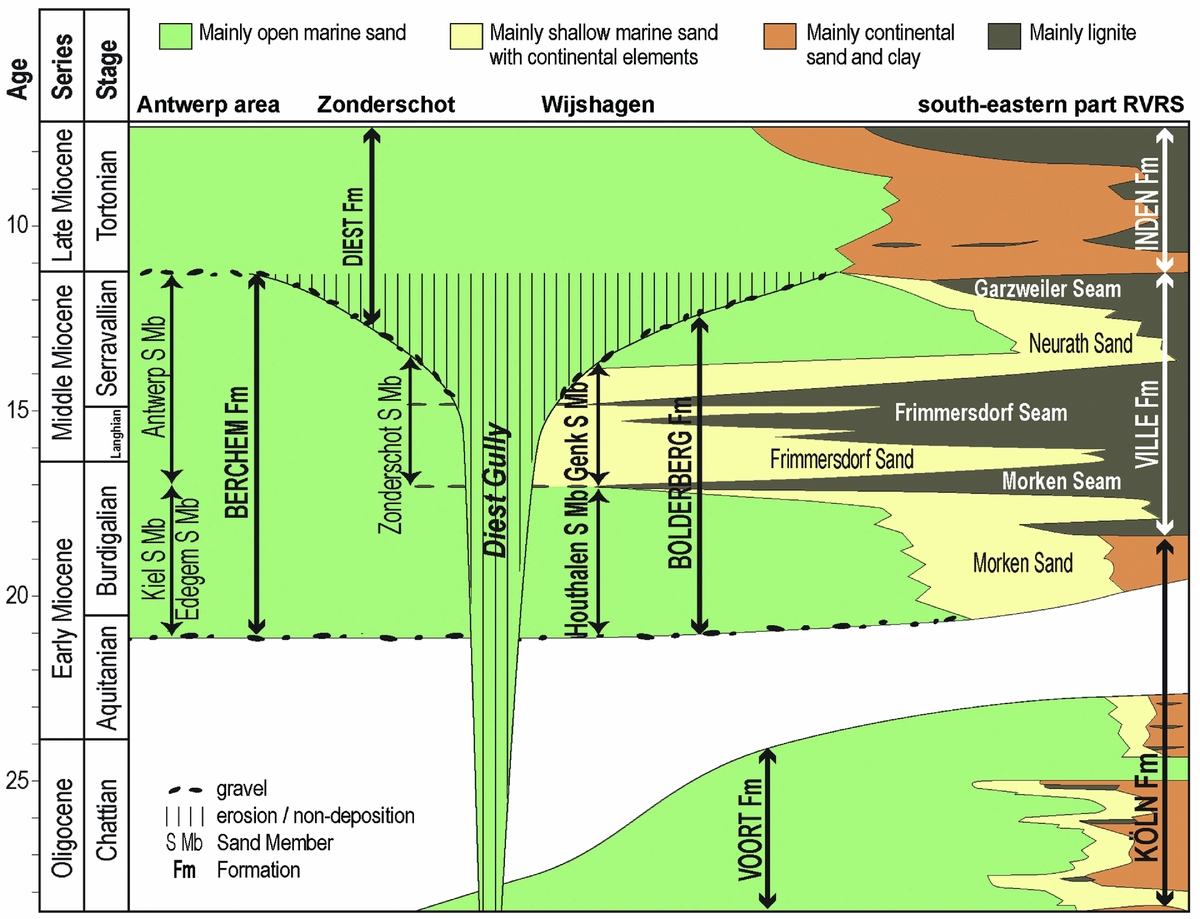
According to Wouters & Vandenberghe (Reference Wouters and Vandenberghe1994), the regressive character of the upper part of the Bolderberg Formation heralded a period of non-sedimentation at the boundary between the middle and late Miocene. Indeed, Louwye & Laga (Reference Louwye and Laga2008) locally noticed a 2 Ma long hiatus in sedimentation at the end of the middle Miocene (middle to late Serravalian). During the later part of this time span a large and deep gully formed along the western flank of the RVRS (Diest Gully in Fig. 1) and eroded the underlying Miocene and Oligocene deposits. This Diest Gully developed at the location of the facies transition between the Bolderberg and Berchem Formations, and thus obscures observation of the lateral continuity between the latter formations.
As the sea level started to rise during Tortonian times, deposition of the shallow marine glauconitic sands of the Diest Formation first took place in the gully and later in the greater part of the southern margin of the North Sea Basin, unconformably overlying the Berchem and Bolderberg Formations (Louwye, De Coninck & Verniers, Reference Louwye, De Coninck and Verniers2000; Fig. 3). The fluviatile sands with some lignites of the Inden Formation were deposited at the same time on top of the Ville Formation in the southeastern part of the RVRS (Fig. 3).
3. Dataset
The Wijshagen borehole (Geological Survey of Belgium archive no. 048W0180) was drilled in 1964 as a reconnaissance well near the village of Wijshagen (Fig. 1). The borehole reached a total depth of 215 m and drilled, following the original stratigraphic interpretations in the drilling report of the Geological Survey of Belgium (by M. Gulinck in 1964), from top to bottom the Quaternary Meuse Group (base at 6 m), the Pliocene Mol Formation (base at 22 m), the Miocene Kasterlee Formation (base at 50 m), Diest Formation (base at 94 m) and Bolderberg Formation (base at 164 m) before ending in the Oligocene Voort Formation. Louwye & Laga (Reference Louwye and Laga2008) carried out palynological analyses on the interval between 54 m and 165 m of the Wijshagen borehole, encompassing the Diest Formation to the base of the Bolderberg Formation (Fig. 4). The stratigraphical interpretation indicated deposition of the Diest Formation during the Tortonian and deposition of the Bolderberg Formation during the Burdigalian to early Serravalian. They report on a major hiatus, of c. 2 Ma, from early Serravalian to early Tortonian, between the Bolderberg Formation and the superjacent Diest Formation. This boundary is marked in the Wijshagen borehole by a basal layer of small sandstone pebbles, coarse-grained sand and shark teeth on top of root traces and wood fragments (Fig. 4). The palynologic analyses of Louwye & Laga (Reference Louwye and Laga2008) furthermore showed that the Diest and Bolderberg Formations were deposited in a marginal marine environment, with short-lived enhanced pulses of continental/fluviatile input in the latter formation.
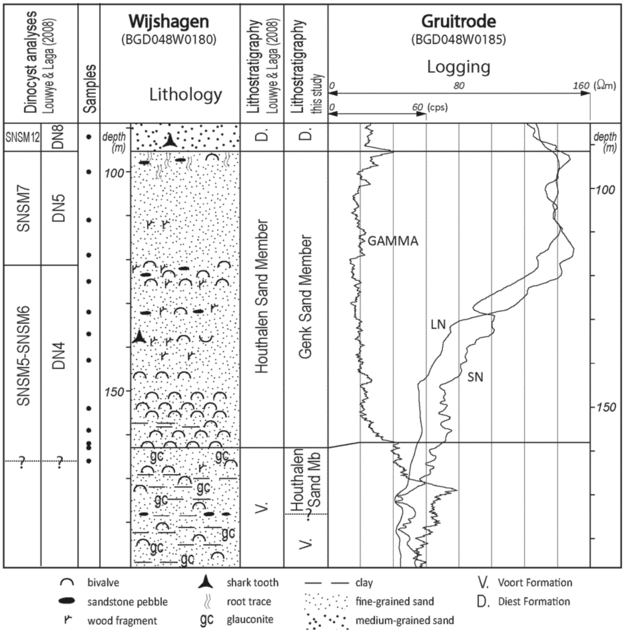
Lithology, log data, litho- and biostratigraphy of the section studied in the Wijshagen (left) and Gruitrode (right) boreholes. The location of these boreholes is indicated in Figure 1. Lithological descriptions and the biostratigraphic results are after Louwye & Laga (Reference Louwye and Laga2008).

The Wijshagen borehole was not logged. However, a 1371 m deep borehole with log data is located nearby at a distance of 650 m (Fig. 1) near the village of Gruitrode. Following the original stratigraphic interpretations (by M. Dusar in 1987), the Gruitrode borehole drilled through the bases of the Diest and Bolderberg Formations at similar depths as in the Wijshagen borehole, and therefore allows for good correlations between the latter boreholes and the integration of the log data from the first borehole with detailed lithostratigraphic descriptions of the latter borehole (Fig. 4).
4. The stratigraphical position of the Genk Sand Member in the Wijshagen borehole
Louwye & Laga (Reference Louwye and Laga2008) relied during their biostratigraphical and palaeoenvironmental study of the Diest and Bolderberg Formations in the Wijshagen borehole on the original lithostratigraphic interpretations provided by the Geological Survey of Belgium. In this section we will revise the previous lithostratigraphic interpretations based on lithological descriptions and log-signatures in the Wijshagen and Gruitrode boreholes, and existing literature data. The main criteria for the lithostratigraphic reinterpretations are the lithological descriptions, but other characteristics of lithostratigraphic units, such as geographic distribution, age and depositional setting, will also be considered.
4.a. Geographic distribution
The Bolderberg Formation is present in the subsurface and local outcrops in the central part of the RVRS (Fig. 1). The Bolderberg Formation in our study area is located in the western flank of the central part of the RVRS. Throughout the geographic distribution of the Bolderberg Formation, the subdivision between a lower Houthalen Sand Member and upper Genk Sand Member can be readily observed (Buffel et al. Reference Buffel, Claes and Gullentops2001). The northern boundary of the geographic distribution of the Bolderberg Formation, and therefore the Genk Sand member, was traditionally considered to be the so-called ‘Diest Gully’, a southwest–northeast-trending gully formed after the deposition of the Berchem and Bolderberg Formations, and completely eroded the latter formations in this area (cf. fig. 6 of Vandenberghe et al. Reference Vandenberghe, Harris, Wampler, Houthuys, Louwye, Adriaens, Vos, Lanckacker, Matthijs, Deckers, Verhaegen, Laga, Westerhoff and Munsterman2014; Fig. 1). Near this Diest Gully, the Genk Sand Member laterally passes northwards into green glauconitic sands with no or only scarce organic material. The Wijshagen and Gruitrode boreholes are located south of this facies transition, and therefore within the geographic distribution of the Genk Sand Member. We can therefore assume that the Wijshagen and Gruitrode boreholes penetrated both the Genk and Houthalen Sand members. This assumption does not accord with the lithostratigraphy followed by Louwye & Laga (Reference Louwye and Laga2008), where only the Houthalen Sand Member was present in the Wijshagen borehole.
4.b. Lithology
Following the stratigraphic definition by De Meuter & Laga (Reference De Meuter and Laga1976) and Laga, Louwye & Geets (Reference Laga, Louwye, Geets, Bultynck and Dejonghe2001), after Dumont (Reference Dumont1850), the Houthalen Sand Member consists of dark-green, medium fine-grained, slightly clayey, often very micaceous, very slightly ligniferous, fossiliferous and glauconiferous sand, while the Genk Sand Member consists of whitish, fine- to coarse-grained sand with gravel intercalations and the local presence of lignite layers and quartzite banks.
The section of the Bolderberg Formation in the Wijshagen borehole between 94 m and 163 m depth consists of pale grey to brown sands with some lignite layers and gravel intercalations (Fig. 4). This lithological description of this succession fits much better the lithological definition of the Genk Sand Member than that of the Houthalen Sand Member. The latter holds much more glauconite and less lignite. However, the locally abundant presence of shells in this section in the Wijshagen borehole (Fig. 4) is not mentioned in the definition of the Genk Sand Member by De Meuter & Laga (Reference De Meuter and Laga1976). Dissolution is a very common process in the so-called ‘silver sands’ such as the Genk Sand Member (Van Loon & Mange, Reference Van Loon, Mange, Mange and Wright2007), and this phenomenon can therefore possibly explain why they were not observed at other locations in the Genk Sand Member. From 163 m depth further down in the Wijshagen borehole, the sands become more glauconitic, clayey (Fig. 4) and dark green coloured and therefore better fit the description of the Houthalen Sand Member. However, the lithology of the Houthalen Sand Member and underlying Voort Formation is very similar, i.e. fine glauconitic dark green sands, which makes them difficult to distinguish from each other in case the basal gravel layer of the Houthalen Sand Member (Elsloo gravel; De Meuter & Laga, Reference De Meuter and Laga1976; Laga, Louwye & Geets, Reference Laga, Louwye, Geets, Bultynck and Dejonghe2001) is not present in a core. At 15 m below the upper boundary of the Houthalen Sand Member, i.e. at 178 m depth, a gravel layer was described in the Wijshagen borehole (Fig. 4). This gravel layer could possibly represent the basal gravel layer of the Houthalen Sand Member in the Wijshagen borehole.
The succession between 94 m and 163 m in the Wijshagen borehole, now lithostratigraphically interpreted as the Genk Sand Member, corresponds in the Gruitrode borehole to an interval of low gamma-ray and high, upwards-increasing, resistivity values (Fig. 4). The Houthalen Sand Member of the Wijshagen borehole below 163 m on the other hand correlates in the Gruitrode borehole with an interval of high gamma-ray and low resistivity values. The contrast in gamma-ray readings between the Houthalen and Genk Sand Member can be explained by the difference in clay and glauconite content, which are high in the first member and low in the latter. The contrast in resistivity can be explained by the coarser-grained nature of the Genk Sand Member compared to the Houthalen Sand Member. The lack of low-resistivity and very low gamma-ray intervals within the Genk Sand Member in the Gruitrode borehole (Fig. 4) indicates that no thick organic layers such as lignite seams are present within this unit in the study area, but that organic material can only be present in thin layers or dispersed within the sands, which is consistent with the lithological descriptions of the samples from the Wijshagen borehole.
The lithological descriptions and log data in the Wijshagen and Gruitrode boreholes indicate that the boundary between the Genk and Houthalen Sand Members is not sharp, but gradual by an upward decrease in glauconite content. Louwye & Laga (Reference Louwye and Laga2008) also did not report changes in the dinoflagellate cyst associations across this boundary in the Wijshagen borehole, i.e. between the samples taken at 162 m and 165 m. The gamma-ray and resistivity values indicate an overall cleaning/coarsening-upwards trend in the Bolderberg Formation from the presumed lower part of the Houthalen Sand Member onwards (Fig. 4). In the Genk Sand Member, the upwards-coarsening trend seems to coincide with an upwards decrease in the observation of bivalves.
4.c. Age
The dinoflagellate cyst analyses by Louwye & Laga (Reference Louwye and Laga2008) indicated that the interval between 94 m and 165 m depth, here reinterpreted as the Genk Sand Member, in the Wijshagen borehole has a late Burdigalian to early Serravalian age (Fig. 4). This age estimate for the Genk Sand Member agrees with the age of the up to 100 m thick brown coal seam (including the Morken and Frimmersdorf seams) in the Bergheim open cast in the southeastern part of the RVRS (Utescher et al. Reference Utescher, Ashraf, Dreist, Dybkjær, Mosbrugger, Pross and Wilde2012; Fig. 3). Lignite seams in the Dutch equivalent of the Genk Sand Member, called the Heksenberg Member (Vandenberghe et al. Reference Vandenberghe, Laga, Steurbaut, Hardenbol, Vail, de Graciansky, Hardenbol, Jacquin and Vail1998; Van Loon, Reference Van Loon2009; King, Reference King2016), are thought to be the lateral equivalent to the Morken and Frimmersdorf Seams (Van Adrichem Boogaert & Kouwe, Reference Van Adrichem Boogaert and Kouwe1997), and this finding corroborates our established age for the Genk Sand Member.
Since we reinterpreted the interval of 163 m to ≥178 m depth in the Wijshagen borehole as the Houthalen Sand Member, the latter must have a late Burdigalian and/or higher age following the dinoflagellate cyst analyses by Louwye & Laga (Reference Louwye and Laga2008). A Burdigalian age for the Houthalen Sand Member is in better agreement with previous studies (cf. Hooyberghs & De Meuter, Reference Hooyberghs and De Meuter1972; Martini & Müller, Reference Martini and Müller1973; De Meuter & Laga, Reference De Meuter and Laga1976; Wouters, Reference Wouters1978; Hooyberghs, Reference Hooyberghs1983; Hooyberghs & Moorkens, Reference Hooyberghs, Moorkens and Vinken1988; Willems, Laga & Moorkens, Reference Willems, Laga, Moorkens and Vinken1988; see Louwye & Laga, Reference Louwye and Laga2008; Fig. 2).
4.d. Depositional setting
The Houthalen Sand Member is considered to have been deposited in a marine environment, while the Genk Sand Member was traditionally thought to have been deposited mainly in a continental/fluviatile environment (De Meuter & Laga, Reference De Meuter and Laga1976).
Van Loon (Reference Van Loon2009), however, discussed that the fossil content and depositional structures in the Opgrimbie sand facies, i.e. the so-called ‘silver sands’ of the Genk Sand Member, suggested a shallow marginal or coastal marine depositional environment instead of a fluviatile depositional environment. Deckers (Reference Deckers2015) furthermore indicated on seismic sections that the Heksenberg Member, i.e. equivalent of the Genk Sand Member (Vandenberghe et al. Reference Vandenberghe, Laga, Steurbaut, Hardenbol, Vail, de Graciansky, Hardenbol, Jacquin and Vail1998; Van Loon, Reference Van Loon2009, King, Reference King2016), was deposited as a system of clinoforms as part of a northwest-prograding delta complex in the strongly subsiding centre of the central part of the RVRS, east of our study area. Deckers (Reference Deckers2015) showed that on log data of the Molenbeersel borehole (Fig. 1), the prograding delta complex was expressed by upwards-decreasing gamma-ray and increasing resistivity readings. The same log pattern is also present in the Genk Sand Member in the Gruitrode borehole (Fig. 4), which suggests that the northwest-prograding delta complex of Deckers (Reference Deckers2015) extended towards the western section of the central part of the RVRS or into the study area.
It can therefore be concluded that the depositional environment of the Genk Sand Member should not be considered as exclusively continental/fluviatile, but more likely as largely shallow, marginal marine as part of a delta system that progressively filled the RVRS. Indeed, organic-walled palynomorph associations indicate that the sediment interval between 94 m and 163 m depth in the Wijshagen borehole (Fig. 4), which we now reinterpret as the Genk Sand Member, was deposited in a marginal marine environment (Louwye & Laga, Reference Louwye and Laga2008). Furthermore the clay mineralogy of several samples of the Genk Sand Member in the Wijshagen borehole indicates a marine provenance signature (Adriaens, Reference Adriaens2015). Episodes with enhanced continental/fluviatile input, typically characterized by deposition of allochthonous organic material, were only short-lived (Louwye & Laga, Reference Louwye and Laga2008) in the Genk Sand Member of the Wijshagen borehole. We therefore propose that the purely fluviatile depositional environment should be rejected in the formal lithostratigraphic definition of the Genk Sand Member. The middle Miocene marine ingression even reached areas much further to the southeast (>40 km), and therefore landward of the study area, as expressed by the presence of shallow marine Frimmersdorf Sands and Neurath Sands in between the lignite seams in the southeastern part of the RVRS (see figs 7 and 8 of Schäfer et al. Reference Schäfer, Utescher, Klett and Valdivia-Manchego2005).
5. Consequences for the interpretation of the early to middle Miocene palaeoenvironment
After a hiatus around the Oligocene–Miocene boundary, the southern North Sea Basin was transgressed during the Burdigalian and covered by glauconitic shallow marine fine sands of the Edegem and Kiel Sand Members of the Berchem Formation in the Antwerp area (Louwye, Reference Louwye2005; Figs 1, 3). Previous studies (Hooyberghs & De Meuter, Reference Hooyberghs and De Meuter1972; Martini & Müller, Reference Martini and Müller1973; De Meuter & Laga, Reference De Meuter and Laga1976; Wouters, Reference Wouters1978; Hooyberghs, Reference Hooyberghs1983; Hooyberghs & Moorkens, Reference Hooyberghs, Moorkens and Vinken1988; Willems, Laga & Moorkens, Reference Willems, Laga, Moorkens and Vinken1988; Fig. 2) indicated that more or less simultaneously with the deposition of the Edegem and Kiel Sand Members in the Antwerp area, the Houthalen Sand Member was deposited in the central part of the RVRS (Fig. 3). Like the Edegem and Kiel Sand Member, the Houthalen Sand Member mainly consists of dark green clayey glauconitic sand. However, the local presence of lignite or wood fragments (e.g. at 168 m depth in the Wijshagen borehole; Fig. 4) testify to shallower, more proximal depositional settings for the Houthalen Sand Member compared to the open marine depositional settings of the Edegem and Kiel Sand Members.
A coarsening-upwards trend, caused by a diminishing clay content, is observed within the Houthalen Sand Member (Fig. 4) and suggests a progressive shallowing depositional environment during the Burdigalian. The upwards shallowing was most probably largely related to the progressive infilling of the RVRS from southeast to northwest, as indicated by northwest-prograding clinoforms on seismic data (Vandenberghe et al. Reference Vandenberghe, Harris, Wampler, Houthuys, Louwye, Adriaens, Vos, Lanckacker, Matthijs, Deckers, Verhaegen, Laga, Westerhoff and Munsterman2014; Deckers, Reference Deckers2015). The high input of clastic/continental material resulted in a decreasing amount of glauconite and an increasing amount of lignite, marking the gradual transition from the Houthalen Sand Member to the Genk Sand Member. The palynological analysis by Louwye & Laga (Reference Louwye and Laga2008) indicated that deposition of the greater part of the Genk Sand Member took place in a marginal marine environment, with limited pulses of short-lived enhanced continental input. These pulses of enhanced continental input agree with the presence of allochthonous, terrestrial debris such as small wood fragments in the Genk Sand Member in the Wijshagen borehole (Fig. 4). South of the study area or further in a landward direction, the pulses of continental/fluviatile input become more significant as indicated by the presence and progressive increase in the thickness of the lignite seams and decrease in the thickness of the intercalated shallow marine sands in a southeasterly direction across the RVRS (see figs 7 and 8 of Schäfer et al. Reference Schäfer, Utescher, Klett and Valdivia-Manchego2005; Figs 1, 3). Indeed, c. 20 km south of the study area in the Maasmechelen quarry (Fig. 1), a several metre thick lignite layer is present in the Genk Sand Member (Gullentops & Bastin, Reference Gullentops and Bastin1967; Dreesen, Mareels & Fries, Reference Dreesen, Mareels and Fries2006) that is underlain and overlain by sand layers with a clay mineralogy that reflects a continental provenance signature (Adriaens, Reference Adriaens2015). The Ville Formation in the southeastern part of the RVRS holds the thick lignite Morken, Frimmersdorf and Garzweiler Seams, intercalated by the transgressive shallow marine Frimmersdorf and Neurath sands (Figs 1, 3). The age of the Genk Sand Member in the Wijshagen borehole is thereby considered equivalent to the combined Morken and Frimmerdorf Seams and the intercalated Frimmersdorf Sands of the Ville Formation (Fig. 3). Some of the lignite in the Genk Sand Member might actually be lateral equivalent to the latter seams, as they extended far northwest into the central part of the RVRS. Adriaens (Reference Adriaens2015), for example, suggested that a lignite layer in the Genk Sand Member in the Maasmechelen quarry might represent the lateral extent of the Morken Seam.
Simultaneously with the deposition of the Ville Formation and Genk Sand Member in the southern and central parts of the RVRS, the glauconitic sands of the Antwerpen Sand Member of the Berchem Formation were deposited in the Antwerp area (Figs 1, 3). The high authigenic glauconite content in the Antwerp Sand Member (Odin et al. Reference Odin, Hunziker, Keppens, Laga and Pasteels1974; Vandenberghe et al. Reference Vandenberghe, Harris, Wampler, Houthuys, Louwye, Adriaens, Vos, Lanckacker, Matthijs, Deckers, Verhaegen, Laga, Westerhoff and Munsterman2014; Adriaens, Reference Adriaens2015) suggests that little clastic input reached the Antwerp area during the middle Miocene. Analyses based on marine palynomorphs furthermore showed that the Antwerpen Sand Member was deposited in a shallow, open marine and more distal environment (Louwye, Reference Louwye2005) than the Genk Sand Member. In the same way as the Genk Sand Member in the study area, the dinoflagellate cyst assemblages and the gastropods from the Antwerpen Sands Member in outcrops near Antwerp also indicate an upward shallowing of the depositional environment during the late Burdigalian to Langhian (Louwye et al. Reference Louwye, Marquet, Bosselaers and Lambert2010). In between the Antwerp area and the study area, the Zonderschot Sands (Fig. 1) were deposited as time equivalents of the Genk and Antwerpen Sand Members (Louwye, Reference Louwye2000; Fig. 3), differing from the latter only by a higher content of mica and ligniferous elements (Louwye, Reference Louwye2005). The Zonderschot Sands thereby form the transitional facies between the marginal marine Genk Sand Member and the open marine Antwerpen Sand Member.
Equivalents of the uppermost parts of the transgressive Neurath Sands and the Garzweiler Seam of the Ville Formation and of the upper part of the Antwerp Sand Member of the Berchem Formation are missing in the study area as the middle to late Serravalian corresponds to a hiatus in the Wijshagen borehole (see Louwye & Laga, Reference Louwye and Laga2008; Figs 3, 4). East of the study area in the Maaseik borehole, located in the central and stronger subsiding part of the RVRS (Fig. 1), middle to late Serravalian deposits are present (Vandenberghe et al. Reference Vandenberghe, Laga, Louwye, Vanhoorne, Marquet, De Meuter, Wouters and Hagemann2005). The absence of the middle to late Serravalian strata in the Wijshagen borehole can be related to either post-depositional uplift and erosion or non-deposition as a result of the relatively high position of the area compared to the stronger subsiding centre of the RVRS.
6. Conclusions
Due to its location, the presence of detailed lithological descriptions and biostratigraphic analyses, the Wijshagen borehole is important for our understanding of the changing Miocene depositional environment in the Roer Valley Rift System at the southern margin of the North Sea Basin. We stratigraphically reinterpreted the early to middle Miocene interval in the Wijshagen borehole based on several criteria, such as lithology, geographic distribution, depositional environment and age. All these criteria allow the reinterpretation of the Burdigalian glauconitic fine sands of the Houthalen Sand Member and the late Burdigalian to early Serravalian grey to brown lignite-bearing sands of the Genk Sand Member in the Wijshagen borehole. The transition from the Houthalen Sand Member towards the Genk Sand Member, or decrease in glauconite content and increase in lignite content, was gradual and probably related to increased input of clastic material in the Roer Valley Rift System. This increasing clastic input formed a northwest-prograding delta system that filled the Roer Valley Rift System and was expressed as an overall coarsening-upwards trend in the Genk Sand Member. The Genk Sand Member within this deltaic system was mainly deposited in a marginal marine environment with some pulses of continental input, as indicated by the palynological associations together with the presence of shells and autochthonous lignite. These pulses of continental input became more significant in a southeasterly direction where they resulted in progressively thicker lignite seams, grouped into the Ville Formation. The lignite content decreases in a northwesterly direction and the sands become more glauconitic as the Genk Sand Member passes in the more open marine Zonderschot and Antwerp Sand Members of the Berchem Formation.
Acknowledgements
We gratefully acknowledge financial support from the Land and Soil Protection, Subsoil, and Natural Resources Division of the Flemish Government. We would like to thank K. van Baelen for her work on the figures. We would also like to thank Dr T. Utescher and an anonymous reviewer for detailed and helpful comments.