Introduction
In this paper Vockerothempis, a new subgenus of Rhamphomyia Meigen (Diptera: Empididae: Empidinae), is erected for Rhamphomyia arakawae Matsumura and its allied species that are widely distributed in eastern Asia and North America. This subgenus is a further addition to the Asio–Nearctic disjunct distribution previously detected in the subgenus Calorhamphomyia Saigusa and the idei-umbilicata group of Rhamphomyia (Saigusa Reference Saigusa1963b, Reference Saigusa1964). Phylogenetic affinity of the new subgenus within Rhamphomyia, its zoogeography, and a brief historical review and difficulties of Rhamphomyia subgeneric classification are discussed. The subgenera Calorhamphomyia Saigusa, Orientomyia Saigusa, and Thalassempis Saigusa have been described previously from the eastern Palaearctic Region. This paper is the first part of a revision of the subgeneric classification of the genus Rhamphomyia on a world basis.
Material and methods
Pinned specimens were loaned to the author from the Canadian National Collection of Insects, Ottawa (CNC), the United States National Museum of Natural History, Washington (USNM) and the Zoological Museum of University of Helsinki. The type series of Rhamphomyia umbrosa Loew was examined by the author in the Museum of Comparative Zoology, Cambridge (MCZ). Measurements, illustrations, and photographs of heads, antennae, mouthparts, legs, male genitalia, and female terminalia were based on material macerated in a hot 10% KOH solution; those of wings (except length of wing in some cases) were based on slide-mounted material. In a few cases dried material was used and so mentioned in the text.
New type specimens have been deposited in CNC, USNM, and Kyushu University Museum, Fukuoka (KUMF). The following abbreviations are used in the descriptions: ad, anterodorsal; av, anteroventral; f, femur; pd, posterodorsal; pv, posteroventral; t, tibia.
Taxonomy
Rhamphomyia (Vockerothempis) subgen. nov.
Type species: R. arakawae Matsumura, 1915.
Etymology
The subgenus is named in honour of my dear colleague, Dr. J. Richard (Dick) Vockeroth, an outstanding Canadian dipterist and insect collector.
Diagnosis
Small- to moderately large-sized blackish brown Rhamphomyia having very long labrum and slender labella without posterior part of pseudotracheal trunk, posteriorly truncate female abdomen bearing short lobe-like cerci, and male genitalia characterized by cercus anteriorly fused with epandrial lamella, well-developed sheath-like hypandrium usually setose basally, and extremely long and slender frequently tape-like phallus.
Description
The following description is based on the named species, the new Nearctic species described in this paper, and several undescribed Asian species listed in “included species”.
Body, antennae, mouthparts, and legs blackish brown; body and legs dark grey to dark brown pollinose; wing often tinged with brown with small discal cell; bristles and hairs all black.
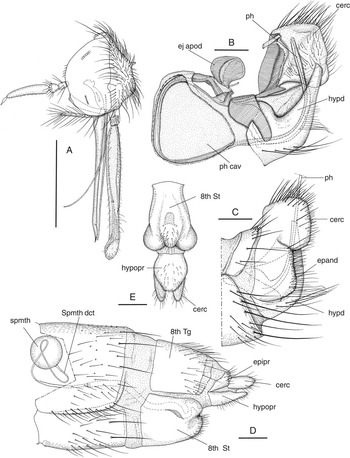
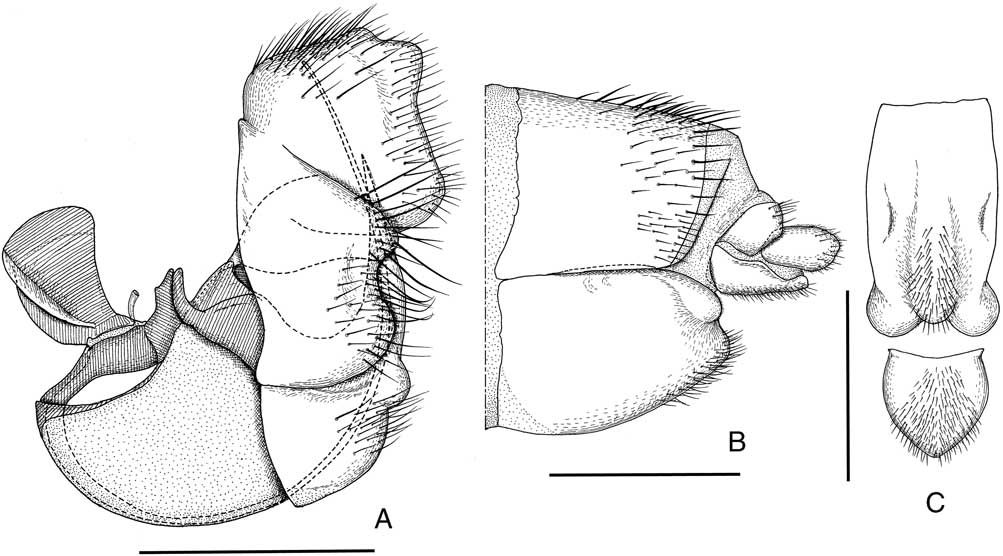
Head (Fig. 1A). Compound eyes holoptic, continuous for long distance on frons in male, widely dichoptic in female; upper facets of male eye considerably enlarged; ocellar tubercle prominent. Male bearing row of fine minute setulae along connecting line of eyes and on small triangle of frons above antennal sockets, most of setulae bent anteriorly near middle; female frons broad, 1/4–1/3 as wide as head, bearing row of straight setulae close to eye margin; face moderately wide and bare, with ventral part weakly produced forward; occiput more or less convex (occasionally moderately or strongly convex in females of some species), densely clothed with strong setae; postocular ciliation often not clearly differentiated from other strong occipital setae.
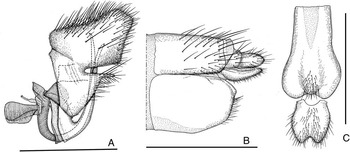
Rhamphomyia (Vockerothempis) arakawae Matsumura. A: male head; B: male genitalia, lateral aspect (left cercus and epandrial lobe removed, membranous phallobasal invagination partly cut); C: male genitalia partly with 8th abdominal segment, lateral aspect; D: female terminalia (showing spermatheca), lateral aspect; E: female terminalia (ventral elements), ventral aspect. Abbreviations: cerc, cercus; ej apod, ejaculatory apodeme; epand, epandrial lamella; epipr, epiproct; hypd, hypandrium; hypopr, hypoproct; ph, phallus; ph cav, phallobasal cavity; spmth, spermatheca; spmth dc, spermathecal duct; 8th St, 8th abdominal sternum; 8th Tg, 8th abdominal tergum. Scale bars = 1 mm in A; 0.2 mm in B–D.

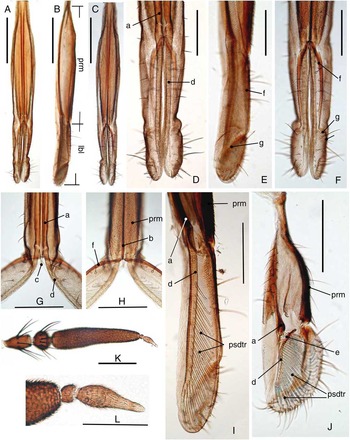
Antenna (Figs. 2K, 2L; 7A–7D) rather short or moderately long, 0.8–1.2 times as long as head; scape 1.3–2.6 times as long as globular pedicel, both bearing setae; postpedicel (or 3rd antennal segment) more or less elongate, 1.5–2.5 times as long as combined length of scape and pedicel, 2.7–6.2 times as long as vertically thick; stylus (Fig. 2L) with basal segment ordinarily small to minute, apical segment excluding apical component more or less fusiform, thickest at middle in most species (almost cylindrical in Rhamphomyia japonica Frey and Rhamphomyia calcarifera Saigusa).
Rhamphomyia (Vockerothempis) arakawae Matsumura, male (A–I, K–L) and Rhamphomyia (s. str.) vernalis Saigusa, male (J). A: labium, anterior aspect; B: ditto, lateral aspect; C: ditto, posterior aspect; D: labella, dorsal aspect; E: ditto, lateral aspect; F: ditto, ventral aspect; G: basal articulation of pseudotracheal trunk, dorsal aspect; H: basal articulation of basilabellar sclerite, posterior aspect; I: right labellum showing pseudotracheal system (left labellum removed); J: labium (left labellum removed showing pseudotracheal system); K: antenna; L: antennal stylus. a, sclerotized stripe of labial trough; b, median ridge of prementum; c, labellar process; d, anterior part of pseudotracheal trunk; e, posterior part of pseudotracheal trunk; f, basilabellar sclerite; g, distilabellar sclerite; lbl, labellum; prm, prementum; psdtr, pseudotracheal branch. Scale bars = 1 mm in A–C; 0.1 mm in D–H, K, L; 0.2 mm in I, J.

Labrum (Figs. 1, 2A–2C,) fairly long, slender and almost straight, 1.1–1.9 times as long as head height, longer in female than in male, directed ventrally; prementum very long and slender, 0.9–1.6 times as long as head height, with posterior outline only slightly arched in profile, and short setulose mostly along lateral margins; anterior membranous area in front of prementum bearing a few short setulae in row extending on to labellar area; labellum (Fig. 2D–2H) moderately long and rather slender, 0.3–0.6 times as long as prementum, both basilabellar and distilabellar sclerites very slender, with base of former articulated with median ridge of prementum (Fig. 2G); small sclerite anterior to base of basilabellar sclerite minute or absent; membranous outer surfaces of basi- and distilabellum bearing short setulae usually shorter than thickness of labellum in profile; pseudotracheal system (Figs. 2G, 2I, 2J; 7E, 7F, 7G) with pseudotracheal trunk lacking in more or less sclerotized posterior part, only very long anterior part present, extending to near tip of labellum; base of anterior part directly articulated with distal end of sclerotized stripe extending throughout lateral membranous wall of labial trough; 12–35 pseudotracheal branches, short and branching obliquely from pseudotracheal trunk beyond subbasal part. Maxillary palpus ca. 2/3 as long as head, usually slender and cylindrical, bearing long setae, rarely strongly compressed laterally with a few fine setae.
Thorax. Moderately robust as in subgenus Rhamphomyia, strongly bristled and haired. Chaetotaxy: Prosternum bare, proepisternum clothed with many setae, lateral area of antepronotum bearing a few strong setae; acrostichals and dorsocentrals fairly long, rarely short, biserial or irregularly triserial; acrostichals usually extending posteriorly to anterior margin of prescutellar depression, with pair of stronger prescutellar anteriorly directed bristles; dorsocentrals ending posteriorly in one to three strong bristles lateral to prescutellar depression (rarely strongly increasing in length and thickness towards very strong spine-like posterior bristles, directed outwardly in female of Rhamphomyia fortisetosa sp. nov.; Fig. 12D), dorsocentral row often obscured by many scattered setae dispersed anterolaterally from dorsocentrals to intrahumeral and posthumeral areas and to dorsal margin of notopleural depression (Fig. 8C, 8D, 8G, 8H); one, rarely two, strong humerals (postpronotals) accompanying many weaker setae, two to three strong dorsally directed notopleurals and two to three shorter laterally directed bristles along lateral margin and many shorter setae scattered on anterior part of depression; one strong anterior supra-alar and one weaker posterior supra-alar; one strong postalar with short setae in front; scutellars usually six, rarely four in number; laterotergal brush consisting of dense and long setae.
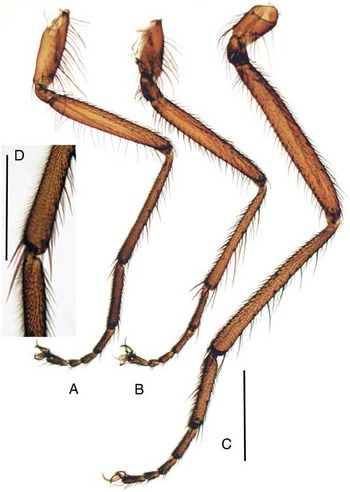
Legs (Fig. 3) moderately long and thick for Rhamphomyia. Femora short setose above; fore femur with av and pv rows of longish fine bristles; mid femur with av and pv rows of short stiff bristles; hind femur slightly thickened in some species, with av rows of bristles various in length by species, occasionally with pv row of shorter bristles, and bearing irregular row of long ad bristles or hairs often interrupted medially, and some dorsal bristles on apical 1/3. Fore tibia (Fig. 3D) densely covered with fine pile on anterior, ventral, and posterior surfaces, and bearing ad and pd rows of bristles and setae, former row often of very short setae, in addition fore tibia with circlet of several short apical bristles; mid tibia with ad and pd rows of two to four strong bristles and several strong apical bristles, and occasionally with similar pv row and av row of dense short spinules, occasionally mixing a few longer bristles; hind tibia bearing five to six ad and pd bristles including apical ones, densely clothed with subdecumbent setae beneath, one long anterior apical bristle just behind apical comb of setulae, and one long pv bristle; in R. calcarifera male hind tibia with anterior clump of a few strong bristles at 2/3. Tarsi short setose above, fore and mid tarsi densely covered with fine pile beneath (Fig. 3D; one undescribed Yunnan species setulose beneath on mid tarsomere 1), tarsomere 1 with a few dorsal bristles, basal four tarsomeres with apical bristles; fore unguis as long as 5th tarsomere; hind tarsus short setose, hind tarsomere 1 usually bearing a few ad, pd, av, and pv bristles, and in some species slightly incrassate; hind tarsomeres 2–4 with apical bristles.
Legs of Rhamphomyia (Vockerothempis) arakawae Matsumura, male. A: foreleg; B: midleg; C: hindleg; D: tibio-tarsal area of foreleg showing ventral pile. Scale bars = 1 mm in A–C; 0.5 mm in D.

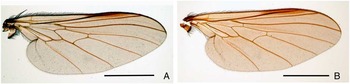
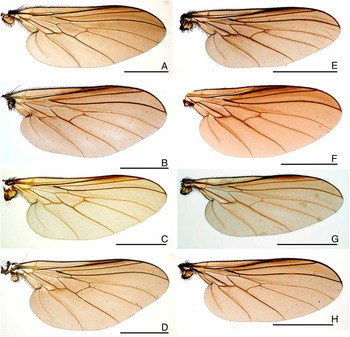
Wing (Figs. 4, 10) broad, 0.34–0.45 times as wide as long, usually broader in female than in male, slightly greyish to dark brown, with basal part sometimes yellowish tinged; pterostigma distinct, long, broad, and dark brown, extending from middle of R1 to near tip of R2 + 3. Alula well developed, gradually widened towards subapical area, usually as wide as or slightly wider than width of cell cua (traditional anal cell); axillary incision deep; anal lobe of wing widely developed, roundly produced proximally, basal margin overlapping or touching apical margin of alula; basal cells short, apex of first basal cell at basal 0.31–0.39 of wing; discal cell short, 0.42–0.54 times as long as distal section of M1 (first vein from cell), and distinctly tapered apically beyond middle, distal end of discal cell at basal 0.48–0.52 of wing; crossvein m-m (vein obliquely closing discal cell) fairly oblique, 0.8–1.5 times as long as middle section of M4; cell cua (traditional “anal” cell or cell cup) rather bluntly ended, not strongly tapered as in many Rhamphomyia species; middle section of vein CuA (recurrent vein closing cell cua) short, 0.8–1.1 times as long as crossvein m-cu and usually weakly arched outwardly; vein CuA + CuP (traditional “anal” vein) strong throughout entire length to wing margin, and base clearly connected to cell cua (usually without connection to cell in Rhamphomyia, except Rhamphomyia (Eorhamphomyia) spinipes (Fallén) and some species of subgenus Dasyrhamphomyia Frey, etc.). Halter usually dark brown, occasionally whitish (R. japonica and an undescribed Japanese species).
Wings of Rhamphomyia (Vockerothempis) arakawae Matsumura. A: male; B: female. Scale bar = 2 mm.

Abdomen. Moderately long and thick, more slender than in subgenus Rhamphomyia. Abdominal terga densely short setose; terga 1–6 bearing posterior row of strong bristles longer on lateral part; sternum 1 bare, sterna 2–6 each with a pair of strong bristles and some short setae. In male terga and sterna 1–7 normal in shape and structure; tergum 8 (Fig. 1C) longitudinally very short, 1/4–1/3 as long as tergum 7, and bearing posterior marginal bristles; sternum 8 (Fig. 1C) fairly large, usually slightly shorter and higher than sternum 7, sparsely short setose and bearing posterior marginal row of strong bristles; tergum and sternum 8 almost touching but separated from each other by narrow membranous area.
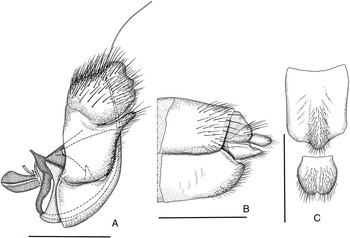
Male genitalia (Figs. 1B, 1C, 6A, 9A, 11A, 13A). Cercus usually moderately large, either triangular, oval, or subquadrate and sometimes weakly or distinctly (in R. japonica) produced posterodistally, rarely prolonged dorsally as hemicylindrical or spoon-like lobe; dorsal margin of cercus short setose, rarely bearing many spinules on mesal surface along dorsal margin; ventroproximal area of cercus completely fused with dorsoproximal area of epandrial lamella leaving no distinct membranous border between them. Epandrial lamella subquadrate or inverted subtriangular, occasionally produced distally into digitate process; epandrial lamella usually shorter than deep, with distal end not reaching distal end of cercus, and with long setae along distal margin; epandrial lamella anteroventrally articulated with anterolateral corner of hypandrium; hypandrium usually exceptionally large for Rhamphomyia, similar in shape to that of Hilara Meigen but smaller, in lateral aspect triangular, often gradually membranous anteroventrally, becoming tapered to rather pointed tip that may be bifid; hypandrium usually bearing short to fairly long setae in basal area; mesal surface of hypandrium forming groove for phallic sheath; membranous phallobasal cavity invaginated anteriorly into abdomen in various depths by length of phallus; phallus fairly long to very long, slender or extremely slender throughout entire length, often flattened tape-like; ejaculatory apodeme moderately large, with horizontal lamellae various in its position to vertical lamella.
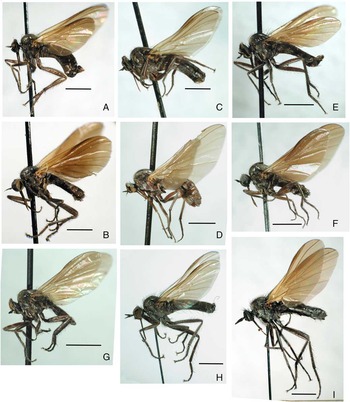
Rhamphomyia (Vockerothempis) spp. A: Rhamphomyia (V.) umbrosa Loew, male; B: ditto, female; C: Rhamphomyia (V.) brevisetosa, sp. nov., holotype male; D: ditto, paratype female; E: Rhamphomyia (V.) chillcottiana sp. nov., holotype male; F: ditto, paratype female; G: Rhamphomyia (V.) fortisetosa sp. nov., paratype male; H: Rhamphomyia (V.) arakawae Matsumura; I: ditto, female. Scale bar = 2 mm.

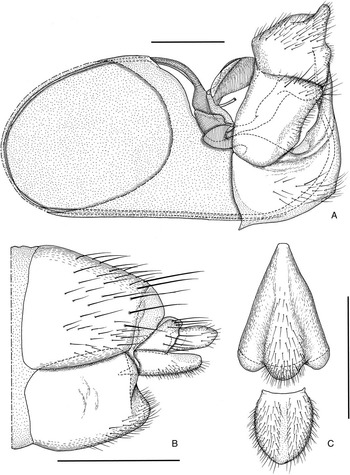
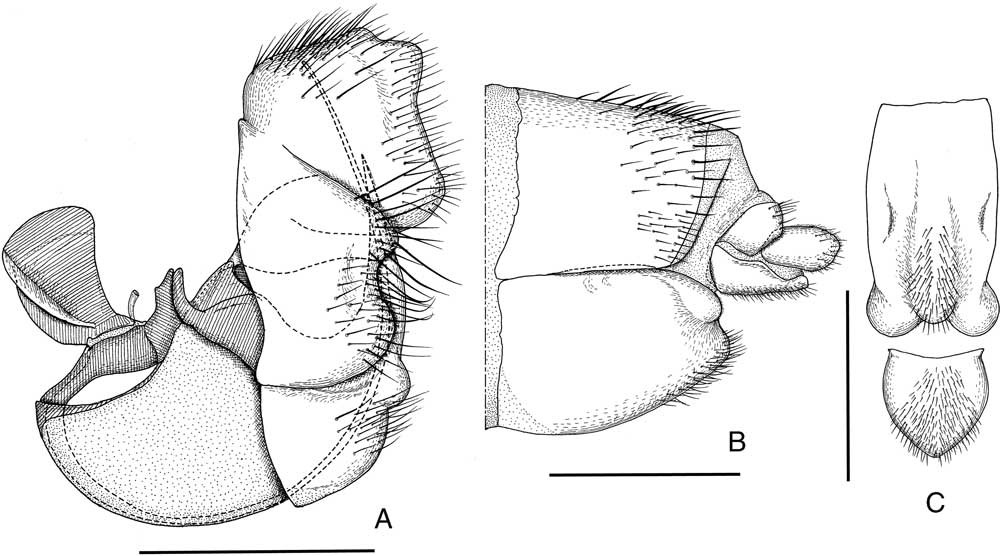
Rhamphomyia (Vockerothempis) umbrosa Loew. A: male genitalia, lateral aspect (membranous phallobasal invagination partly cut); B: female terminalia, lateral aspect; C: ditto, ventral aspect (above, 8th sternum; below, hypoproct). Scale bar = 0.5 mm.

Female terminalia (Figs. 1D, 1E, 6B, 6C, 9B, 9C, 11B, 11C, 13B, 13C). Slightly tapered from middle to 8th abdominal segment, with posterior margin truncate; 8th abdominal segment slightly more slender than 7th segment; tergum similar to those of preceding segments in shape, and bearing strong bristles on hind margin; sternum 8 similar to tergum in shape and size, extensively naked and polished, posterior margin usually more or less produced or angled and usually pollinose sublaterally, ventromedian area of sternum 8 longitudinally swollen and clothed with fine short hairs, and roundly produced posteriorly; 9th + 10th abdominal segment much smaller than 8th, height nearly 1/2 of latter height, tergal element, epiproct, longitudinally shorter than 1/4 length of tergum 8, bearing weak setae along posterior margin; sternal element, hypoproct, oval to pentagonal in shape, produced posteriorly beyond posterior margin of epiproct, and clothed with short fine hairs mostly on posterior area, epiproct, and hypoproct close to but separated from each other laterally; cercus lobe-like, short, oval to bluntly triangular in shape, and lamellate (not cylindrical as in other species of Rhamphomyia), close to posterior margin of epiproct, and bearing a few fine short hairs.
Included species
Rhamphomyia arakawae Matsumura (Hokkaido, Honshu, Shikoku, Kyushu)
Rhamphomyia calcarifera Saigusa (Honshu, Kyushu)
Rhamphomyia japonica Frey (Hokkaido, Honshu, Shikoku, Kyushu)
Rhamphomyia umbrosa Loew (eastern North America)
Rhamphomyia (Vockerothempis) brevisetosa sp. nov. (western North America)
Rhamphomyia (Vockerothempis) chillcottiana sp. nov. (eastern North America)
Rhamphomyia (Vockerothempis) fortisetosa sp. nov. (eastern North America)
In addition to the above-described species, the following examined but undescribed species of Vockerothempis are recognized.
Rhamphomyia arakawae group
species 1. Ussuri, Korea, Japan (Hokkaido, Honshu, Shikoku)
species 2. Ussuri, Korea, Japan (Hokkaido, Honshu, Kyushu)
species 3. Japan (Hokkaido)
species 4. Japan (Honshu, Shikoku, Kyushu)
Rhamphomyia japonica group
species 5. Japan (Kyushu) (not much close to R. japonica)
Species group with flattened palpi
species 6. Japan (northern Honshu) (possibly belongs to arakawae group based on male genitalia)
Species group with enlarged male cerci (probably heterogeneous)
species 7. Japan (Kii Peninsula of Honshu)
species 8. Taiwan (north and central mountain regions)
species 9. China (southern Yunnan)
Species represented by females only (unresolved group assignment to groups)
species 10. eastern Siberia (southern Yakutia)
species 11. China (Fukien) (Saigusa Reference Saigusa1966: 913)
species 12. northeastern Myanmar (Kambaiti)
species 13. eastern Nepal (Taplejung)
species 14. central Nepal
Remarks
The species of Vockerothempis run to the subgenera Alpinomyia Frey and Collinaria Frey in the key to subgenera of Rhamphomyia in Frey (Reference Frey1949). One of the included species, R. japonica, was assigned to Collinaria in the original description. The new subgenus is, however, easily discriminated from Alpinomyia and Collinaria by the long and slender labrum and labium, the male genitalia having the cerci fused with epandrial lamellae proximally and the extremely slender, often tape-like phallus, and the female postabdomen truncate distally with short lobate cerci. The combination of these characters also distinguishes Vockerothempis from all other known subgenera of Rhamphomyia.

Descriptions of Nearctic species
Rhamphomyia (Vockerothempis) brevisetosa sp. nov.
(Figs. 5C, 5D, 7C, 7F, 8C, 8D, 8G, 8H, 9, 10C, 10D)
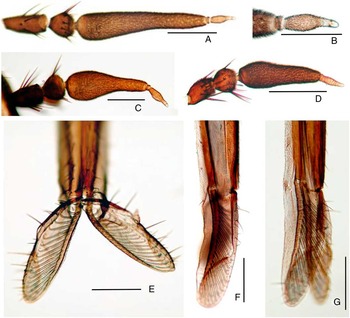
Rhamphomyia (Vockerothempis) spp., male; A–D: antenna; E–G: labella showing pseudotracheal system. A: Rhamphomyia (V.) umbrosa Loew; B: ditto, stylus; C: Rhamphomyia (V.) brevisetosa sp. nov., paratype (stylus partly broken); D: Rhamphomyia (V.) chillcottiana sp. nov., paratype; E: R. (V.) umbrosa Loew; F: R. (V.) brevisetosa sp. nov., paratype; G: R. (V.) chillcottiana sp. nov., paratype. Scale bars = 0.5 mm in A, C, D; 0.1 mm in B; 0.2 mm in E–G.

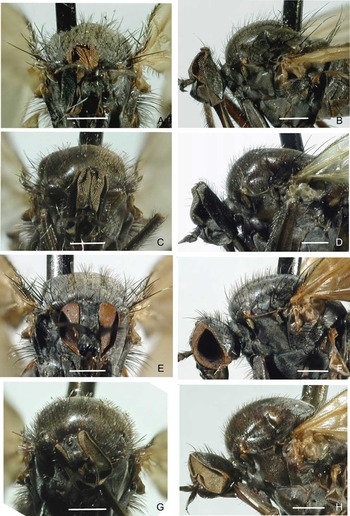
Thorax of Rhamphomyia (Vockerothempis) spp. showing length of dorsal setae; left row: anterior aspect; right row: lateral aspect. A, B: Rhamphomyia (V.) umbrosa Loew, male; C, D: Rhamphomyia (V.) brevisetosa sp. nov., holotype male; E, F: R. (V.) umbrosa Loew, female; G, H: R. (V.) brevisetosa sp. nov., paratype female. Scale bar = 0.5 mm.

Rhamphomyia (Vockerothempis) brevisetosa sp. nov. A: male genitalia of paratype, lateral aspect; B: female terminalia of paratype, lateral aspect; C: ditto, ventral aspect (above, 8th sternum; below, hypoproct). Scale bar = 0.5 mm.
Wings of Rhamphomyia (Vockerothempis) spp. A: Rhamphomyia (V.) umbrosa Loew, male; B: ditto, female; C: Rhamphomyia (V.) brevisetosa sp. nov., holotype male; D: ditto, paratype female; E: Rhamphomyia (V.) chillcottiana sp. nov., paratype male; F: ditto, paratype female; G: Rhamphomyia (V.) fortisetosa sp. nov., paratype male; H: ditto, holotype female. Scale bar = 2 mm.

Type material
Holotype ♂, labelled: Mt. Rainier/Wn/Summerland Trl/24 July 1924/A.L. Melander (USNM). Paratypes:CANADA: British Columbia: 1 ♀, Agassiz, 6.V.1927, H.H. Ross (CNC). USA: Washington: 2 ♂♂, same data as holotype (USNM, CNC); 1 ♂, Mt. Rainier, Narada Falls, 16.VIII.1917, A.L. Melander (KUMF); 1 ♀, Mt. Baker, Skyline Ridge, 10.VIII.1925, A.L. Melander (USNM).
Etymology
The specific name brevisetosa is based on the short acrostichal and dorsocentral setae.
Diagnosis
Large-sized species, with antenna slightly shorter than head, short-setose thoracic nota, greyish brown wings, subquadrate black male cercus and moderately long phallus.
Description
Male (Fig. 5C). Body 6.0–6.9 mm; wing 5.9–6.8 mm. Body blackish brown. Head dark brown pollinose; antenna black, frons and face dark brown pollinose; thoracic nota densely dark brown pollinose, notal pollinosity more velvety-like than in R. umbrosa; pleura dark brown and brown pollinose, subshining; legs dark brown to blackish brown, thinly pollinose; wing greyish brown, not so dark as in umbrosa, with basal area slightly pale; halter dark brown with brown shaft; abdomen dark brown to blackish brown, with anterior sterna more or less lighter, thinly dark brown pollinose, subshining; male genitalia entirely blackish brown including cercus, dark brown pollinose.
Head. Similar to R. umbrosa, 1.32 times as high as long (1 ♂); curved setulae throughout continuous line of compound eyes; occiput vestiture slightly weaker than in umbrosa; ocellar bristles weak, 2 times as long as ocellar tubercle height. Antenna (Fig. 7C) shorter, 0.9 times as long as head, postpedicel rather short, 1.5 times as long as basal two segments together, 2.7 times as long as thick (2.3–3.0 times as long as thick in dried specimens), strongly tapered beyond middle; stylus slightly longer than 1/3 length of postpedicel. Labrum 1.5 times as long as head height; prementum 1.4 times as long as head height; labellum slender (Fig. 7F), 1/3 as long as prementum and with 18 pseudotracheal branches.
Thoracic chaetotaxy (Fig. 8C, 8D). Vestiture on thorax shorter than in umbrosa; acrostichals and dorsocentrals short and hair-like, irregularly biserial, former ending with prescutellar bristle as long as scutellum; dorsocenral row obscured in presutural area by dense setae spreading from row to humeral and notopleural areas; dorsocentral setae at middle of row 0.1 times as long as thoracic width (160–180 μm); dorsocentrals ending in strong bristle; humeral (postpronotal) bristle very weak, 1.5–2 times as long as surrounding fine setae; posthumeral and intra-alar areas in presutural part widely clothed with dense short setae weaker and denser than in R. umbrosa, and without any prominent bristles; two to four notopleural bristles, longest 1/4–1/3 as long as thoracic width, notopleural depression with a few weaker bristles along lateral margin and short hairs on anterior part; one to two supra-alar and one postalar bristles weaker than in R. umbrosa; scutellum with six bristles with one to two additional short setae, inner pair 2 times as long as scutellum.
Legs. Including vestiture similar to umbrosa, but weaker; t2 without ventrodistal group of dense stiff minute setae; f3 with av row of bristles as strong as in umbrosa.
Wing (Fig. 10C). Broad, 2.5–2.6 times as long as wide, with deep axillary incision, well-developed alula slightly wider than cell cua, with distal margin overlapping well-developed anal lobe; stigma extending slightly beyond middle between tips of R1 and R2 + 3. First basal cell ending beyond 1/3 of wing (0.39); discal cell ending before middle of wing, 0.18–0.19 times as long as wing, 0.40–0.45 times as long as M1; m-m crossvein 1.0–1.2 times as long as middle section of M4 (posterior marginal vein of cell); cell r2 + 3 distinctly narrow, less than 1/2 as wide as cell r4 + 5 at level of tip of R1; cell cua rather obtusely ended.
Abdomen. Similar to R. umbrosa, hairs and bristles weaker and shorter; sternum 2 always setose; posterior pair of bristles on sterna 3–7 rather weak, 1/2–2/3 as long as each sternum; sternum 8 with hind marginal bristles weaker, shorter, and more numerous than in R. umbrosa.
Genitalia (Fig. 9A). Cercus subquadrate in shape, with posterior margin weakly roundly produced subapically, densely and rather strongly setose along dorsal margin and sparsely short setose on posterior 1/2; epandrial lamella 2 times as deep as long, with posterior margin shallowly emarginate, bearing setae along posterior margin, those on dorsal part strong; hypandrium 1/2 as deep as epandrium on basal part in lateral view, apical part curved dorsally and evenly tapered to tip, ending at middle of cercus, hypandrium setose on broad ventral area; phallus moderately long, membranous invagination around phallobase rather shallow.
Female (Fig. 5D). Based on two dried specimens, except for macerated terminalia. Body 5.8–5.9 mm; wing 6.5–6.9 mm. Similar to male, hairs and bristles shorter.
Head. Frons wide, parallel-sided, 1.2–1.6 times as wide as distance between lateral ocelli, thinly brown pollinose, with short setulae along eye margin. Antenna with postpedicel 2.3 times as long as thick. Labrum 1.6–1.8 times as long as head height (head height measured on shrunken head, labrum length does not include extreme base).
Thoracic chaetotaxy (Fig. 8G, 8H). Much shorter than in male, dorsocentral setae near middle of row 60–90 μm. Wing (Fig. 10D): darker than in male, 2.5 times as long as wide, first basal cell ending beyond 1/3 of wing (0.39–0.4); discal cell ending at middle of wing, 0.2 times as long as wing, 0.45–0.48 times as long as M1; m-m crossvein 1.0–1.2 times as long as middle section of M4; cell r2 + 3 distinctly narrow, less than 1/2 as wide as cell r4 + 5 at level of tip of vein R1; cell cua rather obtuse apically.
Abdomen. Dark brown, thinly brown pollinose, subshining, with vestiture much shorter than in male.
Terminalia (Figs. 9B, 9C). Tergum 8 bearing weak posterior marginal bristles ca. 1/4 as long as tergum; sternum 8 with posterior margin rather narrow, weakly, and roundly produced posterolaterally, swollen part occupying about 2/3 of posterior margin in lateral view; hypoproct oval with apical margin roundly produced; spermatheca not pigmented.
Distribution
This species occurs in temperate western North America (British Columbia to Washington).
Remarks
This species somewhat resembles R. umbrosa in body size, but is easily distinguished from the latter by the shorter and denser vestiture on the mesonotum in both sexes. The male genitalia of this species are quite different from those of R. umbrosa in the quadrate cercus densely setose dorsally and much shorter phallus.
As far as the collections that I have examined, this species is the only representative of the subgenus Vockerothempis in western North America.
Rhamphomyia (Vockerothempis) chillcottiana sp. nov.
Type material
Holotype ♂, labelled: Highlands/N. C. 3800′/29.V. 1957/J.R. Vockeroth; at light/during/heavy rain; Colot. 3 (CNC). Paratypes:USA: North Carolina: 1 ♀, Wallace Gap, Macon Co., 3000′, 6.VI.1965, J.G. Chillcott, on flowers of Aruncus (CNC); 1 ♀, Soco Gap, Haywood Co. 3200′, 4.VI.1962, J.G. Chillcott, on blossoms of Chrysanthemum/Leucanthemum (CNC). Virginia: 1 ♂, 1 ♀, Bald Knob, 3.VI.1962, Summit 4350′, Giles Co., J.G. Chillcott (CNC); 4 ♀♀, Mountain Lk., Giles Co., 3800′, 31.V.1962, J.G. Chillcott, blossoms of Rubus allegheniensis Porter (Rosaceae) (CNC, USNM, KUMF).
Etymology
Specific name chillcottiana is in honour of the late Dr. J.G. Chillcott, an outstanding Canadian dipterist and one of the collectors of this species.
Diagnosis
Small-sized species with antennae shorter than head, long setose thoracic nota, evenly dark brown wings, posteroventrally bristled mid tibiae, quadrate male cerci as large as apically digitate epandrial lamellae, female mesonotum characterized by two to three extremely strong posteromost dorsocentral bristles, and spherical female head.
Description
Male (Fig. 5E). Body 5.3–5.5 mm; wing 5.1–5.2 mm. Body blackish brown. Head dark brown pollinose, antenna black, labrum and labium blackish brown, frons and dorsal 1/2 of face brown pollinose; thoracic nota densely blackish brown pollinose, pleura slightly tinged brownish and dark brown pollinose; legs blackish brown and thinly dark brown pollinose; wing including veins uniformly dark brown, stigma blackish; halter blackish brown with brown shaft; abdomen including genitalia blackish brown, moderately dark brown pollinose, more or less subshining; abdominal sterna more brownish near thorax.
Head. More or less hemispherical, 1.3 times as high as long, in profile occipital area only weakly swollen, 1/3 as long as compound eye area; compound eyes touching on frons for distance slightly shorter than 1/2 length of frons; a few minute setulae on frons along narrow line of eye separation; ocellar bristles 2 times as long as thickness of ocellar tubercle; occipital setae almost as in R. umbrosa. Antenna short, 3/4 as long as head, postpedicel 1.7 times as long as combined length of two basal segments, 3 times as long as thick, thickest at basal 1/4, then gradually tapered to tip; stylus 1/3 as long as postpedicel. Labrum short, 1.3 times as long as head height; prementum 1.2 times as long as head height, labellum 0.4 times as long as prementum and with 12 pseudotracheal branches.
Thoracic chaetotaxy. Fairly long, similar to R. umbrosa, acrostichals and dorsocentrals biserial, former with pair of prescutellar bristles slightly shorter than scutellum, dorsocentals as long as acrostichals, gradually longer posteriorly, ending in two very strong bristles 1/2 as long as thoracic width; middle dorsocentral setae 0.15–0.17 times as long as thoracic width (190–200 μm); one fairly strong humeral (postpronotal) with many longish setae; posthumeral and prescutellar intra-alar areas sparsely clothed with setae as long as anterior dorsocentrals, without strong bristles; notopleural depression with two to three strong bristles, of which longest is 2/3 as long as thoracic width; two supra-alars and one postalar very strong; scutellum with four strong scutellars accompanying one to two fine setae laterally. Propleural and laterotergal setae dense and black.
Legs. Vestiture similar to R. umbrosa; t2 with pv row of short strong bristles mixed with two to three bristles longer than thickness of t2, without ventrodistal group of minute spine-like bristles; f3 with av row of bristles stronger than in R. umbrosa and 3/4 as long as thickness of f3.
Wing (Fig. 10E). More or less elongate, 2.7 times as long as wide, axillary incision deep; alula well-developed, slightly broader than cell cua, with distal margin touching moderately developed axillary lobe. Wing dark brown, only slightly paled basally and with blackish stigma extending beyond middle of tips of R1 and R2 + 3; tip of first basal cell at basal 0.37 of wing, discal cell ends at near middle of wing, 0.22 as long as wing, 0.54 as long as M1, rather strongly tapered to apex; m-m crossvein slightly longer than 1.3 times off middle section of M4. Halter blackish brown with dark brown shaft.
Abdomen. Clothed with long bristles and hairs on sides and posterior marginal area of terga, longest lateral bristles as long as tergum; sterna 2–7 with pair of posteroventral bristles as long as sternum; sternum 8 with many hind marginal bristles as long as sternum.
Genitalia (Fig. 11A). Cercus large, subquadrate, directed posterodorsally, with posterodorsal corner rounded, posterior margin weakly dentate at middle, extensively setose and densely clothed with stiff setae along dorsal margin; epandrial lamella almost as large as cercus, produced into digitate dorsodistal projection; hypandrium basally 2/3 as high as epandrium, prolonged into long slender apical part, extending to near dorsal margin of cercus; hypandrium without setae; phallus very long, apical half very fine and filamentous.
Rhamphomyia (Vockerothempis) chillcottiana sp. nov. A: male genitalia of paratype, lateral aspect; B: female terminalia of paratype, lateral aspect; C: ditto, ventral aspect (above, 8th sternum; below, hypoproct). Scale bar = 0.5 mm.

Female (Fig. 5F). Body 5.2–5.7 mm; wing 6.0–6.3 mm. Similar to male, but differing as follows.
Head. 1.2 times as high as long, in profile occipital area 1/2 as long as compound eye area; compound eye 1.7 times as high as long; frons 1/3 as wide as head; frons greyish brown pollinose, with several short setae along eye margin. Antenna short, 0.9 times as long as head, postpedicel 1.5 times as long as combined length of basal two segments, 2.8 times as thick as long (in dried specimens 2.1–2.6 times as long as thick); stylus 0.4 times as long as postpedicel. Labrum 1.6 times as long as head height (in dried specimen 1.9 times as long as head height); prementum 1.4 times as long as head height; labellum 1/3 as long as prementum with 12 pseudotracheal branches.
Thoracic chaetotaxy. Similar to male, but notal bristles and hairs mostly shorter but stronger; dorsocentrals represented by continuous row of setae to anterior margin of prescutellar depression and posteromost bristle apart from row situated close to scutoscutellar suture; two to three posterior bristles of continuous row extremely long, thick and spine-like, 0.55–0.6 times as long as thoracic width, usually stronger than prescutellar dorsocentral; scutellum with five to six bristles.
Legs. Almost as in male.
Wing (Fig. 10F). Broader and darker than in male; 2.2–2.3 times as long as wide, apex of first basal cell at basal 0.35–0.36 of wing; discal cell ending at middle of wing, 0.22–0.23 times as long as wing, 0.48–0.52 times as long as M1; cell r2 + 3 1/3 as wide as cell r4 + 5 at level of tip of R1.
Abdomen. Almost as in male in colouration and pollinosity, but vestiture shorter and weaker.
Terminalia (Fig. 11B, 11C). Posterior marginal setae on tergum 8 weak, 1/3 as long as tergum; in lateral aspect sternum 8 with ventral margin curved dorsally towards posteroventral corner, posterior margin short and simple, without dorsolateral swellings, ventral area of sternum 8 rather weakly raised; hypoproct roughly oval in shape, with weak notch on posterior margin; spermatheca dark brown.
Distribution
This species occurs in eastern North America, from Virginia to North Carolina.
Remarks
This new species is easily distinguished by its small size, in addition to the combination of male genitalia with a digitate projection of epandrial lamellae, female abdominal sternum 8 without posterolateral swellings, and very strong dorsocentral bristles in the female.
Rhamphomyia (Vockerothempis) fortisetosa sp. nov.
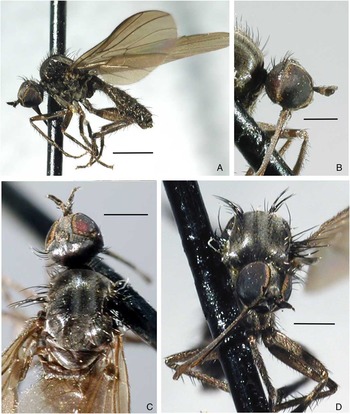
Rhamphomyia (Vockerothempis) fortisetosa sp. nov., holotype female. A: lateral aspect; B: head, lateral aspect; C: head and thorax, dorsal aspect; D: head and thorax, anterior aspect showing divergent strong dorsocentral bristles and short acrostichal setae. Scale bars = 1 mm in A; 0.5 mm in B–D.

Rhamphomyia (Vockerothempis) fortisetosa sp. nov. A: Male genitalia of paratype, lateral aspect; B: female terminalia of holotype, lateral aspect; C: ditto, ventral aspect (above, 8th sternum; below, hypoproct). Scale bar = 0.5 mm.

Type material
Holotype ♀, labelled: Highlands, 3800′, N. C., 3.vi.1957, J.R. Vockeroth (CNC). Paratype:USA: North Carolina: 1 ♂, Highlands, 3800′, 4.VI.1962, at light during heavy rain, J.R. Vockeroth (CNC).
Etymology
The specific name fortisetosa is based on the extremely strong posterior dorsocentral bristles in the female.
Diagnosis
Small-sized species similar to R. chillcottiana, but distinguished from it in female by elongate head in profile, more or less hump-backed mesonotum bearing a posterior group of densely set some 10 long thick spine-like dorsocentral bristles directed dorsolaterally and a group of some 10 strong spine-like notopleural bristles, and in the male by very large cercus and shorter and thicker phallus; supra-alar bristle very weak or absent.
Description
Male (Fig. 5G). Described from dried, teneral paratype male. Body 3.9 mm; wing 5.0 mm. Colouration and pollinosity almost as in female.
Head. Compound eyes touching on frons for 1/3 its length, with upper facets much enlarged; a few minute hairs on frons; occipital setae as in female. Postpedicel as long as combined length of two basal antennal segments, 1.4 times as long as thick; stylus 0.6 times as long as postpedicel. Labrum 1.3 times as long as shriveled head height.
Thoracic chaetotaxy. Similar to female, but dorsocentral row not differentiated as in female, but gradually lengthened posteriorly; notopleural bristles well developed as in female, but slightly weaker. Legs as in female.
Wing (Fig. 10G). 2.7 times as long as wide; development of alula and degree of axillary incision as in female; first basal cell slightly beyond basal 1/3 of wing; discal cell ending at middle of wing, 0.22 times as long as wing, 0.46 as long as M1, m-m crossvein as long as middle section of M1.
Abdomen. Longer setose than in female.
Genitalia (Fig. 13A). Cercus very large, long pentagonal, dorsal margin long, bearing dense long setae, dorsodistal margin short, posterior margin short setose; epandrial lamella triangular and produced into slender digitate distal process bearing longish bristles; hypandrium small, strongly curved dorsally from subbasal part, gradually tapered to pointed tip, reaching middle of cercus; phallus moderately long and rather thick for this subgenus.
Female (Fig. 12). Description based on the dried holotype female that of terminalia on macerated abdomen. Body 3.6 mm; wing 4.5 mm. Body dark brown to blackish brown. Head blackish brown, frons, face and occiput dark greyish brown pollinose. Antenna black, scape and pedicel dark brown. Thoracic notum blackish brown, rather densely dark greyish brown pollinose, when viewed from above pair of obscure lighter stripes appearing between acrostichals and dorsocentral row (Fig. 12C); pleura and legs dark brown, greyish brown pollinose; wing uniformly dark brown, stigma and veins darker; halter dark brown with brownish shaft; abdomen dark brown, very thinly greyish brown pollinose, subshining.
Head (Fig. 12B). Distinctly elongate, slightly longer than deep, 1.1 times as long as high; in profile occipital area 1/2 as long as compound eye area; compound eyes 1.2 times as high as long, frons 0.26 times as wide as head, 2 times as wide as long, bearing row of short setulae along eye margin, foremost one longer; postocular ciliation fairly strong on dorsal 1/2 of occiputal row of similar bristles between eye and neck; a few shorter setae on vertex and ventral surface of cranium. Antenna 0.6 times as long as head, postpedicel 1.4 times as long as combined length of two basal antennal segments, nearly 2 times as long as thick; stylus 0.4 times as long as postpedicel. Labrum long, 1.8 times as long as head height; prementum and labellum slender and elongate.
Thorax. Mesonotum more or less hump-backed, 1/2 as high as long excluding scutellum. Chaetotaxy specialized (Figs. 12C, 12D). Acrostichal row of moderately long setae, ending at prescutellar depression and represented by pair of longish setae in front of scutoscutellar suture. Dorsocentrals biserial, continuing from intrahumeral area to prescutellar depression, row consisting of moderately long setae as acrostichals till middle of row, then on posterior 1/2 row bristles abruptly strongly lengthened and thickened, six to seven bristles on outer row (of biserial row) becoming spine-like (longest 1/2 as long as thoracic width), inner row also long but not so thick as outer ones, both curved and directed dorsolaterally; one to two weak dorsocentral bristles along prescutellar depression; notopleural depression bearing many strong spine-like bristles 3/5 as long as thoracic width, three of them arranged in vertical row on posterior area of depression, and others in horizontal row close to lateral margin; two fairly strong humerals (postpronotals) with a few short setae, one to two weak supra-alar setae, and one strong postalar bristle; scutellum with six scutellars, with inner two pairs very strong; propleural and laterotergal setae unmodified.
Legs. Bristles and setae similar to those of preceding species; t2 with two to three pv bristles; av bristles of f3 longer towards apex, setae as long as f3 thickness.
Wing (Fig. 10H). Narrow, 4.7 times as long as wide, almost keeping same width on middle 1/3; alula more weakly developed than in preceding species with distal margin not strongly rounded; axillary incision deep, but distal margin of alula and anal lobe not touching each other. Apex of first basal cell at basal 1/3 of wing, discal cell ending at middle of wing, 0.22 times as long as wing, 0.46 as long as M1; m-m crossvein 1.3 times as long as middle section of M4.
Abdomen. Long setose and bristled as in female of preceding species.
Terminalia (Figs. 13B, 13C). Posterior marginal setae on tergum 8 moderately strong, 1/2 as long as tergum; in lateral aspect sternum 8 with rather truncate posterior margin, without dorsolateral swellings, ventral area of sternum 8 weakly raised; hypoproct with distinct notch on posterior margin; spermatheca colourless.
Distribution
This species occurs in eastern North America, currently known only from North Carolina.
Remarks
This species is similar to the preceding species, if we consider the resemblance of the male genitalia. The sexual differences in this species are very strong in the shape of head and mesonotal chaetotaxy, so that there is a possibility that the sexes described above do not belong to the same species. However, they were collected in the same locality and the same season, though collection years were different. The labels of the specimens are the same, except that 1962 of the male label was handwritten on printed 1957.
This species is easily distinguished from the preceding R. chillcottiana by the characteristic mesonotal chaetotaxy in the female and by the large cercus in the male.
Rhamphomyia (Vockerothempis) umbrosa Loew
(Figs. 5A, 5B, 6, 7A, 7B, 7E, 8A, 8B, 8E, 8F, 10A, 10B)
Rhamphomyia umbrosa Loew Reference Loew1864: 77. Type locality: New Hampshire.
Type material
Lectotype ♂ (here designated), labelled: “Type 1134/N.H./Loew/basalis”, O. Sacken (MCZ); my lectotype label “LECTOTYPE/of Rhamphomyia/umbrosa Loew/des. T. Saigusa 2011 [red label]” has been attached to this specimen. Paralectotype: 2 ♂♂, 4 ♀♀ (here designated), same data as lectotype. All type specimens were examined by Saigusa in 1985 (see notes on type specimens).
Additional material examined
All material from CNC. CANADA: New Brunswick: 1 ♂, Kouchibouguac N.P., 20.VI.1977, J.R. Vockeroth, Code-5342L; 1 ♂, same locality, 23.VI.1977, D.M. Wood, Code-5389; 1 ♂, Kouchibouguac N.P., 23.VI.1977, G.A. Calderwood, Code-5362F; 1 ♀, same locality, 25.VI.1977, D.M. Wood, Code-5384L; 1 ♀, same locality, 28.VI.1977, J.R. Vockeroth, Code-5449O. Newfoundland: Stevenville, 19.VI.1979, B.V. Peterson. Nova Scotia: 1 ♀, Harbour, Bch. PG962943, 29.VI.1983, J.R. Vockeroth, mixed dry mesophytic wood; 2 ♂♂, 4 ♀♀, Cape Breton Highlands Nat. Pk. (CBHNt. Pk.), Pleasant Bay, PG682873, 6–12.VI.1984, mixed for, B.E. Cooper; 1 ♂, same locality, 25–29.VI.1984, wet hardwood forest, H.J. Teskey; 2 ♀♀, CBHNt. Pk., Grande Anse R., PG716866, 11.VI.1984, swept over R., B.E. Cooper; 1 ♀, CBHNt. Pk., Fishing Cove Trail, 3.VII.1984, H.J. Teskey, damp hillside, mixed forest; 2 ♂♂, CBHNt. Pk., PG715866, 29.VI.-3.VII.1984, H.J. Teskey, dry mixed forest; 1 ♀, Lone Shieling, 3 km E Pleasant Bay, 21.VI.1983, A. Borkent. Ontario: 1 ♀, Sand Lake, 5.VII.1926, F.P. Ide; 1 ♀, same locality, 28.VII.1926, F.P. Ide; 1 ♀, Low Bush, Lake Abitibi, 11.VIII.1925, N.K. Bigelow. Quebec: 1 ♂, Parke Reserve, Kam. Co. 10.VII.1957, G.E. Shewell, flowers of Heracleum; 1 ♀, 6 mi SE Lac Megantic, 22–24.VI.1982, H.J. Teskey; 1 ♀, Mistassini Post, 25.VI.1956, J.R. Lonsway. USA:Maine: 1 ♀, Hunt Trail-16-2400’, Mt. Katahdin, 1–6.VII.1968, D.M. Wood. Michigan: 1 ♀, Marquette Co., M. 20.V.1955, R.R. Dreisbach; 4 ♂♂, 3 ♀♀, Cartwright Lab, 17.VII.1955, E.E. Sterns. North Carolina: 1 ♂, Highlands, 5.VI.1957, W.R.M. Mason; 1 ♂, Highlands, 23.V.1957, W.J. Brown, 3800′; 1 ♂, Mt. Richland-Balsam, 6000–6400′, 30.V.1965, J.G. Chillcott, Blue Ridge Parkway; 1 ♀, Swain Co., GSMNP, Forney Ridge Trail below Clingmans Dome, 1830 m, 12.VI.2008, A. Freidberg; 1 ♂, GSMNP, Noland Divide Trail, 1700 m, 35°33′58″N, 83°28′37″W, 30.V.-4.VI.2001, Malaise trap, J. Skevington & J.M. Cumming. Ohio: 2 ♀♀, Hocking Co. Coovert Preserve, V.2003, MT A, G.A. Coovert 2548. West Virginia: 1 ♂, 7 ♀♀, Tucker Co., Davis, Blackwater Falls St. Pk., 30.V.-2.VI.1990, B.J. Sinclair BS905; 1 ♀, Tucker Co. Davis, Blackwater Falls St. Pk., 30.V.-2.VI.1990, B.J. Sinclair, Falls View Trail, near Lodge, ex. small sphagnum lined stream; 1 ♀, Monongahela N.F., Greenbrier Co., North Bend Picnic A., N. Fk. Cherry River, 3.VI.1990, BS9014, B.J. Sinclair. Virginia: 1 ♀, Amherst Co., Summit, Cold Mountain near Hog Camp Gap, Appalachian Trail, 1256 m, 37°45′08″N, 79°12′12″W, 7.vi.2001, J. Skevington; 1 ♀, Amherst Co., Cold Mountain near Hog Camp Gap, Appalachian Trail, 1256 m, 37°45′08″N, 79°12′12″W, 7.vi.2001, J.M. Cumming.
Diagnosis
Large-sized species, with antenna slightly longer than head, long-setose thoracic nota, dark brown wings slightly yellowish basally, male cercus triangular, produced dorsodistally, and extremely long, slender phallus.
Description
Male (Fig. 5A). Body 5.3–6.2 mm (specimens from NS), 6.7–7.4 mm (specimens from southern areas); wing 6.2–6.9 mm (specimens from NS), 6.9–7.5 mm (specimens from southern areas). Body blackish brown. Head dark greyish pollinose; antenna black, pedicel and scape brown tinged, frons and face dark grey pollinose; thoracic nota densely dark greyish brown to dark brown pollinose, not subshining, pleura dark brown, tinged with brownish partly, dark greyish brown pollinose, subshining; legs dark brown to blackish brown, thinly pollinose; wing brown to dark brown, with basal 1/2 excluding anal lobe with yellowish tinge; halter brown, with shaft yellowish brown; abdomen dark brown to blackish brown, thinly brown pollinose and subshining on terga, dark brown and greyish brown pollinose; pollinosity of abdomen thinner towards posterior end. Male genitalia brown to dark brown, brown pollinose, cercus tinged with reddish brown towards tip, hypandrium extensively polished black.
Head. Spherical, 1.27–1.36 times as high as long, in profile occipital area 1/2 as long as compound eye area; compound eyes touching on frons for 1/2 its length, with upper facets enlarged, twice as large as lower ones in diameter; frons with a few curved setulae between eyes and straight setulae along lateral margins of frontal triangle above antennal sockets; ocellar tubercle prominent with two strong ocellar setae 3–4 times as long as tubercle; occipital setae fairly long and strong, postocular ciliation curved anteriorly on upper part, occipital bristles on dorsal to middle parts very strong, those of ventral part short and fine. Antenna (Fig. 7A, 7B) long, 1.2 times as long as head, postpedicel much elongate, 1.7–1.8 times as long as two basal antennal segments combined, 4.3–4.8 times as long as thick, evenly tapered to tip; scape 1.8 times as long as pedicel; stylus slightly longer than pedicel with basal part swollen. Labrum long, 1.4–1.6 times as long as head height; prementum 1.2–1.3 times as long as head height; labellum (Fig. 7E) slender, 0.3–0.4 times as long as prementum, and with ca. 17 pseudotracheal branches.
Thoracic chaetotaxy (Fig. 8A, 8B). Acrostichals and dorsocentrals fairly long; former biserial, slightly shorter than latter, ending in pair of long prescutellar bristles; dorsocentrals irregularly biserial, with setae on middle part slightly shorter than 0.2 times thoracic width (260–300 μm), longer on posterior 1/3 and ending in two to three strong bristles 1/2 as long as thoracic width; longish fine setae sparsely spreading on area between dorsocentrals and notopleural depression; one to two longish humerals (postpronotals) with a few weaker setae; two to three strong notopleural bristles 1/2 as long as thoracic width, accompanying a few weaker lateral bristles and several setae on anterior part; posthumeral to presutural intra-alar areas bearing two to three weak bristles and rather sparse fine setae slightly shorter than dorsocentrals; two to three very strong supra-alars 3/4 as long as thoracic width; one strong postalar bristle similar to supra-alar and with a few short setae; scutellum with six scutellars, inner pair 2–3.5 times as long as scutellum.
Legs. F1 with av ciliation of setae as long as f1 thickness, pv ciliation of shorter setae; f2 with av row of spine-like bristles 1/2 as long as f2 thickness and similar but slightly longer pv row of bristles; f3 with av bristles 2/3–3/4 as long as f3 thickness, short pv setae, anterior ciliation longer on basal 1/2, two to three rather weak ad bristles on apical 1/3, and clothed with fine longish hairs on posterior surface. Tibiae with several ad and pd bristles, of which longest ca. 1.5 times as long as thicknesses of tibiae; t2 with av and pv rows of dense short stiff bristles, av bristles 1/2 as long as t2 thickness, pv bristles slightly longer and mixed with two to three stronger bristles, t2 also bearing ventral group of dense short stiff setae at tip; t3 with dense av and pv ciliation of short setae 2/3 as long as t3 thickness, mixed with a few stiff setae on av surface; tarsi short-haired above, mid and hind tarsomere 1 with a few dorsal bristles.
Wing (Fig. 10A). Broad, 2.6–2.8 times as long as wide, with deep axillary incision, well-developed alula slightly wider than cell cua, with distal margin overlapping well-developed anal lobe; stigma extending slightly beyond middle between tips of veins R1 and R2 + 3. First basal cell ending slightly beyond 1/3 of wing (0.38); discal cell ending at middle of wing, 0.19–0.21 times as long as wing, 0.43–0.47 times as long as M1; m-m crossvein 1.1–1.2 times as long as middle section of M4 (posterior marginal vein of cell); R2 + 3 fairly broad, nearly as wide as cell r4 + 5 at level of tip of R1; cell cua rather obtusely ended.
Abdomen. Terga short-haired dorsally, clothed with long setae laterally and on posterior margin; sterna 1 and 2 usually free from vestiture including subventral bristles, occasionally sternum 2 with setae; sterna 3–6 with pair of fairly strong subventral bristles as long as sterna from posterior margin; 8th sternum bearing strong hind-marginal bristles.
Genitalia (Fig. 6A). Cercus triangular, slightly raised above beyond dorsal margin of abdomen, with dorsodistal corner produced into short process curving posterodorsally, cercus bearing short setae on dorsal 1/2 and minute pile along middle part of posterior margin; tergal lamella subquadrate with posterodorsal corner slightly roundly produced, bearing longish setae, short-haired along posterior margin; hypandrium large, with apical 1/2 curving dorsally and tapered into pointed tip, extending to middle of cercus; phallus very long and slender, with basal part extending deeply anteriorly into abdomen as illustrated.
Female (Fig. 5B). Body 5.3–5.6 mm (specimens from NS), 5.5–7.7 mm (specimens from southern areas); wing 6.5–7.0 mm (specimens from NS), 7.0–8.2 mm (specimens from southern areas). Similar to male but hairs and bristles shorter, labrum longer, and wing broader.
Head. More spherical, almost as long as high with oral margin weakly produced forwards; frons 0.26–0.29 times as wide as head, almost parallel-sided, thinly greyish pollinose, with five to seven setae along eye margin; face greyish pollinose, slightly wider than frons, weakly widened towards polished black oral margin. Antenna 1.1 times as long as head, postpedicel 1.8–1.9 times as long as length of scape and pedicel combined, 4.0–4.3 times as long as thick. Labrum 1.9 times as long as head height; prementum 1.3–1.6 times as long as head height; labellum 0.36–0.42 times as long as prementum.
Thoracic chaetotaxy (Fig. 8E, 8F). Bristles and hairs shorter; dorsocentals 1/6 as long as thoracic width; longest notopleural bristle nearly 1/2 as long as thorax width.
Legs. Shorter bristles and setae; f1 with av and pv ciliation of setae 1/2 as long as wide; f2 with av and pv rows of longish fine setae; f3 with av row of bristles short and fine, almost confined to apical 1/2 of f3; tibiae with dorsal bristles about as long as wide; t2 with sparse av and pv rows of bristles, fine and slightly longer, mixed with five to six stiff longer bristles; tarsi almost as in male.
Wing (Fig. 10B). Broader than in male; 2.2–2.3 times as long as wide; first basal cell ending slightly beyond 1/3 of wing (0.38); discal cell ending at middle of wing, 0.20–0.21 times as long as wing, 0.44–0.48 times as long as M1.
Abdomen. Not tapered posteriorly, vestiture shorter and finer than in male; abdominal segment 8 truncate apically. Terminalia (Fig. 6B, 6C): tergum 8 bearing strong posterior marginal bristles ca. 1/2 as long as tergum; sternum 8 with posterior margin broad, weakly and roundly produced posterolaterally; hypoproct oval with apical margin roundly produced.
Distribution
This species is widely distributed in temperate eastern North America from Newfoundland to North Carolina.
Remarks
Rhamphomyia umbrosa is similar to R. brevisetosa, R. calcarifera, and R. arakawae from Japan in body size and colouration, but easily distinguished from them by the posterodorsally projecting triangular cercus in the male. It is also distinguished from R. brevisetosa by the longer thoracic setae including acrostichal and dorsocentral bristles.
Notes on type specimens
I encountered some confusion in sorting the type material of this species, which I examined in the MCZ collection. Loew (Reference Loew1864) described R. umbrosa based on an unspecified number of specimens of both sexes. However, there were only four conspecific female specimens in the type tray of this species. Those specimens had the following labels: 1 ♀ (photograph of the label available on the Harvard University's Type Database), Type 1133/191/Loew/umbrosa m./Type R. umbrosa Loew; 1 ♀, 191/O. Sacken/191 R. umbrosa Loew.; 1 ♀, O. Sacken/umbrosa; 1 ♀, O. Sacken/umbrosa Loew.
As well, there were three male specimens of R. umbrosa in the type tray of Rhamphomyia basalis Loew. That tray also contained five female specimens that were identical with the currently recognized R. basalis. Those specimens had the following labels: 3 ♂♂ (photographs of the labels available in the Harvard University's Type Database), Type1134/N.H./Loew/basalis; 1 ♀, Type 1134/N.H./184/Loew/basalis m/Type R. basalis Loew; 1 ♀, Can/O. Sacken/basalis; 1 ♀, Mass./184/O. Sacken/184 R. basalis Loew; 1 ♀, Mt. Washington/N. H. Alpine/Geo Dimmock./1317/O. Sacken/basalis; 1 ♀, Mt. Washington/N. H. Alpine/Geo Dimmock./1317/O. Sacken/basalis Loew.
Rhamphomyia basalis was described on the basis of several female specimens, based on the range of body length provided. No males were included in the description of R. basalis. It can be concluded that at least two of the five females listed above are part of the type-series of R. basalis, and the three males undoubtedly do not represent the type-series of R. basalis. On the other hand, R. umbrosa was described based on specimens of both sexes, but no male specimens were found in the tray of this species as stated above. I am convinced that the male specimens in the R. basalis tray belong to the type-series of R. umbrosa, and were erroneously moved from the R. umbrosa tray to that of R. basalis. Further indirect evidence of this inference is that R. basalis (No. 54) was described immediately following R. umbrosa (No. 53) on the same page in Loew's original publication. The handwriting of the label “basalis” of these male specimens differs from that of the label, “basalis m”. I infer that the labels of specific name followed by “m” are the original identification labels probably attached by Loew himself, and the label “basalis” without “m” was attached later by another person, because Loew's species of Rhamphomyia represented by only one specimen in the MCZ collection always had the label of specific name followed by “m” of the same handwriting.
On the basis of this evidence I have designated a male from the basalis tray as lectotype of R. umbrosa in order to confirm the application of the name of this taxon.
Affinity of the new subgenus
The subgenus Vockerothempis has the following prominent autapomorphies:
1) The male cercus is completely fused anteriorly with the epandrial lamella.
2) The female postabdomen not tapered posteriorly and ending outwardly in the truncate 8th abdominal segment, and with 9th + 10th abdominal segment short bearing short lobate cerci mostly telescoped in the 8th segment.
These character states are quite exceptional not only in Rhamphomyia but also in the related empidid genus, Empis L. Moreover, any intermediate state between the conditions and those of other Rhamphomyia subgenera is not found except for in the female cercus in Rhamphomyia (Ctenempis) mirabilis Saigusa and the subgenus Thalassempis Saigusa.
The cercus in female R. (Ctenempis) mirabilis is short and lobate as in Vockerothempis; however, the female postabdomen is exceptionally strongly tapered posteriorly, so that the condition is quite different from that in Vockerothempis. The development of short cerci in females of this species was probably an adaptation to sandy dune vegetation along seacoasts. Rhamphomyia (Thalassempis) litoralis Saigusa (the only species in the subgenus) exclusively inhabits coastal sandy beaches with low vegetation close to the high wave line (Saigusa Reference Saigusa1994). In this species the female postabdomen is much more weakly tapered posteriorly than in other species of Rhamphomyia. However, its 8th + 9th tergum and short lobate cercus are densely covered with minute spinule-like setae directed anteriorly (Saigusa Reference Saigusa1994). As with R. (Ctenempis) mirabilis, the deviation of the postabdomen of Thalassempis is also considered to be an adaptation to sandy habitats, and unrelated to the development of the female postabdomen of Vockerothempis. The habitat of Vockerothempis is inland forest, not sandy seacoasts or other sandy areas. Unfortunately, oviposition and mating behaviour of Vockerothempis have not been observed.
In conclusion based on these states no sister group to Vockerothempis is identified in Rhamphomyia or Empis.
Other apomorphic features of Vockerothempis are as follows.
1) The elongate mouthparts consisting of the long slender labrum, tapered prementum, slender labella produced ventrally in a line to the axis of prementum, and the obsolete posterior part of pseudotracheal trunk.
Similar conditions are found in some or all species of the subgenera Holoclera Schiner, Lundstroemiella Frey, Aclonempis Collin, and the idei-umbilicata-group, and also in many subgenera of Empis. Considering the prominent apomorphic differences in other morphological features among those subgenera, the elongation of the mouthparts appears to have evolved independently in these groups including Vockerothempis.
2) Alula and anal lobe strongly developed, creating a deep axillary incision.
The development of deep axillary incision is undoubtedly developed independently among subgenera of Rhamphomyia (see Evaluation of characters used in Rhamphomyia classification), though the state of this character in the ancestor of the subtribe Empidina is still unknown. Therefore, the character state does not indicate any affinity of Vockerothempis to other subgenera.
3) Short discal cell.
A short discal cell is found in Holoclera, Calorhamphomyia Saigusa, some species of Megacyttarus Bigot, and the relative length of the cell to wing length is wide ranging in each group, so that this character state provides weak evidence supporting their monophyly.
4) Cell cua not sharply pointed distally, with short middle section of vein CuA usually weakly arched outwardly.
The shape of apical part of cell cua is rather unique to Vockerothempis, but a tendency towards this condition is found in a few species of other groups.
As discussed above, no synapomorphic character state of Vockerothempis is known that suggests a sister group relationship to other groups of Rhamphomyia or Empis. As well, the subgenera Megacyttarus, Lundstroemiella and the idei-umbilicata-group are isolated and have no close allies in Rhamphomyia. Therefore, given present knowledge of Empidini classification based on adult morphology, Vockerothempis is also an isolated group with no known close affinity to any group.
Phylogenetic relationships in Vockerothempis
With respect to described species, the following species groups are recognized in the subgenus mainly based on the male genitalia.
Rhamphomyia (V.) japonica group. This group consists of only R. japonica. This species is characterized by the following features: the male cercal process having a prominent ventrodistal projection; the male hypandrium not evenly tapered distally, but with laterally swollen subapical part and lamellate, compressed apical part; female abdominal sternum 8 with prominent triangular posterolateral projections; the spermatheca membranous, not sclerotized; halter yellowish white. This species is confined to Japan, distributed from Hokkaido to Kyushu. An undescribed species having the male cerci with a ventrodistal projection is known from Kyushu, as indicated in “included species” of this subgenus, but this species differs from R. japonica in other characters.
Rhamphomyia (V.) arakawae group. This group comprises the Japanese R. arakawae and R. calcarifera, the eastern Nearctic R. umbrosa, and the western Nearctic R. brevisetosa. These four species have rather simple lobate cercal processes, evenly apically tapered hypandrium and blackish halteres. The female eighth abdominal sternum of this group has a pair of rounded swellings posterolaterally. Although they share the above-mentioned features, the four species probably are not closely related to each other. Rhamphomyia calcarifera has two small dentations on the distal margin of the cercal process and its male hind tibia bears an anterior clump of strong bristles beyond the middle. Although two Nearctic species share the membranous spermatheca, they do not closely resemble each other by reason of the differences in the shape of male cercal process and the elongation of the phallus. Rhamphomyia brevisetosa resembles the Japanese R. arakawae in the shape of the cercal process and epandrial lamella. There are several undescribed species closely related to R. arakawae in northeastern Asia, including Japan.
Rhamphomyia (V.) chillcottiana group. This group comprises the eastern Nearctic R. chillcottiana and R. fortisetosa. These two species share the epandrial lamella produced into a digitate dorsodistal process. In both species the dorsocentral row ends in two or more extremely strong spine-like bristles in the female. This feature is also an autapomorphy of this group. They are also much smaller in body size than other consubgeners.
In addition to the above three groups, there are some undescribed species from Japan, Taiwan, and Yunnan that are mentioned in “included species”, and differ from the groups mentioned above.
Zoogeography
Vockerothempis is represented by species from East Asia and North America. Asio–Nearctic disjunct distributions are known in other groups of insects (Alexander Reference Alexander1958; Sinclair and Saigusa Reference Sinclair and Saigusa2002). Among empidoid groups that show the East Asio–Nearctic disjunct distribution pattern, the following subtypes are recognizable.
East Asia – pan-Nearctic distribution. The range of this type covers wide areas of East Asia, from Japan and Ussuri to Nepal through to Korea, China, and northern Indochina. Proclinopyga Melander (Collin Reference Collin1941; Saigusa Reference Saigusa1963a; Smith Reference Smith1965), Euhybus Coquillett (Liu et al. Reference Liu, Yang and Grootaert2004), Ochtherohilara Frey (usually treated as a subgenus of Hilara; Collin Reference Collin1941; Frey Reference Frey1952b; Yang and Wang Reference Yang and Wang1998), Trichoclinocera Collin (Collin Reference Collin1941; Saigusa Reference Saigusa1965; Sinclair Reference Sinclair1994), and Diostracus Loew (Negrobov Reference Negrobov1991) are representative of this pattern, though the latter two have single species in polar Europe (Trichoclinocera) and the Alps (Diostracus). European Hilara perversa Oldenberg was included in Ochtherohilara by Frey (Reference Frey1952b), but due to its straight fore tibiae it does not belong to Ochtherohilara.
Hesperempis Melander has this distribution pattern, though its range in East Asia is confined to Japan and Siberia (Saigusa and Kato Reference Saigusa and Kato2002; Shamshev Reference Shamshev2007; Cumming et al. Reference Cumming, Brooks and Saigusa2010). Megagrapha Melander is an aberrant member of this distribution pattern. It was recorded from Japan by Saigusa and Kato (Reference Saigusa and Kato2002) without citation of species, and was also recorded from Hungary (Papp and Földvári Reference Papp and Földvári200) based on a new species, M. europaea Papp and Földvári. Therefore, its distribution pattern is similar to that of Trichoclinocera and Diostracus.
Vockrothempis also shows this pattern, though in East Asia the named species occur only in Japan. More than 10 undescribed species of the subgenus are known from eastern Siberia, Ussuri, Korea, Japan, Taiwan, China (Yunnan), Myanmar, and Nepal (Saigusa Reference Saigusa1997; Saigusa, unpublished data), in addition to an unnamed species from Fukien, China (Saigusa Reference Saigusa1966) (see list of included species).
East Asia–eastern Nearctic distribution. The range of this pattern covers wide areas of East Asia and the eastern Nearctic Region. The idei-umbilicata group of Rhamphomyia shows this pattern (Saigusa Reference Saigusa1963b, Reference Saigusa1964). The species of this group were occasionally included in the subgenus Amydroneura Collin (Frey Reference Frey1949), but they are quite different from each other in labella structure and other morphological characters. The group is represented by about 50 Nearctic and 20 Asian named or undescribed species (Saigusa, unpublished data). A single known exception to the pattern in this group (an undescribed species represented by one male specimen from California in the western Nearctic Region) suggests this group may in fact have a broader East Asia–pan-Nearctic distribution.
Japan–pan-Nearctic distribution. The Asian range of this pattern includes only Japan. Hoplocyrtoma Melander (Saigusa and Kato Reference Saigusa and Kato2002) is the only representative of this pattern and includes very few species.
Japan – eastern Nearctic distribution. The range of this pattern is the narrowest in the Asio–Nearctic distribution and covers eastern North America and, in Asia, only Japan. Calorhamphomyia (Saigusa Reference Saigusa1963b) is a representative of this pattern. The subgenus contains some 50 species each in Japan from Hokkaido to Kyushu and in eastern North America from subarctic Canada to the southern Appalachians (Saigusa, unpublished data). Chvála and Wagner (Reference Chvála and Wagner1989) erroneously assigned Rhamphomyia (Eorhamphomyia) insignis Loew from eastern Siberia to this subgenus (it has no features of Calorhamphomyia).
As stated above the diversity is different by groups, genera, or subgenera in the Asio–Nearctic groups. Some genera, such as Hoplocyrtoma and Hesperempis, contain very few species in the two areas and seem to be rather relict in distribution and diversification. In contrast, although their ranges are rather narrow, the subgenus Calorhamphomyia and the idei-umbilicata group are extremely diverse in Japan and the eastern Nearctic Region.
The diversity of Vockerothermpis is moderate in East Asia and low in the Nearctic Region (where it tends to be relictual).
Difficulties in Rhamphomyia classification
Rhamphomyia is one of the largest empidid genera and includes over 400 species, primarily from the Holarctic Region with a few from other zoogeographical regions. This genus closely resembles Empis; the absence of wing vein R4 in Rhamphomyia distinguishes it from Empis. Except for the absence of vein R4, variation in many other morphological characters of Rhamphomyia is common including: holopticism and dichopticism, lengths of the postpedicel and labrum, shape and setulae of the labella, vestiture of the frons and face, thoracic chaetotaxy, depth and angle of the axillary incision of the wing, reduction of the vein CuA + CuP (so-called anal vein), size and shape of the discal cell, vestiture of the legs, size of the male unguis, and structure of the male pregenital and genital segments and the female terminalia.
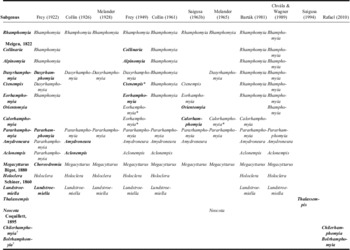
Historical review of Rhamphomyia classification. Frey (Reference Frey1909) made the first serious attempt to divide Rhamphomyia into recognizable subunits, dividing the Finnish species into six groups, but without assigning them to named subgenera. Later, Frey (Reference Frey1922) proposed classification into six subgenera (Table 1) based primarily on Palaearctic and partly on Nearctic species. Some of these subgenera did not strictly correspond with the six groups in his early work. Collin (Reference Collin1926) reassessed Frey's classification, noted that Choreodromia Frey was a junior synonym of Megacyttarus Bigot, and proposed two new subgenera (Table 1). Frey (Reference Frey1935) erected the subgenus Ctenempis for “group 2” of Dasyrhamphomyia. Frey (Reference Frey1949) further reclassified Rhamphomyia into 11 subgenera based on species from Eurasia including Aclonempis and Amydroneura and the new subgenera Eorhamphomyia Frey, Alpinomyia Frey, and Collinaria Frey for groups two and four and part of “group three” of Rhamphomyia, respectively. Frey (Reference Frey1950, Reference Frey1951, Reference Frey1952a, Reference Frey1953) continued to describe many Palaearctic species of Rhamphomyia within his subgeneric system.
Subgeneric classification of the genus Rhamphomyia.

*Some species of Orientomyia and Calorhamphomyia were described in Frey (Reference Frey1950–1953); Rhamphomyia flavipes Matsumura is included in Calorhamphomyia by Barták (1997), but flavipes does not belong to it; Ctenempis was published in 1935.
†Chilerhamphomyia and Belrhamphomyia were described as genera.
Subgenera in bold letters were originally described by author in this column.
Blank spaces indicate subgenera not treated in each work.
In his monograph of the British Empididae, Collin (Reference Collin1961) noted that key characters used by Frey to separate subgenera sometimes did not work well and doubted that species in other zoogeographical regions would be readily assignable to some of his subgenera. Therefore, Collin (Reference Collin1961) did not recognize four of Frey's subgenera (Eorhamphomyia, Alpinomyia, Dasyrhamphomyia, and Collinaria) and assigned species from these four subgenera to the nominal subgenus Rhamphomyia. Ctenempis does not occur in the British fauna and was not treated in his work. Barták (Reference Barták1981) and Chvála and Wagner (Reference Chvála and Wagner1989) followed Collin's concept of Rhamphomyia.
In North America, Coquillett (Reference Coquillett1896) described many species of Rhamphomyia, but did not assign them to groups or subgenera. In addition, he founded Neocota Coquillett, for a species with Rhamphomyia-type wing venation but distinguishable from that genus by its face densely covered with long pile. Melander (Reference Melander1928) recognized that Frey's groupings did not adapt readily to tropical forms but provided diagnostic characters to Frey's (Reference Frey1922) subgenera and attempted to assign some Nearctic species to those groups. However, most of the Nearctic species of Rhamphomyia remained unassigned to subgenera.
Saigusa (1963, described some Japanese species of Rhamphomyia and founded two new subgenera, Calorhamphomyia and Orientomyia Saigusa, for distinctive groups in Frey's Eorhamphomyia. Before he proposed these subgenera, he had corresponded with the late J.G. Chillcott regarding the subgeneric classification of Rhamphomyia, and they had agreed to develop a new Holarctic subgeneric system. Unfortunately, this project suffered a setback with the death of Chillcott during the Canadian Nepal Expedition in 1967. A preliminary key to subgenera had been prepared utilizing many unpublished new subgeneric names proposed by Melander for specimens in his Rhamphomyia collection and in a preliminary key, which he had been preparing to follow Melander (Reference Melander1928). For example, unpublished Melander names corresponded to Calorhamphomyia (described by Saigusa 1963, Reference Saigusa1963b), Vockerothempis (described here), and the idei-umbilicata group.
Saigusa (Reference Saigusa1964) described a further number of new Japanese species of Rhamphomyia, but did not assign them to subgenera, considering the subgeneric classification insufficiently complete. However, Ito and Saigusa (Reference Ito and Saigusa1967) revised the subgenus Orientomyia (later synonymized with Rhamphomyia by Chvála and Wagner Reference Chvála and Wagner1989) and included nine species. Saigusa (Reference Saigusa1994) founded a new subgenus, Thalassempis based on R. (T.) litoralis Saigusa that has short, spinuliferous female cerci unique in Rhamphomyia and lives exclusively on vegetation on sandy beaches.
Evaluation of characters used in Rhamphomyia classification. A comprehensive subgeneric classification of Rhamphomyia remains elusive. Large numbers of Holarctic species of diverse form render classification of groups and subgroups extremely difficult. Although apomorphic characters, such as partly abbreviated veins, undoubtedly occur in different lineages (see Daugeron and Grootaert Reference Daugeron and Grootaert2003), many subgenera of Rhamphomyia are based primarily on plesiomorphic characters (such as the complete vein CuA + CuP) resulting in paraphyletic and often quite heterogeneous groups.
One of the difficulties of the subgeneric classification of Rhamphomyia is the result of the fact that most of the morphological features used to characterize each subgenus appear to have evolved independently in several lineages in Rhamphomyia. For example, Frey (Reference Frey1922) used differences in the axillary incision of the wing to distinguish Pararhamphomyia Frey + Choreodromia (stump bis recht, nicht vertieft) from Dasyrhamphomyia + Rhamphomyia (± vertieft spitzwinklig). However, there is a continuous grade in the degree of axillary incision in some of these subgenera. The deep and acute axillary incision caused by the enlargements of the alula and anal lobe is widespread in large, swift flyers of Rhamphomyia; right-angled to obtuse axillary incisions are found in small, slow flyers. The subgenus Dasyrhamphomyia is undoubtedly a monophyletic group characterized by the peculiar unique development of the male genital cercus. Rhamphomyia (D.) mirifica Frey (body length 8 mm) has a deep and acute axillary incision with the distal margin of alula overlapping the anal lobe near the incision, the incision is slightly more acute than a right angle in Rhamphomyia (D.) vesiculosa (Fallén) (body length 6 mm), and it is right angled in some undescribed Nearctic species with body length 3–5 mm. Calorhamphomyia is a distinct monophyletic group characterized by a pair of movable sternal processes of the male seventh abdominal segment. In Rhamphomyia (C.) compta Coquillett (body length 2.5–3 mm) the incision is nearly 110°, whereas in Rhamphomyia (C.) optimalis Frey (body length 11–12 mm) the incision is deep and acute as in R. (D.) mirifica.
A strong vein CuA + CuP (so-called anal vein), complete throughout its length from base to wing margin, is undoubtedly plesiomorphic in Rhamphomyia, and partial weakening and disappearance of this vein is widely distributed among lineages in the genus. The apomorphic reductions of the vein were often used without precise analysis to characterize Rhamphomyia subgenera. The weakening of the anterior vein of discal cell is one of the main characters of the subgenus Amydroneura. That character, however, is widely distributed in the idei-umbilicata group, which is distinctly separated from Amydroneura on the basis of a short-haired slender labella with reduced pseudotracheae. Chvála and Wagner (Reference Chvála and Wagner1989) assigned two Japanese species of the group (Rhamphomyia idei Saigusa and Rhamphomyia shirayuki Saigusa) to the subgenus Aclonempis, probably based only on the elongate proboscis of this group. The shape and length of the discal cell have been used to characterize some subgenera. For example, Amydroneura has an elongate, apically pointed discal cell and some species of Megacyttarus have a long discal cell, whereas in others (e.g., Rhamphomyia (M.) sororia Frey and Rhamphomyia (M.) brevicellula Saigusa) the cell is very short.
The loss of acrostichal bristles is found among different lineages such as the subgenus Orientomyia, some species of Holoclera, and Rhamphomyia (Calorhamphomyia) amplipedis Coquillett. The pilose prosternum was used by Frey (Reference Frey1949) to characterize the subgenera Rhamphomyia and Ctenempis, but the hairy prosternum also appears in some other species, such as R. (T.) litoralis and R. (E.) insignis.
Holoptism and dichoptism of the male compound eyes in the genera Rhamphomyia and Empis are considered to be strongly correlated to their hunting and mating behaviours. In many Rhamphomyia subgenera (such as Orientomyia, Calorhamphomyia, Dasyrhamphomyia, Eorhamphomyia, and Pararhamphomyia) holoptism or dichoptism are not used as defining characteristics, whereas in other subgenera (such as Megacyttarus and Lundstroemiella) the dichoptic eyes of males are an important defining feature. The males of most species of Megacyttarus catch nuptial gifts on water surface (as do most species of Hilara), and do not require holoptic eyes to facilitate prey capture. Males of Rhamphomyia (Lundstroemiella) magellens Frey do not perform swarming flights and copulate with females on flowers without providing nuptial gifts (Daugeron and Grootaert Reference Daugeron and Grootaert2005). Similar mating and feeding behaviour was observed in the dichoptic males of Empis (Xanthempis Bezzi) (Hamm Reference Hamm1933). In Empis (Planempis Frey) pan Frey and Empis (Anacrostichus Bezzi) cyaneiventris Frey, the males are dichoptic and catch large hovering Diptera (e.g., Bibio Geoffroy (Bibionidae), Allognosta Osten-Sacken (Stratiomyidae)) as nuptial gifts and the females take the initiative early on during courtship behaviour (Saigusa Reference Saigusa1972).
The black halter has been used as one of the main characters of Alpinomyia to distinguish it from Collinaria (with whitish halters). However, as described in this paper, two species of Vockerothempis (R. (V.) japonica and an undescribed Japanese species) have whitish halteres, while all other species of Vockerothempis have blackish halteres.
Holoclera is mainly characterized by slender body and legs, but as Barták (Reference Barták1982 suggested, these characters seem to be invalid to prove the monophyly of the subgenus. Barták (Reference Barták1982 stated that the nigripennis group (one of two subgroups of Holoclera) was “quite different from other Rhamphomyia species and deserving of generic status”.
Frey (Reference Frey1949), Collin (Reference Collin1961), and Barták (Reference Barták1981) used characters of the male genital and pregenital structures to characterize some Rhamphomyia subgenera, but most of their statements concerning these structures are morphologically inadequate. For example, Frey (Reference Frey1949) stated “Hypopyg oben blasenformig erweitert” for Dasyrhamphomyia, and “Hypopyg klein, geschlossen” for Ctenempis. The only somewhat detailed description of the pregenital segments in Frey (Reference Frey1949) is “das letzte Sternit jederseits unten mit einem abstehenden Zahn, das vorletzte Sternit am Hiterrand mit einem Borstenkamm”, stated for Ctenempis. When founding Calorhamphomyia, Saigusa (1963 described in detail a pair of movable processes of the male 7th abdominal sternum that are the most important autapomorphy defining the subgenus. Although the male genital and pregenital structures of Rhamphomyia are as diverse as other morphological characters, precise morphological analysis of these structures will undoubtedly yield further valid autapomorphic character states supportive of many Rhamphomyia subgenera or groups, as has been done for Macrostomus Wiedemann – Porphyrochroa Melander (Empididae), a genus grouping related to Rhamphomyia (Rafael and Cumming Reference Rafael and Cumming2004).
Other difficulties in Rhamphomyia subgeneric classification
Female characters. Although the terminal abdominal structure and holopticism of male Rhamphomyia are diverse and useful in recognition of monophyletic subgroups in the genus (e.g., Ctenempis, Calorhamphomyia, and Dasyrhamphomyia), the female terminal abdominal structures in Rhamphomyia are extremely uniform. The shortened spinuliferous female cerci in Thalassempis and the bluntly ended abdomen with short lobate cerci in Vockerothempis are rare exceptions in the uniformity of these structures in Rhamphomyia. This causes further difficulty in Rhamphomyia subgeneric classification. It is often difficult to assign a species known only from females to any subgenus. Should subgenera be clearly defined by both sexes or only by one sex (mostly male)? If the former, then Calorhamphomyia loses its subgeneric status because a pair of movable sternal processes on the male 7th abdominal sternum is the only character exclusively found in this subgenus among its several diagnostic characters.
Polyphyletic origin. Taxonomy of Rhamphomyia also has difficulty because of the probable polyphyletic nature of the genus. As stated above, the only morphological characters separating this genus from Empis is the disappearance of vein R4. However, the subgenus Aclonempis has almost all the diagnostic characters of the subgenus Empis except for the absence of the vein R4, and some species of Aclonempis occasionally have vein R4 (Collin Reference Collin1961). This evidence undoubtedly suggests that Aclonempis evolved directly from the subgenus Empis. Similar examples exist in a few Japanese species of “Rhamphomyia” that are most closely related to some species of the subgenera Coptophlebia Bezziand Planempis Frey of Empis (e.g., Rhamphomyia clariventris Okada) (Saigusa, unpublished data).
Gondowanan group. Rhamphomyia also includes several Patagonian and Australian species (Collin Reference Collin1933; Smith Reference Smith19). The origins of these species are not yet clarified, but some of them presumably have close phylogenetic relationships with the Gondowanan groups of “Empis”, most of which certainly have no close relationship to Empis from the Holarctic Region. Chilerhamphomyia Rafael and Bolrhamphomyia Rafael, described from the Neotropical Region mainly based on male genitalia (Rafael Reference Rafael2010) are at best subgenera within the present classification of Rhamphomyia. Rafael's (Reference Rafael2010) comparisons of the genera within the whole range of morphological divergence of Rhamphomyia were insufficiently complete to establish them as genera.
Ranking in classification. If we divide Rhamphomyia species into many distinctive species-rich monophyletic groups, there remain many isolated species or groups with only a few species. How do we treat them in the classification: each named or combined with the species-rich monophyletic groups, which they more or less resemble? If we find many monophyletic groups in the genus, how should they be classified: as subgenera, species groups, species subgroups, etc.?
In addition to the subgeneric classification within Rhamphomyia, there are other difficult classification problems such as the status of Macrostomus and Porphyrochroa. Rafael and Cumming (Reference Rafael and Cumming1998) stated that the sister group of Macrostomus + Porphyrochroa presumably belongs to one of the Nearctic taxa currently classified in Rhamphomyia. Therefore, according to the present understanding of the subgeneric classification of Rhamphomyia, Macrostomus and Porphyrochroa should be classified as subgenera of Rhamphomyia (in support of this, the morphological diversity within Rhamphomyia overlaps the character states of Macrostomus and Porphyrochroa). If Rhamphomyia is paraphyletic in relation to Macrostomus and Porphyrochroa and is shown cladistically to include them, then Rhamphomyia should become a junior synonym of the older name Macrostomus. If we avoid this synonymy and treat them as genera different from Rhamphomyia, then some Rhamphomyia subgenera should be classified as genera. However, at our present (2012) state of knowledge on the phylogenetic relationships within Rhamphomyia, it is difficult to choose Rhamphomyia subgenera that should be raised to generic rank in a cladistic classification.
Acknowledgements
I express my cordial thanks to Dr. B.J. Sinclair and Dr. J.M. Cumming for their useful comments on earlier versions of this paper, and also to Dr. R. Bennett for his comments on this paper as Editor-in-Chief. My special thanks to Dr. J.R. Vockeroth for his generosity provided to me in the course of Diptera taxonomy since we worked together in the Bernice P. Bishop Museum in 1966, and to the late Dr. J.G. Chillcott for his cooperation in empidid research, including Rhamphomyia subgeneric classification since 1962. My thanks to the staffs of the Diptera sections of the CNC and of the USNM, especially F.C. Thompson, who provided full access to study the Diptera collections at their institutes including the specimens used in the present paper. Associate Professor K. Yoshizawa (Hokkaido University) assisted with examination of the type material of Rhamphomyia arakawae, and Dr. M. Sugimoto (Kyushu University Museum) is thanked for her help in preparing this paper.