


Introduction
Amber ice was first described by Reference HoldsworthHoldsworth (1974) at the base of Meserve Glacier, Wright Valley, Antarctica. There, the amber ice facies consists of a zone of amber-coloured bubbly ice 0.4–0.6m thick. When compared to the clean englacial ice above, the amber ice was found to have a relatively high concentration of salts and dispersed silt-to-sand particles, the distribution of these impurities being in addition remarkably uniform. Another striking feature reported by Holdsworth was that amber ice is rheologically much softer than the adjacent basal ice facies. This phenomenon was recently reinvestigated at Meserve Glacier by Reference Cuffey, Conway, Gades, Hallet, Raymond and WhitlowCuffey and others (2000a, Reference Cuffey, Thorsteinsson and Waddingtonb) and observed at the margin of Suess Glacier, Taylor Valley, Antarctica, by Reference Fitzsimons, McManus and LorrainFitzsimons and others (1999, Reference Fitzsimons, McManus, Sirota and Lorrain2001). Here we report detailed structural (basal ice velocity) and petrographical (amber ice fabrics) studies conducted at the base of Suess and Rhone Glaciers, Taylor Valley, that are consistent with the above observations. The potential influences of lattice-preferred orientation (LPO), impurities and intercrystalline liquid water on the localization of strain within amber ice are discussed in relation to the deformation mechanisms that operate within this facies.
Field Sites and Methods
Suess and Rhone Glaciers are small cold-based glaciers descending steeply from the Asgard Range in Taylor Valley, Dry Valleys, Antarctica, and flowing on unconsolidated sediments. The terminus of these glaciers forms an 18–20m high ice cliff overriding an ice-and-debris apron. The terminus of Suess Glacier is damming the perennially frozen Lake Popplewell, whereas the snout of Rhone Glacier does not reach the bottom of the valley (Fig. 1).
Map of Taylor Valley, Dry Valleys, South Victoria Land, Antarctica, showing the location of Suess and Rhone Glaciers. (1999).

The base of both glaciers was excavated by digging a tunnel from the foot of the ice cliff. This was done with the aid of jackhammers and electrical chain-saws equipped with tungsten carbide cutters. The tunnels at Suess and Rhone Glaciers were respectively excavated during the austral summers of 1996/97 (Reference Fitzsimons, McManus and LorrainFitzsimons and others, 1999) and 1999/Reference Fitzsimons, McManus, Sirota and Lorrain2000. At the end of these tunnels, a vertical shaft was dug in order to exhume the basal ice sequence and to sample ice blocks. In both tunnels, the basal ice temperature was –17˚C. At both sites, the amber ice was not in direct contact with the bed; it was interbedded between the clean englacial ice above and an alternation of debris-rich and clean ice layers below.
The basal velocity of Suess and Rhone Glaciers was measured in the terminal shafts with the aid of linear variable displacement transducers and precision dial gauges capable of measuring displacements of 0.01 mm. The distances measured between plumb-lines and wooden pegs drilled into the ice walls of the terminal shafts were also used to characterize the form of the lower part of the velocity profile. The whole method for glacier basal velocity measurement was described by Fitzsimons and others
For analytical purposes, adjoining ice blocks (30×10× 20 cm3) were retrieved along the vertical from top to bottom of both shafts. After sampling, the ice blocks were wrapped in polyethylene bags, stored at –18˚C, and transferred to the cold laboratory in Brussels.
In the cold room, vertical thin sections were cut all along the two basal ice profiles. Due to the presence of a high amount of debris, most of the thin sections were cut using a diamond wire saw as described below. Particular attention was paid during the preparation of amber-ice thin sections.
Studying the Petrography of Amber Ice
Very few studies of ice fabrics have been published about debris-laden fine-grained ice. This is mainly because of the difficulty of cutting thin sections within such a material without damaging either the cutting equipment or the ice sample itself. Moreover, when the ice is fine-grained, it is awkward not only to identify the crystal angle of extinction, but also to track individual crystals through the multiple rotation steps of the Rigsby stage. In this work, these difficulties were bypassed as follows. In the Universitè Libre de Bruxelles cold laboratory, thin sections were prepared from amber ice applying the diamond wire-saw cutting technique described by Reference TisonTison (1994). These sections were then smoothed and thinned with sandpapers of decreasing grit size until a thickness of about 300–400 μm was reached, this latter step being essential to prevent, as far as possible, overlapping of neighbouring crystals during analysis of the sections. The fabrics and textures of the amber ice crystals were determined at the Niels Bohr Institute, Copenhagen, Denmark, by means of an automated c-axis analyzer and subsequent digital image processing (based on the Visual Basics and Image Pro softwares) following a procedure adapted from Reference SvenssonSvensson and others (2003). For each pixel in the sample images, c-axis orientations were calculated with an accuracy close to 5˚. The boundaries of crystals as small as 0.1 mm2 were identified, but, because optical properties occasionally changed gradually from one crystal into the next instead of defining sharp domains, the crystal boundaries could not always be properly distinguished. The method succeeded, however, for at least ∼80% of all the ice crystals present on the analyzed sections.
Results
Velocity profiles
In the shaft dug at the end of Rhone Glacier tunnel, plumb-lines and dial gauges recorded velocities from around 50 mma–1 at 300 mm above the glacier bed to around 960 mma–1 at 3600 mm above the bed (Fig. 2). Monitoring of the glacier velocity close to the bed indicated the absence of basal sliding during the 50 week measurement period. Velocity measurements obtained at Rhone Glacier can be compared in Figure 2 with those obtained at the base of Suess Glacier by Reference Fitzsimons, McManus and LorrainFitzsimons and others (1999). At both sites, the amber ice facies appears to have the highest displacement rate.
Velocity profiles within basal ice from Rhone Glacier (this study) and Suess Glacier (after Reference Fitzsimons, McManus and LorrainFitzsimons and others, 1999). Measurements were done using plumb-lines and dial gauges resurveyed after around 1 year.

Amber ice crystallography
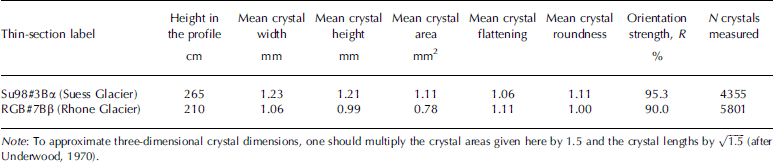
At both study sites, thin sections cut parallel to the local flow show that the air bubbles enclosed within amber ice are a few millimetres long, with their elongation axis parallel to the ice stratification. Under crossed polarizers, all the amber ice sections, whether cut parallel or normal to the local flow, immediately reveal a highly homogeneous texture. In Figure 3a and b, two representative examples of vertical thin sections (Su98#3Bα and RGB#7Bβ) illustrate this strong homogeneity. The results of crystallographic analyses conducted on these sections are given in Table 1. More than 4000 crystals were inspected on the illustrated sections. The amber ice crystals are mainly equant and sub-millimetric. The crystal size distribution of both sections is very narrow, with little deviation around the mean crystal width and heights on a log scale (Fig. 4). In Su98#3Bα, crystals are slightly larger than in RGB#7Bβ. The ice crystals do not present any significant flattening ratio (Table 1). In Figure 5, c-axis crystal orientations are represented on equatorial Schmidt diagrams. The degree of crystallographic orientation (R) used here is a parameter that defines the percentage orientation strength. This parameter varies between 0% for a randomly oriented polycrystal and 100% for the case when all c axes are exactly parallel (Reference WallbrecherWallbrecher, 1978). In both sections, the fabric patterns indicate that the c-axis orientations are highly homogeneous, with an R parameter reaching a minimum value of 90.0% (Table 1).
Representative thin sections of amber ice from (a) Suess and (b) Rhone Glaciers. Artificial greyscale images with crystal contour mask obtained by application of an automated image processing method. The top–bottom direction of the photographs coincides with the vertical.

Crystal area distribution (N = 500) for two representative amber-ice thin sections from Suess and Rhone Glaciers. Note the logarithmic scale of the x axis.

(a) Fabric pattern for the SU98#3BV thin section (Suess Glacier). Orientation strength (R) = 95.3%; N = 4355. (b) Fabric pattern for the RGB#7Bβ thin section (Rhone Glacier). Orientation strength (R) = 90.0%; N = 5801.

Crystallographic parameters computed through automatic c-axis analysis for representative amber ice sections from two Antarctic cold-based glaciers
Discussion
Dislocation creep dominating in amber ice
When studying the petrography of Meserve Glacier, Anderton (1974) did not obtain any fabric data from amber ice. He noted, however, that the amber ice crystals were likely to have a strong fabric, given the uniform optical behaviour of thin sections examined under crossed polarizers. More recently, Reference Cuffey, Conway, Gades, Hallet, Raymond and WhitlowCuffey and others (2000a) also had some difficulty measuring the amber ice crystal fabrics, but obtained successful measurements in 30% of their attempts by using optical magnifying glasses. The data obtained made Cuffey and colleagues confident that the amber ice fabrics of Meserve Glacier were quite similar to those obtained from the overlying clean ice by Anderton (1974), that is, with a strong single maximum normal to the glacier bed. Our investigations at Suess and Rhone Glaciers also show that the amber ice crystals present a strong LPO perpendicular to the effective glacier bed (Fig. 5). These findings support the predominance of dislocation creep during the strain of amber ice (Reference AzumaAzuma, 1994; Reference Duval, Arnaud, Brissaud, Montagnat and De La ChapelleDuval and others, 2000). We suggest that the building of the observed ice fabrics was initiated by rotation recrystallization, the latter tending to produce a substantial grain-size reduction and to facilitate LPO development through polygonization (e.g. Reference Barber and WenkBarber, 1985; Reference PatersonPaterson, 1991; Reference Urai, Jessell, Gottstein and MolodovUrai and Jessell, 2001).
Strong single-pole fabrics are generally interpreted as reflecting a preferential alignment of the crystal basal planes close to the plane of maximum shear stress (Reference AndertonAnderton, 1974; Gow and Williamson, 1976). This idea is supported here by the fact that the orientation of the basal planes coincides with that of the ice foliation, the bubble elongation and the glacier bed, which reveals the influence of strong non-coaxial shearing within amber ice (Reference AndertonAnderton, 1974; Reference Gow and WilliamsonGow and Williamson, 1976).
The small size of the amber ice crystals and their favourable orientation for basal glide are likely to play a major role in the high plasticity of this facies, the two latter parameters being considered to partly control strain enhancement (Reference PatersonPaterson, 1991; Reference Thorsteinsson, Waddington, Taylor, Alley and BlankenshipThorsteinsson and others, 1999; Reference Cuffey, Thorsteinsson and WaddingtonCuffey and others, 2000b). Reference Russell-Head and BuddRussell-Head and Budd (1979), for example, observed through their simple shear tests that ice with a strong single-maximum fabric deformed about four times faster than did isotropic ice. Besides, Reference BakerBaker (1978) reported that, for fine-grained ice, reduction of ice crystal size results in an increase in secondary creep in proportion to about the inverse square of the average grain diameter.
Possible interactions between impurities and ice crystals during amber ice formation
Crystal size and LPO are not the only factors that can influence the strain rate of ice. Debris type, diameter and concentration are other important parameters to take into account. It is well known from metal and ceramic physics that chemical impurities exert a retarding force (called ‘Zener drag’ for solutes, and ‘pinning’ for insoluble impurities) on migrating grain boundaries in a polycrystalline matrix (Reference Alley, Perepezko and BentleyAlley and others, 1986; Reference Alley, Perepezko and BentleyOlgaard and Evans, 1986), thereby leading to a decrease in grain-size when impurity content increases (Reference SmithSmith, 1948; Reference Alley, Perepezko and BentleyAlley and others, 1986; Reference Olgaard and EvansOlgaard and Evans, 1988). Insoluble impurities (or so-called ‘second-phase particles’ in mineralogy) can furthermore constitute impenetrable obstacles for dislocation movements (Reference Gottstein, Mecking and WenkGottstein and Mecking, 1985). Grain growth retardation by chemical impurities has consequently been proposed as potentially controlling the final grain-size achieved during ice recrystallization (Reference BakerBaker, 1978; Reference Alley, Perepezko and BentleyAlley and others, 1986; Reference Langway, Shoji and AzumaLangway and others, 1988), and even helping the strengthening of ice LPO (Reference Langway, Shoji and AzumaLangway and others, 1988; Reference PatersonPaterson, 1991). The volume fraction of sediments reaches a few per cent within amber ice (Reference HoldsworthHoldsworth, 1974; Reference Cuffey, Conway, Gades, Hallet, Raymond and WhitlowCuffey and others, 2000a; Reference Fitzsimons, McManus, Sirota and LorrainFitzsimons and others, 2001), which has been shown to be sufficient for grain growth retardation to initiate in polycrystalline materials (Reference Alley, Perepezko and BentleyAlley and others, 1986; Reference Olgaard and EvansOlgaard and Evans, 1986). Inhibition of grain-boundary migration by impurities may thus affect the grain-size, and therefore the strain rate, of amber ice.
Moreover, chemical impurities, whether soluble or insoluble, favour the growth of interfacial liquid films by depressing the pressure-melting point of the ice at the contact interface (e.g. Reference GilpinGilpin, 1979; Reference Dash, Fu and WettlauferDash and others, 1995), thereby increasing the liquid water content. In creep dominated by dislocation motion, these thin liquid films are assumed to increase the activity of the easiest intracrystalline slip system by reducing internal stresses at grain boundaries (Reference De La Chapelle, Milsch, Castelnau and DuvalDe La Chapelle and others, 1999), thereby promoting strain enhancement within the ice. Grain-boundary sliding (GBS) is a grain-size-sensitive deformation mechanism that requires the existence of interstitial fluids (e.g. Reference Zhang, Hobbs and JessellZhang and others, 1994). The presence of impurities at grain boundaries should facilitate such a mechanism (Reference Barnes, Tabor and WalkerBarnes and others, 1971), even at the low temperatures encountered at the base of the studied glaciers (Reference Cuffey, Thorsteinsson and WaddingtonCuffey and others, 2000a). GBS is, however, believed to be LPO-destructive (e.g. Reference Zhang, Hobbs and JessellZhang and others, 1994); its occurrence should thus be limited, given the strong LPO of amber ice crystals. Grain-boundary diffusion (GBD) is another grain-size-sensitive deformation mechanism; it refers to the movement of lattice defects along grain boundaries. This process is unlikely to produce any LPO comparable to the one observed in this study (Reference Pimienta and DuvalPimienta and Duval, 1987), but it should not be LPO-destructive either (e.g. Reference Krabbendam, Urai and van VlietKrabbendam and others, 2003). Therefore, its influence on the strain of amber ice, if effective, would not be distinguishable from a c-axis orientation point of view. GBD might, however, have provided another active accommodation mechanism, since it is likely to operate at low temperatures (Reference Duval, Ashby and AndermanDuval and others, 1983) as well as at high interstitial impurity concentrations (e.g. Reference Cooper and KohlstedtCooper and Kohlstedt, 1986; Reference Dash, Fu and WettlauferDash and others, 1995). To sum up, impurities present in amber ice may not only have influenced the mobility of grain boundaries during recrystallization, but also have determined the mechanisms by which incompatible deformation was accommodated.
Conclusion
Thanks to a new method and device, crystal fabrics and textures were successfully determined in amber ice, a fine-grained and debris-bearing type of ice that represents an important component of some cold-based glaciers from the Dry Valleys, Antarctica.
Our work sheds light on results obtained from previous strain measurements indicating that amber ice strains more rapidly, and is thus rheologically softer, than other basal ice facies. This paper shows that:
1. The displacement rates measured in amber ice are by far the highest from all the ice facies present at the base of the studied glaciers. Amber ice thus accommodates most of the basal deformation and acts in this way as a decoupling horizon between bulk glacier ice and the base of the glacier. This might lead to the relative preservation of adjacent basal ice units.
2. A strong LPO has developed in amber ice from Suess and Rhone Glaciers owing to a reorientation of basal planes perpendicularly to the effective bed during ductile deformation. This provides evidence that deformation was dominated by dislocation motion.
3. In case debris would have effectively taken part in the hindering of grain growth, its presence apparently did not lead to a switch of deformation mechanism from grain-size-insensitive to grain-size-sensitive dominated flow. Debris may, however, have driven the retardation of grain-boundary migration until an equilibrium grain-size was achieved. This grain-size would have then been maintained at a steady state by continual and dynamic recrystallization.
4. The degree to which dislocation creep was aided by the presence of intercrystalline liquid films remains unclear. Given the relatively high impurity content of amber ice, lubrication at the grain boundaries is a possible accommodation mechanism, especially for crystals smaller than the average since interstitial lubrication is likely to be grain-size-sensitive. Having shown that deformation is dominated by dislocation creep in amber ice, we strongly support the idea of De La Reference De La Chapelle, Milsch, Castelnau and DuvalChapelle and others (1999) that the liquid phase would have the effect of increasing the activity of the easiest slip system by reducing the peaks of internal stress at grain boundaries.
Further work needs to be done in order, first, to identify which of the textural and structural crystal parameters are the most influential upon deformation of amber ice, and, second, to determine in what proportion mass transfer along the intercrystalline liquid network may help to accommodate strain incompatibilities at grain-boundary scale. Such work could help to resolve the discrepancy of results and conclusions relative to the origin of strain partitioning within basal ice.
Acknowledgements
This paper is a contribution to the Belgian Antarctic Program (Science Policy Office). We thank Antarctica New Zealand for providing the logistical support of this study, and the Marsden Fund of the Royal Society of New Zealand as well as the University of Otago for financial support. D. Samyn acknowledges support of a grant from Fonds pour la Formation a` la Recherche dans l’Industrie et dans l’Agriculture (Belgium).



