

The domestication of the horse brought into human use an animal that had the potential to revolutionise the way in which people could travel, control, and trade resources, and fight each other (Levine Reference Levine1996; Anthony Reference Anthony2007; Outram et al. Reference Outram, Stear, Bendrey, Olsen, Kasparov, Zaibert, Thorpe and Evershed2009; Bendrey Reference Bendrey2010). Identifying when and how horses were first used in particular regions is thus of considerable significance for our understanding of social and economic changes in later prehistory.
This paper presents results from ongoing research aimed at investigating the origins and development of horse husbandry and use in the prehistoric past, in particular exploring the evidence for the use of horses in transportation (eg, Bendrey Reference Bendrey2007b; Reference Bendrey2007c; Outram et al. Reference Outram, Stear, Bendrey, Olsen, Kasparov, Zaibert, Thorpe and Evershed2009). The sizeable animal bone assemblage from the Beaker period settlement at the site of Newgrange had been published as producing the earliest evidence for domestic horses in Ireland (O'Kelly et al. Reference O'Kelly, Cleary and Lehane1983; van Wijngaarden-Bakker Reference Wijngaarden-Bakker1986). Our research identified evidence for the use of metal bits on two horse teeth from the Newgrange assemblage. We directly dated the two teeth and found that they were later than their expected date according to the published stratigraphic narrative. This paper presents a discussion of these new direct dates on the Newgrange horses in the context of evidence for early domestic horses from Ireland and Britain, and a brief assessment of the implications of the new evidence for Iron Age activity at the site.
European Domestic Horse Origins, Bell Beakers and Newgrange
There is still considerable uncertainty over the early history of the domestic horse in Europe. Whilst there is clear and direct evidence for the use of domestic horses in the Bronze Age cultures of the 2nd millennium bc, evidence before this tends to be disparate, inconsistent, and equivocal (Bendrey Reference Bendrey2012). Following the end of the Pleistocene, although European wild horse populations decline significantly in numbers with the changing environmental conditions of the earlier Holocene, they do appear to continue in small localised populations in some areas of Europe (Sommer et al. Reference Sommer, Benecke, Lõugas, Nelle and Schmölcke2011; Bendrey Reference Bendrey2012). In particular, survival of wild horses in Iberia and south-east and eastern Europe, and their contribution to local domestic stock, is indicated by the high genetic diversity of modern ‘traditional’ breeds from these regions, while low diversity in the central European breeds suggest that the domestic horses in these regions largely derive from animals imported from elsewhere (Warmuth et al. Reference Warmuth, Eriksson, Bower, Cañon, Cothran, Distl, Glowatzki-Mullis, Hunt, Luís, Oom, Tupac Yupanqui, Ząbek and Manica2011). Archaeozoological interpretations tend to agree with this interpretation from the modern genetic data, in that local domestication is not normally invoked for central or northern Europe; horse husbandry is argued to have dispersed either from the steppe-zone of eastern Europe (eg, Benecke Reference Benecke2006; Bökönyi Reference Bökönyi1978) or from Iberia as part of a Bell Beaker culture expansion (eg, Uerpmann Reference Uerpmann1990; Reference Uerpmann1995). The earliest strong evidence for horse domestication – based on zooarchaeological and lipid residue analyses – comes from the mid-4th millennium bc Eurasian steppe (Outram et al. Reference Outram, Stear, Bendrey, Olsen, Kasparov, Zaibert, Thorpe and Evershed2009). Analyses of ancient DNA targeting nuclear genes responsible for coat colour variation has further indicated the domestication of horses in the Eurasian steppe region some time prior to 3000 bc (Ludwig et al. Reference Ludwig, Pruvost, Reissmann, Benecke, Brockmann, Castaños, Cieslak, Lippold, Llorente, Malaspinas, Slatkin and Hofreiter2009). Whether the incorporation of European wild horses into domestic lineages (Cieslak et al. Reference Cieslak, Pruvost, Benecke, Hofreiter, Morales, Reissmann and Ludwig2010; Warmuth et al. Reference Warmuth, Eriksson, Bower, Cañon, Cothran, Distl, Glowatzki-Mullis, Hunt, Luís, Oom, Tupac Yupanqui, Ząbek and Manica2011) includes further independent domestication events outside the steppe (Uerpmann Reference Uerpmann1990), or just the incorporation of local horses into herds spread from elsewhere, is currently difficult to determine. The events and processes involved in the origins and diffusion of domestic horses in Europe are not clear from the published data, and it is probably the case that reductionist interpretations belie a far more complex situation (Bendrey Reference Bendrey2012).
One of the main contenders for the early diffusion of domestic horses through Europe is the Bell Beaker ‘culture’ – in reality a set of practices and traditions that spread widely across Europe, in various forms, during the second quarter of the 3rd millennium bc (van Wijngaarden-Bakker Reference Wijngaarden-Bakker1974; Reference Wijngaarden-Bakker1975; Reference Wijngaarden-Bakker1986; Clutton-Brock & Burleigh Reference Clutton-Brock and Burleigh1991a; Sherratt Reference Sherratt1997; Uerpmann Reference Uerpmann1990; Reference Uerpmann1995; Albarella Reference Albarella1999; Blaise Reference Blaise2010, 267–70). This ‘culture’ has produced a range of indirect evidence for horse husbandry and its spread (eg, Bokonyi 1978; Uerpmann Reference Uerpmann1990; van Wijngaarden-Bakker Reference Wijngaarden-Bakker1975). The rapid spread of the Bell Beaker ‘culture’ across much of Europe presents it as a possible contender as early users of domestic horses and evidence for increasing stratification of society and mobility at this time could be associated with the early use of horses (Heyd Reference Heyd2007). Further, current evidence identifies the earliest Bell Beakers as originating on the Iberian Peninsula (ibid.), which links in well with the evidence for the presence of horse populations here in the earlier Holocene (Liesau Reference Liesau2005), possible domestication/introgression of local wild stock (Warmuth et al. Reference Warmuth, Eriksson, Bower, Cañon, Cothran, Distl, Glowatzki-Mullis, Hunt, Luís, Oom, Tupac Yupanqui, Ząbek and Manica2011; Lira et al. Reference Lira, Linderholm, Olaria, Brandström, Gilbert, Ellegren, Willerslev, Lidén, Arsuaga and Götherström2010), and metrical evidence for changes in horse body size which have been argued by Uerpmann (Reference Uerpmann1990) as evidence for local domestication (although see discussion in Bendrey Reference Bendrey2012).
The site of Newgrange in Ireland has been important in the argument that the introduction of the horse, to north-west Europe at least, was as part of a ‘Beaker package’. There is no evidence for local domestication of horses in Ireland, or indeed in Britain, and it is generally accepted that domestic horses were brought to these islands from mainland Europe during the Chalcolithic or Early Bronze Age (van Wijngaarden-Bakker Reference Wijngaarden-Bakker1974; Reference Wijngaarden-Bakker1986; Clutton-Brock & Burleigh Reference Clutton-Brock and Burleigh1991a; McCormick Reference McCormick2007a; Reference McCormick2007b; Bendrey Reference Bendrey2010). In Ireland, there is very limited evidence for wild horses in the fossil record, with a single direct radiocarbon date pre-dating the last glacial maximum on a horse scapula from Shandon, County Waterford (see Table 2 below). After this date, horses are thought to have become locally extinct in Ireland due to glacial cover, not returning following the retreat of the ice sheets (McCormick Reference McCormick2007a; Reference McCormick2007b). The next time horses appear in the archaeological record in Ireland is ostensibly at the Beaker period settlement at Newgrange, County Meath (O'Kelly et al. Reference O'Kelly, Cleary and Lehane1983; Smyth Reference Smyth2009, 34–7; Stout Reference Stout2002, 33–8). A few published identifications of horse in megalithic tombs in Ireland are likely to be secondary intrusions or misidentifications (McCormick Reference McCormick2007a; Reference McCormick2007b; McCormick & Murray Reference McCormick and Murray2007, 24). At Newgrange, 151 horse bones and teeth were found in an assemblage of over 12,000 identified bones in contexts dating to the third quarter of the 3rd millennium bc by radiocarbon dates on associated charcoal (van Wijngaarden-Bakker Reference Wijngaarden-Bakker1974; Reference Wijngaarden-Bakker1986; see also Carlin & Brück Reference Carlin and Brück2012).
New Direct Radiocarbon Dates from Newgrange
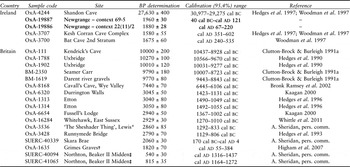
Two horse teeth from Newgrange were dated by accelerator mass spectrometry at the Oxford Radiocarbon Accelerator Unit (ORAU) and calibrated using OxCal 4.1.7 (Bronk Ramsey Reference Bronk Ramsey2009) (Table 1). The specimen from context 22(11)/2 was dated to cal ad 67–220 (95.4% probability), and the specimen from context 69–5 to 40 cal bc–cal ad 80 (91.5%) or cal ad 104–121 (3.9%) (Table 1). Both teeth therefore date to the Irish Iron Age, and not the Beaker period.
Radiocarbon Dates and Isotopic Results for the Newgrange Horse Teeth

It should be noted that collagen yield was low for the two teeth (7.4 mg and 4.3 mg), which is lower than the normal acceptable yield at the ORAU, due to the small sample size (the teeth were sampled by conservators at the National Museum of Ireland and the samples sent to ORAU for dating). However, all other analytical data normally routinely checked by ORAU were within acceptable threshold limits (ORAU, pers. comm.). The carbon/nitrogen (C/N) ratios calculated for both specimens were 3.4 (Table 1), which falls within the range considered to be indicative of good collagen preservation (Ambrose Reference Ambrose1990). Further, the carbon isotope values derived from the two teeth fit in with the general diachronic pattern identified by Stevens and Hedges (Reference Stevens and Hedges2004, 979–80) for horse bone and tooth collagen values over the last c. 40,000 years in north-west Europe, which showed a fall in mean δ13C values from −20.4‰ in the Late Pleistocene to −22.1‰ in the Late Holocene. Nitrogen stable isotope values also compare well to the general pattern for Holocene horse values for north-west Europe, where published (post-10,000 bp) δ15N values range between c. 4‰ and c. 7‰ and have a mean of 6.5‰ (Stevens & Hedges Reference Stevens and Hedges2004, 979 & fig. 2).
Although only two teeth have been dated, recent work re-interpreting the archaeology of Newgrange has both advanced new interpretations of the site as originally proposed (O'Kelly et al. Reference O'Kelly, Cleary and Lehane1983) and re-interpreted the stratigraphic sequence at the site (Cooney Reference Cooney2006; Eriksen Reference Eriksen2008; Mount Reference Mount1994). It is acknowledged that the exact sequence of occupation at Newgrange is difficult to determine, but it is clear that the area in front of the tomb entrance remained a focus of activity through the Late Neolithic, Chalcolithic, and Early Bronze Age (Smyth Reference Smyth2009, 35). However, it is also the area around the entrance to the passage tomb that has produced objects of Roman date. These objects, including 25 coins, date from the 1st to the late 4th century ad (Carson & O'Kelly Reference Carson and O'Kelly1977; Ó Floinn Reference Ó Floinn2000, 26). Based on these finds of late Iron Age/Roman coins and ornaments found in the vicinity of the Newgrange mound, particularly around the entrance, Newgrange has been argued to be a cult site for Roman Iron Age populations (Ó Floinn Reference Ó Floinn2000). These finds have been variously interpreted as votive offerings made by Roman visitors or traders, repatriated Irish exiles or Irish warriors with access to high-status goods from the Roman world (ibid., 26).
These new direct dates for the horse finds from Newgrange, in the first few centuries ad, have significant implications for our understanding of the introduction of domestic horse to Ireland. The direct dates on the two horses from Newgrange (Table 1) throw the Beaker period dates for all the Newgrange horses into doubt. Further support for the later date of these finds comes from the strong evidence for one of the horses being used with a metal bit (see below). Indirect supporting information for a later date for the Newgrange horses as a whole also comes from the small physical size of the animals (van Wijngaarden-Bakker Reference Wijngaarden-Bakker1974; Reference Wijngaarden-Bakker1986), as they are significantly smaller than contemporary Beaker period horses from elsewhere in Europe (Uerpmann Reference Uerpmann1990; Reference Uerpmann1995). Indeed, this small size appears closer to the lower end of the range of Iron Age horses for elsewhere in Europe than to that of Bronze Age horses (eg, Arbogast et al. Reference Arbogast, Clavel, Lepetz, Méniel and Yvinec2002, 46).
The Introduction of the Domestic Horse to Ireland and Britain
If the Newgrange horse finds are excluded, the earliest good evidence for horse in Ireland dates to the Late Bronze Age, at which point horse bones appear in a number of excavated assemblages (McCormick Reference McCormick2007a). There is also a tassel-like ornament of horsehair, found in association with a hoard of Late Bronze Age metal objects at Cromaghs, Co. Antrim (Coffey Reference Coffey1906; McCormick Reference McCormick2007a).
Comparison of the Irish data with the chronological evidence from Britain provides a fruitful perspective (Table 2). The return of horses to Britain following the last glacial maximum is well attested – at a time when Britain is still a contiguous part of the European landmass – and direct dates indicate the presence of wild horses into the Mesolithic (Burleigh et al. Reference Burleigh, Currant, Jacobi and Jacobi1991; Clutton-Brock & Burleigh Reference Clutton-Brock and Burleigh1991a; Table 2). The question of whether there was survival of horse populations in Britain through the Mesolithic and Neolithic, or whether horses become locally extinct, only to be re-introduced later as a domestic animal by human agency, has been much debated (eg, Grigson Reference Grigson1966; Kaagan Reference Kaagan2000; Bendrey Reference Bendrey2010). The latest direct date for horse remains from the earlier Holocene is on a horse incisor from Cavall's Cave, Wye Valley, Herefordshire (a site located near the southern part of the modern border between England and Wales), dating to the later 7th millennium bc (Table 2). It is around the same time as this – c. 6500 bc – that Britain was separated from the continent by rising sea-levels (Preece Reference Preece1995; Bradley Reference Bradley2007, 8–11).
Comparison of the New Direct Radiocarbon Dates on Newgrange Horse Teeth (In Bold) to Selected Direct Dates on Horse Teeth and Bones from Ireland and Britain, Plus the Date for the ‘Sheshader Thing’

Notes: Calibration was carried out using OxCal 4.1.7 (Bronk Ramsey Reference Bronk Ramsey2009) and atmospheric data are from (Reimer et al. 2009)
* = The date for the ‘Sheshader Thing’ is on cattle hair rather than horsehair, although absolute contemporaneity of the two is not in doubt (see description in text); † = this horse skull was originally dated to the Late Neolithic/Early Bronze Age by a conventional radiocarbon determination (Clutton-Brock & Burleigh Reference Clutton-Brock and Burleigh1991b); ‡ = these two dates were derived from the same tooth: SUERC-40094 on enamel and SUERC-41065 on dentine. The Scottish Universities Environmental Research Centre (SUERC), where these radiocarbon determinations were made, are investigating the discrepancy between enamel and dentine results on teeth; it is likely that the dentine date is the more accurate of the two (A. Sheridan, pers. comm.). The Skara Brae date in the table is also from enamel
Although horse is known from a number of Neolithic sites from Britain (eg, Grigson Reference Grigson1966), direct dating of these finds has tended to return later dates (Kaagan Reference Kaagan2000). A number of recently directly dated finds further add to this picture. A horse metapodial from the Early Neolithic site of Whitehawk causewayed enclosure in East Sussex, southern England (Russell & Rudling Reference Russell and Rudling1996), has been directly dated to the later 2nd millennium bc (Table 2; Whittle et al. Reference Whittle, Healy and Bayliss2011, 219). A stratigraphically Beaker period horse tooth from the site of Northton on the Isle of Harris, Scotland (Finlay Reference Finlay2006), has been directly dated to the medieval period (Table 2; Alison Sheridan, pers. comm.). A horse tooth bead from the Neolithic site of Skara Brae, Scotland (Clarke Reference Clarke1976), has been dated to the Iron Age (Table 2; Alison Sheridan, pers. comm.). Finally, a find that has been considered as an early domestic horse is the skull from Grimes Graves, eastern England, which was originally dated to the Late Neolithic–Early Bronze Age by a conventional radiocarbon determination (Clutton-Brock & Burleigh Reference Clutton-Brock and Burleigh1991b). However, a recent AMS determination on this find (Higham et al. Reference Higham, Bronk Ramsey, Brock, Baker and Ditchfield2007) places it in the Roman period (Table 2). Following the re-dating of the Grimes Graves skull, there is now a gap in the record of direct dates between the later 7th millennium and the later 2nd millennium bc (Table 2). For Scotland, a date for horse has also been obtained from a sample of cattle hair comprising part of an organic object found on the Isle of Lewis, Scotland. This object, known as ‘the Sheshader Thing’, is formed of matted cattle hair with twisted woollen cords and plaited horsehair cords attached to it, and has been directly dated to the Late Bronze Age (Alison Sheridan, pers. comm.; Table 2). This then marks out the Middle to later Bronze Age as producing the earliest directly dated evidence for the re-introduction of the horse to Britain. However, there are horse remains that appear, on stratigraphic grounds, to be earlier than this (eg, Olsen Reference Olsen1994). Radiocarbon dating of early horse finds has tended to focus on material from Neolithic contexts (eg, Clutton-Brock & Burleigh Reference Clutton-Brock and Burleigh1991a; Armour-Chelu Reference Armour-Chelu1998; Kaagan Reference Kaagan2000; Bendrey Reference Bendrey2008) (and, as discussed above, to date no find has been confirmed as being of Neolithic date); as such, a tighter chronology confirming the presence of horse earlier in the British Bronze Age has not been established.
Synthetic surveys of archaeological bone assemblages can go some way to exploring this issue. It would seem that in its early period of use, finds of horse are few and far between. The very rarity of the horse creates problems for quantifying changes in the level of its use. Conventional techniques of calculating the percentage of horse present in an assemblage limits analysis to a few large assemblages – such as Early Bronze Age West Row Fen (Olsen Reference Olsen1994) and Middle Bronze Age Grimes Graves (Legge Reference Legge1992) – as horse is absent from most others. However, employing a method for quantifying how ‘rare’ or ‘common’ an animal is in groups of contemporary assemblages, Bendrey (Reference Bendrey2007a) was able to explore changes in horse representation through time. The method uses the relationship that exists between the number of species (or taxa) in an excavated assemblage and the assemblage size – the larger the assemblage, the more taxa are present (Grayson Reference Grayson1984) – and is based on the principle that a ‘rare’ animal is likely to appear in large assemblages and not in small ones, whereas a more ‘common’ animal will appear in relatively smaller assemblages (Lyman Reference Lyman1995). The method was applied to data from collated zooarchaeological assemblages from six counties of southern England. Results showed the horse progressively becoming more common from the Early Bronze Age, when horse keeping appears to be ‘rare’, through an increase in the Middle Bronze Age, to the Late Bronze Age when the horse is in all but the smallest assemblages (a level of presence that continues through the Iron Age) (Bendrey Reference Bendrey2007a). This indicates that horse is an established part of the fauna by the Late Bronze Age, and can be suggested as having widespread use, including in warfare (Bendrey Reference Bendrey2010; Thorpe Reference Thorpe2006).
In McCormick's (Reference McCormick2007a) review of the evidence for the horse in early Ireland, he presents data on the frequency of horse bones in archaeozoological assemblages from the Bronze Age to the medieval period. In the collated data for the Bronze Age (which constitutes assemblages of over 300 bone fragments), the only assemblage ostensibly from the Early Bronze Age (or Chalcolithic) is that from Newgrange; the other four assemblages listed all date to the Late Bronze Age (McCormick Reference McCormick2007a, table 3). We could thus have the situation, as argued for Britain, that horse has entered widespread use in Late Bronze Age Ireland, but that its apparent absence in the earlier Bronze Age or Chalcolithic of Ireland (if the Newgrange evidence is excluded) could be linked to the low number of large archaeozoological assemblages. We would thus have the classic archaeological evidence impasse: are we seeing absence of evidence or evidence of absence?
Bitting Damage Evidence on the Horse Lower Second Premolars (P2) from Newgrange

Notes: Table follows Bendrey (Reference Bendrey2007b); Brown & Anthony (Reference Brown and Anthony1998)
n1 = crown height measurements were taken following Levine (Reference Levine1982); n2 = occlusal length & breadth were taken following Payne (Reference Payne1991; see his measurements OL & B3 respectively); n3 = bevel measurements were taken following Brown & Anthony (Reference Brown and Anthony1998); n4 = not possible to take exact measurements due to damage; n5 = it was not possible to measure the bevel accurately using the methodology of Brown & Anthony (Reference Brown and Anthony1998); see the lateral view of this tooth in Fig 3
Iron Age Horse Use at Newgrange
As outlined above, in the context of wider ongoing research into the origins and development of horse husbandry and use, we examined the horse remains excavated from the site of Newgrange for evidence of transport use: specifically traces left by the use of a bit. The principle behind bitting studies is to look for ‘damage’ to the skeletal tissues of the mouth that shows that a horse was used (ridden or driven) with a bit (Bendrey Reference Bendrey2007b; Reference Bendrey2011; Brown & Anthony Reference Brown and Anthony1998).
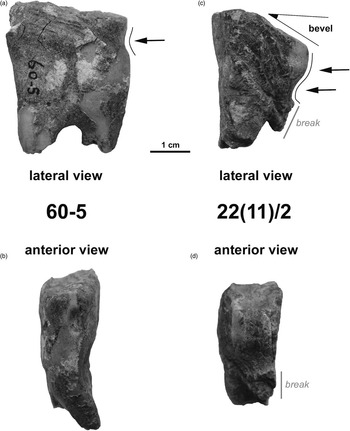
Five lower second premolars (P2) were present amongst the 151 fragments of horse recorded from the site. Of the five teeth examined, two exhibit evidence for wear indicative of bitting (Table 3; Fig. 1). The specimens are from different animals as both are right second premolars. In both specimens, wear on the anterior margin of each tooth has gone into the dentine (ie, through the outer casing of hard enamel). This is good evidence for bit contact, as this kind of wear was only seen in bitted animals in the collections of modern known life history equids studied by Bendrey (Reference Bendrey2007b).
The two Newgrange specimens which show evidence indicative of bitting damage: a right P2 from context 60–5 (a + b); a right P2 from context 22(11)/2 (c + d). The arrows indicate wear into the anterior side of the tooth.

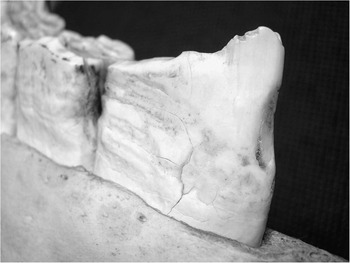
The specimen from context 60-5 exhibits an isolated area of dentine exposure (of a height of 5.0 mm) on the anterior surface of the tooth (Fig. 1b). Viewed laterally, this area of wear can be seen to have a shallow, concave profile (Fig. 1a). This is similar to a form of wear recorded on modern domestic horse teeth in the course of examining comparative reference collections in museums around Europe (eg, Fig. 2).
Modern 14 year old domestic horse left P2 showing pronounced concave ‘scoop’ worn into the anterior surface. The dentine exposed on the front of the tooth is ∼15 mm in height. (Specimen from the collections of the Musée Fragonard of the Ecole nationale vétérinaire, Maison-Alfort, France).

Dentine is exposed along the entire anterior side of the tooth from context 22(11)/2, with the enamel visible in cross-section either side of the band of dentine (Fig. 1d). When viewed laterally, it is clear that a significant portion of the front part of the tooth has been lost (Fig. 1c). The anterior border has a smooth, curved profile, curving deeper into the tooth at the base of the crown. In addition, this is the only P2 from Newgrange to present a bevel on the anterior part of the occlusal surface (Fig. 1d). Such bevels have been argued as being caused by the tooth being worn down when a horse chews the bit (Brown & Anthony Reference Brown and Anthony1998; Anthony Reference Anthony2007, 206–21). Although the reliability of this method has been questioned, as acknowledged by Anthony and Brown (Reference Anthony and Brown2011), due to the fact that a bevel on a P2 can result from abnormal occlusion with the upper second premolar (P2) (see Levine et al. Reference Levine, Whitwell and Jeffcott2002), this specimen also exhibits the absence of the ‘Greaves’ Effect’. The ‘Greaves’ Effect’ is the phenomenon whereby under normal occlusal wear the softer dentine is worn down faster than the harder enamel, leaving raised enamel ridges on the occlusal surface; however, contact with a metal bit causes both the enamel and dentine to wear down to a similar level (Olsen Reference Olsen2006, 254–5). The latter state was noted on the chewing surface of the bevel of the P2 from context 22(11)/2.
The identification of bitting damage on horses of the first few centuries ad is not surprising; what is notable is the extent of wear on the specimen from context 22(11)/2. In this case, it is also likely to have been associated with significant damage to the gum and the mandibular bone at this site. This would presumably have been caused by a combination of frequently and heavily applied rein tension, possibly associated with an abrasive mouthpiece. Certainly, such use of the bit seems excessive by modern standards, and indeed also ancient practices when the wear pattern is compared to the much more subtle traces identified on Iron Age horses from Britain (see Bendrey Reference Bendrey2007b, fig. 8; Bendrey Reference Bendrey2007c, fig. 1). This indicates a manner and degree of use causing frequent and heavy contact between bit and tooth, and begins to give us an insight into how these animals were used and (ill-)treated.
As discussed above, there is other evidence for Iron Age activity at Newgrange. Based on the discovery of Late Iron Age/Roman coins and ornaments found in the vicinity of the Newgrange mound, particularly around the entrance, Newgrange has been argued as a cult site for Roman Iron Age populations (Ó Floinn Reference Ó Floinn2000). The Newgrange horses may perhaps be placed alongside the evidence from the royal centre of Tara, where horse bones have been proposed as possibly being the residue of kingship rituals (McCormick Reference McCormick2002; Reference McCormick2007a). Although the Tara horse bones are not directly dated, they appear to be of similar date to the Newgrange horses; these derive from the Ráith na Ríg enclosure, but are possibly related to the occupation phase of the adjacent site of the Rath of the Synods (McCormick Reference McCormick2002; Roche Reference Roche2002; Grogan Reference Grogan2008). Further, the community occupying the Rath of the Synods appears to have had strong contacts with Roman Britain (Grogan Reference Grogan2008, 90–1). Dowling (Reference Dowling2006) has linked the deposition of both animal and human remains in the Ráith na Ríg enclosure ditch to the concept of the ditch being a crucial liminal space. On British Iron Age and Roman sites, evidence for the deliberate deposition of horse is recognised as both complete burials and disarticulated remains, and is identified in a range of contexts (eg, King Reference King2005; Bendrey et al. Reference Bendrey, Leach and Clark2010; Morris Reference Morris2011).
Tara has produced the highest incidence of horse bones from a site of the Irish Iron Age and also evidence for bit wear on a horse lower second premolar, indicating that it had been used for riding or traction (McCormick Reference McCormick2002; Reference McCormick2007a). The enclosure ditch at Tara which produced this material was located near to a Neolithic passage tomb, and may have been a site of Royal inauguration (ibid.). Indeed, McCormick has invoked a possible connection between the horse bones and kingship rituals based on the fact that the Tara horses had been eaten and the 12th century ad description by Geraldus Cambrensis of the slaughter and consumption of a horse as part of an Irish kingship ritual (for further discussion of these rituals, see also Creighton Reference Creighton1995; Doherty Reference Doherty2005). The heavy bitting damage on the specimen from context 22(11)/2 at Newgrange (Fig. 1) may also provide clues as to the nature of the Iron Age activity, in the light of horse races famous from medieval Irish literature (Charles-Edwards Reference Charles-Edwards2000, 137). It is notable that the Newgrange horses were also probably eaten (van Wijngaarden-Bakker Reference Wijngaarden-Bakker1974; Reference Wijngaarden-Bakker1986), however fuller conclusions as to the nature of use and deposition of the Newgrange horses must await further, more detailed analyses.
Conclusions
The direct dating of horse finds from putative Early and Middle Holocene contexts is essential for accurately establishing the biogeographical range of the wild horse, and the chronology of the domestication and diffusion of domestic horses (Bendrey Reference Bendrey2012). The direct dates for the Newgrange horses presented here shed important new light on the introduction of domestic horses to Ireland and to north-west Europe more generally. The new dates undermine the argument for the introduction of horses to Ireland as part of a ‘Beaker package’, with the earliest strong evidence for horses now dated to the Late Bronze Age. However, the early use of horse is not well defined archaeologically or chronologically, in part due to the general rarity of the domestic horse in the earliest period of its use, and it seems likely that the horse was present in Ireland before the Late Bronze Age, as it is in Britain. Further work is needed before we will be able to understand more fully the early diffusion and use of domestic horses in Ireland and Britain, as is also the case for the archaeological record elsewhere in Europe.
This research has highlighted the need for further work to re-examine in detail the contextual details of the horse finds from Newgrange. As briefly discussed above, there has been some criticism of the published site sequence, and a full assessment of the context and dating of all the horse remains at Newgrange is required. Although the full nature of the Iron Age activity at Newgrange is uncertain, the evidence for bitting damage (Fig. 1) presents a new context with which to view horse use at the site, which can be added to the tantalising evidence for the possible role of horses at Tara (McCormick Reference McCormick2002; Reference McCormick2007a; Doherty Reference Doherty2005), to help inform future avenues of research.
Acknowledgements
We would like to thank the University of Winchester for funding this research, Professor Richard Bradley and Dr Rebecca Oakes for help and advice, Dr Chiara Cavallo and the Universiteit van Amsterdam for hospitality and facilitating the research in Amsterdam, Dr Andy Halpin and the National Museum of Ireland for permission to date the teeth, Dr Alison Sheridan for providing information on the new horse dates from Skara Brae and Northton (dates funded by Historic Scotland) and for valuable comments on a previous version of this paper, and the Musée Fragonard of the Ecole nationale vétérinaire at Maison-Alfort, France, for permission to publish the photograph of a specimen from their collections of modern domestic horses.