With its few remnants of Victorian and art-deco architecture overpowered by hastily assembled modern towers of concrete and glass, Toronto has developed a not-undeserved reputation for paving over its past and short-changing its future.
— Stuart Berman Footnote 1
INTRODUCTION
Urban redevelopment projects that draw on culture as a tool for rejuvenation often display a persistent tension between different ways of valuing spaces in the city. Existing spaces may carry great meaning as they are, but development interests may focus on how these spaces could be more economically valuable if transformed to attract and optimize consumer expenditure. As a result, the notion of what is meaningful about a space—or what carries great cultural community wealth, use-value, or embodies a group’s intangible cultural heritage—often takes a back seat in determining the redevelopment processes of cultural spaces in the city. Within these redevelopment and rejuvenation discussions, Sharon Zukin’s three loosely defined, but often overlapping, camps can be identified: those who focus on historic preservation concerns, those who focus on community preservation concerns, and those who fall under the increasingly vague catch-all term of “gentrifiers.” Footnote 2
In terms of the heritage values of these camps, opinions often clash over questions of whether the future should be privileged over the past, whether heritage should be privileged over innovation, whether heritage preservation is simply a form of outdated nostalgia, or what constitutes “heritage,” along with what kinds of heritage and whose heritage matters, and how to determine which spaces—whose spaces—merit protection and/or preservation. Footnote 3 While the dissonance between these various groups pepper the pages of city news sources, social media, and neighborhood coffee shop chatter, the mechanics of these battles are fought within the intricate legal frameworks of interrelated municipal and provincial zoning as well as planning legislation and decisions, in addition to overarching federal policies and international norms—or what might be lumped together for our present purpose as the relevant legal complexes that shape our cities. Footnote 4 It is here within the “lawscapes,” where the law and the city meet, where the diversity of vested interests in the city space must be—it is hoped—equally valuated and addressed. Footnote 5
Without designing inclusive strategies for effectively consulting the diverse spectrum of parties and cultures affected by urban heritage and cultural city planning processes, a city’s development initiatives risk counterproductively destroying the precise characteristics they are otherwise seeking to nourish, create, and, even, commodify. Footnote 6 And without diligent and critical consideration of how a city’s modern urban heritage and spaces of key cultural practice and consumption are dealt with, a city risks, in Zukin’s words, losing its soul. Footnote 7
When it is determined that a building has heritage merit—whether it is intangible or tangible—the space may be dealt with in a number of ways. Preservation, conservation, restoration, renovation, restoration, adaptive re-use, or demolition and replacement will all amount to a different treatment of the tangible heritage merits of a space. Footnote 8 But the intangible heritage merits of a space will be directly or indirectly affected as well. This article is concerned with the ways in which the modern urban intangible merits of city spaces are valuated and dealt with in light of the comparatively weak regard accorded to intangibility within the available heritage protection legal frameworks of Canada, Ontario, and, specifically, Toronto.
The currently underdeveloped recognition for intangibility in the heritage protection equation not only fails to equally valuate non-dominant, unconventional, or alternative iterations of culture but also falls behind the key guiding documents in international law for the safeguarding and recognition of intangible cultural heritage and in accounting for intangibility in determinations of heritage value. Footnote 9 In examining such concerns, this article will turn to Toronto’s “Music City” strategy that is being deployed as part of a culture-focused urban redevelopment and “Creative City” planning initiative. Footnote 10 A selection of Toronto’s iconic music venues affected by redevelopment processes will be considered for the range in treatment of their heritage merits. The various ways in which the past and future of these music spaces are dealt with reveals how the exchange-value potential of transgressive or unconventional venues and spaces in a city tends to be valuated more highly than the use-value of these spaces of intangible urban cultural heritage, where their use-value and intangible merits frequently go entirely unrecognized and unassessed in redevelopment decision-making processes. This undervaluation may ultimately result in the destruction of the precise attributes a city professes a desire to establish and grow as well as contribute to intergenerational injustice in failing to preserve what may be key elements of Toronto’s musical past and present in building a vibrant musical future.
THE “MUSIC CITY”: CULTURE AND THE ARTS AS URBAN REDEVELOPMENT TOOLS
Like many major cities across the globe that are hoping to attain “world city” status, Toronto (along with many of the communities that surround it along the shores of the Great Lakes) has turned to “culture” and the “arts” as guiding tools and a panacea in its current urban redevelopment projects. Footnote 11 Here, culture is seen both for its ability to contribute to a potentially higher quality of life and leisure in the city as well as for its lucrative economic attributes in drawing tourists and attracting the sought-after, murkily identifiable “creative class.” Footnote 12 One of the particular initiatives in these development strategies is Toronto’s “Music City” strategy. Primarily stemming from documents and reports where municipal economic and development strategies have turned to the music industry as a growth resource—such as “Collaborating for Competitiveness: A Strategic Plan to Accelerate Economic Growth and Job Creation in Toronto” and “Creative Capital Gains: An Action Plan for Toronto” Footnote 13 —Toronto’s Music City plans are a relatively recent development in Toronto’s Creative City-oriented rejuvenation strategy. As a director for one of Toronto’s major annual music and arts festivals “North by Northeast” explains, “[w]hat everyone’s getting … is that not only is music essential for the soul and the imagination, spiritual aspiration of a city, it makes cities money. Like, tons of it.” Footnote 14 Or, as the president of Music Canada, Graham Henderson, explains, “[w]e know that live music is an essential piece of our music story in Ontario and yet, no one has truly tried to capture the extent of its impact on our economy, workforce and communities.” Footnote 15
The guiding document in defining what constitutes a Music City, “The Mastering of a Music City,” notes that “[t]he term ‘Music City’ is becoming widely used in cultural communities and has penetrated the political vernacular in many cities around the world … [and] describes communities of various sizes that have a vibrant music economy which they actively promote.” Footnote 16 “The Mastering of a Music City” follows the 2014 launch of Measuring Live Music Canada, a study designed to measure the economic impact of live music in Ontario, Footnote 17 which itself came on the heels of the 2013 report “The Next Big Bang,” commissioned by Music Canada to explore new strategies to support and grow Canada’s music industry. Footnote 18
Among the key identified marketable musical assets and cultural capital that a city can promote are “noteworthy or iconic music venues” and “a rich musical history” where
[i]conic live music venues can also be compelling tourist attractions and strong branding tools for cities. If marketed with a clear and consistent image, a venue of significant heritage or reputation has the potential to draw music fans based purely on its legacy or buzz. Venues catering to specific genres of music or cultural groups can also appeal to tourists. Footnote 19
The 2013 report goes on to note that the musical landmarks of a city can be leveraged by governments in partnership “with the venue owners to create mutually beneficial promotional campaigns.” Footnote 20
Additionally, many of the reported observations emphasize the growing importance of live music venues in Canada for a number of reasons. The collapse of the market for music products has led to the increased importance of touring for musicians, requiring suitable venues for live musical performance. Footnote 21 As a result, in addition to smaller or more intimate music venues that provide a space for local musical acts to grow and perform, venues that can house large events and serve as higher price-point music consumption and dancing spaces are also necessary. But even though redevelopment strategies and guiding documents that capitalize on existing forms of music culture and heritage comprise part of the legal complexes that shape Creative City plans for Toronto, key music venues and music culture spaces continue to disappear due to other municipal policy and planning documents that deploy conflicting strategies, all while professing to stay in line with Creative City redevelopment strategies. Footnote 22
Whether displaced venues and music spaces have been replaced with parking lots, condominiums, the latest mixed-use redevelopment project, or another kind of commercial space, the current system in place has caused the destruction of important music venues and spaces in Toronto within which the rich fabric of Toronto’s live music and music culture is generated. Footnote 23 Drawn from a series of consultations conducted by Heritage Toronto and the Toronto Historical Association, the 2010 “Heritage Voices” report on heritage preservation issues pinpoints provincial planning processes as problematic to preservation goals and identifies a tendency by the Ontario Municipal Board (OMB) to favor developer interests over cultural heritage interests. Footnote 24 The report notes that there are only a few exceptions where cultural heritage preservation has won out over a development proposal in appeals to the OMB concerning land-use planning disputes. Footnote 25 As we will see below, the Toronto music venue, the Silver Dollar Room, represents one of these exceptions.
CASE STUDIES
The Silver Dollar Room
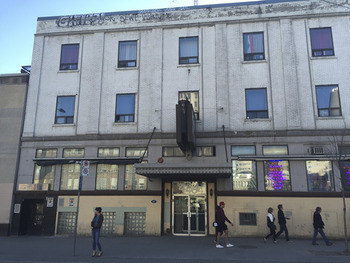
Located near the intersection of Spadina and College in downtown Toronto’s Harbord Village, next to the University of Toronto campus and just a few blocks North of Kensington Market, the Silver Dollar Room was originally built in 1957–58 to serve as the cocktail lounge of the Waverly Hotel, which opened its doors in 1900. One of Toronto’s oldest hotels, the Waverly has since fallen into a state of disrepair. The Silver Dollar sits on the north side of the hotel, its bright red and black exterior and flashy sign in stark contrast to the Waverly’s bland off-white exterior. On the south side of the hotel, identified only by a discrete sign over its entrance and stretching underneath the Waverly, is the Comfort Zone, a venue that will be discussed in the next section (Figure 1). A door on the north end of the Comfort Zone connects it to the internal staircase that leads to the Silver Dollar Room.
Full shot of Comfort Zone exterior and Waverly Hotel. © Sara Gwendolyn Ross.

Soon after opening, the Silver Dollar Room began holding performances of live blues music, jazz, rock, and bluegrass. Other than its brief incarnation as a strip club in the 1960s and some infamous raids by the police in the 1970s and 1980s, Footnote 26 the Silver Dollar Room quickly became one of Toronto’s key venues for live blues music. Although the Silver Dollar Room has a rich musical legacy that has drawn international acclaim as a home for live blues music in Toronto and has attracted a slew of well-known musicians such as Bob Dylan and Blue Rodeo, Footnote 27 it has also carried local importance for Toronto’s live music communities since the 1960s for its role in growing musical talent through its space, programming, and reputation as a venue that welcomes new and developing musicians from Toronto and outside of Toronto to workshop and perform their music to local audiences and to sit in with well-known musicians. Footnote 28 It continues today as an important space for Toronto’s indie music scene. Footnote 29
Despite its importance to Toronto’s music communities, the future of the Silver Dollar Room faced the threat of a proposed amendment to Zoning Bylaw 438-86, which was proposed by the Wynn Group (the owners of both the Waverly and the Silver Dollar as well as the Comfort Zone). This proposed amendment sought rezoning in order to permit “a 22-storey mixed-use development containing 202 residential units and approximately 1,600 square metres of commercial space.” Footnote 30 Beyond the legal language of zoning, the amendment would have allowed the Wynn Group to replace the Waverly, the Silver Dollar Room, and the Comfort Zone with this high-rise mixed-use complex, which was intended as a private student residence for about 200 people in addition to three levels of underground parking and a replacement tavern that would likely emulate the Silver Dollar Room, but, along with other alterations, move its famous sign into the inside of the building, out of site for anyone passing by. Footnote 31 However, as a result of the efforts by a series of Ward 20 (Trinity-Spadina) city councilors, such as Adam Vaughan, Joe Cressy, and Cita Ramkhalawansingh, Footnote 32 cultural preservationists, and the Harbord Village Residents’ Association, the Toronto City Council accorded the Silver Dollar Room cultural heritage designation on 13 January 2015, pursuant to City of Toronto Bylaw 57-2015 under Part IV, section 29 of the Ontario Heritage Act (OHA). Footnote 33
The Silver Dollar Room’s heritage designation is a particularly significant case study due to the unique acknowledgement of its intangible heritage value, the “use” and “function” of the space, and “its contribution to Toronto’s musical culture,” rather than a focus on its built tangible heritage attributes (the first criteria of the applicable Ontario Regulation 9/06), which is rare in Ontario and Toronto where heritage designations are predominantly awarded based on architectural merit. Footnote 34 In the language of Regulation 9/06 and Bylaw 57-2015, the Silver Dollar Room meets the “associative and contextual value” criteria of section 29 of the OHA. The basis of the associative value determination of the Silver Dollar Room is its historical association with “the development and growth of music in Toronto, particularly the genres of jazz, blues, rock and bluegrass, from the 1950s through to the present day,” its role as “an incubator for musical talent,” its “international reputation that allowed local bands to be booked internationally,” and the important musicians associated with its space. Footnote 35 The basis of its contextual value determination is its “value as a landmark in Toronto by virtue of it being a well-known, long-standing destination for live music with an international reputation” as well as for its “important contribution to Toronto’s musical scene.” Footnote 36 Picking up on the venue’s importance to the community rather than its architectural merit, the statement of cultural heritage value within the designating Bylaw 57-2015 notes the relevance of the Silver Dollar Room’s cultural heritage value for its frequent role as a “workshop for new and sometimes struggling musicians, both local and transient, to sit-in with more established musicians, to develop their music and build up a following.” Footnote 37
The heritage protection afforded by Bylaw 57-2015 created a barrier to the redevelopment of the Silver Dollar Room’s space by requiring the owner of the newly designated property under the OHA’s section 29 (the Wynn Group, in the case of the Silver Dollar) to apply to the council of the municipality within which the property is located in order to seek written consent for demolition. Footnote 38 Fortunately for the Silver Dollar, the Toronto Planning Department’s preliminary report, along with other reports, did not receive the Wynn Group’s application and development proposal favorably, Footnote 39 leading the Toronto and East York Community Council to reject the proposal in early 2014 for a number of reasons but generally because “[t]he proposed density, building height, and lack of transition [did] not reinforce or respect the physical character of the existing neighbourhood,” thus contravening the intentions of the City of Toronto’s Official Plan. Footnote 40
The Wynn Group appealed the decision to the OMB, and, on 8 May 2015, the appeal ended in a settlement agreement between the City of Toronto and the Wynn Group that included a reduction in the height of the proposed development from 22 stories to 15 stories and, based on its heritage status designation, mandated the preservation of the Silver Dollar Room along with the intangible cultural heritage and high use-value of the space. Footnote 41 The new development will maintain the current space of the Silver Dollar Room as it is now (along with its iconic sign) and will be constructed in a manner that will highlight the built form of the Silver Dollar Room. Footnote 42 The Silver Dollar Room will also have its original mural and photographs of musicians reinstated, along with the installation of a new plaque recognizing the heritage resources represented by and within the space. Footnote 43
The Waverly Hotel was included in the original request for heritage designation for the Silver Dollar Room’s property, but the board recommended that the Waverly portion of the property undergo further review. Footnote 44 Although it received a full assessment, and despite the objections of the Harbord Village Residents’ Association and the Ward 20 city councilor, the final decision did not find that the Waverly Hotel portion of the property met the requisite heritage criteria for a section 29 heritage designation under Ontario Regulation 9/06. Footnote 45
Comfort Zone
The Comfort Zone faces an entirely different future than the Silver Dollar Room, as its space is destined to eventually become the parkade for the Wynn Group’s student-oriented mixed-use housing complex described above. Footnote 46 And, contrary to the Waverly Hotel, the Comfort Zone was not included in any of the heritage designation requests or heritage assessments. The Comfort Zone is an infamous Toronto afterhours electronic music venue and dance space that opened in 1997, and it is one of the few remaining venues of this format in Toronto, known by many who have spent time within its walls over the years as a Toronto afterhours “institution.” Footnote 47 The venue is accessed via a simple entrance on the south side of the Waverly Hotel, which leads down a set of stairs to a large cavernous space for dancing that stretches underneath the Waverly and connects to a set of stairs on the north side, which is then linked to stairs leading upstairs to the Silver Dollar Room. On some nights, the Comfort Zone will open up access to the staircase and utilize the Silver Dollar Room as an additional room for another disc jockey (DJ) where alcohol can be served and consumed within the confines of the Silver Dollar Room.
The space operates as a electronic dance music event space with DJs spinning a variety of genres that usually lean heavily towards house music, is open predominantly on the weekends, and has deep ties with the underground dance music community and afterhours scene/subculture. Footnote 48 Like most afterhours dance and music spaces, it has no liquor license, does not serve alcohol (although at one point it did), and is seen as a haven for dancing. The crowd at the Comfort Zone is a varied blend of individuals from different walks of life and with no precise demographic, except for the element that unites them—they are all there to dance and nearly everyone does. The musicians and artists that frequent the Comfort Zone also view it as a space for past and present DJs to develop and hone their craft. Footnote 49 As one of the DJs whose career was founded within the walls of the Comfort Zone describes it, “[i]t was a magic zoo that we called home … Even after traveling the whole world, Comfort Zone is still untouchable for me. This place moulded who we are today as people and DJs.” Footnote 50
The case of the Comfort Zone is relevant here for three key points. The first is that the upcoming loss of this space is at odds with the desire to grow and celebrate Toronto’s music culture as part of its Music City initiative. Directly attached and under the same threat as the saved Silver Dollar Room, it is an established music venue that has importance and a high use-value to sections of Toronto’s music subcultures and minority music communities. It also functions as an available space for Toronto’s musicians to hone their craft and for local audiences to experience both the sounds of local musicians and international guest DJs. Second, much of the language used to describe the intangible heritage merits that led to the Silver Dollar Room’s heritage designation also appears in how the music subcultures and communities who attend and participate within the Comfort Zone’s space describe its relevance to their experience of music in Toronto. However, third, and what is most striking, is that throughout the unsuccessful heritage designation inquiry that the Waverly Hotel underwent, and the successful heritage designation decision acquired by the Silver Dollar Room, no public mention, inquiry, or reference was ever made about the Comfort Zone space, and no attempt was made to engage with its soon-to-be-displaced community that occupies the space regularly but at the invisible hours of the day-night continuum.
Like Toronto’s many other venues that have disappeared silently over the years, and as one of the very last (and, arguably, the last “traditional”) afterhours music and dancing space, the Comfort Zone’s disappearance will leave a void in the city for those who have occupied, used, and enjoyed its space. The matter of consulting with these kinds of communities affected by redevelopment decisions, or the potential of there being intangible cultural heritage merit within these kinds of spaces regardless of the tangible heritage merit, has simply never been raised—even while Music City initiatives seek to celebrate Toronto’s music heritage and provide spaces for it to grow.
The Guvernment and the Waterfront
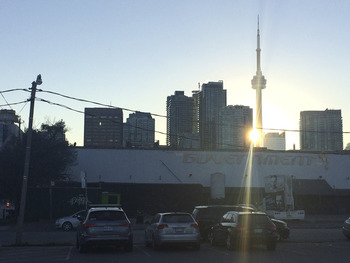
The redevelopment of Toronto’s waterfront is one of the city’s most talked about and heralded redevelopment megaprojects and also a project where the arts, culture, and Creative City redevelopment approaches, in general, have played, and continue to play, a formative role. Footnote 51 The East Bayfront Precinct redevelopment forms a central part of Toronto’s rejuvenation plan and comprises the area where the Guvernment Entertainment Complex was located until its demolition in early 2015 (Figure 2). This project is managed by Waterfront Toronto Footnote 52 and was integrated into Toronto’s 2006 Official Plan, governed by the 2003 Central Waterfront Secondary Plan, and further developed in the East Bayfront Precinct Plan. Footnote 53 The space occupied by the Guvernment was privately owned and was not part of the specific sections of land owned by Waterfront Toronto that are undergoing Toronto’s planned rejuvenation. Rather, the new “Daniels Waterfront—City of the Arts” development that will replace the Guvernment is designed to complement Toronto’s newly rejuvenated and cleansed “creative” waterfront vision. Footnote 54
The Guvernment Nightclub from a nearby parking lot, with the CN Tower in background. © Sara Gwendolyn Ross.

One must only look to the current mayor John Tory’s statement at the unveiling of the plans for the new development to see the excited blessing the private development has received from the city:
The revitalization of our waterfront is one of Toronto’s most exciting and challenging urban renewal projects. The Daniels Corporations vision for the former entertainment complex site [Guvernment] is a groundbreaking project that will have a lasting cultural legacy. Not only will this site feature landmark residential and office towers, but it will also be home to student innovation and a hub for the creative industries. The project will complement the future East Bayfront community, further adding to the diversity of our waterfront while creating jobs that are central to our city’s growth. Footnote 55
The Guvernment was a large warehouse-style music complex, the largest indoor nightclub in Canada and characterized by a number of divided performance spaces of various sizes that could host a number of shows simultaneously. Footnote 56 The Guvernment portion of the space was known for its sound and light design and the size of the no-frills Kool Haus warehouse-style portion of space, and it filled an important gap in Toronto’s available music venues, with an attendee capacity of 2,000–3,000 people, which is an ideal capacity for large indoor music events —larger than what a large nightclub can hold but not as large as a stadium. Footnote 57 While the Guvernment itself opened in 1996, a similar venue, RPM and its sister venue, the Warehouse, had operated in the space since 1985, and, even before that, the space had operated for a few years as the Fresh Restaurant and Nightclub. Footnote 58
The Guvernment was often open until 7 am or later and was known for its well-attended music events, its role in developing Toronto’s local electronic music and electronic music scene, and its nearly 20-year, prolific contribution to Toronto and Canada’s international music reputation. In terms of more marginal music subcultures, the Guvernment was a key venue in the development of Toronto’s and Canada’s “drum ‘n’ bass” musical subculture and existing minority music community, which is characterized by bass-heavy music in the 160–80 beats per minute range. The Guvernment’s history has seen a plethora of key modern performers, much longer than that of the Silver Dollar Room. Its history and relevance is succinctly summarized on the sales website for the new Daniels development that will replace it:
The club finally closed its doors on January 31st, 2015. Formerly the RPM nightclub for about 10 years which brought legends like the Beastie Boys and made former Jamaican born Canadian DJ Chris Sheppard into a superstar in the dance music world. Now currently the Guvernment nightclub which opened its doors in 1996 where superstars such as Lady Gaga and the Rolling Stones played and where DJ Deadmau5 got his start. Charles Khaboth [sic], owner of INK Entertianment [sic] tried to buy the building with his partners but were unsuccessful as Daniels Corp. has bought it to turn the site at Queens Quay and Lower Jarvis into residential and commercial properties known as the Daniels Waterfront Condos. Footnote 59
The sale of the Guvernment’s space occurred despite its continued financial success and popularity, the vocal protests of attendees, and the venue owner and operator’s attempts to purchase the space in order to save it (although his attempts did result in a year-long extension of the Guvernment’s lease on the space). Footnote 60 Keeping in mind Toronto’s Music City project that calls for and encourages spaces for local music production, performance, and consumption and requires large venues for attracting well-known artists and providing the space for enough attendees to leverage these artists’ performance fees—the kind of space the Guvernment provided—one might wonder at the rationale behind replacing the Guvernment with the Daniels development, which the mayor proposes “will have a lasting cultural legacy” without any investigation into the existing intangible cultural heritage merits of the property. Footnote 61
However, as we saw with the Comfort Zone, these kinds of questions have not played into the redevelopment decisions affecting Toronto’s musical vibrancy, music heritage, and intangible culture and the music communities affected by these decisions. Beyond the owners of the buildings and the physical neighbors of the space, these stakeholders were not consulted. While heritage considerations have figured into the designs for Toronto’s waterfront renewal, the applicable planning documents do not address the different kinds of intangible cultural heritage that may exist in a city and glaze over the use-value that exists within cultural spaces that make up, or used to make up, the waterfront area. Footnote 62 The failure to consider the existing intangible cultural heritage within the waterfront space demonstrates a faulty assessment of social impact in order to effectively measure the competing values and interests of the various cultures and communities either culturally and/or economically invested in the space. Footnote 63 Such consideration is in contrast to the acknowledgement and protection of the Silver Dollar Room’s intangible cultural heritage merits, use-value, and live music assets, which occurred 13 days before the Guvernment closed for good.
The oversights surrounding the Guvernment’s demolition are additionally illustrated by the mayor’s excursion to study the live music culture of Austin, Texas, that occurred around the same time as the redevelopment plans for the Guvernment’s space were announced. Upon the mayor’s return, in response to his trip and just days before he spoke glowingly at the unveiling of the plans for the “Daniels Waterfront—City of the Arts” that will replace the Guvernment, he expressed his “determination to more fully integrate music into the cultural and economic fabric of the city.” Footnote 64 Yet, as we have seen, the Guvernment represented the same kind of large, iconic, internationally respected live music venue that is an asset in developing a fuller cultural and economic integration of music into the fabric of Toronto and the kind of music space and culture that the mayor went to investigate and learn about in Austin.
Brunswick House and Albert’s Hall
Located at 481 Bloor Street West, on the outer edge of Toronto’s Harbord Village and bordering on Toronto’s Annex neighborhood, the 140-year-old Brunswick House closed in April 2016. Found in the same neighborhood as the Silver Dollar Room, it has been listed as a heritage property since 17 September 1991. Footnote 65 While its tangible heritage merits have played into negotiations as to how the space will be redeveloped into a pharmacy drugstore chain called Rexall, and even though residents in the area have “expressed concerns about losing The Brunswick House’s rich heritage—it’s been a working class tavern, a noted jazz venue, and a gathering place for local literary lions,” preserving the intangible culture, music assets, and cultural capital of the space has not figured into the redevelopment plans and is not protected by the building’s existing heritage listing. Footnote 66
Unlike the Silver Dollar, or the Comfort Zone, the Brunswick House had shifted from the musical offerings that made it famous and, although operating as a music venue, had become mostly known as a relatively generic nightclub operating on the weekends, popular with a young adult demographic and university students from the nearby University of Toronto campus and often the object of the neighboring resident’s complaints about noise and “disruptive” nighttime behavior. Nonetheless, the Brunswick House’s musical legacy and history as a community gathering space stretches far back. Starting out as a tavern in 1876 that primarily served the local community, the Brunswick House continued on as a neighborhood institution into the 1970s when it also became popular with students—as it was when it closed. As the foreword to a 1975 poetry book written about the Brunswick House reads, “[a] community like this doesn’t need a ‘club, … it develops, indeed evolves, the classical meeting place in the classical Greek manner. The Brunswick House is this meeting place.” Footnote 67
Like the Silver Dollar Room, the Brunswick House originally served as a hotel bar to the hotel above its space, a space that would eventually become a flophouse prior to ceasing operations entirely as a hotel. Footnote 68 As far as its musical past, the Brunswick House struggled to have live music during the 1930s when Ontario’s Liquor Control Board was known to restrict amenities provided by venues serving alcohol, such as live music, which were seen to stimulate alcohol consumption. Footnote 69 Contrary to the requests of “respectable” hotels to have live music, such as “tasteful trios playing on weekend evenings,” the requests from hotels like the Brunswick House with rougher reputations were not often granted. Footnote 70 While the Brunswick House was known in the 1960 and 1970s for performances by the Annex neighborhood’s quirky and eccentric characters that famously comprised its neighborhood fabric, and as the site of LGBTQ community activism, and even as home to a syndicated television series, Footnote 71 the Brunswick House really hit its stride for live music in the 1970s and especially as the 1980s came about. Footnote 72 During this period, the Brunswick House became intimately linked to its newly opened upstairs space: Toronto’s legendary jazz and blues bar, Albert’s Hall. After Albert’s Hall opened in the 1970s, in conjunction with the Brunswick House, acts such as K.D. Lang and blues greats such as Albert King, Etta James, Howlin’ Wolf, Buddy Guy, and Muddy Waters frequently performed in the space. Footnote 73
While the Brunswick House continued as a music and dance venue up until its closure, Albert’s Hall eventually became an unremarkable tele-theater/off-track betting venue and, like the Brunswick House, is slated to be replaced by the Rexall development. Footnote 74 While some nearby residents were concerned with preserving the intangible cultural heritage merits and music assets that were germinated within the Brunswick House’s space over the years, Footnote 75 there are also many who were happy with the news of its closure, such as the Chair of the Harbord Village Resident’s Association (the same association that fought for the Silver Dollar Room’s intangible cultural heritage and heritage designation). Footnote 76 While the Silver Dollar Room has its share of past misdemeanors and a history of disruptive behavior, critics of the Brunswick House’s continued existence highlight “that while there are many people who remember the ‘The Brunny’s’ golden years, when it was filled with university students and live musicians like Jeff Healey, in recent years police have been constantly called to the bar and there’s a regular spillover on to the street after the bar closes around 2 a.m.” Footnote 77
While the protection of the tangible heritage elements of 481 Bloor Street West identified in the 1991 heritage listing of the building must be addressed within Rexall’s redevelopment plans, the original listing focuses on the built merit of the space and does not include reference to, or protection for, the intangible cultural heritage merits of the space—such as the musical culture within its walls—meaning that these characteristics can be effectively ignored as redevelopment occurs. Footnote 78 In the foreword to that 1975 poetry book on the Brunswick House, one can find the proud statement: “For fifty years the Annex Ratepayers Association has tried to keep this area—in spite of developers, city planners and others—as a refuge for humans, for people.” Footnote 79 It seems like the battle here, however, was finally lost, even while the building was listed as a heritage property and even though Toronto’s Music City strategy purportedly seeks to embrace the city’s music heritage and intangible culture that has grown in historic spaces like the Brunswick House over the years. The case of the Brunswick House highlights the importance of the heritage designation process (as opposed to only listing a building on the Heritage Register), and why it is important to look into the intangible cultural heritage merits of a space during cultural heritage designation efforts and decision-making processes since, without this, heritage designation or listing based upon built merit cannot serve effectively to protect the historic culture and communities within the buildings.
BALANCING CONFLICTING NOTIONS OF VALUE AND THE RECOGNITION AND PROTECTION OF SPACES OF INTANGIBLE CULTURAL HERITAGE
As the 2013 Burra Charter notes in Article 5.1: “Conservation of a place should identify and take into consideration all aspects of cultural and natural significance without unwarranted emphasis on any one value at the expense of others.” Footnote 80 There are a number of ways of looking at the value or merit housed within a cultural space in the city. As we have seen, there is the tangible value or merit as well as the intangible—where intangibility tends to be a less acknowledged element. There is also a tension between the use-value of a space and the exchange-value of a space, but even more relevant to the subject of this article, there is the need for intergenerational equity in assessing what constitutes heritage value for divergent groups and generations and what should be protected.
In terms of balancing the diverse and often diverging interests that exist simultaneously within the space, it is problematic when redevelopment decisions and strategies are deployed counteractively, such as the redevelopment of key music venues, while a vibrant Music City steeped in the city’s musical history is also potentially being established. Article 26.3 of the Burra Charter outlines the balancing process that should be applied in order to remove the centrality of commodity and market orientation in heritage decision making:
Groups and individuals with associations with the place as well as those involved in its management should be provided with opportunities to contribute to and participate in identifying and understanding the cultural significance of the place. Where appropriate they should also have opportunities to participate in its conservation and management. Footnote 81
Intangible Cultural Heritage Protection in Canada and Determining What Is Valuable
The reason that the Burra Charter is particularly relevant in this discussion is that the Canadian Register of Historic Places (CRHP) has adopted the Burra Charter’s definition of “heritage value” (used interchangeably with “cultural significance” in the Burra Charter)—“the aesthetic, historic, scientific, cultural, social or spiritual importance or significance for past, present or future generations” Footnote 82 —and has recognized the Burra Charter to be “an internationally accepted statement of principles that provides guidance for the conservation and management of places of cultural significance.” Footnote 83 By using the Burra Charter’s definition of heritage value as a soft regulatory mechanism, the guidance it provides via its practice note in interpreting and deploying this definition (which includes an equitable treatment and valuation of intangible cultural heritage) is thus also applicable in the Canadian context, despite Canada’s dearth of hard regulations dealing with intangible cultural heritage. Footnote 84 In seeking heritage designation status, the CHRP provides national guidance for crafting the requisite statement of significance that will include the information assessed at the provincial level in an Ontario Section 29 OHA heritage designation, for example, through Ontario Regulation 9/06’s “criteria for determining cultural heritage value or interest.” Footnote 85 A building or space that receives heritage designation at the municipal and provincial level will eventually also be listed by the CHRP.
While Canada has yet to ratify the 2003 UNESCO’s Convention for the Safeguarding of Intangible Cultural Heritage (UNESCO Convention) and has not implemented any specific programs or policies explicitly designed to safeguard intangible cultural heritage Footnote 86 —with the limited provincial exceptions of Quebec and Newfoundland and Labrador as well as the acceptance of the Burra Charter’s heritage value definition Footnote 87 —the notion of intangible cultural heritage can be applied in Canada by reading intangibility into the existing frameworks to protect tangible cultural heritage. Footnote 88 We saw this with the Silver Dollar Room where the “associative” and “contextual” heritage criteria set out in Ontario Regulation 9/06 were used to argue that the elements of intangible musical culture and heritage within the space of the Silver Dollar Room were worthy of cultural heritage protection. In addition, the CHRP’s national guide for determining heritage value—through importing the Burra Charter’s definition of heritage value—also incorporates the Burra Charter’s well-developed insistence on including intangibility into heritage value determinations.
While these frameworks theoretically establish the potential for equally valuating intangible and tangible heritage, modern heritage intangibility concerns are not being effectively examined within redevelopment decisions due at least partly to preconceived notions of what constitutes heritage. As we saw with the above case studies, elements such as the comparative age of a venue, its disruptive presence in a neighborhood, and the potential exchange-value gains that can be maximized through replacement or redevelopment can be barriers to preservation considerations. As the Burra Charter’s “Practice Note: Understanding and Assessing Cultural Significance” warns, it is important to avoid preconceptions in heritage determinations:
A place can be culturally significant regardless of its age, notions of conventional beauty, or the presence or absence of built form, or the number of people for whom it is significant. A place does not have to be “old” to be historically or socially significant, nor conventionally beautiful to be aesthetically significant. Places with no visible physical evidence can still be highly significant. In assessing cultural significance, it is essential to be open to knowledge and values expressed from different perspectives and cultural contexts. Be prepared to conduct deeper research beyond “the mainstream.” Footnote 89
This warning lines up with seminal research reports out of the Getty Conservation Institute that acknowledge that different kinds of value or values can exist within a heritage space and that these different and often conflicting values of stakeholders in the space must be engaged within heritage preservation assessments and decisions without allowing one kind of value to dominate to the detriment of other values. Footnote 90 More importantly though, avoiding preconceptions as to what merits heritage preservation and ensuring openness to alternate conceptions of value and cultural significance are gestured to in the 2011 recommendations compiled by Heritage Toronto and the Toronto Historical Association that note a “lack of emphasis on, and protections afforded at the provincial level to intangible heritage resources” Footnote 91 and call on Toronto and local heritage organizations “to update their perspective and broaden their scope in order to reflect a more diverse definition of ‘heritage’, one that includes intangible heritage resources, cultural landscapes and natural heritage resources as well as built heritage.” Footnote 92
Use-Value versus Exchange Value
A useful way of viewing the interplay and clash of values in the context of city redevelopment projects, culture, music, and the various related stakeholders is through a use-value/exchange-value framework. Harvey Molotch and John Logan draw on the “Marxian lexicon” to propose an analytical framework that draws on the “exchange value” and “use value” of a place in a manner designed to speak to the urban development context. Footnote 93 “Exchange-value,” in this context, refers to “the utilization of property to generate profit,” while “use-value” refers to “values individuals assign to property that do not enter into commodity exchange.” Footnote 94 Use-value and exchange-value may or may not overlap and coexist within the physical boundaries of tangible space. Footnote 95 These overlaps in values within the same physical boundaries and tangible space can create an antagonistic relationship between the contrasting and conflicting value interests of stakeholders, which calls to mind Brian Graham, Gregory Ashworth, and John Tunbridge’s description of the inherent dissonance of heritage where: “[H]eritage is both a cultural and an economic good and is commodified as such. This multiple use and consumption occurs with virtually all heritage and is a potent source of conflict between the various interest groups involved.” Footnote 96
Intangible cultural heritage is interconnected with the use-value of a space where intangible cultural heritage can be generated and exist within a space of high community use-value, regardless of the exchange-value the space may or may not carry. Within Toronto’s redevelopment projects, the exchange-value merit or potential of a space often overwhelms considerations of the use-value housed within the same space, which can be observed with the types of projects or private developer interests that are replacing the disappearing music venues described above. However, as expressed by the Burra Charter, as well as by Marta de la Torre and Randall Mason in their work for the Getty Conservation Institute, situations where one kind of value overpowers other(s) must be carefully managed and questioned for who and how these decisions are being made. Footnote 97
Laam Hae underlines a marked “disappearance of spaces for transgressive and alternative subcultures,” such as live music venues and spaces for nighttime experiential production and consumption in today’s post-industrial cities that signifies “a serious decline of people’s rights; that is, people’s rights to appropriate urban space and participate in producing it for the purpose of use value, play, diverse social interactions, alternative community-building and the radical re-imagining of urban society.” Footnote 98 Even though these kinds of spaces of high use-value can play an important role in challenging and resisting the dominance of the exchange-value focus that many redevelopment projects can favor, as we have seen, without a tool like effective intangible cultural heritage protection and determination frameworks, these spaces face an often unspoken but losing battle. Footnote 99
Intragenerational Equity, Intergenerational Equity, and Intertemporal Distributive Justice as Part of Sustainable Development in the City
As the vice-president of public affairs at Music Canada, Amy Terrill asks: “Could it be that if you do not protect, celebrate or nurture your past music history, you cannot hope to maintain or grow a successful current music scene? Does a lack of respect for the past lead to instability in the present and future?” Footnote 100 This prescient statement speaks to the fundamental role of time in heritage, where heritage is “a view from the present, either backward to a past or forward to a future” but where the three tenses of past, present, and future are intimately connected and overlapping. Footnote 101 Within urban redevelopment strategies seeking global recognition and economic gains—as Toronto’s processes display—views of present heritage spaces forward to the future often suffer from an overemphasis of present and future projections of the exchange-value merits over present use-value merits and the cultural importance of a space, in addition to a failure to effectively consider without prejudice future projections of the use-value merits of a space, which are inherently difficult to measure. Footnote 102 While this oversight may seem unimportant or go unquestioned in the present, where spaces of intangible cultural heritage are destroyed, the consequences are irreversible but, again, largely invisible and unquantifiable. Footnote 103 As Gail Higginbottom and Philip Tonner warn, “just because a site has little relevance now does not mean it won’t have any for future generations, who could well be astonished as to why we allowed the destruction of places that presently ‘do not appear to have any value to anyone.’” Footnote 104
In applying sustainable development principles to the cultural heritage context, where “a key element of this concept is equity in the treatment of different generations over time,” David Throsby draws on the terms “intergenerational equity” and “intertemporal distributive justice” in order to “to refer to fairness in distribution of welfare, utility, or resources between generations.” Footnote 105 The Burra Charter’s preamble also picks up on this notion: “These places of cultural significance must be conserved for present and future generations in accordance with the principle of inter-generational equity.” Footnote 106
Along with intergenerational equity, Throsby emphasizes the importance of intragenerational equity, which additionally speaks to the diversity of values and stakeholders affected by city redevelopment processes who may not be adequately consulted, or considered, in redevelopment decisions. Intragenerational equity “refers to equity in access to the benefits of cultural capital across social classes, income groups, locational categories, and so on.” Footnote 107 Finally, as Throsby goes on to note,
[i]t may be appropriate for stakeholders affected by the decision to have some input into these processes. This concern raises the matter of empowerment of those whose interests are affected by heritage decisions; general considerations of sustainability would suggest attention to the fairness of decision-making procedures in this context. Footnote 108
Discussing the future importance of heritage and the dilemma that presents itself between present and future consumption again highlights the need for better consultation with the affected stakeholders, the divergent and often dissonant values that can exist within a space, and the effective acknowledgement of the use-value and intangible cultural heritage merits that can be bound up in spaces targeted for redevelopment. Footnote 109 The future is even more difficult to predict without thorough assessment of who will be affected by decisions and how. In looking back at Toronto’s Music City and redevelopment strategies, it would seem that greater regard for the diversity of values—whether framed as intangible cultural heritage or use-value—would lead to development that is more aligned with a sustainable approach to cultural development that accounts not only for inter- and intragenerational equity but also, more generally, for a more equitable city.
CONCLUSION
While live music venues and spaces of nighttime culture have an unfortunate history of silently disappearing into the night at the mercy of redevelopment projects, the mechanics of how this occurs plays out in the context of municipal legal frameworks and municipal zoning and planning practices. As such, attempts to preserve the use-value and intangible cultural heritage embodied within these spaces are best approached through an engagement with these same frameworks. The Silver Dollar Room is not only a step in the direction of a more equitable weighing of conflicting interests and valuation in the future of existing spaces of intangible and tangible cultural heritage and high cultural use-value, but, hopefully, it is only the beginning of Canada and Ontario’s growing concern with live musical culture and its associated spaces where profit motives and commercial objectives are no longer accepted as the leading concern in city redevelopment, and urban inclusion is prioritized. Footnote 110
The Silver Dollar Room represents an example where provincial legislation governing municipal heritage management was able to step in and contribute to the preservation of an invaluable element of Toronto’s rich musical culture, something that is being rapidly lost with the closure of similar and even adjacent venues. Zooming out to a federal level, the ratification of the UNESCO Convention could be a helpful step in facilitating the creation and application of intangible cultural heritage protection within Canadian cities in order to better account for the use-value within certain spaces of culture. This could in turn provide more effective integration of the lived cultural practices of a city in municipal planning and municipal legal frameworks by focusing on already existing elements of intangible lived culture that are generated in an organic manner (maintaining the use-value of a space) rather than in a planned manner with spaces strategically designed to germinate what is deemed by urban governance and planning actors and Creative City planning documents to be “cultural” or “creative” in order to attract a particular “class” of people—the creative class—thus prioritizing market rationality over concerns with use-value, heritage value, and cultural significance. Footnote 111
ACKNOWLEDGMENTS:
The author would like to thank Ruth Buchanan for her advice on earlier versions of this article, in addition to Alexander Bauer, editor of this journal, and the anonymous peer reviewers for their helpful comments on improving this article.