When will a government expand educational opportunity for poor citizens? In scholarly discourse about developing countries, there is a near consensus on the answer: when it is democratic. A government's need to win elections is generally seen as the most promising predictor of its general tendency to make pro-poor policies, among them efforts to make education available to poor citizens.Footnote 1
This article argues that the consensus is not justified. I examine periods of expanding educational opportunity for poor citizens over the last half century in Ghana, Taiwan, and Brazil, three developing countries with little in common. Democracy does not explain these expansions. In fact, more often than not, the governments that planned and executed them were autocratic.
Instead, what caused each of these governments to expand educational opportunity for the poor was its reliance on encompassing organizations of poor citizens, whose collective action costs it subsidized and whose support it courted. Each stayed in power by mobilizing poorer citizens through what scholars such as William Riker and Douglass North, among others, have called ‘political entrepreneurship:’Footnote 2 leaders of each recognized that the disorganized poor represented a source of latent political power, and sought to mobilize this power against rival elites by developing organizational structures through which poor citizens could overcome their collective action disadvantages and coalesce into a credible source of political support. To maintain the support of the poor citizens they had mobilized, these leaders subsequently developed a package of pro-poor policies that included measures to increase the quality and decrease the cost of the education accessible to poor citizens – primarily by reorganizing the education system to expand and improve primary education. This policy lasted only as long as the poor's support was necessary to the government's survival. When the threat from rival elites subsided or rival elites overthrew the government, mobilization of poor citizens stopped, and education policy subsequently reverted to elitist: the education system was reorganized to concentrate on higher education, into which elite children were channeled by exclusive primary and secondary schools, while resources and quality fell in the remainder of the primary and secondary system.
It is not surprising that a government would pursue pro-poor education when it needed the poor's support and elitist education when it did not. The surprise is that regime type tells us little about whether the government needs the poor's support and will, therefore, make pro-poor policy. Instead, political entrepreneurship of the poor is the common factor underlying pro-poor education in Ghana, Taiwan, and Brazil. By design, Ghana, Taiwan, and Brazil have little in common: they are on different continents and have divergent cultures and histories. In this article I examine their education policies over long periods of time: Taiwan from the time of the Kuomintang's retreat there in 1949 until 2000; Ghana from 1951, when the British ceded to Ghanaians some control over their own affairs, until 2000; and Brazil from the modernizing Revolution of 1930 to 2000. Five periods of pro-poor education policymaking – Ghana from 1951 to 1966 and from the mid-1980s to 2000, Brazil from 1930 to 1964, and Taiwan from 1949 to the mid-1960s and from the late-1980s to 2000 – were each clearly preceded and caused by political entrepreneurship of the poor. These three countries also provide ample opportunity for democracy to make its mark on education policy: I selected them in part because over the periods I examine, all three switched from democratic to autocratic, or vice versa, at least once; collectively they went through ten such transitions.Footnote 3 Yet out of the 173 country-years in this analysis, regime type correctly predicts education policy in fewer than half. Democratic governments were in power in sixty country-years, but made pro-poor education policy in only thirty-three, while autocratic governments made elitist education policy in only fifty-one of the 113 country-years they were in power. More important, where democracy and pro-poor education coincided, pro-poor education preceded democracy, not the other way around: every period in which a country was both a democracy and produced pro-poor education followed a period in which the country was autocratic and yet produced pro-poor education. Quite simply, democracy is an implausible cause of pro-poor education.
These results are a challenge – one among several in recent yearsFootnote 4 – to the conventional notion that democracy increases pro-poor policymaking in general, and pro-poor education in particular, by tethering the government's survival to the support of poor citizens. The key is not whether the poor can vote, but how organized they are. And at least in these three countries, the key to their organization was political entrepreneurship. The article is in five sections. The first section analyses institutional and organizational incentives for a government to serve the poor. The second section defends the selection of Ghana, Taiwan, and Brazil as case studies and describes the research strategy. The third section examines instances of political entrepreneurship from Ghana, Taiwan, and Brazil. The fourth section shows that political entrepreneurship predicts periods in which the government expanded educational opportunity for poor citizens. There is a concluding section.
Policymaking Incentives: Regime Type vs. Political Entrepreneurship
It is intuitive to think that governments will make pro-poor policies when they are democratic. Open, competitive elections should make governments more accountable to poorer citizens, whose votes they need to stay in office. In any country with the standard right-skewed distribution of income, the income of the median voter will be less than the mean, and the median voter will therefore favor some measure of redistribution;Footnote 5 to win over that voter, the government should allocate more of its resources to pro-poor policies. By contrast, an autocratic ruler is not institutionally accountable to the poor, and might safely ignore their interests or consider them only insofar as it increases the rulers’ wealth.Footnote 6
Undoubtedly, democratic institutions create incentives for a government to serve the poor. The issue is the strength of these incentives. To a democratic government concerned with survival – as, it is fair to assume, all governments must lexically be – votes are not the only concern. Particularly in the developing world, leaders often have much more to fear from organized interest groups, such as the business community, large landholders, or the military. These interest groups organize their resources to influence the government and the electorate in a variety of ways: through emotional appeals, careful selection of wedge issues about which some poor citizens care more than they care about their material welfare, vote-buying, and empty or misleading promises and claims. If the only consideration were who can vote, the poor's numbers would be an advantage. But in a contest that requires organization, they are a substantial, well-known disadvantage.Footnote 7 A government facing organized, resourceful elites does not usually have the option of staying in office by courting the disorganized median voter.
This is a reality long recognized in scholarly work about developed democracies. Many classic works about developed-world politics credit the organization of mass numbers of citizens with the smooth functioning of democracyFootnote 8 and the organization of particular groups of the poor with pro-poor policies targeted at those groups.Footnote 9 In developing countries, where institutions are often weaker,Footnote 10 poor citizens have no easier time combating organized elite influence than poor citizens in developed countries. Yet the scholarly discourse about policymakingFootnote 11 in developing countries still tends to treat ‘democracy’ as empowering the poor, ‘autocracy’ as nearly synonymous with elite rule, and undue influence of interest groups over democratic governments as government capture resulting from corruption or institutional immaturity, for which the recommended solution usually is more democracy. This discourse thus misses many of the important political forces that influence policymaking in developing countries. Whether poor citizens can vote is important, because organizing to vote a government out is easier than organizing to overthrow a dictatorship. But it is not decisive. To be politically important, poor citizens must still organize, in democracies as well as autocracies.
But how can the poor organize? As in developed countries, poor citizens in developing countries are generally numerous enough to have tremendous latent political power – power that is usually greater than that of other groups.Footnote 12 Once organized, poor citizens usually can credibly support and defend a government friendly to their interests: the organizations that typically facilitate collective action by poor citizens in developing countries – mass political parties and religious groups, associations of farmers, peasants, and informal workers, unions and professional associations – can often hold greater sway over political leaders’ survival than the bureaucracies and associations of large industrial and agrarian producers that typically represent the interests of the elite. But as Mancur Olson clearly demonstrated,Footnote 13 the latter, because they are smaller, are easier to create and sustain and are thus far more likely to exist. The same quality – numbers – is the source both of poor citizens’ political advantage and disadvantage, relative to elites. Thus, the question is: how is poor citizens’ latent power realized? How do the organizations that allow poor citizens to exercise their political power come into being?
Following earlier theorists, primarily of American politics,Footnote 14 I argue that the answer is: with the help of a ‘political entrepreneur’.Footnote 15 A political entrepreneur sees personal benefit in helping a group that cannot organize itself to act collectively. As Philip Jones wrote in 1978: ‘A political entrepreneur is someone who recognizes that a group of individuals share a desire for the provision of a collective good or common goal, and who believes there to be a profit to himself in undertaking the costs of providing an organization which will furnish such a goal.’Footnote 16 Olson's original theory laid the groundwork for the concept by developing the idea of a ‘mobilized latent’ group: a large group that has ‘latent power or capacity for action,’ but has only ‘been led to act in its group interest … either because of coercion of the individuals in the group or because of positive rewards to those individuals.’Footnote 17 Subsequent scholarship noted that political entrepreneurs might profit monetarily by acting as mobilizers of such a latent group. In the most detailed analysis, Moe develops a definition of the political entrepreneur's profit: the political entrepreneur can ‘earn’ the total value of participant contributions, minus the costs of both organizing the group to elicit these contributions and providing its members with the collective goods for which they are contributing.Footnote 18 Like an economic entrepreneur, a political entrepreneur in Moe's analysis will mobilize the latent group so as to maximize this profit. I expand the concept of the ‘profit’ political entrepreneurs can earn to include the rewards of political power, which, as long recognized in political science, confers benefits of its own – both monetary and material, as well as privileges and distinctions – that are highly motivating to would-be political leaders.Footnote 19 To the extent that the value to the political entrepreneur of these benefits exceeds both the cost of organizing a latent group and the cost of providing the latent group with collective goods, a political entrepreneur may bear the costs of organizing the latent group even if he or she earns no surplus from the group's monetary contributions – indeed, even if the group only helps put the political entrepreneur in power but makes no monetary contributions at all.
Conceived in this way, the concept of political entrepreneurship can help to explain how poor citizens come to be organized politically in developing countries. In conceptualizing political entrepreneurship, it is convenient to think of a political entrepreneur as a single would-be political leader, though in fact the organizational assistance may come from a group of individuals desiring various positions of political authority. This would-be leader sees profit in using his or her resources and organizational talents to lessen the burdens that preclude poor citizens from organizing themselves, and then acting as a champion of their interests. In addition to being numerous, poor citizens are short on spare resources. They may also face additional burdens: they may be illiterate, spread over large areas, and may earn their livelihoods in laborious activities such as subsistence farming, leaving them short on free time.Footnote 20 Each of these makes interaction and information-sharing difficult and impedes poor citizens from identifying and organizing around areas of common interest.
To lessen these burdens, a political entrepreneur can: identify disorganized poor citizens with common interests; create local organizational structures and information-sharing mechanisms that facilitate discussions among these citizens about their common interests with a minimum of effort, and help translate these discussions into policy options that aggregate their common interests and can be demanded of a government in exchange for the groups’ support; link these local structures together into regional or national interest groups; and police free-riding, create norms of group action, and engineer selective incentives so that individual citizens are motivated to participate in the common effort. Thereby, the political entrepreneur can create a newly mobilized latent group of poor citizens, who contribute their collective support to the political entrepreneur as he or she seeks political power. While the political entrepreneur is seeking power, the apparatus the political entrepreneur creates will exist outside the state. But should the political entrepreneur succeed in attaining power, he or she will be able to use public resources both to maintain poor citizens’ support with pro-poor policies, and to help keep them organized – by aligning the organizational apparatus with the government and giving it public support.Footnote 21
Thus this article's central hypothesis is that a government associated with a political entrepreneur should make pro-poor policies.
When does political entrepreneurship of this kind make sense? There are undoubtedly several incentives that contribute to a government becoming associated with a political entrepreneur of the poor, ranging from ideology to favorable circumstances – economic, military, social, ethnic, religious, or geographic – that make poor citizens easier to organize.Footnote 22 In the cases I examine below, there was an important additional incentive: an elite split, which incentivized the group of less-powerful elites to abandon the minimum winning coalitionFootnote 23 and ‘expand the scope’ of the political conflict, in the sense of E. E. Schattschneider, by mobilizing poor citizens.Footnote 24 Disorganized, poor citizens are unreliable allies in a political struggle. Thus to be able to count on their support in a struggle against rival elites, insurgent elites first need to help poor citizens to organize: that is, they need to engage in political entrepreneurship. Once organized, poor citizens can become a reliable source of support. Poor citizens can contribute their support through demonstrations and rallies, by expressing support for the political entrepreneur in existing or new media, even by engaging in violence. In democracies or non-democracies that hold elections, organized poor citizens can also form powerful voting blocs. These actions can be invaluable in aiding the ascendance of a government led by or affiliated with a political entrepreneur, and invaluable in defending that government against rivals. Poor citizens may not always need to contribute active support: demonstrations, action in the media, and violence are not necessary unless the government is under threat. The point is that they are available in reserve, ready to be deployed when the government's power is imperiled. But for the support to be credible, poor citizens must remain an organized political force. Thus the case studies in the remainder of the article examine political entrepreneurship not by analyzing votes or protests and strikes, but by examining efforts to provide structures to keep the poor organized and, thereby, able to express their political opinions and to mobilize in support or opposition to the government.
What incentive do poor citizens have to be, and stay, organized? In one sense there is an obvious answer: in exchange for support, the political entrepreneur offers pro-poor policies. But why should poor citizens believe that a political entrepreneur will follow through – why would the political entrepreneur not simply ride the poor's support to power and then abandon them? The reason is that the political entrepreneur cannot: unless the condition that incentivized political entrepreneurship in the first place goes away after the political entrepreneur attains political power, the political entrepreneur will continue to need the support of poor citizens even after achieving power. In the cases of an elite split such as those we will consider in Ghana, Taiwan, and Brazil, political entrepreneurship occurred when insurgent elites had less political power than their rivals; as long as this threat persisted, the poor could rest assured that their support was vital to the political entrepreneur staying in power, and thus that the political entrepreneur would seek to keep them organized and satisfied.Footnote 25 The political entrepreneur's commitment to the poor is credible in the ‘imperative’ sense:Footnote 26 reneging is not possible.Footnote 27
The political entrepreneur's mobilization can occur through a variety of types of organization, depending on the context. A political entrepreneur organizing a homogeneous group of poor citizens may work with a single organization, while a political entrepreneur trying to organize across economic and social cleavages may use organizations of several types – unions for urban workers, farmers’ associations for rural farmers – linked together through an umbrella organization such as a political party,Footnote 28 or may create new local participatory structures such as local assemblies or councils.Footnote 29 The common characteristic of political entrepreneurship is not the kind of organization but the goal: to mobilize poor citizens into a source of political support for the political entrepreneur.
The organizational structures created in this process often have democratic features, like elections of local leaders and extensive deliberation. But they are quite distinct from democracy as a regime type. Their focus is not on voting, political competition, or alternations of power. In fact, unless a political entrepreneur's supporters demand democracy, the political entrepreneur may seek to impede it, since by design democracy threatens their ability to continue to provide the organizational structures and collective goods that keep poor citizens mobilized and supportive.Footnote 30 Perhaps for this reason, in the three cases I examine, autocratic governments are more often associated with political entrepreneurs than democratic governments. As a consequence, the political entrepreneurship hypothesis produces predictions about when countries will make pro-poor policies that are substantially different from the predictions of the regime type hypothesis.
The next section discusses the selection of Ghana, Taiwan, and Brazil, describing the research strategy in these cases. The section following that moves from this generalized discussion of political entrepreneurship to the specifics of how political entrepreneurs in Ghana, Taiwan, and Brazil came to mobilize poor citizens and rely on them for power.
Case Selection and Research Design
Because there are no cross-national data on political entrepreneurship, this article relies on case studies. One risk of case study research is selection bias. To mitigate this risk and provide as robust a test as possible of the connection between political entrepreneurship and pro-poor education, I selected cases that differ as widely as possible on plausible alternative explanations for government policymaking in distributive policymaking in general and education in particular. If political entrepreneurship is a good predictor of pro-poor education across settings that should, according to existing scholarship, differ in their propensity for both political entrepreneurship and pro-poor education, it allows more confidence that the finding is not an artifact of biased case selection.Footnote 31 The most prominent of the alternative explanations is the regime-type hypothesis,Footnote 32 but scholars have also looked to a country's level of economic developmentFootnote 33 and its cultureFootnote 34 to explain its propensity to invest in mass education.Footnote 35
To arrive at Ghana, Taiwan, and Brazil, I first eliminated countries that had not been through at least one democratic or autocratic transition in the last half-century. According to the standard Przeworski et al. regime-type variable,Footnote 36 128 countries have had at least one regime transition between 1950 and 2000. I then divided these 128 countries by inequality. Inequality is often associated with redistributive policymakingFootnote 37 and, therefore, I wanted to select countries whose inequality levels differed as widely as possible. Among the 128, inequality data for the 1980s (which I took as a reasonable mid-point in the period) are available for forty-five.Footnote 38 I divided these forty-five into three groups: low inequality (Gini of less than 0.35), medium inequality (Gini of between 0.35 and 0.55), and high inequality (Gini of greater than 0.55).Footnote 39
Finally, I sought countries that differed in economic development and culture: specifically, cases that had reached low, medium, and high levels of economic development by 2000, and that were on different continents, so as to maximize variation in culture. I first selected Taiwan, a Confucian society and an Asian Tiger whose high level of economic performance – its 6.4 percent annual growth in real per-capita GDP between 1960 and 2000 was exceeded only by two other countriesFootnote 40 – is often credited partly to its education.Footnote 41 Taiwan is in the low inequality group (Gini of 0.3 in the 1980s). I next selected Brazil, whose Gini coefficient was 0.58 for the 1980s.Footnote 42 As Brazil was a middle-income country by 2000, the remaining country needed to be of medium inequality and a low level of development. Of the twenty-one countries with medium inequality in the 1980s, I selected Ghana: it had lowest per-capita income (just $227 on average over the 1990s) and is on yet another continent. Together, then, Ghana, Taiwan, and Brazil have all been through at least one regime-type transition, have widely different developmental experiences and dissimilar cultures, cover nearly the full range of inequality in the world, and are on three continents. The three, therefore, allow an over-time comparison of the regime-type and political-entrepreneurship hypotheses in three environments that differed in the poor's resource disadvantages relative to elites and that should, according to existing scholarship, have very different propensities to invest in mass education.
In each country, I begin the analysis with the first government to create a modern education system. For Ghana and Taiwan, this happened around independence: for Ghana, in 1951, when the first Ghanaian leaders gained partial control of the government from the British; for Taiwan, in 1949, when, after decades of Japanese colonial rule, the Kuomintang, or Chinese Nationalists, re-formed the government of the Republic of China on Taiwan.Footnote 43 In Brazil I begin with the Revolution of 1930, when allies of Getúlio Vargas overthrew entrenched agrarian oligarchs and established a modernizing government. In each case, I stop the analysis in 2000, to avoid the uncertainty inherent in the effects of current policies.
The upcoming analysis of these countries has two goals: to identify political entrepreneurship in the three cases; and to examine its connection to pro-poor education policymaking. In presenting the analysis, I first describe political entrepreneurship in the three cases and then separately discuss changes in education. This separation is intended to assure readers that political entrepreneurship can be straightforwardly identified independently of the policies the government is making. Because the political entrepreneurship of the poor and pro-poor education are tightly connected in all three cases, readers may be concerned that I am using pro-poor education as a signal of political entrepreneurship of the poor. But political entrepreneurship itself is not about policymaking; it is about organization. Identifying political entrepreneurship is a matter of observing the development of organizational structures that subsidize and enable the collective action of poor citizens, not of observing policies. A government's leaders may in principle engage in political entrepreneurship but not offer pro-poor policies, or offer pro-poor policies when its leaders are not engaged in political entrepreneurship. Separating the analysis this way allows readers to first understand political entrepreneurship in the three cases before the policy changes are introduced. Following this analysis of political entrepreneurship, I consider whether changes in education in the three cases could plausibly be the result of alternative explanations.
Political Entrepreneurship in Ghana, Taiwan, and Brazil
Together, Ghana, Taiwan, and Brazil offer five periods in which governments engaged in political entrepreneurship of the poor: Ghana from 1951 to 1966 and after 1981; Taiwan from 1949 to the mid-1960s and after 1987; and Brazil from 1930 to 1964. Outside of these periods, political entrepreneurship was absent or repressed, preventing poor citizens from organizing politically. The remainder of this section discusses these periods of political entrepreneurship and the reasons they ended.
Ghana
1951–66
After the Second World War, Ghana was in the midst of a struggle to convince its British colonizers whether, and under whose authority, to grant independence. There were two possibilities: the United Gold Coast Convention (UGCC), which represented a small Ghanaian business class and tribal elite, and the Convention People's Party, led by Kwame Nkrumah, who would become Ghana's first modern political entrepreneur.
The split between these two groups of elites was new. Nkrumah, an anti-colonial agitator in the United States and Britain, had only recently come to Ghana at the invitation of the UGCC, which appointed him General Secretary in the hope that he would increase its appeal among the Ghanaian masses. Nkrumah used his leadership of the UGCC to engage in political entrepreneurship, organizing the Ghanaian masses into a viable political force. The UGCC set up units in every town and village and affiliated itself with major Ghanaian organizations – trades unions, women's organizations, social clubs, etc. These efforts allowed the UGCC to channel Ghanaians’ discontent into a nationwide series of large, high-profile protests against the British, and eventually they transformed the UGCC into a mass movement.Footnote 44 But in the process, Nkrumah alienated the UGCC's elite founders, for whom his goals became too radical: the elite members at the UGCC's core wished to gradually take over themselves from the British colonizers, while Nkrumah's mass movement favored immediate independence, even if it required a revolution. In 1949, Nkrumah's faction split from the UGCC and formed the Convention People's Party. The CPP kept the organizational network that Nkrumah had created among the Ghanaian masses, which left the UGCC with only its elite core.
In 1951, the British held the first of several litmus-test elections, to determine which Ghanaian leaders had the greatest support among the population. In an effort to compete with the CPP, the UGCC allied with Ghana's tribal elite and courted the Ghanaian masses through their tribal loyalties, much as the British had done. But these efforts were no match for the CPP's vast organizational network and carefully cultivated support among the Ghanaian masses. The CPP took thirty-four of thirty-eight contested seats in 1951 and thereafter steadily won two-thirds of the seats in Assembly elections. Convinced that Nkrumah enjoyed overwhelming support, the British granted independence under his leadership in 1957.Footnote 45 And supported by the Ghanaian masses, Nkrumah was able to rule until 1966 despite the continuous opposition of Ghana's still-powerful tribal elite and its small business and entrepreneurial class. But Nkrumah's government was only able to maintain mass support by spending down Ghana's cash reserves, which the British had built up over decades of siphoning profits from Ghana's lucrative cocoa exports, into ambitious plans to create a modern Ghanaian economy with ‘Jobs for All.’Footnote 46 By 1960 the government was forced to cut spending and run large budget deficits that drove up inflation. Average real wages began a steep decline after 1960, spreading unrest among workers and threatening the loyalty of even some of the CPP's own parliamentarians.Footnote 47 Ghana's traditional elites had remained powerful during the CPP's rule – despite its best efforts to repress them – and were waiting for just such an opportunity. With the CPP's popular support eroded, they overthrew Nkrumah in a coup in 1966. The coup marked the end of political entrepreneurship in Ghana until 1981: the new government, made up of representatives from the business community, bureaucracy, military, police, and major tribal elites, dismantled the CPP and its organizational network and returned Ghana to elite governance.Footnote 48
1981–2000
For the decade-and-a-half after the 1966 coup, Ghana was ruled by a series of military and civilian governments with elite constituencies. Over these years, Ghana's post-independence economic boom slowed and then reversed – by 1981 real GDP per capita was nearly 15 percent lower than in 1966.Footnote 49 As the economic pie shrunk, elites began fighting among themselves, largely along ethnic lines, for what was left. The neglected masses grew increasingly desperate. But unorganized, they could do little.
The political entrepreneurship necessary to mobilize them came with J. J. Rawlings, a low-level military officer who took power in the 1981 coup. Rawlings did not initially seek power with the backing of the poor. The 1981 coup was, in fact, his second; his first, in 1979, with other low-level military officers, was motivated by narrow grievances against the generals who then ruled Ghana. This earlier coup quickly failed: with little support among the populace, and facing opposition from most Ghanaian elites, Rawlings was forced from power after just four months.
Rawlings did not make the same mistake twice. In 1981, he again took power with a small group of allies: soldiers and a few bureaucrats and university lecturers. Again, Ghana's traditional elites – bureaucrats, entrepreneurs, foreign companies, and Ghana's tribal chiefs – were almost universally against him. But this time, after taking power, Rawlings and his new Provisional National Defense Council (PNDC) added to their political support through political entrepreneurship. They did so through a series of new participatory organizations meant to bypass the existing elite-dominated institutions and give the masses local decision-making power. In place of the courts, the PNDC created Public Tribunals and Citizens’ Vetting Committees. People's Defense Committees, Regional Defense Committees, and National Defense Committees replaced the parliament, and Workers’ Defense Committees organized workers democratically, as did Forces’ Defense Committees in the armed forces and police. Membership in these committees was reserved for non-elites by excluding chiefs and what the PNDC called the ‘exploiting classes.’ The new structures brought the masses into the political process, and their support allowed Rawlings to remain in power for two decades, even with almost the entirety of Ghana's elite arrayed against him.Footnote 50
Taiwan
1949–1965
After independence, Taiwan was the site of a struggle between two elite groups: an indigenous Taiwanese landowning elite and the Kuomintang, or Chinese Nationalist Party, which had just retreated to Taiwan following defeat in the Chinese Civil War. Taiwan's indigenous elite had been nurtured by the Japanese during the half-century they colonized Taiwan, and helped the Japanese to keep control over the island with minimal repressive force.Footnote 51 Their privileged place ended in 1945, when China regained control of Taiwan; the new Chinese government put its own allies in charge and plundered the economy to help Chiang Kai-shek's increasingly desperate armies on the mainland. When Taiwanese elites revolted, they were brutally repressed; tens of thousands were killed during the ‘white terror’ of February 1947.Footnote 52
Thus when Chiang Kai-shek and the Kuomintang's armies and administration fled to Taiwan in 1949, the indigenous elite were distinctly unwelcoming. This put Chiang Kai-shek and the Kuomintang in a difficult position, since they were also facing the threat of imminent invasion by the Chinese Communists. With no chance of allying with indigenous elites, Chiang Kai-shek turned the Kuomintang's efforts toward organizing and courting the Taiwanese peasantry.Footnote 53 Soon after arriving on Taiwan, the Kuomintang reorganized itself: party cells were incorporated across civil society, from unions to schools to business associations. This structure allied the Kuomintang with local organizations and gave the party a distinctly bottom-up character that was designed to organize and empower the peasantry and provide channels by which the leadership could keep informed of their mood and demands. It allowed Taiwanese to gain a foothold quickly in the lower levels of the Kuomintang; for example, by the early 1960s, many provincial and local officials were former elected heads of farmers’ organizations.Footnote 54 Through the 1950s and into the 1960s, the Kuomintang kept this quasi-Leninist structure that organized the peasantry centrally, yet allowed them wide leeway to participate in local government. The structure bought the Kuomintang time, during which it was able to repress the indigenous elite thoroughly and solidify its control over Taiwan.
By the 1960s, the Kuomintang had largely neutralized any threat from the indigenous elite and was protected from the Chinese Communists by the United States. With the threat from rival elites diminished, the Kuomintang no longer needed the support of the peasantry, and promptly moved to end its political entrepreneurship and become an elitist government. The change in governing strategy meant a change in the character of the organizing structures it had created, from organizing the poor to keeping control of them. For example, farmers’ association officers were prohibited from holding elected local government posts and were subject to termination by local government supervisory agencies. Simultaneously the Kuomintang nurtured a network of leaders in local Taiwanese factions, with whom it began exchanging votes for patronage.Footnote 55
1987–2000
Taiwan again saw political entrepreneurship in the late 1980s. It was prompted by the same contest with the native Taiwanese elite that the Kuomintang had faced when they first came to Taiwan. By the 1980s, the indigenous Taiwanese elite had reappeared. After being nearly wiped out, their remnants had grown more radical, and their grievances gradually morphed into an ideology of Taiwanese nationalism that portrayed the Kuomintang as oppressive outsiders.Footnote 56 The nationalist message resonated, since by the mid-1960s the Kuomintang had indeed become an elitist regime that disempowered most Taiwanese. With this message, the indigenous elite began to organize poorer Taiwanese. They set up island-wide networks based around organizations like the Association of Policy Studies and the Association of Campaign Assistance through which they staged increasingly frequent demonstrations, as well as new journals such as Formosa to provide a forum for native Taiwanese to commiserate about the Kuomintang's governance. As in the 1940s, the Kuomintang responded first with repression, notably a violent crackdown in 1979. But the regime had been weakened by international isolation and a leadership crisis: the aging president, Chiang Ching-kuo, had no chosen successor. As repression failed, the opposition grew in strength. Demonstrations were virtually unknown in the early Kuomintang state; from 1983 to 1988, there were nearly 3,000, 1,200 in 1988 alone.Footnote 57 Eventually the opposition's organization formed many Taiwanese into new voting blocs, destroying the Kuomintang's governing strategy, which depended on the local factions’ ability to deliver votes in exchange for patronage.Footnote 58
The loss of the Kuomintang's governing strategy forced the Kuomintang to compete again for the support of the average Taiwanese, as it had in the 1950s. To this end, the Kuomintang again transformed itself. In 1987, it ended the Martial Law decree under which it had ruled Taiwan to that point, selected a native Taiwanese to replace Chiang Ching-kuo, and aggressively courted reform-minded Taiwanese elites, capitalists, and social movements. These efforts helped the Kuomintang remain in power as Taiwan democratized, even as the nationalist elites grew steadily more organized and electorally successful. But the same strategies predictably threatened the flow of largess to the core of the Kuomintang's elite constituency, which eventually abandoned the party. The split allowed the opposition to win the presidency in 2000.
Brazil
1930–64
Over the seventy years of my analysis, Brazil saw political entrepreneurship at the national level only in one period, from 1930 to 1964, though it was entering another in the year 2000 when my analysis ends. It was prompted by an elite split during the 1930–64 period between Brazil's agrarian and industrial elites. Agrarian elites had dominated Brazil's mostly agricultural economy for centuries, but limited economic modernization in the early twentieth century gave birth to a new urban middle and industrial class, which wanted different things from the federal government.Footnote 59 Simultaneously, agrarian elites were weakened by plummeting world prices for their key exports, particularly coffee, after the First World War, and began fighting among themselves for government support. The turning point came in presidential elections in 1930. The emerging industrial classes ran their own candidate, who lost in an election widely recognized as fraudulent. In response, they revolted and put him in power anyway. That candidate was Getúlio Vargas, the man who would dominate Brazilian national politics for the coming quarter-century.
In order to maintain power in the face of fierce resistance from the agrarian elites, who remained powerful, Vargas used political entrepreneurship to build a cross-class alliance that was even more powerful. The alliance was between the emerging industrial class of professionals and entrepreneurs on the one hand, and workers on the other, plus the military. The major vehicle for organizing workers was the union: new laws made unionization easy,Footnote 60 and the government practiced a corporatism in which it regularly raised wages and benefits but simultaneously kept a lid on worker demands. This allowed Vargas to balance union needs with those of the emerging industrial classes in the other side of his cross-class coalition. Like workers, the new industrial classes were also organized, into hierarchical business associations and professional bodies; many also found employment in the bureaucracy, which, under Vargas, became regulated by meritocratic examinations, a break from the practice prior to 1930.Footnote 61
Vargas's political entrepreneurship was circumscribed. Unlike the cross-class alliances in Ghana and Taiwan, it did not include Brazil's vast peasantry. But it was enough to give Vargas a coalition that was more powerful than the agrarian elites, and which supported Brazilian governments for the next three decades. The first of these was autocratic, with Vargas as dictator. But his coalition increasingly wanted democracy in their government, not just their unions and professional organizations, and Vargas gave in to pressure to democratize in 1945. At that time the two groups formed two political parties: the Social Democratic Party (Partido Social Democrático; PSD), representing the salaried middle class and the new industrial elite; and the Brazilian Workers’ Party (Partido Trabalhista Brasileiro; PTB), a union-based workers’ party. Together the PSD and the PTB regularly won a majority of seats in both houses of the Congress – easily defeating the party of the agrarian elites, the National Democratic Union (União Democrática Nacional; UDN) – and governed together as the National Parliamentary Front. The alliance ended only when, in 1961, workers and industrialists, whose interests were diverging, split, and industrialists aligned with agrarian elites. Workers held on for another three years, but were deposed in a military coup in 1964.
The Brazilian federal government was not again affiliated with a political entrepreneur until 2003, after my analysis ends. For the intervening four decades, Brazil's governments were elitist. This is not to say that their constituencies were all the same. In fact the government's constituency expanded appreciably over the period: a military government beholden solely to the industrial and agrarian elite ruled until the mid-1970s, after which the country saw a gradual political opening (abertura) that led to democratization in 1979 and steadily incorporated the middle classes through the 1990s.Footnote 62 But it was not until 2003, when Luiz Inácio Lula da Silva of the PT, or Workers’ Party, was elected president, that the Brazilian federal government was again associated with a political entrepreneur of the poor.
Political Entrepreneurship and Regime Type
In total, Ghana, Taiwan, and Brazil provide five periods in which governments engaged in political entrepreneurship of the poor. Of these, only one could plausibly have been related to democracy (see Figure 1). Ghana saw three democratic governments from 1951 to 2000;Footnote 63 two of these (1969–71; 1980–81) were not affiliated with political entrepreneurs, and the current democratic period began in 1993, a decade after the government became affiliated with a political entrepreneur. Likewise in Brazil, one democratic period (1945–64) came fifteen years after Vargas took power in 1930,Footnote 64 and Brazil's current democratic period began in 1979, more than two decades before the government engaged in political entrepreneurship, an implausibly long causal delay. Only in Taiwan, where the Kuomintang's political entrepreneurship of the late 1980s was followed closely by Taiwan's democratization, might the two be related.Footnote 65 In fact, at least in these three countries, political entrepreneurship occurred more often than not under autocratic governments. Governments engaged in political entrepreneurship in a total of 101 country-years in the three cases; sixty-seven of these were when the government was autocratic.
Democracy and political entrepreneurship of the poor in Ghana, Taiwan, and Brazil

Political Entrepreneurship and Pro-Poor Education
Defining a ‘pro-poor’ policy is not always easy, but discerning pro-poor education is relatively straightforward. Pro-poor policies are generally progressively redistributive, because income distributions are usually right-skewed. In addition, policies may be seen as pro-poor when they open opportunities for or build the capacities of the poor.Footnote 66 The kind of education system that meets both criteria is one that focuses on primary schools.Footnote 67
Why? In poorer countries, poorer families tend to benefit more from investments in primary education, in contrast to wealthier families, for whom investments in higher education are more valuable. Poorer families need the government to provide them with quality primary education because they generally cannot afford any education on their own. Nor can they borrow to buy it unless they are able to offer collateral; without collateral or some government subsidy or guarantee, banks generally find educational loans to be too risky.Footnote 68 Therefore, of necessity, poorer families prefer ‘Bottom-Up’ investments in primary education. By contrast, an education system geared toward serving elites is ‘Top-Down.’ Wealthy families can afford to buy their children education, but the nature of education is that, ceteris paribus, each additional year is progressively more valuable and expensive. Thus, each additional year of schooling is more desirable and yet more difficult to afford, and wealthy families will, therefore, prioritize government assistance with the upper levels of education.
These demands map easily onto political entrepreneurship. Where the government is engaged in political entrepreneurship of the poor, it will need to provide ‘Bottom-Up’ education for the poor citizens whose support it needs to stay in power. How will this system look? Its basic characteristic is increased access to quality primary education. The particular reforms will depend on the status quo ante, but will typically involve a combination of alterations that increase both primary enrolment and student achievement: more primary schools or increased enrolments; increased per-student spending; reforms to teacher hiring, pay, or training in an effort to improve teaching; and school fee reductions or even conditional income supports to offset the opportunity cost of education. To serve the government's elite constituents, it will also provide upper level education, though this will be accessible to poorer students.
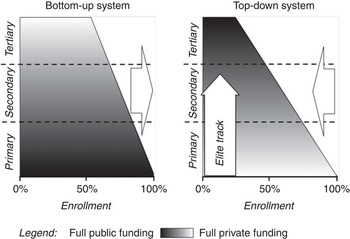
Where the government is not engaged in political entrepreneurship, we should expect it to provide an elitist, ‘Top-Down’ education system. This system will concentrate resources and improve performance at the upper levels, while lowering the quality and/or availability of primary education – by lowering per-student spending, shutting schools, relaxing teaching standards and lowering teacher salaries, etc. In a Top-Down system the upper levels will also be relatively unavailable to anyone outside the elite: the government will create, or allow the private sector to create, a few exclusive, and probably expensive, schools at the lower levels, and erect examinations and other access restrictions at the upper levels to create an elite track through the lower levels, which will give elite students enormous advantages in entering the upper levels and benefiting from the public largess the government is showering on them. Figure 2 portrays the differences between Top-Down and Bottom-Up systems in access and in the relative resources allotted to each level of the system.
Bottom-Up and Top-Down education systems

Ghana, Taiwan, and Brazil show these patterns clearly. Whenever the government was engaged in political entrepreneurship, it subsequently improved and expanded the lower levels of the education system. When this political entrepreneurship stopped, the government subsequently shifted resources from the lower to the upper levels and restricted access so that those levels were increasingly accessible only to elites. These patterns are clear even though, as noted above, these three countries provide maximal variation on the main variables that scholars traditionally use to explain education policy: inequality, institutions, culture, and economic development.
Ghana
Recall that Ghana's government engaged in political entrepreneurship from 1951 to 1966, under Kwame Nkrumah's CPP, and from 1981 to 2000, under J. J. Rawlings’ PNDC. If political entrepreneurship correctly predicts education, Ghana's government should have undertaken Bottom-Up education reforms after 1951, Top-Down reforms after 1966, and Bottom-Up reforms after 1981.
That is what it did. On the eve of Nkrumah's ascendance, when Ghana was still the British Gold Coast, it had an education system that was limited and exclusive. A 1948 census found that only 4 percent of residents of the Gold Coast had ever attended school.Footnote 69 Public primary schools enrolled just over 140,000 students out of approximately 1.3 million children aged 5–14.Footnote 70 But in 1951, Nkrumah became ‘Leader of Government Business’ and his CPP subsequently translated the aspirations of the Ghanaian masses into a promise to provide ‘the minimum basic services for a modern community,’ including education as well as other basic services like health care and clean drinking water.Footnote 71 Once in power, Nkrumah's new government moved almost immediately to expand and improve primary education. As one of its first acts, the new government implemented what it called the ‘Accelerated Plan for Development’ in education, which portrayed the shortage of primary education as a national emergency. The government abolished primary-school fees, and tried to provide the best teachers possible by opening dozens of training centers and by consciously paying teachers more than they could earn in professions demanding similar qualifications.Footnote 72 In January 1952, more than 110,000 children began primary school – more than double the previous year. By 1966, the government was providing quality primary education to more than 1.1 million students, an increase of almost 800 percent in just fifteen years. Over the period the government put, on average, almost half its education budget into primary schools, a relative commitment it would not reach again until 1993.Footnote 73 The reward was remarkable student achievement even as enrollment soared: only in 2002 did average Ghanaian math scores return to their 1960 level; English scores have never completely recovered.Footnote 74
The CPP's constituency was a cross-class alliance: in addition to the Ghanaian masses, it included some elites, specifically a new, Ghanaian bureaucracy and professional class developed to run Ghana's new modern economy. Consequently, the government matched its commitment to primary education with an expansion of quality higher education, heavily subsidized. But it also ensured that this system was accessible to poor students as well as the elite. The British had done little for Gold Coast primary education, but they did invest in higher education: in 1951 Nkrumah inherited a handful of internationally renowned secondary schools that had trained much of Ghana's elite, and a small new University College, enrolling 108 students and granting prestigious degrees from the University of London. The government vastly expanded these levels. It built dozens of new secondary schools, increasing enrollment fifteen-fold by 1966, when Nkrumah was overthrown. Enrollment at University College, which became the University of Ghana, rose from 108 students to 2,200 in 1966, and the government built two additional universities from scratch, bringing total tertiary enrollment to forty-two times its 1950 level. The government invested heavily in these students: by 1962 its spending on them was 60 percent of its spending on all Ghanaian primary and middle school students. But the government also went to great lengths to ensure that poor students had access. Secondary schools were not free, but the government provided most students with scholarships and bursaries to cover costs,Footnote 75 and developed the ‘middle school,’ which gave poorer students extra time and preparation for secondary school examinations. The result was that despite the overwhelming advantages that elite children still enjoyed, by 1960 the children of farmers and fishermen – the occupations of most of Ghana's masses – accounted for a third of students in the fifth year of secondary school.Footnote 76 In addition, universities accepted students not only from secondary schools, but also from secondary-level teachers’ colleges and technical institutes, which enrolled more poor students. In 1960 a third of students at the University of Ghana had not come there from the last year of secondary school, and 40 percent were the children of farmers or fishermen.Footnote 77
All this changed after Nkrumah's overthrow in 1966 ended his political entrepreneurship. The new government openly bemoaned the ‘unplanned and uncontrolled expansion of primary education under the C.P.P. Government’ and established a new ‘planning unit’ to consolidate ‘uneconomic primary schools,’ inevitably into urban areas where the rural poor had difficulty accessing them.Footnote 78 By 1971 the government had closed more than 900 primary schools and reduced primary enrollment by more than 15 percent. Resources became scarce. For example, between 1966 and 1970 real spending by the Education Ministry's textbook unit fell by more than half. Primary teachers largely kept their jobs – the post-1966 governments depended heavily on the political support of the Ghanaian bureaucracyFootnote 79 – but the government demanded far less of them: oversight was removed, and with teaching materials scarce, teachers taught little and often did not even show up. Many teachers avoided teaching entirely by moving into administration, which ballooned: over just a single year, 1967–68, the Ministry's inflation-adjusted spending on central administration rose more than five-fold, to 70 percent of the amount the Ministry was spending on all the primary schools in the country.
At the same time, the government showered resources on secondary schools and universities. As it closed primary schools, the government built new secondary schools, doubling secondary-school enrollment between 1966 and 1975. Over that decade, while real per-student spending on primary and middle schools declined by nearly 10 percent, real per-student spending on secondary schools rose 45 percent. Although primary schools often lacked textbooks, the government proudly touted its ability to put new science equipment and typewriters in all secondary schools.Footnote 80 The same was true of the universities. Enrollment rose 60 percent between 1966 and 1975, and each student received a government scholarship that covered not only tuition, but room and board, books, clothing, travel, examination fees, activities’ fees, and even provided students with pocket spending money.Footnote 81 At the same time, universities became increasingly inaccessible to anyone but the elite. The government made teacher training colleges into post-secondary institutions, preventing poorer students from using them to enter universities without first attending secondary school. But gaining access to secondary schools became a nearly insurmountable challenge for poorer students. Elite children attended a rapidly developing network of ‘special [primary] schools,’ enrollment in which went from 13,000 in 1966 to almost 29,000 in 1971. These schools were generally expensive – 20–100 cedis/day, at a time when the minimum wage was 1 cedi/day – which enabled them to provide excellent resources and attract the best teachers with salaries two-to-three times more than public schools. They taught a curriculum designed specifically to prepare students to take the Common Entrance Examination to secondary school.Footnote 82 At the best special schools, 90–100 percent of students passed the examination, compared to a pass rate for public-school students of just 15 percent; on average well over half of all special school students entered secondary school. The new system set up, as one 1973 Ghanaian Times editorial put it, a widening gap ‘between the haves and the havenots, the privileged and the less privileged, the “equals” and the less “equals.”’Footnote 83
Political entrepreneurship returned to Ghana with Rawlings's coup in 1981. Rawlings confronted economic collapse, so did not tackle education immediately. But by 1985 the economy was returning to life, and in 1986 the government began major reforms to reverse the Top-Down education policies of the previous two decades. The upper levels were opened up: enrollment rose five-fold between 1981 and 2000. But the government also cut resources in order to concentrate them on improving primary schools: upper-level per-student spending was cut in half, and in 1988 the government removed all food and living subsidies from university students. It made these reforms despite vehement protest by elite families and by university professors and students, including a series of strikes that shut the universities from 1995 to 1996. The World Bank, which had long advocated these reforms, watched the government's resolve in the face of this opposition – which previous Ghanaian governments had never been willing to confront – with some amazement. Eventually the Bank concluded that ‘[t]he opposition to the reforms came from the middle class elite, which were not the [government's] political base.’Footnote 84
At the same time that it was expanding and gutting higher education, the Rawlings government was expanding and improving primary education. By 2000, primary enrollment had risen by more than 50 percent, and real per-student spending had almost tripled. The effects were dramatic. Before the reforms, the World Bank estimated that the majority of students who graduated from primary school were illiterate.Footnote 85 A 1988 World Bank survey of Ghanaian primary schools found that less than half could use their classrooms in the rain and two-thirds reported chalk shortages. Only 13 percent of English students and 21 percent of math students had a textbook.Footnote 86 By 2003 a follow-up survey found that two-thirds of classrooms could now be used in the rain and less than 5 percent reported shortages of chalk; 72 percent of English students and 71 percent of math students had at least one textbook. Student performance increased apace: for example, in identical English tests, two-thirds of primary school graduates in 1988 could not outperform guessing; in 2003, less than a fifth scored as poorly as if they had simply guessed.Footnote 87
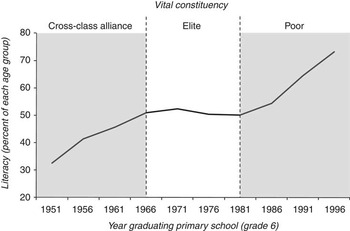
Altogether this half-century of Ghanaian educational history provides evidence of two periods when affiliated political entrepreneurship led to pro-poor education policymaking, and a two-decade hiatus during which the government was not affiliated with a political entrepreneur and made Top-Down education policies. To underline the point, Figure 3 presents data from Ghana's 2003 Core Welfare Indicators survey, a nationally representative sample of 49,005 families that, among other things, measured a person's literacy – defined as ability to read and write in any language – independently of whether the person had gone to school.Footnote 88 The figure shows, for five-year age groups, the proportion of the population who achieved literacy based on when they would have graduated from grade 6, the final year of primary school.
Vital constituencies and progress in literacy in Ghana, 1951–2000

Of the population who would have been of the age to graduate from primary school in 1951, the year Nkrumah's CPP took control of education from the British, a little over 30 percent attained literacy by the time they were surveyed. By 1966, the year Nkrumah was overthrown, that proportion had risen to 51 percent. But thereafter the increase slows, and then – incredibly, since literate parents are very likely to produce literate children – it begins to decline to 50 percent for those graduating in 1981. Starting in 1981, however – the year Rawlings took power – the literate proportion again began to rise, reaching 73 percent for those graduating in 1996.
Taiwan
Taiwan could scarcely have less in common with Ghana. Yet in Taiwan, political entrepreneurship and education are similarly linked. Like Ghana, modern Taiwanese governments engaged in political entrepreneurship of the poor in two periods: 1949–65 and 1987–2000. Thus Taiwanese education policy should have been Bottom-Up after 1949, Top-Down after the mid-1960s, and Bottom-Up again after 1987. Taiwan's education system did in fact develop in this fashion.
When the Kuomintang retreated to Taiwan in 1949, the island's education system was already Bottom-Up. Taiwan's previous colonizers, the Japanese, had built an extensive network of primary schools; at the end of the Second World War, the primary enrollment ratio was 71 percent.Footnote 89 But there was little Taiwanese higher education. In 1939, only nine junior high schools enrolled substantial numbers of Taiwanese students,Footnote 90 and Taiwan's single university accepted only Japanese students. The Kuomintang rapidly improved all levels of this system. By 1965, the primary enrollment ratio had risen to 97 percent, an impressive feat considering that the population was expanding at 3.3 percent a year. From 1950 to 1965, the number of primary students rose more than two-and-a-half-times, from a little over 900,000 to almost 2.3 million. Yet the Kuomintang also poured in resources to keep quality high: real per-student spending on primary schools more than doubled from 1950 to 1965.
The other main group in the Kuomintang's constituency was its own administrative and military corps. The exodus from mainland China added a million-man army and half-a-million bureaucrats and professionals to a Taiwanese population of about six million, effectively increasing it by a quarter. These ‘mainlanders’ wanted higher education for their children, not just primary education, and to serve them the government spent heavily to expand and improve the upper levels. From 1950 to 1965, the government engaged in a massive building program, raising enrollment in junior high schools from 61,000 to 427,000, senior high schools from 19,000 to 116,000, junior colleges from 1,286 to 30,000, and undergraduates from 5,374 to 55,000.Footnote 91 The expansion made these levels easily accessible. In 1950, a junior high school graduate had a 63 percent chance of entering senior high school; by 1965, that graduate had a 96 percent chance. A senior high school graduate had a 73 percent chance of entering university, college, or junior college in 1950; in 1965, the likelihood was slightly less, 70 percent, but this is a fluke: the next year the likelihood was 74 percent.
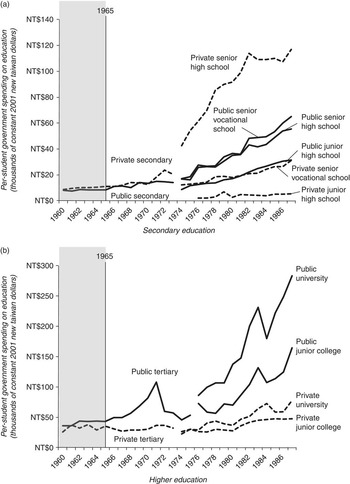
In the 1960s, the Kuomintang ended its political entrepreneurship. The consequences for education were far-reaching: in two decades the Kuomintang transformed Taiwanese education into a Top-Down system. At the upper levels, per-student spending continued to rise (Figure 4). But these levels were increasingly accessible only to elites, because of a new tracking system. The system began in junior high schools, which started separating students judged likely to do poorly on the Joint Entrance Examination to senior high school – inevitably poorer students – from students judged likely to do well; the latter were lavished with the best resources and teachers the school could offer. For elite students who still failed the Joint Entrance Examination, a safety net was available: private academic high schools, which received large government subsidies but also charged high fees, making them accessible only to elites. The nominally private status of these schools allowed them to offer a curriculum entirely geared toward university entrance exams.Footnote 92 Family background soon overwhelmed all other factors in determining a student's likelihood of entering college.Footnote 93
Government per-student spending in Taiwan, 1960–87

For students outside the elite track, increasingly the only option was a newly expanded vocational track, where students paid higher fees and received lower-quality education that prepared them for blue-collar employment in one of Taiwan's booming manufacturing firms – a key Kuomintang constituency. By the mid-1960s, Taiwan's farm labor surplus was drying up: manufacturing wages increased on average by 7 percent a year in the 1960s. In response to this skilled-labor shortage, after 1965 the Kuomintang encouraged the private sector to open dozens of new vocational high schools and junior (vocational) colleges: from 1965 to 1987, enrollment in vocational high schools went from 74,000 to 450,000, 60 percent of which was private; junior college enrollment went from less than 30,000 to 256,000, 80 percent of which was private.Footnote 94 In 1974, the first year separate records were kept on government subsidies, private senior vocational high schools got about a quarter less per student than public academic high schools, while the students themselves paid more: the average academic senior high school student faced fees totaling NT$3,061 in 1971, while the average vocational high school student paid NT$4,175, an amount one-and-a-half times the average monthly salary of a 40-year-old vocational-school graduate.Footnote 95 Figure 4 shows the large and growing government bias in favor of students in the elite academic track over this period.Footnote 96
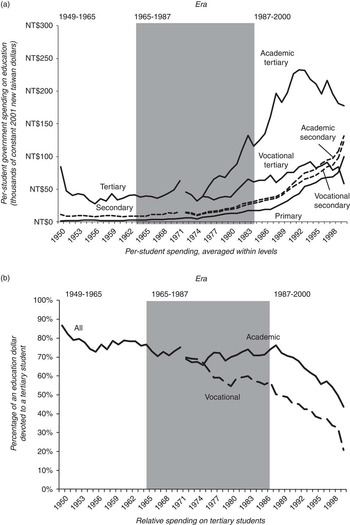
Political entrepreneurship returned to Taiwan in the late 1980s. At the time, dissatisfaction with Taiwanese education, particularly the lower levels, was widespread. Thereafter, Taiwan's government reformed Taiwanese education to again focus on the lower levels. It began by improving the vocational track to which poor students had previously been relegated; when this failed to satisfy the masses – who demanded specific educational reforms to teaching, curricula, class sizes, and access to upper-level education – the government responded by dismantling the vocational track and reforming curriculum and teaching methods in line with these demands.Footnote 97 Simultaneously, it poured resources into the lower levels: from 1989 to 2000, real per-student spending rose two-and-a-half fold in public primary and junior high schools, 190 percent at vocational high schools, 140 percent at academic high schools, and 35 percent at the few remaining public junior colleges (spending fell on private junior college students). These spending increases were partly paid for by lower per-student spending in the formerly privileged upper levels. In response to the concerns of poor parents whose children were struggling against impossible odds in entering upper-level education, the government expanded upper level enrollment, so that access from the lower to the upper levels again became relatively easy, as it had been in the Kuomintang's early days on Taiwan.Footnote 98 In 1989, forty-one colleges and universities enrolled 240,000 students; by 2000, 127 colleges and universities enrolled nearly 650,000 students. But per-student spending on colleges and universities fell by more than a quarter.Footnote 99 Figure 5 puts these trends into historical context. Panel A simplifies the picture by averaging spending at the primary, secondary, and tertiary levels, across both public and private schools. Panel B shows the ratio of per-student tertiary spending to the sum of per-student spending on each level. The breaks are clear: the bias of the system toward academic tertiary students fell immediately after the Kuomintang's arrival; then stabilized even as spending on vocational tertiary students declined; and finally fell precipitously after 1987.
Per-student spending in Taiwan, 1950–2000

Brazil
Brazil provides a third case of the close connection between political entrepreneurship and education, in a context as different from Ghana and Taiwan as they are from each other. Brazil's era of political entrepreneurship lasted from 1930 to 1964. The political entrepreneurship was limited – urban workers and professionals were organized, but not the rural peasantry.
Education policy reflected this pattern of political entrepreneurship. Prior to 1930, Brazilian education was scarce and oriented toward training a few bureaucrats and providing gentlemen's education for elites who wanted the trappings of scholarship. Vargas's constituency, the new urban working and middle classes, were around 30 percent of Brazil's population,Footnote 100 and Vargas's government therefore built up primary education until it covered a quarter of the (appropriately aged) population.Footnote 101 With population growth, this meant enrolment increased by 70 percent from 1933 to 1945, and 260 percent by 1960. The new classes were also poor; hence the government devoted over 70 percent of its education spending to primary education, a complete reversal from the past (in 1912, for example, only 30 percent of federal education spending went to primary schools.Footnote 102 Real per-student spending on primary schools grew by almost 250 percent between 1944 and 1960 (yearly spending data are not available before 1944). As these students began to graduate from primary school, and as the skill demands of the economy increased, the government began investing in the upper levels: secondary, technical, and, finally, higher education. By 1960, secondary enrollment was fifteen times its 1933 level. In the 1950s, the government began creating a network of federal universities, at least one in each state, and enrollment, which had barely budged before 1945, rose four-fold. From 1944 to 1960, real per-student spending rose 244 percent at the secondary level and 60 percent at the tertiary level.Footnote 103
This system, like the cross-class alliance it served, ended with the 1964 coup. The military governments that followed transformed it into a system that was Top-Down to an extreme. At the upper levels, increased public funding and university-governance reforms created world-class education, which was offered free to those who passed the entrance exams. University enrollment grew from 144,000 in 1964 to nearly 1.6 million in 1989, yet despite economies of scale, real per-student spending was only 14 percent less in 1989 than in 1964. Public universities became oases of luxury, with pools, sports centers, and first-rate cafeterias.Footnote 104 Developments at the lower levels ensured that it was elites who benefited: as in Ghana and Taiwan, expensive primary and secondary schools gave students superb preparation for university entrance examinations, to the point where, in the 1970s, only 10 percent of university admissions went to students whose fathers were ‘working class’ – unskilled or skilled workers or supervisors of manual workers.Footnote 105 Outside these elite preparatory schools, the story was the reverse: public primary and secondary schools went from serving a narrow population adequately and equitably to being bloated, underfunded, and extremely poor. In fact, the public lower levels actually grew substantially under the military, but this growth served elites, not students: in particular, politically connected construction companies, which won lucrative contracts to build the schools, and rural county executives, on whom the government depended to keep control of the rural populations and who could dole out teaching jobs as political favors. Harbison and Hanushek describe the staffing of rural primary schools in northeast Brazil in the 1980s as ‘the exclusive prerogative of the county executive and the major form of patronage at the county level.’Footnote 106 Teacher quality and classroom resources fell to abysmal levels. In contrast to the elite public universities, most of the new primary schools lacked running water and basic sanitation,Footnote 107 and many only offered two grades.Footnote 108 Prior to 1964, teaching had been a prestigious, relatively well-paid occupation; after 1964, it became a low-paid and low-status occupation.Footnote 109 Mean teacher salary in the Northeast was less than 60 percent of the minimum wage.Footnote 110 By the early 1980s, 60 percent of rural primary teachers in northeast Brazil had not even finished primary school.Footnote 111 Consequently, though the primary enrollment rate rose from 42 percent in 1960 to 57.5 percent in 1980, the vast majority of the increase was in the first few grades, after which most students dropped out. In 1950, 60 percent of Brazilian primary students completed primary school; in 1976, it was just 15.8.Footnote 112 By the 1980s, more than half of Brazilian students had to repeat the first grade; in the rural northeast it was 73 percent.Footnote 113 In the northeast, by the mid-1980s, the average student starting fourth grade had already been in school for 7.6 years.Footnote 114
The transition to democracy in 1985 did next to nothing to change these trends. Brazilian universities remained privileged havens offering some of the finest education in Latin America, while most public primary and secondary schools languished with few resources and incompetent teachers hired purely for political reasons. Test scores stagnated or even declined: testing under the National Basic Education Evaluation System, established in the 1990s, showed a decline in Portuguese scores and no improvement in math scores from 1995 to 2001: more than half of students could not solve simple problems with units of money and time or use data displayed in graphs; 48 percent of eighth graders performed below the expected level for fourth graders. In the late 1990s, a student from the lowest three deciles of the population – roughly the population below the poverty line – had only a 15 percent chance of completing primary education and a 4 percent chance of completing secondary.Footnote 115 Bourguignon, Ferreira, and Menéndez calculate that inequality in Brazilian education remained so high in 2000 that, if Brazil had replaced its education distribution with that of the United States, Brazil's Gini coefficient would have declined by 6.4 points, which at the time was more than half of the difference in inequality between the two countries.Footnote 116
In sum, education policy in Ghana, Taiwan, and Brazil closely follows political entrepreneurship of the poor. Each time the government engaged in political entrepreneurship, it subsequently expanded educational opportunity for poor citizens.
Alternative Explanations
Could these dynamics be explained by other factors? I selected Ghana, Taiwan, and Brazil because they differ on dimensions that are often associated with educational investments: notably regime type, but also economic development and culture. To conclude the analysis I consider whether these could plausibly account for the dynamics of educational investment in the three cases. The most important alternative explanation for this article is regime type. This article has argued that, while democratic institutions do create incentives to serve the poor, those incentives are weaker than the incentives of all governments, democratic and autocratic, to serve citizens who are organized. The cases of Ghana, Taiwan, and Brazil show this clearly. In all three, the governments that expanded educational opportunity for poor citizens were autocratic more often than democratic. Furthermore, each democratic government that expanded educational opportunity for the poor was simply continuing a policy begun under a previous autocratic government. Regime type correctly predicts education policy in fewer than half of the 173 country-years in this analysis: democratic governments were in power in sixty country-years, but made pro-poor education policy in only thirty-three of these, while autocratic governments made elitist education policy in only fifty-one of the 113 country-years they were in power. Figure 6 tabulates the case-years according to their education policies and their regime type. Regime types are from the standard Przeworski et al. classification;Footnote 117 as the Przeworski et al. coding starts in 1945, I use the Polity IV measure of democracyFootnote 118 for Brazil prior to 1945.Footnote 119
Regime type and education policymaking in the three countries Notes: 173 country-years. Years when regime type correctly predicts education policymaking are outlined by heavy lines. Regime types are from Przeworski et al. (Reference Przeworski, Alvarez, Cheibub and Limongi2000). As their coding starts in 1945, I use the Polity IV measure of democracy (Marshall and Jaggers Reference Marshall and Jaggers2000) for Brazil prior to 1945. A ‘Bottom-Up’ education policy is characterized by an emphasis on quality and access at the lower levels of the system and easy accessibility of the upper levels to poorer students. A government pursuing such a policy might build more primary schools or otherwise try to increase enrollments, increase per-student spending, reform teacher hiring, pay, or training in an effort to improve teaching, reduce school fees or provide financial aid or income supports to offset the direct and opportunity cost of education. Many governments engaging in political entrepreneurship may also have elite constituents and so may provide some higher education as well, but in a ‘Bottom-Up’ system the government will go to great lengths to make these levels accessible to poorer students. By contrast, a government pursuing a ‘Top-Down’ education policy will concentrate resources and improve performance at the upper levels, while lowering the quality and/or availability of primary education – by lowering per-student spending, shutting schools, relaxing teaching standards and lowering teacher salaries, etc. In a Top-Down system the upper levels will also be relatively inaccessible to poor students: the government will create, or allow the private sector to create, a few exclusive, and probably expensive, schools at the lower levels, and erect examinations and other access restrictions at the upper levels to create an elite track through the lower levels. This track will give elite students enormous advantages in entering the upper levels. *Polity IV does not code Brazil an autocracy until 1934; the previous four years are transitional and are coded as neither democracy nor autocracy.

The remaining alternative explanations – culture and economic development – are similarly unsatisfactory. Culture changes slowly, over generations, and thus does not predict the major reforms to educational investments described above; culture cannot explain why governments sometimes expand mass education and sometimes restrict it.Footnote 120 Economic development, which changes more rapidly, does predict over-time changes in investments in primary education and higher education, as the economy's needs change. Specifically, while there is some disagreement among economists about the optimal mix of educational investments for economies at different levels of development,Footnote 121 it is generally thought that the poorer a country is, the more it should focus its attention on primary education, where the economic returns are thought to be higher, and the less it should invest in higher education.Footnote 122 None of the three countries follow this pattern for more than a portion of the periods I examine. The closest is Taiwan, which invested in mass education in the 1950s and 1960s, when the country was relatively underdeveloped, and shifted the focus to technical and higher education beginning in late 1960s. But a developmental explanation cannot account for the second major shift in Taiwanese education, back to a pro-poor education policy, beginning in the late 1980s. In Brazil, economic needs might account for the early emphasis on mass education in the 1930 and 1940s and the gradual inclusion of higher levels in the 1940s and 1950s, but not the hollowing out of the public primary and lower secondary system in the 1960s and 1970s. In Ghana, heavy investments in mass education made some economic sense when the country was on a strong developmental trajectory in the 1950s and 1960s,Footnote 123 but not the shift to higher education in the 1970s when the country's economy was shrinking – exactly the opposite of what the economic-development explanation predicts – nor why the government suddenly began reinvesting in primary education in the 1980s. And in all three countries, the economic-development explanation cannot account for the speed of reforms – why policy would shift from a focus on broad mass education to elite-oriented higher education, or back, within just a few years – nor for details of these systems, such as elite tracks that allowed wealthy students enormous advantages in entering higher education institutions that the government was offering almost free, when these students could have easily afforded to pay far more for their education.
In short, neither regime type, nor alternative explanations such as culture or economic development, can explain the dynamics of educational investments in Ghana, Taiwan, or Brazil. But viewed as a consequence of political entrepreneurship, these dynamics make sense: within a few years of arriving in power, governments affiliated with political entrepreneurs inevitably began major reforms to make their education systems substantially more pro-poor; and when governments stopped their affiliation with political entrepreneurs, they reformed their education systems to make them more elitist.
Conclusion
This article argues that governments make pro-poor education policies when they engage in political entrepreneurship of the poor. Poor citizens generally face collective action costs too high for a government to either rely on them or be threatened by them. For the poor to be politically powerful, they need a collective action subsidy. That is what a political entrepreneur provides. This subsidy allows poor citizens to be a viable political constituency, capable of supporting a government that makes policy in their interest or opposing one that does not. In exchange for this support, a government engaging in political entrepreneurship will provide poor citizens with, among other things, educational opportunity.
The evidence in this article challenges the prevailing explanation of variation in pro-poor policymaking – regime type – and suggests an alternative explanation that is able to explain variation in at least one important policy area. If democratic governments systematically make pro-poor policy, education in Ghana, Taiwan, and Brazil should have become systematically more pro-poor when governments in these countries became more democratic. But in fact, changes in regime type appeared to matter little in all three countries. If anything, governments in these three were more likely to expand educational opportunity for poor citizens when they were autocratic, and even when democratic governments did produce such expansions, they were simply continuing efforts begun under previous autocratic governments. In Ghana, Taiwan, and Brazil, governments expanded educational opportunity for poor citizens when they needed the poor's support, but the reason they needed that support was not to win re-election. At least in these countries, the incentives that democratic institutions created for a government to serve the poor were weaker than the government's incentives to serve citizens who were organized. And while the freedoms associated with democracy undoubtedly make organizing easier for the poor, democratic freedoms did not cause organizing nor were required for poor citizens to become organized.
Instead, what led the poor to be organized was political entrepreneurship. This political entrepreneurship developed organizational structures that allowed poor citizens to overcome their collective action disadvantages and coalesce in support of a government that made policy in their interest. I find that when governments in modern Ghana, Taiwan, and Brazil affiliated with political entrepreneurs of the poor, those governments served the poor with pro-poor education policies.
This finding is notable because of the widespread belief among political scientists who focus on developing countries that democratization reliably leads governments to be more pro-poor in their policymaking. This is the argument of a number of the most influential recent works in the discipline on developing-country policymaking.Footnote 124 The current literature about policymaking in developing countries rarely considers the important role of organization in influencing government policymaking;Footnote 125 in this sense it is disconnected both from the literature on policymaking in the West, which inevitably considers both organization and formal institutions in explaining policymaking outcomes, and from the broader literature on politics in developing countries (as distinct from policymaking specifically), such as work on social movements, revolutions, and political development, in which organization and collective action have long played a central role. The focus on regime type feeds a sense among scholars, and perhaps among the broader public, that poor citizens wishing for a government that is more responsive to their material needs should seek democracy. Thus, even as many citizens of mature democracies increasingly see their elected leaders as unresponsive – and thus are also finding it necessary to mobilize in an effort to put additional pressure on their leaders not to cater to narrow interest groupsFootnote 126 – citizens of many developing countries in the Middle East and elsewhere are mobilizing for democracy, in the hope that once their leaders have the electoral incentive, they can relax and let the institutions of democracy direct government largess their way.
But careful cross-national empirical work, such as that by Ross,Footnote 127 has begun to cast doubt on this contention, concluding that much of the cross-national evidence for it is merely a statistical artifact of biased data.Footnote 128 This article casts further doubt with evidence of a different kind: close analysis of over-time variation in education policy. It suggests that the optimism of Western political scientists for the potential of democratic institutions to make policymaking more pro-poor needs some re-examination. Democracy has many virtues, but the incentives that it creates for leaders to serve the poor may be exaggerated. At least in Ghana, Taiwan, and Brazil, democracy was no substitute for the difficult task of political organizing that leveraged numbers into political power and made poor citizens into a political force – either a capable supporter of a pro-poor government or a credible threat to an elitist government.
Are these findings generalizable? Ghana, Taiwan, and Brazil are as different as any three countries in the developing world. Nonetheless, a study of only three countries is never free of the possibility of selection bias. Therefore, the next step is a cross-national study of the connection between political entrepreneurship of the poor and pro-poor policymaking, which, because there are currently no cross-national data on political entrepreneurship, will inevitably begin with a data-gathering effort to understand where and when political entrepreneurship of the poor has occurred. With cross-national data it will be possible to verify the generalizability of this article's finding that political entrepreneurship of the poor is a reliable predictor of pro-poor policymaking in education, as well as to test its predictive power in other areas of distributive policy.Footnote 129