Introduction
Contemporary narratives speak of young people as the ‘net generation’, ‘digital generation’ or ‘digital natives’ who are constantly engaged with digital media as part of their daily routines, often depicting them as natural-born users of digital media. It is true that today's younger generations grow up surrounded by computers, video games, mobile phones and MP3 players, and this may influence them to think and process information differently from previous generations (Prensky, Reference Prensky2001). It is certainly the case that young people tend to be more adept with digital technologies than their parents’ generation (Pedro, Reference Pedro2006; Tapscott, Reference Tapscott1998). However, Bennett, Maton and Kervin (Reference Bennett, Maton and Kervin2008) conclude that the digital native claims lack empirical and theoretical support. Other studies have found variance within the younger generation in terms of appreciating technologies (Jones & Healing, Reference Jones and Healing2010). Even though digital media is pervasive in the lives of young people, there are differences in the ways in which they engage with these technologies (Holmes, Reference Holmes2011). We need to look at heterogeneity by examining not only those immersed in the technology, but also those who keep a distance (Samuelsson, Reference Samuelsson2010).
Similar to the situation in other developed countries, a large proportion of Australian youth are online. In 2009, 79% of those aged 5 to 14 years were using the internet (Australian Bureau of Statistics, 2011), and in 2013, 96% of households with children under 15 years of age had access to the internet at home (Australian Bureau of Statistics, 2013). While the statistical trend is useful for gauging the proportion of young people that have access to the internet, such indicators do not give information about how frequently they go online and what they actually do while they are online.
The concept of a second-level digital divide captures the varied levels of connectivity among individuals in society that is amplified by the multiple levels of access, use and appropriation of technologies (see Hargattai, Reference Hargittai2002). A gap exists between those who use digital technologies effectively and those who do not (Livingstone & Helsper, Reference Livingstone and Helsper2007; Selwyn, Reference Selwyn2006; Tsatsou, Reference Tsatsou2011; van Dijk, Reference van Dijk2006; Verdegem & Verhoest, Reference Verdegem and Verhoest2009). Scholars have conducted considerable research on why some people choose not to use digital technologies. Empirical evidence shows that the reasons are not entirely economic or social, but rather the result of a complex outcome of preferences and informed decisions (Eynon, Reference Eynon2009; Eynon & Geniets, Reference Eynon and Geniets2012; Reisdorf, Reference Reisdorf2011).
This study has two objectives: one is to explore the infrequent users of the internet among young people, and the other is to investigate why they are disinterested or disengaged. It is important to know who they are and why they are not digitally active because this may result in a new type of digital divide, namely the second-level digital divide among the digital generation. This study adopted an exploratory approach to study a group of Australian youth who are infrequent users of digital media. These users were not digitally disadvantaged youth deprived of access, but rather those who opted out of using technologies. With particular focus on the context of the school environment and students’ academic orientation, this study examined the characteristics of infrequent users as well as the reasons of limited use.
Varied Use of the Internet and its Reasons
Conventional views of the digital generation have been criticised in scholarly work (McMillan & Morrison, Reference McMillan and Morrison2006). Holmes’ (Reference Holmes2011) analysis of OFCOM's Young people and media usage survey suggests that about one-third of 12- to 15-year-olds who have home internet access use the internet only in a narrow sense. With the increase in overall internet penetration, studies have found that access does not automatically lead to usage, and that there is a large variation among people in their use of the internet.
In countries with higher penetration rates of broadband, evidence shows that there is considerable amount of variation in usage levels. A study in Europe suggests that the majority of people are still very low-level users. Brandtzaeg, Heim and Karahasanovic's (Reference Brandtzaeg, Heim and Karahasanovic2010) analysis of the Eurostat on internet usage identifies 42% as non-users and 18% as sporadic users of the internet. They define non-users as those who do not use the internet regularly and sporadic users as those who occasionally use the internet but do not use a wide range of services. Selwyn, Gorard and Furlong (Reference Selwyn, Gorard and Furlong2005) categorised internet users into broad frequent users, narrow frequent users, occasional users and non-users. Longley, Webber and Li (Reference Longley, Webber and Li2006) categorised online users into unengaged, marginalised, becoming engaged, for entertainment/shopping, independents, instrumental users, business users and experts.
Motivation and skills are found repeatedly to be important factors that influence internet usage behaviour. For example, psychological barriers such as anxiety and low self-efficacy affect usage patterns (Lee, Reference Lee2009; Selwyn, Reference Selwyn2004). Such non-cost-related psychosocial obstacles can undermine the motivation for acquiring skills (Stanley, Reference Stanley2003). In a study comparing 10 countries, the most cited reason of non-use was ‘no interest/not useful’. In a similar study conducted in the USA, among the 21% of Americans who do not use the internet, 31% said it was because they were not interested (Zickuhr, Reference Zickuhr2010). The motivational aspect is the first step to a successive model of digital media use.
Another important reason people may not engage online is that they do not have the skills to appropriate all the services. Differential use patterns result from disparity in existing socio-economic, cognitive and cultural resources. This can lead to a further divide in the digital arena (Peter & Valkenburg, Reference Peter and Valkenburg2006). Some people simply do not use the internet because it is frustrating (Ewing & Thomas, Reference Ewing and Thomas2012). The use of digital media requires a wide range of user capabilities, such as computer literacy and technical competence (James, Reference James2008). In addition to individuals’ attitudes and beliefs about their competence in digital media, the social context is also important. Goode (Reference Goode2010) uses the concept of ‘technology identity’ to explain this perception. He suggests that socio-cultural forces affect a person's technology identity. Young people tend to reproduce their digital identities at home and at school.
A Widening Participatory Gap: Why does it Matter?
The provision of access to digital technologies does not guarantee beneficial use. Getting access to the internet is only one step towards digital engagement. In the long run, what matters is how people use the technology that results from divergent skills (Dobransky & Hargittai, Reference Dobransky and Hargittai2006; Vicente & Lopez, Reference Vicente and Lopez2010).
According to Mossberger, Tolbert and McNeal (Reference Mossberger, Tolbert and McNeal2008), digital citizenship is the ability to participate online. For this reason, they define digital citizens as those who use the internet every day. Infrequent or occasional users might not have the skills to use the internet effectively, depriving them of the opportunity to develop new skills. In order to use online resources for beneficial activities, one must have constant access and the motivation to use various services. An immersed type of social engagement with networked publics is necessary for meaningful use (Ito et al., Reference Ito, Horst, Bittanti, Boyd, Herr-Stephenson, Lange and Robinson2008). The online space is expanding, and increasingly information and services are exclusively available online. Since more activities take place online, the ability to engage on the internet is becoming more significant in terms of social inclusion.
Getting access and using the internet frequently are the preconditions of effective use. Once users start to engage in online activities, they progress from simple low-level activities to creative activities as usage expands (Livingstone & Helsper, Reference Livingstone and Helsper2007). Wei (Reference Wei2012) proposes the use of multi-modality as an indicator of digital inequality. His analysis of 11 online activities confirmed that going online is a progression with systematic differences between those who engage in more and fewer activities. As the modes of activities increase, uses become more sophisticated. Both studies show that participatory and creative behaviour occurs later in the ladder. The reason this is important is that certain activities are more beneficial. There are capital-enhancing activities such as looking up information for schoolwork, acquiring political knowledge, searching for job vacancies, and obtaining useful information on financial or health services (DiMaggio, Hargittai, Celeste, & Shafer, Reference DiMaggio, Hargittai, Celeste, Shafer and Neckerman2004). Users must engage frequently as well as have the skills to appropriate the technologies to retrieve these online benefits
The Context of Learning about the Digital Environment at School
Future society calls for a more soft-skilled, flexible work force and thus school internet use should promote such skills, including play, performance, simulation, appropriation, multitasking, trans-media navigation, networking and negotiation. These are all essential qualities in digital media literacy (Jenkins, Clinton, Purushotma, Robison, & Weigel, Reference Jenkins, Clinton, Purushotma, Robison and Weigel2006). School is an important environment where children learn about the uses and rules of digital technologies. However, it is difficult to integrate digital media into the existing school curriculum because of its multi-faceted nature, which allows its use for both education and entertainment. Due to these multiple uses of computers and mobile devices, most schools have a dual approach towards using digital media. On the one hand, teachers try to incorporate and use computers and internet in the curricula. Yet, schools prohibit the personal use of mobile phones or social media on school premises, due to the fear that continuous connectivity of digital media may cause distraction and interfere with learning (Hope, Reference Hope2012).
In Australia, the government is investing heavily to contribute sustainable and meaningful change to teaching and learning in Australian schools via information and communication technologies (ICT), including broadband, computers and digital devices (Department of Education, Employment and Workplace Relations, 2008). By Year 10, students should be able to identify personal and information security issues as well as the social impact of ICT. Therefore, learning about digital media goes beyond its appropriation as an effective learning tool, but to the extent that students will benefit from it in the future.
In schools, computer and internet use is linked to academic performance (Jackson, Brown, & Pardun, Reference Jackson, Brown and Pardun2008; Luu & Freeman, Reference Luu and Freeman2011; Thiessen & Looker, Reference Thiessen and Looker2007). In other words, academically driven digital media use enhances students’ digital media literacy and is encouraged at school. Internet use is positively correlated with reading achievement and higher grades (Jackson et al., Reference Jackson, Brown and Pardun2008), scientific literacy (Luu & Freeman, Reference Luu and Freeman2011) and writing skills (Warschauer, Reference Warschauer2006). Competence in digital media implies higher academic achievement.
The context in which young people use digital technologies is important in shaping their motivation and perception of relevance. Schools give dual messages to students about using digital media at school, some positively associated with academic use and some negatively associated with personal or social use. The main component of positive use is higher academic achievement. For those who are not academically oriented, this may shift their perception of the relevance of digital media further away.
Methodology
Rather than attempting to establish generalisable results, the goal of this study was to obtain an in-depth look into a particular segment of young people identified as infrequent internet users. The chosen method was semi-structured interviews. The list of topics or questions for the interviews included digital media use, online activities, digital media literacy, and digital technologies in the context of everyday lives and their future. A total of 19 teenagers based on a purposive sample were interviewed at a school in Australian Capital Territory (ACT), Australia, from October to December 2011. Jackson School (pseudonym), a senior secondary school, was selected as the site.
The problem of gaining access to the less engaged users is that they are usually left out of large-scale surveys (Eynon & Geniets, Reference Eynon and Geniets2012). Even if we adopt a qualitative approach, it is more likely that users who are more active will be recruited. This study adopted a slightly different approach in order to recruit the most relevant participants. Prior to recruitment, the researcher interviewed three teachers from the school. The teachers advised that students enrolled in the accredited stream tend to have less interest in digital technologies. It was also the case that subjects offered in the accredited stream had lower requirements of digital competency. Therefore, instead of trying to recruit non- or low-level internet users directly, this study adopted a sampling method based on the students’ academic orientation.
Jackson School is one of the 16 senior secondary schools that award vocational qualifications certified by the ACT Board of Senior Secondary Studies. The school offers two streams: an academic stream for those who wish to go to university – the tertiary stream – and a vocational stream – the accredited stream. Tertiary subjects require high levels of computer skills and digital media literacy, whereas students in the accredited stream choose subjects based on their career path, in which case there is often very little computer work involved in the studies. Prior observations of the teachers led the researcher to conclude that recruiting students from the accredited stream would more likely produce less digitally engaged students.
For this study, five accredited classes and one tertiary class were selected as the recruitment pool from a total of 20 English classes, six in the accredited stream and 14 in the tertiary stream. Everyone was invited to participate in the research by the English teacher but among the 10–15 students in each class, 2–4 students volunteered to participate. The interviews were conducted in one of the school computer rooms to ensure a comfortable interview atmosphere. Those who volunteered to participate were excused from their English class to be interviewed.
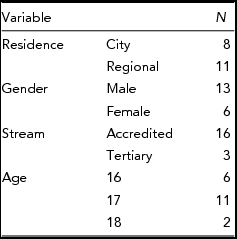
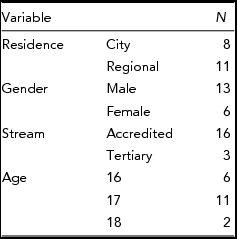
At the completion of the interviews, 68% were male, 84% were from the accredited stream and the average age of participants was 16.8 years. A common characteristic of accredited stream students is that many lived in regional areas and not in the city or the suburbs. More than half (58%) of the participants commuted from the outskirts of the city (Table 1).
Summary of participants.
Prior to the interviews, informed consent was obtained from the participants’ parents or legal guardians, as well as from the participants themselves. The majority of the interviews were conducted by the chief investigator and some by a research assistant participating in the research project. All interviews were recorded and transcribed for analysis. Throughout this paper, pseudonyms are used in place of actual names, including the school name, to ensure the anonymity and privacy of the participants. Appropriate ethics clearance was sought and approved by both the National Health and Research Council through the National Ethics Application Form (NEAF) and the ACT Department of Education and Training.
Findings
The narratives of the interviewees are hardly representative or typical of 16- to 18-year-olds in Australia. On the contrary, they tell quite a different story. While all of the participants had access to computers, internet and mobile phones, most of them were disinterested in digital technologies and did not see the benefits of using them in their everyday context. The analysis in the following shows characteristics of infrequent internet users and some of the reasons why these young people disengaged with digital media.
High Connectivity, Low Use
The concept of the digital generation describes those who grew up in a rich digital environment. Except for one participant, whose parents put a limit on internet usage due to their home broadband subscription plan, all had unlimited access to both the internet and computers at home. Most owned a laptop or computer of their own. All had mobile phones, many with internet subscription. The school had ample computer facilities, which students could use during break or classes. Mobile phone use was quite permissive on school premises. Participants had been exposed to computers and mobile phones since an early age. In primary school, they were required to take computer classes in the third year. Exposure to and ownership of mobile phones occurred usually round the ages of 12 and 13.
However, we cannot assume that all members of the digital generation are immersed in technologies and are adept users thereof. Among the 19 participants, only three used the internet ‘almost every day’. All other participants used the internet less frequently. When they did use it, it was mainly to check and send messages or to watch videos. None of the participants fit the typical model of the digital generation, where their daily lives revolve around the internet, social media and mobile phones.
Many participants did mention that iPods, mobile phones and laptops were essential to their lives, but no-one was constantly tethered to any of the devices, and the uses were mainly functional. For example, when Lawrence (17 years old) uses his computer for homework, he does not go online during or after his task. He turns off the computer when he is done. Tristan (17 years old) owns his own Xbox but only plays with it occasionally; for example, when “friends are over and it's raining and there's nothing else to do”. Lisa (16 years old) checks Facebook notifications only when she is bored and there is “nothing better to do”. Jocelyn (16 years old) recalls that she used to be “pretty into it [Facebook]”, but now she “could live without it”.
Using Selwyn et al.'s (Reference Selwyn, Gorard and Furlong2005) typology of occasional and narrow frequent users, the majority of participants in this study were somewhere in between the two categories. They did not use their digital media often and their uses were limited to one or two functions. Once they fulfilled the purpose, they would log off or turn off the device and not linger on to use other applications. They were not interested in exploring the wide range of services available on the internet or their devices. Despite high-speed connection and various devices they own, they use them for very limited purposes.
“It's not a big thing in my life”
Being infrequent users of the internet, participants were unable to link the benefits of using technology to their own lives. As Sean (17 years old) puts it, “It's not a big thing in my life.” Mason (17 years old) who is aspiring to become a carpenter or mechanic does not think that digital technologies will be significant in his future and has no incentive to learn more. He does not like computers or digital devices and he thinks people who spend time in front of the screen are “slugs”. Similar to what Facer and Furlong (Reference Facer and Furlong2001) found among British youth, interest in digital devices was linked to their identities.
“You try to keep it [Facebook] to a minimum, because it's a waste of time . . . I just like to see if I’ve got any messages and then go off again . . . I think it's silly, so I just try to use it to keep in contact with people.” (Lawrence, 17 years old)
Limiting the use of digital media and the internet was often intentional and was closely tied to how they perceived themselves. Andrew (16 years old) positions himself as an occasional user of computers. When asked why, he replied:
“I just don't – I’ve got better things to do really than sit in front of a screen for too long.” (Andrew, 16 years old)
Charlie (16 years old) does not have any social media account and checks his e-mail about twice a week. Although he uses the computer almost every day, he focuses on only one activity – watching YouTube videos. Mason uses Facebook only when other means are unavailable. Other than that, he sees no point to using it.
“I have a Facebook [account], but I don't use it . . . Because I just don't see [the benefits] – the last time I used it was probably a few months ago . . . I don't see the point of typing on a screen and waiting for them [friends] to respond . . . I find it boring, sitting in front of the computer, talk to people.” (Mason, 17 years old)
Nate (18 years old) finds the internet “quite boring over time” because “you are limited to just so much, even though the internet does seem vast”. Although participants in the study did not all fit neatly into the category of infrequent users, they all shared the common trait of not being enthusiastic about continuously residing online. None of them wanted to improve or expand their uses because they did not see any immediate benefits.
Lack of Digital Media Literacy Leads to Less Use
With an abundance of various digital devices at their disposal, participants found their own ways of learning how to use them. However, they did not perceive themselves as effective or skilled users. Young people tend to compare their skills to those of their peers while constantly confirming their digital identities in terms of how adept they are at using them. Many regarded themselves as “less literate” compared to their ‘tech’ friends. Sarah (16 years old) feels that she and her friends’ digital media literacy level are below average compared to other young people. Rachel (18 years old) feels that the high expectation of society on the digital generation is overwhelming, and that she would never be able to meet such standards.
Participants thought of digital media literacy as a relative measure that marginalised them from the mainstream tech-savvy digital generation. Andrew (16 years old) knows that he is “not as familiar with it as people who are on their computers more often”. In contrast to their tech-savvy peers, digital technologies were something alien to their lives. Rachel describes herself as “technologically illiterate”, and she is “scared that everything is just advancing so fast”. This relative deprivation and lack of skills reinforced their infrequent use. Peter thinks that searching the internet for information is a waste of time. He gets frustrated easily and pulls away from using it.
“You end up having heaps of pages and that's difficult . . . The internet's so time consuming and just a big time waster.” (Peter, 17 years old)
Similarly, Lawrence (17 years old) does not think the internet is an efficient tool for finding information because “you end up reading a lot about something and then realising it's got nothing to do with what you’re researching.”
There was a shared belief that young people should already be equipped with high levels of digital media literacy at school. Due to this expectation, they rarely thought that it was something they could still learn more about and improve on. This pressured students to shy away from technology altogether. It was hard for them to actively seek out help when they were stuck or in need of assistance with the technology. Peter (17 years old) would rather “spend two hours sitting in front of a computer and eventually get it” than ask someone and hear them say, “Look, it's as easy as that.” They did not want to appear incapable in front of their peers. They chose to learn by “mucking around” (Gianna, 17 years old) and through “trial and error, to figure out how it works” (Eric, 17 years old). Students acquired digital literacy mostly “on their own” (Jocelyn, 16 years old) and were “self-taught” (Tristan, 17 years old).
“I am not really good with technology and computers . . . I just try and learn it myself and then I get confused, because no one has really explained it to me properly.” (Lisa, 16 years old)
The Context of Digital Media Use in Schools
Participants in the accredited stream focused on their work experience rather than academic subjects in school. Therefore, there was a discrepancy between what they learn in school and their uses of digital technologies. When computer skills were required in school, it was difficult to bring it into their everyday learning context.
“You don't really learn it [software for music composing]. It's almost like you’re expected to know . . . it's not as if we’re ever taught how to use it, but we’re expected to use it here . . . some people get quite anxious when they have a composition assignment and they don't have a clue what to do because they’re not quite sure how to use Sibelius [software].” (Peter, 17 years old)
Participants translated their lack of confidence in using digital technologies in their schoolwork to their personal and social uses of these technologies. They identified digital technologies as something alien to their lives.
“That is not for me . . . it's for popular ones. Twitter is used by those who have 1000 followers.” (Matthew, 17 years old)
Not being able to link their studies at school to digital media, lack of confidence in their use, and their peers led them to opt out of using these technologies. Even though they all owned multiple devices and had seamless access to the internet at home and at school, this lack of motivation, skills and relevancy were systematically excluding them from any new opportunities to learn about and utilise new digital technologies.
Conclusion
While this study is by no means a representative study of infrequent users, it does uncover certain characteristics of infrequent users and reasons why they choose not to actively engage with digital media. Participants in this study were not disadvantaged in gaining access to digital technologies. Their limited use was, in part, due to low levels of digital media literacy and lack of motivation. Some lacked the confidence, while others merely chose to minimise their use because their interests lay elsewhere. None of them thought that digital technologies and the internet were relevant to their lives or their future.
Infrequent use of the internet was not used as a rigid and theoretically driven concept. Rather, it was an observation that was made through this qualitative study, where young people who had sufficient access to digital technologies did not use them frequently nor reap the benefits of being connected. This confirms that we cannot assume that all young people are constantly online, engaged with digital media and competent users of digital technology.
Those who were identified as infrequent users regarded digital technologies and the internet as functional tools that they sometimes accessed when they needed to communicate or consume content. Instead of staying online all the time, they would log on when necessary, fulfil their needs and then log off. Typical uses were to communicate with friends and to watch videos. Such uses could easily be replaced with other devices, such as phones or the television set. Thus, they did not perceive the internet to be of unique value.
This study uncovered three main reasons why young people might choose not to be digitally engaged: irrelevance, digitally illiterate identities and lack of motivation. Most participants in this study were aspiring to vocational careers after graduation and did not plan on going to university. The disjunction between school ICT education and their career paths led them to identify themselves as the less digitally literate group compared to their highly skilled peers. They did not think that they could improve their skills because they assumed that, as they are the digital generation, they should already be adept users. Consequently, they became less interested in using or learning more about digital media. This was linked closely to the digital identities they attached to themselves. This pushed them further away from exploring further uses and reinforced their functional uses. Another reason why infrequent users were not fully utilising digital technologies was that they were simply disinterested. Many of them could not link the benefits of using the internet to their everyday lives or their future. Motivational aspect is crucial in determining the adoption and use of the internet. Participants did not regard digital technologies as a significant part of their future.
Social exclusion is a state where people cannot participate in key societal activities (Saunders, Naidoo, & Griffiths, Reference Saunders, Naidoo and Griffiths2007). Even though participants were infrequent internet users by choice and not due to their socio-economic status or lack of access, the long-term consequences of being excluded from technologies may result in another type of social exclusion, namely the second-level digital divide. Those who are disenfranchised from ICT resources for socio-economic reasons can be remedied by policy intervention. However, those who have access, but do not have the capacity to use the technologies, impose a more complex issue. Not only is it problematic to identify those belonging to this category, but it is also challenging to provide appropriate motivation and skills to narrow the gap.
This study has methodological limitations because it is based on a small purposive sample. Nevertheless, learning that getting access to multiple digital platforms is not a sufficient condition for effective uses, adds valuable insight into how we can better understand the digital generation. We need to understand the diversity in digital media use among young people, whether they are constantly tethered to digital devices or whether they are disconnected from the online world. Existing studies tend to focus on the impact of continuous connectivity. This study adds to the literature by looking at the other end of the spectrum.
Binary notions of the digital divide along the lines of access and non-access can no longer be applied (Selwyn, Reference Selwyn2004). We need a more nuanced and hierarchical understanding of the divide, distinguishing between effective uses of technologies while recognising the mediating role of existing socio-economic factors that influence digital engagement. The long-term consequences of divergent uses of internet and digital media, particularly among the so-called digital generation, are yet to be uncovered.