Introduction
The ε4 allele of apolipoprotein E (APOE) is the most important currently known genetic risk factor for late-onset Alzheimer's disease (AD) dementia (Paulson & Igo, Reference Paulson and Igo2011), and is thought to account for around 20–50% of the attributable total risk for dementia (Slooter et al. Reference Slooter, Cruts, Kalmijn, Hofman, Breteler, van Broeckhoven and van Duijn1998; Ashford, Reference Ashford2004). Expression of the APOE ε4 allele in the human brain has been shown to affect sterol homeostasis, cholesterol transport, membrane repair and other cellular activities that are related to β-amyloid accumulation and the neurodegenerative process (Schipper, Reference Schipper2011a ,Reference Schipper b ). The presence of the ε4 allele, however, is neither necessary nor sufficient for developing dementia as a substantial number of ε4 carriers do not develop dementia and vice versa a substantial number of non-carriers do (Khachaturian et al. Reference Khachaturian, Corcoran, Mayer, Zandi and Breitner2004; Schipper, Reference Schipper2011a ; Ferrari et al. Reference Ferrari, Xu, Wang, Winblad, Sorbi, Qiu and Fratiglioni2013).
Research in recent years has focused increasingly on possible interactions between psychosocial environments and genes (Grabe & Schwahn, Reference Grabe and Schwahn2011). A growing number of studies also indicate that the impact of the APOE ε4 genotype on dementia risk is dependent on lifestyle factors such as alcohol consumption, smoking, diet or mental and physical activity (e.g. Luchsinger et al. Reference Luchsinger, Tang, Shea and Mayeux2002; Rovio et al. Reference Rovio, Kåreholt, Helkala, Viitanen, Winblad, Tuomilehto, Soininen, Nissinen and Kivipelto2005; Barberger-Gateau et al. Reference Barberger-Gateau, Raffaitin, Letenneur, Berr, Tzourio, Dartigues and Alpérovitch2007; Carlson et al. Reference Carlson, Helms, Steffens, Burke, Potter and Plassman2008; Kivipelto et al. Reference Kivipelto, Rovio, Ngandu, Kåreholt, Eskelinen, Winblad, Hachinski, Cedazo-Minguez, Soininen, Tuomilehto and Nissinen2008; Rusanen et al. Reference Rusanen, Rovio, Ngandu, Nissinen, Tuomilehto, Soininen and Kivipelto2010), providing ‘an optimistic outlook for genetically susceptible individuals’ (Kivipelto et al. Reference Kivipelto, Rovio, Ngandu, Kåreholt, Eskelinen, Winblad, Hachinski, Cedazo-Minguez, Soininen, Tuomilehto and Nissinen2008, p. 2769).
In this study, we aimed to further analyse interactions between the APOE ε4 genotype and lifestyle for dementia and AD risk. We specifically focused on physical activity as a lifestyle factor because, to date, only a few studies have investigated interactions between this factor and APOE ε4 for dementia and AD risk and the findings are inconsistent (e.g. Lindsay et al. Reference Lindsay, Laurin, Verreault, Hébert, Helliwell, Hill and McDowell2002; Podewils et al. Reference Podewils, Guallar, Kuller, Fried, Lopez, Carlson and Lyketsos2005; Rovio et al. Reference Rovio, Kåreholt, Helkala, Viitanen, Winblad, Tuomilehto, Soininen, Nissinen and Kivipelto2005; Kivipelto et al. Reference Kivipelto, Rovio, Ngandu, Kåreholt, Eskelinen, Winblad, Hachinski, Cedazo-Minguez, Soininen, Tuomilehto and Nissinen2008; Paillard-Borg et al. Reference Paillard-Borg, Fratiglioni, Winblad and Wang2009, Reference Paillard-Borg, Fratiglioni, Xu, Winblad and Wang2012). Moreover, we tested for the presence of gene–environment interaction for dementia and AD risk by calculating indices on an additive scale [relative excess risk due to interaction (RERI), attributable proportion due to interaction (AP), and the synergy index (S)]. These indices indicate whether the combined effect of two exposures is larger (or smaller) than the sum of the individual effects of the exposures, compared to indices on a multiplicative scale (e.g. interaction terms in logistic regression or Cox proportional hazards regression models), which indicate whether the combined effect of two exposures is larger (or smaller) than the product of the individual effects of the exposures (Knol et al. Reference Knol, VanderWeele, Groenwold, Klungel, Rovers and Grobbee2011). Although the indices on a multiplicative scale are more commonly used in epidemiological studies, it is recommended that biological interaction should be verified by indices on the additive scale (e.g. Ahlbom & Alfredsson, Reference Ahlbom and Alfredsson2005; Andersson et al. Reference Andersson, Alfredsson, Källberg, Zdravkovic and Ahlbom2005).
Method
Sampling
We studied general practice patients who participated in the longitudinal German study on Ageing, Cognition and Dementia in Primary Care Patients (AgeCoDe). These patients were recruited by their general practitioners (GPs) in six study centres (Hamburg, Bonn, Düsseldorf, Leipzig, Mannheim and Munich), and all provided written informed consent prior to their participation in the study. The study complies with the ethical standards of the Declaration of Helsinki and has been approved by the ethics committees of all participating study centres.
Eligible patients for the AgeCoDe study were aged ⩾75 years, were dementia free according to their GP, and had at least one contact with their GP in the past 12 months. Patients who (i) were not regular patients of the participating practice, (ii) had only home-visit consultations, (iii) were residents of a nursing home, (iv) had an illness deemed likely to be fatal within 3 months, (v) lacked sufficient facility in speaking German, (vi) were deaf or blind, or (vii) lacked the ability to consent were excluded. The study design of the AgeCoDe has been described in detail elsewhere (Luck et al. Reference Luck, Riedel-Heller, Luppa, Wiese, Bachmann, Jessen, Bickel, Weyerer, Pentzek, König, Prokein, Eisele, Wagner, Mösch, Werle, Fuchs, Brettschneider, Scherer, Breitner and Maier2013).
Among the randomly selected sample of 6619 GP-referred patients, 3327 individuals participated in the study at baseline (50.3%) and 2810 at follow-up I (42.5%). As shown in Fig. 1, four of the patients who participated at baseline were aged < 75 years and 42 were already classified as prevalent demented. A total of 143 died before follow-up I, and 364 refused or were otherwise unable to participate in the subsequent follow-up wave. We also excluded those 282 patients from further analyses who were classified as incident demented at follow-up I (n = 69), who had an incomplete follow-up assessment (n = 114) or whose APOE status could not be assessed (n = 99), leaving an analysis pool of 2492 dementia-free patients at follow-up I for our study (Fig. 1).
Sample attrition and sample. BL, Baseline; FUP, follow-up. a Dementia, other disability, etc.; b poor health, removal, etc.

Data collection and assessment procedures
Data collection took place between 23 January 2003 (start of baseline) and 9 February 2011 (end of follow-up IV). Follow-up assessments were scheduled every 1.5 years. Baseline and subsequent follow-up assessments were performed in patients’ homes by trained physicians and psychologists.
The main assessment instrument was the SIDAM (Zaudig et al. Reference Zaudig, Mittelhammer, Hiller, Pauls, Thora, Morinigo and Mombour1991), a structured interview for diagnosis of dementia of the Alzheimer type, multi-infarct dementia and dementias of other aetiology according to ICD-10 and DSM-III-R. The SIDAM consists of: (1) a cognitive test battery and (2) a section for summary clinical diagnostic impression and third-party rating of psychosocial impairment with a 14-item scale for the assessment of activities of daily living (SIDAM ADL scale). The cognitive test battery consists of 55 items, including the 30 items of the Mini-Mental State Examination (MMSE; Folstein et al. Reference Folstein, Folstein and McHugh1975). The items cover several domains of cognitive function (orientation, memory, abstract reasoning, verbal ability and calculation, constructional ability, aphasia and apraxia). To evaluate cognitive impairment, age- and education-specific norms for the cognitive domains were applied (Luck et al. Reference Luck, Zaudig, Wiese and Riedel-Heller2007).
We identified depressive symptoms using the 15-item version of the Geriatric Depression Scale (GDS; Sheikh & Yesavage, Reference Sheikh, Yesavage and Bring1986) with a cut-off score ⩾6 (Gauggel & Birkner, Reference Gauggel and Birkner1999). A standardized interview provided information on sociodemographic characteristics. Participants' GPs completed questionnaires about medical diagnoses and took blood samples for genetic analysis.
We used essentially identical procedures at all four follow-up waves. At follow-up, participants were additionally interviewed regarding participation in seven mental activities (doing crossword puzzles, doing memory training/exercises, participating in voluntary work in a church, a nursing home, a political party, etc., playing board games or cards, reading books or newspapers, writing stories, poems or letters, and playing a musical instrument) and seven physical activities (cycling, hiking or doing long walks, swimming, gymnastics, doing housework or gardening, babysitting, doing other activities such as bowling or playing golf). We asked participants how often they usually participated in the mental and physical activities (categories: every day, several times a week, once a week, less than once a week, never). Those who participated every day or several times a week in an activity were classified as active (with regard to the specific activity). We then generated additive indices for mental and physical activities by summing the number of activities that were done every day or several times a week.
If a participant had died in the interim or was otherwise unavailable, we obtained information about their cognitive status by interviewing an informant using the structured Global Deterioration Scale (Reisberg et al. Reference Reisberg, Ferris, de Leon and Crook1982) and the ‘changes in performance of everyday activities’ and ‘changes in habits’ subscales from the Blessed Dementia Scale (Blessed et al. Reference Blessed, Tomlinson and Roth1968). Dates of death were obtained from relatives or from official registry offices.
Diagnosis of dementia
Dementia status at baseline and subsequent follow-up assessments was agreed at consensus conferences that included the interviewer and an experienced geriatrician or geriatric psychiatrist. Dementia was diagnosed according to DSM-IV criteria (APA, 2000), which are implemented as a standardized diagnostic algorithm in the SIDAM. A diagnosis of AD was established according to the National Institute of Neurological and Communicative Disorders and Stroke–Alzheimer's Disease and Related Disorders Association (NINCDS-ADRDA) criteria for probable AD (McKhann et al. Reference McKhann, Drachman, Folstein, Katzman, Price and Stadlan1984). If SIDAM results were not available, we assigned follow-up dementia diagnoses when ratings were ⩾4 on the Global Deterioration Scale (Reisberg et al. Reference Reisberg, Ferris, de Leon and Crook1982) and/or > 8 on the Blessed Dementia Rating subscales (Blessed et al. Reference Blessed, Tomlinson and Roth1968). In these cases a diagnosis of AD was established if the information provided was sufficient to judge the aetiology of AD according to the criteria stated above.
APOE ε4 genotyping
Leucocyte DNA was isolated with the Qiagen blood isolation kit according to the manufacturer's instructions (Qiagen, Germany). The APOE ε4 genotype was studied as described elsewhere (Hixson & Vernier, Reference Hixson and Vernier1990). Patients were divided by APOE status into those with or without at least one ε4 allele.
Statistical analysis
Statistical analyses were performed using Predictive Analytics Software (PASW) version 20.0 (IBM Corp., USA) and Statistical Analysis System (SAS) version 9.2 (SAS Institute Inc., USA). All analyses used an α level for statistical significance of 0.05 (two-tailed). Group differences were analysed using the t test, the Mann–Whitney U test and the χ 2 test as appropriate.
Analysis of gene–environment interaction for the risk of incident dementia and AD was based on data from dementia-free patients at follow-up I as physical activity was not assessed at baseline.
We used the Kaplan–Meier survival method to estimate dementia- and AD-free survival times subject to APOE ε4 status and the number of physical activities (i.e. activities engaged in every day or several times a week). This method censored participants at the time of their last evaluation if they died or dropped out of the study without developing dementia, or if they had not developed dementia by the end of follow-up IV. With regard to AD-free survival, participants who developed dementia of other aetiology were also censored. We used the log rank test to evaluate differences in the survival distributions of the groups.
Multivariable Cox proportional hazards regressions were used to assess individual association of APOE ε4 status and number of physical activities (at follow-up I) with risk for dementia and AD (at follow-up II–IV). We additionally included age, gender, education, alcohol consumption, smoking, MMSE score, mental activity and co-morbidity at follow-up I (diabetes mellitus, hypertension, cardiac arrhythmia, coronary heart disease, myocardial infarction, peripheral arterial obstructive disease, carotid artery stenosis > 80%, transient ischaemic attack, stroke, hyperlipidaemia, hypercholesterolaemia, hyperthyroidism, hypothyroidism, traumatic brain injury and depression) as covariates in the regression models based on their potential relationship with risk for dementia. For each variable included in the regression models, hazard ratios (HRs) and Wald 95% confidence intervals (CIs) were calculated.
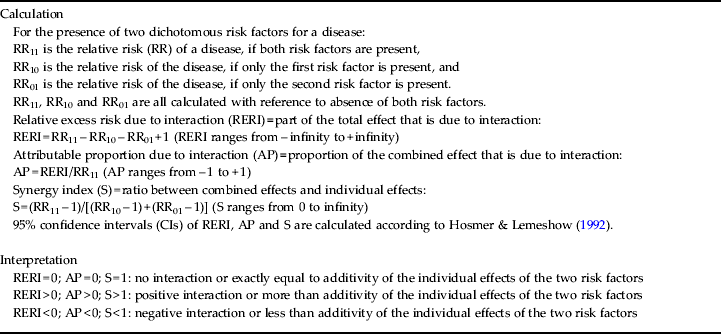
We then tested for interaction of APOE ε4 status with the number of physical activities for dementia and AD risk by calculating three indices: (1) the RERI, (2) the AP and (3) the synergy index S (Rothman, Reference Rothman1986). All three indices are based on an additive scale. For a discussion on the advantages of using these indices over indices on a multiplicative scale, see Ahlbom & Alfredsson (Reference Ahlbom and Alfredsson2005). Detailed information on the calculation and interpretation of RERI, AP and S is provided in Table 1.
Calculation and interpretation of RERI, AP and S as indices of additive interaction of risk factors (Rothman, Reference Rothman1986; Andersson et al. Reference Andersson, Alfredsson, Källberg, Zdravkovic and Ahlbom2005; Knol et al. Reference Knol, VanderWeele, Groenwold, Klungel, Rovers and Grobbee2011)

Because testing additive interaction between risk factors requires binary coding of the risk factors, we used classification and regression tree (CART; Breiman et al. Reference Breiman, Friedman, Olshen and Stone1984) analysis to identify the cut-off of the number of physical activities that discriminated best between patients with high and low risk for dementia.
Results
Characteristics of the sample
A total of 2492 dementia-free patients at follow-up I were included in the analyses (Fig. 1). The mean age of the sample at follow-up I was 81.1 years (s.d. = 3.5); 1612 (64.7%) of the patients were female; 20.6% (n = 514) were carriers of at least one APOE ε4 allele. On average, patients reported participation in 1.8 physical activities (activities that were undertaken every day or several times a week; s.d. = 1.1, median = 2, range 0–5).
Dementia- and AD-free survival time subject to APOE ε4 status and physical activity
A total of 278 of the dementia-free patients at follow-up I (11.2%) developed dementia during the subsequent follow-up waves II–IV (4.5-year follow-up period). A diagnosis of dementia in AD was established in 184 of these patients (Fig. 1).
The mean dementia-free survival time of the study sample, as estimated by Kaplan–Meier survival analysis, was 5.4 years (95% CI 5.4–5.5) and the mean AD-free survival time 5.6 years (95% CI 5.5–5.6).
CART analysis identified a cut-off of ⩽1/⩾2 in the number of physical activities to discriminate best between patients with high and low risk for dementia. Patients with the co-presence of a low number of physical activities (⩽1) and the APOE ε4 allele showed shorter dementia- and AD-free survival times (mean = 4.3 years, 95% CI 4.1–4.6; mean = 4.5 years, 95% CI 4.3–4.7) than patients with the presence of a low number of physical activities alone (mean = 5.0 years, 95% CI 4.9–5.1; mean = 5.2 years, 95% CI 5.1–5.3) or the APOE ε4 allele alone (mean = 5.2 years, 95% CI 5.1–5.4; mean = 5.3 years, 95% CI 5.2–5.5), or patients with none of the two risk factors (mean = 5.6 years, 95% CI 5.6–5.7; mean = 5.7 years, 95% CI 5.6–5.8; Fig. 2). The differences between the estimated dementia- and AD-free survival times of the patient groups were significant (dementia-free survival: log rank χ 2 = 64.262, df = 3, p < 0.001; AD-free survival: log rank χ 2 = 56.766, df = 3, p < 0.001).
Kaplan–Meier curves of (a) dementia-free and (b) Alzheimer's disease (AD) dementia-free survival times subject to apolipoprotein E (APOE) ε4 status and number of physical activities.

Individual association of APOE ε4 status and physical activity with risk for dementia and AD
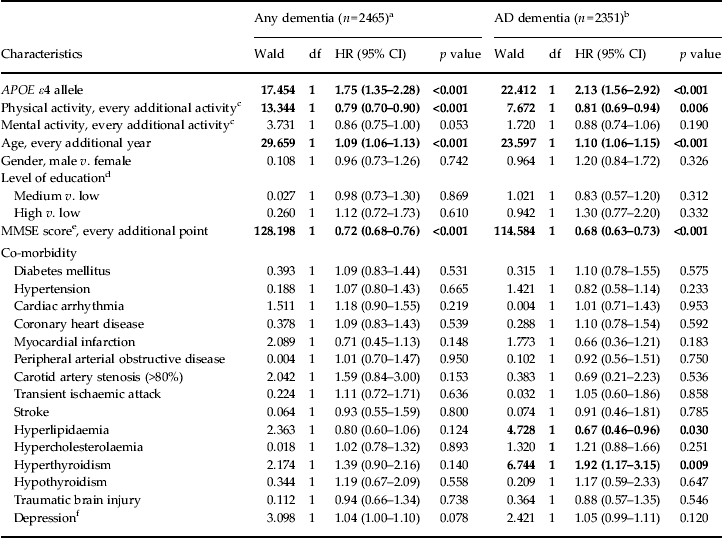
The results of the multivariable Cox proportional hazards regressions showed significant individual associations of the APOE ε4 allele and a lower number of physical activities with increased risk for dementia and AD (Table 2). The regression models also identified older age and a lower baseline MMSE score as significant risk factors for dementia and AD. Hyperlipidaemia significantly decreased and hyperthyroidism significantly increased the risk for AD but did not impact the risk for any dementia. Mental activity showed no significant individual association with dementia or AD risk.
Cox proportional hazards regression to evaluate the risk of dementia and AD according to APOE ε4 status and physical activity, controlled for covariates

AD, Alzheimer's disease; APOE, apolipoprotein E; CI, confidence interval; df, degrees of freedom; HR, hazard ratio; MMSE, Mini-Mental State Examination.
a Data missing for 27 (1.1%) patients.
b Patients who developed dementia of an aetiology other than AD (n = 94) were excluded from the analysis. Data missing for 47 (2.0%) of the remaining 2398 patients.
c Participation in an activity every day or several times a week versus once a week, less than once a week, or never.
d Based on the revised version of the international CASMIN educational classification (Brauns & Steinmann, Reference Brauns and Steinmann1999).
e The higher the MMSE score, the better the cognition.
f Based on the Geriatric Depression Scale (GDS; Sheikh & Yesavage, Reference Sheikh, Yesavage and Bring1986).
Interaction of APOE ε4 status with physical activity for dementia and AD risk
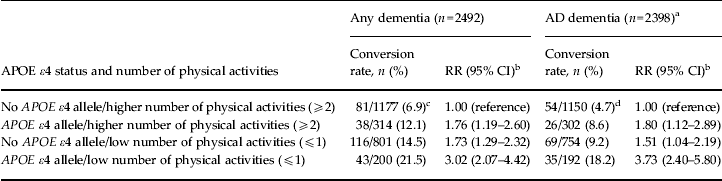
As shown in Table 3, the co-presence of a low number of physical activities (⩽1) and the APOE ε4 allele was associated with a higher conversion rate to, and a higher relative risk of, dementia and AD than the presence of only one of the two risk factors.
Conversion to and relative risk of dementia and AD according to APOE ε4 status and number of physical activities

AD, Alzheimer's disease; APOE, apolipoprotein E; CI, confidence interval; RR, relative risk.
a Patients who developed dementia of an aetiology other than AD (n = 94) were excluded from the analysis.
b Calculation of the RRs was adjusted for the covariates included in the Cox proportional hazards regressions in Table 2.
c Differences in the conversion rates of the four groups were significant (χ 2 = 52.509, df = 3, p < 0.001).
d Differences in the conversion rates of the four groups were significant (χ 2 = 47.290, df = 3, p < 0.001).
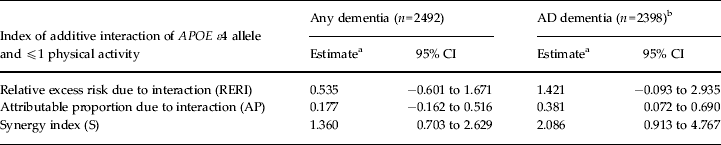
We did not detect a significant interaction between a low number of physical activities and the APOE ε4 allele for general dementia risk; the findings on the indices of interaction (RERI and AP were not significantly different from 0 and S was not significantly different from 1) indicated a combined effect of the APOE ε4 allele and physical activity on dementia risk that is equivalent to the sum of the individual effects of the two risk factors (Table 4). However, we did find that the AP index was significantly higher than 0 (0.381, 95% CI 0.072–0.690), indicating a possible additive interaction between the APOE ε4 allele and low physical activity for AD risk; that is an indication of a combined (adverse) effect of the two risk factors on AD risk that is larger than the sum of the individual adverse effects of the two risk factors. The presence of this additive interaction for AD risk was also supported by borderline non-significant findings of RERI > 1 and S > 0 (Table 4).
Estimates of additive interaction of APOE ε4 status with number of physical activities for dementia and AD risk

AD, Alzheimer's disease; APOE, apolipoprotein E; CI, confidence interval.
a RERI, AP and S were calculated based on the relative risks shown in Table 3.
b Patients who developed dementia of an aetiology other than AD (n = 94) were excluded from the analysis.
Discussion
In this longitudinal study on dementia-free general practice patients aged ⩾75 years, we sought to analyse interactions between the APOE ε4 genotype and lifestyle for dementia and AD risk. We found that the presence of the APOE ε4 allele and a lower number of physical activities in late life were associated with increased dementia and AD risk. The co-presence of the APOE ε4 allele with a low number of physical activities was associated with a higher conversion rate to dementia and AD, a higher relative risk of dementia and AD, and a shorter dementia- and AD-free survival time than the presence of either the APOE ε4 allele or a low number of physical activities alone. The indices of interaction indicated no significant interaction between the two risk factors for general dementia risk, but a possible additive interaction for AD risk.
The findings of previous studies on the interaction between the APOE ε4 genotype and physical activity for dementia and AD risk are inconsistent. Rovio et al. (Reference Rovio, Kåreholt, Helkala, Viitanen, Winblad, Tuomilehto, Soininen, Nissinen and Kivipelto2005), for example, reported a protective effect of physical activity at midlife on dementia and AD risk only among APOE ε4 carriers whereas Podewils et al. (Reference Podewils, Guallar, Kuller, Fried, Lopez, Carlson and Lyketsos2005) found a protective effect of late-life physical activity only among non-carriers. Other studies did not report any interaction between APOE ε4 status and physical activity for dementia or AD risk, neither for physical activity in midlife nor for physical activity in late life (Lindsay et al. Reference Lindsay, Laurin, Verreault, Hébert, Helliwell, Hill and McDowell2002; Kivipelto et al. Reference Kivipelto, Rovio, Ngandu, Kåreholt, Eskelinen, Winblad, Hachinski, Cedazo-Minguez, Soininen, Tuomilehto and Nissinen2008; Paillard-Borg et al. Reference Paillard-Borg, Fratiglioni, Winblad and Wang2009). Discrepancies in these findings, however, might be attributed to differences in the study population (e.g. age), study design (e.g. follow-up time), adjustment for confounders (e.g. cognitive functioning at baseline) and assessment of physical activity, and also in the measurement and interpretation of interaction (e.g. additive or multiplicative interaction), and comparisons should therefore be made with caution.
Our results, which are based on measures of additive interaction and thus on measures that are particularly recommended for verification of biological interaction, tend to confirm those previous studies that indicate a protective effect of physical activity on general dementia risk that is unrelated to APOE ε4 status; that is, that APOE ε4 carriers may benefit to the same extent as non-carriers by increasing physical activity in late life to reduce their general dementia risk. The biological mechanisms underlying this protective effect of physical activity on general dementia risk, however, are not completely understood. Possible explanations, mainly provided by animal studies, include enhanced neuroplasticity and increased expression of neurotrophic factors induced by physical exercise (Ahlskog et al. Reference Ahlskog, Geda, Graff-Radford and Petersen2011). There is also strong evidence that physical activity reduces dementia-related cerebrovascular risk and risk factors (e.g. diabetes mellitus, hypertension, obesity) (Ahlskog et al. Reference Ahlskog, Geda, Graff-Radford and Petersen2011).
Importantly, and in contrast to the findings on general dementia risk, our results suggest a possible additive interaction between the APOE ε4 allele and low physical activity for AD risk. APOE ε4 carriers may therefore benefit particularly from a physically active lifestyle. As outlined by Rovio et al. (2005, p. 710), one possible explanation for such an additive interaction effect may be that APOE ε4 carriers ‘have less effective neural protection and repair mechanisms, and are thus more dependent on lifestyle-related factors to protect them against dementia and AD’ (see also Mahley & Rall, Reference Mahley and Rall2000). Further studies are required to investigate such mechanisms underlying a potential interaction between physical activity and the APOE ε4 genotype.
We did observe one association between a covariate and AD risk that seems to be counterintuitive: hyperlipidaemia was significantly associated with decreased AD risk. Patients with a diagnosis of hyperlipidaemia usually take lipid-lowering agents, particularly statins, and a significant number of studies suggest that statin use may have a preventive effect on AD (for an overview, see Shepardson et al. Reference Shepardson, Shankar and Selkoe2011). The association between hyperlipidaemia and decreased AD risk in our study, however, could not be attributed to such a confounder effect of statin use and needs to be analysed in more detail.
Our study is not without limitations. First, although more than 90% of elderly German people have regular contact with a GP (Linden et al. Reference Linden, Gilberg, Horgas, Steinhagen-Thiessen, Baltes and Mayer1996), our sample may not be representative. The generalizability of our results may also be limited because a significant number of GP-referred patients invited to participate in the study could not be contacted or refused participation and another substantial number of participants had to be excluded from analysis because of missing information. A possible selection bias cannot therefore be excluded.
Second, dementia at follow-up could only be diagnosed at the times of assessment. By convention, we assigned dementia onset at the midpoint between the time of the follow-up assessment when dementia was diagnosed, and the time of the previous assessment. Although, on average, dementia onset could be assumed at this midpoint, this procedure is associated with some inaccuracy.
Third, we chose instruments that were necessarily brief for their applicability to epidemiological studies, and thus may lack either sensitivity or specificity when compared to more extensive examinations. This might be especially true for the assessment of participation in physical activities providing only self-reported information and only on a selected number of activities. We are aware, however, that a more extensive assessment of physical activity providing in-depth information on the single activities (e.g. intensity) may have enabled us to carry out more detailed analyses and to draw more specific conclusions (e.g. of which physical activity in what frequency and what intensity elderly people would have benefited most to reduce their dementia and AD risk).
Nonetheless, these brief instruments provided data sufficient to suggest that a physically active lifestyle even in late life may reduce conversion to dementia and AD or delay onset of clinical manifestations. As we did observe a possible additive interaction between the APOE ε4 allele and low physical activity for AD risk, APOE ε4 carriers may particularly benefit from an active lifestyle. Although we did not find a gene–environment interaction for general dementia risk, a protective effect of physical activity on the risk for dementia was found in both APOE ε4 allele carriers and non-carriers. Engaging in physical activity can therefore be generally recommended, independently of genetic susceptibility.
Appendix
Members of the AgeCoDe Study Group: W. Maier (Principal Investigator), M. Scherer (Principal Investigator), H.-H. Abholz, C. Brettschneider, C. Bachmann, H. Bickel, W. Blank, S. Eifflaender-Gorfer, M. Eisele, A. Ernst, A. Fuchs, K. Heser, F. Jessen, H. Kaduszkiewicz, T. Kaufeler, M. Köhler, H.-H. König, A. Koppara, C. Lange, T. Luck, M. Luppa, M. Mayer, E. Mösch, J. Olbrich, M. Pentzek, J. Prokein, A. Schumacher, S. G. Riedel-Heller, J. Stein, S. Steinmann, F. Tebarth, M. Wagner, K. Weckbecker, D. Weeg, J. Werle, S. Weyerer, B. Wiese, S. Wolfsgruber, T. Zimmermann and H. van den Bussche (Principal Investigator 2002–2011).
Acknowledgements
This publication is part of the German Research Network on Dementia (KND) and the German Research Network on Degenerative Dementia (KNDD) and was funded by the German Federal Ministry of Education and Research (grants KND 01GI0102, 01GI0420, 01GI0422, 01GI0423, 01GI0429, 01GI0431, 01GI0433 and 01GI0434; and grants KNDD 01GI0710, 01GI0711, 01GI0712, 01GI0713, 01GI0714, 01GI0715, 01GI0716 and 01ET1006B). T. Luck was supported in writing the publication by a research fellowship from the German Research Foundation (grant: Lu 1730/1-1).
We thank all participating patients and their GPs for their excellent collaboration.
Declaration of Interest
None.