[F]acts are never meaningless: indeed, they become facts only because they matter in some sense . . . [F]acts are not created equal: the production of traces is always also the creation of silences.Footnote 1
This essay is an attempt to reflect on the past and on possible futures of the historiography of Pahlavi Iran. At its root stands the observation that with the rise of the autocratic Pahlavi dynasty, the state began to cast a long shadow over the way journalists, intellectuals, and scholars saw modern Iran.Footnote 2 Key actors—Reza Shah Pahlavi (r. 1921–41) and his bureaucratic elite, and Muhammad Reza Shah Pahlavi (r. 1941–79) and his technocratic elite—produced an image of the state as a unit completely detached from society and omnipotent enough to be the ultimate reference point for all developments be they social, cultural, or economic.Footnote 3
The first part of the article substantiates this observation by showing how dynastic nationalism positioned the Pahlavi shahs both on top and at the center of society; how bureaucratic and technocratic elites understood modernization as a top-down affair in which society was the object rather than a participant; and how, especially in the 1960s and 1970s, repression reinforced the image of the state as completely distinct from society.
There is no doubt that the Pahlavi state was powerful. Moreover, in the crucial sense that it was an autocracy characterized, particularly from 1926 to 1941 and 1963 to 1978, by the shahs’ extraordinary autonomy to make decisions and that this autonomy was reinforced by bureaucratic and technocratic elites, it was separate from society.Footnote 4 But this is not the full story. However suggestive accounts of Reza Shah abusing his subjects and pictures of Muhammad Reza Shah moving about Tehran's sky in a helicopter, however patent the reality of the Pahlavi autocrats and their bureaucrats taking lofty decisions, however resolute the revolutionary reversal of this situation in the cathartic dismounting of Muhammad Reza Shah—at ground level, state and society were not separable with the clarity that the Pahlavi monarchs imagined and, in 1979, many Iranians wished. What about the millions routinely interacting with government personnel and thus affecting policy implementation? Of most importance, what about people's everyday lives? Can they—indeed, can the sum total of what constitutes “modern Iranian history” and what is worth studying—be reduced to a paradigm of state action/societal reaction?
More often than not, scholars of Pahlavi Iran across the ideological spectrum have looked past such questions. Some, mainly anthropologists, have taken them up, exploring themes such as everyday life.Footnote 5 However, most—including the focal group of this essay's second part, historians and historically oriented social scientists—have not really done so.Footnote 6 They have followed changes in historiography, including the social turn of the 1960s and 1970s and the following decade's cultural turn, but subordinated them to state-centered analyses.Footnote 7 Also, specific case studies have not challenged the general view of the Pahlavi era. The second part of the article examines this situation. In a series of brief analyses, I show how historians have been gripped by the image of an omnipotent, completely autonomous state and how, each one in his or her own way, turned this image into what I call methodological statism.Footnote 8 This historiographic perspective survived the revolution (and, despite recent departures,Footnote 9 is still dominant): the drama of a people's rise and a king's fall magnetized scholarly attention enough to allow the Pahlavi state's hold on analytical imagination to outlive its own death.
Methodological statism “sees like a state,” to borrow James Scott's phrase.Footnote 10 This angle is not out of place for analyzing autocratic Pahlavi Iran. After all, as an anonymous reviewer of this text insisted, “the state under Mohammad Reza Shah actually was instrumental in instigating modernization.”Footnote 11 However, thinking in a methodological statist mold has drawbacks that keep us from seeing a broader picture of Iran and from assigning the state a more realistic place in it. First, by replicating the Pahlavi shahs’ and their elite bureaucrats’ and technocrats’ top-down perspective, it turns the state and, more broadly, politics, into the ultimate reference point of studies focusing not only on politics but also on societal action, the economy, and culture. Second, it reifies: the image of a detached state is a caricature of the complex practice of governing.Footnote 12 We barely understand how societal actions forced the Pahlavi state to react or how societal reactions to policies subjected the latter to unintended changes once off the drawing board. In both cases, policymakers, regular government employees, and ordinary Iranians interacted more intensely than we commonly assume. Finally, we know very little about the diverse and intertwined social, cultural, economic, and political facets of everyday life. Whatever is ostensibly immaterial to the state-driven metanarrative of Pahlavi history—particular aspects of life, such as microhistories of specific villages, neighborhoods, public spaces, and so forth—goes unnoticed and is left to anthropologists, almost all of whom stopped working on the Pahlavi period after 1979.
“How should we address these lacunae?” is the question driving this article's third and final part. I first outline what types of primary sources are available and underline the importance of methodologies rarely used by Iranian historians such as interviews and the analysis of material objects. I then combine exemplary primary sources with existing literature to suggest possible new historiographic angles and fields of research. To be specific, this exercise questions the dominant notion of a strict state–society divide by looking at certain aspects of land reform, social policy, and infrastructural development and explores everyday-life history, a principal lacuna of Iranian historiography, through a series of questions about mass consumption. As this article's conclusion argues, such new questions and approaches should not—indeed, must not—throw the baby out with the bathwater. Methodological statism is not wrong. It is one-sided. Rethinking historiography does not mean discarding it; it involves trying out new sources and perspectives, then fusing them with state-centered perspectives into a broader panorama of Pahlavi Iran.
OUTLINE OF A SELF-PORTRAIT: THE PAHLAVI STATE
In 1936, an Iranian student in Paris published his dissertation under the title Le culte d'État chez la nation iranienne. He argued that “the cult of the state” was the Iranian nation's compass in its quest for independence: since pre-Islamic times, the state had been the banner around which Iranians gathered.Footnote 13 Not by accident, the text was written at the zenith of Reza Shah's rule (1921–41). Early on, the first Pahlavi king fulfilled a popular “desire for a strong power,” ending a decade of foreign interventions that had peaked during World War I.Footnote 14 Members of the emerging educated modern middle class argued that Iran's weakness was rooted also in the political factionalism and “dominance of an ignorant majority” produced by the Constitutional Revolution (1905–11)Footnote 15 and that Iranians would have to start acting rationally for their country to flourish.Footnote 16
To this end, the so-called “ignorant masses”—millions of peasants, tribesmen, and urban toilers—needed guidance. In addition, because “sound constitutionalism is impossible in Iran . . . what is left is an ‘enlightened tyranny.’” It was the state that had to lead society, the modernists functioning as the velvet glove around the shah's iron fist.Footnote 17 The modernists at the helm of a rapidly expanding bureaucracy thus quickened the pace of social and cultural reforms. Although these had been desired for decades (and undertaken in fits and starts for just as long), the bureaucratic elite framed 1921 as a watershed. Eager to leave behind purportedly idle Qajar rulers and Constitutional deadlock,Footnote 18 it declared the state to be a central means to that end. Such arguments in Iran were reinforced by the “monumental comeback of the state” in the West between World War I and the Great Depression, two global catastrophes that put the last nail in the coffin of small government typical of the liberal capitalist 19th century.Footnote 19 During this “fall of liberalism,” which peaked in the 1930s and early 1940s, Iranian modernists also “felt attracted by authoritarian ideologies of the political right.” To them, Kemal's Turkey, Mussolini's Italy, and Hitler's Germany seemed to demonstrate what a strong state and a unified nation could accomplish.Footnote 20
Early in its history, the Pahlavi state had in fact become more transformative than its Qajar predecessor. However, this reality became the base for something entirely different: the image of the state as the only motor for progress and as fully separate from society. It is ironic that this happened at a time when interactions between citizens and a mushrooming number of regular state officials—the daily business of governing, in other words—were growing exponentially. The image of an all-powerful state was amplified by the arbitrary behavior of an increasingly autocratic Reza Shah and underpinned by a dynastic nationalism that placed the king front and center of progress and the nation.Footnote 21
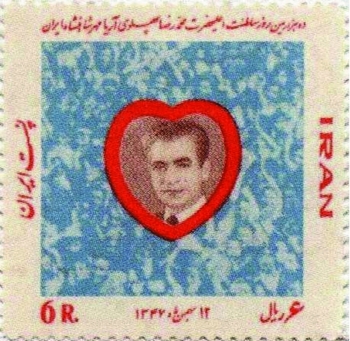
Dynastic nationalism gave the state a recognizable face in the age of expanding mass media and an image of being interventionist in society while ostensibly being removed from it. Reza Shah was depicted on stamps, for example, overseeing modernizing projects such as road construction (Figure 1). After 1941, Muhammad Reza Shah took up this idea. In one of his own stamps, he handed over land-title deeds to peasants (Figure 2). He thereby depicted himself as the motor of the 1963 White Revolution, which was “an attempt . . . to provide a legitimating myth for the Pahlavi monarchy.” In another stamp, he was literally placed at the heart of the nation (Figure 3).Footnote 22
A stamp depicting Reza Shah overseeing road construction. [A color version of this figure can be viewed online at journals.cambridge.org/mes]

A stamp depicting Muhammad Reza Shah handing over land-title deeds to peasants. [A color version of this figure can be viewed online at journals.cambridge.org/mes]

A stamp depicting Muhammad Reza Shah at the heart of the nation. [A color version of this figure can be viewed online at journals.cambridge.org/mes]

Likewise, building on his father's “educational policy stress[ing] God, King, and Country,” Muhammad Reza Shah had school textbooks routinely highlight his central and exalted position in society.Footnote 23 One adult literacy manual included a picture of “His Imperial Majesty the Shah-en-Shah teaching in one of the anti-illiteracy schools” and is full of praise for how the shah “spends his own money and property to [ensure the] people's well-being and the country's development.”Footnote 24 The single most famous event celebrating dynastic nationalism, however, was Muhammad Reza Shah's 2,500-year commemoration of Iranian monarchy in 1971.Footnote 25
The king addressed the tomb of Achaemenid king Cyrus in Persepolis with the words: “Rest in peace, Cyrus, for we are awake, and we will always stay awake.” In his mind, “we” the nation had been revived, and he was the motor at the heart of the state driving its renewal. He dated this special bond between shah and nation back to antiquity: “monarchy . . . [has been] our way of life . . . for 2,500 years.”Footnote 26 It thus was not by accident that the shah chose Persepolis’ “famed ruins . . . as the ultimate symbol of Iran's monarchy and civilization.”Footnote 27 Archaeology bolstered his claim to be the most recent link in an uninterrupted chain of Four Hundred Forty-Six Kings of Iran, as a “publication for the celebration of 2,500 years of kingship” proclaimed.Footnote 28 As with his use of stamps and educational textbooks, the shah's harnessing of the past built on precedent. Starting in the late 1800s, Iranians’ fascination with pre-Islamic history crystallized in the 1921 establishment of the state-supported Anjuman-i Asar-i Milli.Footnote 29 Reza Shah put this fascination to his own dynastic-nationalist use, erecting statues of himself alongside those of past national figures in city squares and “cast[ing] in stone on the facades of newly constructed civic monuments the ancient warrior and king.”Footnote 30
Dynastic nationalism registered abroad, too—particularly when, in the 1970s, the value of the black gold Muhammad Reza Shah needed to develop his “Napoleonic vision of Iran as a new Japan” multiplied. Some observers warned that “the Shah's very supremacy carries dangers,” among which “hubris” was not the least. Still, many agreed that “not a sparrow falls in the kingdom without [the shah's] knowledge.”Footnote 31 This aura of omniscience was cemented by the shah's dealings with foreign governments. Even the United States ended up allowing him to quasimonopolize its sources of information on Iran. As one U.S. analyst wrote, in “the new reality of the 1970s, [the shah was] a ruler who knew his own mind, . . . [he was] firmly in command.”Footnote 32 Abroad, this impression was intensified by the shah's ostentatious grandeur. He brought foreign dignitaries to Iran—among many others, nine kings and sixteen presidents were wined and dined at the Persepolis “bash of bashes”Footnote 33—and was a “jet-set icon” at the world's most ritzy winter resort, St. Moritz.Footnote 34 “[I]n residence for a month every winter [since 1965] . . . [h]e and Empress Farah were usually the guests of honor at almost nightly parties.”Footnote 35 In addition, because Iran was such a cash cow for investors in the oil-crazed 1970s, even statesmen like French president Valéry Giscard d'Estaing made the pilgrimage to the “imperial enclave of Iran at the heart of Europe.”Footnote 36
The Pahlavi shahs did not create the image of the state as a powerful, independent agent by themselves, however. As shown previously, Reza Shah's bureaucrats believed they had the knowledge and the duty to reform society. Postwar technocrats expressed equivalent views but in a new, more sophisticated language. They adapted an early Cold War discourse of development to their own tastes, which, backed by royal support and petrodollars, were elitist even by international standards. (It is not coincidental that James Scott included Muhammad Reza Shah, protector of Iran's technocrats, in the “Hall of Fame of high-modernist figures” who embrace a particularly “muscle-bound version of self-confidence about scientific and technical progress.”Footnote 37)
At the Plan Organization (PO)—home of Iran's leading technocrats since the tough directorship of banker and economist Abolhassan Ebtehaj (1954–59)—many of the “‘young bucks’ educated in the U.S.” were economists for whom specialized technical knowledge was a precondition for a say in Iran's future.Footnote 38 Ordinary people were beneficiaries of development, not partners in it.Footnote 39 In an emblematic story, David Lilienthal, ex-chairman of the U.S. Tennessee Valley Authority and in charge of the flagship Khuzestan Development Project on behalf of the PO, relates how in Khuzestan, Ebtehaj took him to “a small show place . . . [where] . . . villagers shuffled over and looked through the high iron gates.”Footnote 40 Elitism went further: PO technocrats such as Khodadad Farmanfarmaian “had no patience for parliamentarians. We were a different species. . . . In our heart, we believed they knew nothing about economic development and the less they interfered with us, the better it was.”Footnote 41
Like economics, sociology started to gain traction in the 1950s. Taught at Tehran University since 1940, it flourished after World War II as a way of dealing with accelerated social change (the most fundamental of which was rural–urban migration and urbanization) and matured with the 1958 establishment of the Tehran School for Social Work and the Institute of Social Studies and Research (ISSR). Sociologists emphasized their own relevance to state planning—and the state started to shape their research agendas. For instance, Tehran municipality and the ISSR held joint seminars on urbanization, and the PO regularly commissioned the ISSR to conduct field studies.Footnote 42 Although less powerful than the PO's top technocrats, sociologists like ISSR head Ehsan Naraqi embraced a similarly managerial vision of society: “Complex social problems . . . can be solved if the person intent on studying [them] is already familiar with the subject matter and the research methods of the social sciences.”Footnote 43
The technocrats’ writ ran large because by the 1960s, just as the parliament became ever more subservient to the shah, the bureaucracy was growing by leaps and bounds.Footnote 44 Projects multiplied, but results did not necessarily match goals. Although discounting grassroots or parliamentary and ministerial participation in decision making, PO technocrats understood that projects changed during implementation:
[W]e [technocrats] really had a great deal of freedom . . . in formulating the ultimate proposals. . . . Generally speaking, [these] were accepted without too much ado . . . [but] . . . [were] too complicated for many of them [ministers] to really understand. . . . [T]he rub comes that in the implementation, [the ministers] proceeded without any due consideration to what was in the Plan.Footnote 45
Still, technocrats saw unspoken negotiations as aberrations from a norm dictated from the top, not as a problem requiring systemic adjustment. This attitude was even plainer at the court. As Richard Frye, noted American scholar and head of Pahlavi University in Shiraz, recalled, “the people in the court . . . were blind to anything except to their own ability to change the whole country.”Footnote 46 In contrast, when he asked Empress Farah to intercede with the organizers of the 1971 Shiraz Jashn-i Hunar festival, she admitted being incapable of forcing her inferiors to truly obey her orders.Footnote 47 The state appeared to be in full control; reality was quite different.
The ultimate means of state control was not elitist technocracy, but repression, reinforcing an image of the state as fully separate from society. Founded in 1957, the National Intelligence and Security Organization (SAVAK) stepped up its activities after a 1963 revolt against the shah's White Revolution.Footnote 48 Western observers started to pay attention when, during German and Iranian student demonstrations in Berlin against the visiting shah on 2 June 1967, SAVAK agents indiscriminately beat German demonstrators and bystanders and a German policeman killed student Benno Ohnesorg. This event—“the key turning point in the development of the [West German] protest movement [that] . . . led directly to a rapid escalation in violence”—was thus indelibly associated with Iran.Footnote 49 To many people in Germany, and the West in general, the shah became the quintessential capitalist Third World dictator. Ohnesorg's death “created deep sympathy, amongst the European public, for the Iranian opposition.”Footnote 50 This climate precipitated the growth, for instance, of the exile group Confederation of Iranian Students/National Union (CISNU), which called for an “anti-dictatorial and anti-imperial front” against “reaction in Iran and [world] imperialism.”Footnote 51 In 1971, CISNU and its sympathizers were able to shame numerous Western governments into downgrading their participation at the shah's Persepolis fête.Footnote 52 In Iran, the same year witnessed the start of guerilla warfare, mainly by the Fadaiyan and Mojahedin-e Khalq. News was censored and armed resistance failed to jump start popular rebellion, but the drastically intensified state repression started to mark society as a whole. Although in 1970 there were 1,000 political arrests, in 1976 the number had mushroomed to between 25,000 and 100,000.Footnote 53 In the West, public opinion took note of Iranian exile causes célèbres and of opposition groups’ information campaigns, hunger strikes, and exploits. Thus, in 1976, after raiding the Iranian consulate general in Geneva, CISNU published documents proving that this Swiss city was the headquarters of SAVAK's antiopposition operations in Europe.Footnote 54 In the United States, writer Reza Baraheni described in panels and texts his torture by SAVAK, and Iranian activists and Western journalists and lawyers told of outlandish cruelties on a massive scale.Footnote 55 Iran had become “the Shah's police state.” In the eyes of many, it resembled a prison more than anything else.Footnote 56
Without a doubt, there was nothing imaginary about Pahlavi state violence (or technocratic elitism or self-glorifying dynastic nationalism, for that matter). However, the resulting beliefs that the state was the motor of all development and that state and society were strictly separate entities simplified a complex reality. As we will see in the next part, although historians’ fascination with the state was all too natural given Pahlavi autocracy, their focus was as obfuscating as it was illuminating.
TRACING METHODOLOGICAL STATISM: HISTORIANS OF PAHLAVI IRAN
In 1939, Iranian scholar Saʿid Nafisi opened a lecture series on “Iran's Advances in the Pahlavi Era” by referring to the “multifaceted works a great personality of history [Reza Shah] . . . has carried out.”Footnote 57 Foreign scholars and other observers concurred, some also drawing attention to “the great influence of educated men” on the shah.Footnote 58 Less than two decades after the first Pahlavi's ascension to power, dynastic nationalism and bureaucratic elitism had already produced serious effects. Methodological statism was taking form, but it appeared in various hues and shades.
An early postwar classic, historian Amin Banani's The Modernization of Iran, 1921–1941, was driven by the question of how “the impact of the West on the rest of the world” unfolded in Iran. Behind this straightforward formulation lay a work of great nuance. Viewed up close, Westernization is “adoption” rather than “emulation”Footnote 59; the year 1921 was not the absolute watershed Reza Shah and some bureaucrats believed it to beFootnote 60; and although impressed with Reza Shah's zest for action, Banani emphasizes that reforms “were accomplished with the support of [intellectuals],” including the king's “chief lieutenants” in the state.Footnote 61 However, here he drew the line: because by 1921, Westernization had remolded intellectuals but had “scarcely reached the masses,” society at large had no say in subsequent reforms.Footnote 62 Iran's post-1921 Westernization was state driven; hence, its study had to be “institutional.”Footnote 63 This view was reinforced by interviews with “leading [public] figures.”Footnote 64 Indeed, in a fascinating slippage, Banani turned “the concept of the omnipotent state” into an actual “absolute state,” the “source of power” for all reforms.Footnote 65
Ten years before Banani's book and until 1989, Iran was enmeshed in the “global Cold War.”Footnote 66 For the United States, facing the Soviet Union entailed understanding the Third World, which was facilitated by a theory of modernization.Footnote 67 Social scientists defined this process as the reorientation of developing countries toward a future patterned on the United States.Footnote 68 However, they advised caution: marked by the recent experience of European fascist mass movements, they insisted that good, stable governance was for the people rather than by it.Footnote 69
The language of modernization theory distinguished social scientists of Iran from historians like Banani. However, like him, they knew officials who held inevitably top-down views of Iran. Leonard Binder drew on the political insights of Tehran University Dean ʿAli Akbar Siyasi and Director of the USC-affiliated Institute for Administrative Affairs ʿAli Asghar Purhumayun; interviews with Queen Farah Diba and many courtiers, including Prime Minister Amir Abbas Hoveyda, were vital sources for James Bill.Footnote 70 Such contacts and, more crucially, a focus on regime stability, necessarily placed the state at the center of social–scientific analyses and did so in ways that left little place for socioeconomic or cultural contexts.Footnote 71
A study by Daniel Lerner diagnosed a transformation of traditional into modern personality types in Iran. Unavoidable and basically positive, this process was also volatile and thus dangerous, both for the United States and Iran. Interviews with ordinary Iranians conducted during the 1950s oil-nationalization movement indicated that “when domestic violence adjudicates world issues, the politics of the mob requires systematic supervision” by the state.Footnote 72 Ten years later, on the eve of the shah's White Revolution, Binder argued that an unstable Iran had to be treated by “the patient working of the present system. . . . . The shah himself will have to modernize the monarchy.”Footnote 73 In 1972, Bill fine-tuned this perspective, analyzing “political modernization . . . in terms of . . . change mark[ing] group and class relations.”Footnote 74 He did so because a rising professional-bureaucratic intelligentsia's rejection of “traditional power relations” not only challenged the state elite but also promised more governmental rationality.Footnote 75 Although recognizing the intelligentsia's transformative effect on society, Bill focused on how the state met the “alienation” and “disaffection” of this new class. He concluded that the cooptation of some intellectuals notwithstanding, the shah's White Revolution preserved a traditional, personalized political system. Seven years later, his unfavorable judgment—that this was “risky business”—was borne out.Footnote 76
The intelligentsia was not only the concern of James Bill. One Iranian to whom he referred repeatedly was Jalal Al-i Ahmad, intellectual and author of the clandestinely circulated and incisive yet deliberately provocative landmark essay “Gharbzadegi.”Footnote 77 Written in 1962, less than ten years after the emergence of a technocratic elite in the PO, it deplored the underwriting of the West's domination of Iran by “west-stricken, government-employed intellectuals . . . [and their] Second and Third Development Plans.”Footnote 78 Where Bill discerned a group tired of worn-out dogmas and open to foreign ideas, Al-i Ahmad saw “unprincipled” people, “the most misguided [of whom] are the leaders of the nation.”Footnote 79 They were “effeminate . . . no-where men . . ., dust particle[s] floating in space.” Their state not only had “weak underpinnings” and was “dictatorial” but also was “chaotic.”Footnote 80 Al-i Ahmad clearly was not blinded by the state's self-view as an omnipotent force. However, he did see it as the only motor of Iran's development or rather of its retreat into Western dependence: “the ordinary man on the street is not at fault” here. This also implied a total division of state and society; the West-stricken leaders of the former had “severed [their] ties” from the world around them.Footnote 81 All of society was plagued by the West, but only the state was to blame.Footnote 82
Another reaction to the state's vision of itself as an omnipotent, positive force of change was withdrawal. When in 1971, the journal Farhang va Zindigi quizzed four academics about the state of “literary and historical studies,” none mentioned the 20th century.Footnote 83 U.S. historian Nikki Keddie recalls that the Iranian scholars who helped her conduct research—such as Abdol Hossein Zarrinkoub, Iraj Afshar, and especially Hassan Taqizadeh—were not “particularly oriented toward the Pahlavi period.”Footnote 84 Popular historians like Abdol Hossein Zarrinkoub focused on pre-modern times; modern professional historians like Fereydun Adamiyat and ʿAbbas Iqbal examined the decades preceding the Pahlavis.Footnote 85 Thus, some historians sidestepped methodological statism but did not refute the metanarrative itself.
When the 1979 revolution overturned the Pahlavi state, it also cracked methodological statism—but only insofar as that the state's policies were seen to be less successful than previously assumed.Footnote 86 In other ways, it cemented scholarly focus on the Pahlavi state. Iran in 1979 was a “classic example of a political revolution,”Footnote 87 and almost immediately, the hunt for its political root causes was on. Between 1979 and 1982, Ervand Abrahamian, Fred Halliday, Homa Katouzian, and Nikki Keddie published four landmark analyses of Pahlavi Iran.Footnote 88
And how could they not? Revolutions are so extraordinary that they necessarily affect scholars; besides, state power did peak in the 1960s and 1970s. Continued scholarly disinterest in how governing involved complex low-level interactions with society and in how sociocultural change was often not reducible to state action remained highly problematic. However, this does not mean that autocratic Pahlavi decision making did not exist or provoke societal reactions, and it was natural that the revolution cemented these issues as top scholarly priorities. Asked what “general circumstances, specific events, texts, and contacts” influenced his view of Iran, Katouzian wrote: “the Shah's White Revolution, [which] had a deep and lasting impact on me . . .” “I was struck by . . . the fact that, since 1963, [the economy] was going through a boom. . . . The power of the state (i.e., the shah) had dramatically increased, . . . [leading to] total domination of both politics and the economy . . .”Footnote 89 Katouzian translated these concerns into a seminal work, The Political Economy of Modern Iran, in which he argued that the Iranian state and society perennially oppose each other. Despots have always arbitrarily arrogated power and hoarded riches, and subjects have always lived in insecurity. The Pahlavi shahs’ developmental projects and bureaucracy were new, but these were so patently subject to the monarch's interests that they had to be called “pseudomodernist.” Flowing into the shah's pockets, petrodollars aggravated royal arbitrariness.Footnote 90
The Marxist Fred Halliday was as critical as Katouzian but in a completely different way. Written during the “1978 crisis,” his Iran: Dictatorship and Development was openly “antagonistic” toward the shah; it academically criticized modernization theorists for ignoring how socioeconomic interests shape development.Footnote 91 Iran's “overarching conflict,” Halliday argued, pitted “dominant [against] wage-earning classes.”Footnote 92 The country's basic trait was capitalism—since the White Revolution, that is. The year 1963 thus replaced 1921 as historical “turning point.” Here, it is interesting to note that the actor was “the Iranian state.”Footnote 93 While retaining the Marxist base-superstructure paradigm—“profound changes in society” predated the political decision of 1963Footnote 94—Halliday argued that the state kick-started capitalism. Monarchic dictatorship rather than bourgeois democracy ensured capitalist development; the shah was dominant. However, he also entertained an “uneasy link to . . . [his] passive [bourgeois] social base,” and although he was supremely powerful, the monarchy's “implantation [was] fragile.”Footnote 95 Halliday deftly articulated the frailty underlying the state's self-image. However, equating the shah with the state limited the analytical value of his concept of “bourgeois dictatorship,” so useful in illuminating the socioeconomic bases of Pahlavi rule.Footnote 96 State and society were totally separate; the technocratic elite's role in the state remained unclear, which was doubly problematic because it formed part of the bourgeoisie that helped carry state-led capitalism.
In Roots of Revolution, soon to become a major textbook, Keddie outlined her own “critical” approach toward the Pahlavis, distancing herself from earlier, “more optimistic” authors like Banani.Footnote 97 She showed convincingly how reforms benefited the rich, exacerbating social inequality, and how “modernization from above” incongruously superimposed new structures on old ones.Footnote 98 Her conclusion was that “strict centralization . . . separating administrator and subject” defined political and socioeconomic relations.Footnote 99 On this point, her analysis resembled Banani's. However, his qualifications—1921 was not an all-decisive watermark, and the intelligentsia was instrumental in reforms—were less visible in her book. From the perspective of the revolutionary years 1980–81, Reza Shah looked like a singularly absolute rulerFootnote 100 as did his son, who monopolized an introductory section of Keddie's book titled “Royal Dictatorship (1953–1977): General Character of the Period.” Here, even the civil bureaucracy and technocrats went unmentioned and remained underexposed thereafter.Footnote 101 The spotlight that the revolution shone on the shah was so intense that in Roots of Revolution, Keddie made the same “Tehran-centered political and elite emphases” that she attacked in her edited volume Modern Iran.Footnote 102
For some historians, the revolution crystallized intellectual shifts. Abrahamian's brilliant Iran between Two Revolutions, for example, really was two books rolled into one. Its core, three chapters on the Tudeh from 1941 to 1953 plus two chapters on politics during these years, built on a sociological dissertation about the “social bases of Iranian politics” and on texts such as “The Crowd in Iranian Politics” that were inspired by British Marxist social historians.Footnote 103 Like them, Abrahamian's academic interests fed off his politics: he was a CISNU activist and his “understanding of Iran [was] . . . most shaped [by] the oil crisis of 1951–53 culminating in the coup.”Footnote 104 In fact, his historical interests are more political than those of George Rudé or Eric Hobsbawm. Although more inclined toward social history than most other Iranian historians, his article “The Crowd” was “limited exclusively to political crowds,” for instance.Footnote 105 Still, in Iran, the core chapters were more social-historical than the later ones, which put the state center stage in analyzing the revolution's structural causes (in brief, political underdevelopment undercut social development).Footnote 106 This certainly made sense for a book published in the wake of a revolution but in hindsight also heralded an intellectual shift. Concentrating on actors, causes, and consequences of 1979, Radical Islam, Khomeinism, and Tortured Confessions were fundamentally political histories.Footnote 107 Finally, Abrahamian's view of the state as history's motor, contrasting with an earlier focus on the social bases of politics, has crystallized in his recent landmark overview, History of Modern Iran: “Since . . . major transformations . . . in Iran have been initiated invariably by the central government, [this book] will focus on the latter hopefully without falling into the Hegelian–Rankean pitfalls of glorifying the state.”Footnote 108
Since the revolution, many historians of Iran have continued to follow (cultural, discursive, etc.) historiographic turns.Footnote 109 Yet, until recently, they have largely retained their methodological statist focus. One reason may be that in the West, many historians of Iran are Iranians, for whom monarchy and revolution were deeply personal experiences.Footnote 110 Understanding 1979 was a most urgent matter, one whose political nature called for a corresponding scholarly focus. Moreover, like other historians, those of Iran have been affected by present conditions in their country of research.Footnote 111 In Germany, for example, historians started to look past the state only after 1945, as part of “painful and belated democratization.” Historical social sciences, in the 1960s, and everyday life history, in the 1980s, were energized by public interest in the roots of National Socialism and the behavior of ordinary Germans under Hitler.Footnote 112 In contrast, postrevolutionary Iran's general sociopolitical climate does not really challenge historians.Footnote 113 Already before 1979, opposition groups were so “mesmerised by the régime's propaganda” that they “only” replaced the rosy self-portrait of the Pahlavi regime with the nightmarish vision of an inhuman moloch.Footnote 114
In fact, in Iran, there is a certain “nostalgia [about the Reza Shah period] . . . as reflected by many popular histories and biographies of debatable value.”Footnote 115 Moreover, serious historians also see the Pahlavi era through a political lens.Footnote 116 For sure, some are now implicitly turning away from earlier practices and choose “not to dishonor” their subjects.Footnote 117 However, they still depict the Pahlavis as absolute rulers “managing the country . . . by the will and decision of one person.”Footnote 118 Political history dominates; societal action is still seen as a function of a regime that inevitably ended in The Fall.Footnote 119 In the West, the mushrooming literature on the revolution and its causes has naturally focused on groups and ideologies central to 1979. First appeared studies on the Mojahedin, the Liberation Movement, and merchant–cleric networks; the left and student movements followed.Footnote 120 Also, it is understandable that in view of the rise of an Islamic republic, religion has attracted many scholars. For the most part, it is not Shi ʿi Islam as a whole that has fascinated them, however.Footnote 121 They have focused on The Turban for the Crown, that is, the process by which one politically radical, ultimately revolutionary Shi ʿi trend helped overthrow the Pahlavi state.Footnote 122
THE SHAPE OF THINGS TO COME: POSSIBLE FUTURE RESEARCH
A number of historians have recently started to question methodological statism. Some reveal the complexity of interwar reform policies. For instance, Stephanie Cronin shows that state tribal policies were characterized by “abrupt reversals, sudden initiatives and equally sudden retreats.”Footnote 123 Regarding the postwar period, several well-contextualized biographical and ministerial case studies allow first peeks into the changing structure of government.Footnote 124 Historically informed social scientists such as Arang Keshavarzian, in his study of Tehran's bazaar, take a closer look at social actors and find more agency and even autonomy than previously assumed.Footnote 125 Regarding the Pahlavi era as a whole, Cronin and Touraj Atabaki emphasize the relevance of subaltern studies.Footnote 126 In addition, in a major new textbook, Modern Iran, Ali Ansari argues that “it would be wrong to suggest that the elites who dictated the pace and direction of change were oblivious to the consequences for society and to social forces they could neither control nor dictate.”Footnote 127 In short, some scholars are starting to describe the Pahlavi state as a historically changing body; others are now blurring the clear line separating state from society. Still, politics—of the Marketplace, of Tribes, and so forth—remains dominant.Footnote 128
Further rethinking of methodological statism requires a reappraisal of historiographically relevant material. This is a daunting task. The revolution dislocated or obliterated sources and (re)shaped memories; also, government can interfere with research. However, these obstacles are surmountable. First, collaboration with scholars in Iran should be fostered, not the least to work together on new types of sources.Footnote 129 Second, more and more documents are accessible in state archives. In Iran, the Sazman-i Asnad-i Milli alone contains millions of files often dating up to the 1960s.Footnote 130 Also, to my knowledge, nobody has yet tried the seemingly impossible and gained access to court and police records. Abroad, most foreign state archives now grant access to files up to the late 1970s. Third, the Iranian press remains underutilizedFootnote 131; the same holds for visual and acoustic material.Footnote 132 Fourth, we need new sources and methodologies. Historians could take a page from social scientists and conduct interviews more extensivelyFootnote 133; study objects for material history; or locate unpublished texts like memoirs, correspondences, or postcards. Finally, many nonstate archives remain unexplored. These include, in Iran, private collections and unpublished reports held by universities (e.g., libraries of the Tehran University Institute of Social Studies); abroad, these include the archives of organizations and companies (the International Labor Office [ILO], the World Bank, the World Health Organization, and British Petroleum), nongovernmental organizations (Near East Foundation and Amnesty International), and individuals (David Lilienthal, Princeton; Sattareh Farman-Farmaian, Radcliffe Institute; and Daniel Lerner, MIT).
How can we exploit such sources? How can we splice them with existing literature—including anthropological and (micro)historical case studies and state-centered analyses—to open new perspectives? The remaining pages tackle these questions by way of example. I first use three themes—land reform, social policy, and infrastructural development—to question the notion of a strict state–society divide, then turn to patterns of mass consumption to think about the multifaceted nature of everyday life.
The 1963 land reform deeply transformed Iran. It replaced large landowners’ power with state control, benefited peasants already possessing medium plots, and amplified rural–urban migration, particularly by landless laborers and owners of small plots. In his penetrating Land and Revolution in Iran, Eric Hooglund explained how de facto state discrimination against the latter had far-reaching, unintended consequences. Especially in villages where commercial farming was introduced, social ties often deteriorated so sharply that landowners imported cheap, illegal Afghan laborers. Moreover, destitute owners of small plots often illegally sold them upon migrating. In addition, although the state wanted the rural poor to work in expanding urban manufacturing and construction, it did not anticipate that by the 1970s, massive migration would start to sap agricultural production.Footnote 134
Accelerating urbanization and industrialization had various spillover effects. In 1965, the Social Insurance Organization (SIO) expanded social-insurance coverage to white-collar employees in enterprises already insuring blue-collar workers. However, the SIO feared that the former would sidestep social-insurance purposes: medical treatment included in full coverage acutely alarmed “salaried employees.” Of “higher income and position” than workers, they abhorred overrun SIO dispensaries and the bad “conditions . . . [of] medical care.”Footnote 135 ILO advisors praised SIO's solution (partial coverage excluding medical care for white-collar personnel) but deplored resultant bureaucratic complications and weakened social insurance solidarity.Footnote 136
It is evident that the two cases differ. Social considerations affected the very process of SIO decision making; unintended long-term consequences beset land reform, which also shows how drastically a state program could change after leaving the drawing board. However, both cases illustrate that ordinary people affected state policies. Pahlavi Iran being a top-heavy autocracy, such input was rarely institutionalized. However, stories of gendarmes turning a blind eye to illegal land sales or of SIO physicians treating workers underline that the Pahlavi state was not clearly separate from society.
In the spring of 1953, inhabitants of Qom sent a letter to Grand Ayatollah Muhammad-Hussein Burujirdi. They complained about the derelict state of the dams along the Qom river, warned of the imminence of recurrent floods (which indeed materialized), and asked the foremost resident of their city to impress this matter on the authorities. Burujirdi duly contacted the prime ministerFootnote 137 and, one year and several floods later, the governor of Tehran province.Footnote 138 In the spring of 1954, Haji Assadullah Namazikhah, a local merchant, sent a letter to the same effect to Prime Minister Zahidi; earlier, notables had submitted similar letters.Footnote 139 The Qomis’ actions in this matter was decisive enough to allow the city's mayor to use “Grand Ayatollah Burujirdi's . . . questions . . . regarding the well-being of the people” and Qom's “special importance” as a religious center to put pressure on the Interior Ministry.Footnote 140 He did so because the municipality lacked the funds to maintain the Qom River dams.Footnote 141 Although various ministries agreed that Qom's problem was not simply local, all shirked responsibility.Footnote 142 Eventually, however, the U.S. Point Four development aid office—in an operation framed as an Iranian PO initiative— undertook an engineering investigation.Footnote 143 Together with earlier, hands-on local efforts, it succeeded in repairing parts of the dams.Footnote 144 As this case shows, decisions taken and implemented on the ground by social groups could affect the state. Admittedly, Qom was in a strong position and the state weakened in 1954. Nonetheless, we will likely find similar examples defying the traditional “state action–societal reaction” paradigm.
Precisely because Pahlavi society seemed passive and the state active, historians of Iran have shown little interest in everyday life history. However, there is a rich variety of primary sources and older texts to work with on this field—and there are models to think with too. The exchange of ideas between anthropologists like Clifford Geertz and historians like Robert Darnton in the 1970s and 1980s is still thought provoking.Footnote 145 So are products of this debate and attempts to think through the interface between the social and the culturalFootnote 146; microhistorians’ and everyday-life historians’ new topical, methodological, and theoretical perspectives on historiographyFootnote 147; and books that bring a rich analysis of a specific case to bear on larger historical issues.Footnote 148 In the remaining pages, I explore the question of how modern consumption habits affected postwar Iran to illustrate how shifting social, cultural, economic, and political forces interlocked to shape everyday life.Footnote 149
From 1955 to 1960, imports of mass-consumer products to Iran mushroomed. This was not only a result of merchants’ financial interests but also of rising popular demand and apparently of the delegitimized post-Musaddiq state's belief that keeping as many people as possible materially content was key to its survival. If the last hypothesis is true, then the chain reaction of cheaper credits, higher imports and consumption, exploding living costs in 1959, and a 1961 International Monetary Fund stabilization program had much to do with perceived societal demands (and, obviously, real consumption).Footnote 150 U.S. National Archives and Records Administration documents and older interviews point in that direction.Footnote 151
How did different social groups drive consumption? The modern middle and upper classes were the ones who consumed higher-end Western products. Already before World War II, ads promoted goods like Bosch's “perfect bath for every ‘chic’ house” (Figure 4). After the war, an ever-wider range of goods and services were promoted in ads. As objects themselves, these are often fascinating sources.Footnote 152 The ads here, for instance, suggest that consumption was structured not only by class, money, and status but also by gender. But how, exactly? Is the exclamation in Figure 5—“Without Kelomat, entry to the home is forbidden!”—just an (probably Western) ad-man's play on women's wants? Or is it a modern, educated woman's reaction to the fact that her husband was one of those Iranian men who only reluctantly permitted their wives “to take up paid employment when [men] themselves were earning enough as a result of the economic boom” after the mid-1960s?Footnote 153 In addition, what about the air hostess in Figure 6: “12:34, the hour of the daily Iran Air flight to Europe”? Did she simply embody the dream of travel to Europe? Was she a “sex object” displayed in “the mass media”?Footnote 154 Perhaps—but then, did she not also enjoy an elevated status and independent income?
An ad promoting Bosch's “perfect bath for every ‘chic’ house.”

An ad suggesting that consumption was structured not only by class, money, and status but also by gender. [A color version of this figure can be viewed online at journals.cambridge.org/mes]

An ad depicting an air hostess in the mid-1960s. [A color version of this figure can be viewed online at journals.cambridge.org/mes]

Although such ads targeted middle- to higher-income families, these were not alone in participating in mass consumption. The postwar mass import and production of cheap consumer goods “made of aluminum, plastic, and other materials” benefited wide swathes of the populationFootnote 155 (an incredible story that produced material traces nobody has yet followed). It also put massive pressure on traditional craftsmen. In cities, many decided to have their children study other occupations. Likewise, tens of thousands of rural families, so-called khushnishinan who had manufactured goods or sold them, migrated to mushrooming lower-class urban neighborhoods.Footnote 156 New prosopographical studies, older documentation, and archives may help us understand how intersecting consumption patterns, modes of production, and population movements shaped the lives of particular neighborhoods or even families—and how people made sense of these changes.Footnote 157
In Tehran, newcomers sometimes passed their free time “walk[ing] through Lalehzar, Islambol, and other famous streets of Tehran or go[ing] to movies or watch[ing] television in a coffee-shop.”Footnote 158 Modern media were affecting cultural consumption, including that of the urban poor. Penniless brickworkers living in south Tehran went to the movies on weekends; beggars sneaked into theatres to sell cigarettes, gums, and tickets.Footnote 159 Also, after the war, new department stores were opening their doors, frequented mostly by a modern middle- and upper-class clientele. What sociabilities and social hierarchies developed in such new spaces of consumption? Sources like unprinted ISSR studies, newspapers, and older interviews may shed light on such questions.Footnote 160
The study of specific geographies of consumption is not limited to particular spaces, practices, and materials, however. It includes narratives too. Although a wide cross-section of the population went to the movies, culturally elitist intellectuals like Jalal Al-i Ahmad upbraided “the people of Tehran [for] spend[ing] 23 million tomans on the cinema each month.”Footnote 161 It is clear that mass cultural consumption showed the limits of his state-versus-society paradigm for explaining weststruckness. Likewise, clerics abhorred the licentiousness they witnessed in places like Lalehzar Street; secular social reformists, too, warned about immorality.Footnote 162
Leftists, in turn, would have taken issue with the 1956 Coca-Cola Ski Tournament in Iran, the prize of which was a radio set (Figure 7).Footnote 163 Was this tournament part of the U.S. cultural Cold War immortalized in Billy Wilder's comedy One, Two, Three?Footnote 164 What indeed was the global context of consumption? Was the youngster in Figure 7 a cog in an imperialist wheel? Iranian leftists probably would have thought so; in fact, some completely rejected consumerism, leading an “ascetic life as a proof of revolutionary character.”Footnote 165 Consumption remained an issue after 1979: in Mohsen Makhmalbaf's movie Boycott (1985), a SAVAK interrogator pours Coca-Cola over the protagonist's head in a shot that at first makes the spectator believe he is urinating on his victim. In brief, consumption patterns were not only socially, culturally, and economically complex. They were symbolically charged—and may even teach us something new about politics.
The presentation of the prize for the 1956 Coca-Cola Ski Tournament in Iran.

CONCLUSION
By involuntarily sticking to a methodological statism that emerged almost a century ago, scholars of Pahlavi Iran have confined their historiographic vision. However, when such limits become clear, alternative readings are possible. Examining the Soviet steel town Magnitogorsk, Stephen Kotkin argues:
The Bolshevik leadership, with its grand designs for building socialism . . . set what might be called the broad agenda for what was meant to happen at Magnetic Mountain. Important as these intentions were, they constitute only the beginning of the story. For one thing, the policies and programs enacted contained irreconcilable aspects. . . . For another, . . . [people's] actions and reactions, initiatives and responses, in significant ways influenced how those programs were carried out, circumvented, and changed in unforeseen ways.Footnote 166
If a book like Magnetic Mountain can be written about the Soviet Union, a state whose brutality and top heaviness dwarfed the Pahlavi regime, it stands to reason that similar projects are feasible for Iran too. Such a second look at Iran must not throw the baby out with the bathwater, however. It not only involves historiographic rethinking but also requires the painstaking accumulation of concrete case studies and, further down the road, the integration of old and new perspectives into a broader view of the history of Iran before the revolution (Figures 1 to 7).