Introduction
In the last 15 years, substantial research has shown a high prevalence of childhood trauma among patients suffering from psychosis (Read et al. Reference Read, van Os, Morrison and Ross2005). It has been suggested that exposure to traumatic experiences may represent an important risk factor for the later development of psychoses (Bebbington et al. Reference Bebbington, Bhugra, Brugha, Singleton, Farrell, Jenkins, Lewis and Meltzer2004; Janssen et al. Reference Janssen, Krabbendam, Bak, Hanssen, Vollebergh, de Graaf and van Os2004; Spauwen et al. Reference Spauwen, Krabbendam, Lieb, Wittchen and van Os2006) and a recent meta-analysis (Varese et al. Reference Varese, Smeets, Drukker, Lieverse, Lataster, Viechtbauer, Read, van Os and Bentall2012) showed that exposure to trauma is associated with a 2.8-fold increased risk of developing psychosis in adulthood.
Studies performed among psychosis patients have additionally shown a correlation between exposure to childhood adversity and various illness characteristics, including level of functioning (Lysaker et al. Reference Lysaker, Buck and LaRocco2007; Conus et al. Reference Conus, Cotton, Schimmelmann, McGorry and Lambert2010). Functional outcome is a broad term that covers activities of daily living, vocational activities, social relationships, and degree of independence; it is a key element of outcome in psychotic disorders which greatly impacts the social disability burden (Green et al. Reference Green, Kern, Braff and Mintz2000; Cornblatt et al. Reference Cornblatt, Carrion, Addington, Seidman, Walker, Cannon, Cadenhead, McGlashan, Perkins, Tsuang, Woods, Heinssen and Lencz2012). Deficit in functional level is often detectable before the onset of the illness, present in its early stages and it often persists, remaining relatively poor despite resolution of acute psychosis (Menezes et al. Reference Menezes, Arenovich and Zipursky2006). Some studies have focused on the link between exposure to childhood trauma and the later impairment of functional level in psychosis patients. One study (Lysaker et al. Reference Lysaker, Meyer, Evans, Clements and Marks2001) in a sample of chronic patients suffering from schizophrenia showed that history of sexual abuse was associated with poorer social role performance. A subsequent study by the same author (Lysaker et al. Reference Lysaker, Nees, Lancaster and Davis2004) showed that exposure to sexual abuse was associated with vocational deficits and poorer work performance over time. Conus et al. (Reference Conus, Cotton, Schimmelmann, McGorry and Lambert2010) showed in a large epidemiological cohort of 658 early psychosis (EP) patients, that exposure to sexual and/or physical abuse (SPA) was associated with poorer premorbid functional levels. Finally, a recent study (Stain et al. Reference Stain, Bronnick, Hegelstad, Joa, Johannessen, Langeveld, Mawn and Larsen2013) in a sample of 223 first-episode psychosis patients showed that childhood trauma was also associated with poorer premorbid functioning, and that exposure to interpersonal trauma was correlated with poorer social functioning in adulthood. Most studies examining the association between childhood trauma and deficits in functional level were, however, conducted in chronic samples (Lysaker et al. Reference Lysaker, Meyer, Evans, Clements and Marks2001, Reference Lysaker, Nees, Lancaster and Davis2004; Schenkel et al. Reference Schenkel, Spaulding, DiLillo and Silverstein2005; Davidson et al. Reference Davidson, Shannon, Mulholland and Campbell2009), and when performed in EP samples (Conus et al. Reference Conus, Cotton, Schimmelmann, McGorry and Lambert2010; Stain et al. Reference Stain, Bronnick, Hegelstad, Joa, Johannessen, Langeveld, Mawn and Larsen2013), they are limited by their cross-sectional design. In addition, none of them addressed the potential mitigating effect of age at the time of trauma exposure on later functional impairment.
Age at the time of trauma exposure has been highlighted as a potential determinant of the consequences of childhood adversity (Keiley et al. Reference Keiley, Howe, Dodge, Bates and Petti2001; Thornberry et al. Reference Thornberry, Ireland and Smith2001; van der Vegt et al. Reference van der Vegt, van der Ende, Ferdinand, Verhulst and Tiemeier2009). Some studies have suggested that it may modulate its impact and its influence on later development of psychosis. Fisher et al. (Reference Fisher, Jones, Fearon, Craig, Dazzan, Morgan, Hutchinson, Doody, McGuffin, Leff, Murray and Morgan2010) have shown in a case-control study performed on 182 EP patients compared to 246 control subjects, that when physical abuse by the mother started during childhood, the risk to later develop psychosis was twice higher than in subjects where similar abuse started during adolescence. Arseneault et al. (Reference Arseneault, Cannon, Fisher, Polanczyk, Moffitt and Caspi2011) showed in a representative birth cohort of 2232 subjects, that exposure to maltreatment by an adult before age 7 multiplied by 3.48 [95% confidence interval (CI) 1.93–6.26] the likelihood of reporting psychotic symptoms by the age of 12, while exposure between ages 7 and 12 increased this risk only by 2.44 (95% CI 1.10–5.39). There is, however, no study exploring the relationship between age at the time of trauma and subsequent functional level.
Considering these elements we planned the current study in order to examine, in a sample of 225 EP patients treated in a specialized programme, the potential differential impact on functional level of exposure to SPA according to age at the time of exposure. We hypothesized that traumatic experiences occurring at an earlier age would induce a more severe and longer lasting impairment of functional level than trauma occurring later.
Method
Procedure
TIPP (Treatment and early Intervention in Psychosis Programme), a specialized EP programme, was launched in 2004 at the Department of Psychiatry CHUV, in Lausanne, Switzerland (Conus & Bonsack, Reference Conus and Bonsack2004; Baumann et al. Reference Baumann, Crespi, Marion-Veyron, Solida, Thonney, Favrod, Bonsack, Do and Conus2013). Entry criteria to the program are: (i) age between 18 and 35 years; (ii) residence in the catchment area (Lausanne and surroundings; population about 300 000); (iii) meeting threshold criteria for psychosis, as defined by the ‘Psychosis threshold’ subscale of the Comprehensive Assessment of At Risk Mental States (CAARMS; Yung et al. Reference Yung, Yuen, McGorry, Phillips, Kelly, Dell'Olio, Francey, Cosgrave, Killackey, Stanford, Godfrey and Buckby2005) scale. Patients are referred to other treatment programmes if they have been taking antipsychotic medication for more than a total of 6 months, have psychosis related to intoxication or organic brain disease, or have an intelligence quotient <70.
A specially designed questionnaire (the TIPP Initial Assessment Tool: TIAT) is completed for all patients enrolled in the programme by case managers who have up to 100 contacts with patients during the 3 years of treatment. It allows assessment of demographic characteristics, past medical history, exposure to life events as well as symptoms and functioning. It is completed on the basis of information gathered with patients and their family over the first few weeks of treatment and can be updated during follow-up if new information emerges. Follow-up assessments exploring various aspects of treatment and co-morbidities as well as evolution of psychopathology and functional level are conducted by a research psychologist and by case managers after 2, 6, 12, 18, 24, 30 and 36 months in treatment. In particular, substance abuse diagnosis was assessed at each time-point and rated on the basis of DSM-IV criteria (APA, 2000). The Research and Ethics Committee of the Faculty of Biology and Medicine of Lausanne University granted access to TIPP clinical data for research purposes. This is a prospective study based on the 240 patients who had been enrolled in the programme and who had been in treatment for 36 months at the time of the study.
Diagnostic assessment
Diagnosis is the result of an expert consensus and is based on the following elements: (1) diagnosis reported by treating psychiatrist in all medical documents and at the end of any hospitalization; (2) longitudinal assessment by clinical case managers over the 3 years of treatment. The consensus diagnosis procedure realized by a senior psychiatrist and the senior psychologist who is in charge of scale-based assessment over the treatment period. They both review the entire file once after 18 months and again after 36 months or at the end of treatment and conduct a diagnostic process based on DSM-IV criteria (APA, 1994) discussing any unclear issue with the clinical case manager. In this paper, only the final diagnosis, defined at the end of TIPP treatment period, is considered.
Assessment of history of past trauma
Clinicians at TIPP are trained to conduct an extensive assessment of patients, including evaluation of exposure to traumatic life events. Case managers meet patients frequently over the treatment period, which provides a framework for the establishment of a trusting relationship, where extensive knowledge of patients’ history can be gathered. TIAT contains a table where exposure to traumatic life events can be recorded as follows: (1) type of traumatic life event, rated as present or absent (sexual abuse, physical abuse, adoption, migration, separation of parents, loss of parent, sibling or close relative, conflict with partner, emotional neglect, victimization by peers, emotional abuse and a category for ‘other’ types of trauma); (2) time of occurrence in relation to psychosis stage (during the premorbid phase, during the prodrome or after onset of psychosis); (3) age at the time of first exposure to each one of the trauma that occurred and (4) single or repeated exposure to each one of the trauma that occurred. Sexual abuse refers to sexual molestation and/or rape. Physical abuse refers to physical attack or assault or being repetitively beaten by parents, relatives or caregivers. Considering that the clinicians who assessed exposure to life events did not rate the subjective perception of severity of the different forms of stressful events, we focused our analyses on exposure to sexual and physical abuse, considering such events would undoubtedly be considered as highly traumatizing by anyone (Ucok & Bikmaz, Reference Ucok and Bikmaz2007; Conus et al. Reference Conus, Cotton, Schimmelmann, McGorry and Lambert2010; Lysaker et al. Reference Lysaker, Outcalt and Ringer2010). In addition, while sexual and physical abuse may have different impact on patients, we grouped both types of trauma together due to the limited size of our sample, and patients were coded as exposed to ‘SPA’ (sexual and/or physical abuse) if they had been exposed either to sexual or physical abuse or both. Age at the time of exposure was categorized as follows on the basis of previous literature and in accord with the various phases explored through the Premorbid Adjustment Scale (PAS; Cannon-Spoor et al. Reference Cannon-Spoor, Potkin and Wyatt1982; see below): (1) Early SPA refers to exposure between birth and age 11, according to conventions employed by Fisher et al. (Reference Fisher, Jones, Fearon, Craig, Dazzan, Morgan, Hutchinson, Doody, McGuffin, Leff, Murray and Morgan2010), Thornberry et al. (Reference Thornberry, Ireland and Smith2001) and Widom et al. (Reference Widom, Czaja and Dutton2008); (2) Late SPA refers to exposure between ages 12 and 15. Patients who were exposed to trauma after age 15 were excluded from this study, considering they may already have been in the prodromal phase of their first psychotic episode (as described in the Results section).
Premorbid adjustment
Premorbid functioning was assessed with the PAS (Cannon-Spoor et al. Reference Cannon-Spoor, Potkin and Wyatt1982) on the basis of information obtained via interviews with patients and their relatives over the first few months of treatment. The PAS is an interview-based rating schedule designed to retrospectively assess functioning across four developmental phases of life, and before onset of the illness: childhood (up to 11), early adolescence (12–15), late adolescence (16–18), and adulthood (age ⩾19). It contains also a general section concerning the period prior the appearance of first psychotic symptoms. It contains social functioning items (e.g. withdrawal, peer relationships and socio-sexual functioning) and academic functioning items (scholastic performance, adaptation to school) which are rated from childhood through to late adolescence (except socio-sexual functioning which is not rated during childhood). Ratings on PAS are scored on a 0–6 Likert scale, with 0 indicating normal adjustment and 6 indicating severe impairment. The PAS has an established predictive and concurrent validity (Brill et al. Reference Brill, Reichenberg, Weiser and Rabinowitz2008) and is one of the most widely used measures of premorbid functioning in schizophrenia.
In accordance with previous EP studies (Ucok et al. Reference Ucok, Serbest and Kandemir2011; Chang et al. Reference Chang, Yee Man Tang, Lai Ming Hui, Hoi Yan Wong, Kit Wa Chan, Ho Ming Lee and Yu Hai Chen2013), childhood and early adolescence periods only were considered for the assessment of pre-morbid phase, in order to be sure to avoid the potential impact of early prodromal manifestations of the illness on functional level. PAS scores for both childhood and early adolescence phase were determined, as well as a global score based on both of them. In addition, social and academic subscores were determined, in keeping with MacBeth & Gumley (Reference MacBeth and Gumley2008), for each of the assessment phases mentioned above. These nine scores were obtained according to the method developed by Cannon-Spoor et al. (Reference Cannon-Spoor, Potkin and Wyatt1982), and ranged from 0 to 1, a higher score indicating higher degree of impairment and hence lower functioning level.
Level of functioning during follow-up
The level of functioning at baseline and during follow-up was also assessed with the Global Assessment of Functioning (GAF; APA, 1994) scale and the Social and Occupational Functioning Assessment Scale (SOFAS; APA, 1994). While the SOFAS only takes the social and occupational functioning into account, the GAF also includes the level of symptoms. The psychometric properties of these instruments have been attested (Jones et al. Reference Jones, Thornicroft, Coffey and Dunn1995; Jovanović et al. Reference Jovanović, GaSic, Ivković, Milovanović and Damjanović2008). All patients were assessed on the basis of the GAF and SOFAS scales at each time point (baseline, after 2, 6, 12, 18, 24, 30 and 36 months). Instead of relying on a categorical definition of functional recovery (which is dependent on one or several cut-off scores), theses scale were taken as continuous variables when comparing the three groups (Non-SPA, Early SPA, Late SPA).
Statistical analysis
To compare demographic characteristics among the three groups (Non-SPA, Early SPA, Late SPA) the χ2 test and one-way analysis of variance (ANOVA) were used for categorical and continuous variable respectively. Multiple comparisons were performed using the Bonferroni adjustment.
To measure the differences between groups in the premorbid adjustment scores and the level of functioning at baseline, we used a multiple linear regression model introducing the all available baseline measurements of PAS, GAF and SOFAS scores as dependent variables, SPA grouping as the main factor where the Non-SPA group was considered as the reference group in all regression models. The model was adjusted for age, sex, socioeconomic status (SES; subdivided as high, intermediate and low according to Chandola & Jenkinson, Reference Chandola and Jenkinson2000) and history of abuse and/or dependence on substances prior to the age of 16. To compare the level of functioning between groups during the follow-up we conducted linear mixed effects (LME) models taking all the observations by the individual into account throughout the follow-up assessed (at baseline, 2, 6, 12, 18, 24, 30 and 36 months after entry in TIPP). We adjusted the model with age of entry into the study, sex, SES, medical treatment adherence, history of substance abuse or dependence prior to age 16, and current severe substance use, which was considered as such when patients scored ⩾3 in the Case Manager Rating Scale (CMRS; Drake et al. Reference Drake, Osher, Noordsy, Hurlbut, Teague and Beaudett1990) at the respective time point.
Results
Patient sample
Of the first 240 patients consecutively admitted to TIPP between 2004 and 2010, 15 were excluded from the study for the following reasons: (i) age at exposure to trauma was not available (n = 2); (ii) first exposure to SPA occurred during their prodomal phase (n = 5), after psychosis onset (n = 4) or after age 15 (n = 4). Therefore, baseline data on 225 patients was analysed at baseline, and on 169 patients after 36 months of treatment. Out of the 56 patients that were not assessed at the end of the programme, 37 were due to loss in follow-up or to transfer to other services due to moving out of the catchment area; 19 due to missing data regarding the level of functioning at that assessment. No differences regarding sex, premorbid functioning, duration of untreated psychosis, exposure to SPA in different periods, level of functioning at baseline (measured with SOFAS and GAF), age at entry into the programme or SES were detected between patients that completed the assessment and those who did not. We found that patients with a diagnosis of schizophrenia were more likely to be present in the group that was assessed up to the end of the programme (p = 0.026).
Occurrence of of SPA, demographic and premorbid characteristics
The diagnostic breakdown of the sample of 225 patients was as follows: 132 (58.7%) were diagnosed with schizophrenia; 27 (12.0%) with schizophreniform or brief psychotic disorder; 20 (8.9%) with schizoaffective disorder; 15 (6.7%) with bipolar disorder; nine (4.0%) with major depression with psychotic features and 22 (9.8%) with other disorders (psychosis not otherwise specified, delusional disorder, schizotypal personality disorder, autism).
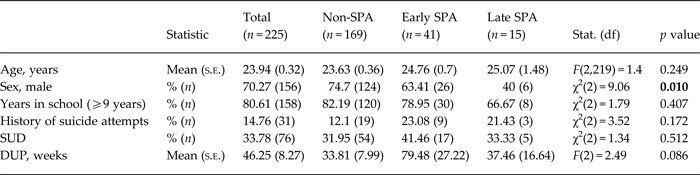
Among the 225 patients, 169 (75.2%) had no history of exposure to SPA while 56 (24.8%) did. Within the SPA group, 41 (18.2%) had been exposed to SPA before age 11 (Early SPA) and 15 (6.6%) between ages 12 and 15 (Late SPA). Twenty-seven (12%) patients had been exposed to sexual abuse; 41 (17.7%) to physical abuse and 12 (5.3%) to sexual and physical abuse. Fifteen (6.6%) patients had been exposed to sexual abuse only; 29 (12.8%) to physical abuse only. No association was found between diagnostic distribution and SPA subgrouping. SPA patients were more likely to be female (p = 0.020). Other demographic and premorbid factors are presented in Table 1.
Demographic and premorbid factors related to early or late exposure to sexual and/or physical abuse

Non-SPA, Non-exposure to sexual and/or physical abuse; Early SPA, exposure to SPA in childhood, from birth to age 11 years; Late SPA, exposure to SPA during early adolescence, from ages 12–15; SUD, current substance abuse or dependence; DUP, duration of untreated psychosis; s.e., standard error.
Premorbid adjustment and level of functioning at baseline in relation to exposure to SPA during childhood and early adolescence
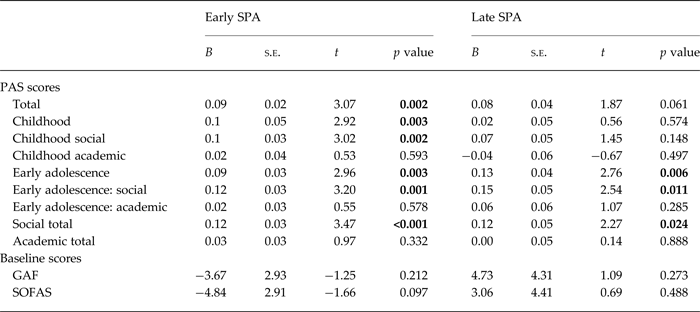
Linear regression models comparing the nine scores of PAS and the scores of GAF and SOFAS at baseline are presented in Table 2. Compared to the Non-SPA group, the Early SPA group showed a poorer level of functioning on the PAS Total score (p = 0.002), the PAS Childhood score (p = 0.003), the PAS Childhood Social score (p = 0.002), the PAS Early Adolescence score (p = 0.003,) the PAS Early Adolescence Social score (p = 0.001) and the PAS Social Total score (p = <0.001). Compared to the Non-SPA group, the Late SPA group showed poorer PAS Early Adolescence scores (p = 0.006) and a poorer PAS Early Adolescence Social score (p = 0.011). There were no significant associations between Early or Late exposure to SPA and the academic domain of PAS. Premorbid substance abuse or dependence were significantly associated with a poorer PAS early adolescence academic score (p = 0.022). No significant differences were found regarding GAF and SOFAS scores at entry to the Tipp programme between Early SPA and Late SPA compared to Non-SPA patients.
Regression analyses comparing the premorbid adjustment and the level of functioning at baseline between patients exposed to sexual and/or physical abuse early or late

PAS, Premorbid Adjustment Scale; GAF, Global Assessment of Functioning Scale; SOFAS, Social and Occupational Assessment of functioning Scale.
Abbreviations of SPA groups are given in Table 1 note. Model is adjusted for age, sex, socioeconomic status, premorbid substance abuse and/or dependence. Non-exposed group has been taken as group of reference.
Relationship between exposure to SPA and functional outcome during follow-up
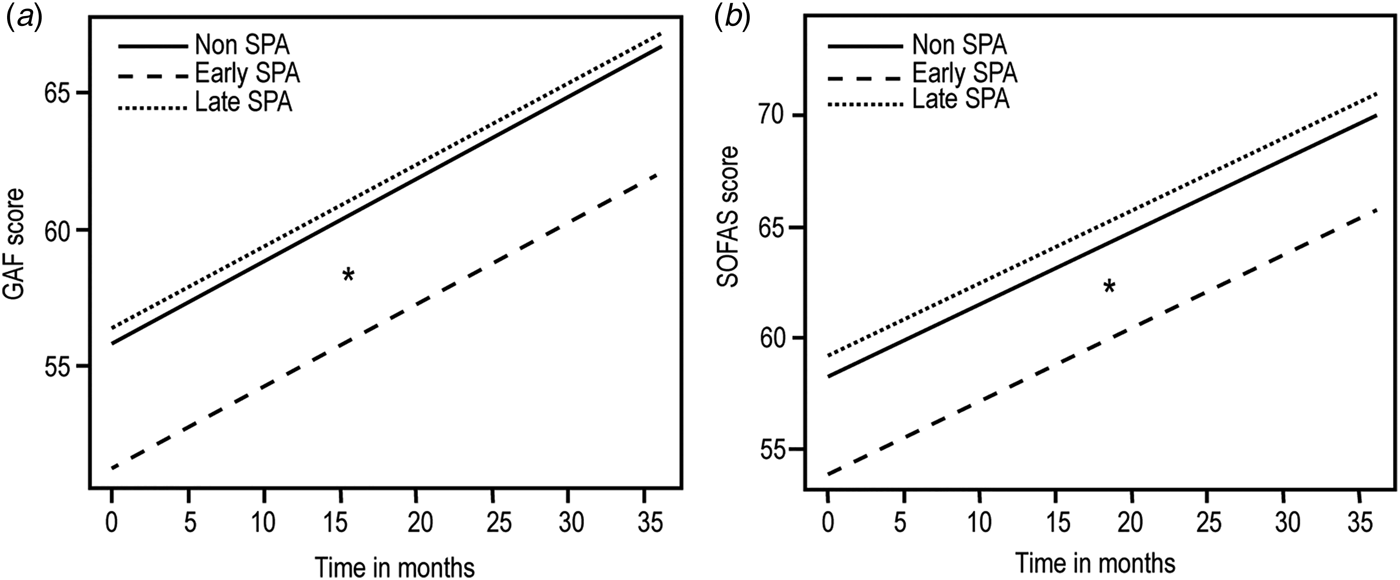
Detailed results of LME models comparing the level of functioning at follow-up between Early, Late and Non-SPA are given in Table 3. We observed a significant difference between Early SPA and Non-SPA groups regarding GAF (p = 0.025) and SOFAS (p = 0.048) scores over all time points. There was, however, no significant difference in this regard between Late SPA and Non-SPA patients (see Fig. 1a, b ).
Level of functioning measured with (a) the Global Assessment of Functioning Scale (GAF) and (b) the Social and Occupational Assessment of functioning Scale (SOFAS) with assessments at baseline, after 2, 6, 12, 18, 24, 30 and 36 months of treatment. Panels (a) and (b) represent a significant difference in GAF and SOFAS scores among Early SPA and Non-SPA groups; a parallel linear trend in time is fitted for all three groups to simplify the fitting process; by using a semi-parametric model we checked if this parallel trend in time is convincing for all groups, and the result supported our initial choice. Goodness of fit for fitted models are checked via graphical tools and were satisfactory for both models.

Linear mixed effects model comparing the level of functioning after 2, 6, 12, 18, 24, 30 and 36 months of treatment between patients exposed to sexual and/or physical abuse early or late

GAF, Global Assessment of Functioning Scale; SOFAS, Social and Occupational Assessment of functioning Scale.
Abbreviations of SPA groups are given in Table 1 note. Model adjusted for age, sex, socioeconomic status, lifetime substance abuse and/or dependence, current substance use and current treatment adherence.
Discussion
To our knowledge, this is the first study exploring the relationship between age at the time of exposure to SPA in childhood and functional level in a sample of EP patients followed-up prospectively. Two main findings stem from our results. First, age at the time of exposure to trauma modulates its impact on later functional outcome. Second, impact of childhood trauma in the premorbid phase of psychotic disorders seems to be restricted to social domains while academic functioning remains similar to that of unexposed patients.
In addition to confirming previous findings that EP patients exposed to severe trauma in childhood have poorer functional outcome than non-exposed patients (Conus et al. Reference Conus, Cotton, Schimmelmann, McGorry and Lambert2010; Stain et al. Reference Stain, Bronnick, Hegelstad, Joa, Johannessen, Langeveld, Mawn and Larsen2013), our study suggests that age at the time of first exposure influences the long lasting effects of these deficits. In line with our hypothesis, we found thatcompared to non-exposed patients, those exposed to SPA before age 11 displayed a functional impairment that was maintained at follow-up, while patients exposed at a later age had improved over the treatment period. Indeed, Late SPA patients went from a functional level that was similar to that of Early SPA patients in the premorbid phase to a functional level that was similar to, if not better than, that of non-exposed EP patients throughout the 3 years of treatment.
Although often reported, the mechanism underlying this link between trauma and later impaired functioning remains unclear. Several hypotheses have been formulated, based on various theoretical concepts. First, some authors have suggested a mediating role for meta-cogniton and theory of mind (ToM; Frith & Corcoran, Reference Frith and Corcoran1996) in this process. Evidence in this field suggests that early adversity such as sexual abuse (Lysaker et al. Reference Lysaker, Gumley, Brune, Vanheule, Buck and Dimaggio2011b ) and early institutional deprivation (Colvert et al. Reference Colvert, Rutter, Kreppner, Beckett, Castle, Groothues, Hawkins, Stevens and Sonuga-Barke2008) leads to a decreased capacity to recognize one's own emotions and the emotions of others, a key aspect of social cognition that has been shown to be specifically linked to deficits in social functioning (Pinkham et al. Reference Pinkham, Penn, Perkins and Lieberman2003; Bora et al. Reference Bora, Eryavuz, Kayahan, Sungu and Veznedaroglu2006; Lysaker et al. Reference Lysaker, Erickson, Buck, Buck, Olesek, Grant, Salvatore, Popolo and Dimaggio2011a ). Deficits in the capacity to ‘think about thinking’ may limit abilities to form a coherent image of oneself as functioning within a social context and may lead in turn to incapacity to resolve the conflicts and misunderstandings arising in daily life (Lysaker et al. Reference Lysaker, Erickson, Buck, Buck, Olesek, Grant, Salvatore, Popolo and Dimaggio2011a ). Such an incapacity to fine-tune to others in complex situations may contribute to poorer social and vocational adjustment. However, while suggested in various publications, the mediating role of ToM deficits per se in the connection between childhood trauma and functional outcomes, and its independence from symptomatology and other confounding factors, still lacks an evidence base and must be explored further. Second, other elements, such as cognitive deficits (Addington & Addington, Reference Addington and Addington2000; Aas et al. Reference Aas, Dazzan, Fisher, Morgan, Morgan, Reichenberg, Zanelli, Fearon, Jones, Murray and Pariante2011); positive symptoms (especially hallucinations; Ross et al. Reference Ross, Anderson and Clark1994), attachment difficulties (Berry et al. Reference Berry, Barrowclough and Wearden2008; Read & Gumley, Reference Read and Gumley2008) or social anxiety (Freeman et al. Reference Freeman, Gittins, Pugh, Antley, Slater and Dunn2008; Freeman & Fowler, Reference Freeman and Fowler2009), may also play an important mediating role in functional outcome. They have been shown to be related to childhood trauma and may well contribute to impairment in psychosocial functioning through increased tendency to isolation, deficit in communication skills or limited capacity to establish interpersonal relationships for example. Finally, hypotheses regarding the mechanisms leading to impaired functioning after trauma and the mediating effect of age the time of exposure in this phenomenon may also be formed at a neurobiological level. Recent research in our group on potential neurobiological mechanisms involved in the development of schizophrenia (Do et al. Reference Do, Cabungcal, Frank, Steullet and Cuenod2009; Steullet et al. Reference Steullet, Cabungcal, Monin, Dwir, O'Donnell, Cuenod and Do2014) suggests that environmental insults during development, through the induction of oxidative stress, may contribute to microcircuits and long pathway alterations which could be at the basis of various symptoms. In particular, oligodendrocytes (Monin et al. Reference Monin, Baumann, Griffa, Xin, Mekle, Fournier, Butticaz, Klaey, Cabungcal, Steullet, Ferrari, Cuenod, Gruetter, Thiran, Hagmann, Conus and Do2014) and parvalbumin interneurons (Cabungcal et al. Reference Cabungcal, Steullet, Kraftsik, Cuenod and Do2013a , Reference Cabungcal, Steullet, Morishita, Kraftsik, Cuenod, Hensch and Do b ), involved respectively in myelination and neural synchronization (Steullet et al. Reference Steullet, Cabungcal, Kulak, Kraftsik, Chen, Dalton, Cuenod and Do2010), are particularly sensitive to early environmental insults. In an animal model with genetic deficit in glutathione, a major cellular antioxidant, the gene–environment interaction model revealed that additional stress in childhood and peripubertal ages, but not in adulthood, lead to severe and permanent parvalbumin interneuron alterations (Cabungcal et al. Reference Cabungcal, Steullet, Kraftsik, Cuenod and Do2013a ). Considering the dynamic and heterogeneous developmental trajectories of brain circuits, it can be hypothesized that early insults may differentially affect circuit connectivity compared to later insults, hence leading to different clinical phenotypes with distinct potential for recovery.
Whatever the mechanism may be, our results reveal a different trajectory for EP patients with childhood exposure to trauma depending on age at first exposure; in particular, they suggest that in the frame of a specialized programme, patients exposed at a later age manage to recover from the social functioning deficit they had, in the premorbid phase, compared to non-exposed EP patients. The comprehensive treatment offered in such settings combines medication and psychotherapy within the frame of the continuity of care warranted by the role of clinical case managers. This may be sufficient in patients who have had the chance to develop some basic relational tools before being exposed to trauma, but it seems ineffective in those where earlier occurrence of trauma has left them with very limited coping capacities. Until new findings open potential avenues for a differential approach at a neurobiological level, it seems therefore necessary to develop new psychotherapeutic strategies in order to help such patients face the challenges of social interactions.
Following the strategy proposed by MacBeth & Gumley (Reference MacBeth and Gumley2008), the separate analysis of the academic and social dimensions of the PAS revealed that there is a specific correlation between exposure to childhood trauma and the social but not the academic dimension of premorbid functioning. This is in contradiction with one study (Stain et al. Reference Stain, Bronnick, Hegelstad, Joa, Johannessen, Langeveld, Mawn and Larsen2013), that found an association between exposure to trauma and impairment in both academic and social dimensions of PAS. The fact that they did not adjust their analyses for confounding factors such as SES and premorbid substance abuse may explain part of this difference. Our findings support previous evidence emphasizing the validity of dividing premorbid adjustment into its subcomponents (Allen et al. Reference Allen, Kelley, Miyatake, Gurklis and van Kammen2001; Norman et al. Reference Norman, Malla, Manchanda and Townsend2005) and point to a certain degree of independence between these two domains. They also suggest that being exposed to SPA early in life induces profound alterations of social interactions in early adolescence, which in turn may lead to avoidance of social contacts and withdrawal, which may precede the onset of psychosis in vulnerable individuals (Murphy et al. Reference Murphy, Shevlin, Adamson and Houston2013).
Rate of childhood exposure to SPA in our sample (24.8%) was slightly lower that that reported by others (Conus et al. Reference Conus, Cotton, Schimmelmann, McGorry and Lambert2010). However, when including patients who were excluded from the study, the rate of exposure rose to 29.5% which is in keeping with previous studies (Ucok & Bikmaz, Reference Ucok and Bikmaz2007; Conus et al. Reference Conus, Cotton, Schimmelmann, McGorry and Lambert2010). Similar to other publications (Neria et al. Reference Neria, Bromet, Sievers, Lavelle and Fochtmann2002), we found that women were more likely to be exposed to childhood SPA than men; this was mainly due to rate of exposure after age 12, otherwise the rate of early exposure to trauma is similar in both genders. In addition, we did not find differences in functioning at baseline between exposed and non-exposed patients. This is line with previous results (Conus et al. Reference Conus, Cotton, Schimmelmann, McGorry and Lambert2010), and could be explained by the ceiling effect of psychotic symptoms at the moment of entry to a specialized EP programme. Finally, contrary to what has been shown by others (De Bellis, Reference De Bellis2002; Gordon, Reference Gordon2002), there was no association in our sample between childhood exposure to SPA and both diagnosis of substance abuse and a past history of suicide attempt (Conus et al. Reference Conus, Cotton, Schimmelmann, McGorry and Lambert2010).
This study has various limitations. First, exposure to SPA was assessed retrospectively in the current study, which may be particularly problematic in patients suffering from psychosis (Howard, Reference Howard1993). However, exposure to SPA was assessed in the frame of 3 years of a rather intensive treatment and on the basis of information obtained from patients and their families in the frame of a trusting therapeutic relationship (Conus et al. Reference Conus, Cotton, Schimmelmann, McGorry and Lambert2010); all these elements may minimize the impact of recall bias existing in other forms of self-report and cross-sectional research interviews (Morgan & Fisher, Reference Morgan and Fisher2007). Second, although age at the time of first exposure to trauma and the repetitive nature of this exposure were recorded, there was no information about the duration of the period of maltreatment. We therefore were not in a position to verify previous findings that only childhood-onset abuse that persists through adolescence may have an impact on later outcomes (Thornberry et al. Reference Thornberry, Ireland and Smith2001). Third, some forms of childhood adversity such as emotional and physical neglect, which have been shown to influence the level of functioning of patients with psychosis (Schenkel et al. Reference Schenkel, Spaulding, DiLillo and Silverstein2005; Davidson et al. Reference Davidson, Shannon, Mulholland and Campbell2009) were not recorded, and may have played a role in the observations we made. Finally, our results stem from comparisons between subgroups of EP patients; due to the impact of the psychotic illness itself at the functional level, we therefore cannot conclude on the impact of childhood SPA trauma on the functional level in general, but only on its possible consequences when present in the past history of EP patients. In addition, it should be mentioned that the design of this study does not provide any information regarding a potential causal link between exposure to trauma in childhood and the later development of psychosis.
Conclusions
Based on a unique 3-year prospective study in EP, our results highlighted an association between exposure to SPA in childhood and the later impairment of social functioning before the onset of the disease in patients with psychosis. In addition, they show that patients exposed to such experiences at an early age present long-lasting social and vocational deficits, while those exposed at later age may have a better potential for recovery. More research is needed to uncover the mechanisms explaining these differences, potentially leading to the development of various specific treatment strategies. In the meantime, current psychological approaches to history of childhood SPA in EP patients may need to be adapted, according to age at the time of first exposure.
Acknowledgements
We thank the Case Managers from Tipp Program for collecting these data and Martin Preisig for his mentorship. We thank our financial support: Swiss National Science Foundation (no. 320030_122419 to P.C. and K.Q.D.); National Center of Competence in Research (NCCR) ‘SYNAPSY – The Synaptic Bases of Mental Diseases’ from the Swiss National Science Foundation (no. 51AU40_125759 to KQD); Alamaya Foundation and Avina Stiftung. Most of all, we express our gratitude to all the patients for their enduring participation.
Declaration of Interest
None.