Introduction
Endemic East African highland cooking bananas (Musa spp., genome group AAA-EA) are among the most important food and cash crops in Uganda (Gold et al., Reference Gold, Karamura, Kiggundu, Bagamba and Abera1999a). These are grown mostly by resource-poor farmers in small plantations with limited inputs. Primary production constraints include the banana weevil Cosmopolites sordidus (Germar) (Coleoptera: Curculionidae).
The banana plant consists of an underground corm, a pseudostem (comprised of leaf petioles), leaves and a true stem that grows through the centre of the pseudostem and bears the flower and subsequent bunch. Banana is a perennial crop with suckers (new plantlets) emerging from the corm. Plants sharing a common corm form a mat. Each plant produces a single bunch. The phenological stages are peeper, sword sucker, maiden sucker, pre-flowered plant and flowered plant. Following harvest of the bunch, the plant dies back leaving the pseudostem, true stem and attached part of the corm as crop residues. In established banana stands, plants of all phenological stages are present at any one time and harvest is throughout the year.
C. sordidus larvae tunnel in the corm, damaging the vascular system and weakening the stability of the plant. Attack may result in sucker death, snapping, toppling, reduced bunch size, mat disappearance and shortened stand life (Rukazambuga et al., Reference Rukazambuga, Gold and Gowen1998; McIntyre et al., Reference McIntyre, Gold, Kashaija, Ssali, Night and Bwamiki2001; Gold et al., Reference Gold, Kagezi, Night and Ragama2004). The insect is dispersed through infested planting material. Population build-up is slow, and yield losses tend to increase over time. For instance, damage levels in one study increased from 7 to >20%, and yield losses increased from 9 to 44% between the first and third rations (Rukazambuga et al., Reference Rukazambuga, Gold and Gowen1998). Gold et al. (Reference Gold, Kagezi, Night and Ragama2004) reported the disappearance of 35% of banana mats within seven crop cycles in a heavily infested field.
C. sordidus attacks only the related genera Musa and Ensete. Adults are free-living, nocturnally active and hydrotrophic (Gold et al., Reference Gold, Pena and Karamura2001). They utilize plant volatiles in locating hosts (Budenberg et al., Reference Budenberg, Ndiege and Karago1993). The weevils attack all phenological stages of the banana plant, including crop residues. Damaged plants (e.g. cut corm or pseudostem material) are especially attractive to C. sordidus (Gold et al., Reference Gold, Pena and Karamura2001), suggesting that such injuries increase the level of volatiles being released. Oviposition is in the base of the plant. In highland banana, Abera et al. (Reference Abera, Gold and Kyamanywa1999) reported highest levels of oviposition on flowered plants and residues, although, in plantain, Mesquita et al. (Reference Mesquita, Alves and Caldas1984) observed that tissue from younger plants was more suitable for larval development.
All highland cooking banana (AAA-EA) and plantain (AAB) clones appear susceptible, while Gros Michel (AAA) is partially resistant and Kayinja (ABB), Kisubi (AB), Sukari Ndizi (AAB) and Yangambi-Km5 (AAA) are highly resistant (Kiggundu et al., Reference Kiggundu, Gold, Labuschagne, Vuylsteke and Louw2003). Antibiosis appears to be the major avenue of resistance (Gold et al., Reference Gold, Pena and Karamura2001; Kiggundu et al., Reference Kiggundu, Gold, Labuschagne, Vuylsteke and Louw2007). Nevertheless, antibiotic mechanisms appear to break down after harvest. Thus crop residues, even in resistant clones, may be heavily attacked by C. sordidus (Gold and Bagabe, Reference Gold and Bagabe1997). Crop residues have also been reported as refuges and food sources for adult C. sordidus (Gold et al., Reference Gold, Pena and Karamura2001).
Crop sanitation (i.e. destruction of residues) has been widely recommended as a means to reduce overall C. sordidus pressure (Gold et al., Reference Gold, Pena and Karamura2001). However, it is unclear which types of residues are most attractive to ovipositing C. sordidus and most suitable for larval survivorship. For example, the exploitation of older residues by C. sordidus has been little studied. In other words, crop sanitation might be timed to encourage weevil oviposition on residues (rather than on plants) that can then be destroyed before the larvae can fully develop. This situation would lead to diminished population growth. Currently, many farmers in Bushenyi district in southwestern Uganda prefer to leave freshly harvested corm residues in situ to stabilize the banana mat and then dig them out several months after harvest, even though it has not been ascertained whether C. sordidus attacks residues of this age. Information on the suitability of residues of different ages for C. sordidus oviposition, survivorship and fitness could be used to optimize recommendations on how farmers should time the destruction of their crop residues.
The objectives of this study were: (1) to determine what types and ages of crop residues are most attractive and acceptable for oviposition to C. sordidus; and (2) to ascertain the success rates of weevil immatures to develop on residues of different ages and in different states of decomposition.
Materials and methods
The research was conducted under ambient conditions in the Banana Entomology Laboratory at the Kawanda Agricultural Research Institute (KARI). KARI (0°25′N, 32°32′E) is 13 km north of Kampala and at 1195 m above sea level. Day length is 12 h throughout the year. Average daily temperatures are 15 °C minimum and 29 °C maximum with mean relative humidity of 76%.
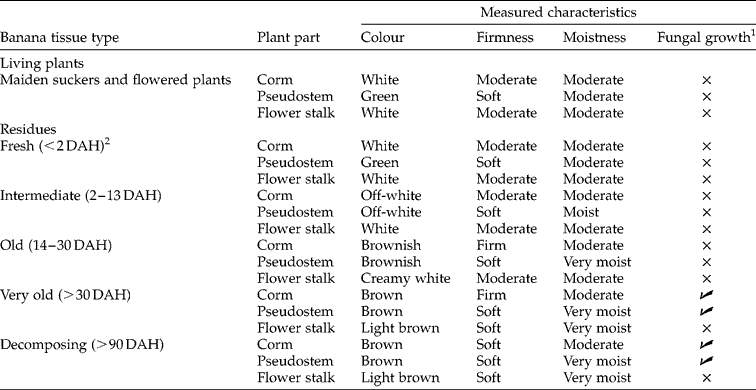
The typical conditions (colour, firmness, moistness and fungal growth) of the different-aged residues used in the experiments are described in Table 1. Firmness was determined by squeezing a sample of banana tissue between the thumb and first finger and classifying the feeling as soft, moderately firm and firm. Banana tissue was classified as moderately moist if on pressing it wetted the fingers, or very moist if water oozed out of it. The other conditions were assessed by visual observation.
Typical conditions of highland banana (AAA-EA) tissues of suckers, flowered plants and residues of different ages
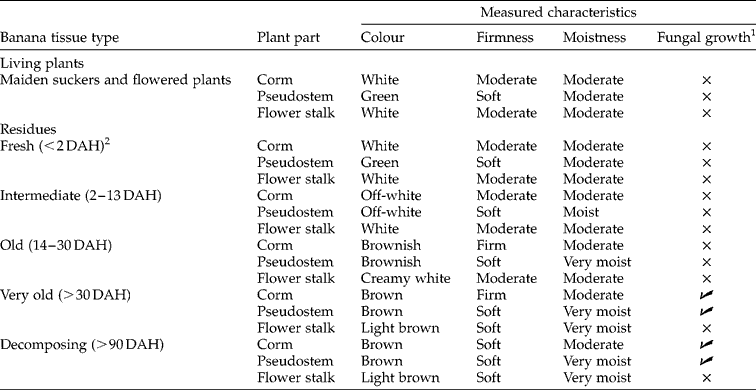
1 Fungal growth: ✓, present; x, absent.
2 DAH, days after harvest.
Experiment 1: C. sordidus attraction to and oviposition on plant and residue material of different ages for a single cultivar
The objective of this experiment was to determine adult C. sordidus attraction to and acceptance of banana residues of different ages using the cultivar ‘Nabusa’ (AAA-EA). Treatments consisted of corms and pseudostems that were collected from maiden suckers or from residues at different numbers of days after harvest (DAH): (1) fresh maiden sucker corm; (2) fresh corm (residues; < 2 DAH); (3) old corm (14–30 DAH) (4) very old corm (>30 DAH); (5) fresh pseudostem ( < 2 DAH); (6) old pseudostem (14–30 DAH); and (7) very old pseudostem (>30 DAH). The different treatments were presented to weevils simultaneously.
Samples (7 × 3 × 1 cm) from corms or pseudostems were cut from the different-aged residues and presented to groups of 70 adult C. sordidus (50% female) in circular plastic containers (50 cm diameter and 20 cm high). The weevils were sexed on the basis of punctation on the rostrum (Longoria, Reference Longoria1968) and curvature of the last abdominal sternite (Roth and Willis, Reference Roth and Willis1963). In each bioassay, banana pieces (one from each of the seven treatments) were placed equidistant from each other and from the centre of the basin in a completely randomized design. The experiment was repeated ten times.
The adult weevils used in this study were obtained from split pseudostem traps (Mitchell, Reference Mitchell1978) in farmers' fields near KARI. Prior to assays, the weevils were maintained on banana corms (cv ‘Namwezi’ AAA-EA) in the laboratory for 1 week. Each weevil was used in a single bioassay and then discarded. The 70 weevils were placed at the centre of the basin, which was then covered with a polythene sheet with tiny holes for ventilation. After 24 h, the number of male and female weevils at each banana piece was counted. We determined oviposition levels on the different residues by gently paring the surface tissue and counting the number of eggs.
Experiment 2: influence of banana residue age on C. sordidus eclosion success
The objective of this experiment was to determine whether residue age influenced eclosion rates of C. sordidus eggs. Treatments consisted of four different corm residue age classes: (1) fresh ( < 2 DAH); (2) old (14–30 DAH); (3) very old (31–60 DAH); and (4) decomposing (>90 DAH) corms.
Residues of different ages (cv Kisansa, AAA-EA) were obtained from banana stands near KARI. Banana corms were removed in their entirety and taken to the laboratory. There the residues were pared and cut into 7 × 3 × 1 cm pieces, weighing about 200 g. Only corms without C. sordidus damage were used.
In each corm piece, ten 2–4 mm deep holes were cut from the surface using the point of a sharp knife. Fresh ( < 24 h old) C. sordidus eggs were placed singly in each hole. The corm pieces were then placed on moist filter paper in Petri dishes. The Petri dishes were placed on racks whose legs were immersed in water traps to protect the eggs from ants. After 10 days, the corms were carefully dissected to determine the fate (eclosed or dead) of each inserted egg. Each treatment was replicated 20 times. The mean temperature during the experiment was 25 °C.
The eggs used in this experiment were obtained from a laboratory colony of C. sordidus. Banana maiden suckers (cv ‘Atwalira’, AAA-EA) obtained from farmers' fields near Kawanda were carefully pared. Two pared suckers were placed in each of four 60 × 20 cm plastic buckets. Each bucket was infested with 250 unsexed adult C. sordidus that had been field collected a week earlier and maintained on banana corms. The buckets were covered with lids perforated with small holes and kept in the laboratory at room temperature. After 24 h, the suckers were pared to expose the eggs. The eggs were carefully extracted using the tip of a sharp knife and then immediately inserted into the test corm pieces.
Experiment 3: influence of plant phenological stage on C. sordidus larval survivorship
Larval survivorship was determined on three phenological stages of highland banana (cv Kisansa, AAA-EA): (1) sword sucker; (2) maiden sucker; and (3) flowered plant. Pieces of corm (7 × 3 × 1 cm; approximately 200 g) were split in half and a small notch (large enough to accommodate a small larva) was cut into the interior of one half. A single recently emerged ( < 24 h) 1st instar larva was placed into this notch. The halves were then put back together with the larva inside.
The corm pieces were maintained in plastic buckets (60 × 20 cm). Larvae were measured every 3 days and corm material renewed until the larvae entered the pre-pupal stage. After opening the corms, the larvae were carefully extracted. For live larvae, head capsule measurements were taken at the widest point (dorsal view) at 40 times magnification with a binocular dissecting microscope fitted with a calibrated micrometer. Larval instars were determined by comparing their head capsule width measurements on a scale developed by Gold et al. (Reference Gold, Nemeye and Coe1999b). In particular, we were interested in determining which larvae had entered the 5th instar. After measurement, each larva was placed in fresh corm from the same treatment group. Pre-pupae and pupae were left undisturbed (except for one time weighing 2–3 days after pupation) in the same corms (rearing chambers). The sex and weight of teneral adults were determined. The experiment was repeated four times with each replicate consisting of 50 larvae per treatment.
The corms used in these experiments were obtained from plants taken from farmers' fields in Semuto, 50 km north of Kampala. Selected farms had low weevil incidence and consisted of the highland banana cultivar Kisansa. Entire banana mats were uprooted with a digging spear and then transported to KARI. The corm material was handled as in Experiment 1, with weevil-damaged corms rejected.
First instar larvae were obtained from a C. sordidus colony maintained in the laboratory. Three thousand adult weevils were placed in buckets containing highland banana maiden suckers. Each day eggs (i.e. < 24 h old) were removed by paring the suckers. These were then maintained on moist filter paper in Petri dishes and monitored daily. Newly emerged larvae were used in the experiments.
Experiment 4: influence of banana residue age on C. sordidus larval survivorship
Larval survivorship on three different age groups of corm residues was determined using methods similar to those in Experiment 3. The treatments were: (1) fresh corm ( < 2 days after harvest); (2) intermediate-aged corm (7–14 days); and (3) very old corm (60–90 days). Experimental procedures for larval rearing, recording of larval size, pupation and date of adult emergence were similar to those in Experiment 3.
Data analysis
For Experiment 1, counts of adults per corm piece, females per corm piece and number of eggs per female on each residue type were subjected to Statistical Analysis System (SAS) generalized linear models procedure (SAS Institute, 1997). Acceptance (number of eggs per female) was computed from data on females attracted and eggs deposited on each of the residues. The numbers of eggs per female were obtained by dividing the total number of eggs found in each residue type by the number of females found at these residues after 24 h. Total number of adult C. sordidus, female C. sordidus and eggs per female on each residue type was subjected to SAS generalized linear models procedure (SAS Institute, 1997). Means were separated by least square means pairwise comparison t-test.
For Experiment 2, counts and percentages of C. sordidus eggs eclosed after 10 days were subjected to mixed model procedure (SAS Institute, 1997) with treatments as fixed effects, while replicates were considered as random. Mean separation was carried out using orthogonal contrasts.
Counts of larval and pupal development stage duration were analysed using the GLM procedure of SAS (SAS Institute, 1990). Mean separation was carried out by pairwise comparison t-test of least square means. The effect of food on larval survival was analysed using generalized linear model procedure of SAS (Genmod; SAS Institute, 1997), with distribution as Poisson, gamma or binomial, with an appropriate link (logarithm) and offset function as a natural logarithm on time. We used a Poisson distribution for larval survival and pupal counts with link function as logarithm, while the offset variable normalized the data to fitted cell means. For survival rate, we used a gamma distribution.
Results
Experiment 1: C. sordidus attraction to and oviposition on plant and residue material of different ages for a single cultivar
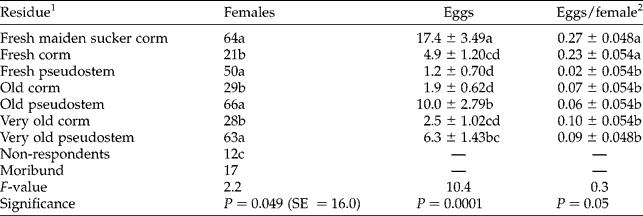
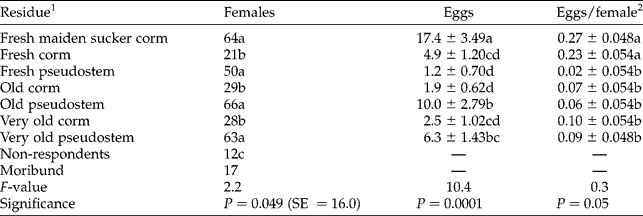
Twenty-four hours after release, 95% of C. sordidus adults were found in contact with banana materials. The remaining weevils were 4–5 cm from any treatment. The number of weevils at maiden sucker corm, fresh pseudostem, old pseudostem and very old pseudostem was significantly higher than those at fresh corm, old corm and very old corm residues (P < 0.05; Table 2). The highest level of oviposition occurred on maiden sucker corms. There was also significantly higher total oviposition on old and very old pseudostems than on fresh pseudostem and old corms (P < 0.01). Oviposition per female was greater on maiden sucker corms and fresh corm residues than on other materials.
Mean of females attracted, mean of eggs deposited per residue and eggs/female laid on different types and aged excised banana tissues of cv Nabusa, AAA-EA in the laboratory (ten replicates; Experiment 1)
Means in columns with the same letter are not significantly (P < 0.05) different by probability of LS means pairwise comparison t-test.
1 Age of residues: fresh < 2; old, 14–30; very old, >30 days after harvest.
2 Total eggs per residue/mean of females at residue.
Experiment 2: influence of banana residue age on C. sordidus eclosion success
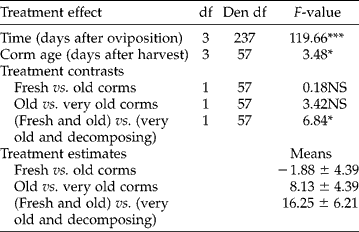
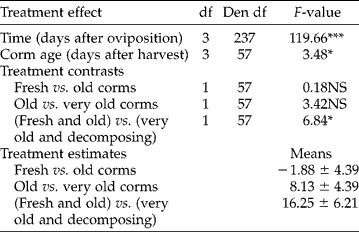
Eclosion success was significantly affected by residue corm age and days after oviposition (Table 3). Eclosion rates on fresh and old corms were significantly higher from those on very old and decomposing corms (Table 3). Eclosion rates of eggs between fresh (66 ± 3%) and old (67 ± 4%), and between old and very old corms (64 ± 4%) were not significantly different from each other (P>0.05). These three treatments all had significantly higher eclosion rates (P < 0.05) than those on decomposing corms (58 ± 4%).
ANOVA for orthogonal contrasts of effect of banana corm age on eclosion success of Cosmopolites sordidus eggs in the laboratory (Experiment 2)
df, degrees of freedom; Den, denominator.
NS, not significant (P>0.05); * P ≤ 0.05; *** P < 0.001.
Residue age: fresh, 1–2; old, 14–30; very old, 31–60; and decomposing, >90 DAH.
Fresh = 55.88; Old = 57.75; very old = 52.75 and decomposing = 44.63.
Experiment 3: influence of plant phenological stage on C. sordidus larval survivorship
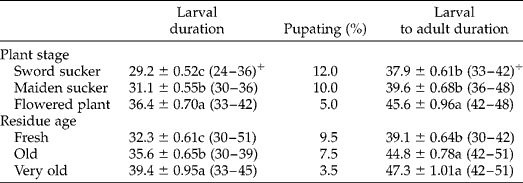
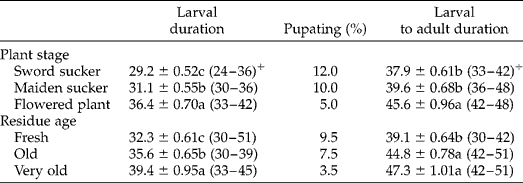
For corms taken from living plants, larval survivorship after 48 days was 12% on sword suckers, 10% on maiden suckers and 7% on flowered plants. For residues, larval survivorship after 51 days was 12% on fresh corm, 8% on old corm and 5% on very old corm. Larval stage duration and larval to adult duration increased with plant and residue age (Table 4). Fewer individuals successfully pupated on older plants and residues. The pupation on corms decreased from 9.5% on fresh corms to 3.5% on very old corms. Larval stage duration was shorter and % pupation was higher on 1- to 3-day-old residues than on flowered plants.
Mean duration (days) of Cosmopolites sordidus larval stage and larval plus pupal stages on corm pieces taken from varying plant phenological stages and residues of different ages (Experiment 3)
Means in columns within plant stage and within residue stage followed by the same letter are not significantly different (P>0.05) by pairwise comparison of the t-test of least square means.
+ Values in parentheses represent the ranges.
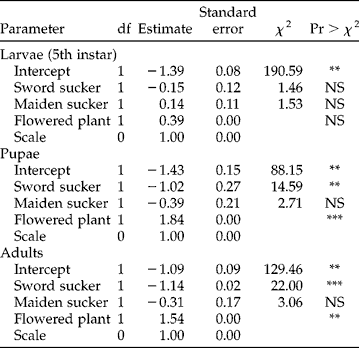
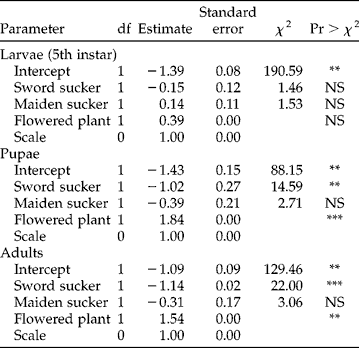
Forty-eight days after insertion of recently hatched ( < 1-day-old) larvae, there were no significant differences in the number of 5th instar larvae on sword suckers, maiden suckers and flowered plants (Table 5). The estimate indicates that significantly more pupae (P < 0.01) and adults (P < 0.001) developed on flowered plants than on sword suckers.
Analysis of parameter estimates for total number of Cosmopolites sordidus 5th instar larvae, pupae and adults on banana sword suckers, maiden suckers and flowered plants corms (Poisson distribution and log as link function; Experiment 3)
NS, not significant (P>0.05); **P ≤ 0.01; ***P ≤ 0.001.
Goodness-of-fit test for (a) cumulative survival: deviance = 702, χ2(30) = 23.4; (b) larval survival rate data: deviance = 201, χ2(21) = 9.6 (model not rejected).
Experiment 4: influence of banana residue age on C. sordidus larval survivorship
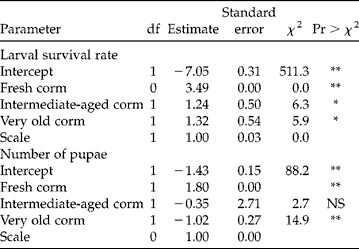
Larval survivorship was significantly higher on fresh corm residues with a parameter estimate of 1.18 than on intermediate-aged and very old banana corm residues (Table 6). On very old corms, the estimate was highly significant and negative ( − 0.33), implying that mortality was higher on these than on fresh and intermediate-aged corms. Parameter estimates for larval survival rate were significant on all feeding materials. It was highest on fresh corm as its estimate was much higher (3.49) than that for intermediate-aged (1.24) and very old corms (1.32). There was also higher probability of pupation on fresh corm (parameter estimate 1.8) than on intermediate-aged ( − 0.35) and very old corms ( − 1.02).
Analysis of parameter estimates for total larval survival, rate of larval survival and number of pupae on banana corm residues of different ages (Experiment 4)
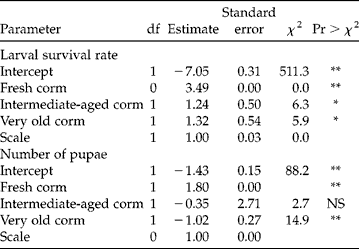
NS, not significant (P>0.05); *P < 0.05; **P ≤ 0.01; ***P ≤ 0.001. Goodness-of-fit test for (a) cumulative survival: deviance = 2878, χ2(30) = 27.8; (b) larval survival rate data: deviance = 1124, χ2(30) = 43.8; (c) pupae: deviance = 61.4, χ2(15) = 25 (model not rejected).
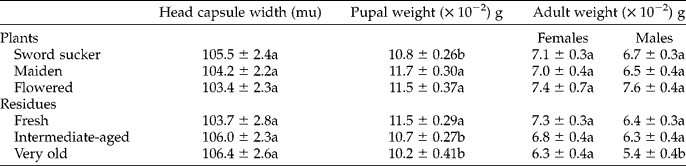
Head capsule size for pre-pupae reared on the plants and residues of different ages were statistically similar (Table 7). Nevertheless, pupal weights were significantly higher on maiden suckers, flowered plants and fresh corms than on sword suckers, old corms and very old corms. That is, pupal weights were lowest on young plants and older residues. Males on very old residues were lighter than those reared on other plant parts and residue types and than females reared on all materials.
Pre-pupal head capsule width (mu), pupal and adult weight (LS means±SE) of weevils reared on plants and corm residues
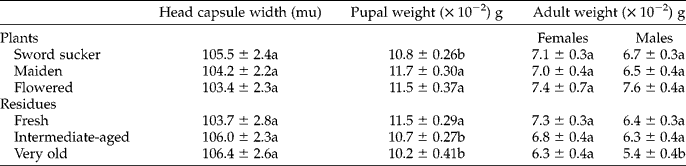
Means in columns within plants or residues followed by the same letter are not significantly different (P>0.05) by pairwise t-test comparison of LS means.
Discussion
Crop sanitation (i.e. the removal of banana residues and cutting them into small pieces) has been widely recommended as a means of controlling C. sordidus by reducing adult refuges and breeding sites (Seshu Reddy et al., Reference Seshu Reddy, Prasad and Sikora1998; Gold et al., Reference Gold, Pena and Karamura2001). The implicit assumptions have been that crop residues (1) encourage C. sordidus oviposition within banana stands; (2) are favourable hosts for larval development with greater survivorship and subsequent adult fitness than growing plants; and (3) contribute to an increased C. sordidus population and higher levels of attack on developing bananas. Thus removal of these residues would lower C. sordidus population levels and damage. None of these assumptions has been tested. Moreover, little has been known on what types of residues are most attractive to C. sordidus adults and most suitable to immature development. Therefore, specific recommendations, based on research data, on timing of sanitation measures have not been available.
In laboratory choice tests (Experiment 1), maiden suckers, fresh pseudostem, intermediate-aged pseudostem and very old pseudostem residues were equally attractive to C. sordidus adults. Females were more attracted to pseudostems than to corms whatever the age. Although similar findings were reported by Cuille (Reference Cuille1950) and Sumani (Reference Sumani1997), most researchers have reported greater attraction to corms than to pseudostems (Gold et al., Reference Gold, Pena and Karamura2001). For residues, maximal oviposition in our experiments was on fresh maiden sucker corm. Oviposition on these corms was twice that on 1- to 2-day-old corms. This reflected more the number of weevils attracted to these materials than oviposition rates per female. Maiden sucker corms and fresh residues also appeared most acceptable to ovipositing females, as indicated by the numbers of eggs per female, while corms of older residues were no more acceptable than corresponding pseudostems.
By contrast, under field conditions, Abera (Reference Abera1997) found more eggs in leaf sheaths than in corms on both living plants and standing residues, although high mat increased the proportion of oviposition on corms. This suggests that corms are preferred oviposition sites, although leaf sheaths may be more accessible to ovipositing weevils under certain field conditions. Abera (Reference Abera1997) also found 26% more oviposition on flowered plants than on residues. The experimental set-up could have had an effect on the behaviour of the insects.
In this study, eclosion rates (i.e. 58–67%) were lower than in other studies (Ogenga-Latigo, Reference Ogenga-Latigo1992; Traore et al., Reference Traore, Gold, Pilon and Boivin1993; Treverrow and Bedding, Reference Treverrow, Bedding, Bedding, Akhurst and Kaya1993). This could be due to the handling of the eggs in the laboratory. Eclosion was higher on old than very old corms. The 10–16% reduction in hatching in older residues may have been caused by higher densities of saprophytic fungi that might have killed the eggs. Nonetheless, the data suggest only modest differences in eclosion rates among residues of different ages.
Longer larval development periods and lower adult male weights were observed on very old corms. Larval survival was negatively related to residue age. Survival was higher on fresh corm (up to 30 DAH) than on older corm residues (i.e. 60–90 DAH). Larval mortality was highest during the first 9 days after eclosion. It is likely that early instar C. sordidus larvae are fragile and especially vulnerable to fungal attack and other mortality factors. Survivorship on residues was somewhat lower than on growing plants. This suggests that growing and recently harvested plants provided higher food quality for larval development than older residues. Mesquita and Caldas (Reference Mesquita and Caldas1986) similarly reported higher mortality in residues than on growing plants. However, our findings contrast with those of Gold and Bagabe (Reference Gold and Bagabe1997) who reported much higher levels of survival on residues of the resistant cultivar ‘Kisubi’ (AB) than on growing plants. In this case, it appeared that antibiotic resistant factors broke down after harvest, leading to greater success of C. sordidus larvae on residues than growing plants.
Fitness is the ability of an individual to pass on genes to the next generation (Godfray, Reference Godfray1994). Fecundity, the most important component of female insect fitness, is strongly correlated with body size (Jervis and Kidd, Reference Jervis and Kidd1996). Pupal weight and adult weights are therefore good measures of C. sordidus fitness. Although we found some differences in pupal weights among treatments, females emerging from different plant phenological stages and different ages of residues were similar in size.
Earlier studies (Rukazambuga, Reference Rukazambuga1996; Abera, Reference Abera1997; Masanza, Reference Masanza2003) have shown that banana crop residues are favoured substrates for ovipositing females. The observations of this study suggest that success of immatures and fitness of emerging females are fairly similar on growing plants and residues of susceptible highland banana. Only minor differences were observed among egg eclosion rates. Larval survivorship rates were also similar in plants and residues. However, we caution that survivorship rates determined on material excised from growing plants in laboratory studies may be elevated as observed by Kiggundu et al. (Reference Kiggundu, Gold, Labuschagne, Vuylsteke and Louw2007) on resistant cultivars such as ‘Yangambi Km5’.
In the present study, the developmental period from egg to adult was 6–7 weeks under laboratory conditions with a temperature of about 25 °C. These results are similar to those of Gold et al. (Reference Gold, Nemeye and Coe1999b) who reported a development period of 6–8 weeks. Although larval stage duration increased on older plants and on older residues, development times were fairly similar between growing plants and residues. Prolonged development period is due to an increase in the number of moults under unfavourable conditions such as poor food quality (Wigglesworth, Reference Wigglesworth1972). This may produce less fit individuals for the next generation. Nevertheless, in our study, females emerging from different plant and residues treatments were similar in weight. Thus although larvae reared on older residues took more time to develop than those reared on younger residues, the resulting adults had the same size.
Our results suggest that all stages of residues, including those decomposing at 120 days old, serve as hosts for C. sordidus and that reproductive success is similar to that on growing plants. Abera (Reference Abera1997) suggested that oviposition peaks on flowering plants. Our data suggest that oviposition on crop residues peaks between 2 and 30 days after harvest and declines thereafter. Larval success on resistant residues (Gold and Bagabe, Reference Gold and Bagabe1997) appears to be negligible during the 30 days following harvest and then increases rapidly between 45 and 90 days. Therefore, we suggest that banana crop residues for susceptible clones might be destroyed shortly after harvest up to 30 days, while residues of resistant clones might be destroyed only after 45 days.
Conclusion
Our results suggest that residues of all ages can serve as hosts for C. sordidus. Even if only a few larvae survive to reproductive stage, their contribution to population increase can be significant because weevils can live up to 4 years (Gold et al., Reference Gold, Pena and Karamura2001), and females may lay eggs throughout their lifetime. Hence farmers should be advised to destroy banana crop residues within a month of harvest, although residues from resistant clones may be left for 2 weeks longer in the field.
Acknowledgements
The Rockefeller Foundation provided the financial support through a grant to IITA. We are grateful to Dr W.K. Tushemereirwe, head of the Ugandan National Banana Research Programme, and to the Kawanda Agricultural Research Institute for their support of this project. Francis Sebulime assisted in data collection. Beverly McIntyre provided critical comments on an earlier draft of this paper.