In recent decades, historians have recognized South Africa's Eastern Cape as a vital crucible out of which the country's racial attitudes were cast.Footnote 1 The nineteenth-century colonial wars – sometimes referred to as the Hundred Years War – form the backbone of the history of the Eastern Cape.Footnote 2 These wars still attract considerable popular interest. In 2011, during a visit by Britain's Prince Charles, traditional leaders drew attention to the relationship between contemporary challenges and the colonial past; as one put it, ‘[o]ur historical lands are still sticky with the blood of our people and ancestors, who fell in the wars of land dispossession waged against them by Charles's people and ancestors.’Footnote 3 Denouncing colonial injustices including the expropriation of land, these leaders singled out the decapitation of Xhosa warriors, whose skulls were taken ‘to Prince Charles's land.’Footnote 4 These statements built on and extended the 1996 search for the skull of King Hintsa kaPhalo which many believed needed to be returned in order for peace and healing to occur in South Africa.Footnote 5
Conventionally, historians identify nine major wars along the Cape Colony's eastern borderlands, stretching from 1781 to 1878. These wars have attracted a great deal of scholarly attention, but a comprehensive revisionist account of the entire span of Xhosa and Khoikhoi resistance is still lacking.Footnote 6 The wars, especially the 1850–53 War of Mlanjeni, were characterised by extreme brutality, including the killing of women and children, lynchings, and the taking of heads.
Head-taking in various colonial conflicts has commonly been seen as originating in scientific racism, with different studies emphasising different aspects.Footnote 7 Of those who have explored the relationship between the collection of body parts and science in Southern Africa, Alan Morris sees the collection of the human remains of indigenous people as part of a European trend of collecting natural science specimens. In a more detailed analysis, Andrew Bank explores the origins of racial science in the Cape Colony, with specific reference to phrenology (upon which local scientific thinking focused) and the collection of skulls. David Bunn adds a further dimension by exploring the relationship between atrocities, landscapes, and colonial painting. Simon Harrison, as part of a more general study of trophy-taking and the Victorian British army, links such behaviour to the development of European science in general, arguing it became an entrenched part of military behaviour in certain circumstances.Footnote 8 European scientific thought and phrenology, in particular, certainly inspired some army officers to collect Xhosa skulls. However, many took heads and other body parts for motives not directly related to phrenology. Moreover, scholars have scarcely examined Xhosa views on the issue. A re-examination of the wars and incidences of head-taking suggests that while the practice might have originated in scientific interest, by the 1870s it was shorn of its scientific trappings and revealed a cruder form of racism among settlers and soldiers. Re-examination also suggests that Xhosa head-taking has been exaggerated through uncritical repetition of nineteenth-century narratives found in the colonial archive.
There are thus several reasons for revisiting the topic. The picture that has emerged so far is incomplete. Studies of human trophy collecting in other conflicts provide useful comparative insights. Harrison's valuable insights into the conduct of Americans in the Pacific in the Second World War, for example, which have not previously been applied to colonial war in Southern Africa, are particularly apposite.Footnote 9 In addition, some sources which shed light on head-taking have been overlooked. Overall, it seems that historians have underestimated how the taking of African body parts constituted a markedly violent and common form of colonial subjugation that formed part of the establishment of colonial hegemony.Footnote 10
Sites associated with the taking of heads and skulls, Cape Colony and Xhosaland, 1819–78

‘SHADOWY IMAGININGS’: MILITARY DISCOURSE AND THE XHOSA
In the historical introduction to his 1851 novel, Thomas Forester neatly summarised perceptions of the Xhosa held by the military, colonists, humanitarians, and philanthropists. Those of the military and colonists have special relevance here:
Military men despise and detest them; they find themselves engaged in protracted wars, which are very harassing, with no striking results. The enemy will not come out of the bush to be shot at. It is very provoking; but such are [Xhosa] tactics. A great majority of colonists fear and hate them; and not without good reason. ‘Exterminate the savages,’ exclaim these parties, ‘or, at least, decimate them; hang their chiefs, and drive the survivors of the razia out of their country; let them find a settlement elsewhere. They deserve nothing better, and there will never be peace without it.’Footnote 11
While the views of humanitarians, philanthropists, and colonists have subsequently been explored in detail, military discourse has received less attention. Alan Lester, in his penetrating analysis of identity creation and colonial processes in South Africa, omits the military from his list of dominant discourses.Footnote 12 Jochen Arndt's recent effort to systematically analyse the attitudes and narratives of colonial and British soldiers and link them to military conduct is limited to the period 1834–53, and does not specifically address head-taking. He argues that military discourse constructed a military knowledge system that justified and underpinned the conquest of the Xhosa and alienation of their land.Footnote 13 Evolving military attitudes created stereotypes of the Xhosa as ‘treacherous savages’ and ‘merciless barbarians’ that facilitated the unlimited warfare waged against them and justified colonisation.Footnote 14 While Arndt correctly identifies that 1834–53 marked an intensification of hostilities against the Xhosa, discourses that framed the Xhosa as savages (and unlimited warfare) began earlier.
Initially, British military officers specifically identified the Xhosa as not being savages, on the basis that the Xhosa had an orderly society with laws and were powerful enough to damage colonial interests if provoked.Footnote 15 This perception changed after British forces became embroiled in war with the Xhosa, and suffered a humiliating defeat in 1799.Footnote 16 By 1812, when they expelled all Xhosa from their lands west of the Fish River, it had all but disappeared. Officers like Lieutenant-Colonel John Graham, who was instrumental in the campaign to drive the Xhosa from the Zuurveld (by employing tactics like the killing of prisoners, burning of homesteads, and destruction of crops), made frequent references to them as savages.Footnote 17
Notwithstanding the pious rebuke in 1835 by Secretary of State for Colonies Lord Glenelg of Governor Sir Benjamin D'Urban for referring to the Xhosa as ‘irreclaimable savages’, the military generally displayed little sympathy for the views of humanitarians.Footnote 18 From the mid-nineteenth century onwards, those associated with the military produced an increasing number of narratives which consciously contributed to the evolving discourse on the frontier, the Xhosa, race, and conquest.Footnote 19 These fall into several categories: narratives produced by regular British officers who served at the Cape for a limited period and who frequently brought with them experience of service in India and elsewhere; accounts by regular soldiers who subsequently took their discharge and became colonists; and those written by settlers who either became career soldiers or who served as volunteers in times of war and then returned to civilian life.Footnote 20 Of the legion of military writers in mid-nineteenth-century South Africa, the honorary colonel was undoubtedly the remarkable Harriet Ward. The daughter of a senior officer (and his biographer), she was married to an officer in the 91st Regiment, and was a confidante of many of the British officers at the Cape in 1846–7. Her narratives contributed in no small way to the evolving anti-Xhosa discourse. As a pioneering female war correspondent, she was a prolific writer for professional military journals and newspapers.Footnote 21 Narratives by ordinary rank and file soldiers, although uncommon, provide an important alternative perspective to those produced by officers.Footnote 22 This military discourse was neither simplistic nor monolithic. A few of the narratives, such as that of Cowper Rose who exhibited an interest in ‘the bold bearing of the free-born savage’, were sensitive to the Xhosa.Footnote 23 These publications are complemented by a considerable archive of letters and journals, some of which have been published.Footnote 24
The Xhosa certainly did not treat captured British soldiers, colonial irregulars, or adult men leniently in wartime, but it is necessary to separate colonial mythology and demonization which formed a strong part of the colonial discourse (and hence the colonial archive), from what most likely occurred. Bank, in his exploration of racial attitudes and colonial iconography, has highlighted the racist underpinnings of colonial art in general and the depiction of Xhosa torturing wounded soldiers in 1846.Footnote 25 This bias is equally pronounced in historical narratives. Accounts of the Xhosa torturing prisoners include a wounded British prisoner who fell into the hands of the Xhosa in 1846, and was lashed to a wagon wheel, burnt alive, and disembowelled.Footnote 26 The fate of Lance Corporal Turnbull, who was found with his hands cut off, and with the head lying on his outstretched arms, was another example.Footnote 27 The most oft-cited case is that of bandmaster Hartung of the 74th Regiment who was captured and tortured to death over several days.Footnote 28 His death, together with a report of the crucifixion of Sergeant Lange, entered the popular British imagination through the writings of no less than Charles Dickens.Footnote 29
Settlers and soldiers tortured themselves with imagining what would happen to them if they fell into the hands of, especially, Xhosa women who they imagined to be cruel and vengeful. As one wrote, ‘The only thing I was afraid of – in fact, dreaded – was falling into the hands of the [Xhosa]. No white man ever received any mercy from them.’Footnote 30 Indeed, British soldiers seemed to fear the Xhosa out of proportion to the number of casualties they suffered. Paradoxically, the racist stereotypes which developed as the wars progressed had the unintended consequence of making the British soldiers more fearful of the Xhosa than they were of European enemies. Minor skirmishes which would hardly have qualified as battles in Europe assumed significance disproportionate to their scope and scale. The image constructed of the Xhosa as inhuman savages thus had a double effect. Aside from enabling the soldiers and settlers to rationalise extreme brutality against them, it made the soldiers frightened and reluctant to pursue the Xhosa into thick bush. Fear of the Xhosa also negatively affected recruitment to colonial units. So widespread were the ‘shadowy imaginings’ that one colonial newspaper was driven to complain: ‘The power of the foe is wonderfully magnified, and the consequence is, that persons even of courageous hearts are led to quail.’Footnote 31
Given the interaction between the military and civilians, and the social position occupied by officers in the Colony, there is a strong overlap between settler discourse and that of the military. Racial prejudice flourished among both groups, but many British officers and men arrived in the Colony with these attitudes already formed, as the words of an officer in 1847 indicate:
As for the rest,
‘Tis powder and ball suits these savages best:
You may cant about mission and civilization –
My plan is to shoot or enslave the whole nation.’Footnote 32
On board ship en route to the Cape Colony in 1847, an ensign produced similar doggerel:
Hunt this ‘black game’ o'er their hills,
Dose them with your ‘leaden pills’,
Sing; digest these if you can,
Or keep your distance [Xhosa] man.
Come on ye cannibals, come on,
Roast, and eat us one by one …Footnote 33
These stereotypes found practical expression in the collection of Xhosa heads and other body parts, informed by at least five inter-related influences: phrenology, military culture, the commodification of Xhosa heads, hunting and trophy collecting, and efforts to physically and psychologically dominate the enemy.
COLLECTING SKULLS FOR PHRENOLOGY
The relationship between phrenology, the taking of African skulls, and racial attitudes in South Africa has been extensively explored by Bank, who correctly sees the wars as ‘fertile terrain’ for the seeds of scientific racism and hatred of Africans.Footnote 34 Locating his useful study within the context of the role played by British settlers in the discourse on the Xhosa as savages, he explores two themes: how European theories of racial differences filtered into the Cape as early as the 1820s; and how the development of racial science, phrenology in particular, at the Cape was linked to the Eastern Cape frontier wars and Cape colonial politics.Footnote 35 Military medical officers, at least initially, played a prominent part in the collection of Xhosa skulls. Examples include the skull of a young Xhosa ‘taken from a native burial ground by a medical officer attached to the British Army’ sometime before 1862; the skull of a chief shot by a party of the Rifle Brigade at Mount Coke during the 1846–7 war; and the skull of a Khoikhoi male ‘obtained and prepared by the donor when stationed at Whittlesea’ in 1851.Footnote 36 The manner in which skulls were catalogued in museum collections reduced them to ‘curiosities and collectors’ items, rather like the horns of an animal’.Footnote 37
Indeed, body parts collected in the Cape Colony and Xhosaland occupy a somewhat unique place in the development of scientific racism. In the period prior to 1820, the most prominent collector of Xhosa heads was Assistant Surgeon Robert Knox of the 72nd Regiment. In his 1850 book, The Races of Men, Knox claimed to have been the first European to study the anatomy of the Xhosa, while stationed on the Cape Colony's eastern border. He boasted that he provided the first Xhosa crania sent to Europe.Footnote 38 He also amassed a large personal collection of Xhosa skulls. When asked how he acquired these, Knox is reputed to have replied, ‘Why, sir, there was no difficulty in Caffraria; I had but to walk out of my tent and shoot as many [Xhosa] as I wanted for scientific and ethnological purposes.’Footnote 39 Knox proved to be one of the most important and influential scientific racists of the era, influencing attitudes and policy towards Africans in West and Southern Africa.Footnote 40
Skull-collecting continued to be inspired by phrenology into the 1850s and beyond. In the latter part of the 1850–3 war in the Waterkloof, Captain W. R. King came across human remains from an earlier battle, and appropriated ‘a fine specimen of a [Xhosa] head’ which he took to Scotland, ‘where it has been much admired by phrenologists for its fine development’.Footnote 41 The emphasis, however, shifted as colonial conflict intensified. After the mid-1830s, Xhosa bodies were also increasingly mutilated for other reasons.
One of the insights from Harrison's study of head-taking in the Pacific in the Second World War is that such trophy-taking flourished in the absence of effective official proscription.Footnote 42 In the colonial wars against the Xhosa, not only was there ineffective prohibition, but the example and tone set by some senior officers encouraged the practice. While they might be viewed as reflecting the prevailing racial climate, the actions and statements of some particularly influential officers stand out. One of these was Lieutenant-Colonel Harry Smith. In the invasion of Xhosaland in 1835, he featured prominently in the murder and mutilation of Hintsa kaPhalo, and the subsequent cover up.
In 1835, the Xhosa king, Hintsa, was enticed to the British camp under the guise of diplomacy, made a prisoner, threatened with execution, killed while trying to escape, and mutilated. One contemporary was convinced that he had been killed in cold blood while begging for mercy. Moreover, his ears, the skin of his chin, some teeth, and testicles (‘emblems of his manhood’) were taken as souvenirs.Footnote 43 A short time prior to the murder, Smith made a public threat to summarily hang Hintsa, Sarhili, and Burhu from ‘the tree under which they were sitting’ if they did not submit to his demands.Footnote 44 A Xhosa tradition, originating with Burhu, was that Hintsa was so alarmed at Smith's threats that he resolved to try to escape.Footnote 45 In obvious reference to the killing of Hintsa, an unrepentant Smith later threatened chief Phatho (who resisted longest and hardest in the 1846–7 war) with the same fate as Hintsa.Footnote 46 This threat was reported by Ward soon after it was made. Tellingly, it was moderated in a later version of the book.Footnote 47 The killing of Hintsa occurred in an atmosphere where Smith had fostered a military culture of rewarding atrocities. In the 1834–5 war, he apparently offered soldiers a ration of grog for each Xhosa killed. Ears were produced as proof. Smith even sent a pair of ears, ostensibly as a joke, to another officer.Footnote 48
The killing and mutilation of the Xhosa king marked something of a watershed in the conduct of colonial warfare against the Xhosa. Among Africans in the Cape Colony and trans-Keian territories, it left a deep psychological scar, to the extent that when Stokwe kaNdlela of the Qwathi was mortally wounded in what has come to be called the Transkei rebellion in 1880, he requested his followers to secretly bury his body in a cave so that colonial forces could not cut off and display his head.Footnote 49
As the high commissioner and commander of the forces in the 1850–3 war, Smith again played a significant role in setting the tone of British military conduct. This war, especially campaigns in and around the Waterkloof, saw an intensification of both the discourse on the Xhosa as savages and the commission of atrocities, including the taking of heads, hanging of Xhosa and Khoikhoi from trees, murder of women and children, and widespread looting of ornaments and personal effects. The atmosphere at the time was decidedly uncompromising towards the Xhosa. On the outbreak of war, several publications ratcheted up the anti-Xhosa discourse, one of which called on the British government to sanction the summary execution of all Xhosa and Khoikhoi males.Footnote 50 It advocated paying a bounty for every Xhosa killed, ‘put a price upon them, as you would do upon so many beasts of prey, and honestly pay … for every [Xhosa] head which might be brought in’.Footnote 51
High Commissioner Harry Smith both reflected and contributed to this mood. On escaping from the blockade of Fort Cox in December 1850, he issued a proclamation calling on colonists to annihilate the Xhosa, ‘[a]nd His Excellency does most ardently hope, that the COLONISTS WILL RISE en masse to aid Her Majesty's Troops …, TO DESTROY AND EXTERMINATE these most treacherous Savages.’Footnote 52 Several contemporary attempts were made to explain away the use of the word ‘exterminate’.Footnote 53 The editor of Smith's autobiography later admitted the word was ‘not a happy one’.Footnote 54
The mutilation of bodies and taking of heads was, however, not only influenced by personal predilections of some officers. It was an extension of the ‘total war’ strategy employed by the British in the absence of large-scale pitched battles. Combined with the evolving discourse on Africans, it proved to be an extension of the tactics of systematically destroying crops, burning homesteads, and killing women and children in the 1811–12 conflict. This seems to be an entrenched feature of what has become known as asymmetrical warfare and allowed the more powerful party to behave like savages.
Harrison argues that in warfare the British approach differentiated between ‘civilized’ and ‘savage’ enemies. The behaviour of the former in battle was considered rational and informed by certain rules. So-called savage enemies, on the other hand, ‘evinced emotional and unregulated brutality’, which manifested itself in customs such as cannibalism and the taking of body parts as trophies.Footnote 55 From this dichotomy, a military ideology emerged which encouraged troops fighting ‘savage’ enemies to emulate their alleged methods, ‘to some extent imitating the savagery imputed to them and reciprocating it’. This ‘out savaging the savage’ emerged alongside the growth of Victorian racial science.Footnote 56
COMMODIFYING XHOSA HEADS
The looting of the bodies of deceased Xhosa was widespread, even if some looters complained that they offered few opportunities for personal enrichment.Footnote 57 The taking of skulls, in a sense, was also an extension of ‘field-stripping’ – the looting of personal effects of the enemy, both for economic reasons and as a ritual to degrade the enemy.Footnote 58 When Hintsa was murdered in 1835, his personal ornaments were looted, and then his body was mutilated for further souvenirs. During the 1846–7 war, taking Xhosa heads as trophies seems to have become increasingly common to the extent that they were traded. Ensign Whitle, while still in Cape Town on his way to join his regiment, informed his parents, ‘I have seen a [Xhosa] head for sale, I would have bought it but it was too dear so I shall wait till I can kill one myself.’Footnote 59 On arriving in the Eastern Cape, he further boasted of his intention to capitalise on the commodification of heads, ‘I intend trying to make some money by selling [Xhosa] heads, which are very expensive in Cape Town.’Footnote 60
The most frequently cited examples of atrocities and skull-taking are those recorded by Stephen Lakeman, leader of a group of irregulars who operated in the Waterkloof and Kat River valley in 1850–3. Lakeman matter-of-factly admitted to a number of atrocities perpetrated by his men. These reveal a brutal campaign of extermination waged against men, women, and children. One of his men carried a broken sickle to cut the throats of the women and children taken prisoner on night patrols.Footnote 61 On head-taking, he famously recorded,
Doctor A--- of the 60th had asked my men to procure him a few native skulls of both sexes. This was a task easily accomplished. One morning they brought back to camp about two dozen heads of various ages. As these were not supposed to be in a presentable state for the doctor's acceptance, the next night they turned my vat into a cauldron for the removal of superfluous flesh. And there these men sat, gravely smoking their pipes during the live-long night, and stirring round and round the heads in that seething boiler, as though they were cooking black-apple dumplings.Footnote 62
The full horror of this description lies not only in the image of bobbing black heads in the boiling pot, but also in the confirmation that men, women, and children had been killed to obtain skulls for a third party.
The trade in heads seems to have continued in the 1877–8 War of Ngcayecibi. The saga of Sandile's head and how an officer came to have what he thought was Sandile's skull on his mantle-piece in Britain, is well documented.Footnote 63 The most convincing explanation as to how Frederick Carrington came to possess a skull which he believed belonged to Chief Sandile is that he bought it from some enterprising ‘pedlar of war relics’.Footnote 64 Forensic analysis has since proved that Sandile was buried with his head intact, but the point is that a vibrant enough trade in heads existed that Carrington was duped into believing his trophy was the skull of Sandile.Footnote 65
TROPHIES OF THE CHASE
Victorian military theorists explicitly linked hunting prowess to expertise in ‘savage’ warfare.Footnote 66 British officers and colonial troops generally evinced a strong hunting ethic as part of their identity. Officers frequently referred to hunting in their reminiscences – sometimes to hunting game and hunting the Xhosa in the same narrative.Footnote 67 Colonial soldiers like Commandant Holden Bowker and his brothers prided themselves on boyhoods that included killing leopards by hand so as not to spoil the skins.Footnote 68 To some, the Xhosa were ‘black game’ to be hunted.Footnote 69 Deriving terminology from foxhunting, British troops were ‘yocking’ when chasing after cattle and the Xhosa.Footnote 70 Other military actions were also organized in hunting language, for example ‘beating the bush’ and organizing ‘drives’ or ‘battues’. More prosaically, one officer characterised the endless rounds of harassing and killing the Xhosa as a ‘rat hunt’.Footnote 71
Close associations between war and hunting, including the depiction of the enemy in animal terms, informed the taking of human body parts as trophies, especially where hunting was an important aspect of masculine identity and where the human status of the enemy was denied.Footnote 72 This established, in the words of Harrison, a ‘powerful and compelling cultural schemata’ associating masculinity and hunting, an integral part of which was a racist representation of the enemy as subhuman.Footnote 73 The demonization of the Xhosa becomes especially clear in military narratives from the 1834–5 war onwards. The increase in head-taking coincides with the decline in earlier depictions which followed John Barrow's famous description of Xhosa men as noble savages in the mould of Greek gods and the emergence of increasingly vituperative narratives characterizing the Xhosa as serpents, jackals, wolves, or similar animals.Footnote 74
When the Xhosa leader Sandile was killed in 1878, authorities (possibly mindful of the outcry over the mutilation of King Hintsa's body) tried to prevent Sandile's corpse from being mutilated by souvenir hunters. Nonetheless, many were still able to remove mementoes. A newspaper correspondent complained, ‘[t]he only trophy that was obtainable was some of the hair from his head.’ After begging an officer ‘to use the scissors on my behalf, I left the shed the happy possessor of a lock of a dead savage's hair and a piece of his white whisker.’ So many souvenir hunters obtained such trophies that the corpse was nearly bald by the time it was buried.Footnote 75 Possessing (and displaying) souvenirs from the bodies of defeated Africans had become part of colonial culture. One officer took locks of hair and beard, which were worn by his sweetheart in a locket engraved, ‘Sandilli’.Footnote 76
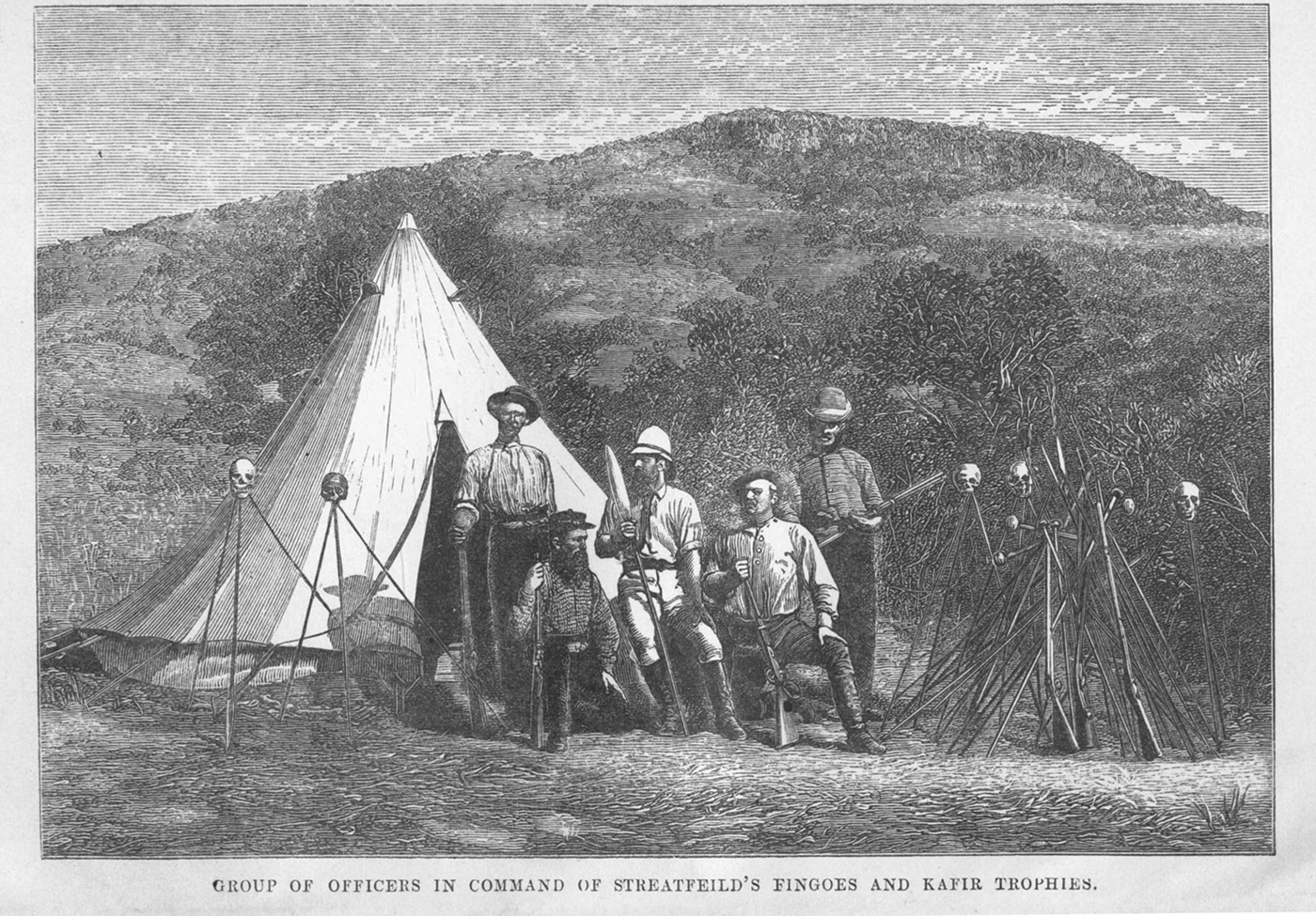
The taking of heads of Xhosa warriors seems to have become so widespread it no longer elicited special comment. In memoirs published immediately after the war, Streatfeild, a commander of Mfengu levies, included an illustration (see Fig. 2) seemingly derived from a photograph, showing officers seated in front of a tent surrounded by skulls, firearms, knobkerries and assegais. The word ‘trophies’ in the caption, ‘Group of Officers in Command of Streatfeild's Fingoes and [Xhosa] Trophies’, reveals the mentality behind the image.Footnote 77
Illustration of British officers with Xhosa skulls and other mementoes near Gwili-Gwili in the Amathole mountains, 1878. Source: F. N. Streatfeild, Kafirland: A Tenth Months' Campaign (London, 1879).
But why collect heads? Morris has suggested that it was part of establishing colonial hegemony, of emphasising the inferiority of colonial opponents.Footnote 78 Through the taking of heads and other body parts, soldiers were signalling their supposed superiority to other soldiers, colonial civilians, and the Xhosa.Footnote 79 In one of the opening battles of the 1877–8 war, the head of the Xhosa woman itola (war doctor) who led the attack was cut off, packed in lime, and proudly displayed to the visiting commander of the forces. As one contemporary source described it: ‘[a]n ammunition-box full of lime was opened, which was emptied into a sack, and the head rolled out. It appeared very like a plaster-cast, as the lime adhered thickly to it. The features and woolly hair were quite perfect.’Footnote 80
Similarly, Siyolo, the elderly Ndlambe chief, was killed in the Fish River bush in 1878 and decapitated. His skull was appropriated by members of the Somerset East Volunteers. This colonial volunteer unit had spent three months ‘hunting’ the Xhosa in the Pirie forests and Fish River bush. They displayed chief Siyolo's skull, along with other Xhosa skulls, attached to their saddles.Footnote 81 Such a public exhibition of skulls served several purposes: bolstering their own bravado, establishing their sense of dominance over the enemy, signalling their prowess as hunters and soldiers, and intimidating the Xhosa. The appropriation of human remains in this manner was intended, in the words of Harrison, as a ‘demonstration of power and conquest’.Footnote 82
APPROPRIATING HEADS FOR REVOLTING PURPOSES? EVALUATING THE EXTENT OF XHOSA HEAD-TALKING
The Xhosa, in contradistinction to the British and colonial forces, do not seem to have systematically collected heads. Previous scholars have postulated, unconvincingly, that the British were mimicking the Xhosa when they took heads.Footnote 83 Military historian Keith Smith asserts the British took heads in the 1850–3 war ‘as a reaction to the instances of murder and torture on the part of the Khoikhoi and Ngqika’. Such atrocities ‘compensated’ for instances when colonists were decapitated.Footnote 84 The evidence, however, suggests otherwise.
There are several reports, increasing in frequency after the 1834–5 war, of the mutilation of colonial corpses; and a few from the 1846–7 and 1850–3 wars, of the Xhosa taking heads. In the absence of reminiscences by Xhosa akin to those of Lakeman who left a detailed written record of the atrocities committed by his troops, it is difficult to discern genuine atrocities committed by the Xhosa from the phobias and propaganda of British and colonial soldiers. In the 1834–5 war, the Xhosa took the Cape Colony by surprise with the scope of their offensive to recapture lands lost to the British. It was the first time significant numbers of settlers of British origin, with access to state power and the press, were affected. The extent and scale of the Xhosa incursions into the Albany and Uitenhage districts dismayed and disheartened settlers and soldiers alike. This contributed in no small way to a hardening of settler attitudes towards the Xhosa, but also provided an opportunity for expanding access to land and extending commercial farming.Footnote 85 Robert Godlonton, as editor of the Grahamstown Journal, set out to catalogue the suffering of British and Dutch-speaking colonists.Footnote 86 Given Godlonton's self-appointed mission as spokesperson of the settlers, had the Xhosa committed atrocities, he likely would have seized on them for propaganda purposes. Furthermore, in the numerous cases of the Xhosa successfully defeating British and colonial troops, such as the 1835 death of Major T. C. White and the killing of Lieutenant C. Bailie and his entire patrol, there is no suggestion in any of the sources of mutilation or the taking of body parts.
The first report of the Xhosa decapitating and removing a head concerned Captain R. Bambrick, who died in the opening stages of the 1846–7 war. His head was apparently taken to make medicine, but a closer examination reveals several settler embellishments that served to cast the Xhosa as superstitious savages. At the time, Harriet Ward described Bambrick's body being cut to pieces and either burnt or ‘hung about the bush’.Footnote 87 Neither William Munro, an army surgeon during the 1846–7 war, nor Lieutenant Jack Bisset, who was in the vicinity, made any reference to decapitation or mutilation of Bambrick's body.Footnote 88 Ward added a further embellishment in the second of her two volumes. According to her, ‘[t]he skull, skin, and right hand’ of Bambrick were presented by Sandile to a prominent ‘witch doctor’ for ‘the most revolting ceremonies’ of witchcraft.Footnote 89 A private in the same regiment, who knew Bambrick personally, did not mention any mutilation of the body.Footnote 90 The official report of Bambrick's death made no mention of decapitation, nor do the detailed contemporary accounts in the Graham's Town Journal.Footnote 91
That heads of British soldiers were taken for ‘magical’ or medicinal purposes is certainly a possibility. Belief in the negative influences of witchcraft was, and is, an important feature of Xhosa society, but whether or not the Xhosa actually used human heads for ritual and medicinal purposes is not as clear cut.Footnote 92 J. H. Soga provided a detailed description of rituals undertaken by a war doctor (itola) in preparing an army for war. The use of human body parts is not included. Given Soga's missionary background, it is possible he may not have highlighted this even if the practice existed.Footnote 93 Peires's useful discussion of beliefs that informed the Xhosa tactic of slitting open the stomach of a vanquished enemy to release inqungu (supernatural forces), and the taking of body parts like livers and skulls for medicinal purposes, suggests that the heads of certain settlers were sent to Mlanjeni for such purposes.Footnote 94 The identity of these settlers is not exactly clear, but may have been James Brownlee and two colonial volunteers, Austin and Gibbons, all of whom were decapitated.Footnote 95 Yet, a close examination of the evidence casts doubt even on these specific cases.
If using human skulls for ritual purposes was a traditional practice, it only appears in the colonial and military archive from 1847. Moreover, in constructing their discourse, settlers and soldiers consistently conflated the activities of different types of Xhosa healers doctoring against witches with witchcraft itself. Mlanjeni is a case in point. Prior to the 1850–3 war, he specifically called on the Xhosa to abjure witchcraft. This was inverted in settler rhetoric which portrayed him as practicing witchcraft and ‘devilry’. The medicines he used to doctor Xhosa warriors were derived from pelargonium and plumbago plants, not human heads.Footnote 96
The case of five British officers successfully ambushed by the Xhosa at Sihota near the Kei River in 1847 confirms how the deep-rooted fears of British soldiers created an exaggerated picture of Xhosa atrocities, and of how stories of skull-taking becoming embellished over time. The officers were ambushed by the Xhosa and killed at a flat-topped mountain overlooking the Kei River. The incident seems to have awakened the worst terrors in some young officers in the field. One, far from the actual scene, anxiously wrote to his parents,
These devils committed one of the most atrocious things ever heard of, by which five officers were butchered; … they were attacked by immense number of Kaffirs, and barbarously murdered. Their skin was cut off in strips, their eyes scooped out, one appeared to have been flogged with chains, and another had his head severed from his body.Footnote 97
Ward, who produced a narrative of these events shortly afterwards, only mentions that they were killed amidst scenes of a fierce fight and their bodies stripped naked.Footnote 98 In the 1851 edition of her book, she embellished her account with references to ‘the merciless cruelty of a barbarous foe’.Footnote 99 Bisset, who was present when the bodies were recovered, but who published his memoirs more than twenty years later, claimed that all five were decapitated and the heads ‘carried away to have diabolical processes of witchcraft and other “devilry” perpetrated on them’.Footnote 100 A member of the burgher forces who was also part of the group who recovered the bodies provided yet another version of the incident in 1897. According to him, four of the five officers were heavily wounded and their heads were removed, ‘om towery mé te pleeg’ (to practice sorcery); and the fifth had no wounds but was beheaded and stretched out on a flat rock. Significantly, he also mentions the presence of numerous vultures in the trees near where the bodies were found.Footnote 101 The official report written at the time by the commanding officer of the forces in the field, however, makes no mention of any mutilation of the bodies.Footnote 102 To try to end embellished descriptions circulating in colonial society, it was admitted that reports of the mutilations were greatly exaggerated and that vultures were responsible for the state of the corpses.Footnote 103 Finally, a church minister who visited the site in 1850 to exhume the bodies for reburial and who interviewed a Xhosa warrior wounded in the engagement, specifically contradicted accounts of their torture and mutilation.Footnote 104
A genuine case of the Xhosa taking a head is that of James Brownlee, who was killed in a skirmish in 1851. His head was taken to Sandile in the mistaken belief that it was that of his brother, Charles Brownlee. The latter had been appointed chief of the Ngqika Xhosa by Governor Harry Smith after he had deposed Sandile in December 1850 – one of the precipitating events of the war. Significantly, the Xhosa returned the head for burial with the body.Footnote 105 Despite reports by settlers and soldiers of Xhosa witchcraft that involved European skulls, corroborating evidence is thin. W. T. Brownlee, James Brownlee's nephew, ascribed a political motive to this head-taking and explicitly dispelled claims that his uncle's head had been taken for the manufacture of war charms. He argued that such incidents were retaliation for the mutilation of Hintsa's corpse.Footnote 106 This explanation suggests that in so far that head-taking became a Xhosa practice, it was one acquired from the British.
An additional tale of Xhosa savagery and decapitations concerns a patrol of the 45th Regiment that the Xhosa defeated at Debe Nek on 24 December 1850. Bisset, writing more than two decades later about ‘a most horrible spectacle’, claimed that when his column came upon the scene they found the bodies of 19 men, ‘most brutally mutilated: their heads severed from their bodies and carried away to exhibit to the different tribes, as an indication that the white man was destroyed, and for the witch-doctors to work their spells’.Footnote 107 Godlonton and Irving, no friends of the Xhosa, published an account in 1851. Citing an eyewitness and participant in the retrieval of the remains, they describe a different picture: the bodies were mutilated and their throats cut from ear to ear, but no decapitations took place.Footnote 108
Another incident, the decapitation of two members of the colonial forces (Austin and Gibbons) at the Blinkwater in December 1850, seems straightforward. Godlonton and Irving reported, ‘these unfortunate men, as we learnt subsequently, were decapitated by their savage murderers, and their heads sent to the … Prophet Umlangeni [sic]’.Footnote 109 Godlonton and Irving later returned to the incident and claimed that Mlanjeni,
directed the colonists' heads … to be roasted over a fire of mimosa bark. These being burnt to cinder, with the ashes he sprinkled his [Xhosa] dupes … The heads of many unfortunate soldiers left in the field in subsequent skirmishes, or who otherwise fell into the hands of the savages, were appropriated to these revolting acts.Footnote 110
This version can be traced to a letter written by Godlonton's daughter from Fort Beaufort in January 1851, which further highlights inconsistencies in the colonial archive, ‘Hermanus [also known as Ngxukumeshe, leader of the Xhosa and Khoikhoi attack on Fort Beaufort in January 1851] murdered two Englishmen up at his place last week, and cut the head off one of them.’Footnote 111 While there is no direct evidence to contradict stories of the decapitation of Austin and Gibbons, Isaiah Staples, a fellow farmer and burgher volunteer from the area, mentioned them by first name in describing their deaths without listing any mutilations.Footnote 112 At the very least, all of this suggests that the taking of heads by the Xhosa was greatly exaggerated and, in the few instances where it happened, it was behaviour that followed British practices.
CONCLUSION
Just how many British and colonial soldiers participated in head-taking is difficult to ascertain. Impressionistic evidence seems to suggest it was a minority. Many – perhaps most – of the soldiers in the wars went about the relatively mundane business of patrolling, killing Xhosa, destroying homes and crops, and trying to survive from day to day, more worried about food and shelter. A few became sickened by the constant burning of homesteads, the destruction of crops, and harassment of starving women and children. Some were sensitive to the plight of the Xhosa, but got on with the business of killing them anyway.
Significantly, collecting body parts, however common it was, was not accepted by everyone. The officer to whom Smith sent the Xhosa ears in 1835 recoiled in horror as he opened the packet and ‘the cold, bloody, black ears fell into his hand’.Footnote 113 Individuals like Charles Lennox Stretch and Dr Ambrose Campbell were outraged at the news of Hintsa's murder and mutilation.Footnote 114 Similarly, when the Somerset East Mounted Volunteers returned to Somerset East in 1878 with Xhosa skulls fastened to their saddles, at least one resident felt compelled to write to a Cape Town newspaper complaining that such conduct created an unfortunate impression ‘as to the character of Englishmen’.Footnote 115 Suggestions that the British imitated the Xhosa in the taking of heads and skulls are without foundation and are contradicted by a detailed analysis of the chronology of head taking. Reports of the Xhosa decapitating soldiers only appear more than a decade after the murder and mutilation of King Hintsa kaPhalo, and most of them do not stand up to close scrutiny.
Although not everyone who fought in the wars participated in head-taking, the practice increased in frequency from the early 1800s to the 1870s. In the nineteenth-century Eastern Cape, specific historical processes gave rise to the collection of heads and skulls. Some were collected for the purposes of phrenology. Skulls, ears, and testicles were also collected widely by many who professed no interest in phrenology. Such collection occurred within a culture of hunting that was a strong component of masculine identity, and where the enemy were seen as subhuman and aligned with animal attributes in military and settler discourses. Taking heads and other body parts as ‘trophies’ was a way colonists exerted power over the Xhosa – by possessing them, literally and figuratively. It was, at least partially, an extension of the collecting of mementoes, the looting of individual bodies in a context of little or no official prohibition. Indeed, some senior officers encouraged the committing of atrocities by both the precedents they set and their public proclamations. The taking of heads and skulls became commodified, as part of wartime trade in at least three of the wars.
The practice increased as the demonization of the Xhosa increased and reflected different strands of racism. At least initially, it was influenced by scientific racism and phrenology, but increasingly it was also driven by a less elaborate and more mundane form of prejudice towards Africans. While not unique to the Eastern Cape or even South Africa, the taking of heads and skulls fed into the complex process of constructing, reproducing, and sustaining colonial domination and racial hierarchies.