INTRODUCTION
In his 2001 book The Great Treks, Norman Etherington critiqued how commonly historians of South Africa have been drawn into ‘viewing events from behind the line of the Cape's expanding frontier of white settlement’.Footnote 1 Etherington made this observation more than three decades after the first waves of Africanist history had washed across the country, yet his proposal that the history of South Africa should be located within wider African processes has still had limited impact. By using new sources however, we demonstrate that the Delagoa slave trade was larger in scale and had broader and deeper regional impact than previous scholarship has acknowledged.
From the 1960s onwards, Africanist historians have pointed to the importance of integrating the history of the country into a wider and deeper history of the region. In 1975, for example, Richard Gray and Shula Marks provided an important overview of the history of southeastern Africa in 1975 that emphasised the importance of long-standing trading systems linking the interior to the Mozambican coast.Footnote 2 Nevertheless, this wider regional perspective developed far more slowly than studies of southern colonial power encroaching on African societies. Because of their inability to read Portuguese, most historians of South Africa were unable to draw on key sources, held at the Arquivo Histórico Ultramarino (AHU), showing trading links between the southeastern coast and interior. While historians who laboured in archives in Lisbon and Maputo uncovered a great deal about the links between Mozambique, the wider Indian Ocean world, and the growth of the slave trade, their work rarely strayed beyond the southern and western land boundaries of the colony which abutted South Africa. As a result, African political processes vital to the history of the wider region have been obscured.
More recent research has highlighted the myriad processes playing out across this terrain, specifically with regards to state formation, and generated new insights and questions. It underscores that, prior to the 1830s, the Delagoa Bay factor was more significant for developments in the interior than the pulses of change emanating from the Cape between 1652 and 1840, leaving indelible marks on the history of the region.Footnote 3
We will explore these wider issues further in ongoing research. In this paper, we demonstrate how using sources focused on Mozambique illuminates the much wider impact of trade. One of the most enduring topics of debate in the history of South Africa is that of the causes of the rise of powerful polities in the northern Nguni area from the late eighteenth century that culminated in the emergence of the Zulu kingdom. Initially, the role of long-distance trade connecting to the coast to the northeast received some attention and generated important insights. In particular, the importance of a trade in ivory was revealed, although the periodisation and nature of this trade remained far from clear. In the 1980s, an argument suggesting that the slave trade had played a key role in shaping change generated a heated debate. This paper argues that the contentions of proponents and opponents of this assertion reflected their primarily Anglophone source base, and employs Lusophone sources to shed new light on this crucial question of the impact of the slave trade on indigenous political developments.
HISTORIOGRAPHY OF SLAVERY IN SOUTHEASTERN AFRICA
In 1969, Gerhard Liesegang briefly mentioned the slave trade in his article about Dingane's attack on Delagoa Bay in 1833.Footnote 4 Alan Smith's 1970 PhD thesis and the important articles that flowed from it described and analysed the long-distance trading system that linked the coast of southern Mozambique to the interior between 1720 and 1835. His focus was on the ivory trade, but he also discussed the impact of slavery on southeastern Mozambique and suggested it might have been a factor in political centralisation across the region.Footnote 5 This line of argument initially found few followers. Six years later, Henry Slater ignored the issue in his doctoral dissertation, as did David Hedges in his important work on southeastern Mozambique in 1978, which illuminated the nature and impact of the ivory trade on the region and made less well-evidenced arguments about the role of a trade in cattle in relation to political centralisation.Footnote 6
In 1981, Patrick Harries revived the issue of slavery.Footnote 7 He argued that forms of slavery were not foreign to northern Nguni societies in precolonial times. Rather, a significant slave trade arose in southeastern Africa, specifically from Inhambane and Lourenço Marques, during the nineteenth century.Footnote 8 However, he did not relate these points to debates about state formation in northern Nguni territory. In 1988, Julian Cobbing drew on Harries’ work to suggest the existence of a significant slave trade out of this area, strengthening the trade hypothesis in relation to the rise of the Zulu kingdom.Footnote 9 His intervention provoked an intense and sometimes intemperate debate questioning the existence and timing of a slave trade with respect to state formation amongst the northern Nguni.Footnote 10 John Wright pointed to trade in ivory and slaves as the impetus for social and political change within northern Nguni societies and argued that evidence exists for the Mthethwa, Ndwandwe, and Zulu trading slaves to the Portuguese.Footnote 11 But scholarly interest in slavery's influence on the region waned after Elizabeth Eldredge argued that there was little evidence for a trade in slaves out of Delagoa Bay during the first two decades of the nineteenth century. She also accused Harries of conflating data from Inhambane and Delagoa Bay, thus exaggerating the volume of slaves traded from the Bay.Footnote 12 She repeated these points in 1994, reiterating the view that the political economy of the Zulu kingdom was antithetical to slave raiding.Footnote 13 Her research was, however, mainly based on secondary sources. The primary material that she did use, including evidence by the leader of the British naval survey team, Captain William Fitzpatrick Owen, was drawn from the Records of South-Eastern Africa, edited by G. M. Theal.Footnote 14 While Eldredge's bold assertions did not draw on a comprehensive survey of all available sources, her conclusions have not been subject to in-depth review — an omission we set out to correct.
There have been further limited sallies into this debate. Based on fragmentary and circumstantial evidence, Dan Wylie proposed that slaving might have been a significant factor in the growth of centralised polities.Footnote 15 But he was left wondering whether Delagoa Bay was involved in this increase in trade or whether it was somehow exempt.Footnote 16 In the end, because of the lack of sources, he concluded that slavery from the Bay remained a controversial subject.Footnote 17 In a more recent publication, Paul Lovejoy discussed slavery in Ndwandwe society, with specific reference to Zwide's migration north, in terms of expanding and reinvigorating societies by raiding for women and young men. However, he did not address slave raiding for the sake of sale at the Bay.Footnote 18
Beyond these tantalising exchanges, the northeastern factor was given short shrift. An especially startling omission was research on the years after 1823, a period when even Eldredge acknowledged the existence of a slave trade from Delagoa Bay. Instead, the main focus of scholars located within South African historiography was on an extended critical interrogation of oral sources and the limited selection of contemporary documentation in English.Footnote 19
The invaluable work of John Wright in editing the James Stuart Archive, now in six volumes, made a crucial collection of oral traditions much more accessible, but his determined scholarship could not overcome key limitations of the archive.Footnote 20 It was collected eighty years after many of the events described and was shaped by explanatory conventions that stressed individuals and internal processes while downplaying external pressures. Notwithstanding the obvious drawbacks of these sources, the archives in Lisbon and Maputo, which contain relevant contemporary documentation, were ignored by most South Africanists.
The AHU files in Lisbon were in disarray at the time of Smith and Hedges's research, but a 1980s project, which placed all documents in chronological order, made it easier for Chewins than her predecessors to find relevant documents. By using the AHU, we outline the changing nature of a trading system that connected Delagoa Bay to its southern hinterland, including the northern Nguni states. We explore the development of the slave trade at Delagoa Bay and argue that trade in general, and specifically in slaves, deserves greater emphasis in the analysis of transformations in the region.Footnote 21
DELAGOA BAY AND TRADE
Delagoa Bay has long been known for its ivory trade. The Portuguese initiated European involvement in the ivory trade from the Bay in 1544, but this commerce remained limited and erratic for many years.Footnote 22 From 1761, however, the demand created by the sought-after goods supplied by the English country trader Edward Chandler accelerated the trade.Footnote 23 Delagoa Bay remained part of a brisk country trade even after Chandler's death in 1768.Footnote 24
From 1777, William Bolts's immensely successful trading venture under the auspices of the Austrian Crown led to a surge in the ivory trade supplied, in the main, by northern Nguni groups. The evidence suggests that the introduction of beads and brass goods deep into the interior was instrumental in deepening the involvement of the northern Nguni in the ivory trade.Footnote 25 After the Portuguese reestablished a trading post at the Bay in 1799, ivory remained a sought-after product, with brass goods in most demand in exchange. Despite Portuguese attempts to exclude them, English traders initially maintained a significant ivory trade between the Bay and India, but the trade decreased in the following year — a decrease that coincided with the start of the Napoleonic Wars and the increasing French naval presence in the western Indian Ocean.Footnote 26 The failure of the ivory trade from the southeastern coast to fully recover after the Napoleonic Wars coincided with the increase in the slave trade.
The first evidence of a relatively small European slave trade lies in the Dutch documents from the period 1721 to 1731. Over the ten years of their trading post's existence, the Dutch traded 257 slaves.Footnote 27 The chiefs of Delagoa Bay referred to the absence of wars as the reason for the lack of captives to sell to the Dutch.Footnote 28 The interlinked themes of the presence of war, violence, and a slave trade would persist throughout the eighteenth and nineteenth centuries.
The establishment of a plantation economy on the Mascarene Islands in 1769 and the growth of a trade to Brazil after 1815 led to a significant increase in the demand for slaves from the east coast of Africa. Especially important in relation to Delagoa Bay was the British-Portuguese agreement of 1815 which included the Bay as a legitimate slave market.Footnote 29 This treaty encouraged increasing numbers of Brazilian slavers to visit the southeastern coast of Africa. The fact that this increased demand for slaves coincided with the upheavals in the Thukela-Mzimkhulu region of the 1810s merits further discussion which, within the constraints this article, cannot be covered satisfactorily.Footnote 30
HISTORIOGRAPHY OF THE MASCARENES
Critical to an understanding of the processes at work in southern Mozambique was the development of a slave trade to provide plantation labour for the Mascarene Islands, Bourbon (Réunion), and Isle de France (Mauritius). By 1785 the Mascarene trade from Mozambique had come to overshadow the slave trade to the south Atlantic ocean.Footnote 31 The Royal Order of 13 August 1769, which ended the French India Company's monopoly and gave licence to French citizens to trade freely in the seas beyond the Cape of Good Hope, led to the ‘unprecedented rise of the slave trade to the Mascarenes’.Footnote 32 Another indication of the rise of the slave trade in the Mascarenes is the number of slaves on the islands. The 221 slaves traded in 1735 grew to 133,000 in 1807–8.Footnote 33 Between the 1670s and early 1830s, one-fifth of French slave trading occurred in the Indian Ocean.Footnote 34
José Capela and Eduardo Medeiros argue that by the end of the eighteenth century there was an ‘intense and growing demand’ for slaves on the Mascarenes.Footnote 35 This view is reinforced by Edward Alpers, who names the earliest slave traders in the western Indian Ocean as French merchants from the Mascarenes, who ‘never [sought] ivory, and who played a crucial role in the rise of the slave trade during the eighteenth century’.Footnote 36 Herbert Gerbeau agrees that the slave trade to the Mascarenes was ‘massive’.Footnote 37 Discussing northern Mozambique, Pedro Machado states that, by the 1810s, slaves had replaced the ivory, gold, and silver trades on the northeast coast of Mozambique in the context of the slave trade to Diu and Daman.Footnote 38
It was not only East Africa that provided slaves to the Mascarenes. The Malagasy market ‘was a vigorous slave trade until the imposition of French colonial rule at the end of the nineteenth century’.Footnote 39 A significant slave trade at Madagascar also fed the Mascarene slave trade, though after the time period examined within this article.Footnote 40
The Mascarene market flourished alongside a wider growing demand for slaves. The French demand rose along with the labour needs of Brazil, Zanzibar, the Comoros, Madagascar, the Persian Gulf, the United States, and Cuba.Footnote 41 Alpers has shown that ‘Moçambiques’ (slaves from the Mozambican coast) were in greater demand in Brazil after the British abolitionists limited slavery to the southern hemisphere.Footnote 42 After the 1820s, the increased demand for slaves led to Quelimane becoming the most important port for Zambezia, while Inhambane became the most significant slave port for southern Mozambique.Footnote 43
As the number of slavers increased, so did the exploitation of the East African coast.Footnote 44 The Treaty of Paris, signed on 30 May 1815, gave France five years to end its slave trade; ironically, this limit increased the impetus to trade, evident in the significant number of slaves traded illegally to Réunion. Between 1811 and 1848, the total number of slaves who had been smuggled onto the island increased from 48,900 to 66,400 — indicating that the number of people smuggled per year had leapt from 1,321 to 1,794.Footnote 45 After 1818, when the French government outlawed slaving by French-owned ships and declared it a crime, the visibility of the trade diminished. Yet neither French or Portuguese legislation, nor British surveillance at sea, put an end to the trade — rather, they accelerated it.Footnote 46
THE BRAZILIAN TRADE FROM SOUTHEAST MOZAMBIQUE
As with the French slave trade to the Mascarenes, the trade to Brazil escalated, especially after the abolition of its trade had been formalised through the Anglo-Brazilian Anti-Slave Treaty signed on 23 November 1826, which promised to abolish slave trading in three years’ time. The trade escalated exponentially in response to the growth of Brazil's agricultural labour demands on its coffee and sugar plantations.Footnote 47 After Britain prohibited the slave trade in its colonies on 25 March 1807, she put increasing pressure on European countries and Brazil to do the same. In 1826, in exchange for British acknowledgment of Brazilian independence from Portugal, Brazil agreed to abolish its slave trade.Footnote 48 Once the deadline of 13 March 1830 to abolish the trade was set, Brazilian trade accelerated, driven by a fear of diminishing profits and the probability of a labour shortage after abolition.Footnote 49 This factor increased the demand for slaves on Brazilian soil and the trade assumed ‘terrifying’ proportions.Footnote 50 Official abolition of slavery drove the trade underground, while increasing its intensity.Footnote 51 Moreover, because the Additional Convention to the Treaty of Vienna of 1815, added in 1817, limited the slave trade to the southern hemisphere, it created the impulse to find new slave markets — a reality exploited by slave traders — and boosted slaving along the southeast African coast.
A HINT OF AN EARLY INCIPIENT SLAVE TRADE AT DELAGOA BAY
The sources are thin on trade in the pre-1820 period, and the evidence is mainly circumstantial. The absence of effective Portuguese control and record keeping for most of the eighteenth and early nineteenth centuries makes it impossible to approximate the scale of the trade. The fragmentary evidence is nonetheless suggestive that a significant trade existed.
Some evidence for a slave trade occurring before 1777 comes from the Carmelite friar Franciso de Santa Thereza, who wrote that the English captured slaves — ‘aprehendidos em Guerra entre elles’, apprehended in war between them.Footnote 52 His sentence is somewhat ambiguous. Did he mean between them (the slaves) and the English? Or war between those who were enslaved and others? In any case, by the time of the Austrian trading post, 1777–81, their abundant slave trade was the envy of the Portuguese. Slaving occurred in such a number that Martinho de Melo e Castro, the Secretary of the Marine and Overseas Ministry from 1777 until 1795, counted the loss of Delagoa Bay's commerce to the Austrians as serious because of the ‘considerável número de escravos que podia fornecer’ (the considerable number of slaves it could supply) once the Austrians had been expelled.Footnote 53
In 1785, another glimpse of the earlier slave trade appears through the activities of the crew of the French ship Thélèmaque.Footnote 54 Portuguese military staff, doubling as traders, assisted the ship's crew to attack the people of chief Capela of Tembe. The expedition backfired when locals killed four Frenchmen and imprisoned the rest of the party, whom they later ransomed back to the fort.
Besides the case of the Thélèmaque, other fragments of evidence exist for an early slave trade out of Delagoa Bay. The renowned slaver, Joaquim José da Costa Portugal, visited Delagoa Bay a few times in his corvette in search of slaves during the late eighteenth century.Footnote 55 In 1814, Governor Teodorico Ramos auctioned off 18 slaves at the Bay.Footnote 56 Thomas, the captain of the Perseverança, was in Delagoa Bay in 1818 to purchase slaves. Moreover, in the same year, the annual official trading ship from Mozambique Island came to fetch ivory, rhinoceros horn, and slaves from the port.Footnote 57 It is interesting to note that Eldredge mentions the absence of the annual ship prior to 1823, but ignores the fact that it had been in the Bay in 1818. It should be noted, of course, that the annual ship was far from the only channel for the export of slaves. This evidence suggests that the potential for profits from the slave trade, coupled with the high French demand, had prompted the development of an as-yet unquantifiable pre-1820s slave trade at the Bay.
THE SLAVE TRADE OF THE 1820s
On 5 July 1821, during the governorship of Caetano Costa Matozo, chief Nyambose from the region south of St Lucia, attacked chief Capella of Tembe with an army of 8,000 men.Footnote 58 His aim was to secure cattle, beads, and brass neck and arm rings. Later in the same month, his son arrived with the same demand, also directed at the Portuguese.Footnote 59 Clearly, groups living in the south, including the area beyond the Phongola River, viewed Delagoa Bay as a source of wealth.
One of these groups was the Vatua or Vatwah, terms used by the Portuguese and English respectively, who were moving north into the Bay from beyond the Phogola River in the south. This group is significant to the argument that the Zulu were instrumental in the Bay's slave trade. The earlier use of the term generally referred to those who spoke languages which included clicks. During 1822–3, however, when Zwangendaba, Soshangane, and Shaka were in the Bay, the term Vatwah designated the Zulu. To the present-day historian, Zwangendaba and Soshangane are known as Ndwandwe, Zwide's erstwhile followers, and certainly not Zulu. To contemporary observers, however, Zwangendaba was the uncle to Shaka.Footnote 60 And Shoshangane was also perceived as Zulu, as in ‘Chinchingane and his Zoolos … attacked Mr Vidal and his party’.Footnote 61 These observations might be because of the similarity the northern Nguni showed in dress, arms, and language. Or their identification might have to do with the fact that Soshangane and Zwangendaba were seen as ‘untethered proxies [of Shaka Zulu] allowed to accumulate non-bovine booty in return for fealty’.Footnote 62 The missionary William Threlfall identifies the king of the ‘Bratwah’ as Shaka.Footnote 63 Dan Wylie dismisses Threlfall's association between the Zulu and Vatua because he says ‘only one account makes this identification’.Footnote 64 Yet according to British naval captain W. F. W. Owen, the Portuguese also identified ‘Chaka the young king [of those] … called Vatwahs or Olontontes’.Footnote 65
The apparently interchangeable use of Vatua, Massuitys, Izitis, and Mapsitis becomes explicable when location is taken into consideration.Footnote 66 The term Vatua seems to indicate people moving north as being from the south. But once the Nwandwe started moving north of Delagoa Bay, the Portuguese attached a different label to them, calling them Izitis, who invaded the northern beaches (‘Izitis que andavão roubando nas praias do norte’) close to the fort.Footnote 67 The governor at Inhambane gathered a force to repel the ‘inimigo Massuittys’ (enemy Massuittys), who had invaded the northern hinterland of Delagoa Bay in 1824.Footnote 68 So there appears to be some differentiation between those who moved north and the Zulu. It is worth noting that the ex-Ndwandwe were called both Vatua while in Delagoa Bay and Izitis/Massuittys/Mapsitis (a term associated with Zwide) further north, while the Zulu were only ever called Vatua.Footnote 69
Portuguese sources also elaborate on the Vatua/Zulu identity in the mid-1830s. This is so well-documented because of the murder of Governor Antonio Ribeiro in 1833 by Dingane's generals.Footnote 70 The Zulu army is identified as the Vatua from the coast of St Lucia, and from ‘terra no Natal ao sul do rio Santa Luzia’ (the land of Natal south of the St Lucia River).Footnote 71 The reason for assuming the Vatua were Zulu in this instance is the nature of the relationship between chief Makasane Maputo and the Zulu, described below.
THE INVASION OF THE BAY
By 1822, and probably before, invaders from the south understood that slaves were in demand in the Bay.Footnote 72 Zwangendaba sold cattle, hoes, and, most importantly, slaves to the Portuguese fort.Footnote 73 Zwangendaba settled in Matola's territory on the north bank of the Bay; people in all directions, including the Tembe under chief Capella, suffered the depredations of Zwangendaba who was supported by over 5,000 subjects.Footnote 74 With Shaka in hot pursuit of Soshangane and Zwangendaba, they could not ‘rest long any where [sic]’.Footnote 75 The invaders then moved further north, decamping to the Nkomati River at a place called Mamaloong at the mouth of the Nkomati.Footnote 76 The short-lived conflict engulfed the surrounds of Delagoa Bay, leaving nothing but ‘desolation and famine in their rear’. Owen commented that the governor could have prevented their suffering if he had intervened; that he did not, this combined with the nonchalant attitude of the Portuguese authorities towards these hostilities, is telling. It indicates that they were at peace and on good terms with the raiders who ravaged the chiefdoms around them.Footnote 77 Their attitude is unsurprising, given that as slave traders they were likely to have been the main beneficiaries of these battles. Historians have commonly viewed Soshangane and Zwangengaba's move north to as an attempt to escape from Shaka's violent orbit.Footnote 78 This may have played a part, but in our view, historians should give greater weight to the pull of an expanding supply of trade goods flowing from the slave trade.
In 1823, Governor Cardenas was deeply involved in the slave trade and there is evidence that he was in contact with Shaka.Footnote 79 The governor was supposedly in ‘dread’ of Shaka and eager to please him.Footnote 80 In reality, however, it was probably the governor's desire for profit that prompted his fawning attitude to the Zulu king. In the same year as Shaka's destructive forays, the governor added to the plight of locals by instigating conflict between local societies, ‘provok[ing] wars between the different tribes of the natives for the sake of getting slaves for cheap’.Footnote 81
In 1823, Shaka Zulu's army was present in Delagoa Bay. The report of the disembowelment of a Portuguese priest in September of the same year by Shaka's men places Zulu presence at the Bay just before the arrival of a slave ship.Footnote 82 In late 1823, Owen claimed that the Vatwah ‘spread panic and terror in the hinterland’.Footnote 83 These raiders were in all probability Zulu, as Soshangane and Zwangendaba had by this time moved north, away from the Bay.Footnote 84 The Zulu army's presence in the Bay therefore coincided with peaks in the slave trade when the trade was ‘hotting up rather than cooling down’ at the Bay.Footnote 85 Their depredations were so severe that surrounding chiefs begged to be subjects of the Portuguese crown so that they might qualify for protection from the fort.Footnote 86 In the wake of the Zulu army's scorched earth strategy, famine gripped the area, producing large numbers of destitute people who could be enslaved relatively easily and cheaply. The oversupply of slaves was such that it depressed the trading price — the market price for slaves fell to a few shillings in 1823.Footnote 87
Although the coincidence in the timing of raiding and trading is suggestive, it does not provide conclusive evidence of Zulu leaders selling slaves to traders. When placed in comparative context, however, it becomes somewhat more telling. Northern Nguni groups, in common with most other societies in the region, took captives in wars and raids, with young women and children especially prized. Attackers often killed men, leaving very young children and the elderly to fend for themselves. Men of high rank were on occasion ransomed by their relatives. The primary motivation was to accumulate concubines and swell regiments, but there is evidence that after the initial processes of consolidation and the emergence of markets for slaves, some states were prepared to sell captives. With Shaka entrenched in power and his armies taking captives far from the kingdom's heartland and close to a booming slave trade in Delagoa Bay, it is plausible that the Zulu sold some captives to European traders through chief Makasane as middleman.Footnote 88
But, even more importantly, the activities of the Exclusive Ivory Commercial Company of Inhambane and Lourenço Marques led to further escalation of the slave trade and levels of violence. The dramatic increase in the slave trade from the mid-1820s therefore coincided with the move of Soshangane and Zwangendaba closer to the source of trade (Delagoa Bay and Inhambane) while the power and raiding-reach of the Zulu kingdom under Shaka grew rapidly. The major upsurge in the volume of the trade took place after 1826 and was connected to the Exclusive Ivory Commercial Company of Inhambane and Lourenço Marques (hereafter called the Company) — a venture that has not enjoyed the attention it merits from historians.Footnote 89
THE SLAVE TRADE AND THE EXCLUSIVE IVORY COMMERCIAL COMPANY OF INHAMBANE AND LOURENÇO MARQUES
Vincente Thomas Dos Santos, who was co-founder of the Company, was not new to the business of slavery. He had frequented the waters between Mozambique Island, the Mascarenes, and Brazil since 1817 and was aware of the lucrative possibilities of the growing Brazilian and Mascarene slave markets.Footnote 90
Born in Lisbon, he became a sailor at the age of fourteen and, over a career of 32 years, led numerous slaving expeditions. Vicente first served as a pilot for the renowned merchant José Nunes da Silveira, who dealt in slaves and other goods. Dos Santos carried his first known shipment of 273 slaves bought at Mozambique Island across the seas for his employer, to Maranhão, in 1817.Footnote 91 But, being an ambitious man, and well-connected to the trade networks of Bourbon Island and Brazil, Vicente became a trader in his own right. He bought da Silveira's ship, the Delfim, in 1826. Later he also purchased the brigantine Maria Theresa at an auction of the Public Deposit Board of Lisbon, from where he sailed directly to buy slaves at Inhambane.Footnote 92 Dos Santos's activities and networks tightened the links between Delagoa Bay and the booming Brazilian slave trade.
Dos Santos made an appearance in Delagoa Bay in 1823, the same year as Captain W. F. W. Owen, who was on a survey journey to map the east coast of Africa from Algoa Bay. He reported that after his ship, the HMS Leven, had left in September 1823, dos Santos sailed into the Bay. Three years later, the Company officially started trading.
Dos Santos and his partner, Carlos Baptista, chartered the Company in Lisbon in 1824, proclaiming the venture to be in line with Portuguese policy to expand trade in Africa.Footnote 93 The purpose of the Company was ostensibly to stimulate economic growth and advance the settlement of Delagoa through trade. The Company had the blessing and protection of King João VI of Portugal while the Company of Merchants of Lisbon supported the charter because its interests lay in the development of new markets for their goods.Footnote 94 But the Company's name belied its primary purpose: trading slaves. Its establishment facilitated a significant growth in the trade. Stating the intention of the Company to trade exclusively in ivory legitimised its existence and served as a front for its core business. It flourished in the context of the ambivalent Portuguese attitude towards abolishing slavery, despite their public pledges to do so. Despite his promises to the British to promote the abolition of slavery, the King of Portugal waived the Company's import duties on slaves by charter — thus in practice promoting the trade.Footnote 95 A large factor in the Company's success was its ample and consistent supply of trade goods, explored further below.
THE SLAVE TRADE IN NUMBERS
The Company had a significant trade with the French. In 1835, an inquest into Governor Dionizo Antonio Ribeiro's death two years earlier at the hands of Dingane's generals documented snippets of the slave trade.Footnote 96 According to these records, the French ships L'evrier, Jan Belier, São João, and L'espiegle, among others bought slaves at the Bay for export to Bourbon Island. The evidence does not detail exactly how many ships did this circuit during the late 1820s and early 1830s. However, we do know that 12 French ships visited the Bay over one period of 18 months, 1827–8.Footnote 97 Moreover, the inquest named four ships regularly involved in the Bourbon Island trade.Footnote 98 Our calculations are conservatively based on these four alone, despite there being other ships (outros mais) involved in this circuit. The 1835 inquest document recorded that from 1826 French vessels shipped slaves to Bourbon Island every two months (‘para Ilha Borbon dous em dous mez’).Footnote 99 Governor and Captain-General Sebastião Xavier Botelho wrote from Mozambique Island that, in 1827 and 1828, a very large number of French ships arrived at subaltern ports to engage in the slave trade.Footnote 100 Yet in the inquest document, de Nascimento stated that the Company delivered a great number of goods from 1826 to 1830 for the slave trade to Bourbon and Brazil.Footnote 101 It was only after the inquest that the truth of the French slave trade at the Bay fully came to light.
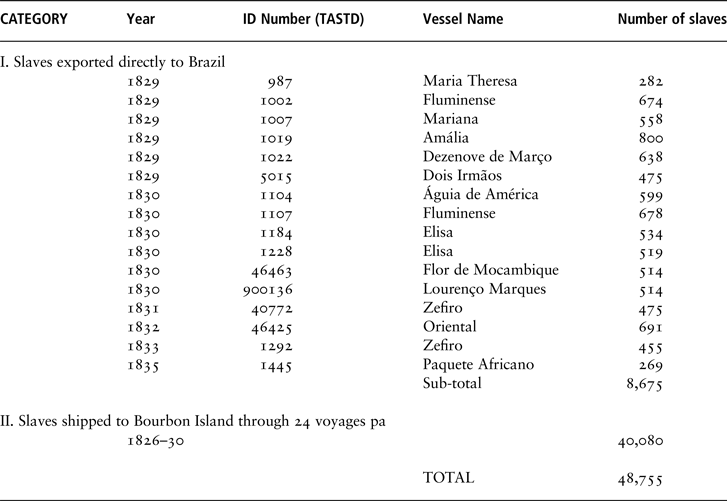
If we assume that each of the four named ships made this journey six times per annum during the period of 1826–30, then that totals 24 journeys per annum over five years, or 120 voyages in total. Assuming the four ships mentioned above were brigs, and taking an average from the first two pages of the Trans-Atlantic Slave Trade database (there are fifteen pages of two hundred entries each), the number of slaves (disembarked in Brazilian port, after losses at sea) on four brigs can be estimated at 334 per ship. Multiplying this number to account for a trip every two months, over five years per ship, amounts to 40,080 slaves for the 1826–30 period (see Table 1). The activity of these four ships translated into a considerable number of slaves over the five-year period (see Table 1). The total of 40,080 slaves exported to Bourbon Island during part of this period is almost certainly an underestimate, because of the unrecorded, clandestine nature of the trade in these waters, and the high level of collaboration between smugglers.Footnote 102 In 1828, the Brazilian ships docked at Mozambique Island illustrate the level of smuggling. Of these 11 ships, only one had a cargo manifesto.Footnote 103
Enslaved People Exported from Delagoa Bay to Bourbon Island (Réunion), 1826–30, and Brazil, 1829–35Footnote 110
Capela and Medeiros also calculated how many slaves left for Bourbon and Isle de France, finding that 16,000 slaves were shipped to the Mascarenes between 1827 and 1830.Footnote 104 However, Capela and Medeiros do not explain how they arrived at the 16,000 and only refer to the L'evrier and L'espiegle. They also use the HMS Helicon's observation of 12 ships present at Delagoa Bay over 18 months to determine how many ships took slaves north every year. From this formulation they calculated that ten ships transported slaves to Bourbon per year. Capela and Medeiros's calculation depends on a conflation of statistical evidence, transposing data from Delagoa Bay to Mozambique Island. Moreover, it is unclear how they calculated the average of four hundred slaves per ship. The number 16,000, uncertainly attained, seems best ignored.
Brazil was the other market for Delagoan slaves, and the ships associated with this circuit were the Maria Theresa, as well as the Eliza, Flumenencia, Agua do Brazil, Amelia, Mariana, Maria Segunda, Industria, Trintão Pequeno, and lastly the Zefiro that went to Brazil ‘many, many times’.Footnote 105 Dos Santos also commanded the state-owned ship, the Dom Estavão de Ataide, to transport his own slaves to Brazil, refusing to freight anyone else's captives.Footnote 106 The Company operated out of the Bay for many years, 1827–35.Footnote 107 As we have seen above, Delagoa Bay was of increasing interest to slavers from the 1790s, and the numbers went up over the ensuing decades — but it is only from the mid-1820s that we have credible evidence about the scale of the trade. The documented, total number of slaves exported from Delagoa Bay directly to Brazil in the years from 1829 to 1835 was 8,675.Footnote 108 In addition to the ships appointed by the Portuguese authorities to prosecute the Brazilian trade, dos Santos employed a number of other ships to carry slaves to Brazil. Again, the highly furtive nature of this trade provides the rationale for assuming this number is quite low compared to the estimates we propose.Footnote 109 While sources indicate that the number of slaves exported from Delagoa Bay diminished around 1830 for at least a while, possibly because of lack of slaves or the mounting pressure of British patrol ships, slavery out of Delagoa Bay seems to have been maintained between 1830 and 1835. It is therefore clear that Delagoa Bay produced a significant number of slaves for the French and Brazilian markets.
TERROR AT DELAGOA BAY
From the late 1820s and into the 1830s, terror reigned at the Bay. Dos Santos executed the Company's first slave raid in KaTembe (or Tembe territory) in 1826 with the help of chief Makasane Maputo. From the ship Maria Thereza, Dos Santos fired a few cannon shots, signaling a Maputo charge toward the Tembe River. The fleeing Tembe were either killed or captured. After the attack, Dos Santos disembarked and, surrounded by his armed escort, conferred with a few of Makasane's men. A few months later, Makasane returned with a force of 25,000 men; this time the army was a mix of Maputo and Vatua (probably Zulu) soldiers. The raiders adopted a scorched-earth approach, killing those who resisted, setting fields and huts alight, and taking captives. The Company, through Dos Santos, was deeply implicated in this event.Footnote 111
The reason for assuming the Vatua were Zulu in this instance is the collaborative nature of the relationship between Makasane and the Zulu at the time. The Maputo had a history of partnering up with the northern Nguni, as in the case of the exclusive partnership in the ivory trade between Makasane and Dingiswayo, for the benefits of trade.Footnote 112 Evidence for the Maputo and Zulu meeting daily to discuss ‘matters necessary to settle’ suggests that this link continued in the 1820s.Footnote 113 However, fuller collaboration only came after the Vatuas overcame the Maputo.Footnote 114 The Vatua then ‘settled [t]here by agreement’.Footnote 115 It appears, then, that Shaka established a group, about 100 kilometers up the Maputo River from the Bay, probably to monitor the flow of goods, as Makasane's homestead was a lively trading post.Footnote 116 As with the case of Dingiswayo and Makasane, the Zulu provided the trade goods, though this time the primary demand was for slaves. The Maputo were the main slave traders, earning wealth in beads, brass, and cloth, part of which passed to the Zulu as tribute.
But it was not only the Company that raided for slaves. From the mid-1820s onward, João Francez, a partner of the new governor, Dioniso Antonio Ribeiro, had a retinue of local men called ‘black smugglers’ to aid in capturing an unknown number of slaves. And if the Company's unit of men is a representative example, these retinues were well-armed with guns and ammunition. The trading post had a garrison of fifty to sixty soldiers employed for the same purpose, recruited locally by the Portuguese.Footnote 117 Avoiding capture and enslavement was probably a strong incentive for their cooperation. Chiefs and headmen were also coerced into slaving operations. A chief named Moleke had promised to provide slaves and had accepted the chains and shackles for this purpose, but when an officer from the trading post, Brancamp de Mello, called to collect slaves, he had none to offer. The unfortunate man thought he could appease the agent by offering ivory. De Mello shunned his offer, and Moleke ended up in the same shackles given to him to restrain the promised captives.Footnote 118
Payment in goods and liquor provided a strong inducement for collaboration. The copious amounts of alcohol, known as arguardente, that the Company supplied was a key element in their success because it could ‘buy anything’.Footnote 119 To the chagrin of the governor, the Company ignored the set prices paid for slaves, determined by the authorities on Mozambique Island, and fixed its own, much higher, rates, pricing the trading post out of the market.Footnote 120 While the Company had a reliable and reasonably priced supply of trade goods, the trading post was dependent on a chronically erratic and expensive supply of beads and brass supplied from the financially beleaguered Mozambique Island. Because of the Company's generous payments in beads and brass, much merchandise from the south was available for purchase, which a close reading of the evidence suggests mainly comprised slaves. The Company, which was ‘careful to only buy slaves’, also used longboats to fetch slaves along the Maputo River, probably at the tent set up on the river's banks, about a hundred kilometers south, where a ‘principal ferry’ shuttled goods and people back and forth.Footnote 121
The insertion of the Commercial Company into the Bay's market disrupted the open communication the trading post had with chiefs, local and remote, and disturbed the ivory trade. The Company's presence brought disorder and dissension among the chiefs and created chaos in the Bay area — perfect conditions for slavery.Footnote 122 It sent out agents to establish ‘new trade routes’, a practice which probably involved additional or new groups of people in the trade. So far, no records have been found, neither of the modus operandi of the agents, nor of the number of slaves they secured. But in 1827 a slave raid, probably on the Tembe, was so successful that Vicente had to leave four cannons behind to make space on his ship for his human cargo.Footnote 123
The picture that emerges from the mid-1820s is that at times bands of Makasane's men, armed with rifles, terrorised the Tembe. At other times, the Maputo, ‘com combinacão com os negros de Certoens’ (in combination with blacks from the hinterland), helped to conduct slave raids.Footnote 124 The ‘negros de Certoens’ were no doubt Zulu as they were dominant military power in the southern interior. The Company's dungeon served as a holding space for the unfortunate souls before embarkation.Footnote 125 The Company, at the very least, extracted tens of thousands of people from a relatively small population over less than a decade for the Bourbon trade. Conservatively calculated, the number of slaves exported annually to the northeast between 1826 and 1830 was over 8,000, whereas the average for Brazil (1829–35) was around 1,400 people per year (see Table 1).
The sources concur that a principal source of the supply of slaves to the Company in this period was raiding by the Vatua, or Zulu, acting in league with Portuguese slavers. For instance, Dingane's relationship with the slave trader Anselmo Nascimento deeply implicates the king's armies in the slave trade.Footnote 126 The Delagoa Bay chiefs called Anselmo a ‘bad man’ for calling the Vatua to war against them.Footnote 127
The attacks of the Vatua were predominately on the Tembe. An explanation for this circumstance probably lies in their previous defeat by the Maputo, an offshoot of the old Tembe lineage. In addition, the Tembe were the least militarised society in the region because of their focus on cultivation.Footnote 128 The capture of the ‘thousand and thousands’, as we have seen above, depleted the population of the Tembe — an observer stated that Tembe territory was ‘almost depopulated because of slave raiding’.Footnote 129 The numerous Matola were a target for slave raiding.
It appears that from 1831 the supply of captives fell, probably because of the dwindling population of the Tembe, who had been the main victims of the trade, possibly because they had been the long-established principal traders of the Bay and potential competitors to Maputo. There is also little evidence that Shaka or Dingane sold subjects from the heartland of the Zulu kingdom into slavery. As with many other slaving states in Africa, relatively weak and less centralised neighbours were the prime source of captives. In this instance, the sources of slaves lay to the north of the kingdom and close to the main market for them at Delagoa Bay. Based on the evidence that is now available, the participation of the Zulu kingdom in the trade seems rather like the pattern of Swazi involvement in the slave/inboekeling (apprentice) trade from the 1840s to the 1870s.Footnote 130 During the period of rapid expansion and wide-ranging raiding, the Swazi state was prepared to trade significant numbers of slaves to the Boers and to Delagoa Bay. But their involvement diminished as the main dynamic of the kingdom shifted towards the consolidation of power in its central regions and raiding declined in the face of mounting resistance from the Pedi kingdom and other chiefdoms in the region.Footnote 131 By the 1830s, the Zulu kingdom was also entering a period of consolidation. It also had an alternate source of wealth because English traders, who could supply the trade goods Dingane desired and who were interested in ivory, not slaves, were by then well-established at Port Natal.
CONCLUSION
Thirty-seven years ago, Harries provided a compelling critique of the idea that the northern Nguni, including the Zulu, had a ‘natural aversion to both domestic and export forms of slavery’.Footnote 132 To this day, historians have not systematically tested this insight against the evidence for the nature and impact of trade relationships between Delagoa Bay and its southern hinterland. Instead, both the endorsement and rejection of his insights has been coloured by the more polemical aspects of the ‘Mfecane’ debate. One of the reasons for this failure to build on his insights has been the inability or unwillingness of historians to engage with documentary material in Portuguese.
This article, on the basis of in-depth archival research, provides a detailed, differentiated, and periodised account of the trading systems linking Delagoa Bay and its southern hinterland. Within this framework we argue that the role of the slave trade has been underestimated. There is evidence that the booming demand for slaves in Brazil and on the Mascarene Islands had a major impact on this region. The scale of that trade is difficult to establish before the 1820s because it was, by and large, an illicit trade, and not systematically recorded. But what is clear is that Eldredge's assertion that there was no significant trade prior to 1823 is at the very least questionable. There is evidence of an increasing, though at present unquantifiable, slave trade in the early decades of the nineteenth century. It gathered pace in the early 1820s and expanded exponentially with the intervention of the Exclusive Ivory Commercial Company of Inhambane and Lourenço Marques after 1826. Local warfare and systematic raiding by armed retainers of the Company and the governor provided some of the supply, but regiments from further south raided into the Bay area, creating prisoners for sale. In the 1820s, during Shaka's rule, there is strong evidence that Zulu regiments participated.
Between 1826 and 1835, the Tembe population of Delagoa Bay was subjected to intense slaving. Over 48,700 people were shipped from the Bay to either the Mascarenes or Brazil. Conservatively calculated, the average annual number of slaves, 1826–35, was 4,876, which we would suggest is an underestimation, but is still rather different from the 2,000–3,000 slaves a year posited by Cobbing and Wright.Footnote 133
The main source of captives were militarily weak societies like the Tembe, lying to the south of the Bay. But as political authority was consolidated in the expanded Zulu state, the numbers of captives offered for sale dwindled and the price rose steeply. This pattern is comparable to the expansion and then contraction of the Swazi trade in slaves to both the Boers and Delagoa Bay in the period 1840–76.
Further research is needed to fully reconstruct the slave trade at Delagoa Bay and to expand our understanding of its linkages to wider transformations in the region. But in our view slavery can no longer be ignored or consigned to the margins of research and debate. This article also gives an indication of the insights that can be gained by a systematic engagement with archives holding records on the history of Mozambique. We believe that more in-depth research on these sources can transform our understanding of the central processes of change in the interior of South Africa from the seventeenth to the middle of the nineteenth century.