

Introduction
You know you have a busy day ahead, so you plan to prepare a good breakfast before dressing and heading out the door. A logical sequence of actions towards a goal involves this complex and dynamic mental stage of forming a plan. Difficulty comprehending the necessary and sufficient steps towards a goal is a common complaint from survivors of brain injury – and involves the comprehension of the mental stage of successful planning (Driver, Haggard, & Shallice, Reference Driver, Haggard and Shallice2008). Shears and Gauvain (Reference Shears and Gauvain2015) report results based on an errand-planning task, which may be useful as a measure of planning comprehension rather than the more commonly assessed skill of planning enactment. Through the use of directive sentences, each participant read a list of errands, contemplated a map of a town, and accordingly made a mental plan to accomplish the errands in one efficient trip through the town. This errand-planning task, which measures an individual's ability to comprehend, rather than enact, the sequencing of goal-directed behaviours in order to accomplish a specified goal, consists of a simple pencil-and-paper map of a town. Participants were presented with various errand lists, and their resulting plans for carrying out these errands discriminated accurately between survivors of brain injury, whose performance scores ranged from 1 to 19 out of a possible 21Footnote 1 , and a group of gender, age and education-level matched non-injured participants, whose errand-planning scores ranged from 20 to 21 out of possible 21. This paper reports a follow-up investigation that examines the performance of a new group of survivors on the errand-planning task, as a predictor for performance on a reading comprehension task that involved making causal inferences.
One way to approach a deficit in knowledge is to employ narrative texts that support causal reasoning. If survivors have impaired access to planning knowledge, the causal relation in these brief narrative texts regarding a character's plans will not be detected because the survivors will not form inferences from this knowledge domain. Trabasso, van den Broek and Suh (Reference Trabasso, van den Broek and Suh1989) examined the importance of causal relations in forming knowledge-based inferences. They suggested that comprehension is a ‘search for explanation’ that motivates a theory of causal reasoning. This search examines one's general knowledge for causal relations that are based on logical necessity. Logical necessity can be identified by counterfactual test (i.e., if A does not happen, B cannot happen; Trabasso et al., Reference Trabasso, van den Broek and Suh1989). Thus, A is a cause or necessary condition for B. This causal reasoning chain enables a search for explanations, motivating the inferences we draw from our general knowledge. The mental stage of planning requires this causal reasoning chain in a prospective direction – the ability to think forward. This paper investigates this aspect of planning in survivors of brain injury using a measure involving inference-making in a reading comprehension task.
For many years research documenting the comprehension deficits following brain injury concluded that the ability to form inferences was impaired in these populations (Peach, Reference Peach2013; Timmerman & Brouwer, Reference Timmerman and Brouwer1999). However, Shears and Chiarello (Reference Shears and Chiarello2004) reported findings that survivors of acquired brain injuries were able to form these critical components of comprehension – but that this ability depended on the knowledge domain of the discourse or text being read. Specifically, Shears and Chiarello (Reference Shears and Chiarello2004) report surprising data from survivors and age-, education-, gender-matched non-injured readers, that demonstrated no difference between reading and forming inferences when the knowledge domain was physical cause and effect (e.g., ‘The scientist poured the powder into the boiling water. After a few minutes, the powder disappeared.’). Brain-injury survivors and non-injured readers alike readily formed a connecting inference in their ongoing comprehension model that the water dissolved the powder. The data indicating that survivors were readily forming this inferred component suggested strongly that the inference process itself was intact and functioning for this knowledge domain. However, this study also showed that reading comprehension of knowledge-based inferences by survivors (relative to non-injured) was impaired at forming inferences from texts describing sequenced actions towards a goal state – which Shears and Chiarello refer to as planning knowledge.
Shears and Gauvain (Reference Shears and Gauvain2015) utilised the errand-planning task as a measure of planning knowledge in survivors and replicated the 2004 finding that it is the domain of planning knowledge that is less accessible to survivors. These results indicate that a critical component of comprehension – the formation of knowledge-based inferences – is available to survivors for physical cause and effect; a surprising and encouraging reversal of a general comprehension deficit. In this paper we sought to replicate the intact ability of survivors to form essential inferences for comprehension and their impaired ability to utilise the inference process for planning knowledge.
Here, we employ the errand-planning task to identify survivors with either high planning knowledge or low planning knowledge. We examine these survivors on the same reading comprehension task to test the hypothesis that if the mental stage of planning is required to form knowledge-based inferences then survivors with high planning scores will form more inferences from planning-knowledge texts than survivors with low planning scores, and there will be no difference between these groups for physical cause and effect knowledge-based inferences.
Method
Participants
Twenty-eight students (13 females) with acquired brain injuries (ABI), who were currently enrolled in the Coastline Community College (CCC) Acquired Brain Injury Program, agreed to participate. These individuals met the following requirements for inclusion in this study: (1) currently enrolled at Coastline; (2) at least 18 years of age, and had sustained a documented brain injury after the age of 13; (3) sufficient physical and mental functions to participate in the study.
All participants were native English speakers, with a mean age of 35.85 years (SD = 12.66) and averaging 13.85 mean years (SD = 2.59) of education. Twelve of these participants were involved in motor vehicle accidents (MVA), which resulted in their acquired brain injury, described by neurological assessment at the time of hospitalisation as non-localised. Nine participants were victims of a fall or other non-localised brain injury, and the remaining seven had cerebral vascular accidents (CVA). The mean time elapsed from date of injury to test date was 5 years 9 months, with a range of 24 months to 30 years post onset. Participants were given course credit or were paid approximately US$10.00 per hour.
Procedure and Tasks
After obtaining informed consent, all participants individually completed the errand-planning task. This was the participants’ first session. These participants were then scheduled to return for the reading comprehension task, which occurred on two successive later days. This was done to avoid fatigue between experimental tasks.
Errand-planning task
Planning knowledge was assessed with a spatial–temporal task that involved errand planning (Hayes-Roth & Hayes-Roth, Reference Hayes-Roth and Hayes-Roth1979; Radziszewska & Rogoff, Reference Radziszewska and Rogoff1988). This task measures a participant's ability to include increasing steps or errands into their plans, as well as his or her ability to formulate a plan based on the logical consideration of the specific errands (for complete details please refer to Shears & Gauvain, Reference Shears and Gauvain2015).
Reading comprehension task
The reading comprehension task used in this study is identical to that in Shears and Gauvain (Reference Shears and Gauvain2015), except that here knowledge-validating questions immediately followed the final sentence. In the reading comprehension task, participants made their yes or no response to the knowledge-validating question after which the screen cleared for 50 ms, followed by a 50 ms pause. Then a message appeared centrally on the computer screen for 500 ms reminding participants to make a yes or no decision as to whether each of the following probe words had appeared in the previous two sentences. No probe words were used that had been in the preceding question.
Results
A two knowledge area (physical vs. planning) by two sentence type (inference vs. control) by two errand-planning score (high vs. low) mixed factorial design was used, with knowledge area and sentence type as within-participant variables and errand-planning score as the between-participant variable. Response times, accuracy of responses to knowledge-validating questions and probe-word recognitions were the dependent variables. For the dependent variable of probe-word recognition, three probe types (text vs. unrelated vs. inference-related) were included as a within-participant factor.
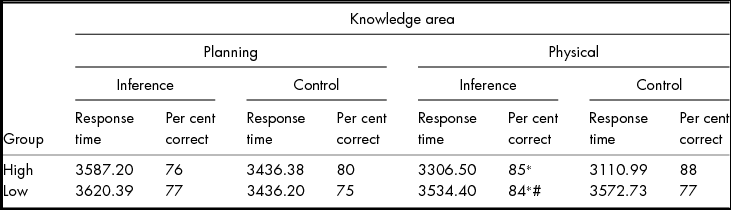
As in the previous study, the errand-planning scores were used to discriminate between High and Low Planners. Participants with scores of 15 or better were grouped together as High Planners (n = 14), and those with scores of less than 15 were grouped together as Low Planners (n = 14). Analyses of variance were conducted separately across groups for mean response times and mean per cent correct answers to knowledge-validating questions for the within-participant factors of knowledge areas (physical vs. planning) and sentence types (inference vs. control). Mean response times and mean per cent correct answers are presented in Table 1. All ANOVA Fs and effect size rs were calculated at p = .05 or less.
Mean Response Times (ms) and Per cent Correct for Knowledge Questions for Control vs. Inference Sentences across Planning and Physical Knowledge Areas for ABI High and Low Planner Groups

* = Physical more accurate than planning answers.
# = Inference more accurate than control sentences.
Knowledge Questions
For High Planners, a main effect of knowledge area, F(1,10) = 4.27, MSE = 20181724.29, r = .547, indicated that faster responses followed physical knowledge questions (3208.74 ms) than planning knowledge questions (3511.97 ms). There were no other main effects or interactions for response time for the High Planners. For Low Planners, there were no significant outcomes for response time.
For High Planners, a main effect of knowledge area, F(1,10) = 9.67, MSE = 1.40, r = .701, indicated that responses to physical knowledge questions (86%) were more accurate than responses to planning knowledge questions (78%). There were no other main effects or interactions in the High Planners’ response accuracy data.
For Low Planners, a main effect of knowledge area, F(1,13) = 3.51, MSE = .594, r = .461, indicated responses to physical knowledge questions (81%) were more accurate than responses to planning knowledge questions (76%). Low Planners also had a main effect of sentence type, F(1,13) = 4.63, MSE = .784, r = .513, indicating that responses following inference sentences (81%) were more accurate than responses following control sentences (76%). There were no other main effects or interactions in the Low Planners’ response accuracy data.
In order to compare performance on knowledge questions between the two planning groups, we examined response times and accuracy separately for the two knowledge areas. These post-hoc analyses revealed no differences between planning groups for planning knowledge. For physical knowledge, a simple main effect of group was found, F(1,24) = 5.73, MSE = .806, r = .439. A simple main effect was also found in response time for physical knowledge questions, F(1,24) = 6.54, MSE = 30182545.52, r = .463. These findings demonstrate that High Planners (86%) were more accurate and faster (3208.74 ms) to answer physical knowledge questions than Low Planners (81% vs. 3553.56 ms).
In sum, results for correct answers to knowledge questions replicated the results of Shears and Gauvain (Reference Shears and Gauvain2015). The main effects for both planning groups indicate more accurate answers to physical knowledge questions. Additionally, while there was no facilitation for correct answers following inference relative to control sentences, High Planners were more accurate for physical knowledge questions than planning knowledge questions. Low Planners demonstrated facilitation for correct responses following inference relative to control sentences, indicating they were able to form physical knowledge-based inferences but not planning knowledge-based inferences.
Probe Word Recognition
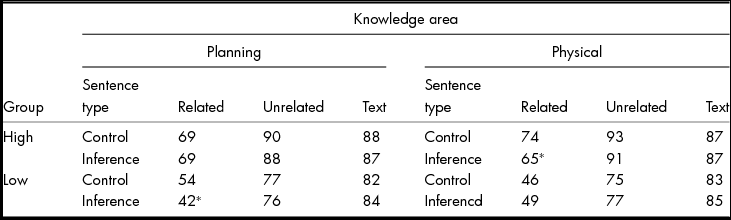
Analyses of variance were conducted separately for ABI planning score (High vs. Low) groups on mean correct response times and mean per cent correct probe word recognition (text vs. unrelated vs. inference-related) for the within-participant factors of knowledge area (physical vs. planning) and sentence type (inference vs. control). Table 2 presents the mean accuracy data for each type of probe word recognition by planning group. All ANOVA Fs and effect size rs were calculated at p = .05 or less.
Mean Correct Recognition for Probe Words (Inference-related vs. Unrelated vs. Text) for Control vs. Inference Sentence Types across Planning vs. Physical Knowledge Areas for ABI High and Low Planner Groups

* = Fewer correct rejections for inference than control sentences.
# = Fewer correct rejections for physical than planning.
For the High Planners there was a main effect of probe type, F(2,10) = 51.61, MSE = 98925088.27, r = .915, indicating that inference-related probes (1765.52 ms) were responded to more slowly than either text probes (1451.66 ms) or unrelated probes (1300.78 ms). There were no other main effects or interactions for High Planners in response times to probe recognitions.
For the Low Planners there was a main effect of probe type, F(2,13) = 8.87, MSE = 27986201.46, r = .637, indicating that inference-related probes (1533.91 ms) were responded to more slowly than either text probes (1331.46 ms) or unrelated probes (1367.52 ms).
We compared response times across knowledge areas and found no difference in probe recognition times between control (1370.15 ms) and inference (1372.15 ms) sentences for planning knowledge, F < 1.00, ns. However, physical knowledge probe recognitions following control sentences (1375.94 ms) were much faster than probe recognitions following inference sentences (1525.61 ms), F(1,13) = 3.97, MSE = 20160249.67, r = .484 (at p < .05).
In sum, the response times for probe recognitions for High Planners are consistent with expectations that inference-related probes take more time for response than either text or unrelated probes. This pattern was also found in the Low Planners' response times. Additionally, Low Planners take significantly more time to respond to probes following physical knowledge inference sentences than planning knowledge texts.
For High Planners, there was a significant main effect of probe type, F(2,10) = 168.78, MSE = 23.04, r = .972, indicating that more incorrect recognitions were made for inference-related probes (69.5%) than for text (87.5%) or unrelated probes (90.5%). There was also a main effect of sentence type, F(1,10) = 6.42, MSE = .876, r = .625, indicating that probes following control sentences (84%) were correctly recognised more than probes following inference sentences (81%). Together these results clearly indicate that High Planners are forming knowledge-based inferences. There were no further interactions for High Planners in the probe recognition accuracy data.
For Low Planners, there was a significant main effect of probe type, F(2,13) = 448.42, MSE = 85.00, r = .986, indicating that more incorrect recognitions were made for inference-related probes (48%) than for text (83.5%) or unrelated probes (76%). There were no other main effects for Low Planners.
A significant three-way interaction involving knowledge area, sentence type and probe type, F(1,13) = 5.31, MSE = 1.00, r = .539 was found in the probe recognition accuracy data for Low Planners. We examined this by knowledge area and found no effect of either sentence type or probe type for physical knowledge, F < 1.00, ns. Low Planners' probe recognition accuracy data revealed that for planning knowledge only, sentence type and probe type interacted, F(1,13) = 9.49, MSE = .010, r = .650. Thus, for planning knowledge control sentences, Low Planners were less able to correctly reject inference-related probes (42%) than inference sentences (54%), F(1,13) = 9.95, MSE = 2.317, r = .658, while there were no differences between planning knowledge control vs. inference sentences for recognitions of either text or unrelated probes, F < 1.00, ns. This result indicates that Low Planners are not forming inferences from either knowledge area.
In sum, High Planners made more false recognitions of inference-related probes following inference relative to control sentences, indicating that High Planners were making inferences, and there was no difference between knowledge areas in these inferences, as we found in our earlier study. Contrary to our earlier study, Low Planners were unable to form inferences from either knowledge domain as measured by probe recognitions.
Discussion
The errand-planning task scores predicted better comprehension of planning knowledge for High Planners than Low Planners, as measured by the ability to form knowledge-based inferences from a simple reading comprehension task. Replicating our prior study, the errand-planning task scores (high above 15, low below 15) accurately predicted that the inference process for physical knowledge was intact for survivors, but only High Planners formed inferences for planning knowledge. Low Planners demonstrated the ability to form inferences in their facilitated answers to physical knowledge questions, but were unable to form planning inferences, whether measured by knowledge questions or probe recognition. High Planners demonstrated inference processes in their probe data, and again there were no differences between knowledge areas. These results confirm the prediction, based on the errand-planning task scores, that High Planners would be relatively unimpaired at inference processes from planning knowledge. However, Low Planners, whose earlier probe data suggested they may be making some planning knowledge-based inferences, failed to show evidence of inference formation from either knowledge domain, as measured by probe recognitions.
Consistent with findings from our first experiment, survivors of brain injury, regardless of their errand-planning score, were more accurate for physical knowledge questions than for planning knowledge questions. High Planners did not demonstrate facilitation for correct answers following sentences requiring inferences from either knowledge area. However, Low Planners did demonstrate facilitation for correct answers following physical inference sentences. Thus, findings across the two experiments indicate that the ordering of the inference measures (probes versus questions) does not impact outcomes for facilitation of knowledge questions in survivors of brain injury.
It is possible that answering questions requires more resources than are available to the ABI participants. However, because ABI Low Planners demonstrated facilitation of correct answers for physical knowledge questions, this result more likely indicates the accessibility of physical knowledge relative to planning knowledge. Because both groups (High and Low Planners) demonstrated inference processes through probe recognition data for physical knowledge, it seems more likely that the findings reported here reflect knowledge area differences and, importantly, indicate that the inference process itself is intact. This finding also provides evidence that use of simple narrative texts, based on actions that are goal-directed, may be useful in cognitive retraining efforts. If survivors are able to form physical knowledge inferences, they may be trained to employ these causal relation skills for planning knowledge.
Finally, it is important to consider what these findings may mean to survivors. This is the fastest growing disabled population in the United States today, with over 1 million persons becoming brain injured per year. This research has potential applications to develop a retraining curriculum that may enable more of these survivors to return to their lives and participate in our society productively. Our earlier study indicates that the errand-planning task is a useful assessment of the comprehension, rather than enactment, of planning knowledge. The current study replicates the usefulness of the errand-planning task as a measure of planning comprehension, by showing that those survivors who score 15 or above are able to form the requisite inferences to support comprehension of plans, while those survivors scoring below 15 are impaired at the inference process for planning knowledge, but not physical cause-and-effect knowledge. Further, the Low Planner group data reported here demonstrated that the inference process itself was not impaired by measures of inference-related probe recognition tasks. This information provides a strategy for rehabilitation that individually focuses retraining efforts on comprehension of goal states. If comprehension of planning involves the flexibility to assess given states (sub-goals) in relation to a super-ordinate goal, this is similar to the inference process, which requires constructing a causal link between ongoing situations. Our data show that the inference process is intact in these survivors; therefore the potential for retraining of the comprehension of planning knowledge is viable.
Acknowledgements
The first author thanks the students, faculty and staff of Coastline Community College Acquired Brain Injury Cognitive Retraining Program for their generous donation of time and support of this research.
Financial Support
This research received no specific grant from any funding agency, commercial or not-for-profit sectors.
Conflict of Interest
None.
Ethical Standards
The authors assert that all procedures contributing to this work comply with the ethical standards of the relevant national and institutional committees on human experimentation and with the Helsinki Declaration of 1975, as revised in 2008.