Chronology is the foundation of the field of archaeology. Without an underlying understanding of the time frame in which ancient groups lived, it becomes impossible to draw conclusions about how past cultures developed and interacted. For this reason, it is important to update long-established chronologies with new data. In Mesoamerica, after years of relying on chronologies developed by early archaeologists, we are going back to the drawing board. With the benefit of modern excavation techniques and improved absolute dating methods, several critical chronologies and their associations with neighboring regions are currently being tested (Bachand Reference Bachand2008; Ball Reference Ball2014; Cowgill Reference Cowgill2015; Inomata et al. Reference Inomata, Ortiz, Arroyo and Robinson2014). Recent changes and refinements often have great implications for the cultural processes these chronologies were once used to support.
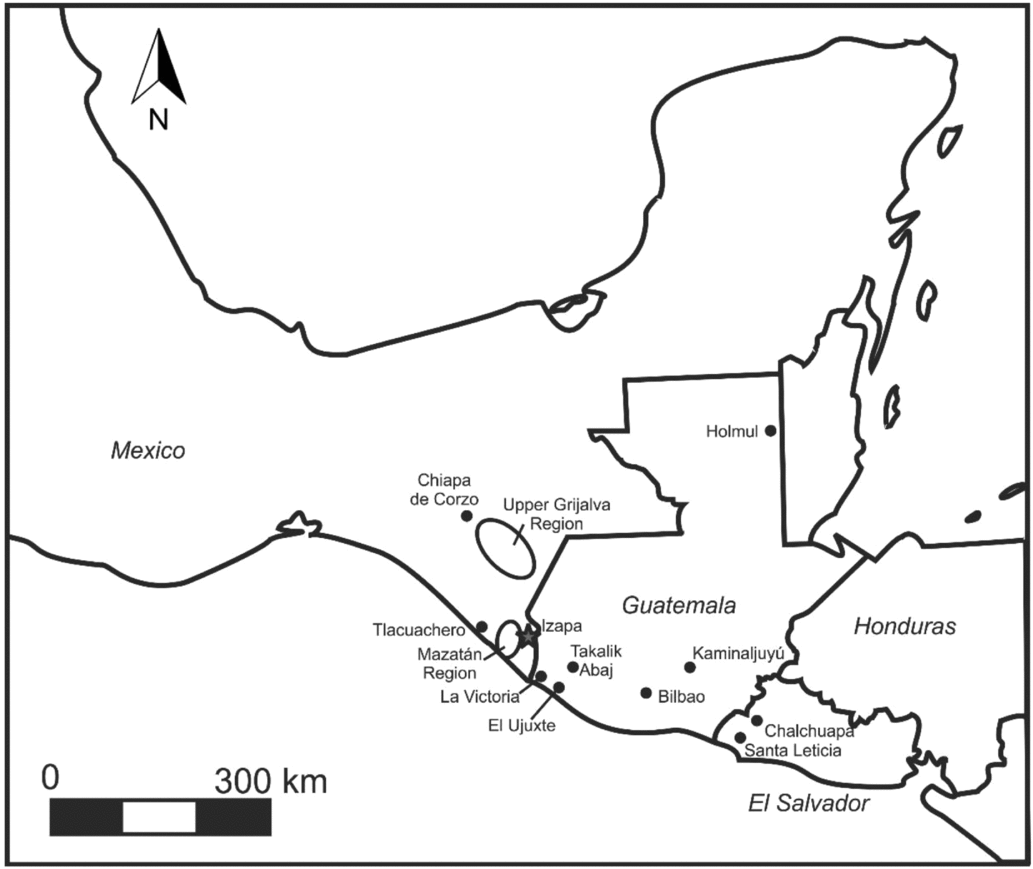
The chronology of Izapa, an early urban center located on the southern Pacific coast of Mexico (Figure 1; Love Reference Love2007), is an example of one long-standing chronology that has received little modification since its establishment. The site is best known as the home of the “Izapan” art style (Guernsey Reference Guernsey2006; Lowe et al. Reference Lowe, Lee and Martinez Espinoza1982). Both the site of Izapa and its characteristic art style have often been hailed as a critical link between the Olmec and the Maya cultures (e.g., Coe Reference Coe1962:100). Although the art of Izapa has received much attention, the archaeology of the site has lagged behind many regions of Mesoamerica. The ceramic chronology for Izapa was developed by Gareth Lowe following his excavations with the New World Archaeological Foundation (NWAF) in the 1960s (Lowe et al. Reference Lowe, Lee and Martinez Espinoza1982) and has received little modification since (but see Lowe et al. [Reference Lowe, Ekholm and Clark2013] for minor changes).
Regional map with sites mentioned in the text.

In contrast, the neighboring city of Kaminaljuyu, another early urban center that shared the Izapan art style, has recently undergone a major chronological revision by Inomata and colleagues (Reference Inomata, Ortiz, Arroyo and Robinson2014). They propose that parts of the ceramic chronology of Kaminaljuyu, and other linked chronologies, must be shifted forward in time by approximately 300 years. Because Kaminaljuyu and Izapa share similar monuments, one question raised by the study was whether or not the chronology of Izapa and its associated monument production needs to be shifted to correspond with the now later date for the Kaminaljuyu monuments (Inomata and Henderson Reference Inomata and Henderson2016).
As part of their proposal, Inomata and colleagues point out that a comparable change in ceramic chronology at Izapa could indicate that Izapa succumbed to the same patterns of rise and fall as sites like Kaminaljuyu (Inomata et al. Reference Inomata, Ortiz, Arroyo and Robinson2014:398–399). During their discussion of ceramic cross-dating with other regions, they raise the possibility that the Guillen phase at Izapa, the period in which Izapan low relief monuments were reportedly erected (Lowe et al. Reference Lowe, Lee and Martinez Espinoza1982), currently dated to 300–100 BC (Lowe et al. Reference Lowe, Ekholm and Clark2013), should be shifted later in time, to after 100 BC. Inomata and colleagues observe that ceramics for the Guillen phase share similar everted rim forms with Istmo/Ix phase vessels of Chiapa de Corzo and the Upper Grijalva region, which date to approximately AD 100–250 (Inomata et al. Reference Inomata, Ortiz, Arroyo and Robinson2014:398–399). They also point to changing censer styles as another possible means of dating the monuments, observing that spiked censers, which Lowe (Reference Lowe1965) dates to the Guillen phase at Izapa, date to the “early Protoclassic” period in neighboring regions (Inomata et al. Reference Inomata, Ortiz, Arroyo and Robinson2014:399). Finally, Inomata and colleagues raise the possibility that Burial 30e-1, an interment previously dated to the Frontera-Guillen transition at Izapa (Lowe et al. Reference Lowe, Lee and Martinez Espinoza1982:129, Figure 7.9), contains “early Protoclassic” features such as a spiked censer and a vessel with nubbin feet (Inomata et al. Reference Inomata, Ortiz, Arroyo and Robinson2014:399). They propose that this burial may, in fact, date to after 100 BC. Inomata and colleagues (Reference Inomata, Ortiz, Arroyo and Robinson2014) propose that, when taken together, these observations may necessitate a later beginning to the Guillen phase in the Izapa chronology.
If Inomata and colleagues’ (Reference Inomata, Ortiz, Arroyo and Robinson2014) proposed changes to the Izapa ceramic chronology were correct, the famous Izapan tradition of low relief monuments would not represent the stylistic bridge between Olmec and Maya cultures frequently attributed to them. Izapa would, instead, be one of many sites where low relief sculpture depicting images of divine rulers were adopted at this time. Moreover, if the chronology is correct, residents of Izapa may have emerged as early leaders in the practice of erecting stone stelae and altar pairs. Would a revised chronology at Izapa suggest the same patterns of growth and decline as other centers in the “Southern Maya area” (Love and Kaplan Reference Love and Kaplan2011)? Or is it unique?
Here, new data are presented from deposits at the southern periphery of Izapa recovered in 2014 by the Izapa Household Archaeology Project (IHAP). The IHAP excavations represent the first screened excavations of a peripheral zone at the site. They provided the unexpected opportunity to test the chronology of the Formative to Classic period transition at Izapa (100 BC–AD 400). Ceramic cross-dating, AMS dates, and Bayesian statistical analysis suggest that the original chronology proposed by Lowe and colleagues (Reference Lowe, Lee and Martinez Espinoza1982, Reference Lowe, Ekholm and Clark2013) is still supported with data from recent excavations. The project also drew attention to a problematic portion of the Izapa chronology. The lack of definition for non-offering ceramics of the Terminal FormativeFootnote 1 and Early Classic periods initially led to difficulty documenting Hato (100 BC–AD 100), Itstapa (AD 100–250), and Jaritas (AD 250–400) phase occupation outside the site core. This problem was resolved over the course of the project by using ceramic cross-dating. Clark's analysis of the nearby Mazatán materials (Clark and Cheetham Reference Clark, Cheetham, Merrino Carrión and García Cook2005) proved particularly helpful for identifying local Terminal Formative ceramics at Izapa.
Results support Lowe and colleagues’ (Reference Lowe, Lee and Martinez Espinoza1982, Reference Lowe, Ekholm and Clark2013) dating for the Hato and Jaritas phases, which anchor the Izapa chronology for the Formative to Classic period transition. Inomata and colleagues’ (Reference Inomata, Ortiz, Arroyo and Robinson2014) proposal that the ceramics of the Guillen phase should be pushed forward in time is rejected. Ceramic cross-ties between the Hato phase at Izapa and the Verbena phase at Kaminaljuyu, however, appear to support Inomata and colleagues’ (Reference Inomata, Ortiz, Arroyo and Robinson2014) revision for the chronology of Kaminaljuyu. Results suggest that residents of Izapa participated in a widespread ceramic horizon from 100 BC–AD 100. The correlation between this horizon and the spread of the stelae-altar tradition, however, remains unclear.
A Brief History of the Izapa Chronology
The first excavations attempting to date Izapa were undertaken by Philip Drucker in 1947. Drucker excavated test pits in peripheral areas of the site, searching for unmixed ceramic deposits to place the site into a chronological sequence (Drucker Reference Drucker1948). He noted the abundance of plumbate and coarse-paste brown and black wares at the site but concluded that the temporal placement of Izapa could not yet be defined.
The bulk of the archaeological research undertaken at Izapa was conducted in the 1960s by NWAF, directed by Gareth Lowe. The NWAF team meticulously mapped the site and conducted extensive excavations between 1961 and 1965. This research culminated in their 1982 site report (Lowe et al. Reference Lowe, Lee and Martinez Espinoza1982), which, while comprehensive, was intended to be a preliminary summary of the excavation data.
Of particular importance from the NWAF project at Izapa was the establishment of a ceramic chronology for the site. The Formative period ceramics (1900–100 BC) for Izapa were analyzed by Ekholm (Reference Ekholm1969) and Lowe (Lowe et al. Reference Lowe, Ekholm and Clark2013). The “Post-Formative” sequence at Izapa included all periods of occupation after the depopulation of the monumental core, the Itstapa through Remanso phases (AD 100–1000). It was documented by Lee (Reference Lee1973, n.d.) for the northern center, Group F.
The missing piece of the Izapa chronology, the Hato phase, was defined by Lowe (Reference Lowe1993; Lowe et al. Reference Lowe, Lee and Martinez Espinoza1982:135–147), who published the details of eight Hato phase urn burialsFootnote 2 and associated offerings recovered from Group B. Although intrusive, the varied depths of these deposits and the temporally diagnostic forms and decorative motifs of the accompanying vessels were used to define early and late subphases of the Hato phase ceramic complex (Lowe et al. Reference Lowe, Lee and Martinez Espinoza1982:135–147). Lowe and colleagues (Reference Lowe, Lee and Martinez Espinoza1982:139, 194) cited the introduction of this urn burial custom and the associated interment of foreign ceramics as evidence for a major cultural shift, and possible conquest, at Izapa. They observed that this Hato phase shift was also accompanied by the interruption of building in the monumental center, initiation of construction activities in a new center to the north (Group F), and a cessation of the erection of stone monuments.
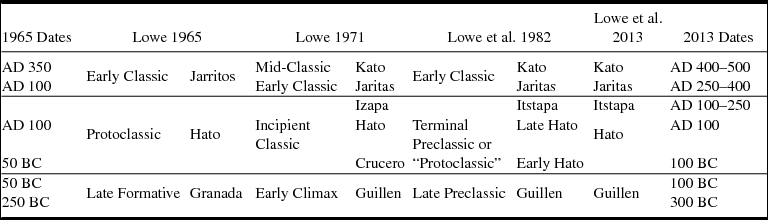
To tie the Izapa chronology to other chronologies of Mesoamerica, Lowe applied a horizon approach, searching for imported vessels and ceramic horizon markers at the site. This was first developed in the form of a working chart (Mendelsohn Reference Mendelsohn2017:Table 3.1), where Lowe plotted important excavation contexts, their associated horizon markers, local pottery wares, and suggested dates. This initial chart was developed in 1965, before the 14C dates were returned. By the time the 1982 Izapa report was produced, Lowe had further refined this sequence (Table 1; Lowe et al. Reference Lowe, Lee and Martinez Espinoza1982:Table 9.1).
Evolution of Gareth Lowe's Izapa Chronology.

Of importance for the present discussion is the fact that no “typical Izapa pottery” was defined for the Terminal Formative Hato phase in the original 1965 chart (Mendelsohn Reference Mendelsohn2017:Table 3.1) or in subsequent publications (Lowe Reference Lowe1993; Lowe et al. Reference Lowe, Lee and Martinez Espinoza1982, Reference Lowe, Ekholm and Clark2013). The definition of both early and late components of the Hato phase ceramic complex were developed based on the urn burials and their imported mortuary offerings in Mound 30d (Lowe Reference Lowe1993). The cultural changes reported for the Terminal Formative period at the site had, therefore, been developed on the basis of ceramics from these offerings contexts alone.
Clark and Cheetham (Reference Clark, Cheetham, Merrino Carrión and García Cook2005) have since expanded on Lowe's chronology with updated ceramic descriptions for the Early through Terminal Formative periods. Their ceramic descriptions included materials recovered from recent projects, including Clark's survey of the Mazatán region, which allowed for a more expansive definition of Hato and Itstapa phase ceramics in the Soconusco region. The recent publication of unfinished manuscripts on Izapa excavations (Clark and Lee Reference Clark and Lee2013; Lieske Reference Lieske2013; Lowe et al. Reference Lowe, Ekholm and Clark2013; Navarrete Reference Navarrete2013) have provided additional details about the Formative to Classic period transition at Izapa. Clark (Lowe et al. Reference Lowe, Ekholm and Clark2013) has also updated the Izapa chronology slightly to reflect updates to other nearby chronologies (see Table 1). These updates are accepted here and referenced throughout the text.
After a hiatus, excavations at Izapa resumed in the 1990s. Hernando Gómez Rueda (Reference Gómez Rueda, Pedro Laporte and Escobedo1995) used targeted excavations to investigate the hydraulic system at Izapa. More recently, Robert Rosenswig has resumed work at the site, initiating his Izapa Regional Settlement Project (IRSP) in 2011. Understanding of Izapa has benefited greatly from Rosenswig's detailed maps generated by light detection and ranging (lidar) imaging, settlement data, and screened excavations in the site center (Rosenswig et al. Reference Rosenswig, López-Torrijos, Antonelli and Mendelsohn2013, Reference Rosenswig, Mendelsohn, Antonelli, Lieske and Núñez Cortés2014). As a better understanding of the ceramics for the first millennium AD has been developed, survey results have been updated (Rosenswig and Mendelsohn Reference Rosenswig and Mendelsohn2016).
The Izapa Household Archaeology Project (IHAP)
IHAP was initiated in 2014 in an attempt to document Formative period domestic occupation at the site. Mounds selected for excavation were chosen from the lidar map and were based on surface collections from the IRSP (Rosenswig et al. Reference Rosenswig, López-Torrijos, Antonelli and Mendelsohn2013). They included two previously unmapped mounds in the southern sector of Izapa, Mounds 255 and 260 (Figure 2).
Map of the study zone. Excavation units are indicated as black rectangles. Contour map created by the New World Archaeological Foundation (Lowe et al. Reference Lowe, Lee and Martinez Espinoza1982:Inset). Lidar maps provided by the Izapa Regional Settlement Project (Rosenswig et al. Reference Rosenswig, López-Torrijos, Antonelli and Mendelsohn2013).

The IHAP excavation methodology followed many of the same techniques used during the 2012 IRSP excavations in the monumental center of Izapa (Rosenswig et al. Reference Rosenswig, Mendelsohn, Antonelli, Lieske and Núñez Cortés2014). Excavation units were placed on the flanks of mounds in places where middens might be expected. On-mound units were 1 × 3 m long. Off-mound units were 1 × 2 m long. Exceptions included units that were opened as extensions to better explore features uncovered in adjacent units (e.g., Suboperations 104c and 105c). Excavations were conducted in arbitrary 10 cm levels unless cultural features were detected.
Although the goals of the project had been to investigate changes in domestic refuse during the Middle Formative to Late Formative urbanization of Izapa, it quickly became apparent that southern neighborhoods at Izapa were also occupied during the Terminal Formative and Classic periods. Though no primary deposits of the Middle and Late Formative periods (850–100 BC) were discovered, the recovery of deposits associated with the Hato (100 BC–AD 100), Itstapa (AD 100–250), and Jaritas (AD 250–400) phases provided an unexpected opportunity to update our understanding of the ceramic chronology of the Formative to Classic period transition at Izapa.
Excavations at Mound 255
Mound 255 was a 2 m high mound located south of the site's monumental core (Figure 2). Excavations at Mound 255 revealed two offerings atop the mound associated with the Hato and Jaritas phases. The three on-mound test pits and their associated materials revealed that Mound 255 had been constructed during the Hato phase. The nearby off-mound unit, Suboperation 104e, revealed evidence of Itstapa phase occupation. Excavations at Mound 255 were significant, as they identified deposits that helped to better define the poorly understood ceramic complexes of the Hato and Itstapa phases. These finds indicated that construction activity continued at Izapa during the Terminal Formative period in zones outside of Group F, a surprising outcome of the project.
Horizontal Excavations at Mound 255
Excavations atop Mound 255 yielded two ceramic offerings, both at the northern side of the mound, in Suboperation 104a. The first offering consisted of a thin-walled jar recovered at the southern end of the unit, immediately west of a rectangular arrangement of irregularly shaped cobbles. The stones sat atop several levels (Levels 2–4) of very compact soil, possibly representing a tamped earth floor. The jar was recovered slightly embedded into this layer, suggesting that the pot, or at least its base, had been deposited intrusively into a floor. Thin-walled offering jars with similar forms and incised designs have been recovered elsewhere at Izapa. Lowe and colleagues (Reference Lowe, Lee and Martinez Espinoza1982:145, Figure 7.19) classified these as intrusive offerings.
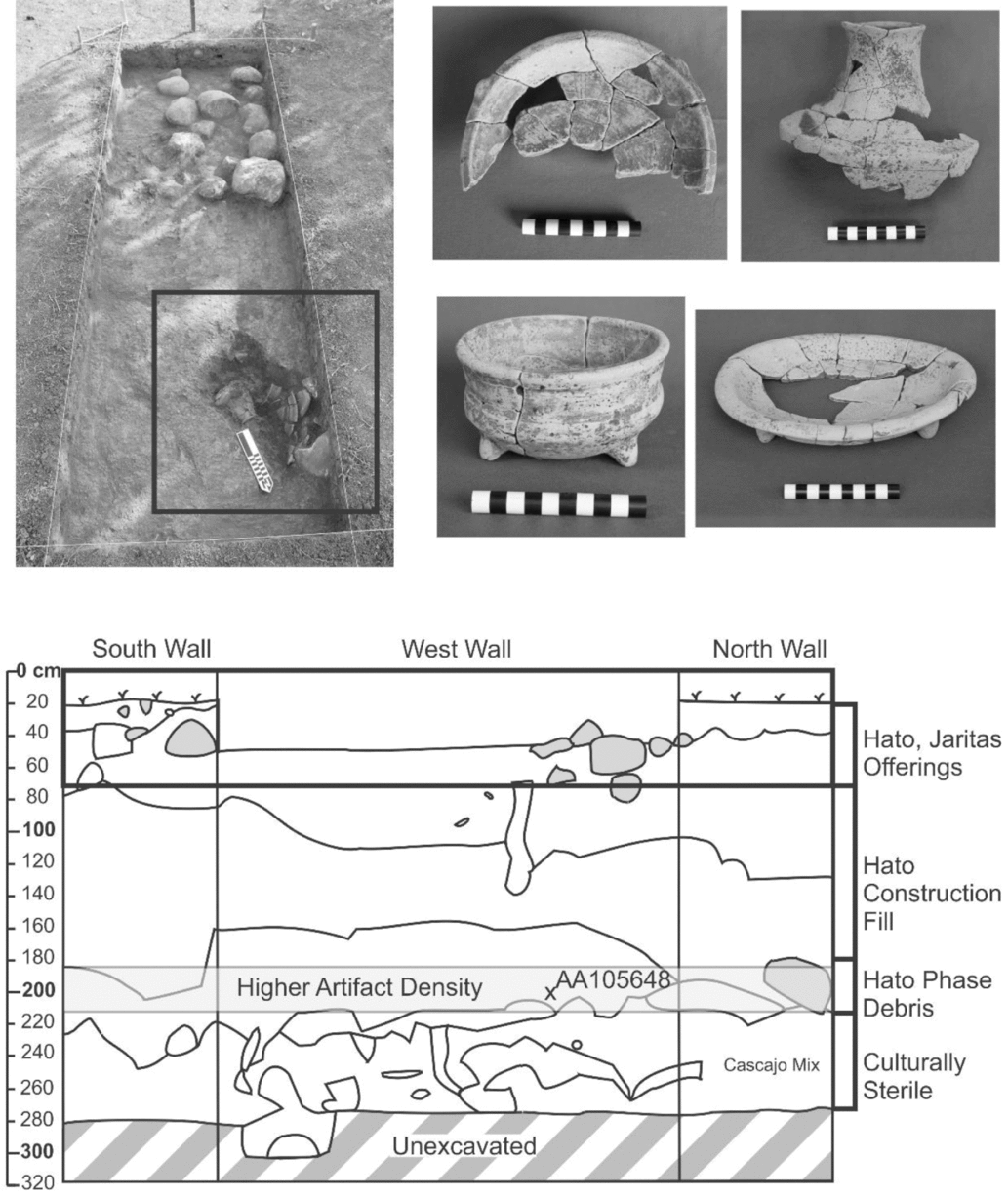
The second Mound 255 offering was encountered at the northwest end of the unit, immediately east of a line of six stones (Figure 3). This feature consisted of four complete or nearly complete vessels and one large decorated sherd. These pots were recovered embedded in a layer of packed earth, suggesting that they had been deposited intrusively. An additional 2 × 3 m horizontal exposure (Suboperation 104c) was opened to the west in an attempt to better define these offerings and stone alignments. Horizontal exposure revealed two additional alignments of stone, each at different orientations from the stone rectangle in Suboperation 104a. The function of these offerings and stone alignments is currently unknown. The vessels may represent a dedicatory offering from the close of construction of Mound 255. It is also possible that these vessels were burial goods, associated with a skeleton that has since disintegrated (see Mendelsohn [Reference Mendelsohn2017] for discussion of this possibility).
Horizontal excavations showing stone feature and Hato phase ceramic offering recovered atop Mound 255 (top). Stratigraphy of Mound 255 as seen through the vertical excavations in Suboperation 104a (bottom).

Vertical Excavations at Mound 255
Vertical excavations at Mound 255 helped to reveal the construction sequence of the mound and recovered Hato phase debris at the base of the mound. Both the ceramic and stratigraphic evidence of Mound 255 suggest that the mound was built to its full height in the Hato phase.
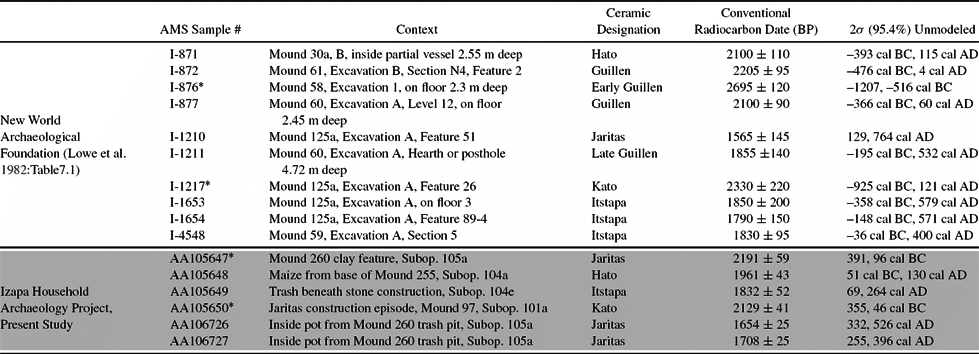
Excavations at Mound 255 revealed a layer of debris at the base of the mound documented in two vertical excavation units. This layer, approximately 30 cm thick, was identified as domestic debris based on the artifacts encountered. These included figurine and ground stone fragments and larger sherds. In Suboperations 104a and 104d, this included Levels 18–20. Flotation samples were taken near large ceramics and burned areas throughout this layer. AMS sample AA105648, a carbonized fragment of a maize cob, was recovered from one such flotation sample. Its approximate location of discovery has been plotted on the profile in Figure 3. This AMS sample yielded a 2σ range of 51 cal BC–130 cal AD (Table 2), suggesting a Hato phase date. The range of the date, however, allowed for the possibly of a late Guillen or early Itstapa phase date for the deposit. Ceramic analysis revealed that ceramics from this layer were predominantly associated with the Hato phase (see below).
AMS Dates from Carbon Recovered from the Izapa Household Archaeology Project and New World Archaeological Foundation Excavations (Lowe et al. Reference Lowe, Lee and Martinez Espinoza1982:Table 7.1).

* Indicates samples that likely represent old carbon.
The discovery of maize dating to this range, as well as the discovery of Hato phase ceramics at the base of the mound, indicates that Mound 255 could not have been constructed earlier than the Hato phase. The presence of offering vessels atop the mound also dating to the Hato phase indicates that mound construction was also completed by this time. Together, these data indicate that Mound 255 was constructed to its full height of approximately 2 m during the Hato phase. This was a surprise, as results from the NWAF project suggested a period of disruption at the site during the Hato phase. Lowe and colleagues (Reference Lowe, Lee and Martinez Espinoza1982:139) originally projected that all occupation activity had shifted north, to Group F, by this time.
Off-Mound Excavations: Suboperation 104e
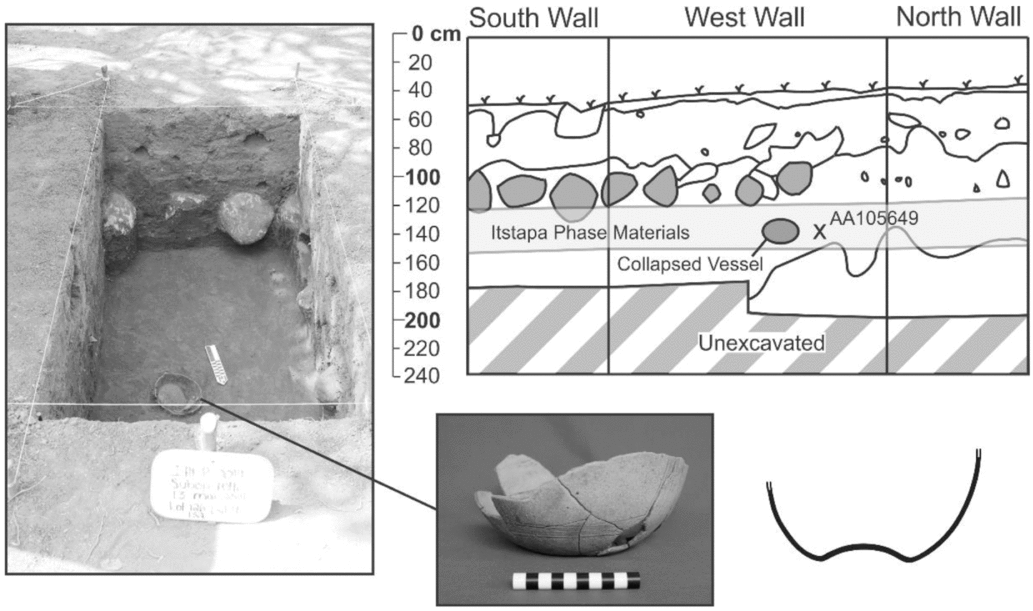
Another excavation unit was placed south of Mound 255 to test for off-mound occupation (see Figure 2). This unit revealed signs of construction activity as well as a layer of domestic debris atop a layer of compact soil, which may have been associated with a floor. Excavations at Suboperation 104e began with the recovery of a concentration of large irregular stones at the southern end of the unit (Figure 4). These stones were likely the remnants of stone architecture (Mendelsohn Reference Mendelsohn2017). Subsequent excavations beneath these stones revealed a 30 cm deposit (Levels 8–10) with large sherds. The recovery of large and nicely preserved sherds with fewer earlier materials suggests a trash deposit for this stratum, beneath the construction.
Stratigraphy of the off-mound unit Suboperation 104e, south of Mound 255, with the collapsed vessel recovered from this unit. Photographs and profile drawing are by the author. Vessel profile drawing by Roberto Hoover Silvano.

Among the large ceramic pieces recovered from this layer was the lower half of a vessel collapsed in situ (Figure 4). This vessel was recessed slightly into a layer of compact soil. The significance of this compact soil was not noted at the time of excavations but was reassessed following the ceramic analysis. Materials from Levels 8–10 appeared to represent distinct ceramic complexes from materials recovered from below Level 10. In hindsight, this compact layer may have represented a tamped dirt floor.
The dating for this deposit was initially unclear. Ceramic analysis revealed that materials recovered from this unit were different than those recovered from both Mounds 255 and Mound 260. Here, an AMS date helped to place the deposit. The Suboperation 104e carbon (AA105649) came from a flotation sample that was taken in association with one of the large ceramic sherds in the Level 8–10 deposit. Its approximate location has been plotted on Figure 4. Carbon recovered from this sample (AA105649) yielded a 2σ range of cal AD 69–264. This range predominantly spans the Itstapa phase, which Lowe and colleagues (Reference Lowe, Lee and Martinez Espinoza1982, Reference Lowe, Ekholm and Clark2013) place from AD 100–250. It might also represent the end of the Hato phase or the beginning of the Jaritas phase. Given the associated AMS date and the absence of similar coarse-incised sherds from other units on Mound 255 or Mound 260, an Itstapa phase assignment for these ceramics appears most appropriate at present (see below).
Excavations at Mound 260
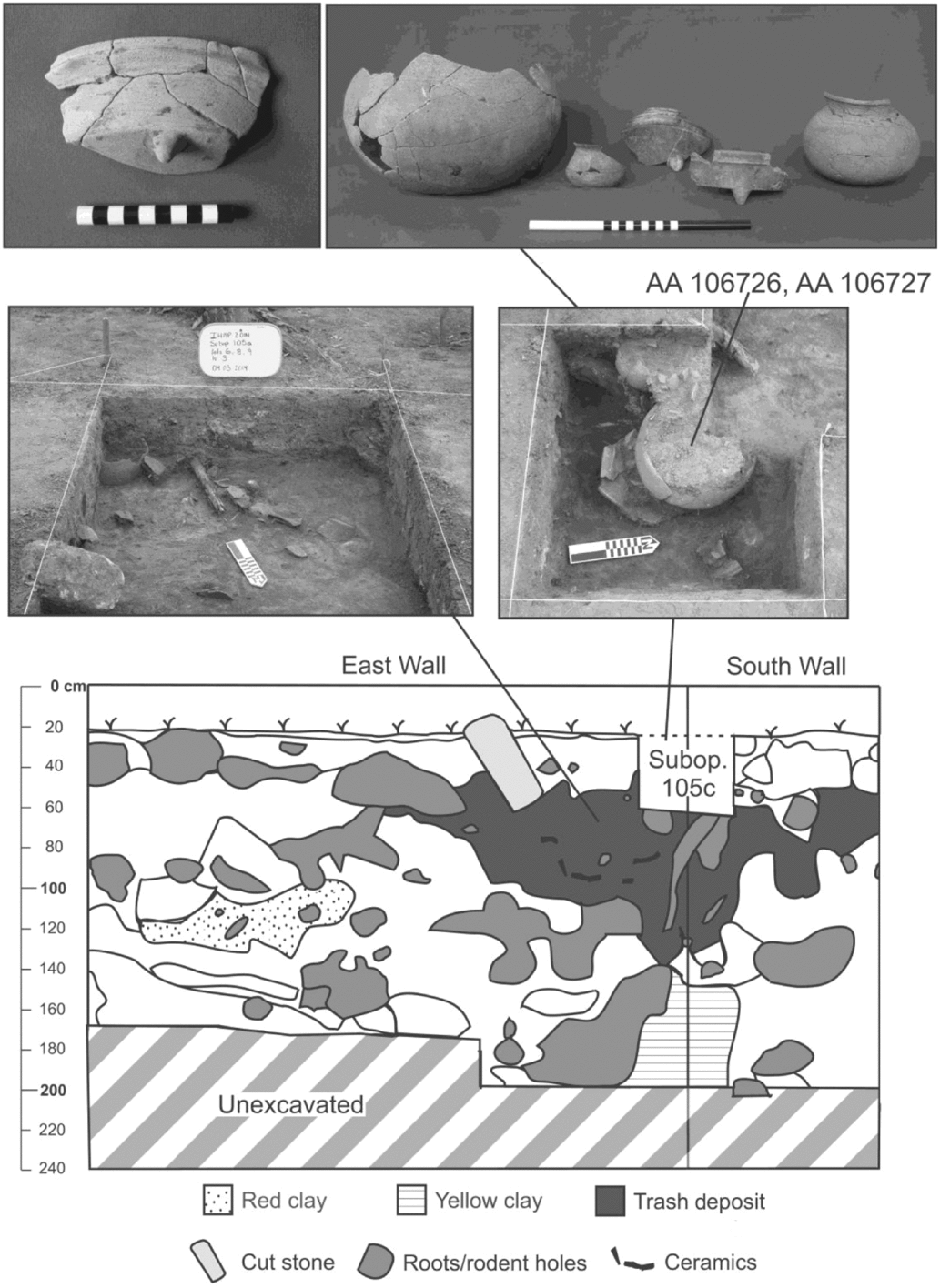
Mound 260 is a low, 1 m high mound located southwest of the monumental core and west of Mound 255 (Figure 2). On-mound excavations at Mound 260 revealed two of the best deposits of domestic debris recovered by IHAP. The northern unit of the Mound 260 excavations, Suboperation 105a, yielded both a trash pit and a fired clay feature of unknown function (see Mendelsohn [Reference Mendelsohn2017] for discussion of the latter). Ceramics from these deposits were uniformly associated with the Jaritas phase. Stratigraphy from Mound 260 (Figure 5) indicates that the mound was both constructed and occupied exclusively during the Jaritas phase (AD 250–400).
Two views of the Mound 260 trash pit during excavation (center) and several of the reconstructed vessels (top) assigned to the Jaritas phase. The location of this feature is shown in the profile of Suboperation 105a (bottom).

The trash pit in Suboperation 105a revealed the most complete utilitarian ceramics recovered by IHAP. The presence of a trash deposit was first revealed when large sherds were excavated along the southern end of the unit (Figure 5). By Level 3, a large, intact vessel was detected at the southeast corner of the unit and a 40 × 65 cm extension (Suboperation 105c) was opened to recover it (Figure 5). This excavation yielded the recovery of five complete and nearly complete vessels. The fragmentary nature of the vessels encountered, their positions at various depths in the soil matrix, and the recovery of large pieces inside the large vessel suggested that this was a trash deposit rather than an offering. The recovered ceramics match those described and illustrated for the Jaritas phase at Izapa (Lee Reference Lee1973, n.d.; Lowe et al. Reference Lowe, Lee and Martinez Espinoza1982:144–147). Carbon samples recovered during the flotation of soil from inside the large vessel (Figure 5) yielded 2σ ranges of 332–526 cal AD (AA106726) and 255–396 cal AD (AA106727), corroborating this Jaritas phase assignment (Table 2).
Ceramics of the Formative to Classic Period Transition
These ceramic deposits recovered by IHAP drew attention to gaps in knowledge in the Izapa ceramic sequence. It quickly became apparent that the several phases of the Terminal Formative and Early Classic periods had been established solely on the basis of offerings and ritual refuse. Hato and Itstapa phase occupation, in particular, could not be identified outside of the ceremonial centers, as local ceramics had not yet been defined for these periods. The aims of the IHAP ceramic analysis needed to be reoriented toward a definition of local ceramics for the Hato, Itstapa, and Jaritas phases. In this pursuit, Clark and Cheetham's (Reference Clark, Cheetham, Merrino Carrión and García Cook2005) publication on the Terminal Formative ceramics from the nearby Mazatán region were an important resource.
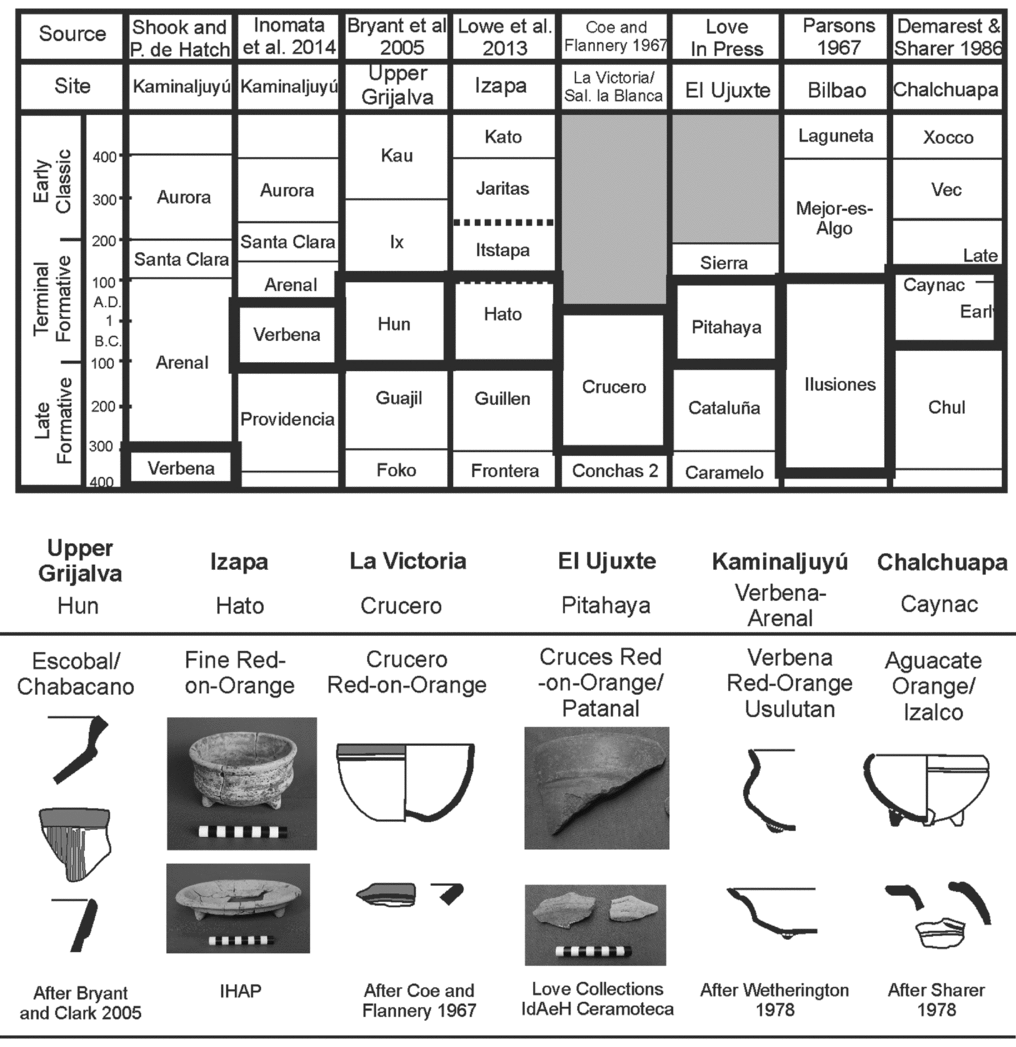
While AMS dates from the deposits were helpful as one line of evidence, their ranges left open some level of ambiguity for the contexts, because the 2σ range usually overlapped with a previous or subsequent phase. Ceramic cross-dating was of considerable utility, narrowing down the ranges for these unidentified ceramic wares. The cross-dating revealed that the local Hato phase ceramics at Izapa were associated with the same widespread ceramic horizon that had been used by Lowe to identify the imported Terminal Formative vessels from the Mound 30d urn burials and to anchor the chronology of the Formative to Classic period transition (Figure 6). The Jaritas phase materials had also been well defined by Lee (Reference Lee1973) and were easily identifiable in excavations. The results, however, raised questions regarding which sherds were meant to constitute the Itstapa phase ceramic complex.
Ceramic cross-dating of the IHAP Hato phase ceramics. Photographs and chronology are by the author. Drawings of ceramics are by the author, after images published in the works cited.

The Hato Ceramic Complex
The Mound 255 vessels included plates with shallow everted rims and three solid conical (nubbin) supports. Many Hato phase ceramics from the Mound 255 offering, occupation layer, and fill had short everted rims that sometimes contained scalloped (or pie crust) modeling. Another common form was the hemispherical bowl with an externally thickened rim and nubbin supports. The clearest examples of Hato sherds included these forms with red-on-orange decoration, where red was often restricted to the rim/lip. The vessels recovered from the Mound 255 offering shared a very fine, almost kaolin-like, white paste with a very fine black or dark gray core.
Cross-dating of Hato ceramics was relatively straightforward due to the many traits, like nubbin feet, fine pastes, red-on-orange decoration, and common vessel forms associated with the early Terminal Formative period across southern Mesoamerica (Figure 6). These correlations helped to support the Hato ceramic complex as temporally distinct from the Guillen phase and to place it at the beginning of the Terminal Formative period. Hato phase ceramics from Izapa cross-dated nicely with other assemblages containing early Terminal Formative markers, including the Verbena phase at Kaminaljuyu, the Early Caynac phase at Chalchuapa, and the Hun phase in the Upper Grijalva region. These associations were aided by Inomata and colleagues’ (Reference Inomata, Ortiz, Arroyo and Robinson2014:Figure 4) correlations of ceramics for this time period and were confirmed by personal observations of collections from Chiapas, Mexico; Guatemala; and El Salvador. For a full review of the cross-dating for the Hato through Jaritas phases, readers are referred to Mendelsohn (Reference Mendelsohn2017).
The Jaritas Ceramic Complex
The Jaritas ceramic complex at Izapa was well defined during the NWAF excavations through offerings in Group B (Lieske Reference Lieske2013; Lowe et al. Reference Lowe, Lee and Martinez Espinoza1982) and Group F (Lee Reference Lee1973, n.d.). Because of the “local character” of the Jaritas phase offerings (Lowe et al. Reference Lowe, Lee and Martinez Espinoza1982:145), these materials were easily identified during the IHAP excavations. For detailed descriptions of Jaritas phase materials, readers are referred to Lee (Reference Lee1973, n.d.) and Lowe and colleagues (Reference Lowe, Lee and Martinez Espinoza1982:145–147).
The deposits from Mound 260 helped to determine that Jaritas phase ceramics include vessels with labial and sublabial ridges or flanges and a red wash, with solid conical feet. Jaritas phase ceramics are also identified by their thin-walled jars, containing rims with “droopy” labial ridges and interior grooves. These are often decorated with parallel wavy lines, or the “sine” motif, on the neck. They also include thin vessels with incised geometric designs, as opposed to the coarse-incised vessels with thicker walls that appear to be common for the Itstapa phase. Vessels with both incised designs and very fine paste (otherwise Itstapa and Hato diagnostics, respectively) are also associated with the Jaritas phase. As Lowe and colleagues observed, ceramics associated with the Jaritas phase represent a local tradition with few links to outside areas (Lowe et al. Reference Lowe, Lee and Martinez Espinoza1982:145). The closest similarities observed for the Jaritas phase ceramics from Izapa were with Early Classic ceramics from the western Soconusco region, including Voorhies's (Reference Voorhies1976:116–132) excavations at Tlacuachero and Pfeiffer's (Reference Pfeiffer1983:Vol. I 224, Vol. II 224–246) project at Rio Arriba.
Somewhere In Between: The Itstapa Ceramic Complex
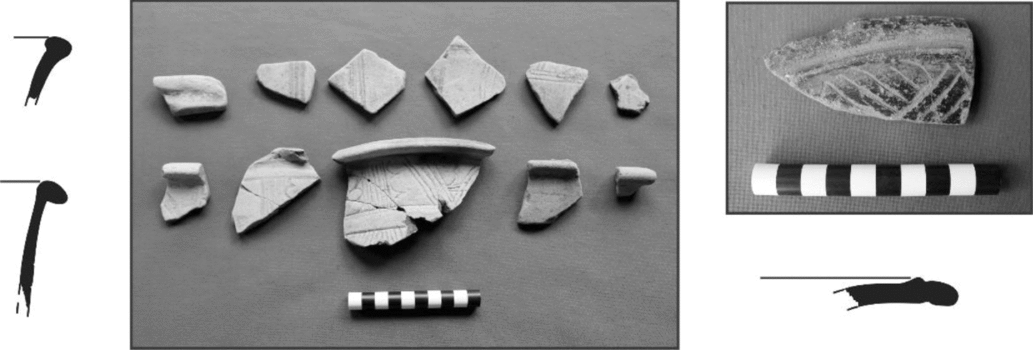
The ceramics from Suboperation 104e raised questions regarding the Itstapa phase ceramic complex at Izapa. The Suboperation 104e deposit included a new type of diagnostic sherd for Izapa: pinkish (or pale orange), coarse-incised sherds with bolstered rims (Figure 7). These diagnostics were unlike materials recovered from within either Mound 255 or Mound 260, suggesting that they belonged to neither the Hato nor the Jaritas ceramic complexes. An Itstapa phase association therefore seemed logical. Clark and Cheetham (Reference Clark, Cheetham, Merrino Carrión and García Cook2005:423–424) reported similar Itstapa phase materials from the Mazatán region. The cal AD 69–264 range for AMS date AA105649, recovered from the same level as the coarse-incised sherds, appeared to support an Itstapa phase association. The range also includes the end of the Hato phase and the beginning of the Jaritas phase, however.
Coarse-incised sherds (left) and a San Jacinto rim (right) from the Itstapa phase deposit in Suboperation 104e. Photographs are by the author. Vessel profile drawings are by Roberto Hoover Silvano.

These materials could not be identified from the Hato, Itstapa, or Jaritas phase ceramics described and illustrated by Lee (Reference Lee1973) or in the Izapa site report (Lowe et al. Reference Lowe, Lee and Martinez Espinoza1982). These findings raised questions about how the Itstapa phase ceramic complex had been defined by Lowe and Lee. An investigation into excavation notes and published studies revealed some concerns. For one, the separation of the Itstapa phase from the Hato and Jaritas phases meant that no urn burials were assigned to the early part of this phase. Urn burials were recovered for the Hato and Jaritas phases in the Mound 30 complex, but Itstapa phase materials in that area were limited to offerings (Lieske Reference Lieske2013:Table 4). In Group F, four different Itstapa phase structures were identified in the Mound 125a stratigraphy (Lowe et al. Reference Lowe, Lee and Martinez Espinoza1982:Figure 13.17). Although offerings were recorded for the first two Itstapa phase structures at Mound 125a, urn burials were not interred in the mound until the second two Itstapa phase structures were erected (Lee n.d.). Likewise at Group B, in the site center, urn burials of the Hato and Jaritas phases were identified, but Itstapa phase vessels were limited to nonmortuary offerings (Lieske Reference Lieske2013).
Lowe and colleagues (Reference Lowe, Lee and Martinez Espinoza1982:141) described the Itstapa phase as a “stabilizing period” at Izapa. The absence of urn burials for the early Itstapa phase, but presence of these burials for phases that immediately precede and succeed it, is not the expected pattern for a period of stability. This observation suggests that some overlap may have occurred in what was being defined as Hato and Itstapa phase materials. Clark (personal communication 2016) has also observed that the date ranges of the Late Hato and the Itstapa phases overlap. Perhaps the most likely explanation is that the Hato and Itstapa ceramic complexes, as previously defined by Lowe and Lee, actually overlap for approximately 100 years, from AD 1–100. The Late Hato phase urn burials might then be considered as Early Itstapa phase deposits.
Lowe made frequent reference to “Ixtapa” ceramics in his lab notes (Lieske Reference Lieske2013:Appendix) but never specified what these ceramics looked like. In one instance, Lowe made passing reference to a “distinctive Izapan Protoclassic and Early Classic coarse-incised pottery style” (Lowe Reference Lowe and Adams1977:234). Many comparable coarse-incised sherds were also discovered throughout Rosenswig's survey (Rosenswig and Mendelsohn Reference Rosenswig and Mendelsohn2016). An intrusive offering vessel with coarse-incised decoration was the closest match of the ceramics illustrated in the Izapa report, attributed to the Itstapa phase (Lowe et al. Reference Lowe, Lee and Martinez Espinoza1982:Figure 7.18f). For Clark's Mazatán survey, similar coarse-incised sherds were included with the Itstapa phase materials (Clark and Cheetham Reference Clark, Cheetham, Merrino Carrión and García Cook2005:421–424). Based on these observations, and the associated AMS date, the coarse-incised sherds and the Mound 104e deposit have tentatively been associated with the Itstapa phase.
Ceramic cross-dating for coarse-incised sherds at Izapa would appear to support an Itstapa phase association (Figure 7). A survey of the presence/absence and frequency of ceramics with coarse incision and deep basin forms is helpful in narrowing down the temporal range of this ware. At Kaminaljuyu, the “Coarse Incised” type (Wetherington Reference Wetherington and Wetherington1978), or “Arenante” ware (Popenoe de Hatch Reference Popenoe de Hatch1997:130–132), is the closest correlate to the Izapa coarse-incised ceramics. Arenante, however, is significantly thicker walled than the coarse-incised sherds from Suboperation 104e. They share, however, a similar form: large bowls with slightly everted walls and thick, bolstered rims. They also share decorative techniques: both include thick, post-slip incision on the exterior of the vessel, beginning below the rim. In his 1965 working chart, Lowe also noted a link between “Arenal Incised” ceramics at Kaminaljuyu and ceramics at Izapa (Mendelsohn Reference Mendelsohn2017:Table 3.1). Prior to the split between Hato and Itstapa phases, he cross-dated this association to the Hato phase at Izapa.
Also of significance was the recovery of a fragment of a polished black, very wide-everted rim from the Suboperation 104e deposit (Figure 7). This rim was associated with San Jacinto, a well-known, fancy, polished black ware in inland Chiapas. San Jacinto ceramics date to the Ix (Bryant and Clark Reference Bryant, Clark, Donne Bryant, Clark and Cheetham2005:332–338) and Hun phases (Clark and Cheetham Reference Clark, Cheetham, Merrino Carrión and García Cook2005:417) in that zone. Although this import does not narrow down the range of the deposit between the Hato or Itstapa phases, it does secure its placement in the Terminal Formative period. Ceramics like this San Jacinto sherd, with the distinctive, wide-everted rim forms, were highlighted by Inomata and colleagues (Reference Inomata, Ortiz, Arroyo and Robinson2014:398–399) to propose that the Izapa chronology, specifically the Guillen phase, should be shifted. The appearance of this San Jacinto sherd in a Terminal Formative deposit serves as evidence against this proposal.
AMS Dates and Bayesian Modeling
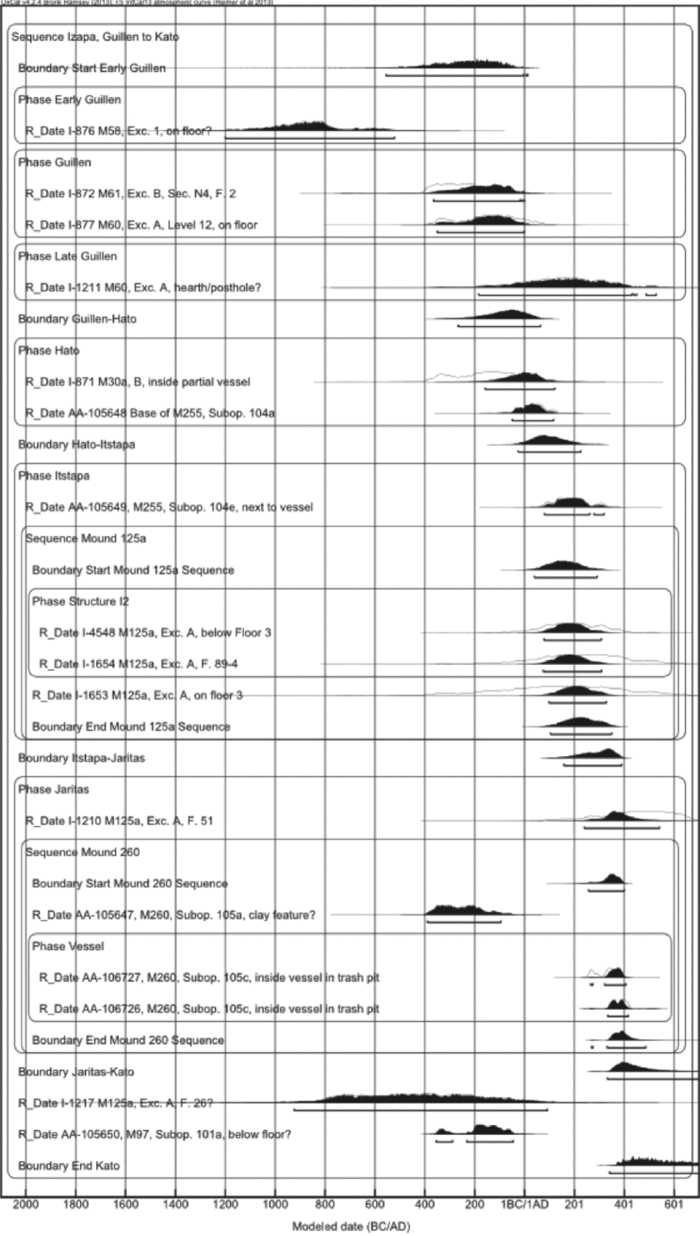
An additional line of evidence for reviewing the chronology of the Formative to Classic period transition at Izapa is Bayesian modeling of carbon dates recovered from the site. Archaeologists are increasingly using Bayesian modeling as a means of developing greater precision in their chronologies, which in turn allows additional archaeological problems to be addressed (Bachand Reference Bachand2008; Bayliss and Bronk Ramsey Reference Bayliss, Bronk Ramsey, Buck and Millard2004; Bronk Ramsey Reference Bronk Ramsey2009). Bayesian models combine the date ranges for multiple carbon dates with researchers’ interpretations of phases and stratigraphic relationships to build on data provided by individual absolute dates. The deposits from which the IHAP samples came are described above. Old carbon and other problematic samples have been identified as outliers and were excluded from the model. The choices made in the development of the Bayesian model in Figure 8 are described in the Supplemental Material. The results of this Bayesian analysis are provided in Figure 8. The final Bayesian model produced in OxCal had both a good model agreement index value (A model = 119.5%) and individual agreement value (A overall = 121.2%). Both values were well above the necessary threshold of 60%, which is used to indicate a problem with the model (Bronk Ramsey Reference Bronk Ramsey2009).
Bayesian model of IHAP (AA numbers) and NWAF (I numbers) carbon samples for the Guillen through Kato phases. IHAP dates were processed by the University of Arizona AMS lab.

Before proceeding to the results, it is worth noting that, ideally, Bayesian analysis would be run only on AMS dates from recent projects, which have shorter ranges and greater accuracy. The ranges for the NWAF dates are long due to the technology available at the time the samples were run. Bayesian modeling of the newer AMS dates from IHAP with the NWAF dates produced by older methods helped to narrow down the date ranges for each phase. There is, however, some danger that these earlier published dates mislead the analysis. The presentation here reflects the data available at the time of writing and should be updated (eventually excluding the older NWAF dates) as additional data become available.
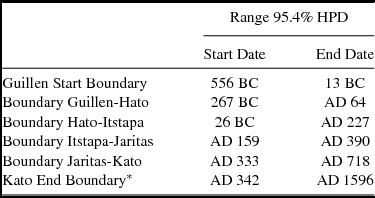
Bayesian modeling produces projected boundaries between phases, presented as ranges (Table 3). These ranges, although wide (as a result of the wide ranges of the original NWAF 14C dates), conform to Lowe and colleagues’ (Reference Lowe, Lee and Martinez Espinoza1982:Figure 7.1) initial chronology, which included the Guillen-Hato transition around 50 BC (100 BC for the Lowe et al. Reference Lowe, Ekholm and Clark2013 update), the Hato-Itstapa transition at AD 100, the Itstapa-Jaritas transition at AD 250, and the Jaritas-Kato transition at AD 400. Lowe and Lee's projected beginning of the Guillen phase at 300 BC is also close to the result of the Guillen start date in the Bayesian model. More Guillen phase dates need to be collected and run using AMS to confirm this. The results for the Kato phase, which contain only two outliers of old carbon, should not be accepted and will need to be revisited in the future with additional dates.
Results of Bayesian Modeling, Indicating Date Range and HPD (Highest Posterior Density) for Each Boundary Modeled.

*Not accepted
Discussion
Recent excavation data from IHAP generally support Lowe and colleagues’ (Reference Lowe, Lee and Martinez Espinoza1982, Reference Lowe, Ekholm and Clark2013) chronology for the Terminal Formative to Early Classic period transition at Izapa. Challenges arose, however, in identifying ceramics associated with each of these phases outside the site core. Because non-offering ceramics had not been defined for the Hato, Itstapa, and Jaritas phase ceramic complexes, ceramic cross-dating was a necessary step to confirm that the AMS dates for these deposits accurately reflected their associated ceramics. For the Hato and Jaritas phases, this was relatively straightforward. For the Itstapa phase ceramic complex, correlation was more challenging.
The biggest inconsistency between offering ceramics and local ceramics was for the Hato phase. This period had appeared well defined in the Izapa chronology, with early and late subphases defined by Lowe (Reference Lowe1993; Lowe et al. Reference Lowe, Lee and Martinez Espinoza1982) for the elaborate offerings in the Mound 30d urn burials. The identification of Hato phase materials became immediately problematic outside the ceremonial center, however, as local ceramics for this phase had never been identified. Luckily, cross-dating of local Hato phase ceramics proved to be relatively straightforward. New ceramic modes, like nubbin feet, red-on-orange decoration, and the adoption of fine pastes, were common at sites across Mesoamerica during the first 200 years of the Terminal Formative period (Figure 6). The appearance of this horizon at Izapa, now documented even among ceramics outside of the site core, has helped to anchor the dating of the Hato phase to a well-documented era at other Mesoamerican sites.
The reconstruction of the Itstapa phase ceramic complex, however, was challenging and still remains uncertain. The poor definition of the ceramics for this phase is related to several issues, including a cultural shift in occupation from the monumental core of the site to the new ceremonial center to the north, Group F. Although it is understood that the first major construction efforts at Group F were undertaken during the Itstapa phase (Lowe et al. Reference Lowe, Lee and Martinez Espinoza1982:229), the amount of overlap in occupation between “Old” Izapa and Group F remains unclear.
The division between early and late phases of the Terminal Formative period also appears problematic at other nearby sites. De Borhegyi (Reference de Borhegyi and Willey1965:11), for example, once suggested that the Verbena (“Miraflores” in his discussion) and Arenal complexes at Kaminaljuyu were roughly contemporaneous. He saw Miraflores ceramics as the elite ceremonial assemblage of the Arenal domestic assemblage (de Borhegyi Reference de Borhegyi and Willey1965:11). Wetherington (Reference Wetherington and Wetherington1978:129) also experienced difficulty in dividing the Terminal Formative ceramic assemblages of Kaminaljuyu. He did, however, note that some changes in form were observable. Standing wall bowls, like those included on thick, incised types, tended to have a higher frequency in the Arenal phase (Wetherington Reference Wetherington and Wetherington1978:131).
A scenario similar to that proposed by de Borhegyi (Reference de Borhegyi and Willey1965) for Kaminaljuyu remains possible at Izapa; the Hato and Itstapa ceramic complexes could still be contemporaneous. The division of the Terminal Formative phases at Izapa still lacks good stratigraphic relationships and requires more absolute dates. At present, however, results closer approximate Wetherington's observations for an increase in coarse incisions and deep basin forms in the Arenal phase, attributes found in the proposed Itstapa phase ceramic complex at Izapa. Future excavations will be necessary to critically evaluate the division of an Itstapa ceramic complex from the better-documented ceramics of the Hato and Jaritas phases.
Love (in press) offers an alternative correlation between Kaminaljuyu and the Pacific coast from his perspective of the site of El Ujuxte, a Guatemalan coastal center between Izapa and Kaminaljuyu. Although the ceramics of Izapa and El Ujuxte cross-date nicely for the Late Formative (Guillen-Cataluña) and early Terminal Formative (Hato-Pitahaya) phases, Love and I have reached different conclusions regarding cross-dating to Kaminaljuyu. Whereas I link the Hato phase at Izapa with the Verbena phase at Kaminaljuyu (following Lowe Reference Lowe1993) and the Itstapa phase at Izapa to the Arenal phase at Kaminaljuyu, Love prefers to link the Pitahaya phase at El Ujuxte with the Arenal phase at Kaminaljuyu. As Love (in press) observes, both sets of correlations cannot be correct. This discrepancy will need to be resolved through additional research.
A possible overlap for Hato and Itstapa phase ceramic complexes at Izapa may explain some of the observed discrepancies with Love's cross-dating. Both Izapa and Kaminaljuyu lack good stratigraphic deposits that would be ideal for differentiating between ceramic complexes of the early and late phases of the Terminal Formative period. At Kaminaljuyu, the divisions between the Verbena, Arenal, and even Santa Clara ceramic complexes have been difficult to distinguish (de Borhegyi Reference de Borhegyi and Willey1965; Ohi Reference Ohi1994; Wetherington Reference Wetherington and Wetherington1978). Likewise, Lowe's Reference Lowe1965 notes suggest that Hato and Itstapa ceramic complexes were, at first, considered contemporaneous (Table 1; Mendelsohn Reference Mendelsohn2017:Table 3.1). Although I have argued that horizon markers for the early phase of the Terminal Formative period are identified at Izapa, El Ujuxte, and Kaminaljuyu, it is perhaps safest at present to discuss cross-dating and cultural activities for a broader Terminal Formative phase spanning from 100 BC–AD 250.
It is now clear that we need a better division between Terminal Formative ceramic complexes at Izapa. Future research that could distinguish between the ceramics of the Hato and Itstapa phases and provide additional dates would have important implications for cultural activities at Izapa, including the Hato phase disturbance reported by Lowe and colleagues (Reference Lowe, Lee and Martinez Espinoza1982). It is suspicious that no urn burials have been documented in either the new ceremonial center or the old for the beginning of the Itstapa phase. The proposed overlap between the Hato and Itstapa phases for the period between AD 1 and 100 might explain this anomaly. It is also possible that a gap in urn burials at the site reflect a response to a local environmental catastrophe. Sometime between 30 BC and AD 80 the nearby Tacaná volcano erupted, resulting in muddy floods at Izapa (Macías et al. Reference Macías, Luis Arce, Capra, Saucedo and Manuel Sánchez-Núñez2018). The cultural impact of this eruption is still poorly understood due to poor chronological refinement for this era. Finally, while survey results currently indicate a decline in Hato phase occupation at the site (Rosenswig and Mendelsohn Reference Rosenswig and Mendelsohn2016), coarse-incised ceramics have been found in abundance in the Formative period core at Izapa. If an overlap between the Hato and Itstapa ceramic complexes proves to be accurate, our interpretations of this population decline will need to be adjusted.
The ceramic identifications and associated cultural activities of the Jaritas phase have been easier to deduce. Unlike the Hato phase, the Jaritas phase offerings documented by Lee (Reference Lee1973, n.d.) consisted predominantly of local ceramics. This meant that the ceramics interred in offering contexts were similar to the domestic ceramics recovered at Mound 260. In addition, Mound 260 was a single component occupation without the interpretive difficulty of earlier materials. The results support Lowe and colleagues’ (Reference Lowe, Lee and Martinez Espinoza1982:145) initial conclusion that Jaritas phase ceramics at Izapa were of a local style, suggesting a dramatic decline in ties with the Miraflores sphere to the southeast by the onset of this phase around AD 250. Here, Love (in press) and I are in agreement that ceramic ties between the Pacific coast and the Guatemalan highlands cease by AD 200/250.
Bayesian statistical analysis of the IHAP dates, together with the original 14C dates from the NWAF excavations, also helps narrow the ranges of the proposed boundaries between phases. These boundaries conformed to the chronology initially laid out by Lowe and colleagues in 1982. They also fit the minor adjustments to this chronology proposed by Clark in 2013 (Lowe et al. Reference Lowe, Ekholm and Clark2013). Yet the absolute chronology of the Late and Terminal Formative periods at Izapa still requires considerable refinement. At present, only two dates for the Guillen phase are accepted (Supplemental Material), two good dates exist for the Hato phase, four dates are available for the Itstapa phase, and three dates now exist for the Jaritas phase. Calendar dates for the Guillen, Hato, Itstapa, and Jaritas phases could therefore be shifted by 50 or even 100 years as additional dates become available (see also Rosenswig and Mendelsohn Reference Rosenswig and Mendelsohn2016:Supplemental Material). Nevertheless, the present results, with their support of Lowe and colleagues’ ceramic chronology, suggest that there is currently little reason to reject the original interpretations of the stratigraphy reported from the NWAF project or Lowe and colleagues’ related inferences regarding the dating for the erection of the Izapa monuments.
In contrast, Inomata and colleagues’ (Reference Inomata, Ortiz, Arroyo and Robinson2014) alternative proposal, that the Guillen phase ceramics at Izapa may date to the Terminal Formative period, is rejected. The proposed link between the wide-everted rims of the orange-slipped Tuzantan ware of the Guillen phase at Izapa (300–100 BC) and the wide-everted rims of the polished black San Jacinto ware of the Ix phase in the Grijalva region (dated to AD 100–300 by Bryant and Clark [Reference Bryant, Clark, Donne Bryant, Clark and Cheetham2005]) do not fit the data from Izapa. Imported black San Jacinto ceramics were associated with the Itstapa phase deposit in Suboperation 104e as well as a Late Hato phase urn burial at Mound 30d (Lowe et al. Reference Lowe, Lee and Martinez Espinoza1982:Figure 7.15). The Itstapa or Late Hato phase date for these deposits is contemporary with the occurrence of San Jacinto sherds in the Hun and Ix phases in the Grijalva region (Clark and Cheetham Reference Clark, Cheetham, Merrino Carrión and García Cook2005). No shift in the chronology is necessary to correlate Terminal Formative ceramics from Izapa with other regions. All of this suggests that the difficulty observed by Inomata and colleagues (Reference Inomata, Ortiz, Arroyo and Robinson2014) in correlating Guillen phase ceramics from Izapa with other Late Formative ceramics of the Maya area will need to be explained by cultural activities rather than a chronological shift.
The above results suggest a rejection of Inomata and colleagues’ (Reference Inomata, Ortiz, Arroyo and Robinson2014) proposal to shift the Izapa ceramic chronology forward in time, but the results appear to support their chronological revision of Kaminaljuyu for the Terminal Formative period. Ceramics of the Hato phase at Izapa cross-date with materials from the Early Caynac phase at Chalchuapa, the Horcones/Hun phases of the Chiapas interior, and the Verbena phase at Kaminaljuyu. This straightforward cross-dating suggests that residents of Izapa participated in a widespread horizon at the onset of the Terminal Formative period (Mendelsohn Reference Mendelsohn2018). The dating of the Hato phase at Izapa to 100 BC–AD 100 supports Inomata and colleagues’ (Reference Inomata, Ortiz, Arroyo and Robinson2014) revised dating of the Verbena phase to 100 BC–AD 50, shifted from its original placement at 400–300 BC (see Love [in press] for an alternative proposal).
The relationship between this ceramic horizon and the Izapan style monuments, however, remains open to interpretation. As Love (in press) discusses, correlations between pottery, burials, and the monuments themselves remain problematic. Recent survey evidence supports Lowe's initial Guillen phase association for the monuments. Very few Hato phase materials were recovered on survey from Groups A and B, where most of the in situ Izapa monuments are located (Rosenswig and Mendelsohn Reference Rosenswig and Mendelsohn2016). In contrast, Guillen phase ceramics were recovered in abundance in these groups (Rosenswig et al. Reference Rosenswig, Gasco, Antonelli, Mendelsohn, Navarro Castillo and Vidal-Guzman2012).
Some of the monuments in the central zones of Izapa (e.g., the cluster of monuments at Mound 9), however, could have been placed in their final positions as late as the Itstapa phase (Lowe et al. Reference Lowe, Lee and Martinez Espinoza1982:207). As I have discussed elsewhere (Mendelsohn Reference Mendelsohn2017), the possibility remains that additional monuments were carved and erected at Izapa into the Terminal Formative period, after the first century BC. Monuments depicting glyphs or personal ornaments of jade, in particular, may be later additions, based on their iconography and locations at the site. Inomata and colleagues’ (Reference Inomata, Ortiz, Arroyo and Robinson2014:399) suggestion that censer styles may help to narrow down the date of the Izapa monuments is also a promising avenue for future research.
Findings from the IHAP have brought us one step closer to understanding Izapa and the regional Soconusco chronology. The present study has highlighted the importance of testing long-standing chronologies with new data. The chronological questions raised by this study will necessitate a reevaluation of the cultural events at Izapa during the Terminal Formative to Early Classic transition and the relationship of its residents to neighboring regions at this time, questions that many researchers working in southern Mesoamerica have long seen as well-established facts. As we continue to refine chronologies of the “Southern Maya area” (which probably was not all Maya), interpretations of political and economic relationships also should be updated. The origin and spread of developments like early kingship symbolism, low relief sculpture, and popular ceramic styles will no doubt continue to be the subject of discussion as new details emerge from southern Mesoamerican sites.
Acknowledgments
The Izapa Household Archaeology Project was supported by funds from a National Science Foundation Doctoral Dissertation Research Improvement Grant (#1349916), a Fulbright-García Robles grant, a DeCormier award from the Institute for Mesoamerican Studies, and an excavation permit from Mexico's Instituto Nacional de Antropología e Historia. This write-up was made possible by a Junior Fellowship in Pre-Columbian Studies at the Dumbarton Oaks Research Library and Collection. I am thankful to Robert Rosenswig, John Clark, Hector Neff, Bárbara Arroyo, Michael Love, Simon Martin, the New World Archaeological Foundation, and Guatemala's Instituto de Arqueología e Historia for access to comparative ceramic collections. I thank Takeshi Inomata for his help with the Bayesian modeling and Roberto Carlos Hoover Silvano for drawing the ceramic profiles. This article has benefited greatly from the comments of participants of the 2015 Kaminaljuyú Roundtable and from Robert Rosenswig, Takeshi Inomata, John Clark, Michael Love, Hector Neff, Jessica Watson, an anonymous reviewer, and the editors, whose comments have helped to improve the manuscript.
Data Availability Statement
Materials excavated during the Izapa Household Archaeology Project are currently housed at the New World Archaeological Foundation in San Cristóbal de las Casas, Chiapas, Mexico. Digital copies of data are also available from the author.
Supplementary Material
To view supplementary material for this article, please visit https://doi.org/10.1017/laq.2017.56