Social mobility is a crucial indicator of a society’s prospects and openness. It has been associated with various consequences, such as economic development and political stability, in China and beyond.Footnote 1 Analysis indicates that despite the overall expanding opportunities resulting from changes in social structure since the reform, relative social mobility (i.e. social fluidity) has recently declined in China.Footnote 2 This means children from different family origins face increasingly unequal chances of advancing up the social ladder. This finding is supported by the observation that economic inequality has surged and remained persistently high since the reforms,Footnote 3 which, as the “Great Gatsby curve” hypothesis suggests, often correlates with declining intergenerational mobility.Footnote 4 Consequently, addressing the issue of possibly deteriorating social mobility has recently become one of the Chinese Communist Party’s (CCP) most urgent tasks.Footnote 5
While objective social mobility has significant consequences, individuals’ subjective perceptions of it – that is, perceived social mobility – are equally, if not more, important. These perceptions critically shape attitudes and behaviour and thus profoundly affect social stability and development. As Martin Whyte’s pioneering study posited, Chinese citizens’ optimism about upward social mobility is crucial to explaining their tolerance of economic inequality and the still dormant “social volcano” of distributive injustice in contemporary China.Footnote 6 His follow-up studies further suggest that this widespread optimism remained relatively stable from 2004 to 2014.Footnote 7 Indeed, these findings align with the “prospect of upward mobility” thesis. According to this thesis, disadvantaged individuals who perceive a good chance of future upward mobility tend to tolerate inequality, demand a lower level of redistribution and are less enthusiastic about democracy, which often involves greater redistribution efforts.Footnote 8 Further in this direction, researchers demonstrate that perceived upward mobility prospects strongly predict affective identification with authoritarian values and high regime support in China.Footnote 9
In this sense, the CCP’s policy initiatives to address social immobility serve a dual purpose.Footnote 10 Not only do they address challenges related to declining objective social mobility, such as underutilization of talent and economic inefficiency, but they also sustain or bolster public confidence in the Party’s commitment and capacity to ensure a prosperous future and equal opportunities. By doing so, the Party seeks to maintain its legitimacy, especially amid increasing economic inequality and a slowdown in economic growth.Footnote 11
Have the CCP’s efforts effectively cultivated public belief in upward social mobility? To shed light on this, we address two specific and interrelated questions in this study. First, how do ordinary citizens perceive social mobility in contemporary China? Second, do these public perceptions accurately reflect reality, or do Chinese citizens exhibit tendencies towards excessive optimism or pessimism?
While important, both questions have remained understudied. Despite the abundant studies that have examined perceived social mobility in China, perceived personal mobility (i.e. the mobility of the respondent or his or her family) has frequently been prioritized over perceived societal mobility (i.e. the chances of society-wide mobility).Footnote 12 Thus, it remains unclear how Chinese citizens view society-wide mobility chances. This is unfortunate because individual perceptions of societal mobility can significantly influence attitudes and behaviour, just as perceptions of personal mobility do. For instance, people demand more government spending and redistribution when they perceive a decline in society-wide mobility opportunities.Footnote 13 Similarly, besides evaluating personal or family circumstances (i.e. pocketbook considerations), the assessment of national circumstances (i.e. socio-tropic considerations) is also an important determinant of political attitude and behaviour.Footnote 14 Broadly speaking, when perceiving more chances for societal mobility, people tend to have greater confidence in meritocracy and the fairness of the current political system and consequently support it more.
Among the few exceptions that explicitly study perceived societal mobility, the concept is operationalized by asking respondents a few direct and generic questions, such as to what extent one agrees that people of different family backgrounds encounter different societal opportunities.Footnote 15 While straightforward, these self-reported measures may be influenced by social desirability bias and may be intertwined with respondents’ general satisfaction or dissatisfaction with their society, which limits researchers’ ability to capture genuine public perceptions.Footnote 16 For instance, recent analyses reveal that Chinese citizens are significantly more likely to attribute poverty to unequal opportunities today than they were ten to twenty years ago.Footnote 17 However, does it indicate that Chinese citizens genuinely exhibit excessive pessimism regarding social mobility? Not necessarily. Survey respondents might intentionally exaggerate opportunity inequality as a way to express broader dissatisfaction amid the recent economic slowdown. Moreover, owing to different scales, these generic and often semantic assessments cannot be meaningfully compared to objective mobility rates to assess the extent of misperceptions. In short, it remains unclear whether most Chinese people genuinely perceive social mobility as excessively optimistic or pessimistic in comparison to reality.
To tackle these problems, we use a novel measurement instrument. Building on previous studies, we elicited individual perceptions of intergenerational mobility using a series of vignette experiments embedded in two online surveys conducted in 2022 and 2024.Footnote 18 These experiments randomly assigned respondents the socio-economic status of vignette parents and asked them to predict the prospects of these parents’ children. We derived a measure of perceived intergenerational mobility by estimating the correlation between the socio-economic status (SES) of hypothetical parents and the SES of their children, as predicted by respondents. To account for the potential variability in Chinese citizens’ perceptions of various aspects of intergenerational mobility, we expanded the original design to encompass multiple indicators of SES, such as income, social status and education. We analysed perceived intergenerational persistence in each of these dimensions, including perceived correlations between parental and children’s education, income and social status. Additionally, we explored a cross-dimensional relationship: the correlation between parental education and children’s income, as perceived by respondents.
As will be discussed in more detail, our measurement strategy mitigates potential social desirability bias and avoids conflating with respondents’ general contentment or discontent, thereby better reflecting their genuine perceptions. Additionally, because objective intergenerational mobility rates are similarly constructed based on the correlation between the SES of actual parent–child pairs, our perception measures are on the same scale as objective mobility measures. This alignment allows a direct comparison between objective and perceived mobility and, thus, an assessment of the extent of misperceptions. Understanding the extent and direction of public misperceptions is important because pervasive overestimation or underestimation indicates that systematic forces, such as government information control and dominant ideological predispositions, drive public perceptions away from reality.Footnote 19 On the other hand, it also highlights opportunities for information interventions to correct misperceptions, fostering changes in attitudes and behaviour.Footnote 20
Leveraging these advantages of our design, we assessed public perceptions of intergenerational mobility across multiple dimensions in China. We further examined the variation of individual perceptions across population subgroups to determine whether disadvantaged groups (for example, rural residents or females) hold more pessimistic views. Additionally, to our knowledge, our study is among the first to directly assess how public perceptions of intergenerational mobility conform to or deviate from the reality in China. These results offer one of the most current and comprehensive snapshots of how social mobility is perceived in China. While primarily descriptive and cross-sectional, our analysis can serve as a valuable reference for future studies investigating the evolving dynamics of public perceptions regarding equal opportunities and related sentiments in China. Moreover, since similar studies have been conducted in other countries, such as the US and South Korea,Footnote 21 and are likely to expand to more societies, our findings will contribute to understanding whether China stands out from a comparative perspective. This is a topic of interest that has been sparked by pioneering studies in the field.Footnote 22
The rest of the paper is organized as follows. The next section reviews studies on objective and perceived intergenerational mobility in contemporary China. Subsequent sections introduce our data and measures of perceived intergenerational mobility, present the estimates and compare them with objective rates, and conclude with a discussion of the results.
Intergenerational Mobility in Contemporary China
Intergenerational mobility refers to individuals’ movement on the social ladder relative to their parents.Footnote 23 Researchers typically distinguish between two types of intergenerational mobility: absolute and relative.Footnote 24 Absolute mobility refers to the overall changes in SES from generation to generation, indicating how differently individuals fare compared to their parents. Relative mobility, also known as social fluidity, concerns comparative changes – that is, how an individual’s position on the socio-economic ladder relative to their peers has changed from that of their parents. Although both measurements are important indicators of mobility, absolute mobility is more susceptible to significant social changes, such as shifts in occupation structure owing to technological progress or economic reform. In comparison, relative mobility – the focal interest of this study – is a more robust barometer of social openness and equality of opportunities.
Dynamics of objective intergenerational mobility
China serves as a unique and valuable case in understanding intergenerational mobility, attributable to the country’s rapid and profound social and institutional changes, which are often driving forces of social fluidity.Footnote 25 Specifically, the reform initiated in 1978 distinctly divides the evolution of relative mobility in the People’s Republic of China (PRC) into two phases.
In the pre-reform period, the ruling CCP carried out multiple policies that helped to weaken class reproduction and promote social mobility across social classes. Upon the founding of the socialist state, private property was abolished, thus eliminating the economic foundation for intergenerational class reproduction. A rigid wage system was implemented to reduce income inequality within and across occupations, effectively lowering overall inequality. As a result, upper-class families lost both the economic resources and the incentives to pass down socio-economic advantages to their children.
Social movements also facilitated intergenerational mobility during this period. For instance, during the Cultural Revolution (1966–1976), China implemented educational policies akin to affirmative action, such as expanding primary education in the countryside, reducing tuition fees and emphasizing political criteria for college admissions. These initiatives aimed to enhance educational opportunities for children from peasant and worker backgrounds. As education plays a pivotal role in social status attainment, these policies reduced intergenerational social status persistence and increased upward mobility chances for disadvantaged children. Numerous studies show that the correlation between a father’s and his children’s educational achievements was notably low during the pre-reform period, reaching its nadir during the Cultural Revolution.Footnote 26
In the second phase (the post-reform period), two countervailing forces – the weakening sector barriers triggered by industrialization and the consolidating status hierarchy triggered by the break from state socialism – jointly shaped the social mobility pattern in China.Footnote 27 On the one hand, the rapid industrialization after 1978 broke the barriers between agricultural and non-agricultural sectors. Such structural changes created abundant opportunities for children from rural areas to move to the cities and get non-farming jobs. As a result, absolute mobility, defined as the proportion of children who move out of the class of their family origin, increased in this era.Footnote 28
On the other hand, while relative mobility has remained largely stable since the reform, it has shown a noticeable decline in recent years.Footnote 29 Although Chinese citizens generally have more favourable opportunities than their parents, the net competition among families has intensified over the years of reform.
The recent decline in relative mobility in China can be attributed to several factors. First, echoing trends observed in other socialist countries undergoing social and economic transformations, Chinese officials had ample opportunities to convert their political influence and social capital into wealth in the reform era, a resource they could easily pass on to their children.Footnote 30 This trend became more pronounced as the reforms progressed. Moreover, the government’s abolition of wage regulations and its promotion of private sector expansion have significantly exacerbated income inequality.Footnote 31 Thus, families of the upper class have more resources and stronger motivation to transmit their socio-economic advantages to the next generation.
Second, education policies have also changed to make education transition, especially the transition to college, more selective based on academic performance. These policies are much less progressive than those in the pre-reform era that promoted an egalitarian education system. Given the robust link between family background and children’s academic performance, these policy changes have increased family origin’s effects on educational attainment,Footnote 32 thereby dimming the prospects of achieving upward mobility for children from the lower class.
Public perceptions of relative mobility
While empirical research has shown a decline in relative mobility in China, citizens may not necessarily perceive it as such. Broadly speaking, public perceptions of society-wide inequality and mobility deviate from reality in many contexts.Footnote 33 Thus, while researchers sometimes use objective mobility rates as a proxy for people’s perceptions of overall mobility chances in society (societal mobility) for convenience, this approach usually fails to capture actual perceptions owing to potential misperceptions. Nevertheless, these perceptions, many of which may be inaccurate, often profoundly impact individual attitudes and behaviour, such as tolerance for inequality,Footnote 34 preferences for redistributionFootnote 35 and investment in education.Footnote 36 Therefore, it is crucial to understand how ordinary citizens perceive societal mobility opportunities in China, without assuming that their perceptions align with reality.
Unfortunately, existing studies have not sufficiently addressed this question, as most studies on perceived mobility have focused on perceived personal rather than societal mobility. In recognition of the importance of understanding perceived mobility, public social surveys, such as the Chinese General Social Survey (CGSS) and the Asian Barometer Survey (ABS), sometimes include questions about how respondents perceive their previous, current and future social statuses. Some also include questions about how respondents perceived their family social status when they were young. These perceived personal or family social statuses are then compared to measure perceived intra-generational or intergenerational mobility, which has facilitated rigorous empirical investigations into the causes and consequences of perceived personal mobility in China.Footnote 37 In comparison, perceived societal mobility has attracted fewer empirical assessments.
Although direct empirical evidence is limited, recent studies have suggested both the possibilities of overly optimistic and pessimistic public perceptions of societal mobility in China. On the one hand, Chinese people may have remained optimistic and even overly optimistic about societal mobility. For instance, amid the declining relative mobility in China, Whyte and Dong-Kyun Im compared two national surveys and found that people were similarly optimistic (or even slightly more optimistic) about societal mobility in China between 2004 and 2009, especially about their and others’ equal chances of getting ahead via hard work.Footnote 38 Closely relatedly, Xi Song shows that, under government control, Chinese media suppress and selectively cover the topic of inequality, leading citizens to underestimate actual inequality in China.Footnote 39 The same logic may apply to perceived social mobility, resulting in the optimism regarding societal mobility shown by previous studies.
On the other hand, comparative studies suggest that citizens in post-socialist countries, because of their predisposed values about equality, are often sensitive to inequality-related issues and tend to exaggerate income gaps.Footnote 40 Similarly, using online query volume data from Baidu, researchers find that Chinese citizens pay close attention to societal mobility, especially those from less developed and more unequal regions.Footnote 41 Thus, even if isolated, extreme cases exposed online, such as the success and luxurious lifestyles of the “second-generation rich” (fu erdai 富二代), can profoundly affect public perceptions of social mobility and foster pessimism about equal opportunities in society. In this direction, recent analyses reveal that Chinese citizens are significantly more likely to attribute poverty to unequal opportunities today than they were ten to twenty years ago.Footnote 42 While informative, this finding may not accurately indicate perceived societal mobility in China, particularly its relationship to actual mobility rates. Additionally, direct survey questions, like the attribution question mentioned above, are prone to response biases, which limits their ability to reveal the genuine perceptions of respondents.
Therefore, to adjudicate whether Chinese people overestimate or underestimate societal mobility chances, we need an improved design that elicits the genuine perceptions of individuals while also allowing for comparisons with objective mobility rates.
Empirical strategy
Measuring perceived intergenerational mobility: an experimental approach
Researchers usually rely on the correlation between parental and children’s SES in assessing objective relative mobility, where a stronger correlation indicates a lack of mobility. We use a similar approach to measure perceived relative mobility using survey experiments. Specifically, we randomly selected the SES of hypothetical parents from a wide range of possible values, presented the information to respondents, and then asked them to predict the prospects of children from these families. Respondents project from the known parental status to the unknown children’s status based on their perceived correlation between the two.Footnote 43 We then infer such perceived correlation, a measure for perceived intergenerational mobility, by regressing respondents’ predictions of children’s prospects on the assigned parental SES.
Following Siwei Cheng and Fangqi Wen, we presented the following vignette information to respondents to measure perceived intergenerational income mobility:Footnote 44
In our society, some families have high incomes, while others have low incomes. Suppose we rank Chinese family incomes from the lowest (leftmost) to the highest (rightmost). For example, if a family’s income is ranked at the 30th percentile, it is higher than 30 per cent of all families nationwide.
Suppose there is a set of parents whose family income is ranked at the p-th percentile (marked on the chart below):

Notably, the value of p mentioned in the vignette is randomly selected each time, ranging from 10 to 90, in increments of 10. The selected p-th percentile is displayed on the slider above to aid respondents’ understanding.
After presenting the information about hypothetical parents, we ask respondents the following question: “Where do you think their child’s family income percentile ranking will be in adulthood, around age 40?” Respondents can select an integer percentile (for example, 23) by dragging a slider that ranges from 0 to 100, with options not limited to quintiles. We measure perceived relative income mobility by regressing respondents’ predictions of children’s income ranking on the assigned parental income ranking and estimating the regression slope.Footnote 45
Our study builds on, but also departs from, the approach originally developed by Cheng and Wen to estimate intergenerational income mobility in the US, offering a novel contribution by capturing the multifaceted nature of perceived intergenerational mobility.Footnote 46 In addition to examining the perceived correlation between parental and children’s income, we explore the perceived correlations of social status and education between generations. Furthermore, we investigate a fourth correlation between parental education and children’s income ranking. This cross-dimensional measure provides insights into how people perceive the transmission of educational advantages to income across generations, which poses an understudied yet intriguing question.Footnote 47
We separately examine each of the four measures of intergenerational mobility, as a single indicator may fail to capture the complexity of public perceptions in China. While researchers sometimes focus on a specific dimension of SES for convenience when studying intergenerational persistence, such findings may not generalize to other dimensions.Footnote 48 Similarly, public perceptions of intergenerational mobility can vary across these dimensions. For instance, Chinese citizens tend to believe that academic achievement and educational attainment are a function of consistent personal efforts rather than family background per se, leading to a perception of high intergenerational educational mobility.Footnote 49 In contrast, perceived intergenerational income mobility is likely lower, influenced by rising economic inequality and the visible displays of affluence by second-generation wealthy individuals on social media. Additionally, differentiating public perceptions of mobility in these dimensions is helpful because they may affect different outcomes in distinct ways. For instance, parents often factor in intergenerational education mobility, but not necessarily other mobility measures, in their decisions about investment in children’s education in China.Footnote 50
Our measurement strategy offers two further noteworthy advantages. First, the experiment-based approach has an advantage over direct questioning. Our estimate, essentially an indirect measure, can mitigate the social desirability bias prevalent in survey designs. As respondents receive information about only a subset of the hypothetical parents (depending on the number of prediction tasks per respondent), they are not fully aware of what researchers intend to measure and, thus, cannot provide answers that align with what they believe the researchers are seeking.Footnote 51 The indirect measures similarly reduce the risk of respondents exaggerating or understating their estimates of social mobility to express contentment or discontent with society, which is more likely when providing direct responses. Moreover, our analysis of perceived relative mobility focuses on the differences in the predicted SES of children across varying vignette parental SES rather than the predicted SES of children per se.Footnote 52 Although the predictions may be susceptible to response biases, comparisons across prediction tasks are less likely to be affected, as experimental randomization helps to balance and offset potential biases.Footnote 53 Thus, this experimental approach elicits more genuine perceptions.
Second, similar correlation-based measures have also been used to study objective intergenerational mobility. Since perceived and objective mobility measures are similarly constructed, we can meaningfully compare perceptions with reality to assess and understand misperceptions. Our experimental design closely follows previous studies that typically examine social mobility in a unidimensional way, focusing on the correlation between a single variable, such as income percentile rankings, across two generations.Footnote 54 This approach offers key advantages, including interpretability and, for our purposes, the straightforward comparability between objective and perceived mobility measures. Rather than attempting a comprehensive evaluation of how the public perceives the influence of all major parental factors on children’s SES – a task that would require simultaneously randomizing multiple parental attributes and assessing their effects on predicted SES of children – we focus on isolating and measuring each specific dimension of perceived mobility.
Online surveys
We implemented the experimental design in two independent online surveys: one conducted between July and September 2022 (Survey 1) and the other between February and April 2024 (Survey 2).Footnote 55 In both surveys, we employed quota sampling to increase the diversity of respondents in terms of gender, education and age. To ensure data quality, we implemented measures including speeder flags, mid-survey attention checks (for example, instructing respondents to select a specific numeric interval varying by gender), and safeguards against multiple survey submissions. Both surveys were administered by a professional survey company based in China.
Surveys 1 and 2 included 3,105 and 2,468 respondents, respectively. Each respondent completed the prediction task twice in Survey 1 and three times in Survey 2, with different randomized parents each time, resulting in 7,210 and 7,404 observations, respectively. Respondents in both surveys were drawn from 30 provinces across mainland China (excluding Tibet), with regional distributions detailed in the online Appendix Table A1.
It is worth noting that, owing to non-probability sampling, neither sample necessarily represents the Chinese adult population. Nevertheless, our samples could loosely represent internet users.Footnote 56 The online Appendix Table A2 compares our samples to internet users from the China Family Panel Studies (CFPS), a nationally representative social survey. The results show that our samples approximate the distributions of the online population in China in terms of gender, age and hukou 户口 (household registration) status. For the key findings, we further applied weights to better represent adult internet users in China. As discussed below, the results remain similar.
Moreover, while online surveys typically oversample respondents who are wealthier, younger, better educated and more urban-based compared to the general Chinese population,Footnote 57 these oversampled groups are often attuned to information about social mobility. They also possess greater resources to act upon their perceptions, such as investing in their children’s education or advocating for new government policies, compared to disadvantaged groups. Thus, despite some deviations from the general Chinese population, our samples offer valuable insights into a group most likely influenced by perceived social mobility in China, providing an important reference for policymakers and future research.
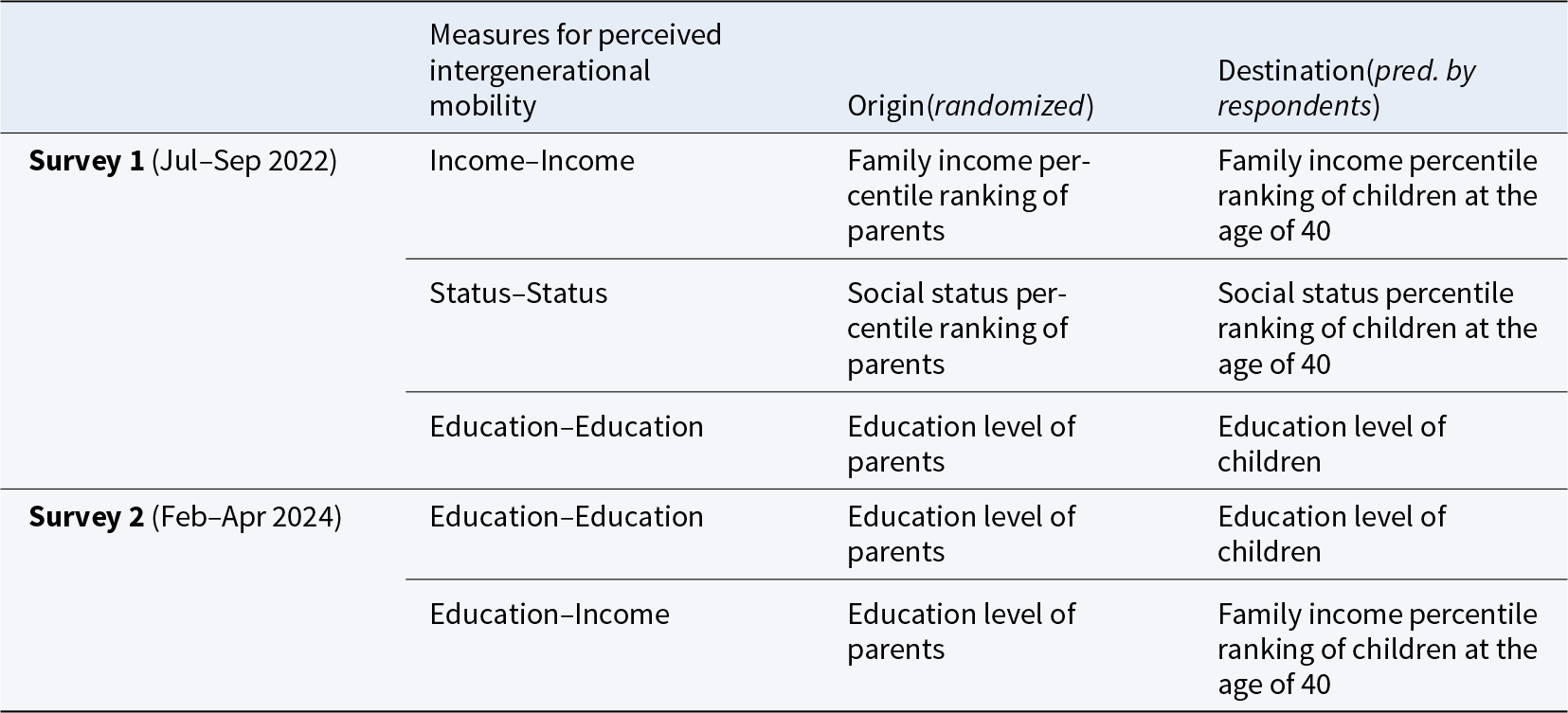
As summarized in Table 1, Survey 1 randomizes the family income (jiating shouru 家庭收入) percentile ranking, social status (shehui diwei 社会地位) percentile ranking and education levels (jiaoyu chengdu 教育程度) of vignette parents and asks respondents to predict the corresponding status of their children.Footnote 58 Each respondent is assigned two vignette parents per mobility measure of income, status or education, resulting in a total of six prediction tasks. Survey 2 randomizes the education levels of vignette parents and asks respondents to predict both the education levels and family income rankings of children, with each respondent assigned three vignette parents, also completing six prediction tasks in total.
Measuring Perceived Relative Mobility

Notes: Respondents completed prediction tasks multiple times for each measure, with the respective values of parents’ income, social status or education levels randomly selected each time. Respondents completed six prediction tasks in Survey 1 (3 measures×2 tasks each) and in Survey 2 (2 measures×3 tasks each).
In Survey 1, the perceived Income–Income and Status–Status correlations reflect respondents’ perceptions of how parental income and status rankings influence children’s corresponding outcomes. In Survey 2, the perceived Education–Income correlation captures perceptions of how parental education transmits to children’s income rankings. The perceived Education–Education correlation, measuring perceptions of educational persistence, is estimated in both surveys for comparison and validation.
Estimations, randomization and measurement validation
We measured perceived intergenerational persistence across these four dimensions by regressing respondents’ predicted family SES for children on the SES of vignette parents. The slope estimates from these bivariate regressions capture the average perceived persistence in each dimension (see online Appendix Equation A1). Additionally, we employed a multilevel model that allows the slopes to vary across social groups (online Appendix Equation A2), offering insights into the social contours of these perceptions. Finally, since each respondent completed multiple prediction tasks for each mobility measure, we leveraged these multiple observations to estimate individual-level perceptions (see online Appendix Equation A3).
Before presenting the main results, we highlight two auxiliary findings that reinforce the reliability of our measurement strategy. First, the randomizations in vignette experiments are effective, as shown in Appendix Table A3, which confirms that assigned parental income, social status and education levels are independent of respondents’ characteristics.
Second, our measures of perceived mobility align with respondents’ overall assessments of societal mobility. In Survey 2, we gauged the general mobility assessment by asking respondents whether they agreed that children from poor families can rise to the top (hanmen chu guizi 寒门出贵子), coding disagreement as general pessimism. Individual perceptions of intergenerational immobility (estimated based on Appendix Equation A3) were positively and significantly correlated with general pessimism, confirming the validity of our measurement strategy (see Appendix A2 for more details).
Perceived Intergenerational Mobility in China
Descriptive results: family background and perceived prospects of children
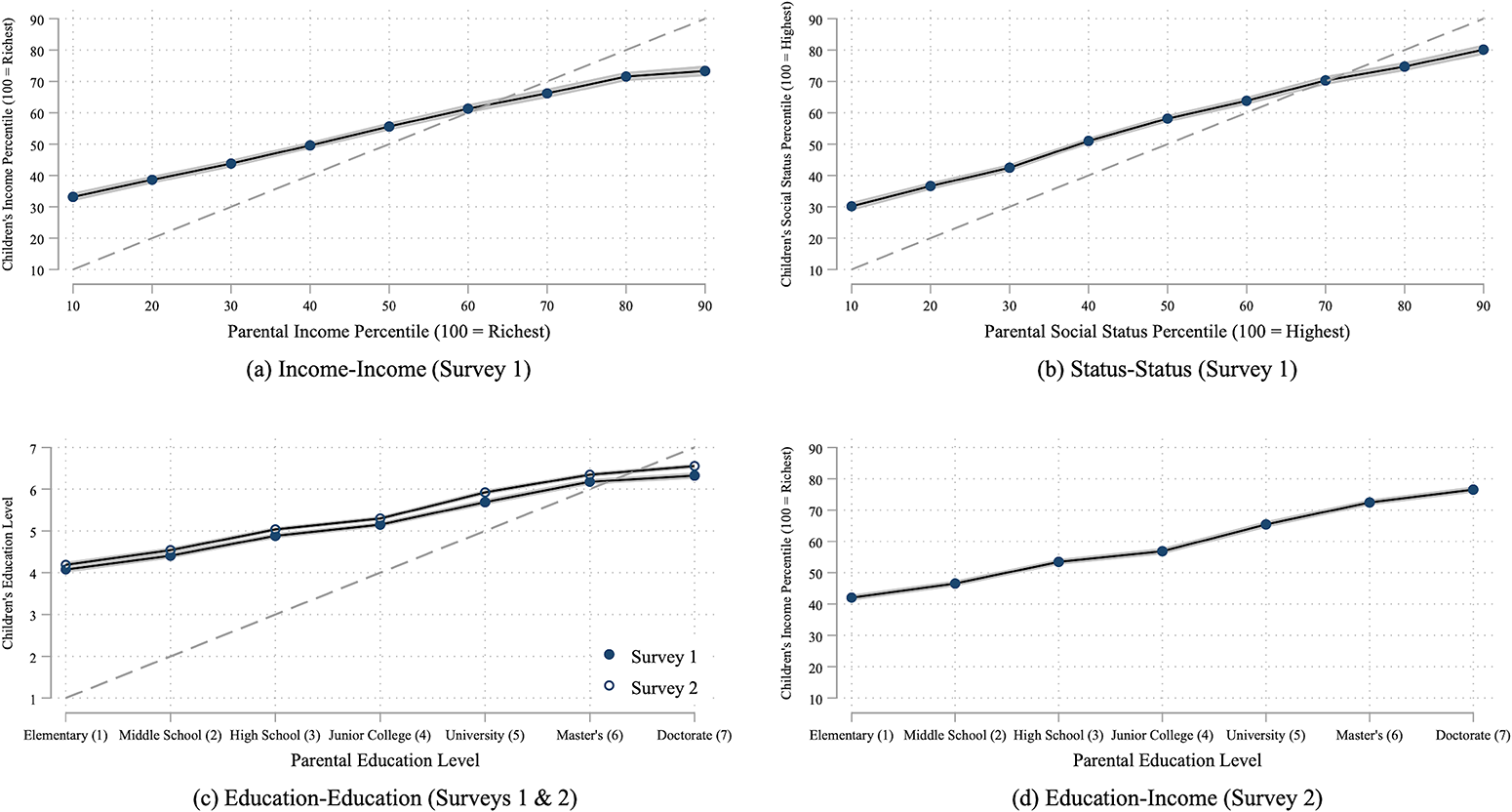
In the eyes of the public, what are the prospects of children from different family backgrounds? Figure 1 presents how our respondents predict children’s prospects based on parental SES. For reference, in panels (a), (b) and (c), we also present a 45-degree diagonal line that indicates perfect immobility; that is, parents and children share the same socio-economic ranking or education levels.
Perceived Intergenerational Mobility in China

Panel (a) presents respondents’ predicted children’s income percentile ranking by each of the nine possible income percentile rankings of vignette parents. Respondents believe that the income ranking of children whose parents’ income lies at the bottom 10th percentile will, on average, earn more than 30 per cent of their peers. For children of parents whose income ranking is at the top 10 per cent (the 90th percentile), respondents predict that their income ranking will be higher than 70 per cent of those in their generation. However, since this prediction falls below the diagonal reference line, it indicates that children from very affluent families are expected to have lower income rankings than their parents. Similar patterns are observed in respondents’ predictions of the social status rankings of children from various family backgrounds, as depicted in (b).
Panel (c) shows the perceived intergenerational persistence of education levels. It is striking that the results from Surveys 1 and 2 – two different samples – closely resemble each other, although respondents from Survey 2 are slightly more optimistic about children’s education given parents’ education. Even for children of parents who completed only elementary education, respondents believe these children, on average, can attain a junior college education. Panel (d) presents the perceived relationship between parental education levels and the income percentile ranking of children. For instance, respondents believe that children of parents holding doctorate degrees will earn more than 75 per cent of their peers.
Two general findings in Figure 1 are notable. First, respondents tend to predict better prospects for children compared to parents, particularly when the parents are disadvantaged. This tendency is evident in the relatively high “intercepts” across all four panels, representing the predicted statuses of children from the most disadvantaged parental backgrounds. While these “intercepts” likely capture a perceived generational shift in social structure, which is a key component of perceived absolute mobility, they are not central to our analysis of relative mobility.Footnote 59
Second, across all four panels, children’s predicted SES increases monotonically with that of their parents. Although the relationship is not strictly linear, the regression slopes provide a reasonable first-order approximation of this association. Moreover, the linear regression slopes offer significant advantages in terms of interpretability and simplicity. They effectively summarize the relationship between parental and children’s SES, revealing how, on average, differences in children’s predicted SES correspond to differences in parental SES. Following previous studies on both perceived and objective intergenerational mobility, our subsequent main analysis focuses on these regression slopes, with a steeper slope indicating lower perceived relative mobility.Footnote 60
Regression estimates: perceived intergenerational mobility
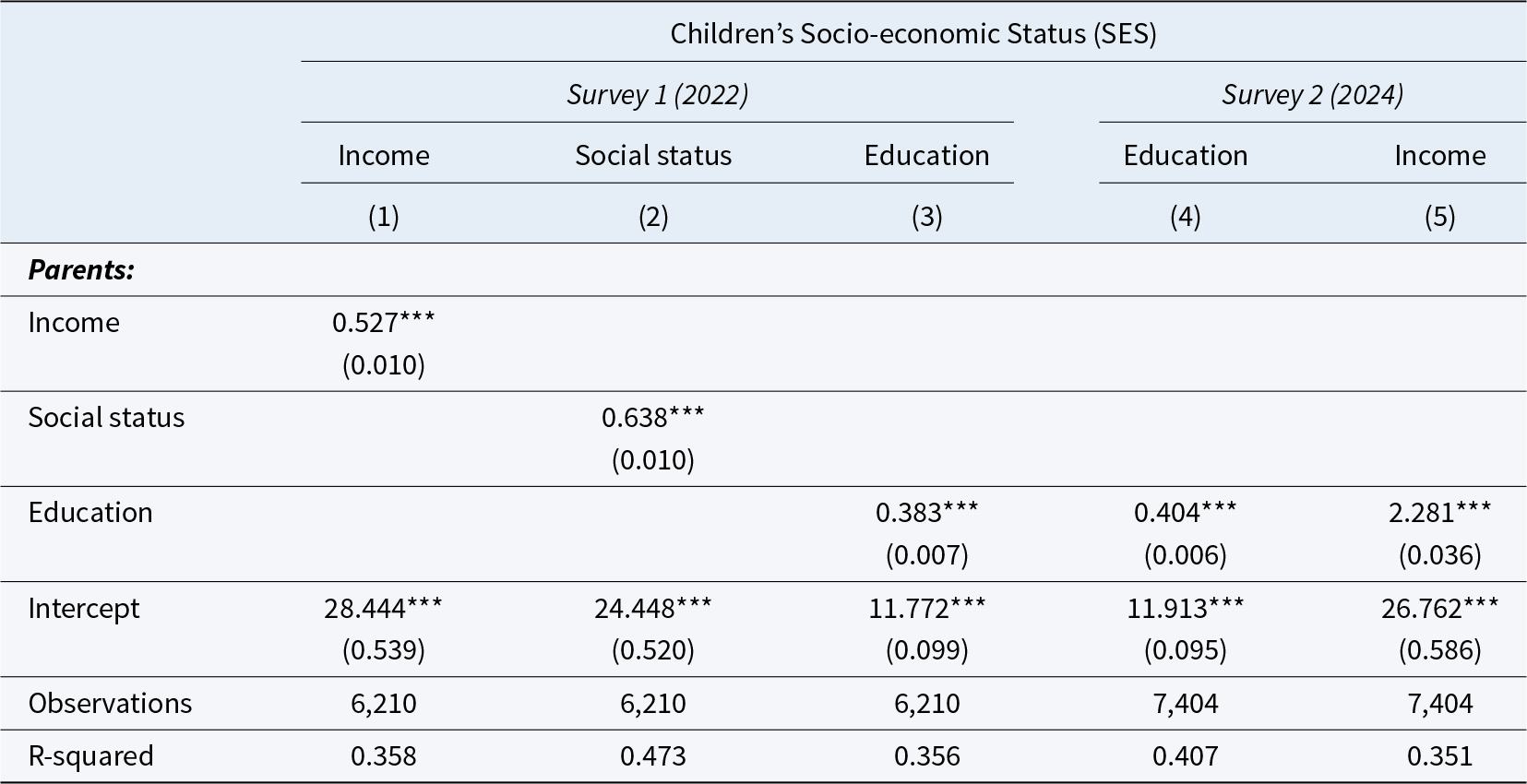
Table 2 presents perceived relative mobility estimated using regression models. Specifically, column (1) estimated the perceived Income–Income correlation (i.e. the regression slope) to be 0.527. Thus, in respondents’ eyes, a 1-percentile increase in parents’ income ranking will advance their children’s income ranking by approximately 0.53 percentile. Notably, our estimate is lower than a recent US estimate constructed similarly at 0.65.Footnote 61 In other words, our respondents exhibit greater optimism about intergenerational income mobility than typical Americans, despite recent evidence indicating that intergenerational persistence in post-reform China is approaching levels observed in the United States.Footnote 62 Furthermore, our perception estimate exceeds the reported figure for South Korea (0.422),Footnote 63 aligning with recent comparative analyses suggesting that South Korea has lower objective intergenerational income persistence compared to China.Footnote 64
Public Perceptions of Intergenerational Persistence

Notes: Income is the percentile income rankings of parents and children; social status is the percentile social status of parents of children; education is years of schooling of parents and children. Standard errors in parentheses are clustered at the individual level. ***p < 0.001, **p < 0.01, *p < 0.05.
In column (2), the perceived Status–Status correlation is 0.638. As income and social status are similarly measured in percentile rankings, the two regression slope estimates in columns (1) and (2) are loosely comparable. The larger Status–Status slope suggests that, in the eyes of the public, high-status families are more likely than high-income families to transmit family advantages to offspring. This could reflect the perceived fluctuation or uncertainties of family income in China.Footnote 65 In this sense, family income is perceived as an unsatisfactory indicator of social status in China.
In columns (3) to (5), we convert the education levels into years of schooling before estimating the regression models. The Education–Education correlation is moderate and consistent across both surveys: 0.383 in Survey 1 (column 3) and 0.404 in Survey 2 (column 4). These results indicate that the respondents perceive each additional year of parental education as adding approximately 0.38 to 0.4 years to their children’s schooling. In column (5), we estimate the Education–Income regression slope to be 2.281, indicating that respondents perceive that each additional year of parental schooling leads to a 2.28 percentile increase in children’s income ranking.
Table A4 in the online Appendix replicates Table 2 but incorporates weights so that our surveys better represent adult internet users in China, yielding similar results.
Social contours of perceived intergenerational mobility
We further assessed how people’s perceptions of intergenerational mobility vary across population subgroups. Research on objective intergenerational mobility has revealed significantly different upward mobility chances for males and females and for urban and rural hukou, with females and rural residents having a dimmer prospect of achieving upward social mobility.Footnote 66 Moreover, ordinary people tend to overgeneralize personal experience or the experience of their immediate reference group.Footnote 67 Thus, we would expect disadvantaged groups to underestimate societal mobility. We assess this possibility by estimating a multi-level model (Appendix Equation A2).
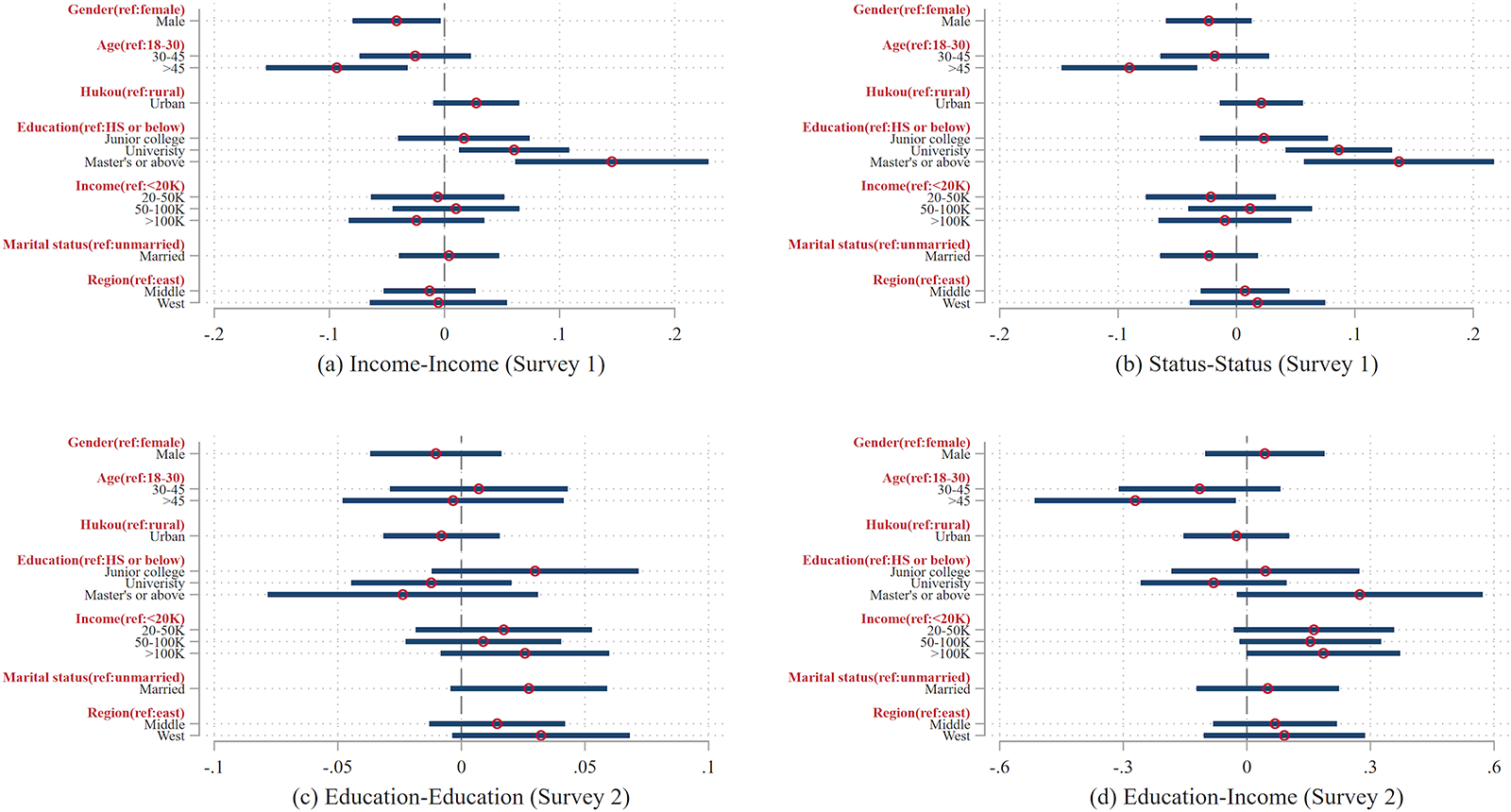
Figure 2 presents the results. A positive coefficient (i.e. a circle) indicates a more pessimistic view about intergenerational persistence in that group, while a negative coefficient implies the opposite. The horizontal lines indicate the 95 per cent confidence interval, which, if crossing the vertical zero line, indicates statistical insignificance at the conventional level.
Social Contours of Perceived Intergenerational Immobility

We find some mixed results. On the one hand, evidence supports the idea that more disadvantaged groups tend to be more pessimistic. Specifically, females are significantly more pessimistic about the income link between parents and children (Figure 2a). On the other hand, however, this pessimism does not extend to other aspects of perceived mobility: the gender difference loses its statistical significance in panels (b) to (d). Moreover, we find contrary evidence that more educated individuals are more pessimistic about both the Income–Income and Status–Status links between parents and children (Figure 2a and b), suggesting that the disadvantaged group appears to be more optimistic rather than pessimistic. As we have focused on perceived societal rather than personal mobility, the relative pessimism among better-educated individuals is not entirely surprising.Footnote 68 In fact, it has been similarly documented in previous studies.Footnote 69 This may stem from the fact that more educated individuals tend to be more critical of the status quo and are often more attuned to patterns of bias, as advanced education is linked to a heightened awareness of such issues.Footnote 70
In addition to these mixed results, Figure 2 overall reveals more homogeneity than heterogeneity across population subgroups. For example, the difference between rural and urban residents remains statistically insignificant across all four panels. Notably, in Figure 2(c), individual perceptions of the correlation between parental and children’s years of schooling do not significantly vary across any groups defined by different socio-economic or demographic variables.
Thus, in China, traditionally disadvantaged groups (for example, females, rural hukou holders and individuals with low education) do not necessarily exhibit more pessimism about societal mobility. One possible, broader explanation is that they may be more receptive to political rhetoric and state propaganda promoting equal opportunities,Footnote 71 which counterbalance the potential pessimism shaped by their personal experiences. Supporting this conjecture is the finding that older individuals, particularly those over 45 years old, who are also likely influenced by government information control, tend to underestimate intergenerational persistence in society (Figure 2a, b and d).
Comparing Perceived and Objective Intergenerational Mobility
How close are the public’s perceptions to the reality? To address this question, we utilized the Chinese Family Panel Studies (CFPS),Footnote 72 a nationally representative survey, to estimate objective intergenerational persistence and compared the data with the perception estimates derived from our second survey experiment conducted in 2024. Specifically, we analysed data from the 2022 wave of the CFPS, the most recent dataset available at the time of writing. We applied survey weights from the CFPS throughout the analysis to ensure that the estimated objective measures of intergenerational mobility accurately reflect contemporary patterns in China.
Preparing data for comparison
To ensure a reliable comparison between objective and perceived intergenerational mobility, we took the following steps. To begin with, our comparison centres on two primary correlations: the link between parental and children’s years of schooling (i.e. the Education–Education correlation) and the association between parental years of schooling and children’s income percentile ranking (i.e. the Education–Income correlation). We did not assess whether people overestimate or underestimate the correlation between parental and children’s income (i.e. the Income–Income correlation) or between their social statuses (i.e. the Status–Status correlation) due to the absence of reliable data required to estimate these objective measures.
Accurately estimating intergenerational income mobility requires income data for both parents and children, ideally collected when they are at comparable life stages – typically 20 to 30 years apart. While social surveys often gather income data from either parents or children, obtaining reliable information for both is challenging. Recent studies have addressed this issue using linked administrative tax data;Footnote 73 however, such panel data are unavailable in our context.Footnote 74 In contrast, education level is typically established by one’s early 20s, making parental education easier to recall and report than income, which can fluctuate significantly over time. Moreover, education level is less ambiguous and more straightforward to measure than social status. For these reasons, we compared perceived and objective measures of the Education–Education and Education–Income correlations.
Additionally, we refined both the CFPS and experimental survey samples to enhance comparability. First, to align with our experimental design, which specified that the child would be 40 years old, we restricted the CFPS sample to respondents – who serve as the children in our analysis – aged between 30 and 55 years when estimating the objective Education–Education and Education–Income correlations. Second, to ensure that the vignette parental education level appeared realistic to respondents, particularly younger cohorts, we did not include parents with no formal education in the randomization process of survey experiments. For consistency, we also removed CFPS respondents whose parents had no formal education. Third, among the remaining CFPS respondents, only a small number had parents with a master’s degree or higher, so we removed them from the CFPS sample. Similarly, we excluded survey experiment prediction tasks where the assigned vignette parental education was a master’s degree or higher. These second and third adjustments ensured that the parental education levels in both the experimental and actual samples fell within the same range, thereby enhancing the comparability of the estimated perceived and objective mobility rates.
Are Chinese citizens overly optimistic or unduly pessimistic?
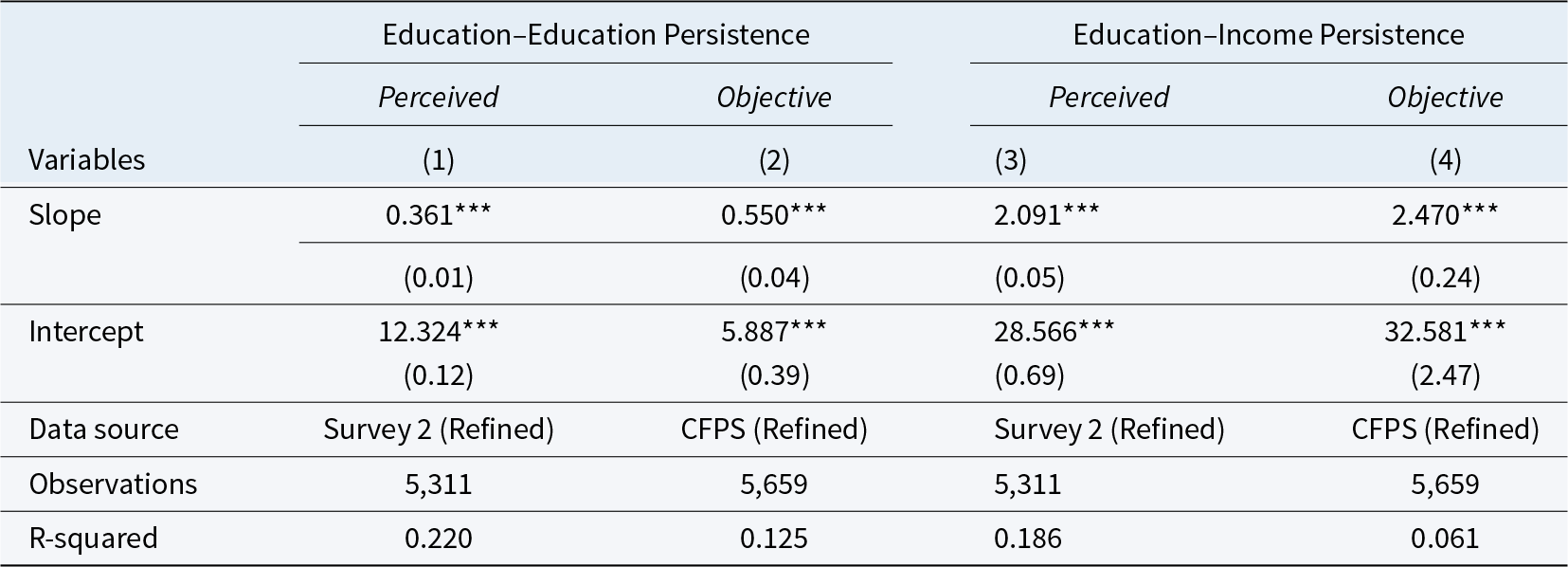
Table 3 summarizes the results. In terms of intergenerational mobility in education, a comparison of the slope estimates in columns (1) and (2) reveals that our respondents, on average, are more optimistic than reality suggests. While the objective slope indicates that an additional year of parental schooling helps children to increase their years of schooling by 0.55 years, respondents perceive that it advances children’s years of schooling by 0.36 years – a substantial underestimation of approximately 34.5 per cent.
Objective and Perceived Intergenerational Immobility

Notes: Parental education level is measured by the highest level of either parent in the CFPS (2022). Education levels are converted into years of schooling for analysis. Survey 2 asks each respondent three times for each measure; thus, columns (1) and (3) report standard errors clustered at the individual level in the parentheses. Columns (2) and (4) report robust standard errors in the parentheses. ***p<0.001, **p<0.01, *p<0.05.
Similarly, columns (3) and (4) suggest that our respondents also tend to underestimate intergenerational transmission from parental education to children’s income ranking. While the objective slope indicates that an additional year of parental schooling helps children to increase their income ranking by 2.47 percentiles, respondents estimate that it advances the income ranking by 2.09 percentiles, an underestimate of around 15.4 per cent.
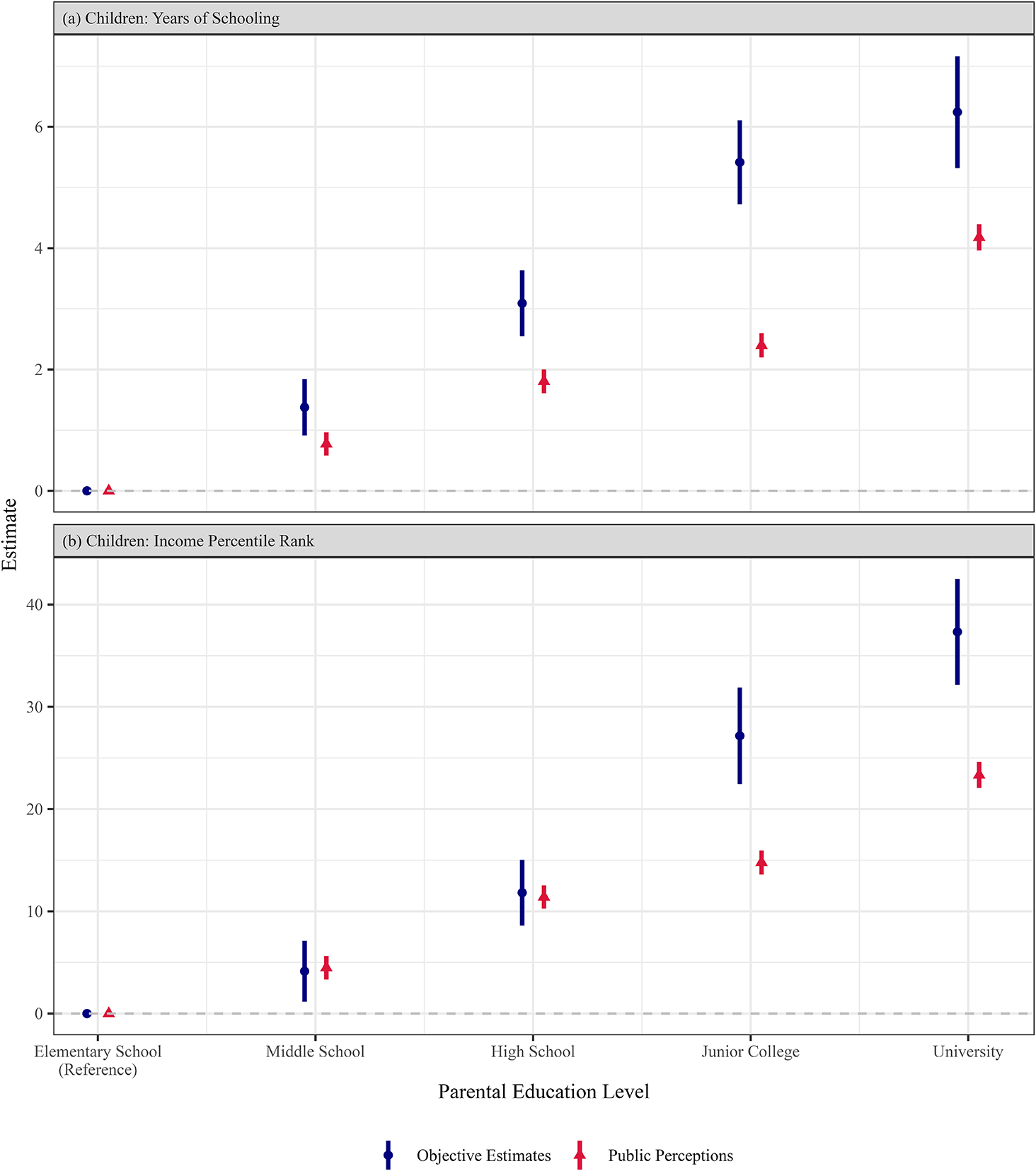
While, for simplicity, we converted both parental and children’s education levels into years of schooling to estimate regression slopes in Table 3, the observed underestimation of both Education–Education and Education–Income correlations is not attributable to this simplified model specification. To address potential non-linear effects of parental education, we employed a semi-parametric approach, treating parental education levels as categorical variables and estimating the effects for each specific level.
Figure 3 presents the estimated advantages, both perceived and objective, for children with varying levels of parental education, using elementary school completion as the reference group. Panel (a) shows that respondents consistently underestimate the educational benefits conferred by parents who attained education levels beyond elementary school. Panel (b) highlights that the optimism about the equal income rankings of children from parents with different educational backgrounds is primarily driven by significant underestimations for children whose parents completed junior college or higher. Conversely, respondents generally provide accurate estimates of the relative advantages for children whose parents completed middle or high school compared to those whose parents only completed elementary school. These findings illustrate that even with more flexible estimation methods, the patterns of underestimation persist, underscoring the robustness of the observed trends.
Comparing Perceived and Objective Effects of Parental Education Levels on Children’s Education and Income

Collectively, Table 3 and Figure 3 reveal two key insights. First, Chinese citizens tend to underestimate the intergenerational transmission of family advantages, particularly regarding children’s educational attainment and income outcomes for parents with higher levels of education. While comprehensive data to fully account for these perceptions are unavailable, this public optimism likely arises from a combination of historical and contemporary influences. Historically, Confucianism and the civil examination system have fostered a deep cultural emphasis on education and the belief in upward mobility through academic achievement.Footnote 75 Many Chinese citizens also view educational success as primarily driven by personal effort, minimizing the role of family background.Footnote 76 Recent policy initiatives, such as the “double reduction” policy aimed at promoting educational equity, may have further bolstered public confidence in the fairness of educational opportunities.Footnote 77
Second, the underestimation of the Education–Income slope is less pronounced than that of the Education–Education slope. In other words, while Chinese citizens exhibit an overly optimistic perception of equal educational opportunities, this optimism is attenuated, although not entirely eliminated, when assessing income disparities between children of highly educated and less educated parents. A plausible explanation for this pattern is that ordinary citizens may recognize that privileged families, such as those with highly educated parents, often pass on advantages to their children beyond formal education. These families often leverage non-educational means, including extensive social networks, to materialize their children’s educational achievements into improved income prospects.
Additional evidence for public optimism
We also conducted additional analysis to substantiate the results above. First, the perception estimates in columns (1) and (3) of Table 3 closely align with those in columns (4) and (5) of Table 2. This consistency suggests that refining the survey experiment sample to better match the CFPS sample neither significantly alters the perception estimates nor impacts the conclusions drawn from the comparisons. Second, the findings in Table 3 remain robust after weighting the survey experiment sample to align with the demographic distributions of internet users in China (Appendix Table A5).
Third, the underestimations are not driven by a small number of individuals with extreme misperceptions but rather reflect a widespread tendency to underestimate the intergenerational transmission of family advantages in education. Using multiple observations per respondent, we estimated individual-level perceptions (Appendix Equation 3). Analysis reveals that 64.2 per cent of respondents underestimated the Education–Education slope, and 52.8 per cent underestimated the Education–Income slope, compared to the objective estimates.
Finally, the results remain robust even after accounting for potential horizontal stratification, where children’s education levels may not be perceived as strictly ordered (Figure A2 in the Appendix).
Conclusion
This paper uses a novel measurement instrument to provide an updated understanding of public perceptions of intergenerational mobility in China. Drawing on multiple survey experiments conducted with two online samples, we assessed public perceptions of relative intergenerational mobility across various dimensions, explored how these perceptions differ among social groups, and investigated the extent and prevalence of misperceptions.
We find evidence of public optimism regarding social fluidity in China. First, respondents estimate that a 1-percentile increase in parental income ranking corresponds to a 0.53-percentile increase in children’s income ranking. While this appears moderate, it is lower than estimates for the United States, suggesting that Chinese citizens are more optimistic about mobility prospects than their US counterparts, despite a narrowing gap in actual intergenerational mobility between the two countries.
Second, individuals typically disadvantaged in upward mobility, such as women and rural residents, do not necessarily perceive societal mobility as lower. These discrepancies in perceived versus objective mobility across social groups highlight an opportunity for the government to address concerns over declining social fluidity before these issues escalate into public grievances that threaten social stability.
Third, our respondents demonstrate overly optimistic beliefs about the extent to which children of parents with different education levels can achieve similar educational attainment and income rankings compared to reality. This optimism may be rooted in the historical legacy of the civil examination system and recent policies, like the “double reduction” initiative, which are aimed at promoting educational equality.
These findings suggest that Chinese citizens generally hold an optimistic view of intergenerational mobility, which may have contributed to public enthusiasm for investing in children’s education, tolerance for economic inequality and sustained support for the government. However, signs of growing pessimism are emerging. Younger cohorts, for example, tend to estimate stronger intergenerational persistence. Moreover, when evaluating social status, which is arguably a more comprehensive measure than income or education, respondents estimate that a 1-percentile increase in parental social status ranking corresponds to a 0.64-percentile increase in children’s ranking. While direct benchmarks for cross-national or perception-versus-reality comparisons are unavailable, this moderately strong estimate aligns with recent research showing that Chinese citizens increasingly attribute wealth to unequal opportunities and family affluence rather than individual merits like talent and hard work, reversing the dominant perception of a decade or two ago.Footnote 78
To mitigate rising pessimism and its potential impact on social stability, the Party may implement more measures to boost public confidence in social mobility. We hope our study’s design and findings will inspire future research to track the evolving perceptions of social mobility in China and assess the effectiveness of such policy interventions over time.
Supplementary material
The supplementary material for this article can be found at http://doi.org/10.1017/S030574102500030X.
Acknowledgement
We thank the anonymous reviewers and participants of conferences at Tsinghua University and Sun Yat-sen University for their valuable feedback. We also thank Zhiwen Xiao for his research assistance. Yang acknowledges financial support from the Faculty Research Grant at Peking University (Grant No. 7100603771). Liu and Li gratefully acknowledge funding from the National Social Science Foundation of China (Grant Nos. 19CSH022 and 22CSH076, respectively).
Competing interests
None.
Feng YANG is an assistant professor at the Center for Social Research, Guanghua School of Management, Peking University. His research centres on Chinese and comparative politics, with a focus on the dynamic interplay among institutional design, policy reforms and public opinion in China and beyond.
Airan LIU is an associate professor at the Center for Social Research, Peking University. Her main areas of interest are child development, inequality in early life, Asian Americans and China.
Wangyang LI is an associate professor at the School of Sociology, Beijing Normal University. Her research interests are social stratification and mobility, child and youth development, family and gender. Specifically, she has been studying how family affects individual well-being and societal inequality in a life course perspective.