INTRODUCTION
Calanoid copepods belonging to the family Pseudodiaptomidae are circumglobal in distribution and are highly diversified. The genus Pseudodiaptomus includes 77 species (Walter et al., Reference Walter, Ohtsuka and Castillo2006) which Walter (Reference Walter1986) divided in seven species' groups, primarily distinguished by the presence or absence of endopods on the right and left male fifth legs. Pseudodiaptomus species are typically found in tropical and temperate, shallow coastal waters, living exclusively in estuarine and protected areas, where they can inhabit fresh to hypersaline waters. In general they are hyperbenthic copepods, entering plankton at dusk and remaining near or attached to bottom substrates during the day (Walter, Reference Walter1986). The Asiatic species Pseudodiaptomus marinus Sato (Reference Sato1913), belonging to the Ramosus group (Walter, Reference Walter1986), was first described from samples collected from an embayment near Takashima and Oshoro on the west coast of Hokkaido, Japan (Sato, Reference Sato1913). It has subsequently been reported in other areas of Japan and China and also in coastal waters of the north-west Pacific, north-east Pacific, central Tropical Pacific, Indian Ocean and California (Gulf of California) (as reported in the ‘Distribution map of Pseudodiaptomus marinus by geographical zones’, Razouls et al., Reference Razouls, Bovée, Kouwenberg and Desreumaux2005–2011).
Until now it has never been observed in the Mediterranean Sea. We now report the first discovery of P. marinus in the Adriatic Sea. The Adriatic Sea presents morphological and hydrographic characteristics that make this area very different from the rest of the Mediterranean Sea, the North Adriatic Sea being the most unusual sector. The North Adriatic Sea spans from the continental northern border to the −100 m contour line: it features an extremely shallow mean depth of ~30 m and a weak depth gradient along the major axis together with a strong annual thermal variation (8°C–25°C at the sea surface; Poulain et al., Reference Poulain, Kourafalou, Cushman-Roisin, Cushman-Roisin, Gačić, Poulain and Artegiani2001). Fresh water inputs in this region represent 20% of the inputs of the entire Mediterranean (Mariotti et al., Reference Mariotti, Struglia, Zeng and Lau2002), justifying its low salinity. Stormy winds from the north-east and south-east, allow water mixing, thus enhancing the recirculation of the nutrients. All these characteristics create a highly productive system, which makes this basin one of the richest in the Mediterranean.
MATERIALS AND METHODS
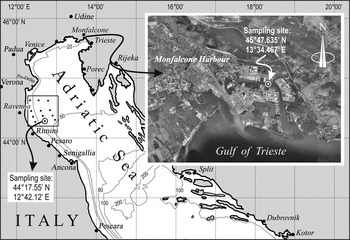
Mesozooplankton samples were collected in two different areas of the North Adriatic Sea: a station located along the Italian coast near Rimini in November 2007 and an artificial channel (canale Locavaz), located near the harbour of Monfalcone, in May 2009 (Figure 1; Table 1). The Locavaz channel is used as a cooling channel for power plant; water is collected from the harbour of Monfalcone and spilled into the channel. Moreover an aquaculture activity is present in the middle of the channel.
Sampling location.

Zooplankton sampling information, abundance of Pseudodiaptomus marinus and female size (prosome length: mean value ± standard deviation).

N, number of measured specimens.
All samples were collected during the daytime by a WP2 net (200-µm mesh size) vertically towed from 27 m and 5 m depth to surface, in November 2007 and May 2009 respectively. All samples were fixed and preserved in a 4% buffered formalin solution. Taxonomic identification was made by dissection and checked using a stereomicroscope (90× magnification). Finally some specimens of Pseudodiaptomus marinus (males and females) were sent to Dr Walter Chad, who confirmed our identification.
RESULTS
Pseudodiaptomus marinus was first detected near Rimini, where 11 specimens were collected: six females, four males and one copepodite. One female specimen was ovigerous. This station was part of a sampling grid of 14 stations (Figure 1) and yet P. marinus was not found elsewhere. Pseudodiaptomus marinus was found again in May 2009. In this case, four specimens of P. marinus (3 females and 1 copepodite) were collected in an artificial channel. Though the channel was monitored monthly from May 2006 to June 2009, P. marinus was observed only once. The abundance of P. marinus recovered in the two areas is reported in Table 1. Except for the fact that the females collected in the Locavaz channel were slightly larger than the females collected near Rimini (Table 1), no further difference between the specimens collected in the two different areas was observed. During the same period, zooplankton was also collected in the Gulf of Trieste at a site (C1) 200 m offshore (45°42.06′N 13°42.60′E; LTER site) where sampling was performed monthly with similar methodology but P. marinus was never observed (unpublished data).
DISCUSSION
Among the 955 alien species reported in the Mediterranean Sea, only 42 are planktonic copepods (Zenetos et al., Reference Zenetos, Gofas, Verlaque, Cinar, Garcia Raso, Bianchi, Morri, Azzurro, Bilecenoglu, Froglia, Siokou, Violanti, Sfriso, San Martin, Giangrande, Katagan, Ballesteros, Ramos-Esplà, Mastrototaro, Ocaña, Zingone, Gambi and Streftaris2010), three of which are in the Adriatic Sea: Acartia tonsa Dana, 1849 (origin: West Atlantic/Indo-Pacific, establishment success: established); Paracartia grani Sars G.O., 1904 (origin: Atlantic, establishment success: established); and Pseudocalanus elongatus (Boeck, 1865) (origin: East Atlantic, establishment success: cryptogenic). Tropical species can enter the Mediterranean through either the Suez Canal (lessepsian migration) or the Strait of Gibraltar, the first way has been generally attributed to the Indo-Pacific species. Pseudodiaptomus marinus is not yet observed along the coasts of the Levantine Sea (Zenetos et al., Reference Zenetos, Gofas, Verlaque, Cinar, Garcia Raso, Bianchi, Morri, Azzurro, Bilecenoglu, Froglia, Siokou, Violanti, Sfriso, San Martin, Giangrande, Katagan, Ballesteros, Ramos-Esplà, Mastrototaro, Ocaña, Zingone, Gambi and Streftaris2010) therefore it is highly probable that it arrived in the Adriatic Sea due to human activity linked to vessel traffic or aquaculture. Ballast water release is considered one of the main vectors of long-distance transfer of aquatic invertebrates (Carlton & Geller, Reference Carlton and Geller1993; Galil, Reference Galil2009). More than 1500 copepods/m3 were found in samples from ballast water of cargo ships arriving on the west coast of North America from 25 Japanese ports (Carlton & Geller, Reference Carlton and Geller1993). The Mediterranean Sea is particularly susceptible to ship-transported bio-invasions which are increasing in this region (Coll et al., Reference Coll, Piroddi, Steenbeek, Kaschner, Ben Rais Lasram, Aguzzi, Ballesteros, Bianchi, Corbera, Dailianis, Danovaro, Estrada, Groglia, Galil, Gasol, Gertwagen, Gil, Guilhaumon, Kesner-Reyes, Kitsos, Koukouras, Lampadariou, Laxamana, López-Fé de la Cuadra, Lotze, Martin, Mouillot, Oro, Raicevich, Rius-Barile, Saiz-Salinas, San Vicente, Somot, Templado, Turon, Vafidis, Villanueva and Voultsiadou2010). Regarding the finding of P. marinus in the Locavaz channel, we suggest two hypotheses: (a) the species has arrived by ship in the port of Monfalcone and then it has been spilled into the channel with the water cooling of the power plant; or (b) P. marinus was accidentally imported with other organisms used in the aquaculture plant and has subsequently ‘escaped’ into the channel. This hypothesis is supported by the fact that crustaceans (Artemia salina Linnaeus, 1758), typically used as food for fish larvae, were often being recorded in our zooplankton samples. Introduction of P. marinus as a consequence of aquaculture activity was hypothesized also in Southern California embayments (Fleminger & Hendrix Kramer, Reference Fleminger and Hendrix Kramer1988). The occurrence of P. marinus at a single station out of 14 along the Rimini coast (Figure 1) is more difficult to explain and the study area is not close to major commercial ports. The finding of P. marinus was fortuitous on both occasions as the samplings were not initially designed to study the distribution of this species. The low abundances recorded (Table 1) may be due to the fact that samplings were performed during daylight hours and the net's mouth was always lowered at least 2.5–3 m from the bottom, while Pseudodiaptomidae are primarily demersal during the day (Walter, Reference Walter1986). Zenetos et al. (Reference Zenetos, Gofas, Verlaque, Cinar, Garcia Raso, Bianchi, Morri, Azzurro, Bilecenoglu, Froglia, Siokou, Violanti, Sfriso, San Martin, Giangrande, Katagan, Ballesteros, Ramos-Esplà, Mastrototaro, Ocaña, Zingone, Gambi and Streftaris2010) also considered the species ‘established’ with at least two records in the area spread over time and space. Nevertheless more records are likely necessary to consider P. marinus a newly established species in the North Adriatic Sea, though the presence of a female with eggs indicates the possibility that this species may find the conditions suitable in the Adriatic Sea to develop a population. Pseudodiaptomus is not known to have resting eggs or a diapausing copepod stage (Fleminger & Hendrix Kramer, Reference Fleminger and Hendrix Kramer1988; Mauchlaine, Reference Mauchlaine1998). Liang & Uye (Reference Liang and Uye1997a) carried out a study on the seasonal reproductive biology of P. marinus in a eutrophic inlet of the Inland Sea of Japan: here this species reproduced throughout the year, living at temperatures ranging from 8.9 to 28.2°C and salinity from 28.6 to 32.3. These environmental conditions are very similar to those observed at the stations where we found P. marinus (Table 1), except for the higher salinity measured near Rimini. Moreover Liang & Uye (Reference Liang and Uye1997b) showed that the egg-carrying strategy allowed a great advantage to P. marinus by strongly reducing mortality in the egg stages in comparison with the corresponding stages of free-spawning calanoid copepods, i.e. Acartia omori Bradford, 1976, Centropages abdominalis Sato, Reference Sato1913 and Paracalanus sp. Boeck, 1865. What is completely unpredictable is if P. marinus could survive in the Adriatic Sea over time and what might be the consequences of its establishment on pelagic and benthic communities. A systematic spatial and temporal sampling in coastal waters and a greater attention to rare copepods species will be essential to understand the spreading of P. marinus in the Adriatic Sea.
ACKNOWLEDGEMENTS
We express our sincere thanks to Dr Walter Chad of the Smithsonian Institution. This manuscript would not have been written without the help of Dr T.C. Walter: he personally observed our samples and validated the identification of Pseudodiaptomus marinus. We are grateful to Diego Borme, Cinzia Comici and Federica Grilli for their help in the zooplankton sampling and the collection of hydrological data and to Giorgio Fontolan who produced Figure 1. The sampling of November 2007 was carried out in the framework of the European Project SARDONE (‘Improving assessment and management of small pelagic species in the Mediterranean’ FP6-44294). This research received no further specific grant from any funding agency, commercial or not-for-profit sectors. We thank Dr Maria Grazia Mazzocchi and the anonymous referee for their helpful comments.