

Motivational Interviewing (MI) has been defined by Miller and Rollnick (Reference Miller and Rollnick2002, Reference Miller and Rollnick2009, Reference Miller and Rollnick2012) as an evolution of Carl Rogers' Person-Centered Approach (PCA) to counselling. However, they argue that MI departs from PCA by being consciously goal-oriented, by being intentionally directive and by selectively reinforcing the client's change talk. Despite these differences, commentators have often alluded to the debt that MI owes PCA (e.g., Britt, Blampied & Hudson, Reference Britt, Blampied and Hudson2003; Csillik, Reference Csillik2013; Mason, Reference Mason2009; Wagner & McMahon, Reference Wagner and McMahon2004). Recent commentaries have also aligned the traditional rehabilitation counselling theme of self-determination with both MI (Page & Tchernitskaia, Reference Page and Tchernitskaia2014; Wagner & McMahon, Reference Wagner and McMahon2004) and PCA (Crisp, Reference Crisp2011).
It is easy to conflate the “spirit” of MI (Miller & Rollnick, Reference Miller and Rollnick2002, pp.34–5) with PCA since both approaches value collaboration, both aim to elicit the client's own intrinsic motivation for change, and they privilege the client's autonomy. They share a disdain for confrontation, a preference for drawing on the client's own resources rather than imparting knowledge, and avoid taking an authoritarian stance. But, can rehabilitation counsellors practice and integrate both MI and PCA without one or the other being compromised?
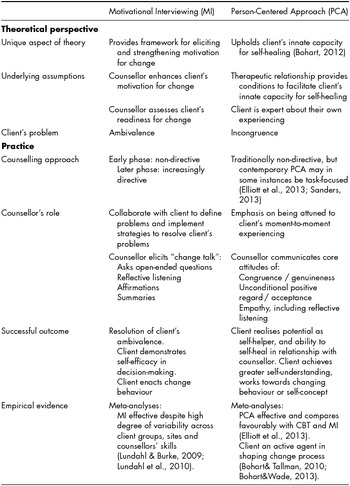
While Miller and Rollnick (Reference Miller and Rollnick2002, Reference Miller and Rollnick2009, Reference Miller and Rollnick2012) acknowledge Rogers' (Reference Rogers1961) emphasis on reflective listening, MI and PCA tend to diverge in several ways, not least in their notions of empathic understanding and reflective listening. In this article, I will contend that PCA is not easily integrated with MI because MI diverges significantly from PCA in both its non-directive and directive aspects. In Table 1, MI is summarised and compared with PCA in terms of theory, practice and evidence-based research. The issues listed in Table 1 serve as the framework for the discussion that follows. The aim of this article is to clarify the differences between MI and PCA and the implications for the practice of rehabilitation counselling.
Comparison of Motivational Interviewing and Person-Centered Approach*

*Note: Unless otherwise indicated, summary of MI is based on Miller and Rollnick (Reference Miller and Rollnick2002, Reference Miller and Rollnick2012) and summary of PCA based on Rogers (Reference Rogers1957, Reference Rogers and Koch1959, Reference Rogers1961).
Unique Aspects of MI and PCA
MI elicits and strengthens the client's own perceptions and motivations for change by helping them to explore and resolve ambivalence. It is assumed that the client is ambivalent about change and will offer resistance if the counsellor argues for change. On the one hand, the counsellor explicitly avoids arguing for change when the client is unwilling to change. On the other, the counsellor will relish the opportunity to engage with the client's pro-change statements, especially those statements that denote a strong commitment. Strength, rather than frequency, of commitment language is more likely to predict the client's own efforts to implement behavioural change according to a specific plan for carrying out the change (see Hettema, Steele & Miller, Reference Hettema, Steele and Miller2005, p.107; Miller & Rose, Reference Miller and Rose2009, pp.531–3).
Carl Rogers was arguably unique in his belief that we should trust in the client's capacity for self-healing (Bohart, Reference Bohart2012). He valued learning from his own experiences in relation to his clients, and he regarded clients as his primary teachers (Rogers, Reference Rogers1961). Recently, trust in clients was added as a key characteristic to the Master Therapist prototype developed by Ronnestad and Skovholt (Reference Ronnestad and Skovholt2013), and is consistent with Rogers' viewpoint (Crisp, Reference Crisp2014). Support for this stance comes from empirical evidence reported in recent meta-analytic reviews (summarised by Norcross & Wampold, Reference Norcross and Wampold2011) that highlighted the importance of three factors, these being: client-perceived empathy that predicts therapeutic outcome better than observer- or counsellor-rated empathy, especially among less experienced counsellors; a strong therapeutic alliance, that is to say a partnership of mutual collaboration between counsellor and client; and client feedback collected regularly by counsellors. From this perspective, clients may be inherently motivated to achieve their goals when they are afforded participation in a collaborative counsellor-client relationship; and when they are active co-managers in their vocational rehabilitation programs (Wright, Reference Wright1983).
Underlying Assumptions
MI privileges empathic listening and its underlying assumption is that people are often persuaded by their own verbalisations for change. The MI counsellor evokes the client's verbalised thoughts and feelings about the advantages and disadvantages of implementing strategies to resolve their problems. This approach is generally considered to be most effective with individuals who are resistant to change or who lack confidence in decision-making. But, it is expected that a client's readiness for change and/or resistance may fluctuate within a single session, and it is a measure of the counsellor's skill that he/she can attend and respond to these fluctuations (Miller & Rose, Reference Miller and Rose2009). It follows that an important ancillary function of MI resides in assessing the client's readiness for change. Proponents of MI often utilise the Transtheoretical Model of Intentional Behaviour Change (see, for example, DiClemente & Velasquez, Reference DiClemente, Velasquez, Miller and Rollnick2002). In this model, change is viewed as a progression from an initial pre-contemplation stage (client is not considering change), to contemplation (client considers the pro's and cons of change), preparation (client plans and strengthens commitment to change), action to achieve change, and maintenance. While these stages of change do not usually occur in a strictly linear sequence, they serve as a guide for the counsellor concerning the extent to which they will be non-directive or directive with the client. Empathic understanding and reflective listening, for example, is likely to be most effective with a client at the pre-contemplative stage. At later stages, MI counsellors utilise “careful listening, summarizing, feedback, double-sided reflections, affirmations” (DiClemente & Velasquez, Reference DiClemente, Velasquez, Miller and Rollnick2002, p.210) as will be discussed below.
In contrast, PCA eschews that type of assessment, and instead assesses the potential for entering into, and maintaining, a therapeutic relationship (Gillon, Reference Gillon, Cooper, O'Hara, Schmid and Bohart2013). While assessment and ‘case formulation’ is typically used by rehabilitation counsellors to ‘make sense’ of a client, it is never used in PCA to determine the methods and means to direct the counselling process. To do so would, from a PCA perspective, undermine the client's own perceptions and experiencing. Being with the client is preferred to doing something to the client. Critical appraisals of PCA point to other perspectives (e.g., cognitive-behavioural therapy, MI) that effectively utilise directive strategies as well as the core conditions of congruence, unconditional positive regard and empathy that Rogers advocated (see, e.g., Goldfried, Reference Goldfried2007; Miller & Rose, Reference Miller and Rose2009; Watson, Reference Watson2007). This issue will be discussed again, below, in relation to empirical evidence.
Client's Problem
Addressing ambivalence is a central task of MI. The client who experiences ambivalence is seen as someone who may disregard advice from counsellors, friends or family. Such advice may be perceived as a threat to their autonomy. They have mixed feelings or conflicting motives about ‘problem’ behaviours that they perceive to hold both benefits and costs. Likewise, implementing change also carries benefits and costs that need to be considered. Miller and Rollnick (Reference Miller and Rollnick2002, Reference Miller and Rollnick2012) stress that an individual's ambivalence is not a sign of pathology or lack of motivation, but a natural and momentary life event that requires the counsellor to adopt the attitudes of acceptance and empathic understanding.
While PCA is well suited to responding to ambivalence, the client's problem is defined more broadly than in the MI literature. The problem, as defined by Rogers (Reference Rogers1957), is the client's incongruence, a “discrepancy between the actual experience of the organism and the self picture of the individual's experience” (p.222) that leads to the distortion or denial of organismic experiences and leaves the individual vulnerable to anxiety and depression. Organismic experience refers to the ways that persons experience themselves and their environment through their bodily felt sense (e.g., physical, sensory, visceral), cognitions and emotions. Rogers (Reference Rogers1957, Reference Rogers and Koch1959) proposed that these experiences are inhibited when persons ‘introject’ the values or conditions of worth (i.e., adverse judgment, disapproval) of significant others to gain social acceptance. Rehabilitation counsellors may also encounter individuals whose incongruence can be attributed to being temporarily overwhelmed by traumatic onset of impairment, change of body image, and the subsequent loss of valued social roles that are at odds with their self-concept (Crisp, Reference Crisp2010, Reference Crisp2011).
Counsellor's Role
MT is applied across two phases, the first phase being non-directive, and the second being increasingly directive. In the first phase, the counsellor focuses on eliciting “change talk” to bring forth the client's speech that favours change. When this has been achieved, the counsellor focuses upon converting “change talk” into a commitment to achieve specific goals and strategies to attain these goals. As mentioned earlier, emphasis is on eliciting a strong “commitment language” (Miller & Rose, Reference Miller and Rose2009, p.531).
In MI, the counsellor's “change talk” consists of the following elements:
• Open-ended questions that are designed to elicit exploration of topics, and to encourage the client to do most of the talking about change;
• Reflective listening that is used to maintain the focus on the client's frame of reference, and to reflect on both sides of the client's ambivalence;
• Affirmations from the counsellor that express his/her appreciation of the client's values and attributes;
• Summaries that are used by the counsellor to encapsulate the essence of the client's ambivalence (Miller & Rollnick, Reference Miller and Rollnick2002, Reference Miller and Rollnick2012).
It is important to note that different forms of reflective listening are used in both the non-directive and directive elements of MI. They are used extensively in both the earlier phase of MI when building motivation for change; and, later, when commitment to change is being strengthened and a plan is being negotiated. In its simplest form, reflective listening is utilised to communicate acknowledgment of the meaning of the client's thoughts and feelings. Other forms of reflective listening (e.g., “double-sided reflection”) are designed to capture or amplify both sides of the client's ambivalence. Counsellors may increasingly use ‘directive’ reflections to switch the focus onto specific aspects of the client's narrative so that the client can examine his or her situation in a different light.
In contrast, PCA counsellors tend to be less inclined to guide clients on how to work on particular types of problems. They may provide resources and offer suggestions when requested by the client. They may also unwittingly display nonverbal gestures that reinforce or guide clients towards talking about certain topics. But, they strive to maintain a non-expert, non-authoritarian role.
MI can best be differentiated from PCA insofar as MI seeks to establish empathic rapport whereas PCA aims for communicative attunement (see Elliott, Bohart, Watson & Greenberg, Reference Elliott, Bohart, Watson and Greenberg2011, p.44). In the former, the counsellor demonstrates compassion and understanding of the client's situation in order to set the context for active problem-solving activities. On the other hand, the PCA counsellor focuses on staying actively attuned to the client's experiencing on an ongoing moment-to-moment basis. It is an attempt to tentatively comprehend the implicit in the client's narrative (Elliott et al., Reference Elliott, Bohart, Watson and Greenberg2011). The counsellor's empathy may be a response to a vague, bodily-felt, pre-conceptual experiencing of the client that he/she has not previously communicated or perceived as an element of self. The counsellor does not attempt to diagnose, interpret, or uncover feelings for which the client is totally unaware. The counsellor's empathy is communicated to the client as provisional and open to being corrected by the client (Rogers, Reference Rogers1975). Empathic understanding is maintained by being as unconditionally open as possible to whatever the client discloses about their moment-to-moment experiencing. Thus, the task of the PCA is two-fold: to acknowledge and understand persons who reveal themselves, and maintain faith in their courage and creativity for self-healing and problem-solving rather than play the ‘expert’ who dispenses advice and implements techniques to resolve the client's problems (Bohart, Reference Bohart, Cooper, O'Hara, Schmid and Bohart2013; Rogers, Reference Rogers1961).
In this sense PCA has challenged the typical therapist-centric view of counselling. Similarly, in recent Master Therapist research, experienced counsellors (with different theoretical perspectives) reported a change of attitude in which they had progressively de-emphasised their power as therapists. Over the course of their careers, they observed “a realignment from self as powerful to client as powerful” (Ronnestad & Skovholt, Reference Ronnestad and Skovholt2013, p.115). This issue arguably poses a challenge for those rehabilitation counsellors who work in organisations that adhere closely to a medical model and/or a legislative mandate that provides clear directives for them to guide and sanction client behaviour. Person-centred counsellors tend to be sceptical of and opposed to mandatory and coercive systems that set standards outside the client's frame of reference. Both PCA and MI counsellors may be appreciated by clients in these systems. As Miller and Rollnick (Reference Miller and Rollnick2012) observed,
. . .a therapeutic approach that is empathic, compassionate, respectful, and supportive of human strengths and autonomy is likely to shine. MI has taken root in caring for some of the most neglected and rejected members of society. It also seems to take hold in systems that have relied too heavily on authoritarian directing (p.381).
Successful Outcome
Proponents of MI regard the indicators of successful outcome as being the resolution of the client's ambivalence, and a clear demonstration of client self-efficacy in decision-making and change behaviour. It is expected that these factors will contribute to clients obtaining and/or returning to work after the onset of injury, and/or better psychosocial adjustment to living with illness or injury (Lloyd, Tse, Waghorn & Hennessy, Reference Lloyd, Tse, Waghorn and Hennessy2008; Page & Tchernitskaia, Reference Page and Tchernitskaia2014; Wagner & McMahon, Reference Wagner and McMahon2004).
From a PCA perspective, successful outcome is defined by the client's movement towards greater self-understanding that enables progress towards making significant choices, and towards changes in behaviour or self-concept (Rogers, Reference Rogers1961). The client realises their potential as a self-helper and their enhanced ability to self-heal in relationship with the counsellor (see Schmid, Reference Schmid, Cooper, O'Hara, Schmid and Bohart2013, pp.72–5). The counsellor-client relationship includes clients as co-managers in the planning, implementation and evaluation of their rehabilitation programs. While evidence-based rehabilitation research has not always identified the counsellor-client relationship as a key variable, PCA has received strong support from evidence-based research in other fields of counselling, as will be discussed below.
Empirical Evidence
There is a dearth of evidence-based research for MI in relation to vocational rehabilitation (Page & Tchernitskaia, Reference Page and Tchernitskaia2014). Rehabilitation counsellors may nevertheless be encouraged to practise MI given the large amount of research that has demonstrated the efficacy of MI for persons with a wide variety of problems. Meta-analyses have consistently indicated that MI is associated with small to medium, but significant, effect sizes across a variety of behavioural outcomes, mostly among persons with addictive and health related behaviours (Hettema et al., Reference Hettema, Steele and Miller2005; Lundahl & Burke, Reference Lundahl and Burke2009; Lundahl, Kung, Brownell, Tollefson & Burke, Reference Lundahl, Kunz, Brownell, Tollefson and Burke2010; Miller & Rollnick, Reference Miller and Rollnick2012). Over 200 clinical trials indicate that MI is often associated with beneficial outcomes when compared with no intervention or brief advice, or when applied with other active treatments such as cognitive-behavioural therapy (CBT).
The largest meta-analysis of 119 studies by Lundahl et al. (Reference Lundahl, Kunz, Brownell, Tollefson and Burke2010) focused on the unique effect of MI compared with other treatments or control conditions. Lundahl et al. concluded that basic MI was most effective as a pre-treatment whereas Motivational Enhancement Therapy (i.e., MI with problem feedback given to client) is valid as a stand-alone treatment. They also found that MI works for clients regardless of the severity of their problems, age, and gender. Effect size of MI was twice as large for persons from certain ethnic minority groups than for persons from the ‘white majority’ (see also Hettema et al., Reference Hettema, Steele and Miller2005). This result suggests that MI may be attractive for persons who have experienced social rejection. Better results were also evident when practitioners closely followed the ‘spirit’ of MI and competently applied change talk; and when they flexibly responded to clients rather than apply a standardised manual in a formulaic way. While MI was more effective for clients who received greater rather than less ‘dosage’ of MI (i.e., greater versus less treatment time), it was found to work as well as other treatments that require more treatment time than MI. In other words, MI was more cost effective (Lundahl & Burke, Reference Lundahl and Burke2009; Miller & Rollnick, Reference Miller and Rollnick2012).
A recent meta-analysis of humanistic-experiential psychotherapies by Elliott, Greenberg, Watson, Timulak and Freire (Reference Elliott, Greenberg, Watson, Timulak, Freire and Lambert2013) yielded similar results to Lundahl et al. (Reference Lundahl, Kunz, Brownell, Tollefson and Burke2010) in studies of persons with substance abuse or other self-damaging activities. Like MI, the humanistic-experiential psychotherapies studied by Elliott et al. (Reference Elliott, Greenberg, Watson, Timulak, Freire and Lambert2013) consisted of two components: one that was characterised by “a genuinely empathic and prizing therapeutic relationship” (p.495); and, the other, “a more active, task-focused process-facilitating” or “process-guiding” (p.496) style that addressed specific problems.
Elliott et al. (Reference Elliott, Greenberg, Watson, Timulak, Freire and Lambert2013) also found that ‘pure’ PCA (i.e., without a “process guiding” or psycho-educational component) “appeared to be consistently, statistically, and practically equivalent in effectiveness to CBT . . . even without controlling for researcher allegiance” (p.502). However, the evidence for the PCA core conditions of congruence, unconditional positive regard and empathy is mixed: empathy is a stronger predictor of outcome than congruence and unconditional positive regard (Norcross & Wampold, Reference Norcross and Wampold2011). Another recent meta-analysis by Elliott et al. (Reference Elliott, Bohart, Watson and Greenberg2011) found that empathy is no less important in other counselling orientations than in PCA. In other words, an empathic attitude is an essential component of any counsellor's work regardless of their theoretical orientation. Moreover, the counsellor's empathic understanding depends on the client's openness to communicating their inner experiencing.
But, what is the extent of the client's role in influencing what happens in their relationship with the counsellor? Reviewing empirical evidence from a person-centred perspective, Bohart and colleagues (Bohart & Tallman, Reference Bohart, Tallman, Cooper, Watson and Holldampf2010; Bohart & Wade, Reference Bohart, Wade and Lambert2013; Elliott et al., Reference Elliott, Bohart, Watson and Greenberg2011) argued that clients actively shape the therapeutic process; for example, they influence the counsellor's empathy by choosing how much they communicate their inner experiencing and/or respond to the counsellor's expressions of empathy. Clients may use the counsellor's empathy to obtain support if they are looking for support; or for insight-giving if they are seeking insight. They may combine what they learn with their own agendas and schemas to arrive at solutions that are odds with the counsellor's perceptions. They may engage in covert reflection while overtly deferring to the counsellor; creatively misinterpret the counsellor; use ‘unhelpful’ chance remarks and ignore those the counsellor regards as ‘helpful’; work to their own agenda even when they seem to be passive, resistant; and they may ignore or ‘work around’ bad (e.g., non-empathic) responses and use what is beneficial to them.
Thus, rehabilitation counsellors need to be attentive to how clients process information, utilise rehabilitation services, achieve their own insights, and contribute to change. Rehabilitation counsellors may achieve better outcomes by regularly seeking feedback (e.g., session by session) from clients, being responsive to clients' concerns or complaints, and being prepared to admit mistakes.
Limitations
MI research indicates a very high degree of variability in effect sizes across studies, different sites and clinicians' skills (Miller & Rollnick, Reference Miller and Rollnick2012; Miller & Rose, Reference Miller and Rose2009). In particular, the efficacy of MI is determined by differences in the clinical skills of MI practitioners in terms of their ability to co-create with clients a therapeutic relationship, and to elicit change talk. It is likely, for example, that the effectiveness of MI practitioners whose competencies reside in one or both of these skills (e.g., empathy and/or change talk) may yield different results across a range of clients and clinical settings.
Overall, there is still a lack of understanding about MI in relation to “the precise links between its processes and outcomes” (Lundahl et al., Reference Lundahl, Kunz, Brownell, Tollefson and Burke2010, p.154). Several trends are, however, evident. MI is likely to be most effective with individuals rather than in a group format (Lundahl & Burke, Reference Lundahl and Burke2009). In groups, it may be more difficult to empathically respond to individuals who vary in confidence, self-efficacy, and their readiness, or strength of commitment, to change their behaviour. For individuals not receiving any other treatment, Motivational Enhancement Therapy (i.e., MI with problem feedback given to client) is more likely to be effective than basic MI. But, the latter in conjunction with CBT, or other treatments, is recommended (Lundahl et al., Reference Lundahl, Kunz, Brownell, Tollefson and Burke2010).
Critics of PCA have argued that developing a therapeutic relationship alone is insufficient. They also advocate utilising techniques since “techniques help to build the relationship, which then allows other techniques to be used, which in turn facilitate a deeper relationship and enable external changes” (Hill, Reference Hill2007, p.263). It has also been argued that counsellors need to determine when, and for whom, a more guided and structured approach is indicated (Goldfried, Reference Goldfried2007; Watson, Reference Watson2007). Rogers has been criticised for taking a ‘one size fits all’ stance (Hill, Reference Hill2007; Silberschatz, Reference Silberschatz2007). This criticism is difficult to counter; for example, evidence-based research indicates that directive strategies tend to suit those clients diagnosed with anxiety who want guidance to learn skills to manage painful emotions and reduce symptoms, and who are reluctant to focus upon their anxiety-provoking experiences in interpersonal relationships (Elliott et al., Reference Elliott, Greenberg, Watson, Timulak, Freire and Lambert2013). Consistent with this finding, MI integrated with CBT was found to be effective in the treatment of anxiety disorders (Lundahl et al., Reference Lundahl, Kunz, Brownell, Tollefson and Burke2010).
Conclusion
Can Motivational Interviewing be truly integrated with person-centered counselling? Despite MI being commonly regarded as an evolution of PCA, I argued that the theory and practice of MI is fundamentally different from PCA. These differences were discussed in relation to the unique aspects of each perspective, their underlying assumptions, how they define clients' problems, and how they articulate the role of counsellor and successful outcome.
Empirical evidence for the efficacy of both MI and PCA is strong across a range of client groups and health care settings. However, the highly variable effectiveness of both MI and PCA suggests that further process-outcome research is needed. Differences in practitioners' skills and competencies as well as the relative contributions of the relational and technical components of MI practice need to be clarified (Lundahl et al., Reference Lundahl, Kunz, Brownell, Tollefson and Burke2010; Miller & Rose, Reference Miller and Rose2009). These issues are also a matter of ongoing concern in the contemporary PCA literature (see, for example, Bohart & Wade, Reference Bohart, Wade and Lambert2013; Elliott et al., Reference Elliott, Greenberg, Watson, Timulak, Freire and Lambert2013; Sanders, Reference Sanders, Cooper, O'Hara, Schmid and Bohart2013). These same issues should matter to rehabilitation counsellors involved in both practice and research.