Introduction
Police reform remains an urgent concern in a number of countries, including those outside the advanced industrialized democracies. To this end, several nations have initiated measures to improve the functioning and perception of law enforcement, such as quotas for women and minorities (Karim et al. Reference Karim, Gilligan, Blair and Beardsley2018; McCrary Reference McCrary2007), as well as the establishment of specialized police stations and help desks for vulnerable groups (Santos Reference Santos2004).
Most academic scholarship on policing has focused on the persecution, abuse, and killings of ethnic or racial minorities (Lerman and Weaver Reference Lerman and Weaver2014; Soss and Weaver Reference Soss and Weaver2017). Yet women may also face a form of police discrimination rooted in exclusion, such as difficulty accessing police stations, family or community pressure against coming forward, and even dismissive attitudes by law enforcement officials about assault (Human Rights Watch 2009; Iyer et al. Reference Iyer, Mani, Mishra and Topalova2012). The goal of gender-based hiring quotas and “enclave” police stations for women is to make law enforcement more accommodating for female complainants and more responsive to cases involving sexual and domestic violence (Karim Reference Karim2017; Perova and Reynolds Reference Perova and Reynolds2017).
Enclaves are physically distinct, autonomous units in which constituent members belong entirely to a particular identity. The assumption underpinning enclaves is that the segregation of women (or minorities) in group-specific institutions will better serve their interests. For example, in police stations run by policewomen for female victims of crime, administrators and clients will be theoretically unencumbered by patriarchy; similarly, women will be more likely to see justice in a women-only court that hears gender violence cases, while female judges working in the institution will also be empowered.Footnote 1
Are enclaves effective at articulating and accommodating the interests of vulnerable groups? I study the Indian experience of all-women police stations through eight months of ethnographic research in the states of Haryana and Uttar Pradesh. I investigate whether such police stations, a form of “descriptive representation” for women in law enforcement, generate “substantive representation” for in-groups (Mansbridge Reference Mansbridge1999; Pitkin Reference Pitkin1967). Specifically, I assess the impact of enclaves on empowering policewomen and, indirectly, on victims of gender-based violence by providing female administrators with more responsibilities or increasing victims’ access to police services.
The findings suggest that all-women stations provide standard police stations with an excuse to lighten their caseloads. All-women police stations are also more likely than standard police stations to practice an informal type of complaint resolution: “counseling” and reconciliation with abusers. With regard to female administrators, I find that enclaves may prevent policewomen from gaining the same experience as men by relegating them to tackling specific cases at the expense of diverse forms of police work, potentially reinforcing gender stereotypes that women are best suited for “women's work” (Martin Reference Martin1982, Reference Martin1999; Rabe-Hemp Reference Rabe-Hemp2009). I argue that group-specific measures may create challenges for both administrators and clients.
This article is structured as follows: First, I situate the discussion of enclaves within the social science literature on representation and highlight the theoretical foundations behind separatism as a social strategy. Next, I use survey data to contextualize violence against women in India and point to the intuition of policy makers in creating separate spheres. Then, I carry out an ethnographic analysis of all-women police stations and use these institutions to make a larger claim about the inefficacies associated with segregation as a delivery mechanism for public services.
Representation and Law Enforcement
The impacts of quotas or affirmative action measures for vulnerable groups have been studied vis-à-vis a range of outcomes.Footnote 2 This literature shows that a demographically inclusive political body (descriptive representation) generates substantive outcomes—for example, the presence of women in politics improves attitudes toward leaders (Beaman et al. Reference Beaman, Duflo, Pande and Topalova2012), changes gender norms (Beaman et al. Reference Beaman, Chattopadhyay, Duflo, Pande and Topalova2009), and promotes development (Chattopadhyay and Duflo Reference Chattopadhyay and Duflo2004). There is also a robust literature on the impact of representation for women in unelected state agencies (Keiser et al. Reference Keiser, Wilkins, Meier and Holland2002; Riccucci, Van Ryzin, and Li Reference Riccucci, Van Ryzin and Li2016). This literature, part of a broader academic discussion of “representative bureaucracy,”Footnote 3 suggests that the presence of women in law enforcement increases trust in the police as well as registrations of sexual assault or domestic violence (Meier and Nicholson-Crotty Reference Meier and Nicholson-Crotty2006; Miller and Segal Reference Miller and Segal2019).
However, research on the impact of “representative” police forces in the Global South has yielded mixed results (Karim Reference Karim2020; Karim et al. Reference Karim, Gilligan, Blair and Beardsley2018),Footnote 4 and existing scholarship has largely been restricted to affirmation action. Nevertheless, quotas are just one variant of representation. Policy makers have considered alternative measures based on the intuition that, even with affirmative action, vulnerable groups would likely still be constrained by the majority (Sabha Reference Sabha2012); instead, group-specific enclaves would potentially ensure that administrators are able to interact with and be responsive solely to in-groups (Kethineni and Srinivasan Reference Kethineni, Srinivasan and Unnithan2013; Nelson Reference Nelson1996; Santos Reference Santos2004). For example, while a gender quota for the police would still enable female officers to work on diverse cases, and a similar policy in a village council would ensure that a woman elected leader (sarpanch) remains answerable to male villagers, group-specific bodies would associate female administrators with in-group complainants and gendered concerns alone.
Some scholarship suggests that enclaves can be empowering. In Tamil Nadu, for instance, policewomen enjoy working with other female officers because it fosters a sense of camaraderie (Natarajan Reference Natarajan1996, Reference Natarajan2005). Mangai Natarajan (Reference Natarajan2008) notes that in standard police stations, women primarily do clerical work; yet all-women stations allow policewomen to advance their careers along a parallel track that is less dominated by men. This author argues that institutional segregation is effective for women in “traditional societies” because it provides a “backdoor to equality.”Footnote 5
On the other hand, scholars of Brazil are more reserved. The first all-women police station in Latin America was opened in São Paulo in 1985 as a way to create new jobs for policewomen as well as to improve services for victims of sexual violence (Santos Reference Santos2004, Reference Santos2005). Some feminists were skeptical that such a “separatist strategy” would be beneficial, because, they argued, women do not have innate talents in assisting other women, and since policewomen operate in the same cultural milieu as men, biases and bureaucratic incentives would likely remain constant (Santos Reference Santos2004, 30–36). Evidence suggests that Brazilian policewomen in all-women police stations may sometimes be more dismissive of gender violence than policemen in an effort to be seen as worthy by the bureaucracy. Policewomen may not want to work in segregated institutions either, if doing so comes at the expense of carrying out frontline work (Hautzinger Reference Hautzinger2007; Nelson Reference Nelson1996).
Separatism as a Strategy and Policing in India
Separation from men as a form of empowerment has its roots in the first wave of American feminism during the late nineteenth and early twentieth centuries, when activists appropriated the notion of “separate spheres”—which previously had been used to reinforce norms of women in domestic roles or a gendered division of labor—to challenge patriarchy (Kerber Reference Kerber1988; Marshall Reference Marshall1986; Rosenberg Reference Rosenberg1982). Estelle Freedman (Reference Freedman1979) notes that “separate spheres” became a strategy to develop all-female institutions such as women's colleges, political parties, health clinics, trade unions, and so on. The creation of homogenous physical spaces and institutions, it was argued, would enable women to speak freely and gain a footing in bodies previously denied to them (Schulz Reference Schulz2004).
Nonetheless, some argued that embedded within separate spheres was a paradox—that is, group-specific institutions promoted gender differences by reinforcing an exclusively “male” domain against which women-only bodies could be measured (Craig Reference Craig1994; Kessler-Harris Reference Kessler-Harris1989). Early American feminists such as Jane Addams and Crystal Eastman were aware of the dilemma of creating institutions that excluded men while removing barriers to gender equality (Craig Reference Craig1994); there were even anxieties about women's colleges inadvertently preparing men for prestigious jobs by training women for less valued “women's work” (Spain Reference Spain1993, 140).Footnote 6
In the early twentieth century, American feminists created the first all-women police stations in the United States, called Women's Bureaus.Footnote 7 Proponents of the Women's Bureaus contended that all-women police stations were effective because policewomen were fairer and better suited for gendered cases, and such bodies would provide policewomen more responsibilities while giving policemen time to deal with “urgent” cases (US Congress 1925).Footnote 8 However, certain senators and congressmen disagreed, believing that group-specific institutions had the potential to create a system of pass-the-parcel by inducing existing stations to turn over their gendered cases to women-only institutions.Footnote 9 Eventually, all-women police stations in the United States were largely abolished by the end of World War II, when norms about group-specific measures changed. There would be no large-scale implementation of such institutions until Brazil did so in 1985, followed by India in 1992.
Today, India houses the largest number of all-women police stations.Footnote 10 In fact, the broader idea of separate, group-specific arrangements as a vehicle of empowerment has a long history in the subcontinent. Prior to independence, there was a robust debate about the efficacy of separate electorates.Footnote 11 While nationalists such as Aruna Asaf Ali and Shrimati Renuka Ray considered (but ultimately disfavored) gender quotas in legislative institutions (Government of India 1999), freedom fighters such as Santi Das and Sarala Devi Chaudhurani supported separate electorates for women (Forbes Reference Forbes1999, Reference Forbes2005). Interestingly, debates about quotas versus group-specific measures were not restricted to politics. Following the Emergency, the government-appointed National Police Commission (1977–81) outlined the need to increase participation for female officers in the police:
In fact, employment of police women in the investigative processes . . . of kidnapping, abduction, rape, etc. will be very useful as victims will be more willing to talk freely to women police officers and furnish vital information essential for the investigation and prosecution of such cases . . . Such a role will also help in improving the general image of the police with the public . . . Women police, in our view, have a greater potential to cool, defuse and de-escalate many situations, and therefore greater use should be made of them than at present . . . Many women victims of crime are usually deterred from going to the police stations to make a complaint because of [a] lack of confidence in having a sympathetic and patient hearing at the police station. The presence of women police in police stations would greatly help in creating such confidence and trust in the police. (Vira and Reddy Reference Vira and Krishnaswamy Reddy1980, 57)
The push toward increasing the presence of women in law enforcement ran parallel with another proposal: separating policewomen in their own bureaus, isolated from policemen. Ultimately, the National Police Commission disfavored the idea based on an intuition that such a strategy may, on the pretext of empowerment, in fact hinder the professionalization of policewomen (Vira and Reddy Reference Vira and Krishnaswamy Reddy1980; PTI 1983). The commission noted,
We do not favor the present practice in some states of constituting a separate women['s] police wing or branch and confining recruitment and promotion in it to women in that branch only. Apart from its being an exclusive branch secluded from the general police stream, promotion prospects in a small branch will remain limited and restricted. (Vira and Reddy Reference Vira and Krishnaswamy Reddy1980, 59)
The Introduction of All-Women Police Stations in India
Following the 1980s, as new laws against gender violence were enacted,Footnote 12 the state of Tamil Nadu, led by Chief Minister J. Jayalalitha, decided to roll out all-women police stations (Natarajan Reference Natarajan2008; Ruiz Reference Ruiz2006). The institutions fused the notion of women being suited for tackling gendered crimes with the idea of physical separation in group-specific bodies in which female administrators would be under their own supervision and could work entirely with female staff.Footnote 13 The special stations are identical to standard police stations, except that they are run by and for women.Footnote 14 The institutions are tasked with investigating (gendered) crimes of the Indian Penal Code (see table 3 in the online appendix) and registering First Information Reports (FIRs), which are a complainant's first step toward formal access to justice. Policewomen may be stationed by their superiors at a standard station or in the female-only unit, which is typically located in the district headquarters. A victim of gender-based violence may theoretically register a crime at the standard station near where the crime occurred or the segregated unit.
Following Tamil Nadu, other state governments began experimenting with all-women stations. The cities of Lucknow (Uttar Pradesh) and Bhagalpur (Bihar) introduced their first units in 1993 (Rao Reference Rao1993) and 1995 (TNN 1995), respectively. Some feminists and human rights groups in India expressed skepticism about a large-scale rollout. As early as 1993, women activists argued, “Of course, a woman may feel comfortable speaking to another woman, whether a police officer or not. But care must be exercised that this practice does not make general police stations unapproachable,” or “If all cases of domestic violence are forwarded to an all-women police station it may also create an impression in the long run that women police officers should tackle women's problems only” (Rao Reference Rao1993).
In 2002, the National Conference for Women in Policing began calling for a 33 percent gender quota in the police. In 2009, adopting some of the conference's recommendations, the federal government began issuing advisories to state governmentsFootnote 15 urging them to install any mechanism they saw fit to promote the participation of women in law enforcement, including women's help desks in standard stations, group-specific police stations, and/or hiring quotas (Home Secretary 2009, 2013). Following the 2009 advisory, however, states were reluctant to adopt the 33 percent gender quota; instead, there was enthusiasm among policy makers for adopting all-women police stations. From 2009 to 2012, the number of all-women stations increased from 1 to 40 in Bihar, from 12 to 71 in Uttar Pradesh, and from 8 to 31 in Gujarat.
All-women stations were seen as a means to display a progressive vision on gender justice without the more costly policy of changing hiring practices; essentially, the exiting staff of policewomen could simply be posted to a separate building. The state of Haryana, for instance, adopted all-women police stations in 2015 but did not implement a gender quota; on the other hand, Maharashtra consciously eschewed enclaves in place of increasing the number of policewomen and ensuring that some were posted at every regular station (Sabha Reference Sabha2012). In fact, the federal government had to reprimand state governments for not implementing a quota: “The Ministry of Home Affairs had issued an advisory . . . whereby the States/UTs were requested to raise the women representation in police to 33 percent. However, it is a matter of concern that not much has been done in this regard, except for a few states” (Home Secretary 2015).
The gang rape of a college student in New Delhi in 2012 created a new urgency for enacting policies to mitigate violence against women. Indian law required that a woman police officer be present for the recording of a female complainant's testimony (Government of India 2013).Footnote 16 However, this raised a potential concern: the implementation of physically separate all-women police stations (which associated policewomen with investigating rather than just recording gendered crime) would move existing female officers to separate institutions, thereby potentially making it less likely that they could be present for the recording of a female victim's testimony at standard stations (Gilmore et al. Reference Gilmore, Srivastava, Daruwala and Prasad2015; Jha Reference Jha2016).Footnote 17 In fact, even the federal government acknowledged potential challenges associated with enclaves by noting,
For complainants too, it is difficult to contemplate filing a complaint with the AWPS [all-women police station] when the well-known nearby police station could provide the necessary succor. The existence of an all-women police station is also cause for diverting all such complaints to the AWPS by regular police stations which is also not desirable. (Sabha Reference Sabha2012, 40)
Gender Norms in Haryana and Uttar Pradesh
To evaluate the efficacy of enclaves, I turn to Uttar Pradesh (UP) and Haryana's all-women police stations. UP has housed all-women police stations since the mid-1990s, while Haryana implemented its units in 2015. This enables me to investigate the impact of two sets of all-women police stations, one decades old compared with a more recent intervention. In so doing, I am able to hold constant factors such as culture and language; both UP and Haryana belong to the Hindi-speaking heartland, a region that retains particularly regressive gender norms.
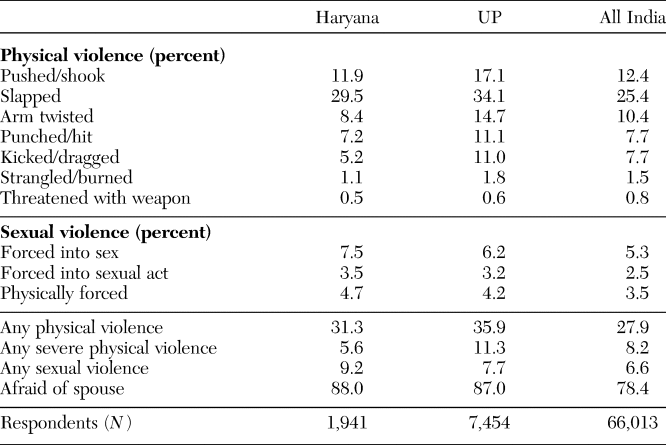
I consider data from two modules of the 2015–16 Indian National Family Health Survey that highlight the similarities between Haryana and UP in terms of the abuse that women face and the ways in which such violence is internalized. Table 1 shows that in Haryana and UP, respectively, about 31 percent and 36 percent of women report some form of physical violence (e.g., being pushed, slapped, or punched), and about 6 percent and 11 percent report severe physical violence (e.g., being kicked, strangled, or threatened with a weapon). A striking statistic is that about 9 percent and 8 percent of women report sexual assault by their husband; this is noteworthy considering there is no law against marital rape (Chhibber and Jassal Reference Chhibber and Jassal2018b).
Women's Experience of Physical and Sexual Violence in India
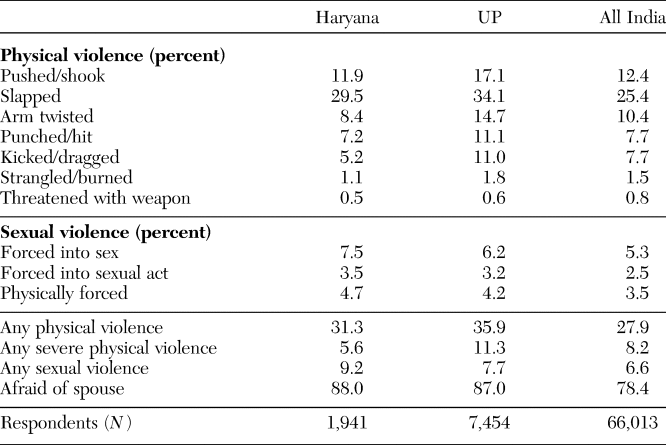
Notes: Percentages of women in Haryana, Uttar Pradesh, and all India, ages 15-49, who experienced violence by their husband. Any physical violence refers to being pushed, slapped, having one's arm twisted, and punched. Any severe physical violence refers to being kicked, strangled/burned, and/or threatened with a knife/weapon. Answer choices for afraid of spouse reflect those who responded “most of the time” or “sometimes.” Analysis is based on the National Family Health Survey 4.
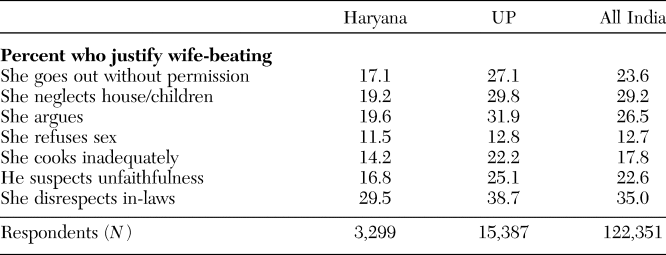
Table 2 reveals two points. First, a significant proportion of women believe that wife beating is justified. Of female respondents, between 17 percent and 20 percent in Haryana and between 22 percent and 32 percent in UP believe that it is justified to beat a wife if she goes out of the house without permission, neglects the house or children, argues, cooks inadequately, or is suspected of being unfaithful. Approximately 12 percent of women in both states believe it is justified to beat a wife if she refuses sex. The highest figure is in the category of “disrespect toward in-laws”: 30 percent and 39 percent of women in Haryana and UP, respectively, believe wife beating is justified if a woman disrespects her husband's family.
Attitudes among Women about Spousal Violence
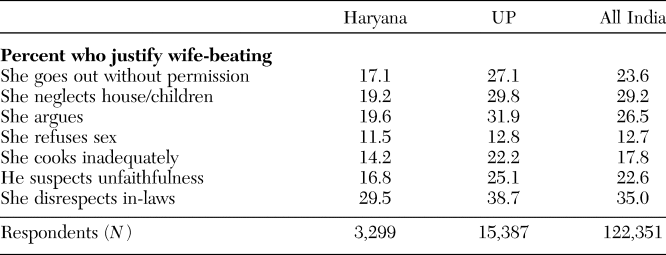
Notes: Percentage of women in Haryana, Uttar Pradesh, and all India, ages 15–49, who believe that wife beating is justified for the listed reasons. Analysis based on the National Family Health Survey 4.
Second, based on the table, it can be inferred that if women believe that it is justified for them to be beaten in a variety of contexts, then it is likely that victims of violence—especially abuse by a husband or in-laws—would turn to the police only as a last resort. In other words, it is important to contextualize the following analyses by noting that women who visit a police station in Haryana and UP to register a crime have likely suffered significant hardship to have taken the step of approaching law enforcement.
All-Women Police Stations: An Ethnographic Analysis
I visited more than a hundred police stations in the region and carried out observational and interview-based research (Patton Reference Patton1990; Schutt Reference Schutt2018). I visited two to three standard and all-women police stations in each of Haryana's districts; in Uttar Pradesh, I visited police stations in the east (Varanasi, Jaunpur) as well as in the west (Noida, Meerut).Footnote 18 In total, I interviewed approximately 180 police officers.
The reason for carrying out interviews is simple. A non-interpretivist method would define some objective measure of “police efficacy” or “access to justice” (e.g., registrations of crime) and categorize outcomes that conform to that definition (e.g., the number of registered reports in a particular station) (Jassal Reference Jassal2020). However, police officers in India may have their own definitions of “access to justice,” which is why it is important to ask them directly to gauge how they experience and understand such concepts (Patton Reference Patton1990).
Upon arriving at a police station, I introduced myself and the research agenda to the station house officer (SHO) (see the “Template Recruitment Script” in the online appendix). The officer had the ability to choose the location of the interview, and invariably decided to do so in his or her office. While the SHO would often ask to clear his or her office, it was not unusual for deputies and complainants to enter the room midway through the interview and give the SHO paperwork or have him or her take a telephone call. After completing my interview with the SHO, I asked permission to carry out additional interviews with deputies at the station. The rest of the interviews were largely carried out with sub-inspectors, assistant sub-inspectors, and constables. (My interviews focused on officials from the state cadre because they—unlike senior officers from the Indian Police Service bureaucracy—carry out most policing on the ground.) The SHO did not have a role in identifying or selecting other police officers to be approached. Interviews with the SHO's deputies took place in a separate office within the police station or outside. It was easier to carry out interviews with deputies in privacy and without interruption because they were not always restricted to an office. At no time could the SHO hear the responses given to me by the deputies.Footnote 19 Each interview lasted approximately 30 minutes per officer and occurred at anytime between 9:00 a.m. and 8:00 p.m.
To mitigate social desirability bias, I took a number of steps. I informed respondents that they were free to skip, ignore, or decline to answer any or all questions. In addition, information was collected anonymously for all respondents. I took down only basic demographic information and my notes were categorized as, for instance, “Assistant Sub-Inspector 2, X Police Station, Date.” On occasion, when a sensitive topic arose, I reiterated to the officer that his or her identity would remain anonymous. Almost all the officers I interviewed provided consent and seemed more than eager to participate.
Still, even when taking steps to mitigate social desirability bias, interviews with public officials come with unavoidable challenges—for example, officials may seek to provide answers that are not detrimental to their professional standing. When public servants are conscious that they are being observed, it may generate reactivity (Bouchard Reference Bouchard1976). For this reason, I supplemented interviews with observation-based research by recording the routines and habits of officers as well as the dynamics inside the station. Because ethical guidelines of research precluded me from directly interviewing victims of sexual and gender-based violence, by simply being present at the station, I was able to observe officers’ interactions with victims. I spent up to four hours at each police station as a “fly on the wall.” Since a public setting like a police station can be a hotbed of activity, my presumption was that any social desirability bias associated with my presence or identity would diminish after an extended period of time as officers become engaged with or distracted by other responsibilities. Moreover, I never gained the impression that any complainant was concerned about my presence; despite being a male researcher at the station, I was one of dozens of individuals at the institution at any given time that may have included escorts sitting in the waiting room, drivers, or other male family members of complainants.
Finally, in ethnographic research, it is important to identify oneself and acknowledge how one is a part of the construction of the material (Rubin and Rubin Reference Rubin and Rubin2012; Wedeen Reference Wedeen2010). Therefore, in forthcoming descriptions, I highlight the questions that I asked in order to contextualize and be transparent about the way in which the information was obtained. The interviews were carried out in Hindi; the notes for the interviews and observations were transcribed at the end of each day they were conducted.
Multiple Jurisdictions
When I arrived at Jaunpur's all-women police station on September 27, 2017, it was already nighttime. I met two women police officers (a sub-inspector and a note taker or munshi sitting on a cot outside the station). They informed me that the SHO was away, but they agreed to answer my questions. The policewomen were eager to vent to me about how dissatisfied they were about being posted at an all-women station.Footnote 20
The policewomen disliked the fact that they were away from their families, which would not be the case if they were posted at a standard (or zonal) police station, and they underscored that policemen use the enclave to lighten their own caseloads. I began by asking the sub-inspector how many officers work at the institution. The sub-inspector said, “15 or so, but there are just two officers—me and the SHO. It's tough because we answer to the whole district—and we go wherever we have to. So, going and investigating can be a bit of a challenge in a way that would not be at a normal thana [police station].”
“Do many complainants come to you?,” I asked.
The sub-inspector responded, “Yes, but largely when complainants get forwarded here. That's when the madam [the SHO] investigates it. Most cases do not come directly. FIRs [crime reports] are sometimes registered here but very, very few.”Footnote 21
“What are your hours?,” I asked.
No hours. We have to be here 24 hours. We have to be physically present for 8 hours but we can be called anytime. If there's been a murder, and a woman is crying, we often have to go to wherever the incident occurred. I have to pay for my own private room. We get an allowance but it doesn't cover rent entirely. For women police officers, it's a huge inconvenience.
The policewomen described not only how the physical segregation isolated them from mainstream police work, but also how all-women stations—in addition to forcing complainants to travel longer distances to access justice—create inefficiency because there are times when a woman needs to be interrogated or asked questions at other venues.
At this moment, the munshi interjected: “My family life is being ruined. I have to live here. I barely get to see my family. I want to be posted in a zonal police station closer to home. Male officers just have their work, but we have dual roles.”
After some time, the SHO arrived in a Jeep with her driver. After introducing myself and my research agenda, she invited me into her office. Eager to answer my questions, and having called for tea, she asked me to begin my inquiry. I began by asking her thoughts about the efficacy of all-women stations.
The SHO noted,
There's nothing inherently wrong about the concept of an all-women station. There's work here, too. But some basic resources should be brought it. There are some advantages of being a gent's thana. The gent's police stations have more records and archives. We don't have registers or records of people who have been accused repeatedly of offenses. The basic amenities that a sub-inspector needs are only available at a gent's thana.
In the exchange, the SHO hinted that these dynamics would be less likely to occur if she were posted at a standard police station. Like the sub-inspector and the munshi, the SHO expressed that the all-women stations have a lot of work because standard police stations around Jaunpur use the enclave as an opportunity to lighten their own loads.
The SHO continued,
We will have to go to the very outskirts of a whole district in UP if necessary. So, a woman officer will go, along with four or five constables. But the other officers think we do not have work, so they send us more rape cases! We are posted here, but when sometimes they need a complainant to talk about what happened, they call us. That's why often when a zonal officer at a gent's police station needs our help, he sends for us to speak to an aggrieved female victim. And we have to go there, too.
In this way, not only are gender violence cases passed on to all-women police stations, but also the segregation of policewomen manifests in fewer resources (at least in UP) and isolation. There is also a disconnect in that policewomen think that policemen at the standard stations have little work to do because policemen are not responsible to a whole district; then again, policemen at standard stations believe that all-women stations have few responsibilities because the institutions are only associated with gendered crimes. This incongruity likely plays a role in inducing officers at standard stations to deflect gendered cases, potentially affecting complainants’ access to services because they are forced to navigate this maze created by multiple jurisdictions.
A sub-inspector at the all-women station in Varanasi was even more explicit about bureaucratic inefficiency. When I visited the institution on September 26, 2017, she underscored that because all-women stations cater to a whole district but the institutions get the same monetary allowance as standard stations, the physical segregation makes it difficult to carry out investigations. She said,
Money is tight. We have to spend some of our own money at these police stations sometimes. Because we cater to a whole district, sometimes we have to go far. Petrol costs money, and we have a set allowance. So, we have to ask money from the people who want the investigations done. And then people think that we are corrupt—we are not corrupt, that's the situation we face! And if you spend money on each investigation, what are you going to feed your kids? The Station House Officer gets a driver, but we get nothing. And we are the ones who are often doing the investigating. So, if the Station House Officer is not here and the car isn't available, we have to hire a tempo. I'm also a sub-inspector like the Station House Officer but I don't get the same resources when posted at the all-women station because I have to do so much traveling.
“Don't you get reimbursed?,” I asked.
The sub-inspector said,
No. If I go outside the city, yes. It comes after a year or two. Any place around Benaras I will have to spend my own money if the car isn't free. So, these are the problems with an all-women station. And on top of that, all-women stations are not taken that seriously by other officers, who keep shuffling off crimes to us that they feel are beneath them.
I asked the sub-inspector, “So you also register heinous gendered crimes like rape?”
If a woman is raped—sometimes it's better for her to register the crime in the gent's police station. If a woman is raped, the police officers of the gent's thana in that particular zone might arrive at the scene more quickly than we can—we are in the district headquarters. Even we as lady officers posted here sometimes encourage women victims to go to the local police station so the male officers can catch the culprit quickly. The guy [suspect] may run away by the time the complainant comes all the way here, in which case who are the police going to interrogate?
Puzzled at the repeated use of the phrase “gent's police station,” I said, “It's interesting that you refer to the other police stations as ‘gent's thanas.’ Aren't policewomen also posted at normal police stations—shouldn't victims feel comfortable reporting crimes there or to the female officers posted there?”
“There, you might have two or three female officers. Four tops. Police stations sometimes have 80–90 police. So, if a victim goes there, she will really just see mostly men. Here you have all women. But, still, it's sometimes better for the complainant to go to the gent's thana.”
My sense was that the creation of all-women police stations—without clear jurisdictions outlining responsibility for investigating gendered crimes—affects not only the complainants, but also policewomen's morale and sense of worth. Female officers referred to standard police stations as “gent's thanas,” suggesting that the creation of all-women stations impacts police jargon such that now a standard police station is seen primarily as a man's domain.
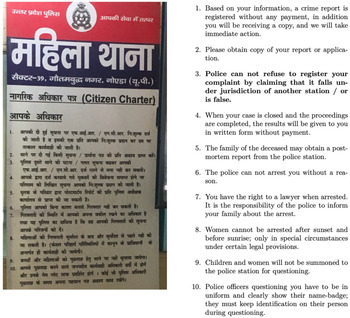
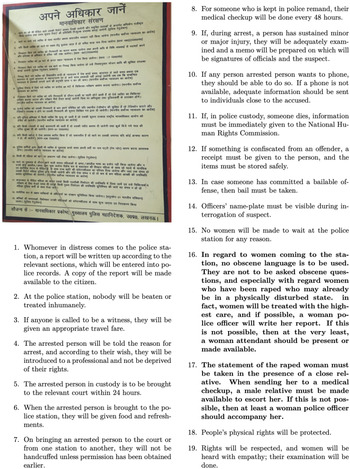
Figure 1 shows a photograph taken inside a UP station. The board—which highlights rules to be followed by officers—is revealing. It illustrates that citizens are not supposed to be turned away. Rule 3 explicitly states that officers cannot refuse to register a complaint if they believe it to be false or exaggerated, and citizens cannot be turned away with the excuse that the case falls under the jurisdiction of another station (colloquially referred to as “burking”). Another board inside a standard police station (Figure 2) outlines that women police officers should, if possible, help in the recording of female victims’ statements. Yet, because most policewomen are posted at all-women police stations, the inaccessibility of policewomen at standard stations makes it more challenging to assist female victims in distress when they approach zonal institutions.
“Know Your Rights” Board Inside UP Police Station (emphasis added).
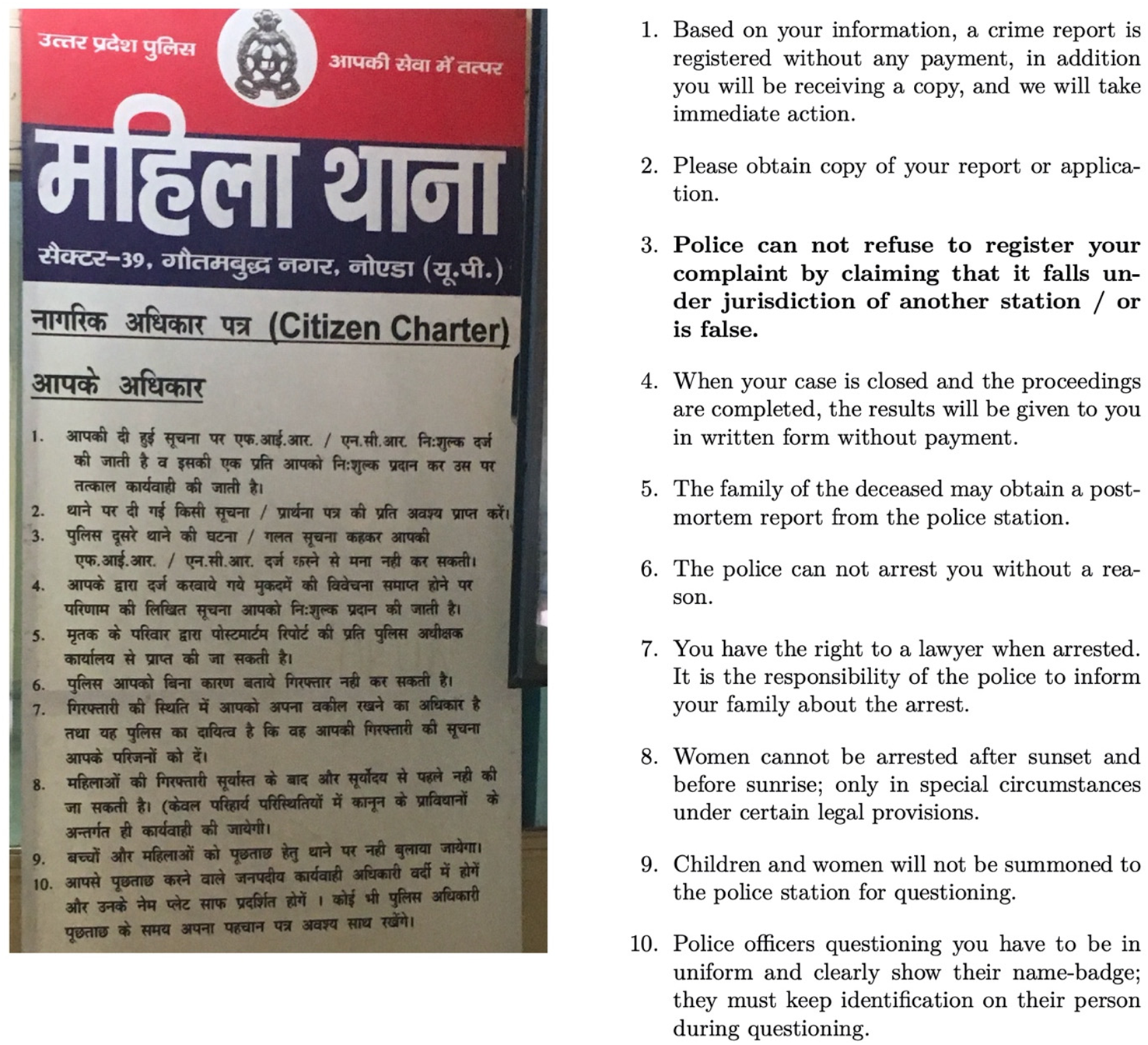
“Know Your Rights” II (emphasis added).

Institutional Norms and Reconciliation
In some contexts, all-women police stations are associated with the “counseling” of female complainants. Some have referred to counseling as “forced moralizing” (Johari Reference Johari2019), whereby officers caution women against registering crime reports by raising discussions about the victim's status in relation to the marriage or community. Because standard police stations tackle all forms of crime (and therefore are hubs of activity), there are fewer opportunities and simply less time for (male) officers to spend time mediating between victims and abusers. If, for instance, at a standard police station, an officer believed a case to be frivolous, it would likely simply be dismissed. On the other hand, at all-women police stations—because the institutions are associated with gendered crimes only—there is more room to encourage complainants to change their behavior.
One may ask, what purpose does a resolution to a gender violence case in the form of counseling or mediation serve as opposed to the arrest of a suspect? Gender-based crimes, and dowry harassment in particular, are among the most common forms of complaints brought forward in India. Counseling enables cases to be resolved in an informal fashion to the benefit of the bureaucracy without “clogging” an overburdened criminal justice system. Then again, while counseling may be used for cases of domestic violence (Kethineni and Srinivasan Reference Kethineni and Srinivasan2009), discussions with police officers, including policewomen, reveal that counseling victims of marital rape is also seen as preferable to filing cases.
I walked into the SHO's office at the all-women station in Faridabad, Haryana, on November 11, 2017. As I approached the SHO's desk that afternoon, she was in the process of scolding a man who was standing across from her with his face bowed. Before entering, I had noticed a woman waiting outside the SHO's office (whom I later discovered was the man's wife) with her hair and forehead covered with the loop of her sari. Still, a black-and-blue bruise was clearly visible on the woman's cheek near her nose ring.
The SHO yelled, “Go back to the gully where you are from and find out how pathetic your reputation is there!” She continued, “How dare your father tell his daughter-in-law to get out of the house! Is it his damn house? She's the one earning. That's her house. Have you no shame?”
As I approached the SHO, the phone rang and she motioned me with her hand to wait. She said to the person at the other end of the phone, “Yes, the marriage will get saved. Just tell the guy to speak to his wife with affection. Look, my job is counseling. I've counseled both of them. After mediation, we will counsel. So, don't worry. The marriage will get saved.”
My impression was that someone had called the SHO about whether a crime report was going to be lodged against a family member or friend; she was intimating to the person on the other end of the line that no formal crime report would be registered.
After hanging up the phone, she resumed her rebuke of the man standing in front of her and said,
If your marriage is not saved then I'll register an FIR and lock you up in the hawallat [prison]—if you ever trouble your wife again! Every day you spend Rs. 10,000 on alcohol. No wife is going to tolerate this! If you need to drink, drink at home. What kind of behavior is this where you walk around like a drunkard and stumble back into your house to beat your wife?
The man responded, meekly, “She doesn't want to talk to me even.”
The SHO, lowering her voice, responded, “She will. If any wife is touched, and her father-in-law kicks her out of the house, then she gets these strange ideas. Just tell your wife—‘look, my father made a mistake, he's your father too.’”
The man, regaining confidence and appearing defensive about the SHO's earlier remark about beating his wife while drunk said, “I also didn't drink that much, ma'am.”
The officer, continuing to lower her voice, told the man, “You know, it's an indication of a weak man to lay his hands on his wife . . . a very weak man. Just fix and patch up this fight. Come back on Saturday at 11 a.m. If you haven't patched up by then, we'll give you another date after that—don't worry, everything will be fine.”
The officer appeared to be trying to calm the nerves of the man and reassure him that no crime report would be lodged; during this exchange, the woman remained outside the officer's office. At this moment, turning to me, the SHO asked me my business. After explaining my purpose and my research agenda, she asked a female constable present in the room to escort the man outside, despite my protests that I could come back later. She insisted that I have tea with her so that she could tell me about all-women stations.
By the time an assistant (who was also a woman) brought the tea, the SHO and I were engaged in a discussion about her background and how long she had been working in the police. I broached the subject about the origins of the all-women police station in Haryana, and she told me that previously there existed “women's cells,” which were located inside standard police stations. The goal of those cells was to counsel female victims of gender violence into reconciliation with abusers.
The SHO said,
The Haryana government decided, ‘you know what, why not create a separate women's police station.’ The main reason to create these institutions was that, for instance, if there was a rape of a woman, only a lady could tell another female officer what exactly happened and how. If a male cop asks a female victim, she'll definitely tell him, but she won't do it openly.
“Couldn't this have occurred at a standard police station?,” I asked.
A lady victim may not be able to say to a cop, “you know, there were four guys, two of them grabbed my hand, one of them held my face, one guy inserted it there . . .” The reason these stations were needed was because—look, even though there is a female constable at a normal police station who will probably hear what the female victim has to say, the investigation will end up being undertaken by the man. Now consider whether the female victim needs to undertake a medical. We [at the all-women station] can advise the doctor, often times a female doctor, “look this victim needs to get X or Y test done, or a rape test or pregnancy test.” Previously, the male officers wouldn't know the full story—they would only find out through the doctor that a rod was utilized or a stick or whatever else.
In this exchange, the SHO described shockingly graphic images of women being violated in a fairly matter-of-fact tone of voice, suggesting that such complaints were not unusual. I then asked about the woman sitting outside the office and whether a crime report would be lodged against the man she had been scolding earlier.
“No. His wife doesn't want an FIR [crime report] registered. The wife wants to be counseled and patched up,” said the SHO.
“Did she come here to register a crime report?,” I asked.
The officer replied,
She came here before to register a crime report once, but not this time. I have so many complaints like this come to me, I can tell what she wants. She feels that if an FIR is lodged it will ruin her family dynamics. She wants mediation and then counseling, and she wants the man to understand. She also says that if she has any faults she wants to be alerted to them. This will help to patch her up.
My sense was that the SHO was putting words in the complainant's mouth; she acknowledged that the victim had visited the institution before to register a case. The officer also used a phrase that I would hear repeatedly: “patch up.” My impression was that the focus in all-women stations was not to register or formally investigate complaints that may “ruin family dynamics” but simply to provide a safe space for complainants to talk. The dynamics illustrated a broader norm about violence against women—no matter how brutal or incessant—being a matter than can be mitigated by reprimanding abusers.
The story was the same in Varanasi. I asked a female sub-inspector what steps she followed when confronted with a case of assault.
“Well, if it's between a husband and wife, we don't follow any steps per se. We do mediation, and explain if there are any problems again with beating up of the spouse, there will be consequences,” said the sub-inspector.
“Do women officers who work here have any special training to counsel?,” I asked.
The sub-inspector responded, “No. We don't have any separate training to work in these thanas.”
“So when is it that you register a crime report?,” I queried.
If a complainant comes, their case won't be registered immediately. We need to do some preliminary, basic investigations first before we lodge an official FIR. We need to go often to the place and speak to the constables working there and others to make sure it's not a fraud violence case. It's not like a complainant comes and says she was being beaten and immediately an FIR is registered. Only with regard to little children and if there is a rape case, only in those cases is an FIR registered immediately. Or, maybe if she is beaten really badly, or is burned. Then yes we'd register an FIR immediately.
I asked, “Do you think women by their nature are better suited to work with gendered crimes?”
She said, “Probably. We are more emotionally suited. If a woman is crying at a gent's police station, the male officer won't know why. We will.”
“Do you ever feel that if you write down an FIR, you're perhaps putting the girl in some more danger? Her husband and his family might punish her for going to the police? Is that a reason why you avoid registration?,” I asked.
The sub-inspector responded,
Imagine there's a husband and wife. And the wife has an FIR registered. Sometimes her family members will be angry. That's why we don't do an FIR immediately. We need to spend time finding out what's going on. Now, if suddenly the girl decides not to pursue the case, there's not a lot we can do about it. Sometimes the girl doesn't support the registration of an FIR later on. That's why mediation prior to the registration of an FIR is key.
Officers also acknowledged that formally registering crime could pose a danger. For instance, when I asked a policewoman in Jaunpur about a victim's life being threatened if a case is registered, she said,
Yes, that's certainly possible that the girl could be in serious trouble by her in-laws if an FIR is lodged. This is UP. It's a possibility we may never hear from her again! But we always tell the girl, “look, what you're doing is not wrong. You're fighting for your rights.” We give them our numbers, and let them know if they call us we will come and sort it out.
In this way, victims are not necessarily dissuaded from registering cases for malign reasons (e.g., to reduce caseloads); often, by failing to register to a case, policewomen may be protecting complainants from further retribution and, in some cases, saving their life.
When I visited the all-women police station in Sonipat on November 22, 2017, I asked the SHO about her perceptions of the efficacy of enclaves. She noted that a homogeneous environment affords a safe space for women; yet, in the same breath, she underscored how cases were rarely registered or formally investigated.
The SHO informed me,
Counseling and mediation is what sets us apart from normal police stations. First, a complaint comes to us. We then typically conduct three rounds of counseling with both parties. For example, if a woman complains about something and tries to register a case, we will send an officer to bring the other party to the police station and have a round of counseling, thereby giving them an opportunity to resolve the issue in front of us. If it's not resolved, we give them another date where both parties have to appear at the police station. Once again, if it's not resolved we make them come here at another date. If it's still not resolved, we send them to the mediation center, where there is counseling there too. If after all that the issue is still not resolved, then only then do we lodge an FIR.
In the foregoing quotation, the policewoman describes how repeatedly trying to counsel a victim with her abuser are the main steps to be followed. The SHO further explained,
At a normal police station, a woman could easily express how she is having problems with her in-laws, or that they asked for dowry and beat her up. However, the dynamics between a husband and wife, and the specific nuances of those household dynamics women can only express in such an environment. They would not be able to tell men. Here we can spend time counseling.
“So, your first reaction is to save the marriage?,” I asked.
“Our first reaction is to bring all the parties to the police station. Then, yes, we start with the counseling.”
“Even if a woman is being raped by her husband?”
Nothing really happens with that [marital rape] here. Section 377 [unnatural or anal sex/sodomy] comes to us, but it's difficult to verify. For cases like 498A [cruelty by a husband upon his wife], we don't register an FIR immediately. Dowry harassment is the case that we primarily tackle—if a husband happened to beat up his wife a bit too excessively asking for more dowry. But, first, it's important to verify with both parties. We have to ask if the allegations made are true or not, and whether they have anything to say. For rape cases however, the person accused is arrested and a crime report is lodged straight away.
Similarly, the SHO in Faridabad informed me on November 11, 2017,
Look, when we patch up the girl with her relatives, we have the relatives over here. We give them the girl and the relatives two separate dates to appear here, 15 days apart. We ask the girl, ‘look, are you still having any problems? Your relatives didn't punish you or anything for going to the police, did they?’ Then we actually meet everyone again after a month, then three months, and then six months. During those meetings we ask the girl how she is being treated. We also ask the husband separately what's going on in the house. If an issue persists, then we do focus on counseling. We tell the girl sometimes, “child, those are your in-laws, and they are like your parents. You should listen to them.” That becomes a routine where after six months, the sourness between everybody recedes.
Qualitative insights suggest that registration of crime may not fully encapsulate the notion of “access to justice” or “police efficacy” because victims of spousal abuse may not always want to take the step of lodging a criminal case; they may seek mediation in front of an authority figure. Counseling does involve “informal” investigation in the sense that complainants and abusers are called to the police station; this act may occur repeatedly, generating a feedback loop in which abusers (and victims) change their behavior. Still, based on my observations, I witnessed many complainants explain to policewomen that they indeed sought the registration of crime but were being dissuaded from doing so. While research on all-women stations in Tamil Nadu shows that policewomen do not file case reports for crimes such as domestic violence because victims want their cases to be mediated (Kethineni and Srinivasan Reference Kethineni and Srinivasan2009), I find that this dynamic also occurs with other forms of violence against women.
How much is counseling an artifact of all-women police stations? Indeed, even standard police stations have established “counseling” centers (Business Standard India 2013). I eschew any qualitative judgment as to whether counseling is appropriate, except to note that the distinction between all-women stations and standard stations is that the former regularize the push toward reconciliation. Moreover, the emphasis on reconciliation highlights the manner in which certain forms of gender-based violence are seen as “family matters.”Footnote 22 Consider Figure 2, which depicts a bulletin board inside a police station in UP. Point 17 notes that a male relative should be present when taking a woman's testimony. I interpret this as an example of the belief that “real rape” is between a woman and a person unknown to the victim (Barn and Kumari Reference Barn and Kumari2015), because the rule disregards assault by a male family member.Footnote 23 Policewomen posted at enclaves did not appear to view such norms differently simply because they were physically segregated.
In sum, counseling is a form of “rehabilitative” rather than “redistributive” or “formal” justice (Hoyle and Sanders Reference Hoyle and Sanders2000; Stalans Reference Stalans1996). The emphasis on reconciliation does not mean that policewomen are not doing their jobs; quite the contrary, they may be fulfilling a crucial role in the interests of the broader bureaucracy, which may seek to deprioritize cases seen as lacking in hard evidence or potentially a strain on police resources.Footnote 24 Nevertheless, the findings may help to explain why, anecdotally, all-women stations have not generated the desired response (Talwari Reference Talwari2018). In fact, senior officers from the Indian Police Service (IPS) acknowledged that all-women stations were not popular among either policewomen or female victims. When I interviewed an IPS officer in Chandigarh on July 27, 2017, about his perceptions of enclaves, he said,
As district chief of Pauri in Gharwal, I had a mahila thana [all-women police station] under my jurisdiction. My sense was that the women themselves—barring those who wanted to be in a comfortable day job with not much stress or they [had] just had a baby—wanted to be posted at mainstream thanas. Unlike a mahila thana, a regular thana is a 24/7 hub of activity . . . You think you would expect more women to come forward and say they want their crimes investigated by a mahila thana. I did not see any such preference on the ground. I might as a policymaker feel very good about such a reform, but if the people manning the thanas, and the people who would go there, don't feel particularly enthused, then I need to ask myself what “effectiveness” means.
Diminution of Capacity
While enclaves are theorized to empower administrators by increasing their capacity, I find that group-specific institutions may in fact diminish their professionalization. Even though policewomen may be engaged in counseling at all-women stations, the service is a form of informal work that does not count as investigation of a formal case. In other words, because the number of victims whom policewomen “counsel” does not appear on their listed caseload, it is plausible that they may be evaluated as having less experience by the bureaucracy when in consideration for promotion or in the running to head a regular police station. For instance, when I visited the all-women police station in Faridabad for a second time on November 24, 2017, I asked the SHO whether she had requested to work there. The officer said, “There are no requests to be posted anywhere. They [the government] said we should have a women's police station, and it has to be run by a woman, so I'm here.”
“Do you find working here fulfilling?,” I asked.
“Well, in a gent's thana, there are a variety of crimes. Their portfolio is bigger. Ours is specific to crimes against women, rape, dowry. We are specialized. We have a bigger zone and are responsible to a district. I don't get to investigate other crimes here.” While policewomen's occupational segregation—the disproportionate assignment of gendered tasks—was also a practice in standard police stations, all-women police stations simply institutionalized such imbalance in activities, forcing female administrators staffing those units to only work on those cases explicitly listed in table 3 in the online appendix.
In fact, at standard police stations, policemen appeared content with the arrangement of separating policewomen. When I arrived at a standard police station in Meerut on November 17, 2017, I noticed that the offices were all empty except for a handful of constables and two sub-inspectors playing cards outside. I asked to speak to the SHO, but a sub-inspector told me that the officers were away on VIP duty (i.e., escorting an important person). I asked a sub-inspector, “What do you think of policewomen in the force?”
“They are good, but not for arrest. For arrest, you need to catch the guys. The men are the perpetrators. You need to arrest them. Most of the women are constables who can't investigate, the other policewomen are posted in the all-women thanas.”
“Do you think it's a good idea to have all-women police stations? There is one not far from here,” I noted.
The male sub-inspector responded, “All-women stations are important. Only women can tell other women their problems without any inhibitions.” Then, the male sub-inspector used my question as a cue to paint a broad picture of the significance of giving policewomen gendered tasks. He continued,
Policewomen can spend time explaining things. Look, there's something wrong in this country. 70 percent of crimes have to do with differences between husbands and wives and dowry. A man can't keep a wife, and a woman can't make her husband happy. People have no understanding of their responsibilities. What's the duty of a woman? She should know, that she should make her husband breakfast. Instead of thinking about the man's breakfast, she is thinking about how much money she is going to earn for herself over the course of the day. Women pressure their husbands by threatening to lodge cases of dowry, only to pressure them into behaving a certain way. How are they going to make this small fight as a crime? Women engineer these small crimes as conflict—their ways of thinking don't match men, but then they engineer it like a crime. Otherwise, how will the women create pressure? Suppose a woman gets married; she has been married for 5–7 years, and she has three children. Up till now, she has never spoken of dowry with this man. How is it possible that after so long she is going to come up with dowry? Where did this come from? Suddenly, the couples’ views don't match, and now the woman wants to create pressure. Why will a father-in-law misbehave with his daughter-in-law? Then she suddenly decides to put a case against the father-in-law. The law is very strict about that—it means that the father-in-law will go to jail for ten years. She does this knowing the consequences. Now the lawyers who sit in our courts, their job is to register these cases, and they make them up—they sit in the courts and write up these fraud cases. There are also all these NGOs and social organizations. But even the social organizations are sitting there and eating ras malai [dessert], building up these imaginary crimes and increasing pressure. Policewomen can be used to explain to the couples their rights and responsibilities. But there's no incentive from any of the areas I have mentioned to cease the pressure and stop the engineering of these offenses. That only the police can do . . . in mahila thanas [all-women police stations] there are few arrests. They counsel everyone and wrap everything up there and then. Only in rare cases do they actually have to go out and investigate.
I highlight this quote from a policeman in Meerut because it exemplifies several points. First, policewomen, according to some policemen, are seen as useful in order to counsel—or caution—complainants from registering “fraud” cases. Second, it is evident that police officers may believe that cases involving cruelty by husbands against wives are fraudulent because they invoke a law often related to dowry harassment.Footnote 25 Third, there is a sense of exhaustion among officers with the number of gender violence cases that come before the police; there is a belief that such cases are “engineered” by NGOs and that it is the duty of law enforcement to push back and “stop” the manufacture of such offenses. In this way, the policeman intimated that not only do all-women police stations have limited (frontline) work, but by grouping all the policewomen in a homogeneous enclave, the dynamic can heighten the likelihood that complainants are counseled into reconciliation. According to the policeman, counseling is a tool utilized by the police to explain to victims their “responsibilities.”
Airing of Grievances
There is evidence that all-women police stations may be effective in allowing grievances to be heard and that they are a welcome assignment for officers less inclined to frontline police work. For instance, when I interviewed the SHO of the all-women station in Noida on November 20, 2017, she said,
I prefer all-women stations. I've worked at a standard police station. We patrol and work all day and night there. If I worked in a general police station, as an inspector, I would get quite a bit of respect. But, I have girls [female deputies] here. If they work there, there will be a change in the kinds of duties they perform. We sometimes bring our family and our children to work, if they are close by. What I don't like is that when others [policemen] send over complainants to us because they don't want to investigate. They dump their cases so they can become free.
In this way, aside from reiterating that all-women stations are a site for “dumping” unwanted cases, the SHO expressed that she was not interested in being posted at a standard police station, where, she acknowledged, she would have more influence. I then asked the SHO why she had joined the police; she told me that she had always disliked policing but enlisted because her husband was killed during the Khalistani secessionist movement.Footnote 26
My husband was expired in an encounter there. After that I had to join the police. I had very small girls. I was married for 7 years. I was only 24 when I lost him. I got married young. I was more of a homebody and I was thrust into this world. I did the training . . . But, I mean, the whole police atmosphere—I haven't been able to immerse myself in it completely. I can't use bad language and speak in a crude way, I can't misbehave with people. At this police station, I don't have to be “tough” or use a weapon.
At this point, a woman who was weeping barged into the SHO's office. She told the officer that her mother-in-law had been making her life a living hell. The young woman said that her mother-in-law told her to remove all her belongings from the house and get out or she would kill her and her children. The SHO brought in another female assistant sub-inspector to console the victim and informed her that she would hear the whole story once the complainant caught her breath.
Turning to me, the officer said, “Did you notice that? Do you see the positive effect of these women's police stations? The complainant didn't need to ask anyone to see the top officer. She walked right in. This wouldn't have happened at a normal police station; she'd have to wait.” About two hours later, the husband and mother-in-law of the victim showed up at the police station. They, too, walked into the SHO's office and, making themselves comfortable, asked if they could speak freely.
The officer invited the mother-in-law to relate her side of the story by saying, “Now, aunty, tell me what happened.” The old woman began explaining how she lives on the ground floor of her son's house and has been having problems with the living arrangements. The old woman said that her daughter-in-law would beat her with shoes simply because the mother-in-law asked for some money. The son—whose wife remained in the other room with the assistant sub-inspector—remained silent and appeared comfortable in having his mother speak for him. The mother-in-law explained to the SHO that she never got any jewelry at her son's wedding and that there was only one piece of gold, yet everything else was silver. The mother-in-law explained that she knew the girl was going to come to the police to register a case against her and her son, which is why she decided to come to the all-women's station to explain her side of the story. During this entire episode, the SHO listened to the mother-in-law's point of view without interruption.
Then, the SHO instructed a deputy to call the daughter-in-law into the room. The young woman, upon seeing her relatives, quickly summarized the events that led her to come to the police station. Yet, the woman spoke so quickly that she stumbled over her words. I sensed desperation and a feeling of being outnumbered; the woman appeared to be doing everything in her power to be taken seriously so that those in the room would not be able to discredit her. Still, the officer listened, telling the son and mother-in-law to be quiet as they occasionally tried to interject with the word jhoot, or “lie.”
Importantly, the SHO allowed all sides to present their perspectives and air their grievances in front of her. As I sat in the corner of the large main office, nobody appeared concerned about or even conscious of my presence. The parties were entirely focused on convincing the SHO who was right. It took almost 1.5 hours for both parties to yell at each other, with the SHO occasionally telling someone to be quiet so that she could hear the other person. At the end, no crime report was lodged. The daughter-in-law stayed at the police station refusing to leave with the others, and it was unclear when, if at all, she returned to her house.
Discussion
Even though a number of nations have enacted measures to promote the participation of diverse groups in public institutions, there is scant research about the impact of such measures, especially in the Global South. I attempt to expand academic discussions of representation—which have largely focused on quotas in elected institutions—to new modes of accommodating group interests. I do so within the context of an understudied institution: the police. In general, the police is an important site to probe the impact of representation measures because, unlike elected office, law-and-order agencies have their own organizational culture and socialization processes, and may be particularly unlikely to be representative of the broader social composition.
Some have claimed that even with the implementation of quotas, minority groups might still be constrained by dominant members from assisting in-groups; for this reason, policy makers have considered group-specific institutions. Such institutions theoretically promote representation by separating administrators based on identity such that they are able to articulate and accommodate the interests of in-groups without constraints. I use the case of all-women police stations to probe the efficacy of this “separatist strategy,” or the idea that segregated enclaves empower vulnerable groups by providing administrators more responsibility or increasing clients’ access to services. There are some limitations of this study. I make a claim about victims’ access to police services by relying on observation (rather than interviews with survivors of assault), and the insights gleaned are based on fieldwork from just a few North Indian states. Nevertheless, I argue that while enclaves may provide a space for citizens to air grievances, such measures may be associated with challenges for three reasons: multiple jurisdictions, institutional norms, and diminution of administrator capacity.
First, all-women police stations may induce the deflection of gendered cases from standard police stations. In this context, I find remarkable parallels between the anxieties associated with segregated women's police stations in early twentieth-century America and outcomes a century later in modern India. While complainants are not supposed to be turned away at standard stations, the institutionalization of enclaves may enable this to occur more frequently. The act of forwarding complainants may discourage victims from seeking help from law enforcement and provide standard police stations time to deal with “urgent” cases. While all-women stations are not voluntary for the staff who work inside them, they were designed as an optional resource for complainants. However, the creation of multiple overlapping jurisdictions may affect both the speed and likelihood that victims are able to have their complaints addressed by narrowing rather than enlarging access points.
Second, I find deep-rooted norms that hinder women from registering cases. While “counseling” may serve the interests of the police bureaucracy, evidence suggests that the emphasis on mediation might also enable other heinous forms of crime such as rape to be lumped into the same category as marital disputes. In many of the instances that I observed, victims approached law enforcement to register a complaint but were unable to do so. While it is true that complainants may not always want their marriages to end (in cases of spousal abuse), I find that counseling may sometimes be coercive and limit victims’ choices (Hoyle and Sanders Reference Hoyle and Sanders2000). However, this does not necessarily imply malign intent on the part of administrators; law enforcement officers may have their own definition of what “efficacy” means in the context of accommodating gender violence cases, and female officers in particular may be doing their best to be helpful within the system in which they operate. In their view, enabling victims to speak freely or reach a compromise with abusers in front of an authority figure may be both an alternative as well as safer approach than pursuing charges.
Third, enclaves may lower the likelihood that female administrators are able to develop capacity and experience. Because all-women police stations prioritize gendered crimes, the implementation of enclaves forces the limited existing staff of policewomen to be moved from standard stations, thereby giving policewomen less experience with nongendered cases. Interviews suggest that policewomen are often unsatisfied in all-women police stations; they are not discontented with tackling gendered cases per se, but the physical segregation isolates them from carrying out assignments that the broader criminal justice system may prioritize. Occupational segregation, in addition to physical separation, may manifest in fewer resources and a misalignment of the interests of administrators with those of the bureaucracy. Future research could shed light on whether, if policewomen serve in units away from policemen, male officers may become less likely to be sensitized to gendered issues. Broadly, the design of enclaves, wherein segregation is embedded, may create a system of “separate and (un)equal.”
I do find evidence that enclaves enable female victims of certain crimes to speak freely about the abuse that they endured; this conforms with social science literature about enclaves and deliberation. Still, realities on the ground suggest a more complicated story than theory may predict. The premise of “separate spheres” is that when citizens are accommodated by their own group, they will be less likely to face bias. However, minority group administrators may also be conditioned to particular practices or embedded within a broader cultural milieu in which certain issues are prioritized over others. In this way, the physical (and occupational) segregation of administrators based on identity may not be a panacea; enclaves may be more likely to empower if they are established in conjunction with, rather than at the expense of, other inclusionary modes of representation.
Acknowledgments
I thank Raminder Jassal, Smita Tewari Jassal, Pradeep Chhibber, Alison Post, Irfan Nooruddin, Rajkamal Singh, Janaki Bakhle, and Laura Stoker. This research was made possible with the help of a Minerva Peace and Security Fellowship from the US Institute of Peace; an Allan Sharlin Award from the Institute for International Studies at the University of California, Berkeley; grants from the Poverty Action Lab at the Massachusetts Institute of Technology; and a Gender Research Fund from the University of California, Berkeley, Department of Economics.