Introduction
The method of in vitro fertilization can be used with advantage in breeding programmes provided that it will be possible to produce enough transferable embryos from the majority of elite sires. One of the options for achieving this goal is to test fertilizing abilities of the sperm of prospective sires in an in vitro system and, based on results, to prepare optimal conditions for a fertilization process. The production of transferable embryos can be enhanced by using optimal concentrations of spermatozoa or heparin during in vitro fertilization (Hillery et al., Reference Hillery, Parrish and First1990; Ward et al., Reference Ward, Enright, Rizos, Boland and Lonergan2002; Lu & Seidel, Reference Lu and Seidel2004) or by adjusting the time of in vitro insemination to compensate for reduced in vitro fertility of some bulls (Ward et al., Reference Ward, Lonergan, Rizos, Corridan and Boland2001a). If the course of fertilization and early embryo development could be predicted for individual sires before they are used in IVF programmes, it would be possible to control the process of fertilization effectively and to increase the probability of obtaining the desirable number of embryos from elite animals.
At present, the chief criterion for selection of bulls in IVF programmes is their field fertility, because the bulls with a low non-return rate (NRR) have been found to have a reduced capacity to produce in vitro embryos (Palma et al., Reference Palma, Braun, Stolla and Brem1996). Some authors, who have studied relationships between in vivo and in vitro bull fertility, found a varying correlation between the NRR and the embryo cleavage or development to the blastocyst stage (Marquant–Le Guienne et al., Reference Marquant-Le Guienne, Humblot, Thibier and Thibault1990; Zhang et al., Reference Zhang, Larsson, Lundeheim and Rodriguez-Martinez1997; Ward et al., Reference Ward, Rizos, Corridan, Quinn, Boland and Lonergan2001a, b, Reference Ward, Enright, Rizos, Boland and Lonergan2003). It has been shown that zygotes sired by high-fertility bulls have an earlier onset of the first S phase and a shorter G2 phase and their entry into the M phase, cleavage and blastocyst stage was accelerated, as compared with zygotes sired by low-fertility bulls (Eid et al., Reference Eid, Lorton and Parrish1994; Eid & Parrish, Reference Eid and Parrish1995; Comizzoli et al., Reference Comizzoli, Marquant-Le Guienne, Heyman and Renard2000, Reference Comizzoli, Urner, Sakkas and Renard2003). Conversely, some other authors failed to prove a relationship between in vivo and in vitro fertility or the correlation they found was very low (Schneider et al., Reference Schneider, Ellington and Wright1996, Reference Schneider, Ellington and Wright1999; Vandaele et al., Reference Vandaele, Mateusen, Maes, de Kruif and Van Soom2006).
All studies dealing with in vitro bull fertility, however, have come to the conclusion that the proportion of embryos obtained under standard conditions of fertilization is highly variable (Palma & Brem, Reference Palma and Brem1994; Kurtu et al., Reference Kurtu, Ambrose and Rajamahendran1996; Katska & Smorag, Reference Katska and Smorag1996; Palma & Sinowatz, Reference Palma and Sinowatz2004), even for bulls with high NRRs (Palma & Brem, Reference Palma and Brem1994; Palma & Sinowatz, Reference Palma and Sinowatz2004; Yang et al., Reference Yang, Giles, Liu, Jiang, Presicce, Foote and Wang1995; Machatkova et al., Reference Machatkova, Jokesova, Petelikova, Horky and Priesnitz1996).
It is of primary importance, therefore, to develop quick, exact and reliable methods for testing in vitro semen fertility, as well as to seek out the reasons for its high variability in bulls with high field fertility. Based on the results of these methods, in vitro conditions for oocyte fertilization should be modified so that the individual needs of each bull spermatozoa could be met and then the probability of producing embryos of desired genetic origin could be increased. This approach would allow us to make the best use of high performance sires and to eliminate those animals that are not suitable for the in vitro production of transferable embryos.
The aim of this study was to characterize in vitro fertilization of oocyte with spermatozoa of bulls with high field fertility but with different efficiencies of in vitro embryo production in order to find some parameters suitable for a prompt and reliable prediction of in vitro bull fertility. Based on the present knowledge of paternal influence on zygote and embryo behavior, we focused on the early oocyte penetration and fertilization and on the first and second embryo cleavage.
Methods
Bulls tested
The frozen semen of nine 2-year-old bulls, Czech pied breed, with 60.2–66.4% NRRs was obtained from one AI-centre. In preliminary experiments, in vitro embryos were prepared from each tested bull by the standard protocol described previously by Machatkova et al. (Reference Machatkova, Krausova, Jokesova and Tomanek2004). Three replicates were performed for each tested bull; the control bull (A) was used in all the experiments.
Embryo preparation
Cumulus–oocyte complexes were collected from follicles 3 to 6 mm in diameter after the appropriate ovaries were selected from slaughtered cows. Only good-quality oocytes with even, dark cytoplasm and a complete cumulus were used in the experiments. They were matured in 500 μl of TCM-199 medium (Earle's salt), with addition of 0.20 mM sodium pyruvate, 50 IU/ml penicillin, 50 μg/ml streptomycin (Sigma Chemical), 5% ECS (estrus cow serum) and gonadotropins (P.G.600 15 IU/ml; Intervet) in a microplate (Nunclon Intermed) for 24 h. Motile spermatozoa were isolated from frozen-thawed semen by the swim-up method, using SP–TALP medium. Fertilization was carried out in modified Tyrode's medium (IVF–TALP) containing 1 × 10⁶ spermatozoa/ml and 10 μg/ml heparin. Twenty-four hours after fertilization, cumulus cells were removed by vortex and presumptive zygotes were cultured in 500 μl of B2 Menezo medium on BRL (Buffalo rat liver) cell line monolayer (ATCC) at 38.5 °C in a humidified atmosphere of 5% CO2 in air. The efficiency of embryo production was expressed as the blastocyst rate on days 7 (d7) and 8 (d8) after insemination.
Bull categories and their assessment
According to the d8 blastocyst rate, the bulls were categorized as high-productive (HP: A, B, C), medium-productive (MP: D, E, F) or low-productive (LP: G, H, I). In further experiments, the efficiency of oocyte penetration, fertilization and cleavage was assessed for each bull and these categories at selected time points after insemination.
Oocyte penetration and fertilization
Oocytes were examined for penetration and fertilization efficiencies at 6 and 18 h after insemination (hpi). The required numbers of oocytes were denuded from cumulus cells and spermatozoa by vortexing, fixed in aqueous glutaraldehyde solution, 2.5% (v/v), stained with bisbenzimide-33258 Hoechst in citrate buffer (10 μl/ml in 0.154 M sodium chloride and 0.015 M trisodium citrate) at room temperature for 10 min and subsequently rinsed three times in Dulbecco–PBS. Wet mounts were prepared in 5 μl glycerin buffer and the oocytes were examined by epifluorescence at ×400 magnification. They were evaluated according to the criteria given by Xu & Greve (Reference Xu and Greve1988). The oocytes with two pronuclei (2PN) were considered as normally fertilized, those with >2PN as polyspermic. For normally fertilized oocytes, the syngamy per penetration was calculated from the penetration rate at 6 hpi and syngamy rate at 18 hpi.
Oocyte cleavage
At 24 hpi, some presumptive zygotes were denuded from cumulus cells by vortexing and transferred to a BRL cell line monolayer. They were cultured in 500 μl of Menezo B2 medium with 10% ECS at 38.5 °C in a humidified atmosphere of 5% CO2 in air. At 44 hpi, the cleaved and fast-cleaved embryo rates (i.e. achievement of at least 4-cell embryo stage from all the cleaved oocytes) were recorded.
Statistical analysis
The results were expressed as mean percentages. They were analysed by the chi-squared test and Pearson's correlation test using the ANOVA procedure, version 6.1, for Windows software (SPSS).
Results
Embryo production
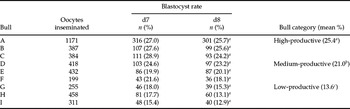
There were no significant differences in d8 blastocyst rates among the bulls within the same category, but significant differences in blastocysts production were confirmed among the three bull categories (HP compared with MP bulls, p < 0.05; HP compared with LP and MP compared with LP bulls, p < 0.01; Table 1).
Embryo production for the tested bulls and their categories.

There are no significant differences within the same bull category but significant differences were confirmed among the bull categories. Values with different superscripts within the column differ significantly (a–c, b,c, p < 0.01; a,b p < 0.05).
Comparison of bulls within the category
Oocyte penetration and fertilization
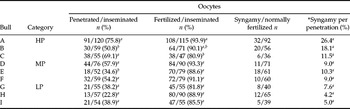
The efficiency of oocyte penetration and fertilization for the tested bulls are shown in Table 2. No significant differences in the 6 hpi penetration rate among the bulls of the same category were found except for bull B and bull E (p < 0.05). It can be seen, however, that the efficiency of penetration at 6 hpi tends to decrease from the high-productive bull A to the low-productive bull I. The 18 hpi syngamy rate did not differ significantly within the bull category, but a tendency to decreasing syngamy rates from the bull A to the bull I was also found. Conversely, this tendency was not observed for the 18 hpi fertilization rates, which were not much different among the individual bulls; no significant differences in fertilization efficiency at 18 hpi were detected within the same bull category, except for bull C (p < 0.05).
Penetration and fertilization rates for the tested bulls and their categories.

Values within columns with different superscripts in the same bull category differ significantly (a,b p < 0.05).
*The values were calculated according to the formula: syngamy rate (%) × penetration rate (%)/100.
Oocyte cleavage
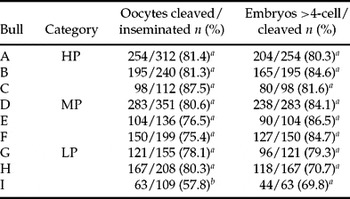
The efficiency of oocyte cleavage for the tested bulls is shown in Table 3. The 44 hpi cleavage rate did not differ significantly within the same bull category, except for the low-productive bull I (p < 0.01). No significant differences in the fast-cleaved embryo rate were found among the bulls of the same category (Table 3).
Cleavage rates for the tested bulls and their categories.

Values within columns with different superscripts in the same bull category differ significantly (a,b p < 0.01).
Comparison of the bull categories
Oocyte penetration and fertilization
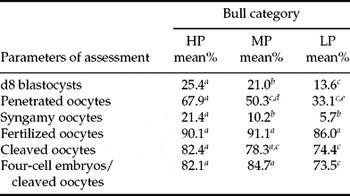
The 6 hpi penetration rate was significantly higher for the HP bulls than for the MP and LP bulls (p < 0.01). A significant difference in the 6 hpi penetration rate was also found between the MP and LP bulls (p < 0.05). The 18 hpi syngamy rate was significantly higher for the HP bulls, as compared with both the MP and LP bulls (p < 0.05). Conversely, no significant differences in the 18 hpi fertilization rate were found among the HP, MP and LP bulls.
Oocyte cleavage
The 44 hpi cleavage rate was significantly higher for the HP than for the LP bulls (p < 0.01), but it did not differ significantly between the HP and MP and between the MP and LP bulls. The fast-cleavage rate was significantly higher (p < 0.01) for both the HP and MP bulls, as compared with the LP bulls (Table 4).
Fertilization and cleavage rates related to the bull categories with different embryo production.

Values with different superscripts within the row differ significantly (a–c, b,c p < 0.01; a,b, d,e p < 0.05).
Relationship between evaluated parameters and embryo production
A strong positive correlation was found between the embryo production and each of the parameters that characterized oocyte fertilization and early embryo development, i.e. penetration (r = 0.803, p < 0.01), syngamy (r = 0.826, p < 0.01), cleavage (r = 0.635) and fast-cleavage (r = 0.709, p < 0.05).
Discussion
A quick and reliable method for prediction of in vitro bull fertility is important not only for further progress of reproductive biotechnologies, but also for more effective production of genetically valuable embryos suitable for transfer and cryopreservation and utilizable in cattle breeding. Bulls with high field fertility are usually tested before their inclusion in IVF programmes on the basis of the 7- to 8-day embryo production after fertilization of oocytes collected from ovaries of slaughtered cows. The criteria most frequently used included the proportion of cleaved embryos, the proportion of blastocysts and their quality (Larsson & Rodriguez-Martinez, Reference Larsson and Rodriguez-Martinez2000). This approach, however, requires insemination of a high number of oocytes with spermatozoa of the tested bulls and cultivation of presumptive zygote for a relatively long time. Because such testing is limited by time and costs, the selection of a suitable sire and oocyte fertilization conditions is then made complicated.
Recently, simple functional tests have been developed for the prediction of both in vivo and in vitro bull fertility; they include sperm–zona pellucida, hemizonia pellucida or oolemma binding assays and induction of a sperm–acrosome reaction. Although some correlation has been found between the results of these tests and in vitro embryo development, none of the tests has correlated with the outcomes of field fertility in the tested bulls. For in vivo bull fertility predictions, these tests had to be combined (Zhang et al., Reference Zhang, Larsson, Lundeheim, Haard and Rodriguez-Martinez1999; Giritharan et al., Reference Giritharan, Ramakrishnappa, Balendran, Cheng and Rajamahendran2005).
In this study, we report on a method that allowed us to assess in vitro bull fertility, with the use of a relatively low number of bovine oocytes and short time, usually 24 hours. Our test is based on the onset of penetration of spermatozoa into oocytes and syngamy of formed pronuclei that were evaluated at selected time points.
A test for detection of field fertility of both bulls and boars based on the assessment of sperm penetration into immature homologic oocytes has been described previously by Henault & Killian (Reference Henault and Killian1995) and Gadea et al. (Reference Gadea, Matas and Lucas1998) respectively. Recently, differences in the kinetics of sperm penetration into mature bovine oocytes among bulls with different NRRs have been reported by Ward et al. (Reference Ward, Enright, Rizos, Boland and Lonergan2002) and Puglisi et al. (Reference Puglisi, Balduzzi and Galli2004). Maximum differences in the penetration rate between high- and low-field fertility sires were determined at 9 to 12 h after insemination, but after that period these differences disappeared (Ward et al., Reference Ward, Lonergan, Rizos, Corridan and Boland2001a; Puglisi et al., Reference Puglisi, Balduzzi and Galli2004).
In our experiments, sperm penetration was assessed at the early time, i.e. at 6 h after gamete co-cultivation. It is known that spermatozoa start to penetrate mature bovine oocytes at 3 to 4 h after insemination; between 5 and 6 h the penetration rate increases rapidly and reaching its maximum (Park et al., Reference Park, Ohgoda and Niwa1989; Saeki et al., Reference Saeki, Kato, Hosoi, Miyake, Utsumi and Iritani1991; Laurincik et al., Reference Laurincik, Hyttel, Baran, Eckert, Lucas-Hahn, Pivko, Niemann, Brem and Schellander1998). Our results showed that there was a positive correlation between early sperm penetration and the ability of bull to produce in vitro embryos. This finding is in agreement with the results reported by Ward et al. (Reference Ward, Lonergan, Rizos, Corridan and Boland2001a) who confirmed the relation between sperm penetration rates and NRR values.
No differences in the course of pronuclei formation were reported, regardless of whether spermatozoa came from high-field or low-field fertility bulls (Eid et al., Reference Eid, Lorton and Parrish1994). In addition, the timing of pronuclei formation was similar for both high-blastocyst-rate and low-blastocyst-rate bulls (Comizzoli et al., Reference Comizzoli, Marquant-Le Guienne, Heyman and Renard2000).
In our experiments, therefore, a further criterion for evaluation of fertilizing ability of spermatozoa was based on the syngamy rate. The breakdown of pronuclei and their synkaryosis have been observed in the ooplasm of mature bovine oocytes at 20 to 26 h after insemination (Xu & Greve, Reference Xu and Greve1988; Hyttel et al., Reference Hyttel, Greve and Callesen1989). We detected the early syngamy (at 18 hpi) and, therefore, for evaluations, the early penetration (at 6 hpi) was taken into consideration. Our assumption was that only early and normally penetrated oocytes, i.e. those by a single spermatozoon each, could reach the syngamy stage at 18 h after insemination. Using the penetration and syngamy rates, differences were found among the three (high, medium and low embryo production) bull categories as well as among individual bulls within the same category. Only the former, however, were statistically significant. This finding can be explained by the fact that standard conditions of insemination were used for spermatozoa of all tested bulls. It is possible that the differences among bulls in the same category would be higher if conditions of fertilization would be modified for spermatozoa of each bull.
Information on differences in the fertilization rate in relation to either in vivo or in vitro bull fertility has been provided by Yang et al. (Reference Yang, Giles, Liu, Jiang, Presicce, Foote and Wang1995) and Alomar et al. (Reference Alomar, Mahieu, Verhaeghe, Defoin and Donnay2006) respectively. Ward et al. (Reference Ward, Rizos, Boland and Lonergan2003) reported a correlation between the fertilization rate at 17 h after oocyte insemination and the NRR and Alomar et al. (Reference Alomar, Mahieu, Verhaeghe, Defoin and Donnay2006) described a correlation between the fertilization rate at 18 h after oocyte insemination and embryo development to the blastocyst stage.
In our study, the fertilization rate was also assessed at 18 hpi, but in contrast to the results of Alomar et al. (Reference Alomar, Mahieu, Verhaeghe, Defoin and Donnay2006), no relationship between the fertilization efficiency of oocytes and embryo development to the blastocyst stage was found at that time. Our results, however, are in agreement with those of Puglisi et al. (Reference Puglisi, Balduzzi and Galli2004), who reported that fertility rates that differed significantly at 15 hpi showed no differences at 18 hpi, when the low-field fertility bulls exceeded the high-field fertility ones.
The first cleavage of bovine oocytes was observed between 26 and 28 h after insemination (Xu & Greve, Reference Xu and Greve1988). Van Soom et al. (Reference Van Soom, Van Vlaenderen, Mahmoudzadeh, Deluyker and de Kruif1992) reported that, for developmentally capable embryos, cleavage in the first two cell cycles appeared at 36 and 42 h after insemination, respectively. The sire had a significant effect on the kinetics of early embryo development, as measured by time of the first cleavage (Ward et al., Reference Ward, Lonergan, Rizos, Corridan and Boland2001a). Eid & Parrish (Reference Eid and Parrish1995) described that the earliest detected cleavage was at 30 h, with significant differences for zygotes sired by high-field fertility bulls, as compared with zygotes sired by low-field fertility bulls. In recent studies, the differences in cleavage, from 30 to 48 hours, have also been observed between high-field and low-field fertility bulls (Ward et al., Reference Ward, Lonergan, Rizos, Corridan and Boland2001a). A strong correlation between cleavage and blastocyst development was found by Gadea et al. (Reference Gadea, Matas and Lucas1998). The blastocyst rate was significantly higher for the 30- and 36-hour first-cleaved embryos sired by high-field fertility bulls than for the 48-hour first-cleaved embryos sired by low-field fertility bulls (Vandaele et al., Reference Vandaele, Mateusen, Maes, de Kruif and Van Soom2006).
In agreement with Ward et al. (Reference Ward, Rizos, Corridan, Quinn, Boland and Lonergan2001b, Reference Ward, Enright, Rizos, Boland and Lonergan2003), who reported a correlation between the 33-hour and 48-hour cleavage rates and the NRR, we found a correlation between the 44-hour cleavage and blastocyst rates. This correlation was higher when the fast-cleaved embryos were employed. Our finding supports the conclusions made by Ward et al. (Reference Ward, Lonergan, Rizos, Corridan and Boland2001a) that the time of sperm penetration is responsible for the timing of cleavage because, also in our study, the blastocyst high-productive bulls with early sperm penetration produced more fast-cleaved embryos than the blastocyst low-productive bulls with delayed sperm penetration.
It can be concluded that: (1) differences were found in the efficiency of early fertilization (penetration and syngamy) and embryo development (first and second cleavage) in bulls with different in vitro blastocyst yields; (2) the parameters reported here were related to embryo production; early penetration and syngamy had the highest predictive values; and (3) the simple and quick test can be used for in vitro bull fertility assessment.
Acknowledgements
This study was supported by grants MZE 0002716201 and 1B44018 from the Ministry of Agriculture of the Czech Republic.