The rapid multiplication and expansion of resort towns on Spain's Mediterranean coastline during the latter stages of the Franco dictatorship has been assimilated into a wider perceived pattern of the urban consequences of a new kind of ‘mass tourism’, based on packages involving cheap flights and sunny beaches, and producing characterless, cloned resorts devoid of distinctiveness, history or local identity. Such perceptions fail to take account of differences between the new leisure towns, most of which were built around existing settlements, and all of which varied (and changed over time) in terms of architecture, planning and urban layout, visiting publics and migration fields. They also set aside older traditions of Spanish coastal tourism, some of which originated as early as the second quarter of the nineteenth century.Footnote 1 Many involved the grafting of beach resort settlements on to existing seaports, commercial and administrative centres and provincial capitals, taking advantage of existing urban amenities and sociability. The responses of these established urban centres to the challenges and opportunities of the apertura of economic policy during the later Franco years after 1959 have hardly been investigated. This article examines the historical roots of urban coastal tourism in Spain before the Civil War, on the basis that subsequent developments cannot be understood without some understanding of the earlier history, before assessing diversity and difference among the ‘new’ urban beach resorts of the second half of the twentieth century, and focusing on the fashionable Biscay coast resort and long-time summer capital, the Basque city of San Sebastián, during the much-trumpeted rise of the popular Mediterranean passion and fashion during the ‘second period’ of the Franco regime.
Coastal tourism in Spain: the historiography and its problems
Spain's Mediterranean coast was a pioneer of the new beach-based, sun-worshipping international package holidays, first by coach, then by air.Footnote 2 Pack provides the best overview in English of these phenomena, which drew the Franco regime's modernizing tendency into increasingly enthusiastic encouragement of international beach tourism. His book is an excellent introduction to the domestic and international politics and policies of Spanish tourism during the post-war decades. However, it shares the common tendency to represent Spain before the 1950s as unimportant as a tourist destination, and Spanish domestic tourism as of little account, and to regard the new developments as uniform, standardized, mass-produced responses to the ‘mass tourism’ promoted by international tour operators, effectively a version of ‘McDonaldization’.Footnote 3 A recent article pays more heed to earlier developments, and draws attention both to unavailing attempts to impose planning and regulation in the new resorts, and to exceptional cases of higher-quality architecture among the lowest-common-denominator concrete.Footnote 4 Valero has noted the common, and erroneous, assumption (not least among policy-makers) that coastal tourism in Spain began in 1950; but such awareness remains unusual.Footnote 5 It is shared by Pi-Sunyer, who notes the early but unobtrusive presence of middle-class summer visitors on the Catalan coast from at least the early twentieth century; by Barke and France, who show awareness of earlier origins on what became the Costa del Sol around Marbella and Torremolinos; and by Buades and Buswell in their work on the Balearic Islands. Some local studies also recognize this longer history.Footnote 6
Moreover, while Moreno's introduction to the history of tourism in twentieth-century Spain devotes six chapters to the pre-Civil War period, her emphasis is overwhelmingly on government policy, the provision and regulation of infrastructure and early tourism promoters and enthusiasts. Her chapter on the 1950s looks forward rather than back, regarding that decade as laying the essential groundwork for the ‘industria masiva’ that was to follow. Only one brief chapter, focusing on the 1920s, deals with holidaymaking and tourist destinations before the 1960s. Discussion of the historical relationships between urbanization, urban systems and tourism remains underdeveloped. But local case-studies have demonstrated the growing importance of a coastal tourism sector, fuelled mainly but not exclusively by domestic demand, from the later nineteenth century, gathering momentum under the contrasting and changing political regimes of the 1920s and Second Republic.Footnote 7
This is not to deny the transitional importance of (especially) the 1960s. Under the apertura, the capture of much-needed foreign currency accompanied the enhanced legitimacy, improved visibility and sanitized image provided by participation in international tourism, although beach tourism was always in tension with puritanical and authoritarian tendencies within the regime. Franco's tourism minister Manuel Fraga Iribarne is indelibly associated with the slogan ‘Spain is different’. This not only encapsulated the combination of political propaganda and marketing which marked the international tourism promotion campaign, but also affected academic debates on alleged Spanish exceptionalism.Footnote 8 The lack of academic attention to tourism as a force for economic and social change, and urban growth, in Spain since the 1960s remains surprising. Although one article in the most recent collection of essays on the development of economic regions in ‘contemporary Spain’ recognizes its recent importance as the ‘fundamental driving force of the Catalan economy’, the contribution on the Canary Islands acknowledges the vital role of tourism without developing the theme, and that on Cantabria (including the Basque Country) says nothing about its historical development.Footnote 9
There are three misleading aspects of the existing literature on these developments in Spain: the tendency to regard the experience of ‘package’ holidaymakers as uniform, defined and controlled by the standard provision made by the tour operators, and devoid of agency on the part of passive holidaymakers; the assumption that the urban developments which accommodated and serviced this kind of tourism were uniform concrete jungles; and the predominant focus on new developments on the Mediterranean coast (and on the Balearic and Canary Islands) has marginalized older seaside tourism traditions, especially on the Atlantic coast in northern and western Spain, where Spanish seaside tourism began.Footnote 10 With all their virtues, Spanish critics of the ‘neo-colonialism of space’ in this context, since Gaviria's pioneering polemic in 1974, have reinforced such perceptions.Footnote 11
First, the package holidaymakers of the 1950s onwards had agency and were capable of exercising it, whether by exploring and making their own entertainment or complaining and negotiating assertively.Footnote 12 Nor were the towns that serviced the package holidaymakers identical. Wilson's history of Benidorm asserts its individuality, from the strong personality of its long-serving mayor, Pedro Zaragoza, during the transition to international resort status, through the formative and enduring importance of the town planning scheme, to the employment of distinguished Catalan architects and the changing patterns of visitor recruitment and migration flows. Benidorm's history as a seaside resort went back to 1858. It retained an old village core by the harbour, as did (for example) Lloret and Tossa de Mar on the Catalan coast, and sustained a tradition of domestic tourism which diversified in the late twentieth century to embrace the Basque Country as well as Madrid.Footnote 13 Málaga, an important port, agricultural export processing centre and provincial capital, similarly had traditions as a climatic and beach resort that went back to the nineteenth century, acquired the new cafes and art nouveau architecture that became widespread in provincial Spain at the turn of the nineteenth and twentieth centuries, and went up-market with ambitious new developments in the 1920s.Footnote 14 Palma de Mallorca is another well-documented example.Footnote 15 Such diverse earlier histories helped to translate into contrasting markets and development experiences along the same coastlines, as was evident in adjoining settlements on the Costa del Sol during the boom years.Footnote 16
San Sebastián and the Atlantic coast
The pre-1950 histories, usually dominated by domestic tourism, constitute a missing dimension in studies of the coastal tourism boom of the late Franco period, which did not begin from a blank slate. There is a broader geographical dimension. Early Spanish coastal tourism was directed towards the northern and western Atlantic coasts, following medical advice that favoured the health-giving qualities of cold northern oceans, as opposed to the malarial enervation associated with Mediterranean climates. Already by the later nineteenth century, as railways linked Madrid with the northern Atlantic seaports, sea-bathing tourists were congregating at coastal cities from Vigo to San Sebastián by way of Corunna, Gijón, Santander and Bilbao's seaside suburbs. Strings of little fishing villages were also welcoming long-stay summer visitors in search of charm, quiet and security as well as health.Footnote 17 Growth in coastal settings was fuelled by the upper and middle classes from Madrid, provincial capitals and other expanding towns, and even (in the case of Santander's Sardinero beaches) by rustic health-seeking Castilian farmers on a tight budget, sent by village doctors.Footnote 18 During the first third or so of the twentieth century, especially under the Second Republic after 1931, these Atlantic resorts became more relaxed and democratic. The rise of sunbathing and an active beach culture, and the controversial easing of taboos on bodily exposure, changed the holiday atmosphere and aroused the anger of religious and social conservatives.Footnote 19 Such developments responded, from the 1920s, to a popular consumer culture that sustained a brisk expansion of demand for sport and popular entertainment.Footnote 20
The Basque town of San Sebastián, capital of Gipuzkoa province, was the epitome and in many senses the originator of these changes. It was among the earliest Spanish seaside resorts, emerging during the late 1820s, and the first to develop significantly. It attracted royal patronage, and from 1887 became the summer capital. This cemented its role as fashionable meeting-place for the Madrid elite, and for lower strata of the middle classes who wanted to bask in their aura.Footnote 21 Casino gambling added an extra frisson, and 1887 also saw the opening of the Gran Casino. Its roulette tables were technically felonious, but quietly tolerated in practice.Footnote 22 Between the 1870s and the early 1920s, the town developed an impressive infrastructure of entertainment and sporting facilities. Queen María Cristina was deeply attached to San Sebastián and returned almost every summer between 1887 and 1928, building the Miramar summer palace in a prominent position above La Concha beach.Footnote 23 San Sebastián also became renowned for the attractive architecture and planning of its ensanche or extension, built on a grid plan across reclaimed dunes and marshland after the demolition of the town walls from 1863 onwards, and identified with Parisian sophistication.Footnote 24 World War I, in which Spain was neutral, confirmed San Sebastián's place on the international high society tourism map. By the early 1920s, it was attracting visitors from the provincial middle classes across the whole of Spain, while developing a regional day-tripper and evening economy as cheap transport expanded and a new popular consumer society emerged.Footnote 25 These democratizing trends helped it to cope with the suppression of casino gambling under the Primo de Rivera dictatorship in 1924, and eased the adjustment to the death of Queen María Cristina in 1929 and the advent of the Second Republic in 1931. The town did its part by inviting the new government to celebrate the anniversary of the Pact of San Sebastián of 17 August 1930, a defining moment in the making of the new Republic, just as it was subsequently to accommodate the winning side in the Civil War. Summer capitals need flexible politics.Footnote 26 At the beginning of the Franco regime, San Sebastián, with a resident population of around 80,000, was Spain's most prestigious and well-known resort.Footnote 27
San Sebastián under the Franco dictatorship
As with Spain's other Atlantic coastal resorts, the development of the Franco regime's policy of promoting international beach tourism on the Mediterranean coast and islands left San Sebastián out in the cold from the late 1950s onwards.Footnote 28 It faced increasing competition for domestic as well as international markets, as growing numbers of Spanish holidaymakers also discovered the Mediterranean.Footnote 29 San Sebastián had a double identity, and in its Basque guise as Donostia it embodied important tensions between the Spanish and the Basque, the perceived luxury, even effeminacy of a tourist economy and the tough, abstemious rural virtues with which Basque nationalists identified.Footnote 30 But the Franco regime's economic policy for the Basque Country focused on expanding the conventional extractive and manufacturing industries, which were already firmly entrenched around Bilbao and in parts of Gipuzkoa.Footnote 31 Tourism, as such, was not a policy priority, but the encouragement of migration from other Spanish regions was part of the process, challenging the identity politics of Basque nationalism. Of the increase of more than 80 per cent in the population of the Basque Country between 1950 and 1970, which helped to exacerbate regional popular pressure on San Sebastián's crowded beaches, half was due to in-migration, and by the latter year 35 per cent of the population of San Sebastián's Gipuzkoa province came from beyond the Basque Country.Footnote 32
San Sebastián did not immediately lose its role as summer capital. It came through the Civil War almost unscathed, falling into the hands of the rebels as early as September 1936, and becoming a safe haven ‘behind the lines’, although many of its working-class and nationalist inhabitants had fled.Footnote 33 The outbreak of war stranded many early visitors of limited means, clerks, administrators and small proprietors in Madrid and Aragón, a reminder of the democratic dimension of the tourism market.Footnote 34 But by October, as visitors reappeared after the fall of the city, and comfortably-off people arrived from Republican Madrid and Barcelona to take refuge from the war, the town's Aquarium symbolically reopened.Footnote 35 Bullfights returned in 1937, and a full programme of entertainments in the summer of 1938. By 1939, with the war at an end, the regime's press could claim a return to normality. But an older elite domination was reasserted.Footnote 36 The first foreign tourists reappeared in 1950.Footnote 37
An important aspect of the return to ‘normality’ was San Sebastián's role as summer seat of government. From 1939 until 1973, Franco spent time in the city every year, at first for a week or so in late September or October, and from 1946 for longer periods during the summer season, bringing ministers and diplomats in his wake and holding an annual summer cabinet meeting in the city. His visits were marked by intensified repression and security, and pre-emptive arrests of ‘suspect’ characters.Footnote 38 He did not stay in the royal Miramar Palace, but at the older Ayete Palace behind the sea front, which had royal associations without seeming to pretend to regal status, and which the city government was quick to purchase and hand over as his official summer residence, spending heavily on decoration and improvements.Footnote 39 He revived monarchical ceremonial practices, such as attendance from 1946 onwards (with military escort) at the annual Salve church service on 14 August, the eve of the festival of the Assumption. This was the traditional climax of the busiest week of the summer holiday season, the Semana Grande, with its bullfights, fireworks and elaborate entertainment programmes. The Salve took place at the heart of the Parte Vieja, the old urban core beside the fishing harbour and the heart of Basque-speaking Donostia. Despite his hostility to peripheral nationalisms, and his repressive promotion of a united Spanish culture, Franco was prepared (like Queen María Cristina) to endorse particular Basque sports and customs by his official presence and participation in prize-giving ceremonies. He was particularly visible at Basque sporting events, in keeping with the regime's preferred vision of a de-politicized, Catholic, strong, virile Basque identity which could strengthen Spain from within. Pelota, the emblematic Basque ball game, had for half a century been a commercialized urban spectacle across Spain and the Hispanic world, and it is not surprising to find Franco attending tournaments and presenting prizes.Footnote 40 But what Franco most enjoyed was the regatas de traineras, rowing championships for ocean-going fishing boats, and he increasingly delayed his visits for the finals in early September.Footnote 41 Over time, his visits dwindled a few days; and his ceremonial presence fell away. His final attendance at the Salve was in 1965, and the formal aspect of the summer regime diminished thereafter, with declining attendances by ministers and ambassadors.Footnote 42
Franco's last visit to San Sebastián was in 1973. The same summer saw the final debutantes’ ball at the Real Club de Tenis, where numbers had been falling off for several years as the rising generation preferred the Mediterranean.Footnote 43 This was also the last year of the bullring, whose programme had provided the highlights of the August and September high season into the early 1970s. In 1974, the Gran Kursaal of 1922, another emblematic building, was demolished. It had languished unused or under-used since the suppression of casino gambling in 1924, despite occasional special events and an important role in the Film Festival since the mid-1950s. All this, in the twilight of the Franco regime, appeared to mark the end of an era. This was the culmination of a longer set of processes, however, and within the decay of older patterns of holidaymaking were emergent innovations which proved to have lasting transformative force. From another perspective, the 1972 season was said officially to have broken records for visitor numbers, with an impressive volume of transatlantic arrivals and a strong showing from Spanish demand as living standards rose. The old elites might be disappearing, but the growth of more popular currents of tourism, national and international, was evident.Footnote 44
Crisis and transition
The combined sense of crisis, change and opportunity was already apparent in 1971, when the director of San Sebastián's Centro de Atracción y Turismo, Rafael Aguirre Franco, prepared a report on tourism policy.Footnote 45 He identified a tension between the need to sustain and expand high-quality tourism, and the pressure of local and regional popular demand as working-class living standards at last began to improve. Easier road access put San Sebastián within comfortable day-trip range of a populous hinterland which extended into south-western France, across Gipuzkoa province, and as far west as the regional metropolis of Bilbao. The limited beach space already posed problems, especially as the growing local working-class population was increasingly attracted to the shore on summer week-ends. The town was expanding rapidly, like the coastal and industrial Basque Country generally, fuelled especially by the development of manufacturing on its inland fringes, as well as the extension of the municipal boundary to include adjoining settlements. The census population had already reached 113,776 in 1950, and the estimate for 1971 was nearly 166,000.Footnote 46
One possible response was expanding the existing beaches, especially the small, polluted, flood-prone and unfashionable Zurriola beach to the east of the river estuary, a victim of speculative urban development in the early twentieth century. This would require investment on a then unthinkable scale, and Aguirre Franco suggested the provision of attractive popular swimming pools on the outskirts, to divert or filter local demand.Footnote 47 Another plan, canvassed in 1974, was to encourage the eastward extension of the fashionable, picturesque and emblematic La Concha beach by using groynes to accumulate sand; but this was quickly recognized as high-risk, unsightly and deeply unpopular.Footnote 48 But the growing regional pressures towards a local, democratic version of ‘mass tourism’, reminiscent of England's Blackpool a century earlier, were disquieting.Footnote 49
Sustaining or reviving elite Spanish or international tourism also presented challenges. San Sebastián's post-war international tourism market contained a growing proportion of mochileros or back-packers in transit from northern Europe, who hitch-hiked or arrived by train through France. They were attracting media attention by the mid-1950s, provoking interest and suspicion in equal measure. The first official camp-site to open, in 1959, was isolated on a hill a few miles out of town. In 1961, the first converted camper-vans appeared from France, marking a further step towards cheapness and informality, while in 1970 the first ‘hippies’ were identified.Footnote 50 But between 1956 and 1964 there were regular and substantial English package tours by motor-coach, which fell away due to Mediterranean competition and the switch from coach to air. Aguirre Franco highlighted the deficiencies of San Sebastián's airport at Fuenterrabía, whose runways were too short to accommodate contemporary jets and could not be extended: in 1971, the regular direct service between London and Fuenterrabía, begun as recently as 1967, had just been abandoned. This was a recent problem: the airport had attracted considerable government investment in the late 1950s and early 1960s. It was overtaken by cumulative lack of investment and failure to respond to sudden advances in aircraft technology.Footnote 51
By 1971, it was clear that most foreign tourists were in transit, and of limited economic value. Motor traffic across the frontier, on the western route between France and Spain, grew rapidly during the 1960s, choking San Sebastián's access routes and damaging the amenity of central squares and boulevards. Many motorists broke their journey in the city, at least becoming tourists of passage, but the opening of a new by-pass in 1972 eased aspects of the congestion problem while, for some, discouraging a break of journey.Footnote 52 This was unsatisfactory, but there was no future for San Sebastián in the new ‘mass tourism’ on the Mediterranean model. Air access apart, the Atlantic climate was too unreliable, and there was nowhere to put the necessary new hotels. The seasonality of the tourist market, concentrated into July, August (above all) and September, was a major problem. Aguirre Franco, following many commentators since the mid-1920s, saw the return of casino gambling as essential to the revival of San Sebastián as an international elite resort; but this depended on national policy changes which the city government lacked the leverage to bring about. It was one thing to lobby Franco, every summer, for road improvements and similar infrastructural expenditure; it was another to precipitate a fundamental change of policy on an emotive issue with religious overtones.Footnote 53 Moreover, as an industrial sociologist observed, the Basque provinces consistently received much less than their equitable share of government spending, and saw large proportions of their tax contributions siphoned off elsewhere, even as their infrastructures continued to decay.Footnote 54
San Sebastián was already suffering from a chronic shortage of hotel accommodation. In 1935, 45 hotels had offered 3,953 beds; by 1969, the figures were 30 and 3,288. Moreover, their facilities were becoming dated: several had been downgraded in the most recent inspection. Soaring local property values, together with high prices and overheads, a short summer season and growing demand for year-round residential accommodation, made apartment conversions attractive to owners and speculative purchasers. Municipal townscape protection ordinances made it almost impossible to build high-rise. Aguirre Franco advocated specific relaxations of the height restrictions to encourage hotel development, perhaps with municipal financial support, but this proved not to be practical politics, and central government financial incentives for hotel building were not available on this coastline. Statistics from the second half of the 1950s suggest that between three-fifths and two-thirds of hotel guests were foreigners, but by 1971 Aguirre Franco was arguing that hotel tourism depended heavily on the upper levels of the domestic market. Hoteliers would reserve blocks of rooms well in advance for regular summer visitors from Madrid and environs, the northern and north-eastern provinces and parts of Andalucía and Extremadura.Footnote 55 Official plans announced in 1974 for a new five-star hotel on the site of the Kursaal, with five others of four stars elsewhere in the city, together with a new bullring, remained purely speculative.Footnote 56
An ageing and declining hotel stock (only two new hotels opened during the 1950s, and two more in the 1960s) was part of a broader pattern of fading glory. The townscape was becoming less compelling, as featureless apartment blocks of six or seven storeys spread along La Concha promenade and into parts of the ensanche, and speculative development marred the architectural unity of the emblematic Avenida.Footnote 57 From the 1950s onwards, Spanish urban development in general was left increasingly to market forces, leading to free rein for speculators, loss of status and power on the part of urban planners and the creation of chaotic urban environments: exactly what was criticized in the new developments of the Mediterranean coast.Footnote 58
In San Sebastián, the municipal presumption in favour of development brought about the demise of several familiar landmarks.Footnote 59 The general development plan of 1950 was quietly abandoned, although its replacement in 1962 presented similar ineffectual aspirations. Of 35 proposed development sites, 32 were actually built, but only two were in conformity with the plan. There was little control over speculative development beyond the nineteenth-century city. New concrete buildings of poor standard proliferated, land values continued to soar, and infrastructures lagged behind expanding sprawl and increasing density.Footnote 60 But the extremes of destructive, uncontrolled redevelopment were held at bay in much of the centre of San Sebastián by strong civic traditions and pride in existing architecture. Pressures on land values found less dramatic outlets in a plethora of attics and other piecemeal, relatively unobtrusive upward extensions, and in chaotic urban fringe developments as the city spread along the surrounding valleys, away from tourist and traditional residential areas. At least the broad official assumptions about the location of elite and middle-range tourism, working-class housing and factories coincided with developers’ expectations. These patterns of change, together with boundary extensions, fuelled the explosion in the number of individual dwellings from 25,000 in 1953 to 53,000 in 1974.Footnote 61
Much attractive ‘traditional’ architecture of the late nineteenth and early twentieth centuries did survive in the original ensanche, and the Parte Vieja remained practically untouched. Aguirre Alcalde wrote in 1976 of ‘more than twenty years of vandalism in planning and policy’, but enumerated the city's surviving architectural glories, some of which were in a parlous state. He described the ‘ruinous’ gardens of the Art Nouveau houses of the left bank of the river; but admired the glass miradores on corner plots, the ‘splendid wrought-iron balconies’ and the ‘English confection’ (‘tarta inglesa’) that was the Casa Derby department store. He was encouraged by the catalogue of protected buildings which had been completed on 25 May 1976, and by other recent symptoms of revived municipal interest in and commitment to the urban environment; but he emphasized that continuing vigilance was necessary to protect the character and heritage of the late nineteenth-century city.Footnote 62 Not all the new building of the Franco era lacked character or interest, but the established townscape was clearly under threat.Footnote 63
Recent monumental highlights reflected the preoccupations of the regime. They were out of keeping with the prevailing French, central European and Art Nouveau tastes of the characteristic late nineteenth-century boulevards. Apart from the concrete modernist luxury hotel which opened in 1967 on Monte Igueldo, overlooking the western beaches, the most conspicuous additions were religious: an eclectic twin-towered diocesan seminary overlooking Ondarreta beach, and a very prominent naturalistic statue in reinforced concrete representing the Sacred Heart of Christ, a strong element in popular Basque piety and also in the official religious culture of the Franco regime, dominating the castle hill above the harbour and Parte Vieja.Footnote 64 The hotel was highly controversial when proposed in 1964, due to its prominent position and the loss of existing popular leisure amenities on the site.Footnote 65 Meanwhile, the unconventional guide-book writer of the mid-1970s, Aguirre Alcalde, denounced the ‘espantable’ (‘frightful’) Sacred Heart statue for damaging the historic environment of the castle.Footnote 66
Proposals proliferated for further development during the Franco years: the problem was to resource them and overcome opposition, which even in this ostensibly autocratic (but really highly complex) political setting could seldom be brushed aside. Additional proposals included the municipal engineer's plan of 1936 to take advantage of the depopulation of the unplanned and mainly working-class eastern seaside suburb of Sagües after the rebel capture of San Sebastián in the Civil War, by demolishing it and replacing it with a ‘garden city’ with open-air sea-water swimming pool and solarium. This followed current fashions and would remove an ‘unsightly’ popular residential presence from the sea-front on a prime site under Monte Ulía. The return of most of the residents, coupled with post-war financial stringency, put this plan on hold, but a revised version appeared in 1963, in an abortive competition for the best proposals for developing Ulía. Less ‘official’ was a project of 1966, from a Bilbao speculator, for six residential skyscraper blocks (rascacielos) across the base of Monte Igueldo. This scheme was opposed by the influential proprietors of villas on the slopes, who would lose their views, and fell foul of local preferences for an older and less assertive building aesthetic.Footnote 67
Some of the old, and emblematic, entertainments and spectacles were in decline. The deteriorating quality of the bullfight programme was discussed regularly from the 1960s onwards, long before the bullring was demolished to make way for more apartments in 1973, and the Semana Grande festive programme in mid-August was increasingly dependent on fireworks and theatre. Aguirre Franco's Centro de Atracción y Turismo tried to remedy the situation, receiving sharp increases in municipal funding and advertising expenditure in the early to mid-1960s, and again a decade later. It promoted traditional activities, from the old elite sports (horse-racing, pigeon-shooting, golf) to Basque sports and culture, safely shorn of any political content. Aguirre Alcalde unkindly described its priorities and responsiveness as ‘antediluvian’.Footnote 68 The main driving forces for new growth came from beyond the remit of the official tourist authority.
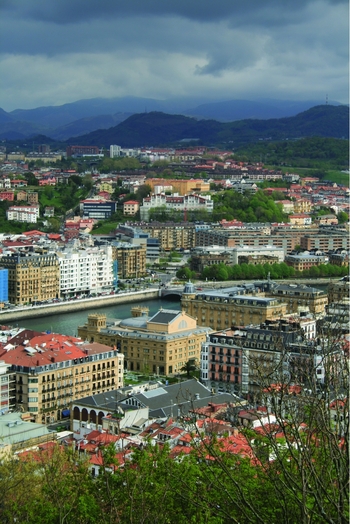
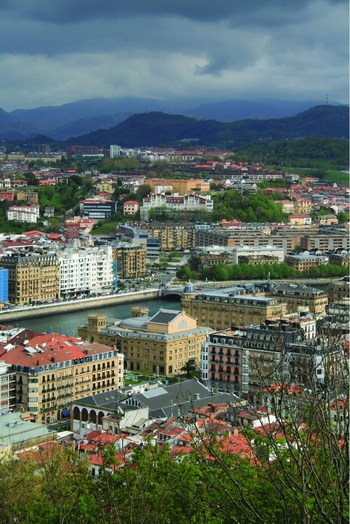
San Sebastián from Monte Urgull, looking across the River Urumea towards the south-east. In the centre are the Teatro Victoria Eugenia and the five-star Hotel María Cristina, both completed in 1912. Across the river are the lower-status districts of Gros and Egia. Credit: Christine Ratcliffe.
Aguirre Franco advocated the benefits of tourism in bringing economic growth without social disturbance or environmental pollution; but in fact the estuary (especially) and the bathing beaches were already polluted before the Civil War, and conditions were visibly worsening by the early 1970s. Aguirre Alcalde commented acidly about the state of the sea at La Concha beach, remarking that most people went there to sunbathe rather than go in the water, and with good reason. The Urumea estuary, which divided the city into a fashionable left bank and a less desirable right bank, carried industrial and domestic pollution from growing industrial settlements upstream.Footnote 69 A report in 1974 confirmed that most of its aquatic life had perished, and the Urumea was contaminating the waters of the bathing beaches.Footnote 70 What had been cleaned up, immediately after the war, was the perceived ‘immorality’ of San Sebastián's beaches, as strict regulations restricted bodily exposure and discouraged sunbathing, as on other Spanish coastlines at this time. This was not sustained in full rigour during the apertura, and by the 1970s sunbathing had recovered sufficiently to keep voyeurs (mirones) interested in the views of the beach from La Concha promenade.Footnote 71
Awareness of pollution did not make the beaches less frequented. The distribution and prices of awnings, tents and beach umbrellas reflected established patterns. There were, in 1974, 1,000 awnings (toldos) on the central La Concha beach, 700 on the fashionable Ondarreta section to the west, but only 15 on the plebeian Zurriola beach on the wrong side of the river. The corresponding figures for beach umbrellas (sombrillas) were 300, 250 and 7, while beach tents (carpas) were only available at Ondarreta, where there were 600. Renting beach furniture was expensive, especially on Ondarreta, and the convention was to book it for a whole summer, following aristocratic practices which were now in sharp decline. Its distribution, which consumed space greedily on the fashionable beaches, reflected the fundamentally exclusive nature of beach society during the season, although the beaches became less crowded during the unfashionable early afternoon, and chairs were more affordable at five pesetas per day. A further carryover from older holiday practices was the continuing identification of particular parts of the beach with particular socio-geographic groupings among its users. Visitors from Zaragoza congregated under the clock and barometer in the centre of La Concha; those from Navarre joined the ubiquitous Madrid people in the middle of Ondarreta, where wealthy visitors from the capital rubbed shoulders with local social climbers and ordinary residents of the local Antiguo district. Such patterns of beach usage were already familiar by the 1920s.Footnote 72 No wonder local tourism managers were worried about the potential for regional and local demand to disrupt these traditional, exclusive holiday practices.
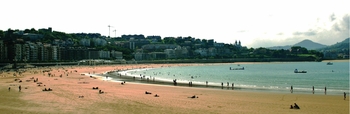
View of La Concha beach and the apartment blocks behind it, looking westward, including the La Perla bathing and leisure complex. Towards the right is the Miramar Palace, and beyond it can be seen the beginning of Ondarreta beach. Credit: Christine Ratcliffe.

Aguirre Franco's main concern was the revival of tourism based on quality rather than quantity. He was particularly concerned to revive and expand San Sebastián's hotel accommodation stock (this required ‘URGENTE y DECIDIDA’ attention from the local authority).Footnote 73 He focused on keeping the patronage of comfortably-off Spanish tourists and recruiting the next generation, with updated entertainments and a ‘puerto deportivo’ or marina, a European trend to which San Sebastián needed to respond. This would entail the controversial displacement of the local fishing fleet, and he seemed unaware that the ambience of the fishing harbour was already a distinctive tourism asset.Footnote 74 He understood that the hotels were not the whole story, but his analysis of accommodation provision became very imprecise below that level, failing to take account of an extensive unofficial sector whose invisibility reduced the apparent importance of tourism in local economic indicators. The almost complete absence of sea-front hotels on the long La Concha promenade reflected high land values and the acquisitive power of opulent visitors who preferred to own second homes or rent summer apartments in such exclusive locations. Aguirre Franco was aware of the importance of ‘second home’ tourism and the upper levels of the rental market (villas and high-quality flats), which helped to sustain the high local property values which damaged the economics of the hotel trade; but his analysis ignored the large number of pensions and guest-houses, most of which focused on the lower levels of the holiday market: the compilers of a municipal list had already counted 168 of these in 1920.Footnote 75 San Sebastián's limited hotel accommodation had long been the tip of an extensive iceberg: most short-term tourist accommodation was provided in pensions, guest-houses and private houses, much of it below the radar of taxation and police invigilation, a problem that evaded the gaze of the Franco regime. In 1938, the authorities issued a series of denunciations and warnings about ‘clandestine pensions’ which were avoiding their scrutiny, although rented flats were the real core of the unofficial accommodation industry.Footnote 76 Below this level was a further underworld of unofficial holiday lettings at the height of the season, untaxed and unregulated, in the spare (or even main) bedrooms of widows and hard-pressed families.Footnote 77 Here was San Sebastián's popular holiday accommodation industry, international as well as domestic, lurking beyond the official administrative gaze.
A new tourism culture
This tourism underworld was spreading in the Parte Vieja, not hitherto part of the tourist agenda, which by the late 1960s was attracting back-packers and other tourists to its traditional bars. The main explosion of tourism here came at the end of the Franco regime and during the transition to democracy from the later 1970s, but its roots lay deeper. They were encouraged by the Centro de Atracción y Turismo, which had been promoting Basque music, dancing and other (non-political) cultural activities since 1950 as part of a ‘revaluation’ of the area, even before the revival of the Semana Vasca four years later, which used Basque cultural motifs in tourism promotion.Footnote 78 In 1973, a new guide-book to the Basque Country, published in Bilbao, had surprisingly little to say about San Sebastián; but its half-dozen descriptive sentences included the accolade that ‘the fishing quarter and the historic city centre are very “típico”’, adding that there were frequent Basque folkloric and sporting festivals, especially in summer.Footnote 79 Six years earlier a more expansive guide-book (published in French, but in Barcelona) described the ambiance of the fishing harbour as ‘d'une intensité extraordinaire’, crowded, busy and active, with the fishermen's cottages displaying ‘(une) simplicité et (une) beauté frappantes’. The Parte Vieja (or Barrio Viejo) was represented as attractively busy and crowded, with its narrow streets and absence of pavements, little local shops, taverns and restaurants. The author emphasized that these streets had no artistic value: they represented ‘something better, which the visitor will do well to savour: the surviving authentic charm of a district overflowing with personality and teeming with human life’.Footnote 80 The emergence of the harbour area as tourist magnet by the mid-1970s was underlined by Aguirre Alcalde's reference to ‘the leprosy of souvenir shops and cheap grill restaurants (parrilladas)’, which compromised authenticity.Footnote 81 The prioritization of local life and colour as worthy of the tourist gaze, especially in historic maritime settings, had many antecedents elsewhere in western Europe and beyond, over the past century, and was belatedly adding a new dimension to San Sebastián's international tourist trade, which local planners were slow to identify.Footnote 82
Panoramic view of San Sebastián across the base of Monte Urgull, from the Aquarium to the Gran Casino of 1887, which under Franco became the Ayuntamiento or Town Hall. The fishing quarter follows the foot of the hill, with La Concha beach in the foreground. On top of Monte Ulía is the castle, crowned by the ‘espantable’ Sacred Heart statue. Credit: Christine Ratcliffe.

The life of the Parte Vieja remained below the radar of official tourism policy. It was still strongly associated with the sociable evening activities of local people. Aguirre Alcalde provided a lovingly detailed anatomy of what the district had to offer, from men's cooking and dining clubs, through bars and restaurants (already in transition, with the decline of the older cider cellars and wine stores, and the rise of bars offering distinctive snacks alongside the drinks), to the brothels, here as elsewhere in the town. The growing importance of new kinds of tourism here, in search of local colour and authenticity, added a further dimension to changes arising from the accelerating transformation of local society, as well as that of the Spanish holiday market.Footnote 83
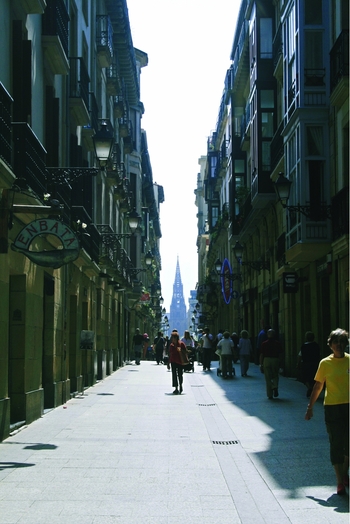
The main street of the Parte Vieja, the Calle Mayor, looking towards the Buen Pastor cathedral in the urban extension of the later nineteenth century. Credit: Christine Ratcliffe.
The rise from the late 1960s of new kinds of night life, in the form of late bars, night-clubs and dancing, also lay mainly beyond the official gaze, although Aguirre Franco commented on new boites, or night-clubs.Footnote 84 Aguirre Alcalde provided a vivid picture of the new nocturnal economy and its service providers, as the various clubs rose, fell and transformed themselves over the last decade of the Franco regime, which coincided with the emergence of the miniskirt and the Beatles. Further beyond the reach of official reports was the emergence from the early 1970s of the puticlú, a twilight zone on the frontiers of prostitution where attractive and adventurous young women were employed to encourage alcohol consumption by men in search of sexual enjoyment.Footnote 85 Aguirre Alcalde noted a further democratization of access to leisure spaces, as the ‘Vandal hordes’ of San Sebastián's industrial fringe and satellite towns invaded the exclusive pleasure haunts of the aristocracy and upper bourgeoisie, the hai, especially along La Concha.Footnote 86 This opening out of leisure and relaxation of behaviour was important in attracting a new generation of tourists as well as reflecting the changing mores of local society, although some of these aspects of San Sebastián's nocturnal economy had long been catered for by establishments like the Teatro Colón, with its dancers and suggestive singers (cupletistas).Footnote 87 Late night dancing establishments for various markets also had a long local history. Tourism managers were keen to attract a younger generation to more relaxed entertainment regimes, but turned a blind eye to these more risqué developments.
Aguirre Franco's report did pick up on San Sebastián's Film and Jazz Festivals. From small beginnings as early as 1953, just as the rigours of early Francoism began the gentlest of thaws, the Film Festival achieved international recognition very quickly, in 1957. It soon became an important feature of the autumn entertainment calendar as well as an excellent vehicle for international publicity. The Jazz Festival, at the beginning of the summer season, expanded similarly from small beginnings, this time in the mid-1960s. Aguirre Franco noted these phenomena briefly in his report, just as (presciently) he mentioned the possibilities for gastronomic tourism through the promotion of Basque cuisine (cocina vasca).Footnote 88 Aguirre Alcalde promoted the delights of San Sebastián's cuisine, while also noting the arrival of the first Chinese restaurants in (suitably) the Ensanche Oriental, and passing on characteristic stories about their menus passing off seagull as duck.Footnote 89 The Chinese remained marginal, though symptomatic of a wider opening out; but it was on such foundations that the re-making of cosmopolitan San Sebastián, for a new generation and new sets of cultural values, was to be based. The resort adapted itself to the new, young, adventurous, independent, rail- and car-borne international and democratic markets which were emerging alongside the package tourism of the Mediterranean.
The rise of radical Basque nationalism had yet to pose problems of public order and security in San Sebastián itself. The foundation of ETA in 1959 led to the first rash of radical nationalist graffiti in the following year, but during the Franco years this was not translated into actions that threatened the city's tourism. ETA's campaigns of violence and assassination in the Basque Country did not begin to gather momentum until the last days of the Franco regime during 1973–75, reaching a climax during the transition to democracy in the late 1970s and early 1980s. San Sebastián was not yet a focus for ETA violence in public places, although a police sergeant was murdered in the city in 1975.Footnote 90 Aguirre Alcalde's contemporary commentary was more concerned about street violence and vandalism by the far right, and the roots of the city's problems during the Franco years lay elsewhere.Footnote 91
Conclusions
San Sebastián's remaking and revival took time, and the late 1970s and 1980s were particularly difficult years, as violent radical nationalism increasingly made its presence felt and affected the tourist season, the urban environment and the security and comfort of local people. But what this article demonstrates, above all, is the resilience and adaptability of a resort economy that had never been as conservative and socially exclusive as it was sometimes painted, and which evolved in marked contrast to the more prominent and problematic developments in international tourism on the Mediterranean coast. The city's enduring role as summer capital, which both sustained its economy and channelled official thinking in particular directions, was a distinctive feature, and comparisons with similar resorts in other countries at different periods and under contrasting regimes, from Brighton in England to Ostend in Belgium, Estoril in Portugal, Hua Hin in Thailand and Jurmala in Latvia under Soviet rule, would probably prove rewarding.Footnote 92 San Sebastián was also notable for a capacity for effective popular resistance to unwanted change, as indicated by the growing reputation for power of neighbourhood associations, which were strong enough (for example) to block proposals for the prettifying of the main square of the Parte Vieja to its detriment as a space for local social interaction.Footnote 93 The resolution of the problems which had accumulated during the Franco dictatorship required extensive innovation and investment, and the political violence which took off in the late 1970s, and stretched well beyond the transition to democracy of the late 1970s and 1980s, made the task more difficult. That is another story; but a fuller understanding of the post-war urban history of Spanish (and European) coastal resorts will have to pay heed to the diversities and complexities which have been outlined here, some of which will undoubtedly have their counterparts on other areas of the Spanish coastline, even the ones most strongly associated with the so-called ‘mass tourism’ of the ‘boom’ of the later Franco years, whose impact on San Sebastián has proved to be so complex and, on some assumptions, apparently contradictory.