Introduction
Since Enthoven’s (Reference Enthoven1985: 3, 42) call to introduce ‘powerful incentives for National Health Service (NHS) personnel to serve patients as efficiently as possible’, which concluded that ‘there is nothing like a competitive market to motivate quality and economy of service’, policy makers have sought to promote competition between hospital providers. The United Kingdom has led international interest in the role of market-based incentives to deliver efficiency and quality objectives since 1991 (Hunter, Reference Hunter2011; Mays et al., Reference Mays, Dixon and Jones2011; Propper, Reference Propper2012). According to Bevan and Skellern (Reference Bevan and Skellern2011), studies of the NHS markets have generally used one of two paradigms either using qualitative or mixed methods to analyse the effects of the market on stakeholders (e.g. Audit Commission and Healthcare Commission, 2008; Brereton and Gubb, Reference Brereton and Gubb2010; Frosini et al., Reference Frosini, Dixon and Robertson2012) or using econometric methods to test the relationship between competition and quality (e.g. Propper et al., Reference Propper, Burgess and Green2004; Propper et al., Reference Propper, Burgess and Gossage2008; Bloom et al., Reference Bloom, Propper, Seiler and Van Reenen2011; Cooper et al., Reference Cooper, Gibbons, Jones and McGuire2011; Gaynor et al., Reference Gaynor, Moreno-Serra and Propper2011; Gaynor et al., Reference Gaynor, Moreno-Serra and Propper2012).
Bevan and Skellern (Reference Bevan and Skellern2011) highlight that the different types of study have come to different conclusions. Very broadly, the first group ‘found little hard evidence of systemic improvements attributable to competition arising from patient choice or selective contracting by purchasers’ (Bevan and Skellern, Reference Bevan and Skellern2011: 2). The second group suggest a positive relationship between greater competition and quality during the New Labour government administration (1997–2010) when fixed prices were introduced for many hospital services (Bloom et al., Reference Bloom, Propper, Seiler and Van Reenen2011; Cooper et al., Reference Cooper, Gibbons, Jones and McGuire2011; Gaynor et al., Reference Gaynor, Moreno-Serra and Propper2011). These studies rely on a number of key assumptions including a spillover effect, such that competition for elective patients will drive improvements in hospital management resulting in higher quality for both elective and emergency patients. This is important because the studies have used deaths of emergency patients admitted for acute myocardial infarction (AMI) as an outcome measure. The studies have proved highly controversial (Bevan and Skellern, Reference Bevan and Skellern2011; Pollock et al., Reference Pollock, Macfarlane, Kirkwood, Majeed, Greener, Morelli, Boyle, Mellett, Godden, Price and Brhlikova2011; Gravelle et al., Reference Gravelle, Santos, Siciliani and Goudie2012; Greener, Reference Greener2012). The spillover effect has been questioned. Gravelle et al. (Reference Gravelle, Santos, Siciliani and Goudie2012: iii, 32) found that ‘in general quality measures are not highly correlated and often not correlated at all’ and concluded that ‘the question of the existence and size of the effect of competition on hospital quality in the NHS is not yet settled’. Bevan and Skellern (2011: 3) argue that ‘the chain of causation is not adequately understood’ as the impact of competition for elective patients on management effort may not have a consistent impact on the quality of other hospital services. Similarly, Propper (Reference Propper2012) notes that there is a ‘black box’ in our understanding of exactly what purchasers, managers and clinical practitioners do in response to competition that affects outcomes.
This study belongs to the first group that analyses the effects of the market on the various players, and aims to contribute towards illuminating the ‘black box’. While some studies focus on patients and how providers respond (e.g. Dixon et al., Reference Dixon, Robertson, Appleby, Burge, Devlin and Magee2010), how these reforms have impacted on particular conditions has been relatively underexplored. It explores producer views on competition within orthopaedics across the wider policy mix, drawing on the framework of four interrelated work streams (Department of Health (DH), 2005; see Figure 1) to examine the cumulative effect of policies since 2002 (see also Audit Commission and Healthcare Commission, 2008; Brereton and Vasoodaven, Reference Brereton and Vasoodaven2010; Mays et al., Reference Mays, Dixon and Jones2011). In doing so it aims to examine wider perspectives on ‘policy success’ (Marsh and McConnell, Reference Marsh and McConnell2010) rather than single indicators such as reduction in hospital mortality. Given the challenges in attributing change to a particular policy or incentive given the complex interactions between potential causal and confounding variables, the study adopts a realist perspective in arguing that it is not enough to know whether a programme works, but to know why it works, and to uncover the stakeholders’ ‘programme theory’ of what works for whom in particular circumstances (Pawson and Tilley, Reference Pawson and Tilley1997; see also Pawson et al., Reference Pawson, Greenhalgh, Harvey and Walshe2005; Greenhalgh et al., Reference Greenhalgh, Humphrey, Hughes, Macfarlane, Butler and Pawson2009; Millar et al., Reference Millar, Powell and Dixon2012).
Framework for health reform in England. Source: DH (2005: 9)

The study achieves this by analysing how these combined reforms impacted on the delivery of orthopaedic services across six case-study local health economies, in their post-2006 primary care trust (PCT) configurations. Orthopaedics has historically been a focus of concern as a high volume specialty that has struggled to meet national access targets (Harrison and Appleby, Reference Harrison and Appleby2005). The six PCTs were chosen to illustrate a range of local contexts as we anticipated that the impact of the reforms would be affected by a range of contextual factors and local contingencies. In doing so it raises important questions about the role of competition in the policy mix, and how might quality of care be improved in rural areas where competition is unalterably weak (Bevan and Skellern, Reference Bevan and Skellern2011).
Healthcare reform and orthopaedics
The New Labour government pursued a variety of policies, which it summarised in terms of four reform streams (Figure 1). Broadly, the explicit policy trajectory can be characterised in terms of evolution from initial dominance of ‘central control’ programme theory, to the subsequent period in which market-orientated mechanisms were gradually implemented (Mays et al., Reference Mays, Dixon and Jones2011). The policies underlying these programme theories are detailed below in relation to their implications for orthopaedic services. A more general analysis of the reform streams has been reported by Millar et al. (Reference Millar, Powell and Dixon2012).
System management reforms
The rule-based framework was arguably headed by the performance management policy of national maximum waiting time targets (DH, 2005). The NHS Plan (DH, 2000) published a target to reduce maximum waiting times for inpatient treatment to six months by the end of 2005. Subsequent targets culminated in the 18-week target from referral to treatment by the end of 2008. Waiting time provided a measure of quality about which Trusts could compete for patients, and maximum-wait targets provided a direct incentive for Trusts to change behaviour. In addition to centrally managed support for poor performers, pressure on executives to meet the targets was considerable, with organisation-level quality ratings and job tenure at stake (Bevan and Hood, Reference Bevan and Hood2006). Orthopaedics was host to a range of redesign initiatives intended to improve working practices (Harrison and Appleby, Reference Harrison and Appleby2005). However, nationally, orthopaedics was one of two specialities not to reach the 18-week target by 2009.
The regulatory system also evolved. First published in 2002/2003, annual performance measures for provider organisations and PCTs were intended to provide a basis for promoting competition, as well as sanctions for poor performers. The requirement to comply with the European working time directive and the Modernising Medical Careers agenda also posed additional challenges.
The unprecedented increase in NHS funding under New Labour provided an opportunity for policy makers to make additional resources available in support of their objectives, such as reducing waiting times, such that opportunity costs were subject to little scrutiny (Appleby et al., Reference Appleby, Ham, Imison and Jennings2010).
Transactional reforms
Orthopaedic services were an intended beneficiary of the Payment by Results (PbR) tariffs that were introduced from 2004/2005 to ‘incentivise expansion of elective surgery so that waiting times fall’ by increasing the link between funding and activity for NHS providers (DH, 2002: 4). PbR heightened opportunities and challenges for supply and demand-side reform. The evidence of the impact of competition on selected efficiency measures after the introduction of PbR suggests that Trusts located where competition was more feasible experienced gains compared with other Trusts (Cooper et al., Reference Cooper, Gibbons, Jones and McGuire2012). PbR has been the dominant transactional reform, which, regardless of its potential to influence commissioners or competition between providers, provided an incentive for acute providers to reduce costs (Farrar et al., Reference Farrar, Yi, Sutton, Chalkley, Sussex and Scott2009).
Supply-side reforms
The creation of Foundation Trusts from 2004 changed the context in which orthopaedics was delivered, heightening incentives to maximise revenue, and underlining how success was articulated in terms of money following patients to high performing providers. Failure was couched in terms of the potential takeover of persistently poor performing Trusts and the imposition of ‘management with a proven track record of success’ (DH, 2002: 29).
The introduction of independent sector treatment centres (ISTCs), announced in two waves in 2003 and 2005, was intended to further increase capacity in specialties performing weakly against access targets, including orthopaedics. The location of ISTCs and the size of their initial five-year contracts were centrally determined. Agreed ISTC capacity was funded, whether or not it was utilised, based on a provider-specific premium to the relevant PbR tariffs. Although the impact of ISTCs on reducing waiting times was limited (Naylor and Gregory, Reference Naylor and Gregory2009), they formed part of a wider move to diversify providers and encourage existing providers to improve productivity (Allen et al., Reference Allen, Turner, Bartlett, Perotin, Matchaya and Zamora2012).
Demand-side reforms
From 2002, PCT commissioners were tasked to promote efficiency via contracting for services from providers. The introduction of PbR increased the incentive for commissioners to manage the associated financial risk and minimise hospital demand (Farrar et al., Reference Farrar, Yi, Sutton, Chalkley, Sussex and Scott2009), and the major reorganisation of PCTs, from 303 to 152 in 2006, was intended to improve their effectiveness. However, the introduction of world class commissioning (WCC) acknowledged the continuing weakness in the performance of PCT commissioners (DH, 2007) with limited influence on acute providers (Smith et al., Reference Smith, Dixon, Mays, McLeod, Goodwin, McClelland, Lewis and Wyke2005). In orthopaedics, local initiatives included introducing triage services to manage hospital referrals, sometimes using explicit scoring criteria. The introduction of choice of provider by patients from 2006 was intended to further strengthen the potential of market forces to deliver gains in efficiency and quality (Dixon et al., Reference Dixon, Robertson, Appleby, Burge, Devlin and Magee2010).
Summary
The reform streams promoted numerous incentives and it is not surprising that at among national policy-makers there ‘wasn’t a good understanding of how things [the four work streams] were meant to fit together’ (Millar et al., Reference Millar, Powell and Dixon2012: 13). Given the prominence of policies intended to enhance market forces, our hypothesis was that better performance was likely in the delivery of orthopaedic services where competition and choice were present in the local PCT context.
Methods
The evaluation of the inter-connection of policy processes and their impact on orthopaedic services is challenging since it requires an understanding of both the impact in relation to objectives (i.e. waiting times) and the associated processes (i.e. the policy streams described above, and how these were influenced by contextual factors). In order to achieve this, the study drew on Pawson and Tilley’s (Reference Pawson and Tilley1997) ‘realistic evaluation’ conceptual framework, which facilitates mixed-methods exploration of the relationship between context (geographical and institutional factors but also a broader set of constraints, norms and values held by stakeholders), mechanisms (stakeholders’ behaviour in the presence of incentives associated with policy interventions), and outcomes (measures of impact associated with the policy interventions including intended and unintended consequences). This approach allowed us to test the hypothesis that more competitive local environments would experience better performance.
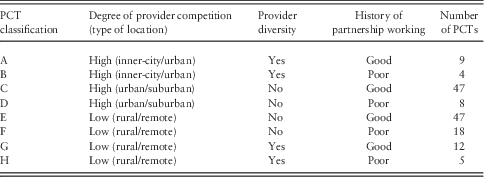
The study utilised local health economies as its unit of analysis and purposively selected six PCTs (geographical areas defined by commissioning boundaries) on the basis of three contextual variables. The main variable was ‘provider market’: the extent to which the PCT offered the prospect of competitive behaviour and choice between NHS providers. The selection was informed by data on the average number of hospitals accessible within 30 min at the level of Lower Super Output Areas (LSOAs; Department for Transport, 2007). The mean number of hospitals accessible within 30 min at PCT-level was calculated as the mean of the LSOA values for all LSOAs within each post-2006 PCT boundary. PCTs with a ‘high’ degree of provider competition had on average more than one NHS hospital accessible within 30 min, while PCTs with a ‘low’ degree of provider competition had on average less than one NHS hospital accessible within 30 min. Two other variables were also taken into account: Provider diversity sought to distinguish between PCTs hosting independent and NHS providers and those with only NHS Trust providers. In practice, this was a crude measure of diversity because patients could potentially travel to an independent provider in another PCT locality. History of partnership working was based on an assessment of three available markers of integration between the PCT and local government: coterminous boundaries; history of pooled budgets using arrangements introduced under Section 31 of the Health Act 1999; and whether the PCT was a ‘long-term conditions demonstrator’ site. PCTs with at least two of these three markers were categorised as having ‘good’ partnership working. The PCTs selected represented extremes where none of these markers were present (in two cases) and where all three were present (in four cases) (Powell et al., Reference Powell, Millar, Mulla, Brown, Fewtrell, McLeod, Goodwin, Dixon and Naylor2011). The criteria for PCT categories were chosen for a wider study of services for diabetes and mental health in addition to orthopaedics, and the history of partnership working criterion was not expected to have a major impact on orthopaedic services (Powell et al., Reference Powell, Millar, Mulla, Brown, Fewtrell, McLeod, Goodwin, Dixon and Naylor2011). Six PCTs were selected from the eight potential categories to ensure that a diversity of contexts was represented, including three urban localities (A, B and C) and three rural localities (E, F and G; Table 1). Each PCT was selected from a different region (Strategic Health Authority) in England in order to promote geographic dispersion.
PCT classification based on contextual variables
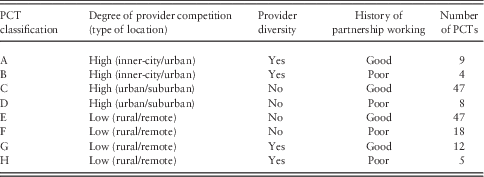
PCT=primary care trust.
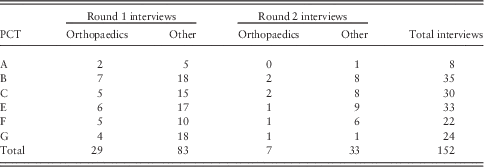
The research employed mixed methods in order to triangulate our understanding of the reforms. Qualitative data analysis was used to capture how people understood, defined and perceived the combined and relative impact of the reform policies on behaviour, relationships and social structures. Two rounds of qualitative data collection were undertaken across the six PCTs between October 2008 and December 2009, resulting in 152 interviews with 112 key informants (Table 2). Interviewees spanned the PCT commissioner and provider arms, relevant acute providers, general practice, host strategic health authorities and local authorities. Interviewees were identified on the basis of their role and responsibilities and an assumption that this would require knowledge of reform implementation. Both senior managers and clinicians were included and one quarter of the interviewees (29/112) was selected for their responsibility for orthopaedics. The second round of interviews was with a selection of interviewees from the first round; they were used to provide some limited dynamic element examining change over time to the analysis, and to test out key observations and findings from the first round. The second round interviewees were purposively chosen on the basis of the findings from the first round of interviews.
Number of interviews by PCT
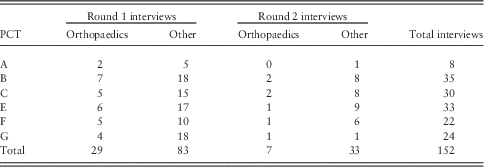
PCT=primary care trust.
In line with the realistic evaluation approach, data analysis looked to examine how the policy mechanisms interacted within local orthopaedic services. Qualitative data analysis paid particular attention to interviewee reflections on the reforms in terms of how the reforms ‘worked’ as levers and incentives. This analysis examined interviewee reflections on behaviour in the presence of incentives associated with the various policy mechanisms. It also assessed contextual factors shaping implementation, paying particular attention to any geographical and institutional factors but also any broader constraints, such as professional or managerial norms and values held by stakeholders. To capture this empirical material a form of pattern coding was employed that grouped segments of data into a smaller number of sets and themes describing the reforms and their interactions (Miles and Huberman, Reference Miles and Huberman1994). The NVivo computer software programme supported the analysis in assigning and displaying coding schemes.
Hospital Episode Statistics for the residents of the six case study PCTs were analysed using the post-2006 PCT configurations. Admission rates between 2002/2003 and 2008/2009 were assessed, defined as the number of discharges occurring within each financial year per 1000 resident population, using estimates of resident population from National Statistics (Information Centre, 2009). Changes in admission rates between 2002/2003 and 2008/2009 at PCT and main provider level were tested for statistical significance at the 5% level for day cases, inpatient admissions and all admissions.
Waiting times from the date of the decision to admit to the date of admission were assessed in terms of the six-monthly mean and median at PCT level between 2002/2003 and 2008/2009. Differences in the proportion of patients waiting less than three months in the urban PCTs and rural PCTs were compared using standard probabilistic methods. DH monthly ‘referral to treatment’ returns for admitted care were used to calculate the proportion of orthopaedic admissions within the 18 week target during the three months to March 2009 for the case-study PCTs (DH, 2009).
A regression analysis using a multilevel linear mixed-effects model was used to examine the relationship between patient-level waiting time and PCT, controlling for patient age and year of admission. Data on admissions in each of the six years to 2008/2009 were included. The model was run separately for inpatients (137,208 admissions) and day cases (130,481 admissions). The model took the form:
 $$Y_{{ij}} =\beta _{0} {\plus}\beta _{1} {\rm X}_{{1ij}} {\plus}\beta _{2} {\rm X}_{{2ij}} {\plus}u_{j} {\plus}{\varepsilon}_{{ij}} $$
For i=1,...,n admissions and j=1,...,6 PCTs. Y ij is the square root of waiting time (from the decision to admit to the date of admission) for patient i in PCT j, X 1ij is age in years of patient i in PCT j, X 2i is the year of admission of patient i in PCT j. β 0 is the intercept and εij is a random error term. In model (1) β 0+β 1X ij+β 2X ij gives one overall regression line accounting for patient age and year of admission representing the population average. Patient age and year of admission were included in the model as continuous explanatory variables. In model (1) u j+εiJ, u j is a random shifter of the regression line for each PCT. Square root transformation of the waiting time data was undertaken in order to reduce the right skewness of the distribution due to the small number of patients waiting a comparatively long time for admission. The Kernel density estimate of the waiting time square root transformation was closer to normality compared to the Kernel of either the log transformation or the natural units. In order to provide an alternative measure of PCT-level effects, a linear fixed-effects regression model was also run. However, the results were not sensitive to choice of model and so the results of the linear fixed-effects regression model are not reported here. STATA version 12 software was used for the analysis.
Findings
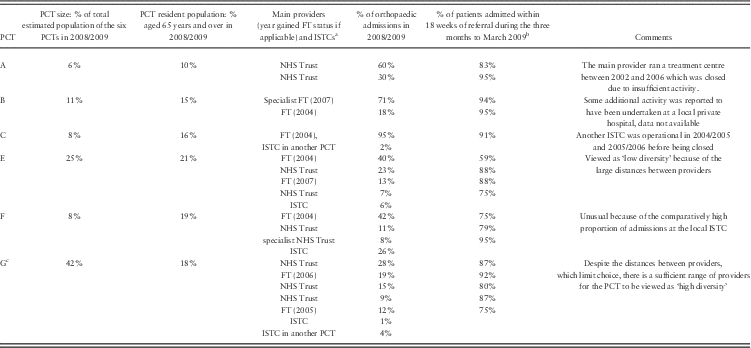
The three urban PCTs can be characterised in terms of having a main provider undertaking the majority of orthopaedic admissions (Table 3). The comparatively larger rural PCTs are served by geographically dispersed providers, such that on average they have less than one hospital Trust available within 30 min travelling time, and the opportunity for competition between Trusts tended to be more limited (Table 3).
PCT size and percentage of orthopaedic admissions by PCT and main providers in 2008/2009
PCT=primary care trust; ISTC=independent sector treatment centres; NHS=National Health Service.
a Main providers are those accounting for at least 5% of orthopaedic admissions for the PCT in 2008/2009.
b Comparable data for the ISTCs were not available.
c Percentages for 2007/2008 admissions are shown here as data for one of the ISTCs were not available for 2008/2009.
System management reforms
Given the key historical issue of access to orthopaedics, ‘system management’ marks the starting point for assessing the four reform streams.
Waiting time targets
From an explicit operational perspective, meeting the increasingly demanding maximum waiting time targets was a clear priority. However, its status among senior clinicians was widely questioned. Some were positive: ‘… to reduce the waiting times to what was thought to be acceptable, down to 18 weeks …[was] a noble aspiration; I think patients did wait too long’ (PCT G orthopaedic surgeon). Others were unwilling to engage with the reduction of waiting times as an appropriate objective.
All the case-study PCTs experienced reductions in waiting time from the decision to admit over the seven years to March 2009 for elective orthopaedic admissions. Figures 2 and 3 show the change in median and mean waiting time for inpatient admissions. In general, the urban PCTs experienced better waiting time performance, although the rural PCTs experienced larger falls in waiting time during this period. For example, in 2002/2003, 58% (6,130/10,541) of patients were admitted within three months of the decision to admit across the urban PCTs (A, B and C) compared to 37% (9,550/25,732) across the rural PCTs (E, F and G; 2003/2004 data were used for PCT F), and the difference in proportion was significant (21 percentage points difference, 95% CIs 20 to 22 percentage points). By 2008/2009, 81% (10,737/13,241) of patients were admitted within three months across the urban PCTs compared with 70% (28,177/39,988) across the rural PCTs, with the urban PCTs’ performance significantly stronger (11 percentage points difference, 95% CIs 10 to 11 percentage points).
Median waiting time for inpatient orthopaedic admissions (weeks) Note: 2002/2003 data are not shown for PCT F because in that year 65% of decision to admit records were set to the date of admission.
Mean waiting time for inpatient orthopaedic admissions (weeks)
Note: 2002/2003 data are not shown for PCT F because in that year 65% of decision to admit records were set to the date of admission.
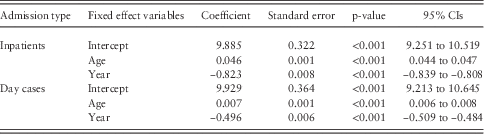
The multilevel linear models used the square root of waiting time (from the decision to admit to the date of admission) as the dependent variable. Patient age, year of admission and PCT were found to be statistically significant predictors of waiting time. Interpretation of the coefficients based on the square root of waiting time is not straightforward beyond determining whether the association between explanatory variables and waiting time is positive or negative, and, when comparing their relative size in the inpatient and day case results. The patient age and year of admission coefficients for the inpatient and day case models are summarised in Table 4, and the PCT-level random effects used in the same models are shown in Figure 4. Patient age is positively associated with waiting time, with a larger impact on inpatient admissions compared with day cases. The year of admission is negatively associated with waiting time, with a larger impact on inpatient admissions compared with day cases (Table 4).
Inpatient and day case waiting time PCT-level random effect coefficients and 95% CIs
Multilevel linear regression models: coefficients for patient age and year of admission
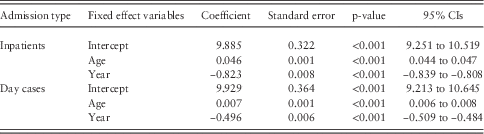
The PCT-level random effects for inpatient admissions show that the three urban PCTs (A to C) are associated with significantly shorter waiting times than the average, and the three rural PCTs are all associated with significantly longer waiting times than the average (Figure 4). The results of the day case model are similar, with the urban PCTs B and C experiencing shorter waiting times than the three rural PCTs. However, PCT A’s experience was not as good as that of PCT F.
Focusing on 2008/2009, PCTs A, B and C experienced lower median and mean waiting times for inpatient admissions, compared with PCTs E, F and G. The regression model described above found that having controlled for patient age, the PCT effects for PCTs E, F and G were all significantly above average in 2008/2009. In 2008/2009, day case waiting times varied comparatively little across these PCTs. The trend for the urban PCTs to experience lower waiting times than the rural PCTs was maintained, with PCTs A and B experiencing lower waiting times than PCTs E and G. The regression model found that having controlled for patient age, the PCT effects for PCTs E and G were significantly above average, and those for PCTs B and C were significantly below average in 2008/2009.
During the first three months of 2009, the three urban PCTs met the target of at least 90% of orthopaedic patients admitted within 18 weeks of referral (A 90%, B 95%, C 92%), while the rural PCT fell short (E 77%, F 85%, G 87%).
Concern was expressed about the overall approach taken to delivery on waiting times:
I cannot understand how they can’t learn that if they set a target, and they threaten the managers with death if they don’t meet the target, and they throw money in to the system at the same time, that the money gets wasted! (PCT B orthopaedic surgeon).
Instead, they pointed to the need to focus on quality measures relating to disease severity and clinical outcomes:
[There are] two big, big issues in our world. There’s the … diagnosis inflation issue, so trying to get objective measures of disease severity … the bigger the diagnosis the bigger the operation, the bigger the remuneration. … So there’s the diagnostic quality and then there’s the therapeutic quality and at the moment we have no national guidelines for either (orthopaedic surgeon).
Policy interventions relating to redesign or the workforce were not often raised by interviewees, but when they were, views were critical of the DH’s approach and implementation.
Supply-side reforms
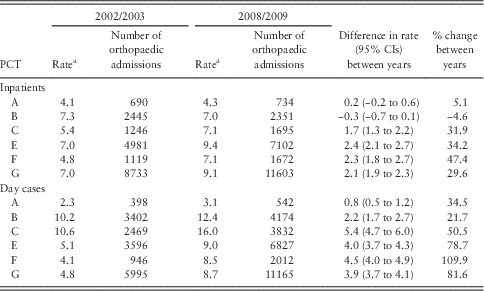
The rural PCTs experienced substantial increases in both inpatient and day case admissions, although their day case rates remained lower than those in the two largest urban PCTs (Table 5). Urban PCT C also experienced large increases in inpatient and day case admissions. PCTs B and A experienced comparatively small changes in inpatient and day case admission rates over time (Table 5). However, they also mark the extremes in terms of admission rates. PCT B had the highest admission rate during the four years from 2002/2003 and strongest waiting time performance, and would arguably have incurred least pressure to subsequently increase activity (Powell et al., Reference Powell, Millar, Mulla, Brown, Fewtrell, McLeod, Goodwin, Dixon and Naylor2011). PCT A has a markedly younger resident population compared to the other case-study PCTs, along with the lowest admission rate since 2002/2003 (Tables 3 and 5).
Summary changes in elective orthopaedic admission rates
PCT=primary care trust.
a Per thousand registered population.
One surgeon suggested that some of the increase in admissions could be attributed to a greater proportion of patients presenting for surgical treatment as waiting times fell: ‘one of my best treatments used to be a waiting list … because in the days when I had a six to 12 month waiting list, I probably had at least 10, 15 per cent of patients who for one reason or another came off the list, the majority of those reported that their symptoms had got better’ or were less likely to choose private practice.
The most talked about and tangible policy intervention intended to increase supply was the introduction of ISTCs. The three rural PCTs and one of the urban PCTs were affected, and by 2008/2009 ISTCs accounted for between 1% and 6% of admissions in three of the PCTs and 26% in PCT F (Table 3). Staff working in NHS hospitals were typically concerned by the introduction of ISTCs, and the presence of ISTCs has been viewed as highly controversial in some localities. The way in which the initial ISTC contracts were centrally agreed, with revenue largely disconnected from volume, and at premium to national tariffs, led to significant criticism: ‘it makes a lot of people grit their teeth … it was handled … very much out of our hands, it was handled centrally and that was the problem’ (PCT commissioner).
The response to ISTCs was specialty specific. For example, in 2008, a big ISTC opened close to a Trust serving PCT G; ‘that's the first time … we’ve ever had any competition [here]’. In some areas, such as hernia repair, the Trust seconded staff to the ISTC to provide the activity: ‘I think we’d all recognise that's actually much better for patients to have what is routine surgery in … a much better …, dedicated elective environment’. However, it was viewed as important to retain orthopaedics in order to maintain the viability of its trauma service. The impact of ISTCs leaving other providers ‘with a rump of complex high co-morbidity patients’ was consistently viewed negatively by staff from affected providers.
The ISTC in PCT F undertook more total knee replacements than the PCT’s main provider in 2008/2009 (154 and 101, respectively). The mean age of patients undergoing a TKR was 66.5 years at the ISTC compared with 79.9 at the main provider, and the difference in mean was significant (−13.4 years, 95% CIs −14.8 to −12.0 years). Similarly, the mean length of stay was lower at the ISTC compared with the main provider (4.5 and 6.7 days, respectively), and the difference in mean was significant (−2.2 days, 95% CIs −3.2 to −1.2 days). These findings suggest that the ISTC was treating less complex patients than the main provider.
In this case, the local FT main provider acknowledged that it had faced a problem ‘as some waiting lists started to stretch’. However, despite the unusually extensive use of the ISTC, this FT’s waiting time performance was one of the weakest of all the main providers across the six case-study PCTs (Table 5). Furthermore, it appeared that the FT had not responded to this exposure to competition by challenging its own working practices. Despite the large proportion of total activity undertaken by the ISTC in this locality, an orthopaedic consultant from the PCT’s main provider noted: ‘in fact, … it hasn’t actually reduced the amount of work that we are doing, we are still working to capacity’.
In several PCTs, there was an expectation that contracts would be renewed, but on the same basis as any other provider, without guaranteed activity. The impact of ISTCs has been wider than their limited contribution to capacity, in some localities prompting reassessment of the potential for competition between providers: the ISTC ‘really is shaking up the health economy. … on the positive side it did make the surgeons think in the NHS perspective’ (PCT G manager).
Both NHS Trusts and FTs shared an incentive to maximise revenue and the drive for FT status, in combination with PbR, was widely viewed as having incentivised NHS providers to treat more patients. The financial interest of providers has been in line with the national policy intention to deliver shorter waiting times by increasing activity. However, the FT policy was also viewed as highly contentious, having ‘fragmented the health service and to get the best value out of the healthcare system, we need to bring it back together’. This issue was both expressed by PCT commissioners and acknowledged by the FTs themselves.
From a system perspective, it has been increasingly recognised that some localities have cost pressures, driven in part through increases in activity and funded capacity in specialties including orthopaedics, that need to be addressed. This concern was most clearly expressed in the rural PCTs, which tended to have comparatively weak ratings for financial performance and a larger number of orthopaedic service providers.
Demand-side reforms
Commissioning
Commissioning in relation to orthopaedics has played a minor role and stakeholders expressed doubt about the ability of the commissioning function to manage demand. PCT commissioners appeared to be preoccupied with addressing the WCC agenda and local competency scores as a whole, rather than seeking to influence their acute providers.
There were examples of community-based triage services being implemented across some of the case-study PCTs, which in general focused on changing access to orthopaedic consultants in order to improve their ‘conversion rate’, the proportion of new outpatients subsequently receiving treatment, thereby increasing the proportion of their time available for undertaking surgery. In one well-established scheme, consultants were paid on a sessional basis to see selected patients in community settings. Here, the NHS provider Trusts were willing to forgo some outpatient revenue, so long as ‘their’ consultants encouraged patients requiring surgery to book their treatment with them. In one case, this was reported to have resulted in an NHS Trust agreeing especially short waiting times for admission for a particular surgeon who was offering patients a choice between the Trust and a private hospital.
One scheme reported undertaking a study, which suggested an increase in treatment thresholds had occurred compared with other localities, but in that PCT the commissioners were assessing performance on conversion rates rather than treatment rates. Hence, there was no direct attempt to manage the growth in surgical activity. Explicit management of treatment thresholds has typically not been implemented by PCT commissioners. NHS providers have appointed additional consultants and commissioners have had to accept the consequences: ‘Every time we appoint someone with a special interest … it attracts more work. I don’t know, I really don’t know how the mechanism happens’ (PCT F orthopaedic surgeon).
Nevertheless, some PCT commissioners expressed some confidence in being able move beyond ‘payment by activity’ towards ‘payment by results’ and establish more direct links with measures of impact on health outcomes. This aspiration was matched with a view that practice-based commissioners had the potential to play a key role in developing patient pathways, but in practice, the initiative appeared to be far from their grasp.
Choice
The choice agenda was often raised in relation to orthopaedic services. Orthopaedic consultants tended to see themselves as the key criterion for choice: ‘the most important thing … is the person who’s actually wielding the knife …. I think most patients want … a local surgeon … who has a reputation to protect … [in contrast to] somebody coming in for six weeks from Sweden or South Africa hacking their way through a list of patients and then clearing off again’. The response of an NHS hospital to choice being offered between it and a private hospital in a triage service, noted above, demonstrates an extreme outcome for choice of surgeon. More generally, tension for PCTs between allowing patient choice and ensuring that ISTC contracts were utilised was often cited. For example, it was reported that patients were ‘bullied’ via repeated phone calls from referral management centres into changing their choice to the local treatment centre: an example of a ‘dichotomy between commissioning and choice’ (manager).
Transactional reforms
In addition to the issues noted above, several factors relating to the PbR tariffs were cited by orthopaedic staff. Some tariffs were criticised for promoting inappropriate incentives. For example, a surgeon reported being ‘berated’ for using a high cost prosthesis, which was viewed as being cost-effective. At the same time, this interviewee also noted that PbR was fuelling consideration of treatment options with cost-saving consequences, such as partial knee replacement instead of total knee replacement. However, the surgeon also emphasised pressure to undertake profitable surgery of doubtful efficacy:
… we are being strongly incentivised … to do procedures that are of limited or negligible benefit … HRG4 strongly rewards us to do arthroscopic surgery on arthritic joints which is cheap but doesn’t work and that’s barmy isn’t it?
PbR was positively viewed by senior managers in NHS acute providers. For some, there was a sense of PbR contributing to greater provider-level efficiency. However, there was also appreciation of a bigger picture:
… our Trust … is making a great profit but the PCT is making a great loss and for us, financially, if the PCT goes bust, whatever that means, that puts us as their main provider in a rubbish situation (PCT E).
At another large case-study, the PCT commissioner reported limiting providers’ surpluses by moving away from PbR in order to fund deficits: ‘We’re now closer to block contacts, or less variable contracts, than we were before’.
Discussion
The main concern for the quality of orthopaedics was waiting times, and to the extent that the urban PCTs experienced shorter waiting times than the rural PCTs, our findings on waiting times are broadly in line with the econometric group of competition studies (although Gaynor et al. (Reference Gaynor, Moreno-Serra and Propper2011) did not find a waiting time response to competition policy). However, the rural PCTs ‘closed the gap’ on waiting times to a considerable degree, throughout the period in which New Labour sought to supersede ‘central control’ with ‘market-orientated’ programme theories (Mays et al., Reference Mays, Dixon and Jones2011). This finding could be viewed as a policy success, but invites consideration of why the rural PCTs did not achieve better access, given the DH’s focus on this measure for orthopaedics. Overall, the experience of the case-study PCTs suggests that provider competition has had limited impact on the provision of Orthopaedic services.
Our findings illuminate stakeholders’ perceptions of the interaction of the reform process. Most interviewees were aware of the potential of choice and the threat of competition, even in largely monopolistic markets. However, in terms of the views expressed by local stakeholders, the potential impact of market forces, in which incumbent providers compete on the basis of comparative quality in the face of fixed prices, was overshadowed by the arrival of ISTCs affecting the three rural PCTs and one of the urban PCTs. Here, in response to this nationally determined initiative, local commissioners were faced with a pressing challenge to persuade GPs and patients to use this premium-cost capacity in preference to their other providers. With one exception, the contribution made by the ISTCs was limited. NHS providers were affected, but only to a limited extent because they still enjoyed the lion share of the considerable increases in admissions. Even in PCT (F) where the ISTC accounted for a quarter of orthopaedic admissions, the main local NHS provider experienced growth in admissions, and staff appeared remarkably unconcerned by their competitor. This finding confirms that in a context of there being ‘more than enough [work] to go round’ competition-related incentives are weak (Frosini et al., 2012: 20; Greener, Reference Greener2012). The introduction of ISTCs was not viewed within the affected localities as contributing to a coherent approach to promoting efficiency, a perspective for which there is wider evidence (Street et al., Reference Street, Sivey, Mason, Miraldo and Siciliani2010).
In the context of increasing NHS resources, the combined impact of national targets, tariffs and the FT agenda allowed providers’ profit-maximising incentives to dominate service delivery. In the absence of widely implemented robust demand management tools, it appears likely that treatment thresholds changed, and PCT commissioners have not been well placed to counter providers’ incentives. The view that the supply and demand streams were ‘unbalanced’ strongly echoes the national perception that the local commissioning function was weak (Audit Commission and Healthcare Commission, 2008). Certainly, the two largest case-study PCTs, which were both rural and comparatively weak performers, were disadvantaged by having to contend with the full burden of major structural change following the 2006 PCT reconfigurations. Nevertheless, the commissioners’ focus on conversion rates rather than treatment thresholds, suggests limited resolve to engage on clinical issues (Frankel et al., Reference Frankel, Eachus, Pearson, Greenwood, Chan, Peters, Donovan, Smith and Dieppe1999). Overall, the case-study experience suggests that locality-based commissioning relating to orthopaedics was not likely to ‘catch-up’ and then ‘stand-up’ and effectively influence use of available resources.
The rural case-study PCTs’ experiences during this period of reform illustrate the constrained potential of competition in the face of differing local contexts. This finding is echoed by Garber (Reference Garber2011: 65) who, while advocating competition, concluded that ‘we simply don’t know which approaches [to commissioning and the use of incentives to reward providers] work best’. The DH claimed that market forces would deliver more than what could be achieved via targets and performance management (DH, 2005). International experience suggests that the introduction of market principles has led to the reassertion of state regulatory authority (Hassenteufel et al., Reference Hassenteufel, Smyrl, Genieys and Moreno-Fuentes2010). Across the six case-study PCTs, concern over national waiting time targets appeared to be a more important long-standing influence on Orthopaedics staff than the cumulative impact of market-orientated policies. However, even the ‘targets-and-terror’ associated with performance managing waiting times did not necessarily prevail over providers’ self-interests. To the extent that there is a trade-off for providers between meeting access targets and maximising admissions and revenue, providers in the rural localities appeared to be less concerned about waiting time performance. This may be because they were less exposed to competition. However, the rural PCTs highlight a clear distinction between providers’ interests and those of the wider NHS, despite an ostensibly dominant policy imperative to deliver access targets.
The Coalition Government, formed by the Conservative and Liberal Democrat parties in May 2010, has committed the NHS to further market reforms, seeking to extend opportunities for supply-side competition, while also endorsing the FT model for NHS providers and locality-based commissioning (Gregory et al., Reference Gregory, Dixon and Ham2012). The language relating to national targets has changed, but a high profile remains attached to meeting national waiting time standards. In terms of these components of the policy landscape, the challenges experienced in the case-study PCTs remain just as relevant under the Coalition Government. What can potentially counter the dominance of FTs to dictate service delivery, as exemplified by the observation that the only constraint on their profit maximising behaviour would be the consequences associated with the local PCT ‘going bust, whatever that means’? The new NHS England (formerly known as the NHS Commissioning Board) has the potential to deliver a powerful leadership role and could herald a substantial move away from reliance on local commissioning and provider competition to influence provider behaviour. For example, if developed by NHS England, model pathways for joint replacement cases incorporating treatment threshold criteria could strengthen opportunities to hold FTs to account. However, as long as the FT model is pursued, a price may be paid for the potential conflict between their organisation-level incentives and those of the wider NHS.
The pragmatic adoption of the realist evaluation framework provided a productive basis for our analysis using multiple data sources and methods. The stakeholders’ stated views of the reforms, which tended to reflect the circumstances of their local roles, rather than any system-wide overview of the reform streams, provided a rich basis for comparative analysis complemented by the quantitative measures of change over time. Nevertheless, the practical limitations of using the realist framework must be acknowledged as we attempted to understand the extent to which reform processes influenced the delivery of orthopaedic services. The study focused on the main themes that emerged from the stakeholder interviews, and does not present a complete analysis of all reform policies.
Conclusion
New Labour sought to justify a change in dominant programme theory from one of ‘central control’, to one based on ‘market forces’: ‘we can use targets and performance management to drive up standards. But it can only ever take us some of the way’ (DH, 2005: pi). This study suggests that the impact of market forces remained limited: the views expressed by hospital managers and clinicians suggest that they were not highly motivated to change working practices on the basis of actual or potential provider competition, despite the major effort made to expand local capacity via ISTCs. Instead, national access targets continued to play a more tangible role in influencing service delivery in both urban and rural localities. The resulting mixture of programme theories was not viewed as comprising a coherent and mutually supportive set of arrangements. Moreover, the rural PCTs in particular illustrate the dominance of the FT policy such that provider-level incentives were viewed as being more influential than national targets or the efforts made by local commissioners to influence service delivery. The reports of commissioners moving away from PbR funding towards less activity-sensitive contracts indicate a much more blunt intervention on the part of commissioners in their attempt to manage resources. Our analysis of stakeholders’ views of the reform process suggests that policymakers have not yet achieved an appropriate balance of incentives within local health economies. NHS England could help realise this, if it engages more directly with FTs, rather than relying on competition rhetoric.
Acknowledgment
This is an independent article using data from a study funded by the Policy Research Programme in the Department of Health. The views expressed are not necessarily those of the Department.