1. Introduction
The existing Iranian record of the Ordovician graptolites is incomplete and mostly confined to the Upper Ordovician strata. Two publications by Rickards et al. (Reference Rickards, Hamedi and Wright1994, Reference Rickards, Hamedi and Wright2001), which together represent the most comprehensive Iranian Ordovician graptolite account yet published, are dedicated to a moderately rich fauna from the lower part of the Katkoyeh Formation in the vicinity of the Banestan village (SE Central Iran). It includes numerous dendroid taxa, for example, Callograptus huckriedei Rickards et al. Reference Rickards, Hamedi and Wright2001; Dictyonema bitubulatum Rickards et al. Reference Rickards, Hamedi and Wright2001; Dendrograptus sp. cf. D. flexuosus Hall, Reference Hall1865; Acanthograptus divergens Skevington, Reference Skevington1963 and Thallograptus? succulentus Ruedemann, Reference Ruedemann1904; the tuboid graptolite Galeograptus sp.; the graptoloids Aulograptus? sp.; Didymograptus incertus Perner, Reference Perner1895; Undulograptus formosus (Mu & Lee, Reference Mu and Lee1958) and Yutagraptus sp. cf. Y. mantuanus Riva, Reference Riva, Chen, Erdtmann and Ni1994, suggesting an early Darriwilian age.
Another paper by Rickards et al. (Reference Rickards, Hamedi and Wright2000) is dedicated mainly to the Silurian (Llandovery) graptolites from Faraghan Mountain and Gahkum Mountain, which are located in the southeastern part of the Zagros Ranges. Only two Late Ordovician species were documented, and details of their stratigraphic position were not given. One of them, identified as Orthograptus amplexicaulis abbreviatus Elles & Wood, Reference Elles and Wood1907, occurs in the Seyahou Formation (middle Katian) and the other one, Normalograptus persculptus (Elles & Wood, Reference Elles and Wood1907), is from the lowermost Sarchahan Formation (Hirnantian). Subsequently, Ghavidel-Syooki et al. (Reference Ghavidel-Syooki, Álvaro, Popov, Ghobadi Pour, Ehsani and Suyarkova2011) provided more detailed data on the moderately diverse Hirnantian graptolite association from Faraghan Mountain, which is dominated by Normalograptus ajjeri (Legrand, Reference Legrand1977). Other reports on graptolite occurrences in Iran, summarized by Rickards et al. (Reference Rickards, Hamedi and Wright1994), are based on brief notes with preliminary identifications and are considerably outdated; they include a note by Stöcklin & Setudehnia (1972) on the occurrence of Tetragraptus and Didymograptus in deposits erroneously assigned to the Mila Formation in the western Alborz Mountains and southern Azerbaijan, which was until now the only evidence for the occurrence of Lower Ordovician graptolites in Iran.
The present paper discusses (1) a collection of fragmentary Tremadocian graptolites from the Saluk Mountains in NE Iran, and (2) collections of graptolites, some of which indicate beds of early Floian age, from closely spaced localities around Simeh–Kuh.
2. Materials and methods
The graptolite specimens used in the present study were sampled from poorly consolidated black or dark grey silty argillite. Many of them are fragmentary and most are variably affected by diagenetic flattening, such that the tubaria are commonly represented as dull black silhouettes that may sometimes show interthecal septa, etc., but sometimes, when weathered, may form a rusty film (see Maletz, Reference Maletz2020). The periderm may flake away, leaving an external mould in low relief that could be cast using rubber latex. A few samples are partly preserved as pyrite casts in strong relief.
Specimens selected for illustration were drawn at a large magnification using a Wild camera lucida and were then inked-in and reduced to a standard magnification of ×10 or ×5. All specimens illustrated or referred to in this paper are deposited in the Sedgwick Museum, University of Cambridge (museum nos SM X 50352.1 to SM X 50352.45).
3. Geological and geographical settings
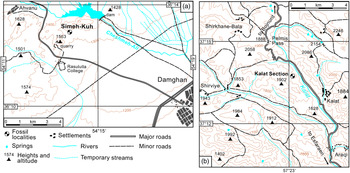
The Lower Ordovician graptolites that are the subject of the present study are derived from two new and separate localities in NE Iran; one is situated in the Saluk Mountains, south of Bojnurd in the Kopet–Dagh Region (North Khorasan Province), and the other is at Simeh–Kuh, NE of the city of Damghan in eastern Alborz (Semnan Province) (Figs 1, 2). At present, no adequate lithostratigraphical subdivision of the Lower Ordovician deposits of North Iran has been published, but this under revision. In earlier publications (e.g. Ghavidel-Syooki, Reference Ghavidel-Syooki, Goodman and Clarke2001, Reference Ghavidel-Syooki2006; Bruton et al. Reference Bruton, Wright and Hamedi2004; Ghobadi Pour, Reference Ghobadi Pour, Bassett and Deisler2006; Ghobadi Pour et al. Reference Ghobadi Pour, Vidal and Hosseini-Nezhad2007), the Lower Ordovician deposits were usually assigned to the Lashkarak Formation; however, the term Lashkarak Formation, as originally defined by Gansser & Huber (Reference Gansser and Huber1962), can be applied only to the Middle and Upper Ordovician deposits of Alborz not older than Darriwilian, as was demonstrated by Ghobadi Pour et al. (Reference Ghobadi Pour, Popov, Kebria-Ee Zadeh and Baars2011). It is worth noting that, on existing geological maps, the Ordovician deposits cropping out in the vicinity of Simeh–Kuh are currently depicted as Upper Devonian strata (e.g. Alavi & Salehi-Rad, Reference Alavi and Salehi-Rad1975).
Geographical sketch maps showing position of the graptolite localities: (a) map of the area NW of the city of Damghan showing position of the Simeh–Kuh section; and (b) map of the area south of the Pelmis Pass at Saluk Mountains, showing the position of the Kalat section west of the road connecting Bojnurd and Esfarayen.

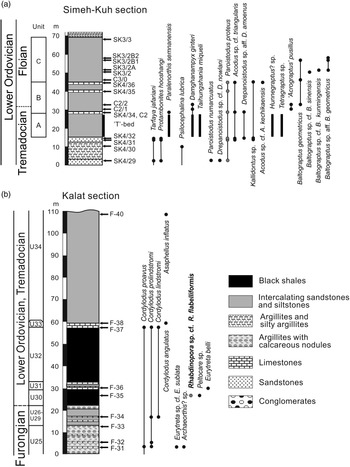
Stratigraphical columns through (a) Tremadocian–Floian transition at the upper part of the Lower Ordovician succession at Simeh–Kuh, showing the position of the graptolite localities and stratigraphical ranges of graptolite and selected brachiopod, trilobite and conodont species; and (b) Cambrian–Ordovician boundary beds of Kalat section in the Saluk Mountains, showing stratigraphical ranges of graptolite and selected brachiopod, trilobite and conodont species.

In the Saluk Mountains, the Lower Ordovician succession is best documented in the Kalat Valley on the west side of the Kalat stream, about 39 km south of the town of Bojnurd along the road to Esfarayen (Fig. 1). A brief outline of the geology of the area, and the conodont biostratigraphy through the Cambrian–Ordovician transition, was given by Jahangir et al. (Reference Jahangir, Ghobadi Pour, Holmer, Popov, Ashuri, Rushton, Yu Tolmacheva and Amini2015). The uppermost Furongian part of the succession (Cordylodus proavus and Cordylodus prolindstromi conodont zones) comprises mainly grey argillites and siltstones with limestone nodules and occasional thin bioclastic limestone beds (Fig. 2). Close to the Cambrian–Ordovician boundary, grey siltstones and argillites are replaced by black shales and limestone nodules completely disappear.
In the Kalat Valley, the graptolite Rhabdinopora sp. cf. R. flabelliformis (Eichwald, Reference Eichwald1840) has been recovered from a single horizon (Fig. 2; sample F-35) at 4.6 m above the base of the unit of black shales and 8.7 m above the brachiopod shell bed that contains the stratigraphically lowest examples of the conodont Cordylodus lindstromi Druce & Jones, Reference Druce and Jones1971 (Fig. 2, sample F-34). Geographical coordinates of the locality are 37° 13ʼ 48ʼʼ N, 57° 23ʼ 15ʼʼ E. The associated fossil assemblage includes the olenid trilobite Peltocare sp. and a few unidentified obolid brachiopods. The second limestone bed, at the top of the black shales (Fig. 2, samples, F-37, 38), contains the conodont Cordylodus angulatus Pander, Reference Pander1856.
Although the species of Rhabdinopora from Kalat is not identified with certainty, the regularity of the mesh is more suggestive of a subspecies close to R. flabelliformis flabelliformis rather than R. flabelliformis parabola or R. f. canadensis, in which the mesh is less regular (Cooper et al. Reference Cooper, Maletz, Wang and Erdtmann1998). If this is accepted, the age is likely to be close to that of ‘Assemblage 2’ of Cooper et al. (Reference Cooper, Maletz, Wang and Erdtmann1998, fig. 3), that is, early but not earliest Tremadocian.
In the absence of conodonts of the Iapetognathus lineage, the occurrence of Rhabdinopora sp. cf. R. flabelliformis is the principal indication of the proximity of the Cambrian–Ordovician boundary in the Kalat Section and it may coincide with the beginning of black shale deposition. At present Kopet–Dagh is the only region in Iran where the position of the Cambrian–Ordovician boundary can be recognized with some precision in a continuous succession.
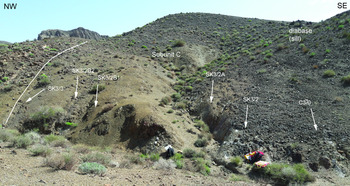
The other graptolite locality is situated at Simeh–Kuh, c. 13 km NW of the city of Damghan, east of the road connecting Damghan with Cheshmeh–Ali, in the eastern Alborz Mountains (Semnan Province) (Fig. 1). The Ordovician geology and biostratigraphy of the area are characterized in detail in a number of publications (Ghobadi Pour, Reference Ghobadi Pour, Bassett and Deisler2006; Popov et al. Reference Popov, Ghobadi Pour and Hosseini2008; Ghobadi Pour et al. Reference Ghobadi Pour, Popov, Kebria-Ee Zadeh and Baars2011; Jahangir et al. Reference Jahangir, Ghobadi Pour, Ashuri and Amini2016), but so far no formal lithostratigraphical units have been introduced. The graptolite-bearing interval is composed mainly of dark grey argillites and siltstones (Figs 2, 3), in total 52.85 m thick, not yet assigned to a formal lithostratigraphical unit (Fig. 3). It can be subdivided into three subunits as follows. (A) Silty argillite, total 13.65 m thick, with abundant trilobites Asaphellus fecundus Ghobadi Pour et al. Reference Ghobadi Pour, Vidal and Hosseini-Nezhad2007, Damghanampyx ginteri Ghobadi Pour et al. Reference Ghobadi Pour, Vidal and Hosseini-Nezhad2007, Taihungshania miqueli (Bergeron, Reference Bergeron1894) and brachiopods Paralenorthis semnanensis Popov et al. Reference Popov, Ghobadi Pour, Bassett and Kebria-Ee Zadeh2009, Polytoechia hecatompylensis Popov et al. Reference Popov, Ghobadi Pour, Bassett and Kebria-Ee Zadeh2009, Ranorthis cheshmehaliana Popov et al. Reference Popov, Ghobadi Pour, Bassett and Kebria-Ee Zadeh2009 and Xinanorthis qoomesensis Popov et al. Reference Popov, Ghobadi Pour, Bassett and Kebria-Ee Zadeh2009. (B) Laminated silty argillite with occasional millimetre-scale beds of siltstone and three bioclastic limestone beds at 0–0.6 m, 10.24–10.34 m and the upper 0.1 m of the subunit, total 16.7 m thick. The lowermost limestone bed is rich in brachiopod coquinas, mainly disarticulated shells of rhynchonelliforms Paralenorthis semnanensis, Polytoechia hecatompylensis, Ranorthis cheshmehaliana and Xinanorthis qoomesensis and micromorphic linguliform brachiopods, including Eosiphonotreta sp., Ghavidelia damghanensis Popov et al. Reference Popov, Ghobadi Pour and Hosseini2008, Orbithele sp. and Wahwahlingula? sp. (Popov et al. Reference Popov, Ghobadi Pour and Hosseini2008, Reference Popov, Ghobadi Pour, Bassett and Kebria-Ee Zadeh2009, sample ‘Tc’). Conodonts characteristic of the Paroistodus proteus conodont zone have been recovered from the two lowermost limestone beds, while the upper limestone bed contains Acodus sp. cf. A. kechikaensis Pyle & Barnes, Reference Pyle and Barnes2002, probably conspecific with the species indicative of the Floian kechikaensis conodont zone of Canada (Jahangir et al. Reference Jahangir, Ghobadi Pour, Ashuri and Amini2016). (C) Light to dark grey argillite and silty argillite, about 22.5 m thick with occasional graptolite rhabdosome accumulations on the bedding surfaces in the lower and middle part and condensed levels with brachiopod shell accumulations in the upper part (Figs 2, 3). A thickness of up to 5 m of highly altered subvolcanic doleritic rock is intruded into the lowermost part of Subunit C.
Exposure of graptolite-bearing argillites in the upper part of the Lower Ordovician succession (Subunit C) at Simeh–Kuh, showing position of graptolite samples.

The graptolite-bearing beds are underlain by a unit of cross- and parallel-bedded sandstone and impure limestone that includes shell beds formed by disarticulated valves of Protambonites hooshangi Popov et al. Reference Popov, Ghobadi Pour, Bassett and Kebria-Ee Zadeh2009 and Tarfaya jafariani Popov et al. Reference Popov, Ghobadi Pour, Bassett and Kebria-Ee Zadeh2009, while conodont samples from the base and the top of the unit contain conodonts of the lower Paroistodus proteus Zone (Ghobadi Pour et al. Reference Ghobadi Pour, Vidal and Hosseini-Nezhad2007; Popov et al. Reference Popov, Ghobadi Pour, Bassett and Kebria-Ee Zadeh2009; Jahangir et al. Reference Jahangir, Ghobadi Pour, Ashuri and Amini2016).
The graptolite-bearing argillites of Subunit C are overlain by intercalations of bioclastic limestones and argillites with the brachiopod Yangtzeella longiseptata (Ghobadi Pour et al. Reference Ghobadi Pour, Popov, Kebria-Ee Zadeh and Baars2011) of late Floian age, and are not presently assigned to a formal lithostratigraphical unit (Figs 2, 3).
Two graptolite-bearing samples were collected from the uppermost Tremadocian part of the Simeh–Kuh section, while seven other samples, listed below, were collected from Floian strata.
Sample ‘T’ (trilobite bed; 36° 12ʼ 44.8ʼʼ N, 54° 13ʼ 30.1ʼʼ E; altitude 1382 m), was taken within the interval l0−14.4 m above the base of Subunit A (Fig. 3); this yielded a single specimen of a horizontal Tetragraptus? that resembles T. longus Lindholm, Reference Lindholm1991, but is too fragmentary to be determined exactly. Also present are fragments of broad distal stipes of dichograptid appearance, but not further identifiable.
From the same sample, there are fragments of broad stipes accompanied by two strongly flattened proximal ends that resemble a gently declined didymograptid. These resemble the proximal ends of Hunnegraptus copiosus Lindholm, Reference Lindholm1991, but regrettably are much flattened and the presence of confirmatory bithecae remains to be proved. The associated shelly fossil assemblage contains abundant trilobites of the Asaphellus fecundus – Taihungshania miqueli trilobite zone (Ghobadi Pour et al. Reference Ghobadi Pour, Vidal and Hosseini-Nezhad2007, Reference Ghobadi Pour, Popov, Hejazi, Holmer, Hosseini-Nezhad, Rasuli, Fallah, Amini and Jahangir2015), brachiopods Polytoechia hecatompylensis Popov et al. Reference Popov, Ghobadi Pour, Bassett and Kebria-Ee Zadeh2009, Paralenorthis semnanensis Popov et al. Reference Popov, Ghobadi Pour, Bassett and Kebria-Ee Zadeh2009, Ranorthis cheshmehaliana Popov et al. Reference Popov, Ghobadi Pour, Bassett and Kebria-Ee Zadeh2009 and Xinanorthis qoomesensis Popov et al. Reference Popov, Ghobadi Pour, Bassett and Kebria-Ee Zadeh2009, and unidentified ostracods.
Sample C2/1 is taken from a fossil horizon in dark grey argillites that lies 0.5 m above the lowermost limestone bed at the base of Subunit B; it contains conodonts of the Drepanoistodus aff. amoenus Subzone identified by Oliver Lehnert from the University of Erlangen (Ghobadi Pour et al. Reference Ghobadi Pour, Vidal and Hosseini-Nezhad2007; sample Tc), which is the lowermost subunit of the Paroistodus proteus conodont zone (Löfgren, Reference Löfgren1994) and suggests a late Tremadocian age. The graptolite assemblage includes a slender species of Acrograptus comparable to Acrograptus pusillus (Tullberg, Reference Tullberg1880); it occurs with fragments of a similar but slightly broader didymograptid that has an asymmetrical proximal end and is comparable to ‘Didymograptus cf. pusillus’ as described by Monsen (Reference Monsen1937, p. 129). These forms are not very decisive, but are suggestive of the presence of uppermost Tremadocian or lower–middle Floian strata. The associated trilobites are represented by Apatokephalus sp., Asaphellus sp., Euloma sp., Damghanampyx ginteri Ghobadi Pour, Reference Ghobadi Pour, Bassett and Deisler2006 and Geragnostus (Geragnostella) lycaonicus Dean, Reference Dean1971 (Ghobadi Pour, Reference Ghobadi Pour, Bassett and Deisler2006).
Sample C2/2 was collected from dark grey argillites about 3.3 m above the base of Subunit B (Fig. 2). The graptolites collected are declined didymograptids, including Baltograptus geometricus (Törnquist, Reference Törnquist1901), associated with an example that resembles Acrograptus pusillus (Tullberg, Reference Tullberg1880) and also fragments that recall Acrograptus cf. A. pusillus (of Monsen, Reference Monsen1937, pl. 2, figs 21, 50). B. geometricus is typically early Floian in age and at Hunneberg first appears near the middle of the range of Paratetragraptus approximatus; its first appearance can be used to mark the base of the Cymatograptus protobalticus graptolite zone (Egenhoff & Maletz, Reference Egenhoff and Maletz2007). The associated faunal assemblage includes the trilobites Asaphellus sp., Damghanampyx ginteri and Geragnostus (Geragnostella) lycaonicus Dean, Reference Dean1971, brachiopod Paralenorthis semnanensis Popov et al. Reference Popov, Ghobadi Pour, Bassett and Kebria-Ee Zadeh2009, bivalve Glyptarca sp. (Cope & Ghobadi Pour, Reference Cope and Ghobadi Pour2020) and numerous unidentified ostracods.
Argillites of Subunit C were sampled from two parallel transects. Sample C3/0 was taken in a prolongation of the measured profile described by Ghobadi Pour (Reference Ghobadi Pour, Bassett and Deisler2006), whereas samples SK3/2, SK3/2B, SK3/2B1, SK3/2B2 and SK3/3 (Fig. 3) were collected along the north side of the unnamed dry creek about 150 m to the north.
Sample C3/0 was taken from dark grey argillites at 0–0.5 m above the uppermost limestone bed of Subunit B. Among the graptolites found are Baltograptus geometricus, represented by a tubarium with 12 thecae in each stipe, associated with a few proximal ends and some distal stipe fragments assigned to the same species. Other distal fragments are somewhat curved and may represent another, but so far undetermined, species.
Sample SK3/2 (36° 12ʼ 49.8ʼʼ N, 54° 13ʼ 30.6ʼʼ E) was taken from dark grey argillites at 3.30 m from the contact with a dolerite sill (Fig. 3). The graptolite assemblage includes Baltograptus sp. cf. B. sinensis (Lee & Chen, Reference Lee and Chen1962). Lee & Chen (Reference Lee and Chen1962) described Didymograptus sinensis from the lower part of the Tonggao Shale (T. approximatus graptolite zone) in the Sandu district of Guizhou, China. The associated shelly faunal assemblage includes the trilobites Asaphellus sp., brachiopods Paralenorthis sp. and bivalves Glyptarca sp.
Sample SK3/2A was taken from dark grey argillites of the Subunit C, lower part, at 1.0 m above the previous fossiliferous horizon. The collection consists of several fragments of a deflexed didymograptid that we assign to Baltograptus sp. cf. B. kunmingensis (Ni in Mu et al. Reference Mu, Ge, Chen, Ni and Lin1979, pp. 80, 147) and a single specimen of a declined species of didymograptid that resembles Baltograptus geometricus, but differs in having the thecae more closely set. Mu et al. (Reference Mu, Ge, Chen, Ni and Lin1979, p. 145) recorded B. kunmingensis from the lower part of the Ningkuo Shale, from the deflexus Zone (horizon N3), in particular the Didymograptus eobifidus Subzone (horizon N3a).
Sample SK3/2B1 was taken from dark grey argillites in the middle part of Subunit C at 12.1 m below the top of the graptolitic shale bed. It contains declined didymograptids including B. geometricus and flattened fragments that differ from the typical B. geometricus in having thecae with the apertures somewhat acutely pointed. Also present is the brachiopod Paralenorthis sp.
Sample SK3/2B2 was taken from dark grey argillites in the middle part of Subunit C at 0.7 m above the previous fossiliferous sample. It contains declined to nearly horizontal didymograptids that are tentatively identified with B. geometricus.
Sample SK3/3 was taken from grey argillites within the interval 0–1.0 m below the top of Subunit C, and consists of finely arenaceous rock with mica flakes. The few graptolites found are fragmentary and cannot be identified satisfactorily; however, the fragments collected appear to suggest the presence of one or more taxa that were not identified at lower horizons.
4. Systematic palaeontology
We comment here on the identifiable graptolite material collected from the Kalat section and the localities at Simeh–Kuh. We follow the classification of graptolites as discussed by Maletz (Reference Maletz2014).
Because the graptolites discussed here involve many that are fragmentary, we have measured the thecal spacing using the ‘two theca repeat distance’ or ‘2TRD’ of Howe (Reference Howe1983), in addition to the conventional number of thecae in 10 mm.
Order GRAPTOLOIDEA Lapworth (in Hopkinson & Lapworth, Reference Hopkinson and Lapworth1875)
Family ANISOGRAPTIDAE Bulman, Reference Bulman1950
Genus Rhabdinopora Eichwald, Reference Eichwald1855
Type species. Gorgonia flabelliformis Eichwald, Reference Eichwald1840, designated by Eichwald, Reference Eichwald1855.
Rhabdinopora sp. cf. R. flabelliformis (Eichwald, Reference Eichwald1840)
(Fig. 4a–f)
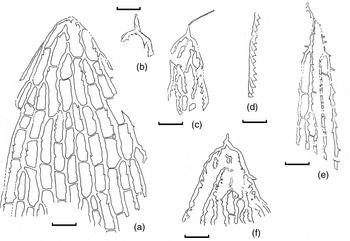
Rhabdinopora sp. cf. R. flabelliformis (Eichwald); all from Sample F-35, the Lower Ordovician (Tremadocian) of the Kalat section, south of Bojnurd, NE Iran: (a) proximal part of tubarium, with some of the lateral stipes missing; specimen SM X 50352.1; (b) proximal end, specimen SM X 50352.2; (c) proximal fragment showing nema, specimen SM X 50352.3; (d) stipe fragment seen in lateral view, specimen SM X 50352.4; (e) fragment of tubarium with indication of some autothecae, specimen SM X 50352.5; and (f) proximal fragment, specimen SM X 50352.6. Scale bar: (a, c–f) 2 mm and (b) 1 mm.

Material. The sample F-35, Kalat section, Kuh-e Saluk Mountains, includes a large number of fragments, mainly small and flattened, but some partly preserved in low relief.
Remarks. Several fragments are referable to the nema-bearing graptoloid Rhabdinopora. There is a relatively complete proximal fragment nearly 2 cm long (Fig. 4a) and other proximal fragments, one of which shows a nema, and distal fragments showing the mesh of the tubarium. A slightly incomplete sicula (Fig. 4b) is about 0.8 mm long (estimated to be 0.9 mm when complete) and another example (Fig. 4c) is 1.1 mm long with a nema over 2 mm long.
The tubarium of the specimen in Figure 4a is a little wider than long at a distance of 5 mm from the proximal end; the full width of the tubarium is not preserved distally. At 10 mm from the proximal end, there are, measuring across the tubarium, 10 stipes in 10 mm, and at 15 mm from the proximal end there are 10–11 stipes in 10 mm. The stipe width ranges from 0.3 to 0.4 mm, averaging 0.34 (n = 10), and the interspaces range from 0.63 to 0.93, average 0.76 (n = 9). Dissepiments are fairly regularly developed, numbering about 4 or 5 in 10 mm, the ‘fenestrules’ being irregularly rectangular or oval and commonly three times as long as they are wide.
Some thecae are seen in places, but in general they are not very distinct. In the specimen in Figure 4d, thecae are spaced about 0.5 mm apart, equivalent to about 20 in 10 mm.
Species of Rhabdinopora are variable and identification of the species or subspecies depends on assessment of good populations (Cooper et al. Reference Cooper, Maletz, Wang and Erdtmann1998). The present material is insufficient to allow a full assessment, but the specimens from Kalat have a general form and mesh characters comparable with Rhabdinopora flabelliformis (Eichwald, Reference Eichwald1840), as described by Bulman (Reference Bulman1927, Reference Bulman1954, p. 14), though the stipes are slightly more closely spaced than Bulman recorded; the density of the stipes in specimen no. 2 (Fig. 4a) lies in the upper part of the range given for a Norwegian population studied by Cooper et al. (Reference Cooper, Maletz, Wang and Erdtmann1998, p. 13). The thecae appear to be set at about 20 per 10 mm, which is denser than in R. flabelliformis flabelliformis, for which Bulman recorded 12–16 thecae in 10 mm. Bulman (Reference Bulman1954, p. 21) described densely set thecae in his subspecies R. flabelliformis multithecata, but in that subspecies the thecae have long apertural spines that are not seen in the present specimens.
Genus Hunnegraptus Lindholm, Reference Lindholm1991
Type species. By original designation Didymograptus copiosus Lindholm, Reference Lindholm1991.
Diagnosis. See Lindholm (Reference Lindholm1991, p. 299). The proximal part of Hunnegraptus resembles a didymograptid but distally the stipes divide dichotomously, mostly at rather remote intervals. The type species has a sicular bitheca; however, diagenetic flattening commonly makes bithecae undiscernible. Most records of Hunnegraptus are reported from the later part of the Tremadocian.
Hunnegraptus? sp.
(Fig. 5a, b, d)
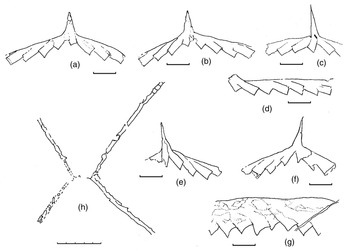
Graptolites from Sample ‘T’-bed, the lower part of the graptolite-bearing interval (Subunit A) at Simeh–Kuh section NW of Damghan. (a, b, d) Hunnegraptus? sp.; (a, b) part and counterpart of a much-flattened proximal end, specimen SM X 50352.7.1 and 50352.7.2a; (d) proximal fragment of a stipe associated with (b, c) SM X 50352.7.2c; (c) proximal end of undetermined dichograptid, specimen SM X 50352.7.2b, associated with (b, c); (e, f) (counterparts) are flattened proximal ends of an undetermined dichograptid, specimen SM X 50352.9.1 and 50352.9.2; (g) fragment of a broad dichograptid stipe, perhaps Tetragraptus?, specimen SM X 50352.8; (h) resembles a horizontal tetragraptid, but is very incompletely preserved; the stipe extending NE-wards is at least 40 mm long; specimen SM X 50352.10. Scale bar: (a–g) 1 mm and (h) 5 mm.

Material. Two proximal fragments from Unit 8, a specimen in counterpart, nos SM X 50352.7.1 and X 50352.7.2 (counterparts), associated with several distal fragments.
Description. Sicular length about 1.6 mm, width of aperture 0.35 mm. Theca 11 appears to originate about 0.5 mm below the sicular apex, grows down for about 0.5 mm, then turns outwards at about 45°. The origin of stipe 2 is not seen; the two stipes diverge at 140°. In the first 2–3 mm the stipes are 0.6 mm wide, with 2TRD 1.5 mm. Thecae appear to be cylindrical tubes (now flattened), inclined at 25° to the dorsal edge, about 1.5 mm long and 0.35 mm wide, with apertures perpendicular to their axes; the overlap is nearly one-half.
Remarks. The fragments recorded here as Hunnegraptus? are only doubtfully referable to the genus, because bithecae are not clearly observed. However, some slight convexity alongside the sicula suggests the possible presence of a flattened sicular bitheca there (Fig. 5b). No bithecae were seen on any of the associated stipe fragments and none of the stipes is seen to branch.
Compared with Hunnegraptus copiosus, the present form has a larger sicula and slightly wider stipes proximally; the thecae are a little more closely set and are more steeply inclined to the dorsal edge of the stipes than those of H. copiosus.
Family DIDYMOGRAPTIDAE Mu, Reference Mu1950
Genus Baltograptus Maletz, Reference Maletz, Chen, Erdtmann and Ni1994
Type species. Didymograptus vacillans Tullberg, Reference Tullberg1880, by original designation (Maletz, Reference Maletz, Chen, Erdtmann and Ni1994, p. 36).
Baltograptus geometricus (Törnquist, Reference Törnquist1901)
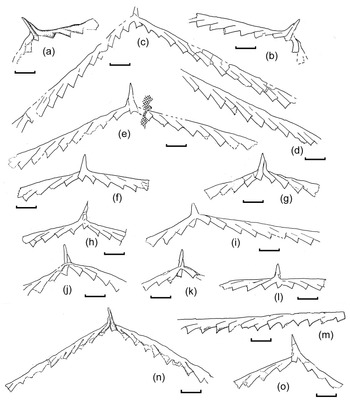
Graptolites from the middle and upper part of the graptolite-bearing interval (subunits B, C) at Simeh–Kuh section NW of Damghan. Baltograptus geometricus (Törnquist): (a, b) pyritized proximal end of fragmentary tubarium, from collection SK3/2B1, specimen SM X 50352.35: (a) latex cast and (b) drawing of the external mould; (c, d) flattened tubarium and an associated distal fragment, both from collection C3/0, specimens SM X 50352.17.1 and 50352.18; (e) flattened tubarium from collection C2/2, specimen SM X 50352.16; (f–h) proximal portions: (f) from collection SK3/2B1, SM X 50352.36; (g, h) external moulds in very low relief from collection C3/0, SM X 50352.19 and 50352.20.1; (i) longer specimen, collection SK3/2B1, specimen SM X 50352.37; (j) latex cast of external mould in very low relief, reverse aspect showing the isograptid arch, collection SK3/2B2, specimen SM X 50352.39; (k) proximal fragment, reverse view, collection C3/0, specimen SM X 50352.20.2; (l) horizontal proximal fragment, collection SK3/2B2, specimen SM X 50352.40. (m–o) Baltograptus sp. aff. B. geometricus (Törnquist), with the sicula inclined towards the first stipe and the thecae rather closely set: (m, o) a stipe fragment and a proximal end, both from collection C2/1, specimens SM X 50352.13.1 and 50352.13.2; (n) partly pyritized tubarium, collection SK3/2A, specimen SM X 50352.34.1. Scale bar represents 1 mm for all figures.

Select synonymy:
1901 Didymograptus geometricus n.sp.; Törnquist, p. 11, pl.1, figs 12–14 [described, figured].
aff. 1937 Didymograptus aff. geometricus Törnquist; Monsen, p. 132, pl. 2, figs 1, 23, 33, 45, 51, 52 [specimens from Oslo district].
1995 Baltograptus geometricus (Törnquist, Reference Törnquist1901); Maletz, Kley & Reinhardt, p. 171, fig. 3, nos 1–4, 6?, fig. 3, nos 11, 14, 15 (figured from southern Bolivia).
1997 Baltograptus geometricus (Törnquist); Toro, p. 398, pl. 1, figs 7, 8 (figured from NW Argentina).
2008 Baltograptus geometricus (Törnquist); Toro & Maletz, p. 978, figs 4/2, 4/3 (proximal development).
Type specimen. Maletz (Reference Maletz2020, fig. 7H) shows as ‘holotype’ specimen no. LO 1585T in the Palaeontological Institute, University of Lund, Sweden. Törnquist (Reference Törnquist1901) did not originally designate a holotype and Maletz’s citation may be taken as a designation of a lectotype.
New material: Several collections from Simeh–Kuh contain fragments of declined didymograptids that resemble Didymograptus geometricus.
Description of Iranian specimens: The specimens are small, the largest tubaria barely 10 mm across. Stipes straight, typically diverging at about 140°, but varying from 120° to 160° or more. Sicula usually 1.3 mm long, but may be 1.1 mm or up to 1.5 mm long; aperture 0.3 mm to 0.4 mm wide and ventrally free on one side for 0.2–0.35 mm (in one instance 0.45 mm). Stipes widen from 0.4–0.5 mm proximally to 0.7 or 0.75 mm in the first few thecae. Thecae nearly straight cylindrical tubes, inclined at 20–30° to the dorsal edge of the stipe, overlap about one-half; apertures commonly perpendicular to the thecal axis, but slightly acute in some broader stipes. 2TRD uniform, typically close to 1.5 mm, ranging from 1.4 mm to 1.6 mm.
Remarks. Törnquist’s original description was based on syntype specimens from Mossebo, Västergötland, Sweden, and he mentioned that at Flagabro in Skåne, identical forms are associated with variant forms which have ‘the stipes less rigid’ and are ‘somewhat wider towards the extremities’. His drawings are good, but regrettably he figured only three examples: one fairly complete at natural size, the other two being enlargements of fragments. He recorded them as occurring in the ‘Zone of Didymograptus balticus’, an interval now known as the Cymatograptus protobalticus Biozone. Subsequent workers have illustrated several additional specimens that encompass a range of forms, some declined, others nearly horizontal; these include examples shown by Monsen (Reference Monsen1937, pl. 2), Maletz et al. (Reference Maletz, Rushton and Lindholm1991, fig. 7f, g, h), Maletz et al. Reference Maletz, Kley and Reinhardt1995 (fig. 3/1–4), horizontal examples by Maletz et al. (Reference Maletz, Löfgren and Bergström1996, fig. 13.7), and declined forms by Toro (Reference Toro1997, pl. 1, figs 7, 8).
Maletz’s (Reference Maletz, Chen, Erdtmann and Ni1994, p. 36) original diagnosis of Baltograptus described a ‘moderately low origin of th11…’, although in the Abstract it is mentioned as ‘moderately high’. In Maletz et al. (Reference Maletz, Kley and Reinhardt1995, p. 171) the low origin was given as a feature of B. geometricus, but we note that in the type description of B. geometricus Törnquist (Reference Törnquist1901, p. 11–12) reports that theca 11 originates near the sicular apex and, in his plate 1, figure 13, it is shown to appear less than 0.2 mm below the apex. Well-preserved proximal ends of B. geometricus from Argentina, illustrated by Toro & Maletz (Reference Toro and Maletz2008, figs 4-2, 4-3), show th11 appearing about 0.5 mm below the sicular apex, so we suppose that a wide variation in this attribute is accepted. Fragmentary specimens from Simeh–Kuh include some proximal ends that suggest a high origin of th 11 (Fig. 6a, b) and others which are more like the Argentinian specimens.
One tubarium from Collection SK3/2A, no. 11 (Fig. 6c) is partly preserved in pyrite and differs from most B. geometricus in having the thecae more closely set (2TRD around 1.2 mm).
Baltograptus? sp. cf. B. sinensis (Lee & Chen, Reference Lee and Chen1962)
(Fig. 7a–c)
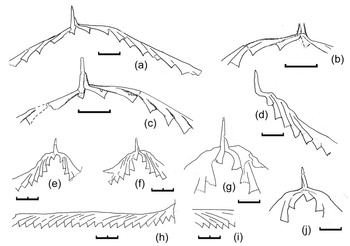
Graptolites from the upper part of the graptolite-bearing interval (Subunit C) at Simeh–Kuh section NW of Damghan. (a–c) Baltograptus sp. cf. B. sinensis (Lee & Chen), partly in relief, from collection SK3/2 in the Simeh–Kuh section: (a) proximal part of tubarium, specimen SM X 50352.23.1; (b) the counterpart, showing a reverse view, specimen SM X 50352.23.2; and (c) the same as (a), showing the development of the first theca. (d–j) Baltograptus sp. cf. B. kunmingensis (Ni in Mu et al.), all from collection SK3/2A from the Simeh–Kuh section: (d) a single stipe, latex cast of external mould, specimen SM X 50352.28; (e) proximal end, flattened; specimen SM X 50352.27; (f, g) proximal end, flattened, showing 1st theca, specimen SM X 50352.24; (h) distal stipe fragment, specimen SM X 50352.30; (i) fragment of a broader stipe, specimen SM X 50352.31; (j) proximal part of flattened specimen, possibly a composite mould showing a trace of the isograptid arch, specimen SM X 50352.25. Scale bar: (a–d, g, j) 1 mm and (e, f, h, i) 2 mm.

Material. A few fragmentary specimens from Sample SK3/2. These are slightly declined didymograptids of the kind commonly assigned to the genus Acrograptus but are here tentatively transferred to Baltograptus. Some specimens are flattened but specimen SM X 50352.23.1 has part of the proximal end preserved as an internal mould in relief (Fig. 7c).
Description of Iranian specimens. The sicula is 1.3 mm long and 0.27 mm wide at the aperture, and a short nema is seen at the apex (specimens no. 3, 4). The first theca, Th11, originates 0.45 mm below the apex, grows downwards for 0.5 mm before bending outwards, leaving the ventral wall of the sicula free for about 0.3 mm. The origin of th12 is not seen, so we cannot be certain whether the further development is of isograptid or artus type; however, the early development of this species suggests that it may be referable to the genus Baltograptus Maletz, Reference Maletz, Chen, Erdtmann and Ni1994.
The stipes are fairly straight and diverge downwards from the sicula at about 140°; they widen from 0.37 mm at th1 to about 0.5 mm at th3 and about 0.55 mm at th5. The thecae are slightly curved conical tubes about 1.3 mm long, lying at 20–25° to the dorsal margin of the stipe with an overlap of about one-half; their apertures are simple and when in flattened preservation the tips are slightly acute. The 2TRD is about 1.6–1.7 proximally and reduces to about 1.45–1.35 at th3–5.
Remarks. These specimens agree in form and dimensions with Didymograptus sinensis Lee & Chen, Reference Lee and Chen1962 and are tentatively referred to that species. They are comparable to Baltograptus geometricus (Törnquist), but differ from that species in that the initial theca, Th11, originates lower on the sicula, the stipes are narrower proximally and the earliest-formed thecae are more widely spaced.
B. sinensis was originally described from the lower part of the Tonggao Shale in Sandu district of Guizhou, China (Lee & Chen, Reference Lee and Chen1962), and was assigned to the Paratetragraptus approximatus graptolite zone, now representing basal Floian. B. sinensis was later figured from the overlying A. filiformis graptolite zone (N2) in the Ningkuo Shale Formation of south China (Mu et al. Reference Mu, Ge, Chen, Ni and Lin1979, pp. 80, 147), but those illustrations show the proximal parts of the stipes to be broader and the thecae more closely set than in the original account of Lee & Chen (Reference Lee and Chen1962).
Baltograptus sp. cf. B. kunmingensis (Ni in Mu et al. Reference Mu, Ge, Chen, Ni and Lin1979)
(Fig. 7d–j)
Material. Several fragmentary specimens from Locality SK3/2A. The specimens are flattened and it is uncertain whether the appearance of left-handed development (Fig. 7f, g, j) is genuine, or merely a consequence of the preservation as composite moulds.
Description. Fragments of a deflexed didymograptid are comparable with Baltograptus kunmingensis (Ni in Mu et al. Reference Mu, Ge, Chen, Ni and Lin1979, pl. 32, figs 14–18).
Sicula 1.9–2.1 mm long and 0.45 mm wide at the aperture. Th11 originates at about 0.5–0.65 mm below the tip of the sicula, extends down for about 0.85 mm before bending abruptly away, leaving the ventral side of the sicula free for 0.4–0.75 mm, typically 0.6 mm. The origin of th12 is not well seen, but the development appears to be of isograptid type.
The stipes are deflexed. Where they diverge from the sicula, they are nearly horizontal, but they immediately bend down for one or two millimetres, giving a convex curve to the dorsal edge; after this, near th4, they make a concave curve towards the horizontal. For the first two thecae, stipe 1 may be narrower than stipe 2; the stipe width at the aperture of th12 may therefore be as much as a half a millimetre more than the width of th11. The difference between th21 and th22 is less marked and, by th4, the two stipes are of similar width. Distally the stipes vary in width from about 1.25 mm to 1.8 mm. Specimen no. 7 (Fig. 7h) is a distal stipe 1.4 mm wide and the thecae are long, slightly curved tubes set at an angle (as measured near the aperture) of about 30° to the dorsal edge of the stipe. Thecal overlap is about three-quarters and the 2TRD is 1.4 (14 thecae in 10 mm). Specimen no. 8 (Fig. 7i) is 1.8 mm wide, the thecae are set more steeply (35°) and more densely (2TRD around 1.35) and they show greater overlap (about four-fifths).
Discussion. There are several comparable species figured from the Ningkuo Shale by Mu et al. (Reference Mu, Ge, Chen, Ni and Lin1979), and the present material shows dimensions close to those of Baltograptus kunmingensis (Ni), to which species it is here compared. B. varicosus (Wang, Reference Wang1974) has very similar dimensions (Zhang, Reference Zhang2008), but differs in having artus-type development with th11 dicalycal (Zhang & Zhang, Reference Zhang and Zhang2014, p. 440), though those authors expressed doubt whether this difference was sufficiently clear to support a separate specific concept. Baltograptus jacksoni Rushton, Reference Rushton2011 is also similar to B. kunmingensis and has isograptid development, but was distinguished because the free ventral wall of the sicula is commonly shorter, the thecae are slightly less closely set than those of B. kunmingensis and they overlap less (about two-thirds). B. jacksoni originates from Skiddaw Group mudrocks of the Didymograptus varicosus Biozone of Cooper et al. (Reference Cooper, Fortey, Hughes, Molyneux, Moore, Rushton and Stone2004), which is now renamed the Baltograptus jacksoni Biozone.
Baltograptus kunmingensis occurs in the deflexus Zone (N3a) of the Ningkuo Shale in southern China (Mu et al. Reference Mu, Ge, Chen, Ni and Lin1979), which is correlated with the late Floian Age (Zhang et al. Reference Zhang, Chen, Goldman, Zhang, Cheng and Song2010, fig. 2) and B. jacksoni is recorded from the Hope Beck and Loweswater formations in the lower part of the Skiddaw Group, and is correlated with the mid-Floian.
Family SIGMAGRAPTIDAE Cooper & Fortey, Reference Cooper and Fortey1982
Genus Acrograptus Tzaj, Reference Tzaj1969
The type species of Acrograptus, chosen by Tzaj (Reference Tzaj1969), is Didymograpsus affinis Nicholson (Reference Nicholson1869), and this was accepted in Li et al. (Reference Li, Feng, Wang and Chen2012) in their paper on Acrograptus in South China. However, in their revised diagnosis of Acrograptus (Li et al. Reference Li, Feng, Wang and Chen2012, p. 1118), they report ‘… sicula long and slender’ and describe ‘…divergence of th11 and th12 from the sicula at different levels’; these details of the diagnosis, if accepted, would exclude the type species, A. affinis, from the genus Acrograptus, because the lectotype of affinis (Elles & Wood, Reference Elles and Wood1901, p. 23, text-fig. 13a; pl. 2, fig. 1b) has a short sicula (0.6 mm long) from which the two stipes diverge at the same low level (see also Rushton, Reference Rushton2000; Cooper et al. Reference Cooper, Fortey, Hughes, Molyneux, Moore, Rushton and Stone2004, fig. 13l, m). Here we use the genus in a less formal sense.
“Acrograptus” pusillus (Tullberg, Reference Tullberg1880).
(Fig. 8a, b, f, g, also 8c–e?)
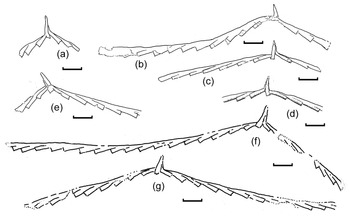
Acrograptus species, all magnified. (a–e) From the middle part of the graptolite-bearing interval (Subunit B) at Simeh–Kuh section NW of Damghan: (a) declined proximal end doubtfully compared to Acrograptus pusillus (Tullberg), collection C2/1, specimen SM X 50352.12; (b) flattened but relatively complete, collection C2/2, specimen SM X 50352.15; (c, d) specimen with stipe 1 leaving the sicula a little higher than stipe 2; partly in relief, from collection C2/1, specimen SM X 50352.11; (c) is an external mould and (d) is a latex cast of the proximal part; (e) Acrograptus sp. cf. A. pusillus (Tullberg) of Monsen (Reference Monsen1937, pl. 2, fig. 21), with the sicula inclined towards the first stipe, collection C2/1, specimen SM X 50352.13.1. (f, g) Acrograptus pusillus (Tullberg), after drawings by Dr K. Lindholm: (f) lectotype; (g) syntype; both specimens on Tullberg’s type slab, from Kiviks-Esperöd, Sweden, specimens in the Paleontologisk-Geologiska Intitutionen, Lund, Sweden, number LO348T. Scale bar represents 1 mm for all figures.

1880 Didymograptus pusillus n. sp.; Tullberg, p. 42, pl. 2, figs 12–14.
cf. 1937 Didymograptus cf. pusillus Tullberg; Monsen, p.129, pl. 2, figs 21, 50, 61, 65; pl. 9, fig. 4.
Material. Tullberg’s original material is from loose slabs near Kiviks–Esperöd, 15 km NNW of Simrishamn on the Baltic coast of Skåne, southern Sweden (Törnquist, Reference Törnquist1901, p. 6). We show here drawings by Dr Kristina Lindholm of specimens from Tullberg’s material, namely specimens associated on block no. LO 348T in the Palaeontological Institute, University of Lund, Sweden. The specimen in our Figure 8f is the lectotype and Figure 8g is a previously unfigured example on the same block. From Simeh–Kuh we have a fairly complete specimen from collection C2/2 that we tentatively assign to A. pusillus, and some other fragments are compared to the species.
Description. Tullberg described his Didymograptus pusillus in these terms: very small; stipes very narrow, of even breadth, diverging at 170–145°; and dorsal edge generally straight, although the proximal part may be somewhat convex so that the angle of divergence there is less. Sicula simple, drawn out to a sharp point. Thecae 14 in 10 mm, straight cylindrical tubes inclined at about 15° (to the dorsal edge of the stipe), wholly free, their length two and a half times their width. Dr Lindholm’s drawings show the sicula to be 1.1 mm long and the stipe to be up to 0.4 mm wide.
Discussion. Comparison of D. pusillus with Acrograptus affinis is hampered because details of the proximal development of A. affinis are not clear; however, in both these species the two stipes diverge from the sicula at the same low level, leaving little of the sicula free ventrally. The appearance of their proximal ends is symmetrical. We use this feature to assign D. pusillus to Acrograptus and consider that it may not be correct to refer other, more strongly asymmetrical specimens shown by Li et al. (Reference Li, Feng, Wang and Chen2012, figs 5a, d, e), to Acrograptus. A. affinis differs from A. pusillus in having a shorter and more widely conical sicula (about 0.6 mm long) and less closely spaced thecae (2TRD about 1.75, compared with 1.4 for pusillus).
‘Acrograptus’ pusillus is reported from lower Floian strata, but only rarely. At Mt Hunneberg, Sweden, Egenhoff & Maletz (Reference Egenhoff and Maletz2007, figs 3, 4) record it as scarce in the Baltograptus vacillans graptolite zone, at levels above that of B. geometricus that occurs in the underlying Cymatograptus protobalticus Biozone. It is reported in the Ningkuo Shale of SW China from level N2, the Didymograptus filiformis Zone, and with doubt from the overlying horizon N3a, at the base of the Didymograptus deflexus Zone (Mu et al. Reference Mu, Ge, Chen, Ni and Lin1979, pp. 79, 146). In the Tøyen formation of the Oslo region, Monsen (Reference Monsen1937, p. 246) identified a comparable form as ‘Didymograptus cf. pusillus’, but in her figured specimens the sicula is not vertical; it leans towards the first stipe, leaving one side of the sicula free for 0.3 mm. Monsen’s specimens are from her Zone of Didymograptus validus, the division of which yielded the youngest examples of her ‘Didymograptus aff. geometricus’ and underlies her records of Baltograptus vacillans (Tullberg) and Cymatograptus balticus (Tullberg). In northern Argentina, Toro (Reference Toro1997, p. 401) recorded Acrograptus sp. cf. A. pusillus with A. filiformis (Tullberg) from the mid-part of the very thick Acoite Formation succession in the Cordillera Oriental, where again it occurs above the level of Baltograptus geometricus. However, Toro & Maletz (Reference Toro and Maletz2008, p. 982) subsequently transferred those figured specimens to Cymatograptus bidextro Toro & Maletz.
In the Simeh–Kuh section, specimens that we identified as A. pusillus appear at least as low as the lowest examples of B. geometricus found there; however, it must be emphasized that the stratigraphical ranges of these graptolites may be quite incompletely represented in Iran.
5. Discussion and conclusions
5.a. Biostratigraphical and biogeographical significance of the graptolite faunas
Nearly all the Early Ordovician graptolites from Simeh–Kuh are fragmentary specimens enclosed in layers of dark-grey argillites, which contain subsidiary millimetre-scale beds of siltstone and sandy siltstone, and occasional limestone beds with trilobites, brachiopods and conodonts, probably representing distal tempestites.
In general the Tremadocian – lower Floian deposits in Simeh–Kuh comprise a condensed succession of fine siliciclastic rocks, mainly siltstones and argillites c. 130 m thick, deposited in the upper offshore environment below seasonal storm wave-base. They contain moderately diverse trilobite faunas characteristic of the nileid and raphiophorid biofacies (Ghobadi-Pour et al. Reference Ghobadi Pour, Vidal and Hosseini-Nezhad2007, Reference Ghobadi Pour, Popov, Hejazi, Holmer, Hosseini-Nezhad, Rasuli, Fallah, Amini and Jahangir2015). Within the stratigraphic interval of the Psilocephalina lubrica – Kayseraspis trilobite zones and the Paltodus deltifer – lower Drepanoistodus proteus conodont zones, there are up to four short-term episodes during which a strong influx of coarser sediments resulted in the deposition of sandstone beds up to 3 m thick. The two upper sandstone units comprise medium- to coarse-grained sandstones and impure limestones, including extensive brachiopod shell-beds. They probably represent either proximal tempestites or partly eroded shoal complexes, suggesting a considerable drop in sea levels.
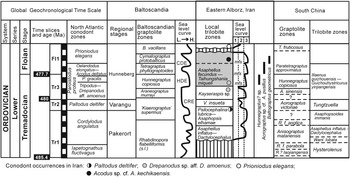
The sharp boundary of graptolite-bearing argillites with the uppermost sandstone bed represents a sequence boundary and a major flooding surface, followed by a highstand system tract. The observed sea-level rise was probably synchronous with the Copiosus Drowning Event (CDE) of Nielsen (Reference Nielsen, Webby, Paris, Droser and Percival2004) in the uppermost Tremadocian strata of Baltoscandia (Figs 2, 9). It also coincides with a proliferation of the trilobites of the Taihungshania Association (Ghobadi Pour, Reference Ghobadi Pour, Bassett and Deisler2006) and the first invasion of a low-diversity graptolite association including Hunnegraptus? sp. and Tetragraptus sp.
Chrono- and biostratigraphical chart of the Lower Ordovician (Tremadocian – lower Floian) succession of eastern Alborz, northern Iran (mainly after Ghobadi Pour et al. Reference Ghobadi Pour, Popov, Hejazi, Holmer, Hosseini-Nezhad, Rasuli, Fallah, Amini and Jahangir2015) with the Global Chronostratigraphical Scale (Cooper & Sadler, Reference Cooper, Sadler, Gradstein, Ogg, Schmitz and Ogg2012), graptolite succession of Baltoscandia (after Egenhoff & Maletz, Reference Egenhoff and Maletz2007; Maletz & Ahlberg, Reference Maletz and Ahlberg2011) and South China (Zhang et al. Reference Zhang, Erdtmann and Feng2004), and trilobite succession of South China (after Zhou & Zhen, Reference Zhou and Zhen2009). Graptolite-bearing interval in the Iranian succession is highlighted in grey. Sea-level curve for Baltoscandia is mainly after Nielsen (Reference Nielsen, Webby, Paris, Droser and Percival2004). CRE – Ceratopyge Regressive Event; HDE – Hagastrand Drowning Event; CDE – Copiosus Drowning Event; 1 – peritidal zone; 2 – inner shelf; 3 – outer shelf; mfs – position of maximum flooding surfaces.

There is a report on the occurrence of Hunnegraptus copiosus in the Seidişehir Formation of the western Taurus in Turkey (Sachanski et al. Reference Sachanski, Özgül and Arpat2006). Remarkably, the Seidişehir Formation contains also trilobites Taihungshania sp. cf. T. miqueli, while the cranidium of Orometopus sp. illustrated by Dean & Monod (Reference Dean and Monod1990, fig. 7b) from the same unit strongly recalls Damghanampyx and is most probably congeneric with it. Both trilobite taxa occur in Simeh–Kuh within the range of Hunnegraptus? sp, but the relative positions of graptolite and trilobite occurrences in the Seidişehir Formation remains uncertain.
The thin limestone bed at the base of Subunit B represents a brachiopod shell bed formed due to hiatal/condensed shell concentration (Colmenar & Álvaro, Reference Colmenar and Alvaro2015). Its upper surface represents a hardground, while the boundary with the overlying argillites coincides with a flooding surface. It also coincides with the invasion of a new graptolite fauna. The graptolites are almost all small didymograptids, of which the commonest species identified in the succession exposed at Simeh–Kuh is Baltograptus geometricus (Törnquist). The latter species appears suddenly in considerable numbers above the flooding surface accentuated by the condensed shell concentration horizon. That and other didymograptids, including ‘Acrograptus’ pusillus (Tullberg), are thought to represent shallow-water species that existed at times of raised sea levels, carried into relatively shallower shelf-edge areas of deposition, and were preserved there, as shown by Egenhoff & Maletz (Reference Egenhoff and Maletz2007, p. 379); compare also the discussion of such occurrences in South China by Zhang et al. (Reference Zhang, Chen, Goldman, Zhang, Cheng and Song2010). In Iran, no examples have yet been found of the contemporaneous pandemic graptolites with large multi-branched tubaria, such as Clonograptus or Dichograptus, characteristic of deep-water strata. We postulate that the shallow-water didymograptids were able to occupy the Simeh–Kuh area only when the sea invaded during periods of maximum flooding, as has been proposed for the type Floian succession at Diabasbrottet in Västergötland, Sweden (Egenhoff & Maletz, Reference Egenhoff and Maletz2007, fig. 3). There, B. geometricus also appears abruptly and in abundance in strata just above one of the maximum flooding surfaces identified in the succession. However, in Iran these graptolite faunas differ from the Scandinavian records in being almost monospecific, and therefore appear to represent more restricted conditions than existed in Västergötland, perhaps because the water was shallower. Comparable incursions of graptolites occurred during Ordovician marine highstands in Oman and the United Arabic Emirates, although at somewhat later intervals than the Iranian records, namely the Dapingian and Darriwilian events reported by Rickards et al. (Reference Rickards, Booth, Paris and Heward2010).
The graptolites in collection SK3/2A also form an almost monospecific assemblage but, apart from a single declined specimen, all the identified graptolites in this collection are deflexed forms: they have longer siculae and much broader stipes than the declined forms and the thecae show a much greater overlap, especially proximally. This collection may represent part of an assemblage from a biotope different from the one that provided the declined didymograptids seen in collections from both below and above collection SK3/2A.
In Västergötland, B. geometricus occurs within the total range of Paratetragraptus approximatus (Nicholson), and appears at several levels from the base of Cymatograptus protobalticus Zone, which corresponds with the boundary between the conodont zone of Paroistodus proteus (below) and that of Prioniodus elegans (above), as recorded by Maletz et al. (Reference Maletz, Löfgren and Bergström1996, figs 4 and 5). In the Tøyen Shale Formation of the Oslo region, Norway, Monsen (Reference Monsen1937, p. 132) identified comparable graptolites under the tentative name Didymograptus aff. geometricus and recorded their zonal range as the same as that of Paratetragraptus approximatus. There they are associated with other species of didymograptids and tetragraptids that presumably represent deeper-water assemblages.
Two major flooding surfaces in the Simeh–Kuh succession, of which the lower coincides with incursions of Hunnegraptus? sp. and the upper with Baltograptus geometricus, are most probably synchronous with those in the lower part of the Hunnegraptus copiosus Biozone and at the base of the Cymatograptus protobalticus Biozone of the Tøyen Shale Formation succession of Västergötland. The sequence boundary at the top of the range of Hunnegraptus? sp. at Simeh–Kuh also looks similarly placed, but in Simeh–Kuh it is associated with the flooding surface. It may be suggested that, in both cases, observed characters of sedimentation were eustatically controlled. The progradational or retrogradational patterns in the condensed Tremadocian–Floian deposits in the Simeh–Kuh succession are significantly obscured due to strong sediment starvation (Ghobadi Pour et al. Reference Ghobadi Pour, Popov, Hejazi, Holmer, Hosseini-Nezhad, Rasuli, Fallah, Amini and Jahangir2015), suggesting that the surrounding area was tectonically inactive during that time. However, a pattern of sea-level fluctuations inferred for the Tremadocian time interval at the Simeh–Kuh succession is quite dissimilar when compared with the eustatic sea-level curve based on the Baltoscandian succession elaborated by Nielsen (Reference Nielsen, Webby, Paris, Droser and Percival2004). While detailed discussion of these differences is not intended in the present paper, it would be useful to refer to the publication by Egenhoff et al. (Reference Egenhoff, Cassle, Maletz, Frisk, Ebbestad and Stübner2010), who pointed out that deposition of the Bjørkåsholmen Formation through the Ceratopyge Regressive Event of Nielsen (Reference Nielsen, Webby, Paris, Droser and Percival2004) was controlled by a regional tectonically enhanced lowstand. Earlier, Artyushkov et al. (Reference Artyushkov, Lindstrom and Popov2000) recognized a significant tectonic component to account for the Acerocare Eustatic Event in the upper Furongian succession of South and Central Sweden. Unrecognized local and regional tectonic movements that may have affected the Caledonian margin of Baltica should be considered in interpreting the Baltoscandian sea-level curve.
5.b. Revised position of Tremadocian–Floian boundary in Simeh–Kuh section
For some time the Tremadocian–Floian boundary was provisionally recognized at Simeh–Kuh, at the base of the limestone bed 0.1 m thick (Fig. 2; sample SK4/36) that lies at the top of Subunit B (Fig. 2), which contains the conodont Acodus cf. kechikaensis Pyle & Barnes, Reference Pyle and Barnes2002 (Jahangir et al. Reference Jahangir, Ghobadi Pour, Ashuri and Amini2016). It is probably conspecific with the eponymous species of the A. kechikaensis conodont zone recognized at the base of the Floian Stage in the conodont biostratigraphical succession developed by Pyle & Barnes (Reference Pyle and Barnes2002, p. 27) for western Canada. However, the occurrence of Baltograptus geometricus (Törnquist) in sample C2/2 (Fig. 2), about 11 m below the conodont-bearing limestone bed, suggests that the uppermost 13 m of Unit 11 are of Floian age and correspond to the Baltoscandian Cymatograptus protobalticus graptolite zone (Egenhoff & Maletz, Reference Egenhoff and Maletz2007; Maletz & Ahlberg, Reference Maletz and Ahlberg2011), the first occurrences of Acrograptus sp. being just 0.5 m above the top of the limestone bed at the base of the Subunit B (Fig. 2). This limestone bed apparently represents a condensation interval formed during the time of sea-level fall. It contains disarticulated but well-preserved rhynchonelliform brachiopods, including Polytoechia hecatompylensis, Paralenorthis semnanensis, Ranorthis cheshmehaliana and Xinanorthis qoomesensis (Popov et al. Reference Popov, Ghobadi Pour, Bassett and Kebria-Ee Zadeh2009), and abundant conodonts and linguliform brachiopods, including Eosiphonotreta sp., Ghavidelia damghanensis Popov et al. Reference Popov, Ghobadi Pour and Hosseini2008 and Orbithele sp. It is also the last documented occurrence of Drepanoistodus sp. aff. D. amoenus, which is the index species of the lowermost subzone of the Paroistodus proteus conodont zone at the top of the Tremadocian succession of Baltoscandia. The underlying argillites also contain Hunnegraptus?, reminiscent of the uppermost Tremadocian Hunnegraptus copiosus graptolite zone (Figs 2, 9). The hardground surface at the top of the limestone, indicating an interval of non-deposition and a sharp change of the graptolite fauna, can be taken as indirect evidence that the base of the Floian Stage is probably to be placed at the sequence boundary close to the first occurrence of Acrograptus (Figs 2, 9); however, this taxon cannot be considered as definitive in that aspect.
Acknowledgements
Adrian Rushton thanks: Dr Kristina Lindholm for much past discussion and for sending duplicate specimens and drawings relating to Early Ordovician graptolites; Dr J Maletz for helpful guidance in the present study; staff of the Natural History Museum, London, for enabling his status as Research Associate; and the librarians for their tireless assistance. Mansoureh Ghobadi Pour acknowledges support from the Golestan University (research grant no. 961452), Gorgan, and logistical support from the National Museum of Wales, Cardiff. Leonid Popov acknowledges support from the National Museum of Wales, Cardiff. The research of Arash Amini was supported by the Golestan University. This paper is a contribution to IGCP Project No. 735: Rocks and the Rise of Ordovician Life. The manuscript has greatly benefited from the constructive comments provided by Dr Jörg Maletz (Freie Universität Berlin) and Professor Mark Williams (University of Leicester).
Conflict of interest
None.