I. INTRODUCTION
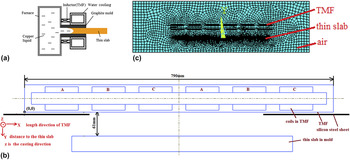
Horizontal continuous casting of thin copper slab is an important production process for copper strips, which has the advantages of short steps, low production costs, and small footprint equipment. It is especially used for the production of hot-rolled tin phosphor bronze alloys. Reference Guo, Liu and Sun1,Reference Hwang, Li, Hwang and Hu2 However, during the horizontal continuous casting process, the temperature gradient and cooling speed of a slab are found to be high, which cause segregation, center porosity, inclusions, and other defects. These defects exposed at subsequent processing seriously affect strip quality. Reference Lu, Dong and Lei3 Previous studies have shown that the flow of molten metal in a mold has a significant impact on the quality of the slab. Reference Bai4–Reference Kim, Sung and Kim7 Therefore, the traveling magnetic field (TMF) is used during horizontal continuous casting of thin tin phosphor bronze slab with dimensions of 16 × 655 mm. The schematic diagram of the casting is shown in Fig. 1(a). Some studies have shown that applying TMF during horizontal continuous casting of thin copper slab can improve the flow pattern and flow velocity of molten metal in the mold, as it significantly refined the grain structure and reduced the segregation and shrinkage defects of tin phosphor bronze slabs. Reference Yu, Li, Deng, Lei and Ren8–Reference Li, Jin, Zhang, Ru, Zhou and Wang11 However, during the course of industrial tests, it is found that there is strong melt circulation at the mold ends when the TMF is applied as the flow intensity in thin slab is too large. This will affect the solidification process of the molten metal at the mold ends and cause crack defects at the thin slab ends. Reference Thomas12,Reference Dahle and StJohn13 Various previous studies have been focused on improving the quality of these slabs. Reference Yamaguchi, Nakashima and Sawai14,Reference Zeng, Chen, Wang and Wang15 In this study, to improve the ends quality of horizontal continuous casting tin phosphor bronze slab, three methods (i) the use of silicon steel at the ends of the TMF, (ii) the change in TMF length, and (iii) the reduction in ends current intensity of TMF, are proposed. The numerical simulation method is used to study the electromagnetic force, flow and solidification process of molten metal in each case. Then, according to the numerical simulation results, experiments were performed to acquire the high quality, tin phosphor bronze thin slab.
Schematic diagram of experiment process (a), Structure and size of TMF and the distance from the mold (b), Finite element model of the continuous casting process (c).

II. NUMERICAL SIMULATION OF HORIZONTAL CONTINUOUS CASTING WITH TMF
In this paper, electromagnetic field, flow field, and solidification temperature field are computed to analyze the effect of the TMF on the solidification of molten metal in the mold during horizontal continuous casting. To simplify the calculation process, the following assumptions are made: (i) the liquid metal is incompressible conductive fluid; (ii) all physical parameters of the liquid metal, such as density, viscosity, specific heat, thermal conductivity, electrical conductivity, and magnetic permeability, are scalar constants; (iii) the impact of flow of liquid metal on the magnetic field is ignored; (iv) the flow of liquid metal is turbulent. Reference Zhang, Nagaumi and Cui16
A. Establishment of mathematical model
1. Electromagnetic field model
Maxwell equations are solved to acquire the current density and magnetic induction intensity in the molten metal. Then, the electromagnetic force and joule heat are obtained by using subsequently Eqs. (1) and (2). During calculation, the boundary conditions of magnetic field parallel to the boundary are imposed around the periphery of the air. Reference Feng17
 $$F = J \times B\quad ,$$
 $$Q = {J^2} \times {1 \over \sigma } \times t\quad ,$$
where, B is the magnetic induction intensity; J indicates the current density; σ is the conductivity; t is the time; F is the electromagnetic force, and Q is the joule heat.
2. Flow field model
The electromagnetic force acquired from the electromagnetic field model is applied to the Navier–Stoke model as the source, which is expressed as Eqs. (3) and (4), and the κ-ε turbulent model is used to describe the turbulence of the molten metal. During calculation, no-slip boundary condition is applied to the around of the molten metal. Reference Wang18,Reference Ge, Isac and Guthrie19
Continuity equation:
 $${{\partial {u_i}} \over {\partial {x_i}}} = 0\quad .$$
Momentum conservation equation:
 $${{\partial \left( {\rho {u_i}} \right)} \over {\partial t}} + {{\partial \left( {\rho {u_i}{u_j}} \right)} \over {\partial {x_i}}} = \rho {g_i} - {{\partial p} \over {\partial x{}_i}} + {\partial \over {\partial {x_i}}}\left[ {{\mu _{\rm{e}}}\left( {{{\partial {u_i}} \over {\partial {x_j}}} + {{\partial {u_j}} \over {\partial {x_i}}}} \right)} \right] + {F_i}\quad ,$$
where, ρ is the density; p indicates the pressure; g is the gravity acceleration; u is the velocity; μ is the dynamic viscosity; μe is the effective viscosity; μt is the turbulent viscosity, μe = μ + μt; F i is the electromagnetic force; subscript i, j indicates the direction along x, y.
3. Solidification model
The Joule heat acquired from the electromagnetic field model is applied to the energy conservation equation as the source. Reference Zhang and Yi20 During calculation, different heat transfer boundary conditions are applied at different locations of the molten metal.
Energy conservation equation:
 $${{\partial \left( {\rho T} \right)} \over {\partial t}} + {{\partial \left( {\rho {u_i}T} \right)} \over {\partial {x_i}}} = {\partial \over {\partial {x_i}}}\left( {{\Gamma _{{\rm{eff}}}}{{\partial {u_i}} \over {\partial {x_j}}}} \right) + S\quad ,$$
where, Гeff is the effective temperature diffusion coefficient, T is the temperature, S is the source, including latent heat and Joule heat.
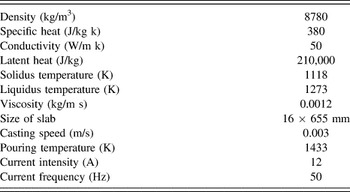
The parameters used in the calculation are shown in Table I. The structure and size of the TMF and the distance from the TMF to the mold are shown in Fig. 1(b), the finite element model is shown in Fig. 1(c).
Physical parameters of tin phosphor bronze and continuous casting process parameters.

B. Numerical simulation results analysis
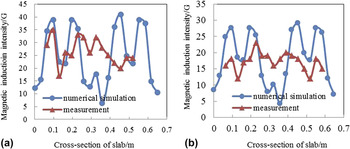
The mathematical model is experimentally validated to ensure the accuracy of the numerical simulation results. In the absence of liquid metal, TMF is opened, and the magnetic induction intensity was measured near the top and lower surface of the mold. The experimental results are compared to the numerical simulation results, which are shown in Fig. 2. It can be seen that the experimental results are deviated by the numerical simulation results because in the mathematical model the shell of TMF, which is made of stainless steel, and the graphite mold, are all ignored to simplify the calculation. However, the trend of both is similar. Thus, it can be said that the mathematical model is reliable.
The comparison of the experimental and calculated magnetic induction intensity under the TMF (I = 12 A, f = 50 Hz) (a) Upper surface of mold and (b) lower surface of mold.

1. Effect of silicon steel sheet
During the tin phosphor bronze thin slab horizontal continuous casting, a silicon steel sheet, located between the ends of the TMF and the mold, is used as the silicon steel has strong magnetic effect to lessen the strong circulation at the ends of mold caused by the TMF. Then, the influence of the length and width of the silicon steel sheet on the magnetic field, melt flow and solidification at the ends of the mold has been analyzed in details. Due to the large ratio of the width to the thickness of the thin slab, only the left ends of the thin slab numerical simulation are shown to clearly display the melt flow at the ends of the mold.
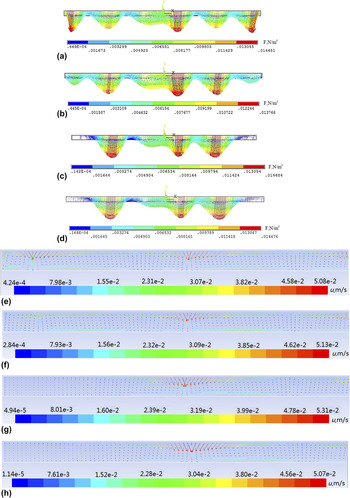
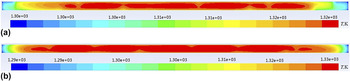
It can be seen that the application of silicon steel sheet at the TMF ends can effectively reduce the electromagnetic force and molten metal flow at the mold ends. This is attributed to the electromagnetic field shielding effect of silicon steel sheet (Fig. 3). On the other hand, when the length of the silicon steel sheet is small, the magnetic field intensity and the circulation flow at the mold ends is lesser. However, the electromagnetic force and circulation flow at the mold ends almost disappear at the silicon steel sheet length of 150 mm [Figs. 3(b), 3(c), 3(f), and 3(g)]. The influence of silicon steel sheet thickness on the electromagnetic force and melt flow is not significant [Figs. 3(c), 3(d), 3(g), and 3(h)]. Therefore, if the space between the TMF and the mold is limited, the thin silicon steel sheet with 0.5 mm thickness may show a desired result. From Fig. 4, it can be seen that the growth of the solidified shell melt is uneven, when there is no silicon steel sheet. In this case, cracks were observed in the microstructure. However, the solidified shell of the melt is even, when silicon steel sheet is applied, because the silicon steel sheet affects the flow at the melt ends. Thus, a 150 × 0.5 mm silicon steel sheet was chosen to be placed at the ends of TMF to reduce the circulation flow of the molten metal at the ends of mold during the tin phosphor bronze slab horizontal continuous casting.
Effect of silicon steel sheet on the electromagnetic force of molten metal (a) without silicon steel sheet; (b) 100 × 5 mm silicon steel sheet; (c) 150 × 5 mm silicon steel sheet; (d) 150 × 0.5 mm silicon steel sheet; Effect of silicon steel sheet on the molten metal flow (e) without silicon steel sheet; (f) 100 × 5 mm silicon steel sheet; (g) 150 × 5 mm silicon steel sheet; (h) 150 × 0.5 mm silicon steel sheet.

Effect of silicon steel sheet on the solidification of molten metal (a) without silicon steel sheet; (b) with 150 × 0.5 mm silicon steel sheet.

2. Effect of TMF length
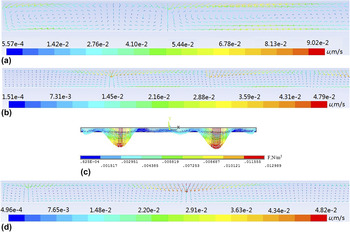
In this study, the length of the TMF is changed to obtain better melt flow at the mold ends. Figures 5(a) and 5(b) show the melt flow for the TMF length of 950 mm and 560 mm, respectively, where the original length was 790 mm.
TMF length effect on the molten metal flow (a) length is 950 mm; (b) length is 560 mm; Effect of current intensity (A = C = 6 A, B = 12 A) on the electromagnetic force and flow of molten metal (c) electromagnetic force distribution; (d) flow distribution.

It can be seen that the increase in TMF length does not improve the melt flow of mold ends, and when the TMF length is decreased, it can reduce the circulation flow of melt at the mold ends [Figs. 5(a) and 5(b)]. This is attributed to the fact that when the length of the TMF is less than the width of the thin slab (655 mm), the effect of the TMF deteriorates at the ends of the thin slab, and the circulation flow of melt is reduced at the mold ends. However, as the TMF length is limited by the wound coil number and the yoke width, the method of using the decreased TMF length to improve the melt flow at the mold ends is not suitable.
3. Effect of TMF current
Three-phase alternating current is passed into the TMF to stir the molten metal in the mold, to obtain better metal flow at the mold ends. In this study, the current intensity at both ends of the TMF is decreased. The current intensity of phase A and C decreases from 12 to 6 A, and for phase B remains unchanged (12 A).
Figures 5(c) and 5(d) shows the electromagnetic force and flow of molten metal varying with different current intensity. It can be seen that when the current intensity at both ends of TMF is decreased, it has minor effect on the electromagnetic field distribution. This is attributed to the fact that the change of current phase A and C will change the total magnetic field distribution and not only weaken the electromagnetic field at the ends of the mold. Hence, the large circulation flow still exists at the mold ends, which does not help to compensate the solidification of the molten metal and improve the ends quality of the thin slab.
III. EXPERIMENTAL STUDY OF TMF WITH SILICON STEEL SHEET
According to the above numerical simulation results, the method of use of the silicon steel sheet with the length of 150 mm and width of 0.5 mm can reduce the electromagnetic force on the copper liquid at the end of the mold, and improve the flow of copper liquid. Therefore, the experiment of using the silicon steel sheet at the ends of the TMF is done in the factory. During the horizontal continuous casting with TMF, the silicon steel sheet is placed as shown in Fig. S1(a) and the magnetic induction intensity with or without silicon steel sheet was measured with magnetic field measuring device, as shown in Fig. S1(b).
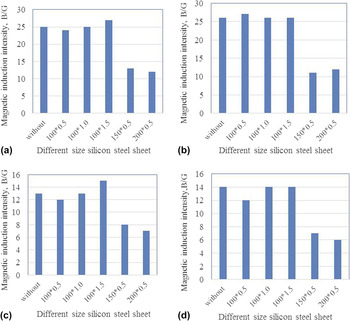
Figure 6 shows the comparison of the magnetic induction intensity with different sizes silicon steel sheet at the constant current intensity (12 A) in TMF. Figure 6 displays the measurement results at different positions shown in Fig. 1(b). It can be seen that after the application of silicon steel sheet, if the length of the silicon steel sheet is short, such as 100 mm, and the thickness of the silicon steel sheet is increased to 1.5 mm, the effect of magnetic field shielding is not significant. However, when the length of silicon steel sheet is increased to 150 mm, even if the thickness of silicon steel sheet is only 0.5 mm, the magnetic field strength at the ends of the TMF is significantly reduced to approximately half of the original. Interestingly, if the length of the silicon steel sheet is further increased to 200 mm, the magnetic field strength changes insignificantly. Therefore, it can be concluded that when the length of the silicon steel sheet is greater than 150 mm, the shielding effect of the magnetic field is improved, and the thickness of the silicon steel sheet has less influence on the magnetic shielding effect. The results are in good agreement with the numerical simulation results.
Magnetic induction intensity with different silicon steel sheet size at different position (a) X: 0 mm; Y: 45 mm (b) X: 50 mm, Y: 45 mm (c) X: 0 mm; Y: 61 mm (d) X: 50 mm; Y: 61 mm.

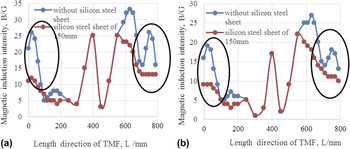
Figure 7 shows the measured values of magnetic induction intensity along the length direction of TMF with and without silicon steel sheet. Figure 7(a) shows the measured magnetic induction intensity at a position of 45 mm away from the TMF, while Fig. 7(b) displays at a position of 61 mm distance from the TMF. It can be seen that in either positions, when the silicon steel sheet of 150 mm in length and 0.5 mm in thickness was applied, the magnetic induction intensity at the ends of the TMF was significantly reduced, and the magnetic induction intensity in the middle of the TMF did not change. It demonstrates that the silicon steel sheet acts as good shield of the ends of the TMF.
Magnetic induction intensity with and without silicon steel sheet along the TMF length direction at a position of (a) 45 mm and (b) 61 mm away from the TMF.

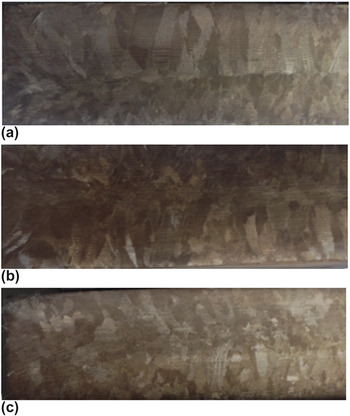
Figure 8 shows the macroscopic solidification structure at the ends of the tin phosphor bronze thin slab with or without TMF. It can be seen that without TMF, the solidification structure of the thin slab is coarser, and when the TMF is applied, the grains are refined, but are uneven. When the silicon steel sheet is applied at the ends of the TMF, the solidification structure at the ends of the thin slab is finer and uniform. Because it is well known that the crack defects are closely related to the solidification process, the method of applying the silicon steel sheet at the ends of the TMF to improve the flow and solidification of copper liquid in the mold and improve the quality of thin slab, especially the ends quality, is considered as effective.
Macroscopic solidification structure at the ends of tin phosphor bronze thin slab (a) without TMF, (b) with TMF, (c) with TMF and silicon steel sheet.

IV. CONCLUSIONS
The following conclusions can be drawn:
-
(1) Due to the electromagnetic field shielding effect, a silicon steel sheet at the ends of TMF can effectively reduce the magnetic field intensity at the ends of the TMF. For instance, when the length of silicon steel sheet was 150 mm and the thickness was 0.5 mm, the magnetic field strength at the ends of TMF was significantly reduced to approximately half of the original. However, both the change in the length of TMF and the decrease of current intensity at the ends of the TMF were not greatly effective for the magnetic field distribution and melt flow at the ends of mold.
-
(2) The length of silicon steel sheet has a higher impact on the TMF than on its thickness. Such as, when its length was 100 mm, the change in the magnetic field intensity was not substantial.
-
(3) When the magnetic field intensity at the ends of the TMF was reduced, it significantly improved the flow and solidification of the melt at the ends of the mold and made the solidified shell, especially the ends solidified shell, uniform, which is helpful to improve the ends quality of the continuous casting thin slab.
Supplementary Material
To view supplementary material for this article, please visit https://doi.org/10.1557/jmr.2017.241.
ACKNOWLEDGMENTS
This research was supported by grants from the National Natural Science Foundation of China No. 51204101 and Application and the Basic Research of Qingdao No. 14-2-4-109-jch.