Implications
Access of rearing stock to mountain pastures is often claimed to be beneficial with respect to health and longevity, but the robust evidence is scarce. Therefore, its effect was tested by including it in the routine genetic evaluation data set for longevity. Rearing stock that had access to Alpine pastures, at least once for a minimum of 60 days, had a reduced culling risk as cows. Apart from many other positive aspects of the Alpine transhumance practice, evidence for the positive effect on the animals’ fitness could thus be provided.
Introduction
Alpine transhumance or droving livestock to mountainous areas during summer months is highly relevant for Austrian agriculture but also for other countries in Alpine regions. This traditional practice enables the utilization of additional forage areas and can thus result in higher profit despite higher effort (Mack et al., Reference Mack, Walterand and Flury2013; Ländliches Fortbildungsinstitut (LFI), 2015). Further reasons for grazing animals on Alpine pastures are potential beneficial effects on the health status of the animals (e.g. Corazzin et al., Reference Corazzin, Piasentier, Dovier and Bovolenta2010) and the reduction of work burden if employees look after the animals (Mack et al., Reference Mack, Walterand and Flury2013; LFI, 2015). Besides, mountainous pastures play a major role with regard to tourism and recreation (e.g. Daugstad and Kirchengast, Reference Daugstad and Kirchengast2013), biodiversity (e.g. Mack et al., Reference Mack, Walterand and Flury2013) as well as protection of resources (e.g. water, soil) and protection against natural hazards (e.g. floods) (e.g. Greif, Reference Greif2010; LFI, 2015). Finally, Alpine transhumance is closely connected with old customs and has thus high emotional significance (LFI, 2015).
Access to pasture was reported to have positive effects on health and fitness-related traits (e.g. Washburn et al., Reference Washburn, White, Green and Benson2002; Hernandez-Mendo et al., Reference Hernandez-Mendo, von Keyserlingk, Veira and Weary2007). As reviewed by Imfeld-Müller (Reference Imfeld-Müller2012), the effect of extensive pasture, for example in mountainous areas, was also studied in cows. Results of various studies suggest positive effects on fitness-related traits (e.g. Köll, Reference Köll2004; Corazzin et al., Reference Corazzin, Piasentier, Dovier and Bovolenta2010). The literature on the effect of young stock reared in extensive grazing systems or high altitudes is scarce. However, the few available studies indicate possible beneficial effects, for example on longevity (Krogmeier et al., Reference Krogmeier, Kimmerle, Schmidt and Götz2015). Reasons for positive effects may include increased activity, higher UV-radiation, feed resources that are rich in variety or temperature fluctuations. Therefore, the aim of the present study was to analyze the effect of Alpine pasturing of rearing stock on their longevity as cows by including this effect in the routine genetic evaluation for functional longevity.
Material and methods
Alpine transhumance practice
According to AWI, the Federal Institute of Agricultural Economics (Bundesanstalt für Agrarwirtschaft (AWI), 2016), registered Alpine pastures account for about 11% of the total Austrian area. Somewhat more than a third of this area is Alpine forage area, which substantially contributes to the farms’ overall forage-supply. Nearly 26 000 Austrian farms with personnel of 7000 people practice Alpine transhumance on about 8000 Alpine pastures. Per year, about half a million animals are driven to Alpine pastures; the majority being cattle. The total number of cattle on Alpine pastures has hardly changed during the past 15 years, young stock up to an age of 2 years have the main share (AWI, 2016; Table 1). Moving to and from Alpine pastures needs to be registered; legal frameworks include the national cattle registration regulation (BGBl. II Nr. 201/2008) and the EU decision (2001/672/EC). Alpine pasturing is defined as grazing on an Alpine pasture between 15 April and 15 October in a calendar year. In order to be eligible for subsidies or direct payments, animals must stay at the Alpine pasture for a minimum of 60 days (Agrarmarkt Austria (AMA), 2017).
Overview of the Austrian Alpine transhumance (farm characteristics and number of cattle, horses, sheep and goats) in the years 2000 and 2015 (AWI, 2016)

1 Only available for 2014.
Data
All Austrian Fleckvieh (dual-purpose Simmental) cows included in the routine genetic evaluation of functional longevity were considered in this analysis. Austria was the first country worldwide to introduce a genetic evaluation for functional longevity in the year 1995 (Fürst and Fürst-Waltl, Reference Fürst and Fürst-Waltl2006). Alpine pasturing of cows has been considered as an effect in the genetic evaluation since its introduction. The Alpine transhumance information on the young stock has however not been provided before this investigation. Nearly 4 000 000 Alpine transhumance records (animal identity, dates moving to and from Alpine pasture) from 2001 to 2013 were collected from AMA (Agrarmarkt Austria, the Austrian Paying Agency for Agriculture and Rural Development). Inter alia, AMA is responsible for the administration of animal identification and agricultural subsidies, including Alpine pasturing of cattle. After several plausibility checks, discarding the years 2001 to 2003 and restriction to animals with sire and dam known, data were merged with the genetic evaluation data set. In total, records of 871 287 Fleckvieh cows sired by 9953 bulls were finally available.
Model
The routine genetic evaluation of functional longevity is carried out by means of the software Survival Kit v6 (Mészáros et al., Reference Mészáros, Sölkner and Ducrocq2013; https://www.nas.boku.ac.at/nuwi/the-survival-kit/). In the joint genetic evaluation of Austria, Germany and Czech Republic, the following piecewise hazard model is used (Fürst et al., Reference Fürst, Dodenhoff, Egger-Danner, Emmerling, Hamann, Krogmeier and Schwarzenbacher2017):
 $$h\left( t \right){\equals}h_{{0,ls}} \left( \tau \right){\times}{\rm exp }\left\{ {\Sigma _{m} {\rm }f_{m} \left( t \right){\plus}hy_{k} \left( t \right){\plus}s_{i} {\plus}0.5\,mgs_{j} } \right\}$$
where h(t) is the hazard of a cow t days after first calving; h
0,ls
(τ) is the Weibull baseline hazard function per lactation l and stage of lactation s with the scale parameter λ and the shape parameter ρ; τ being the number of days since the last calving;
 $\Sigma _{m} f_{m} \left( t \right)$
is the sum of fixed effects including region-year-season (time dependent), age at first calving (17 classes), relative performance within herd (fat plus protein yield; seven classes, time dependent), change of herd size (six classes, time dependent), Alpine pasturing of cows (time dependent), heterosis (10 classes) and recombination loss (10 classes); hy
k
(t) is the random time-dependent effect of herd-year following a log-gamma distribution; s
i
is the random sire genetic effect; and mgs
j
is the random maternal grandsire genetic effect.
The random genetic effects s
i
and mgs
j
are assumed to follow a multivariate normal distribution with a mean of zero and a variance of
 $A\sigma _{s}^{2} $
with A being the relationship matrix and
 $\sigma _{s}^{2} $
being the variance among sires.
For the analysis of the effect Alpine pasturing of rearing stock an additional fixed effect was included either as (1) Alpine pasturing of rearing stock yes or no or as (2) Alpine pasturing of rearing stock depending on age at Alpine pasturing. To create classes for (2), 3-digit codes were defined with the first, second and third position representing the 1st, 2nd and 3rd year of life. With regard to year assignment, the 1st day within calendar year that an animal spent on Alpine pasture was relevant. For all years of life, 0 and 1 indicated not and on Alpine pasture, respectively. Animals had to spend a minimum of 60 days on Alpine pasture per year to be included in category 1. For the 3rd year the additional code 2 indicates that the animal had already calved and hence Alpine pasturing as heifer had not been possible any more. In total, 12 classes were considered, for example 000 for not on Alpine pasture in either year of life, 100 on Alpine pasture in the 1st year of life only, or 112 on Alpine pasture in the 1st and 2nd year of life, whereas in the 3rd year it was not possible due to preceding calving.
Results
Alpine pasturing of rearing stock
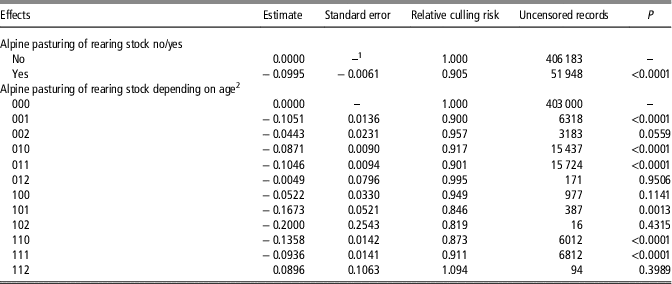
The relative culling risk of cows that spent a minimum of 60 days on Alpine pasture before first calving compared with cows never on Alpine pasture as rearing stock is about 10% lower (P<0.0001, Table 2). With a genetic standard deviation of s a =0.303 and one s a corresponding to 180 days, the difference in functional longevity is about 56 days. In a second analysis, it was differentiated based on when and how often an animal spent a minimum of 60 days/year on an Alpine pasture. A significant decrease (P<0.01) of the culling risk was found for almost all animals that had the chance to be on Alpine pasture in the 3rd year of life (no calving before) and spent at least one summer on an Alpine pasture (codes 001, 010, 011, 101, 110, 111). Among those animals, the lowest relative culling risk was observed for cows that had grazed on Alpine pasture as calves or heifers in years 1 and 3 (relative culling risk=0.846). Animals that were on Alpine pasture during the 1st year of life only (code 100), also had a decreased relative culling risk, the effect was however not significant (P>0.05). The effects for animals that calved early and thus had no chance to be in the mountains during their 3rd year of life were not significantly different from zero (codes 002, 012, 102 and 112; P>0.05).
Effect of Alpine pasturing of rearing stock on the relative culling risk of Fleckvieh cows (Number of cows=871 287, number of sires=9953) based on Survival Analysis

1 Not available.
2 Within the 3-digit code, the first, second and third positions represent the 1st, 2nd and 3rd year of life; 0 and 1 indicating not and on Alpine pasture, respectively. For the 3rd year, the additional code 2 indicates that the animal had already calved and hence Alpine pasturing as heifer had not been possible.
Other effects
With increasing age of calving, the risk of culling slightly increased. While the relative culling risk in the youngest age class (up to 24 months) is 0.878, it is 1.115 in the highest age class (40 months and older). The relative fat and protein yield was the most important effect in order to address functional longevity. The relative culling risk of a cow with a fat and protein yield more than 35% below herd average is about 8-times higher than that of an average cow (relative culling risks of 8.279 and 1.000). Cows with a fat and protein yield more than 15% above herd average have a relative culling risk of 0.696. Further, the relative culling risk is affected by the change in herd size. A reduction in herd size increases the relative culling risk. Finally, Alpine pasturing of cows reduces the culling risk. During the time on Alpine pasture, the risk of cows being culled is about five times lower than that of cows staying on the farms (relative culling risks 0.192 v. 1.000).
Discussion
Fleckvieh cows that had access to Alpine pasture during their rearing period at least once had functional longevity that was nearly 2 months prolonged compared with cows that had always stayed on the farms as calves or heifers. In a more detailed analysis, the lowest relative culling risk among the significant estimates was observed for cows that had been Alpine pastured in years 1 and 3; it was about 15% below that of cows that had never had access to mountain grazing. Hence, their functional longevity was prolonged by more than 90 days. The lowest and highest relative culling risks were observed for animals that were grazed on Alpine pastures once or twice but calved early so that Alpine pasturing was not possible during the 3rd year of life. These results, however, have to be interpreted carefully as effects were not significant and class occupancies were very low.
Calves and heifers that spent time on Alpine pastures certainly have a higher probability of being driven to mountain grazing as cows. This possible confounding is however prevented by including both effects, Alpine pasturing as rearing stock and a cow, in the model. This also applies to age at first calving, which may be affected by Alpine pasturing and thus indirectly influence functional longevity. Our results are consistent with those of Krogmeier et al. (Reference Krogmeier, Kimmerle, Schmidt and Götz2015) reporting a higher survival rate of Bavarian cows with Alpine pasturing (at maximum twice during the rearing period) as heifers. Applying a linear model, not considering Alpine pasturing of cows and the genetic effect, the authors observed that longevity was significantly prolonged by 96 days for Fleckvieh and 106 days for Brown Swiss cows, respectively. Differences in culling reasons were small; the only exceptions were culling for high age or low milk production. Bavarian cows, which experienced high altitude grazing as heifers less frequently left the herd due to low production but were more frequently culled because of high age.
In conclusion, evidence for the beneficial effect of Alpine pasturing of rearing stock on the animals’ later fitness, indicated by longevity, could thus be provided. In the current study, a differentiation was however only possible between farms with and without Alpine transhumance practice. Exercise may be one of the most important causes for long-term effects on health and fitness. Thus a more detailed analysis on a comparable number of animals but distinguishing between heifers that are kept indoors, have (limited) access to pasture, are kept outdoors on the farm or outdoors on high altitudes would be favourable. The current Austrian cattle database does however not allow for such detailed differentiation.
Acknowledgements
The authors are grateful to AMA (Agrarmarkt Austria, the Austrian Paying Agency for Agriculture and Rural Development) for providing Alpine transhumance records for Austrian cattle.
Declaration of interest
The authors declare no potential conflict of interest associated with this research.
Ethics statement
No work carried out for this research was subject to the approval of an ethics committee.
Software and data repository resources
The data sets analysed during the current study are not publicly available as their containing information could compromise the privacy of third parties.