Introduction
Semen cryopreservation and artificial insemination (AI) offer the opportunity to improve the breeding potential of male animal. Semen storage technology was revolutionized more than 50 years ago by the discovery of the cryoprotective capacity of glycerol. This important discovery introduced the long-term storage of spermatozoa through cryopreservation and its subsequent use for AI (Holt, Reference Holt2000).
During the past decades, intensive researches have been carried out to develop suitable semen cryopreservation methods in many species that would yield viable spermatozoa with acceptable fertility following preservation. The wide-spread uses of AI in different species became possible due to the availability of suitable diluents and due to the fact that similar pregnancy rates can be achieved with small doses of preserved semen (Salisbury et al., Reference Salisbury, Fuller and Willett1941; Foote and Bratton, Reference Foote and Bratton1950; Foote et al., Reference Foote, Gray, Young and Dunn1960). Over the past decades, various investigations aiming at extender development have focused on the subject of membrane-stabilizing compounds (Dee Leeuw et al., Reference Dee Leeuw, Dee Leeuw, Dean Daas, Colenbrander and Verkeij1993). Egg yolk and milk proteins are routinely included in cryopreservation protocols to minimize cold-shock and have been the subject of many investigations (Dee Leeuw et al., Reference Dee Leeuw, Dee Leeuw, Dean Daas, Colenbrander and Verkeij1993; Holt, Reference Holt2000). Bull spermatozoa are routinely cryopreserved using 4% to 8% glycerol and acceptable results are also obtained in wild ruminants when this range is used (Hopkins et al., Reference Hopkins, Armstrong, Hummel and Junior1988; Garland, Reference Garland1989; Fennessy et al., Reference Fennessy, Mackintosh and Shackell1990).
Mithun (Bos frontalis), a descendant of wild gaur, is found in many locations of Southeast Asia. This species is reared under the free-range system at an elevation of 1000 to 3000 m above the sea level. This unique bovine species is primarily used for beef production and it also plays an important role in the socio-economic life of its rearers (Simoons, Reference Simoons1984; Mondal and Pal, Reference Mondal and Pal1999). A tremendous opportunity lies ahead to utilize this species for organic beef production as it is reared under the free-range system in natural forest. Previous studies indicate the utilization of gaur semen for in vitro embryo production (Johnston et al., Reference Johnston, Parrish, Monson, Leibfried-rutledge, Susko-parrish, Northey, Rutledge and Simmons1994; Hammer et al., Reference Hammer, Tyler, Loskutoff, Armstrong, Funk, Lindsey and Simmons2001). It is also reported that cryopreserved gaur semen is capable of establishing pregnancy in cow through AI (Sukwongs et al., 1998). Previous reports indicate that the different qualitative parameters of mithun semen are within the normal range and may be compared with cattle (Bhattacharya et al., Reference Bhattacharya, Goswami, Bujarbaruah, Deka, Baishya and Sarma2005; Karunakaran et al., Reference Karunakaran, Dhali, Mech, Khate, Rajkhowa and Mishra2006). The recent initiatives to popularize mithun as an economic beef animal emphasize the introduction of control breeding and breed improvement programme in this species. In this context, it becomes necessary to standardize a suitable semen preservation protocol to adopt AI in this animal.
To the best of our knowledge, no efforts have been made thus far to preserve mithun semen at ultra-low temperatures. The specific objective of this study was to determine whether mithun semen could be cryopreserved in liquid nitrogen using tris–egg yolk–glycerol diluent.
Materials and methods
Experimental animals and semen collection
Semen was collected from five healthy adult mithun bulls (4 to 6 years of age). The experimental animals were maintained at the Institute’s mithun farm, Jharnapani, Nagaland, India. The animals were daily offered 40 kg mixed jungle forages (18.6% dry matter and 13.1% crude protein (CP)), 4 kg concentrate mixtures (89.2% dry matter and 15.3% CP) fortified with mineral mixture and salt and ad libitum drinking water. Semen was collected through the rectal massage method. Briefly, seminal vesicles were massaged centrally and backwardly for 5 min followed by the gentle milking of ampullae one by one for 3 to 5 min, which resulted in erection and ejaculation. During collection, the initial transparent secretions were discarded and neat semen drops were collected in a graduated test tube with the help of a funnel. A total of 40 ejaculates were collected from the experimental animals over 3 months. Among these ejaculates, 15 ejaculates were discarded because of poor quality (mass activity score 2 or less) and the remaining 25 ejaculates of good quality (mass activity score 3 or more) were preserved in liquid nitrogen. All the experimental protocols met the Institute Animal Care and Use Committee regulations.
Semen dilution and preservation protocols
After collection, the samples were subjected to the initial dilution with pre-warmed (37°C) 1 ml of tris–egg yolk–glycerol diluent (solution-A: tris-hydroxymethyl aminomethane 30.28 mg/ml, sodium citrate 16.75 mg/ml, fructose 12.50 mg/ml, glycerol 7% and 100 000 IU of Penicillium G sodium salt and 100 mg dihydrostreptomycin were added in 100 ml solution. The diluent was prepared by adding 40 ml of solution-A and 10 ml of egg yolk. Fresh diluent was prepared before every collection). The partially diluted samples were brought to the laboratory (within 30 min of collection) in a thermo flask containing warm water (37°C) for further processing. The final dilution of the sample was done with pre-warmed (37°C) diluent in such a way that after dilution a volume of 0.50 ml contained 30 × 106 spermatozoa. After final dilution, samples were packaged in 0.50 ml straws, leaving a small air space at the open end. The open end of straw was heat sealed by pressing it between the heated ends of a forceps. The straws were then equilibrated at 5°C for 4 h. After equilibration, straws were frozen in liquid nitrogen vapour, 5 cm above the liquid nitrogen level for 10 min and then plunged into liquid nitrogen for storage.
Evaluation of semen samples
Immediately after collection, the samples were evaluated for volume, colour, consistency, mass activity and pH. Fresh semen samples were subjected to the determination of mass activity using a 5-point scale (0 to 5; 0 = no motility and 5 = vigorous motility in wave like pattern) by analysing 4 to 5 fields of view of neat semen drop placed on a pre-warmed slide (37°C) by two persons (magnification 100×). Spermatozoa concentration was determined in fresh semen samples using the haemocytometer method (magnification 400×). Progressive motility was determined in fresh samples, in diluted samples after cooling (at 5°C for 4 h) and in cryopreserved samples. The cryopreserved samples were evaluated after minimum 7 days of storage. Thawing of the cooled and frozen semen samples was carried out by immersing straws into a water bath at 37°C for 1 min. The percentage of progressively motile spermatozoa was subjectively determined to the nearest of 10% by analysing 4 to 5 fields of view of the sample placed on a pre-warmed slide (37°C) under a cover slip by two persons (magnification 400×). The live spermatozoa count, morphological abnormalities and acrosomal status were evaluated simultaneously using the trypan blue-Giemsa staining technique (Kovacs and Foote, Reference Kovacs and Foote1992). Four different classes of spermatozoa were distinguished during the evaluation. These were the live spermatozoa with intact acrosome (acrosome: purple; post acrosomal area of head: white or light pink), dead spermatozoa with intact acrosome (acrosome: purple; post acrosomal area of head: violet), dead spermatozoa with damaged acrosome (acrosome: lavender; post acrosomal area of head: violet) and dead spermatozoa without acrosome (anterior part of head: greyish; posterior part of head: violet). The total morphological abnormality was determined by adding the proportion of head abnormalities (loose), midpiece abnormalities (degenerated or bent) and tail abnormalities (bent or coiled). The live spermatozoa count, morphological abnormalities and acrosomal status were evaluated (magnification 400×) with a Nikon microscope (Eclipse 80i) attached with a liquid crystal display (LCD) viewer. The view of spermatozoa (magnification 400×) was further enlarged (2× or 4×) from the LCD viewer if required.
Artificial insemination
The efficacy of the cryopreservation protocol was further checked through AI. Three multiparous healthy mithun cows were inseminated with the cryopreserved semen. The animals were inseminated (two straws) at 10 to 12 h following the onset of oestrus. Pregnancy detection was done through per-rectal examination at 60 and 90 days following the insemination.
Statistical analysis
All the statistical analyses were performed using SPSS software package (SPSS, 1999). Data were analysed by means of a general linear model. The model included treatment (fresh semen, cooled semen or cryopreserved semen) and bull as a source of variation. The analyses were performed after arcsine transformation of the results expressed as percentages. All pair wise multiple-comparison procedures between means were conducted using the Student-Newman-Keuls (SNK) test. The data are presented as mean ± s.e.
Results
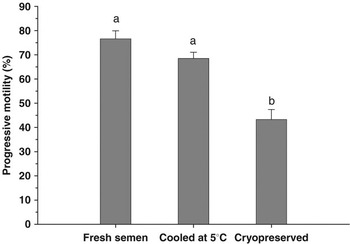
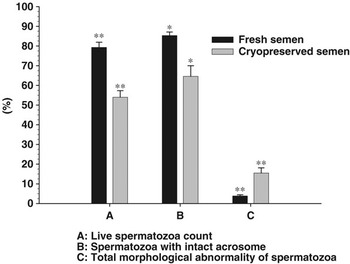
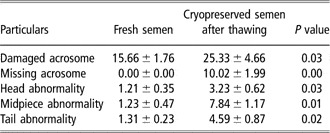
The colour, consistency and mass activity of the fresh samples were found to be creamy white, medium and 3 to 4, respectively. The volume (ml), pH and spermatozoa concentration (×106/ml) of the fresh samples were found to be 0.6 to 1.1, 6.9 to 7.1 and 440 to 550, respectively. The variations in progressive motile spermatozoa in fresh semen, diluted semen cooled to 5°C and cryopreserved semen are depicted in Figure 1. It was observed that the progressive motility did not differ significantly in fresh and cooled semen, but it was significantly (P < 0.01) lower in cryopreserved samples. The variations in the percentages of live spermatozoa, spermatozoa with intact acrosome and total morphological abnormality in fresh and cryopreserved semen are depicted in Figure 2. It was observed that the percentages of live spermatozoa (P < 0.01) and spermatozoa with intact acrosome (P < 0.05) decreased significantly in cryopreserved samples. The total morphological abnormality was found to be increased significantly (P < 0.01) after cryopreservation. The variations in the percentages of damaged acrosome, missing acrosome and abnormalities of head, midpiece and tail in fresh and cryopreserved semen are presented in Table 1. The acrosomal and morphological abnormalities were increased significantly (P < 0.05) in the cryopreserved samples. The evaluated seminal parameters did not differ significantly among the bulls. All the three mithun cows were conceived following AI and gave birth to healthy calves.
Variations (mean ± s.e.) in the percentage of mithun spermatozoa showing progressive motility in fresh semen, diluted semen after cooling (at 5°C for 4 h) and thawing and cryopreserved semen after thawing. Letters a and b on error bar indicate a significant difference (P < 0.01).

Variations (mean ± s.e.) in the percentage of live spermatozoa, spermatozoa with intact acrosome and morphologically abnormal spermatozoa in fresh semen and cryopreserved semen after thawing. **Significant difference at P < 0.01 and *significant difference at P < 0.05.

Variations (mean ± s.e.) in damaged acrosome, missing acrosome and different morphological abnormalities in fresh and cryopreserved mithun semen

Discussion
The genome resource banking and assisted reproductive technology are the important tools to maximize the genetic diversity in wild and domestic species. In the present study, we tried to standardize a cryopreservation protocol for mithun semen that can be practically used for AI. The results represent a significant step towards the development of a suitable semen cryopreservation protocol in this species. To the best of our knowledge, this is the first report on the cryopreservation of mithun semen and birth of mithun calves through AI.
The most important aspect of any semen cryopreservation protocol is to design a suitable extender, which will provide the optimum chemical and osmotic environment to spermatozoa during the entire process. To ensure a good post-preservation sperm survival, extender should be standardized with a species-specific buffer system, cryoprotectants and additives such as sugars and proteins (Holt, Reference Holt2000). The tris–egg yolk–glycerol diluent is widely used for cryopreservation of cattle semen (Vyas et al., Reference Vyas, Mohan, Dhami and Sahni1992; Thun et al., Reference Thun, Hurtado and Janett2002; Januskauskas et al., Reference Januskauskas, Lukoseviciute, Nagy, Johannisson and Rodriguez-martinez2005). During the study, we tried to cryopreserve mithun semen using tris–egg yolk–glycerol diluent.
In the current investigation, the qualitative parameters of the semen samples were comparable with the previous studies in mithun (Bhattacharya et al., Reference Bhattacharya, Goswami, Bujarbaruah, Deka, Baishya and Sarma2005; Karunakaran et al., Reference Karunakaran, Dhali, Mech, Khate, Rajkhowa and Mishra2006). In our study, the percentage of progressively motile spermatozoa in cryopreserved samples was found to be comparatively lower than cattle bull. Previous reports in cattle indicate that semen retains approximately 50% to 70% post-thaw progressive motility, when cryopreserved in tris–egg yolk–glycerol diluent (Vyas et al., Reference Vyas, Mohan, Dhami and Sahni1992; Thun et al., Reference Thun, Hurtado and Janett2002; Januskauskas et al., Reference Januskauskas, Lukoseviciute, Nagy, Johannisson and Rodriguez-martinez2005). The results of the present study indicated that approximately 55% spermatozoa were viable, 65% spermatozoa retained intact acrosome and 75% spermatozoa were morphologically normal after cryopreservation. These observations are in agreement with the previous reports in cattle. It is evident in cattle that 60% to 70% spermatozoa remain viable (Somfai et al., Reference Somfai, Bodo, Nagy, Papp, Ivancsics, Baranyai, Gocza and Kovacs2002; Nagy et al., Reference Nagy, Hallap, Johannisson and Rodriguez-martinez2004), 70% to 80% spermatozoa remain morphologically normal (Somfai et al., Reference Somfai, Bodo, Nagy, Papp, Ivancsics, Baranyai, Gocza and Kovacs2002; Januskauskas et al., Reference Januskauskas, Lukoseviciute, Nagy, Johannisson and Rodriguez-martinez2005) and 50% to 80% spermatozoa retain intact acrosome after cryopreservation (Somfai et al., Reference Somfai, Bodo, Nagy, Papp, Ivancsics, Baranyai, Gocza and Kovacs2002; Nagy et al., Reference Nagy, Hallap, Johannisson and Rodriguez-martinez2004). The current study revealed that the trypan blue-Giemsa staining technique can be used efficiently for the simultaneous evaluation of viability, morphological abnormality and acrosomal integrity of mithun spermatozoa.
Though our study indicated a lower post-thaw progressive motility of cryopreserved mithun spermatozoa compared to cattle, all the three mithun cows conceived and gave birth to healthy calves, when inseminated with the cryopreserved semen. The previous report on gaur, the wild relative of mithun, also indicates that the cryopreserved gaur semen with 30% to 45% progressive motility can establish pregnancy when inseminated in cattle (Sukwongs et al., 1998). In our study, the low post-thaw progressive motility of the cryopreserved samples may be attributed to the species difference. It is reported that cooling rate during the process of cryopreservation and glycerol content of diluent can affect the post-thaw motility of spermatozoa (Holt, Reference Holt2000; Thun et al., Reference Thun, Hurtado and Janett2002). Therefore, further studies should be carried out on these fascinating aspects to elucidate the role of different combinations of cooling rate and glycerol content on the post-preservation qualities of mithun spermatozoa.
In conclusion, our investigation revealed that mithun semen could be cryopreserved successfully using tris–egg yolk–glycerol diluent and acceptable levels of post-thaw progressive motility, viability and acrosomal integrity could be achieved. The cryopreserved semen could also be utilized to establish pregnancy in mithun cows through AI. However, further investigations are suggested to improve the post-preservation qualities of semen in this species using different diluents and cooling rates.