Introduction
Boreal forests are strongly affected by forest harvesting resulting in loss of old forest, habitat fragmentation and a generally increased importance of forest edges in the landscape. Edges influence the structure, function and dynamics of forest ecosystems by their effects on microclimatic gradients and biota, including epiphytic lichens (Saunders et al. Reference Saunders, Hobbs and Margules1991; Chen et al. Reference Chen, Franklin and Spies1995; Harper et al. Reference Harper, MacDonald, Burton, Chen, Brosofske, Saunders, Euskirchen, Roberts, Jaiteh and Esseen2005). Mechanisms behind lichen responses to edges are complex and poorly understood because they are influenced by multiple environmental factors (Esseen & Renhorn Reference Esseen and Renhorn1998). These include both local factors, such as vegetation structure, edge orientation, size and shape of the open habitat, and regional factors, such as latitude, topography, and macroclimate, that modify the strength and spatial scales of edge influence (Saunders et al. Reference Saunders, Hobbs and Margules1991; Harper et al. Reference Harper, MacDonald, Burton, Chen, Brosofske, Saunders, Euskirchen, Roberts, Jaiteh and Esseen2005). Edge creation results in steep edge-interior gradients in microclimate. Forest edges, being generally more exposed locations, receive more irradiance and experience higher wind speeds, resulting in lower relative humidity than in the interior (Chen et al. Reference Chen, Franklin and Spies1995). These factors are especially important for growth and survival of poikilohydric organisms, such as epiphytic lichens (Esseen & Renhorn Reference Esseen and Renhorn1998; Palmqvist & Sundberg Reference Palmqvist and Sundberg2000). Previous studies have documented both positive and negative growth responses in foliose lichens at forest edges (Sillett Reference Sillett1994; Renhorn et al. Reference Renhorn, Esseen, Palmqvist and Sundberg1997; Coxson & Stevenson Reference Coxson and Stevenson2007; Stevenson & Coxson Reference Stevenson and Coxson2008). However, growth responses of pendulous lichens to edges are poorly understood. Long pendulous lichens are sensitive to fragmentation by wind and show lower abundances at high contrast edges than in the interior (Esseen & Renhorn Reference Esseen and Renhorn1998; Rheault et al. Reference Rheault, Drapeau, Bergeron and Esseen2003; Esseen Reference Esseen2006). Reducing the edge contrast, i.e. the difference in composition, structure, function or microclimate between two adjacent patches (Ries et al. Reference Ries, Fletcher, Battin and Sisk2004; Harper et al. Reference Harper, MacDonald, Burton, Chen, Brosofske, Saunders, Euskirchen, Roberts, Jaiteh and Esseen2005), will presumably mitigate edge influence by reducing wind speed and direct radiation (e.g. Denyer et al. Reference Denyer, Burns and Ogden2006). The effects of edge contrast have seldom been rigorously studied and need further investigation (Ries et al. Reference Ries, Fletcher, Battin and Sisk2004), especially regarding responses of epiphytic lichens.
Our objective was to study the effect of distance from forest edge and edge contrast on lichen growth using the epiphytic lichen Usnea longissima Ach. as a model species. This pendulous lichen has considerable growth potential and is suitable for transplant studies (Renhorn & Esseen Reference Renhorn and Esseen1995; McCune et al. Reference McCune, Derr, Muir, Shirazi, Sillett and Daly1996; Keon & Muir Reference Keon and Muir2002). Moreover, and more importantly, European populations of U. longissima have been declining for a long time due to logging operations resulting in loss, alteration and fragmentation of habitat, and air pollution (Ahlner Reference Ahlner1931; Sérusiaux Reference Sérusiaux1989; Thor & Arvidsson Reference Thor and Arvidsson1999). Creation of forest edges may negatively affect U. longissima through reduction of population size and vitality (Esseen et al. Reference Esseen, Ericson, Lindström and Zackrisson1981; Esseen & Ericson Reference Esseen and Ericson1982).
Usnea longissima was transplanted to forest edges for one year at sites representing three levels of edge contrast (clear-cut, sapling and young forest stands), using length and weight gain to assess lichen performance. We predicted higher growth near edges than in forest interiors due to increased irradiance (Renhorn et al. Reference Renhorn, Esseen, Palmqvist and Sundberg1997; Dahlman & Palmqvist Reference Dahlman and Palmqvist2003). We also hypothesize that edge contrast would influence lichen growth by altering light and moisture regimes. Our prediction was that some buffering vegetation outside the edges would stimulate growth by allowing longer periods of hydration but high levels of irradiance. Since growth capacity of lichen thalli may also vary significantly with thallus size and chlorophyll a concentration (e.g. Palmqvist et al. Reference Palmqvist, Dahlman, Jonsson, Nash and Nash2008), we used two different size classes and measured the pigment concentration in thalli before and after harvest.
Material and Methods
Study area
The study area, in the county of Västernorrland in eastern Sweden (62°39′–63°10′N, 17°7′–18°3′E), has the highest number of U. longissima sites in Sweden (Esseen & Ericson Reference Esseen and Ericson1982; Thor & Arvidsson Reference Thor and Arvidsson1999). The landscape consists of undulating forested hills traversed by river valleys. It is strongly affected by forest fragmentation and is dominated by managed coniferous forests regenerated after clear-cutting. Scattered remnants of old Picea abies (L.) H. Karst forest with multi-layered canopies and frequent small gaps occur on the hills. Pendulous lichens such as Alectoria sarmentosa (Ach.) Ach., Bryoria spp. and Usnea spp. are abundant.
The growing season (average temperature >5°C) is 160 days and the mean annual temperature is 2–4°C with monthly mean temperatures ranging from −10°C to 15°C (Raab & Vedin Reference Raab and Vedin1995). Annual precipitation varies from 700 to 800 mm, of which 35% falls as snow (Raab & Vedin Reference Raab and Vedin1995). Climate during transplantation was fairly normal (compared to means for 1961–1990) but with 100 mm more precipitation in the autumn of 2004 and 150 mm less in summer 2005 (Anon. 2004; Anon. 2005). The frequency of high wind events (mean wind speed ≥10 m s−1 for 10 minutes) was less than half compared to long-term data (1965–2007; data from the Swedish Meteorological and Hydrological Institute; SMHI). Several criteria were used to select suitable sites, and potential study sites were surveyed in the field using aerial photos and stand data. Nine edges were selected between cutovers (clear-cut, sapling or young forest stands) and old forests (100–200 years old) being current or predicted suitable habitat for U. longissima. Edges were facing east to south (100–188°) and were on flat or gently sloping ground. They formed straight borders of at least 200 m (mean 460 m, maximum 1150 m) and the altitude ranged from 215 to 385 m a.s.l.
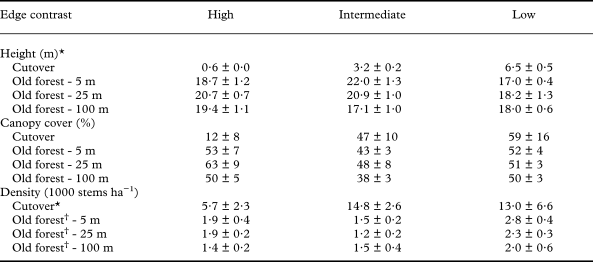
Cutovers were wider than 150 m and larger than 5 ha (up to 20 ha) with no or few residual trees. Stand data from cutovers were recorded in circular 20 m radius plots, with mid-points 20 m from edge. The sites represented three levels of edge contrast; high, intermediate and low, each with three replicates. Cutovers were 5–9, 11–16 and 15–25 years old respectively (average of three cored stems per plot). Stem density was obtained by counting all stems taller than 0·5 m in four random 10 m2 circular subplots. Vegetation structure on the cutovers differed markedly by level of edge contrast (Table 1). The vegetation was very low at high contrast cutovers (0·6–0·7 m) whereas saplings were 2·8–3·5 m tall at intermediate contrast cutovers and thus of similar height as the position of lichen transplants (3·1 m). The trees on the low contrast cutovers (young forest) were twice as a high (6·0–7·5 m) as the transplant positions and were expected to reduce light availability and increase humidity. One 105 m transect into the forest was randomly positioned at each site along the midsection of the edge, with ≥100 m to the corners of cutovers. Three 10 m × 30 m experimental plots were marked at 0–10, 20–30 and 95–105 m from the edge (referred to as 5, 25 and 100 m). The plots had their long sides parallel to the edge. Mean basal area of trees was 34 m2 ha−1 (range 25 – 44 m2 ha−1) and forests were dominated by P. abies (78–91% of basal area). Tree height (average of five large P. abies trees per plot) varied between 17 and 20 m among sites (average tree height 19 m). Canopy cover (vertical projection) was visually estimated to the nearest percentage. The forests had relatively open canopies with 37–64% canopy cover (average cover 50%). Forest structure was similar across distances, but with somewhat higher stem density near the edge (P = 0·002, ANOVA). The structure of the old forest showed only minor variation among sites (Table 1).
Stand data for cutovers and lichen transplant sites (old Picea abies forest) at three distances from edge for sites representing three levels of edge contrast (means ± SE, n = 3)
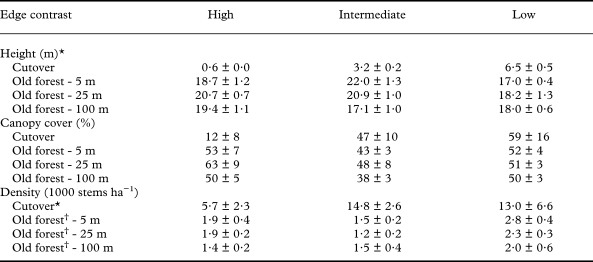
* stems higher than 0·5 m
† stems higher than 1·3 m.
Lichen material
Healthy thalli of U. longissima were collected on 16–18 August 2004 from six and 13 P. abies trees, respectively, at two sites: Storbacken (62°39′N 17°8′E, 300 m a.s.l.) and Skidstabodarna (63°4′N 18°6′E, 340 m a.s.l.). Both sites had rich populations of U. longissima and less than 30% of the population on each tree was sampled from branches 2–8 m above the ground were sampled. Thalli were air dried the same day as collected and brought to the laboratory. They were cleaned from debris, left for 24 h at room temperature (21°C and 35% relative humidity; RH) and cut in 12 or 27 cm long thallus strands, all lacking apical meristems. Thalli were weighed (± 0·1 mg) while regularly recording air temperature and RH. Weights were corrected to weights at 40% RH using a reference curve. We randomly selected 270 short and 270 long thalli for the growth experiment; the remaining thalli were stored at −80°C for measuring start values of chlorophyll concentration.
Transplant experiment
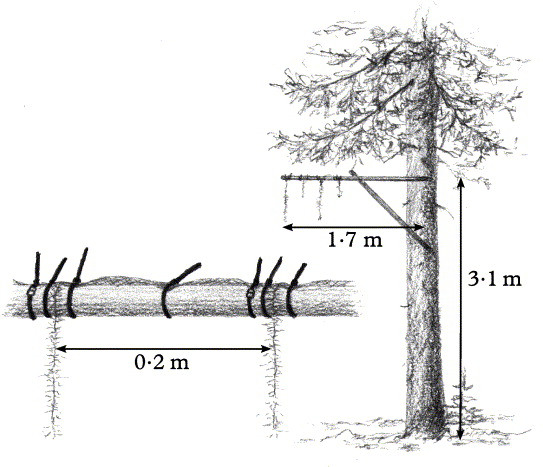
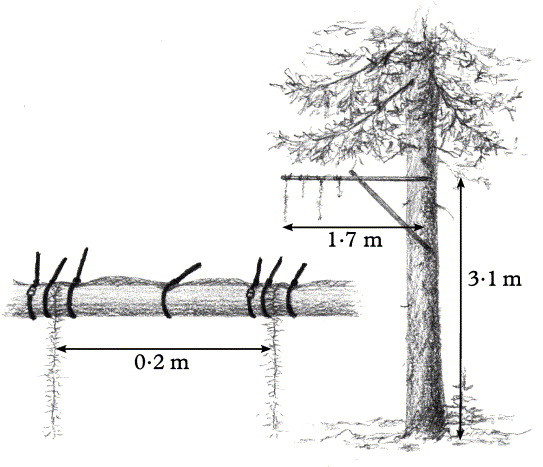
Trees for the transplantation were selected by dividing each 10 m × 30 m plot into five 10 m × 6 m subplots. One P. abies with DBH > 15 cm (mean: 26 cm, range 15–49 cm) was randomly selected per subplot. Thalli were sprayed with water and attached to 1·7 m long wood sticks (cross-sectional diameter = 25 mm). One end of the main axis of the thallus was placed over the stick and fastened with a narrow (15 mm) strip of plastic mosquito netting (Fig. 1). UV-resistant nylon zip ties were used to fasten the netting to the wood stick. Four thalli were attached to each stick (alternating long and short thalli) and the sticks were mounted 3·1 m above ground on P. abies stems, parallel with the edge. The transplantation period was one year (359–361 days) between late August 2004 and late August 2005.
Design of transplant setup. Thalli of Usnea longissima were attached to wooden sticks using plastic mosquito net and UV-resistant nylon zip ties. Four thalli (alternating long and short) were attached to each stick.
Thalli were air-dried the same day as harvested and brought to the laboratory where they were left for 24 h at 21°C. The length of the main axis was measured to the nearest 0·1 cm; short thalli longer than 11·5 cm and long thalli longer than 26·5 cm were classified as intact. Thallus weights were recorded (± 0·1 mg) and corrected to weights at 40% RH. Annual weight and length gain were calculated for intact thalli as follows: growth = (end value – start value) / start value. Weight gain values were multiplied by 100 to obtain percentage growth.
Chlorophyll pigments were quantified before and after the transplantation to assess changes in photosynthetic capacity and inherent growth potential (Dahlman & Palmqvist Reference Dahlman and Palmqvist2003; Palmqvist et al. Reference Palmqvist, Dahlman, Jonsson, Nash and Nash2008). All thalli, with a weight above 40 mg at harvest, were freeze-dried prior to analysis, pulverized, extracted in MgCO3-saturated dimethyl sulphoxide (DMSO) at 60°C for 40 min, and quantified spectrophotometrically following Palmqvist & Sundberg (Reference Palmqvist, Sundberg, Kranner, Beckett and Varma2002). Since previous studies have shown that the chlorophyll a concentration alone may be more informative than total chlorophyll (a+b) (Palmqvist et al. Reference Palmqvist, Dahlman, Valladares, Tehler, Sancho and Mattsson2002) only the former variable was used.
Statistical analyses
ANOVA (significance level P < 0·05) was used to assess the effect of distance from forest edge, site location and edge contrast on length gain, weight gain and chlorophyll concentration after one year. Distance and edge contrast were treated as fixed factors while site was treated as a random factor. We analyzed short and long thalli separately and used the means of intact thalli (1–10 thalli) per plot as one observation in the ANOVA. We tested effects of distance and edge contrast in separate ANOVAs as it is the edge plots and not the interior plots that are subjected to the treatment edge contrast. The analyses were made with the GLM general factorial procedure in SPSS for Windows version 15.0 (SPSS, Inc. Chicago, USA). Data on weight gain and chlorophyll concentration fulfilled requirements for parametric analysis without transformations, while length gain was log transformed.
Results
Growth
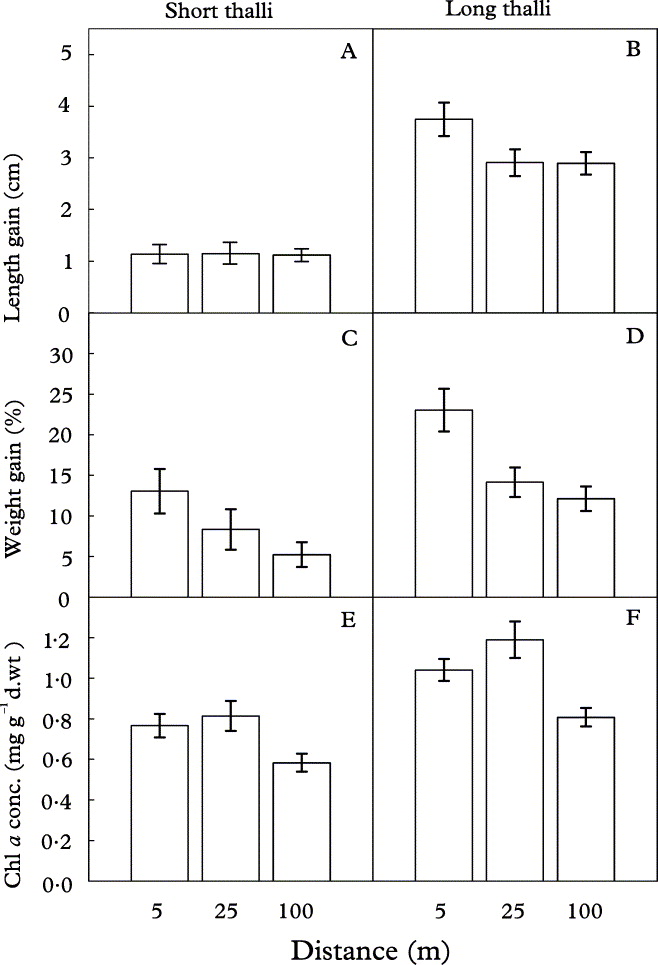
Growth data are based on the 249 thalli that were intact at harvest. The number of lost and fragmented thalli showed no pattern with distance from edge or edge contrast. We attribute this to the low frequency of storm events during the transplantation period. Growth responses of U. longissma depended on the transplant size, with growth being higher for long ones (Fig. 2). Annual absolute length gain was three times higher in long (3·2 ± 0·1 cm; mean ± SE) than in short (1·1 ± 0·1 cm) thalli. Relative weight gain showed a similar pattern with twice as much weight gain in long (17 ± 0·9%) than in short thalli (9 ± 1·1%) (P < 0·001, Independent sample t-test). Length and weight gain were significantly correlated (r = 0·80, P < 0·001).
Usnea longissima transplants after one year at increasing distances from forest edge. A & B, length gain; C & D, weight gain; E & F, chlorophyll a concentration. Each bar represents the mean (± SE) of nine plots (one per site); data for each plot were calculated as the mean of intact thalli.
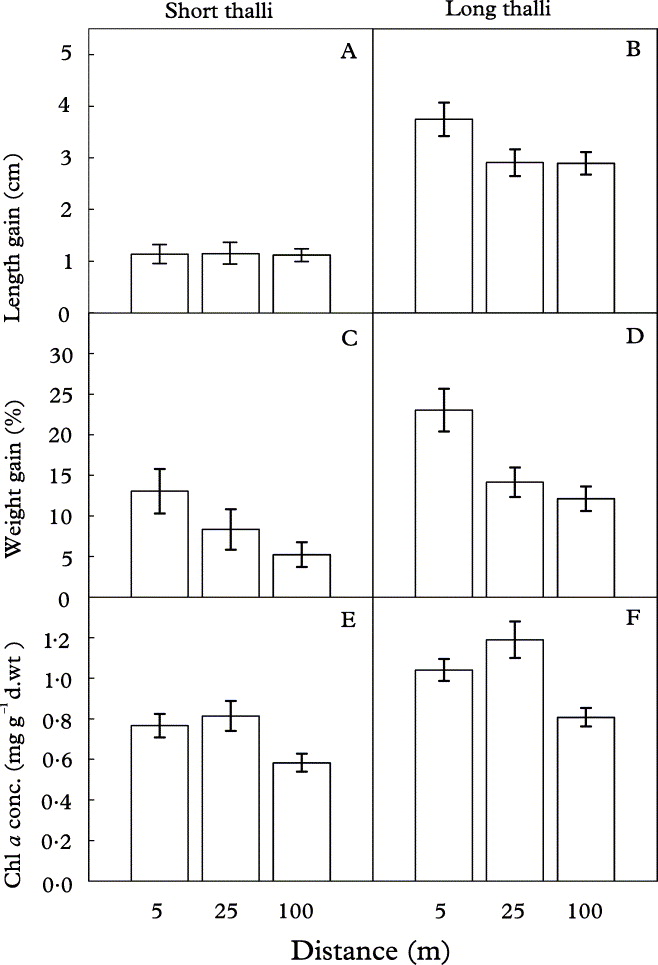
Treatment effects depended on thallus size. Distance from the edge significantly influenced both length and weight gain of long thalli, P = 0·027 and 0·002, respectively (Table 2). Weight gain of long thalli was twice as high (23%) at 5 m from the edge compared to the interior (12%, Fig. 2). In contrast, distance effects on growth could not be detected in short thalli, presumably because of their lower growth rate. No effect of site location on weight or length gain was observed (Table 2).
Summary of ANOVA results (P) for effect of distance from forest edge and site location (n = 9) on length gain, weight gain and chlorophyll a concentration in transplanted Usnea longissima after one year

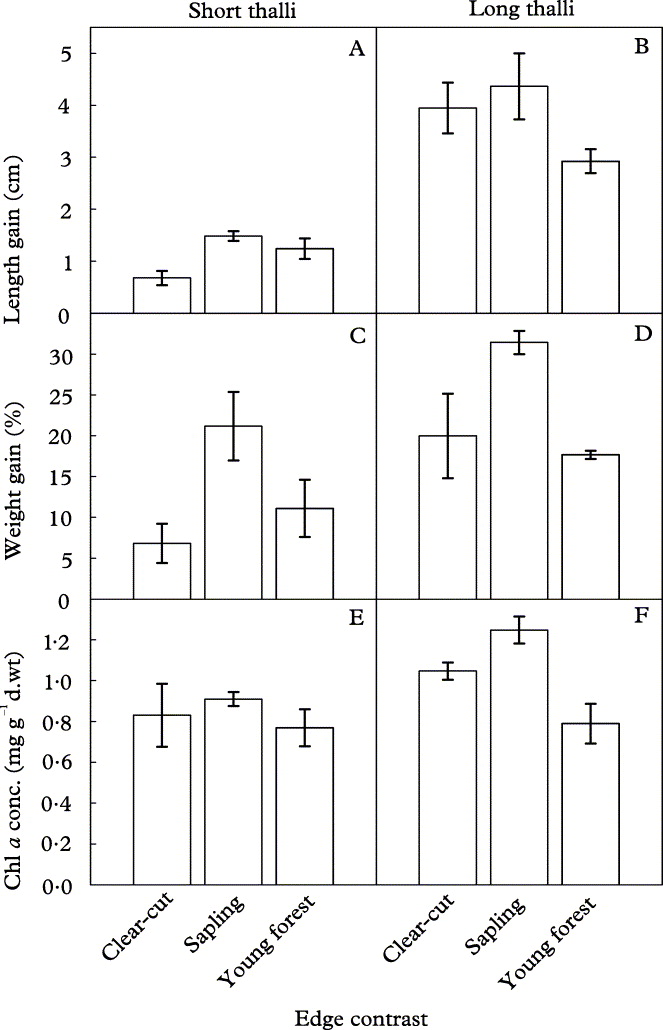
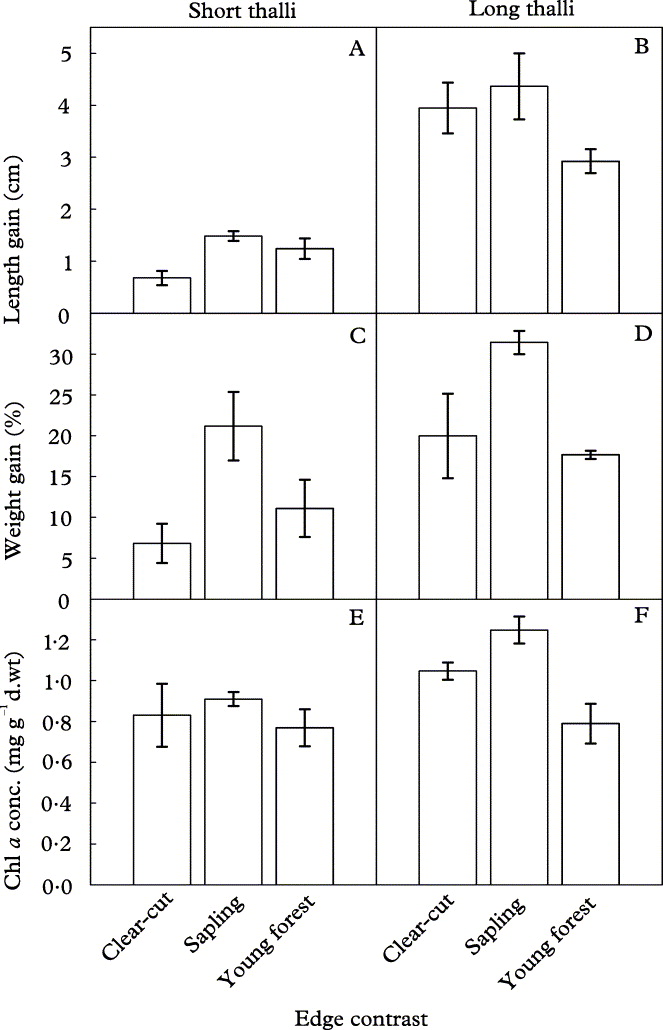
Edge contrast influenced growth of U. longissima near the forest edge (5 m) but not further into the forest (Table 3). We found significant effects of edge contrast for weight gain in long thalli (P = 0·042), and length gain in short thalli (P = 0·026). The highest growth occurred at intermediate contrast edges (Fig. 3). Weight gain of long thalli was 31% at intermediate contrast edges compared to 18% at low contrast and 20% at high contrast edges.
Usnea longissima transplants after one year at edges (5 m plots) representing three levels of edge contrast. A & B, length gain; C & D, weight gain; E & F, chlorophyll a concentration. Each bar represents the mean (± SE) of three plots (one per site); data for each plot were calculated as the mean of intact thalli.
Summary of ANOVA results (P) for effect of edge contrast (n = 3) on length gain, weight gain and chlorophyll a concentration in transplanted Usnea longissima after one year

Chlorophyll a concentration
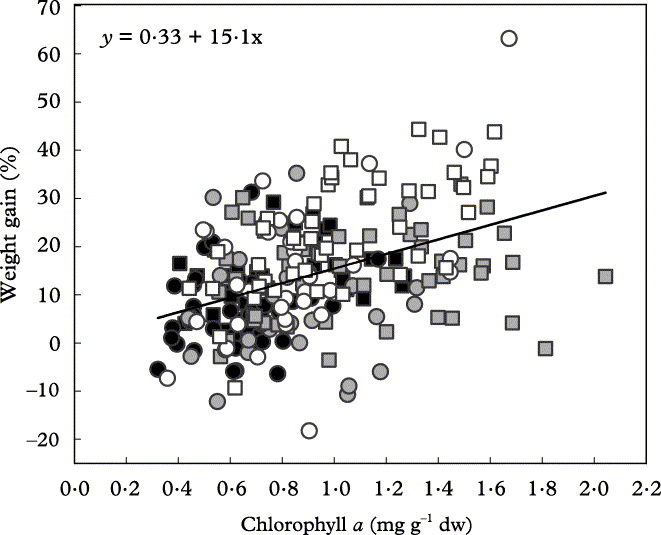
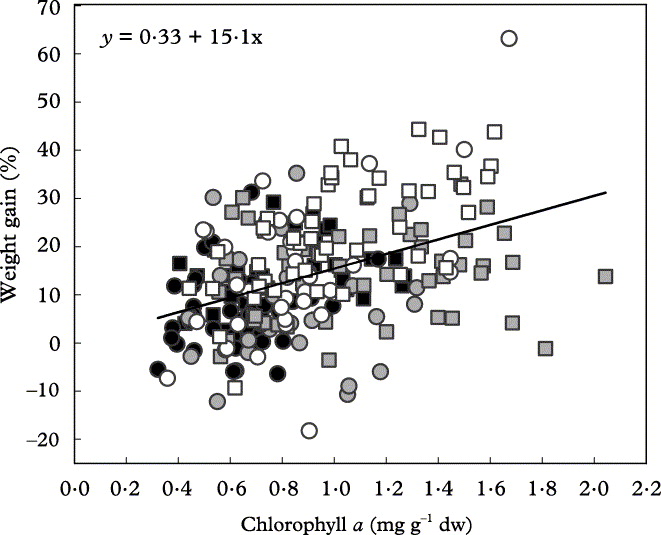
The range of chlorophyll a start values was narrower (0·40–1·47, average 0·95 mg g−1 dry weight, n = 95) than the range at harvest (0·32–2·04, average 0·89 mg g−1 d. wt, n = 239). Higher values at harvest were mainly found in thalli transplanted to positions near the edge (Fig. 4). Long thalli had a higher (0·99 ± 0·03 mg g−1 d. wt) chlorophyll a concentration than short thalli (0·77 ± 0·03 mg g−1 d. wt) at harvest (P < 0·001, Independent sample t-test). Both long and short lichen thalli had significantly higher concentrations of the pigment closer to the edge than in the interior, P = 0·002 and P = 0·001 for short and long thalli, respectively (Table 2, Figs 2 & 4). Chlorophyll a concentrations differed between sites for long thalli (P = 0·011) and was nearly significantly different for short thalli (P = 0·054, Table 2). Long thalli at high and intermediate contrast edges also had higher chlorophyll a concentrations than thalli at low contrast edges (P = 0·012; Table 3, Fig. 3). Weight gain and chlorophyll a concentration across all thalli was positively correlated (r = 0·42, P < 0·001; Fig. 4).
The relationship between weight gain and chlorophyll a concentration in Usnea longissima transplants after one year (r = 0·42, P < 0·001). Symbols: circles – short thalli (n = 102); squares – long thalli (n = 137); open symbols – 5 m from edge; grey symbols – 25 m from edge; black symbols – 100 m from edge.
Discussion
Distance from edge
Growth of U. longissima thalli was stimulated by proximity to forest edge, particularly in long thalli. Lichen growth is determined by a combination of internal and external (environmental) factors with light availability during the wet and active periods being the most important (Palmqvist et al. Reference Palmqvist, Dahlman, Jonsson, Nash and Nash2008). In our study, the increased irradiance near the edges was presumably the dominant factor stimulating lichen growth. Gauslaa et al. (Reference Gauslaa, Palmqvist, Solhaug, Holien, Hilmo, Nybakken, Myhre and Ohlson2007) have shown that growth of U. longissima depends on canopy openness with depressed growth in shady young forests. Renhorn et al. (Reference Renhorn, Esseen, Palmqvist and Sundberg1997), working in a forest similar to our forests found light intensity more than four times higher at a high contrast edge compared to the forest interior.
The broadly positive correlation between weight gain and chlorophyll a concentration (Fig 4.) could suggest that the weight gain mainly corresponded to growth of new fibrils, shown to have higher chlorophyll concentration than the main axis (Nybakken & Gauslaa Reference Nybakken and Gauslaa2007). However, a positive correlation between chlorophyll a concentration and growth has also been found for other lichens (cf. Palmqvist & Dahlman Reference Palmqvist and Dahlman2006; Gaio-Oliveira et al. Reference Gaio-Oliveira, Moen, Danell and Palmqvist2006), suggesting that increased photosynthetic capacity stimulates growth more generally. The thalli transplanted close to the forest edge displayed higher chlorophyll a concentration at harvest compared to those transplanted to interior conditions (Fig. 2), suggesting that chlorophyll bleaching had not occurred in exposed sites. The high chlorophyll a concentration closer to edges possibly implies a higher airborne deposition of nitrogen and minerals (Balsberg Påhlsson & Bergkvist Reference Balsberg Påhlsson and Bergkvist1995), since nitrogen availability appears to determine thallus chlorophyll a concentration (cf. Palmqvist et al. Reference Palmqvist, Dahlman, Jonsson, Nash and Nash2008).
Edge contrast
Lichen growth near the edge also depended on the contrast in vegetation structure between the cutover and the old forest. Growth was highest at intermediate contrast edges where the regenerating vegetation on the cutovers was of similar height to that of the transplants. This indicates that some shelter but little shade from adjacent vegetation benefits growth, is consistent with microclimatic buffering from vegetation as discussed by Didham & Lawton (Reference Didham and Lawton1999) and Denyer et al. (Reference Denyer, Burns and Ogden2006). The thalli at high contrast edges received more irradiance but presumably also experienced shorter periods of hydration due to the drier conditions at exposed edges (cf. Chen et al. Reference Chen, Franklin and Spies1995). It is plausible that the delicate combination of high irradiance and humidity at intermediate contrast edges resulted in longer periods of photosynthetic activity than at either the high or low contrast edges. Our findings confirm the importance of edge contrast for old forest lichens as shown in North America by Coxson & Stevenson (Reference Coxson and Stevenson2007) and Stevenson & Coxson (Reference Stevenson and Coxson2008). They compared lichen growth responses in foliose Lobaria spp. transplanted in soft (low contrast) and hard (high contrast) edge to interior gradients. Lobaria retigera and small L. pulmonaria thalli showed a positive growth response at soft edges sheltered by retention trees, while there was a pronounced dieback of L. retigera and lower growth rates for small L. pulmonaria at hard clear-cut edges.
Implications
The spatial and temporal response of pendulous lichens to forest edges depends on interactions between positive (growth) and negative (mortality) factors as well as stand and landscape factors (Esseen & Renhorn Reference Esseen and Renhorn1998). Previous studies have shown that large clear-cuts with high-contrast edges may adversely affect pendulous lichens in adjacent old forests by reduction of population size (Esseen & Renhorn Reference Esseen and Renhorn1998; Rheault et al. Reference Rheault, Drapeau, Bergeron and Esseen2003). The present findings emphasize that previously observed decline of pendulous lichens after edge creation cannot be explained by growth responses to altered microclimate. Instead, stochastic disturbance events, particularly fragmentation by heavy wind- and rainstorms or high snowloads, are likely to be the major factors reducing pendulous lichens (Esseen & Renhorn Reference Esseen and Renhorn1998). This is supported by previous studies (Esseen et al. Reference Esseen, Ericson, Lindström and Zackrisson1981; Esseen & Ericson Reference Esseen and Ericson1982) and recent field observations showing large population reduction of, and mechanical damage in, U. longissima following creation of forest edges at sites exposed to high winds. Apparently, the higher growth rates near edges are not sufficient to compensate for fragmentation and periodic dieback at wind-exposed sites for a lichen that is unique in the sense that it lacks a permanent holdfast (Gauslaa Reference Gauslaa1997). Moreover, the positive effect of proximity to edge on growth of U. longissima may explain its occurrence at other, less exposed sites. Field observations from sites near the study area reveal that U. longissma may be abundant just a few metres from edges at locations protected against high winds and at north- or east-facing edges. These observations are in line with several studies showing that U. longissima is favoured by an open forest and vicinity to small gaps or mires (Esseen et al. Reference Esseen, Ericson, Lindström and Zackrisson1981; Keon & Muir Reference Keon and Muir2002; Josefsson et al. Reference Josefsson, Hellberg and Östlund2005; Gauslaa et al. Reference Gauslaa, Palmqvist, Solhaug, Holien, Hilmo, Nybakken, Myhre and Ohlson2007). Open, patchy forest canopies, either resulting from naturalgap dynamics or artificial creation of small gaps, are apparently beneficial to pendulous old forest lichens such as U. longissima, by giving lichens in the lower canopy access to high irradiance and prolonged periods of wet and active time.
We conclude that conditions for pendulous canopy lichens in fragmented landscapes can be improved by creating buffer zones consisting of regenerating forest, or by leaving residual trees from the old stand (e.g. Stevenson & Coxson Reference Stevenson and Coxson2008). Such vegetation buffers would be particularly important at high-contrast edges and wind-exposed sites, whereas no or only a narrow buffer seems to be sufficient at low-contrast edges or at wind-protected sites.
We are indebted to Johan Asplund, Jenny Dahlin, Magnus Huss and Ann Sehlstedt for assistance in both the field and the laboratory. Göran Englund and Jon Moen provided statistical advice and Lotta Ström skilfully drew Figure 1. Yngvar Gauslaa gave valuable comments on the manuscript. Tomas Rydkvist helped with study site information and SCA Forest and Timber and private land owners kindly permitted access to their properties. The county board in Västernorrland approved collection and transplantation of U. longissima. FORMAS, Sweden, provided grants to P.-A.E. (no 217-2004-1126) and to K.P. (no 24.0795/97).