Introduction
Four species of chewing lice (Phthiraptera) infest feral pigeons, Columba livia Gmelin (Aves: Columbiformes: Columbidae) in Manitoba, Canada: Philopteridae – Campanulotes compar (Burmeister), Columbicola columbae (Linnaeus), and Coloceras tovornikae Tendeiro; Menoponidae – Hohorstiella lata (Piaget) (Galloway and Palma Reference Galloway and Palma2008; Galloway and Lamb Reference Galloway and Lamb2014). These species occupy the skin or feathers of their host (Nelson and Murray Reference Nelson and Murray1971; Singh et al. Reference Singh, Kumar, Badola and Saxena2000), often on the same bird, and all have chewing mouthparts: three are feather feeders (Philopteridae) and one feeds on blood (Menoponidae) (Galloway and Palma Reference Galloway and Palma2008). Coloceras tovornikae appears to be a relatively recent introduction into North America (Galloway and Palma Reference Galloway and Palma2008), compared with the other three species, which may have been introduced to North America along with the rock pigeon. Nevertheless, each species has a characteristic population biology (Galloway and Lamb Reference Galloway and Lamb2014). Campanulotes compar and C. columbae are abundant and their populations are relatively stable from year to year, whereas C. tovornikae and H. lata are less abundant and less stable than the former species.
The habitat of bird lice, the surface of the body of the host, has a relatively constant temperature through the season, in comparison with the changes in ambient air temperature experienced by the host, particularly in a continental climate such as that of Manitoba. Seasonal changes in louse populations might be expected to be more muted than those of multivoltine insects more openly exposed to ambient temperatures (Woodman and Dicke Reference Woodman and Dicke1954). On the other hand, many bird species exhibit seasonal changes in their life histories associated with migration, moulting, and reproduction, which may affect the seasonal biology of their ectoparasites. Foster (Reference Foster1969) concluded that the life cycles of a warbler and its blood-feeding chewing lice (Ricinus picturatus (Carriker) and Menacanthus Neumann species) were synchronised: oviposition by lice coincided with the short nesting period of its host. She found no evidence that oviposition occurred when birds moulted. Hamstra and Badyaev (Reference Hamstra and Badyaev2009) hypothesised that ectoparasite populations thrive at particular points in the life history of their avian hosts, because the energetic requirements of moulting or breeding limit immune responses and preening behaviour, the main defences against ectoparasites. Little information is available on the seasonal dynamics of lice on birds to assess these hypotheses. To date, studies of seasonal dynamics are based on examination of museum specimens for the presence of eggs (Foster Reference Foster1969) or collections from birds through one year (e.g., Boyd Reference Boyd1951; Woodman and Dicke Reference Woodman and Dicke1954; Kettle Reference Kettle1983; Spitznagel Reference Von Spitznagel1985; Chandra et al. Reference Chandra, Agarwal and Saxena1988; Petryszak et al. Reference Petryszak, Rościszewska, Bonczar and Pośpiech2000; Hamstra and Badyaev Reference Hamstra and Badyaev2009), or over a relatively short period of time, up to three years (Boyd Reference Boyd1951; Bergstrand and Klimstra Reference Bergstrand and Klimstra1964; Tuleshkov Reference Tuleshkov1965; Baum Reference von Baum1968; Eveleigh and Threlfall Reference Eveleigh and Threlfall1976).
Feral pigeons in Winnipeg, Manitoba are abundant and non-migratory, with high winter counts compared to many other locations in North American (Taylor Reference Taylor2003). Pigeons alternate between phases of roosting communally and a long breeding season. In Manitoba, pigeon eggs have been observed in nests between 16 April and 29 July, and at least two broods may be produced each year (Taylor Reference Taylor2003). In one previous study of seasonality of louse populations on pigeons in Poland, Petryszak et al. (Reference Petryszak, Rościszewska, Bonczar and Pośpiech2000) found the greatest abundance of C. compar in July and C. columbae in autumn.
We investigate the seasonal population dynamics of four species of lice on feral pigeons to assess whether differences in seasonality contribute to the species-specificity of population processes of these lice and whether louse seasonality is coordinated by pigeon life history.
Materials and methods
Ten years of data are used to describe seasonal patterns in the abundance of lice on pigeons salvaged from rehabilitation hospitals at the Wildlife Haven (Manitoba Wildlife Rehabilitation Organization, Winnipeg, Manitoba, Canada) and Prairie Wildlife Rehabilitation Centre (Winnipeg, Manitoba, Canada). All came from southern Manitoba, Canada, mostly from Winnipeg. The majority of birds were euthanised soon after arrival, immediately placed in sealed plastic bags, and frozen for at least 48 hours until they could be processed. Lice were collected by washing pigeons (Mironov and Galloway Reference Mironov and Galloway2002), and this method removes nearly all lice from the host (Clayton and Drown Reference Clayton and Drown2001; T.D.G., personal observation). The samples of pigeons and lice are described in detail by Galloway and Lamb (Reference Galloway and Lamb2014).
For the years 2003–2012 the following data were considered for each species of louse and each pigeon: collection date, number of lice, number of adult females and males, and number of nymphs. Nymphs were not sexed. Eggs were not removed reliably by washing and so were not tallied. The 10 chicks in the sample were excluded from parameter estimates because they came from a restricted part of the season, whereas the 49 juveniles and larger sample of adults were distributed throughout the year. Data for 11 pigeons were excluded because they were considered outliers with extremely high infestations of one louse species (>10 times mean intensity) (Galloway and Lamb Reference Galloway and Lamb2014). If they had been included, the high louse numbers would have biased estimates of peak seasonal abundance, assuring that the month of peak seasonal abundance was determined by the collection date of a single, heavily infested bird. The excluded birds comprised 2% of the total, leaving 542 birds. The number of pigeons available in each year ranged from 26 to 126, and in seven of the years 41 or more birds were assessed each year.
Data for the 10 years were first partitioned into samples for each month, providing a mean of 45±9 (SD) pigeons per month. Abundance, prevalence, intensity, ratio of males to females, and ratio of nymphs to females were estimated for each month and louse species. Prevalence is the proportion of birds infested by a louse species, intensity is the number of lice of that species on an infested pigeon, and louse abundance equals prevalence multiplied by intensity (Rózsa et al. Reference Rózsa, Reiczigel and Majoros2000). This monthly partition provided an overall picture of the dynamics of each louse species over the year, but no indication of how uniform any seasonal patterns were from year to year. In some years, the number of pigeons available some months was inadequate to effectively compare monthly estimates among years, in part because of the large difference in louse abundance among pigeons. Many pigeons had no lice, particularly the less common louse species, assuring that abundance was not normally distributed (Galloway and Lamb Reference Galloway and Lamb2014).
To help assess year-to-year variation in seasonality, data also were partitioned into four seasons: winter (December, January, and February), spring (March, April, and May), summer (June, July, and August), and autumn (September, October, and November). For each of seven years of the study (2004, 2005, 2007, 2009, 2010, 2011, and 2012), this partition provided 41–126 pigeons per year, or usually, 10 or more pigeons per season: mean of 16±12 (SD, n=28, range 4–66) birds per season. The other three years had 26–33 pigeons per year, too few to provide useful estimates for a season. The number of pigeons collected in a season represents the sample size for abundance and prevalence, but for the other three parameters sample size is the number of pigeons with lice (prevalence multiplied by the number of pigeons). When prevalence was low, the sample size of birds with lice was sometimes small increasing variance in estimates substantially (see Results).
The uniformity of seasonal patterns for the population parameters was assessed in a number of ways. First, two-way analyses of variance were conducted for each parameter, attributing variability to year and month, or year and season (SYSTAT 2010). A significant F-value for month or season confirmed that a parameter varied over the year. Because parameter estimates often were not normally distributed and their variances were sometimes not homogeneous, the analyses were repeated with a Kruskal–Wallis one-way analysis of ranks or a Mann–Whitney rank sum test (SYSTAT 2010). These non-parametric tests led to essentially the same conclusions as analyses of variance. Patterns of abundance were compared between the first and second five years of the study, to assess whether they were consistent. Pearson’s product moment correlations (SYSTAT 2010) were used to compare monthly abundances between the two five-year intervals, and also to assess the similarity of the seasonal patterns between species of louse. Finally, the monthly and seasonal parameter values were ranked for each year, and the number of years (out of seven) that the same month or season ranked lowest or highest was determined. If the same month or season always, or nearly always, ranked lowest or highest, this result provided evidence for seasonal patterns in parameter values.
The degree of seasonality, or degree to which a parameter value changed over the year, was quantified for each louse species in two ways. First, the coefficient of variation (CV) and its 95% confidence interval (corrected following Sokal and Rohlf (Reference Sokal and Rohlf1981)) was calculated for the 12 monthly estimates. The confidence intervals allowed apparent differences among louse species to be evaluated. Coefficient of variation included variation that resulted from seasonal changes and also variation due to “error” (imprecision in the monthly estimates). The error was likely to be higher when the number of pigeons with lice and the numbers of lice per pigeon were low (e.g., C. tovornikae and H. lata), which might have inflated the estimate of seasonality. To reduce this possible source of bias, the degree of seasonality was also quantified as the range for the highest and lowest monthly estimate, divided by the annual mean for all months, eliminating variation from month to month and therefore much of the error. The disadvantage of this approach was that no confidence intervals could be estimated. The similarity in the estimates resulting from the two methods (CV versus range adjusted for the mean) was compared for each parameter and the four louse species, using Pearson’s product moment correlations (SYSTAT 2010). The two methods were highly correlated (r>0.98, P<0.02, n=12 months), and so CV and its confidence limits were adopted as an index of the degree of seasonality. To further validate apparent differences among species, the process of estimating the degree of seasonality was repeated using estimates for winter, spring, summer, and autumn (correlation of CV versus range adjusted for the mean: r=1.0, P<0.0001, n=4 seasons), which provided a less precise characterisation of seasonal change (four seasons instead of 12 months) but larger samples of pigeons for each estimate.
Results
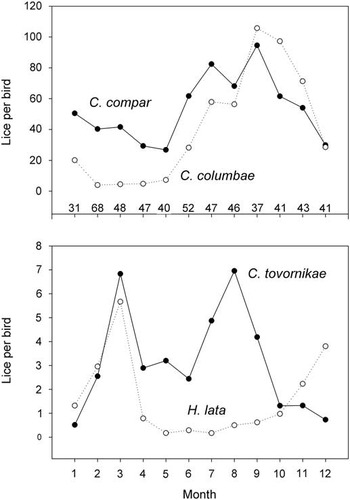
In every month of the year, adults and/or nymphs of each of the four species of lice were present on some pigeons (Fig. 1). The two most common louse species, C. compar and C. columbae, had one annual peak in abundance in September with a mean of about 100 lice per bird. Both species had relatively low abundance from February through May. In contrast, abundance of the two less common lice, C. tovornikae and H. lata, was usually an order of magnitude lower and showed more complex seasonal patterns. Both peaked in March at about six lice per bird. Coloceras tovornikae had a second peak from July to September, and about one louse per bird from October through December. Hohorstiella lata had less than one louse per bird from April to October before abundance began to rise in November.
Mean monthly abundance (n=10 years) for four species of lice collected from feral pigeons in southern Manitoba, Canada. The pigeons most heavily infested with lice (2%) are outliers and excluded (see text). The monthly sample sizes of pigeons are given on the upper x-axis.

Feral pigeons have a long breeding season in southern Manitoba. The 10 chicks (birds without fully developed flight feathers) collected in this study occurred between 5 April and 21 October. Five chicks had lice, mostly C. compar (mean of 47 lice per bird), and 93% of the 609 lice of all four species came from three chicks collected in September and October. The 50 juveniles (birds that had fledged but retained some juvenile plumage) were collected in every month except March, the last winter juvenile was collected on 27 February and the first spring juvenile on 27 April, leaving a two-month gap. Juvenile birds occurred most frequently through the summer and autumn. The prevalence of juveniles with lice for the four species were C. compar – 72%, C. columbae – 72%, C. tovornikae – 30%, H. lata – 20%, respectively, higher than for chicks. Similar numbers of C. compar were found on chicks and juveniles, but other species of lice had more than twice as many lice on juveniles as on chicks. Infestation of juveniles was similar to that of adults (Galloway and Lamb Reference Galloway and Lamb2014).
The seasonal patterns of louse abundance on pigeons were based on mean monthly estimates over 10 years. These patterns might reflect real seasonal changes or random variation in abundance from month to month. Partitioning the variance in abundance of lice (square root transformed) between year and month for individual pigeons, revealed differences among months for all four species (F=2.7, P<0.002, df=11, 438), consistent with seasonal patterns. However, abundance was not normally distributed for any of the four species and variance in abundance differed among months even after transformation, casting doubt on the test. Partitioning variance of mean monthly abundance between year and month (pooling data from all pigeons collected in a month) eliminated the unequal variances, but means were not normally distributed even if log-transformed. Differences were detected among months for C. compar and C. columbae (F=2.7, P<0.005, df=11, 104 and F=7.8, P<0.001, df=11, 104, respectively), but not for C. tovornikae or H. lata (F=1.4, P=0.208, df=11, 104 and F=1.6, P=0.122, df=11, 104, respectively). Partitioning data into four seasons (pooling data from all pigeons collected in a season) gave essentially the same result (not shown), regardless of whether data were log-transformed. Kruskal–Wallis one-way analyses on ranks (which does not assume data are normally distributed) confirmed differences among months for C. compar and C. columbae (H=23.4, P=0.016, df=11 and H=55.8, P<0.001, df=11, respectively), but not for C. tovornikae and H. lata (H=16.0, P=0.142, df=11, and H=13.3, P=0.275, df=11, respectively).
For both C. compar and C. columbae, which had the clearest seasonal patterns, abundance declined in autumn, was lowest in winter and spring, and increased in summer to September (Fig. 1). Monthly average abundance was correlated for the two species (Pearson’s product moment correlation: r=0.865, P<0.001, n=12), confirming the similarity in their seasonal patterns. The patterns were not identical, however, with C. compar having a mean monthly abundance over 10 years of 25.4 lice per bird from February through May in comparison with 2.8 for C. columbae (Mann–Whitney rank sum test: T=1642, P<0.001, n=36, 36). For both species, seasonal patterns were consistent between the first (2003–2007) and second (2008–2012) five years of the study with monthly abundances in the two periods correlated for C. compar (Pearson’s product moment correlation: r=0.547, P=0.066, n=12) and for C. columbae (r=0.839, P<0.001, n=12), and with the patterns correlated between species in both time periods (2003–2007: r=0.855, P<0.001, n=12; 2008–2012: r=0.662, P=0.019, n=12).
Although seasonal patterns were clear for mean monthly abundance over 10 years, year-to-year differences in the patterns occurred. For C. compar, peak abundance occurred in January, June, and November in individual years, but seven of 10 peaks occurred in August–October. Seasonal minima for this species usually occurred from February to May, but also in August and December in individual years. For C. columbae, peak abundance always occurred from July to October, usually in September. Seasonal minima occurred from January to June.
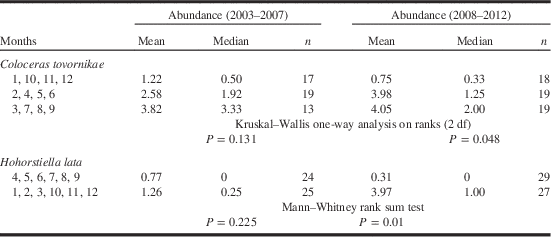
Possible seasonal patterns for C. tovornikae and H. lata were not confirmed by analysing abundance for individual months because of the small numbers of infested pigeons. However, abundance of C. tovornikae from February to September was higher than from October to January (Mann–Whitney rank sum test: T=1431, P=0.004, n=70, 35). Abundance was low in early winter, intermediate in February and spring, and high in March and summer, consistently so in both five-year periods (Table 1). The spring peak occurred from February to June, most frequently in May, whereas the summer peak occurred from July to November, with 4.5 months between peaks, on average. Abundance of H. lata was higher in the colder part of the year (October–March) than in the warmer months (April–September) (Mann–Whitney rank sum test: T=3150, P=0.007, n=52, 53), consistently so in both five-year periods (Table 1). However, H. lata could be absent from the sampled birds in any month of the year. Peak abundance occurred in cold months seven of 10 years and in warm months three of 10 years. For both C. tovornikae and H. lata, patterns of seasonal abundance were more clearly expressed from 2008 to 2012 than from 2003 to 2007 (Table 1).
Consistency in seasonal patterns of abundance for Coloceras tovornikae and Hohorstiella lata between the first (2003–2007) and second (2008–2012) five years of a study on lice on feral pigeons in southern Manitoba, Canada.
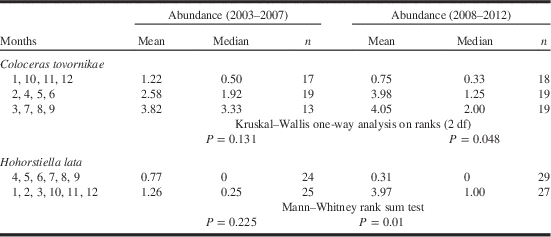
For C. tovornikae, month 3 was included with 7, 8, and 9 because from 2003 to 20012, abundance was highest in these four months.
Pigeons with the highest intensity of lice (2% most infested), which were excluded from estimates of monthly abundance, tended to follow the seasonal patterns for each louse species. For C. compar, the most heavily infested pigeons were found from June to October, when peak abundance typically occurred. The same was true for C. columbae, with the most infested birds found from July to September, over a narrower range of months than C. compar, as was the case for peak abundance (see above). For C. tovornikae, however, the highly infested pigeons were found in July and November when monthly abundance was not at its highest. For H. lata the most heavily infested pigeons were found in March when abundance peaked and in October when abundance was beginning to rise as winter approached.
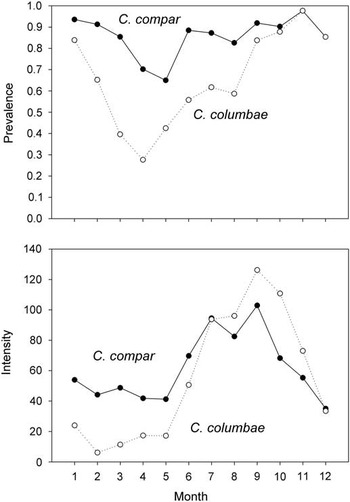
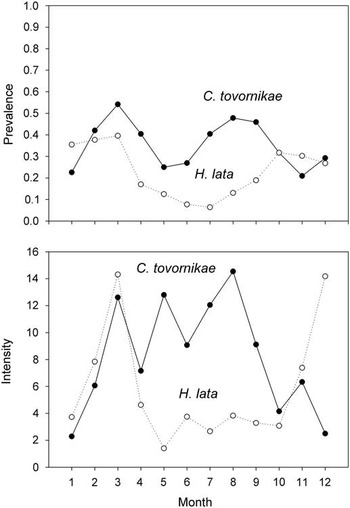
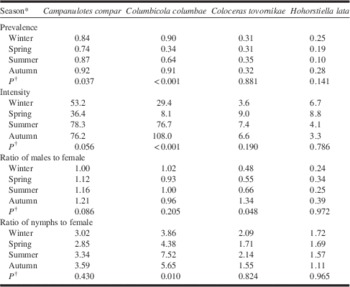
From April or May to September, the abundance of C. compar increased threefold (Fig. 1) due in part to a small increase in prevalence, but due primarily to a 2.5-fold increase in intensity (Fig. 2). In the same interval, C. columbae increased 21-fold (Fig. 1), due to a threefold increase in prevalence and a sevenfold increase in intensity (Fig. 2). Prevalence varied less over the season than intensity, and both species had high prevalence in winter but relatively low prevalence in April and May. Patterns in these two components of abundance were confirmed in one-way analyses of variance on ranks of seasonal mean values for the seven years with largest collections of pigeons: prevalence and intensity were lowest in spring (Table 2). For C. tovornikae, prevalence showed a March and a late summer peak (Fig. 3), consistent with the two peaks in abundance (Fig. 1), but when data were partitioned into four seasons, prevalence was uniform (Table 2). For C. tovornikae, intensity was erratic but low from October to February (Fig. 3), consistent with the low value for intensity in winter (Table 2). The relatively smooth curve for prevalence, contrasted with the curve for intensity (Fig. 3), probably reflects the differences in sample sizes for the two measures: all birds contribute to the sample size for prevalence but only about 30%, on average, the birds with lice, contribute to the sample size for intensity. For H. lata, prevalence was highest in the six coldest months and intensity also peaked in those months (Fig. 3), consistent with abundance (Fig. 1). Although no seasonal differences were detected, prevalence was highest in winter and autumn and intensity was highest in winter and spring, consistent with the relatively high abundance of this species in cold months (Table 2).
Mean monthly prevalence and intensity of infestation (n=10 years) for Campanulotes compar and Columbicola columbae on feral pigeons from southern Manitoba, Canada. The monthly sample sizes of pigeons are as shown in Fig. 1.

Mean monthly prevalence and intensity of infestation (n=10 years) for Coloceras tovornikae and Hohorstiella lata on feral pigeons from southern Manitoba, Canada. The monthly sample sizes of pigeons are as shown in Fig. 1.

Seasonal estimates of population parameters (prevalence, intensity, ratios of males and nymphs to females) for lice on feral pigeons collected over seven years in southern Manitoba, Canada.

* n=119, 117, 123, and 97 pigeons assessed in winter, spring, summer, and autumn, respectively. Sample sizes for intensity and the two ratios=prevalence times n.
† Probability (P) that seasonal estimates differ for each parameter and species based on Kruskal–Wallis one-way analysis of variance on ranks (3 df) (SYSTAT 2010), estimated after eliminating one to five pigeons (1%) with the highest ectoparasite intensity.
Adult lice of both sexes were present on some feral pigeons each month of the year. Sex ratio was near 1:1 and relatively uniform from season to season for C. compar and C. columbae (Table 2). Males were sparse in winter for C. tovornikae, consistent with the low intensity of this species in that season (Table 2), and perhaps reflecting higher death rates of males in winter. The ratio of males to females was <0.4 for H. lata throughout the year, lower than for any of the other species, with no seasonal pattern in the sex ratio detected (Table 2).
Nymphs were present on some pigeons every month of the year for all four species, and always more abundant than females (Table 2). No differences in the ratio of nymphs to females was detected among seasons for three of the species, but for C. columbae the proportion of nymphs was highest in summer and autumn when intensity peaked for that species (Table 2).
The seasonal patterns were usually consistent from year to year over seven years. For example, prevalence of C. compar was always highest in autumn and usually lowest in spring (five of seven years). Intensity was usually lowest in spring (five of seven years). For C. columbae, overall abundance was always highest in autumn and lowest in spring. Prevalence was always and intensity was usually (five of seven years) lowest in spring. The ratio of nymphs to females was always lower in winter than in summer. For H. lata, prevalence was usually (six of seven years) lower in summer than in autumn.
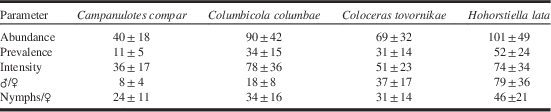
The degree of seasonality differed among the four species (Table 3). Seasonality was quantified as a coefficient of variation for monthly means (10 years) for parameters. These means were not always normally distributed; therefore, coefficient of variation should be considered an index of the degree of seasonality, with confidence intervals approximate estimates. Campanulotes compar showed the least seasonality for all parameters, with CV usually less than half that for C. columbae and H. lata (Table 3). Coloceras tovornikae tended to have an intermediate degree of seasonality, except for sex ratio, but is perhaps a special case because it exhibited two annual peaks in abundance rather than one.
Index of seasonality (CVFootnote *±95% confidence interval) for population parameters (abundance, prevalence, intensity, ratios of males and nymphs to females) for monthly estimates of lice on feral pigeons collected over 10 years in southern Manitoba, Canada.
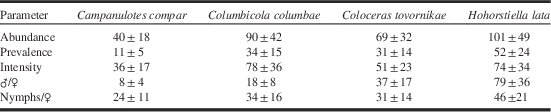
* Coefficient of variation (%) measures the amount of variation among 12 monthly estimates, for a mean of 45 (range 31–69) pigeons per month.
Discussion
The two more common species of lice that infest feral pigeons in Manitoba, C. compar and C. columbae, have one late summer peak in abundance, while the less common species, C. tovornikae, has two peaks in abundance, in late winter and in summer. The fourth species, H. lata, has its highest abundance in the coldest months of the year. These seasonal patterns are consistent between two five-year periods, although the month of peak abundance varies from year to year, being less consistent for the uncommon species than the common ones. Even though pigeon populations were assessed over a longer period (10 years) and the sample of birds was larger than in previous studies, confirming that these seasonal patterns are real was challenging. Month-to-month changes in abundance or the components of abundance and year-to-year changes in the timing of the seasonal dynamics require large monthly samples of the host, particularly if a louse species is present on a small proportion of birds in the population. The aggregated distribution of lice on birds contributes to this problem. Nevertheless, sufficient data were collected for the louse populations on pigeons in Manitoba to show that the four species have distinct seasonal population dynamics. The one previous study of seasonality of louse populations for pigeons, in Poland, reports the highest abundance of C. compar in July and C. columbae in autumn (Petryszak et al. Reference Petryszak, Rościszewska, Bonczar and Pośpiech2000). This one-year study is consistent with the seasonal patterns observed in Manitoba some years, but not others. It is too short to assess whether these species have the same seasonal dynamics in Poland and Manitoba. Petryszak et al. (Reference Petryszak, Rościszewska, Bonczar and Pośpiech2000) collected lice by ruffling the feathers of their hosts, so mean intensities of infestation by the various species of lice were likely underestimated (Clayton and Drown Reference Clayton and Drown2001; T.D.G., personal observations).
All four species of lice are present on pigeons throughout the year, with males, females, and nymphs present in every month of the year. The ongoing presence of all stages suggests that development and reproduction are continuous throughout the year, although that conclusion needs to be confirmed by establishing that eggs are laid continuously. An alternative hypothesis is that nymphs take months to reach adulthood, or perhaps females enter a reproductive diapause. These explanations seem unlikely, given that the lice live at or near the skin temperature of their host, though host physiology has been suggested to affect seasonal abundance of the blood-feeding amblyceran louse, Menacanthus eurysternus (Burmeister) (Phthiraptera: Menoponidae) infesting European starlings (Sturnus vulgaris Linnaeus; Aves: Passeriformes: Sturnidae). This species has been reported to cease reproduction during the winter months (Boyd Reference Boyd1951; Kettle Reference Kettle1983). This certainly was not the case for the blood-feeding H. lata in our study, which reached its greatest intensity during winter.
Do seasonal changes in the life history of the pigeon in Manitoba affect the seasonal dynamics of the louse populations? Feral pigeons alternate between roosting communally, when inter-bird contact is probably high, and breeding, when contact is more restricted, primarily with a mate and offspring. These phases might affect dispersal of lice to uninfested hosts, the onset of reproduction might change hormone levels in the bird that cue louse reproduction (Foster Reference Foster1969), or reproduction might reduce the defence capabilities of the pigeons (Hamstra and Badyaev Reference Hamstra and Badyaev2009). In Manitoba the seasonal biology of pigeons has not been investigated in detail. At least two broods per year are reported, with eggs observed in nests between 16 April and 29 July, and the latest nestling reported on 21 August (Taylor Reference Taylor2003). However, our data for the occurrence of chicks show the nesting phase may begin in April some years, possibly earlier, and extends to October. Although sample sizes were small, chicks had lower prevalence of lice than juveniles, suggesting that establishment of the lice on chicks does not occur immediately, perhaps not until the development of feathers is adequate for C. columbae (Johnston and Janiga Reference Johnston and Janiga1995). Campanulotes compar, however, had louse intensities on chicks as high as those on juveniles, suggesting this species disperses to nestlings more rapidly than the other louse species. By the time pigeons had fledged, the abundance of lice on the juvenile birds was similar to that on adults.
None of the louse species shows a change in abundance that matches the timing of reproduction by its host. Campanulotes compar and C. columbae are near their population minima through winter until a few months past the onset of breeding by the host. Similarly, the patterns of seasonal dynamics for C. tovornikae (peaking first before pigeons breed in spring and again four months after reproduction has begun) or H. lata (peaking in winter when pigeons are not breeding) are not coordinated with the onset or end of pigeon reproduction. The species on pigeons provide little support for the hypothesis that lice populations are synchronised with the breeding season of their host as is thought to be the case for a warbler (Foster Reference Foster1969). Unlike the feral pigeon, this warbler is migratory with a short, well-defined breeding season.
Environmental factors may influence the seasonal patterns observed in our study. Moyer et al. (Reference Moyer, Drown and Clayton2002a) showed that low relative humidity had a detrimental effect on pigeon lice. In Manitoba, there is little moisture in the air during winter months, and this may cause the reduced populations of C. columbae and C. compar we observed at this time of the year. However, relative humidity during the Manitoba winter is high, commensurate with low temperatures. It is not known whether such conditions affect louse populations.
The seasonal moult cycle of pigeons might also affect the seasonality of louse populations. Pigeons typically moult once per year (Johnston Reference Johnston1992), and in individual birds, the moult extends over a prolonged period of many months (Johnston and Janiga Reference Johnston and Janiga1995). Since chewing lice are permanent ectoparasites that attach their eggs to feathers and hair, moulting in the host may conceivably result in some eggs being lost along with their substrate. Some authors have maintained louse populations decline following the moult in their hosts (see Marshall Reference Marshall1981). However, Moyer et al. (Reference Moyer, Gardiner and Clayton2002b) demonstrated that experimentally induced moulting in rock pigeons that had been bitted to prohibit the impact of host preening had no detectable effect on populations of C. compar and C. columbae, especially when the most efficient means of estimating numbers of lice was used, i.e., washing. We washed pigeons in our study, so the numbers of lice recorded is a close approximation of the numbers present on the birds.
Preening is perhaps the most important factor affecting numbers of lice on any one pigeon. Clayton (Reference Clayton1991) has shown that when the effectiveness of preening is manipulated by placement of a bit on the upper mandible of a pigeon, populations of C. columbae and C. compar increased dramatically. Preening is affected by physiological and behavioural factors (Johnston and Janiga Reference Johnston and Janiga1995) and no doubt by the presence of organisms on the feathers and skin, so anything that results in changes in grooming behaviour might also impact numbers of lice. Despite this, we observed consistent seasonal patterns in louse infestations on feral pigeons. Preening by the host may also affect competition between species of lice infesting pigeons. Bush and Malenka (Reference Bush and Malenka2008) observed competitive displacement of wing lice by body lice, especially when preening ability of the host was hampered. Galloway and Lamb (Reference Galloway and Lamb2014) found no evidence for competition among chewing lice on pigeons, and it may be that louse populations were not large enough in feral pigeons in our study for demonstratively competitive interactions to be expressed.
As is the case for their population stability (Galloway and Lamb Reference Galloway and Lamb2014), the seasonal dynamics of these four lice are characteristic of each species. The most similar species are the two most abundant ones, C. compar and C. columbae. Their seasonal patterns of abundance differ, however, in the extent of the decline during winter and the uniformity of their prevalence through the year. Campanulotes compar is less seasonal than C. columbae for all the parameters measured. The two less common species, C. tovornikae and H. lata, have different seasonal patterns from the two abundant ones. What causes these seasonal changes in abundance remains to be determined. Living on the surface of their warm-blooded host allows these insects to be active all year round although the pigeons in this study were found in a north temperate environment with extreme annual fluctuations in temperature. Nevertheless, three of the four louse species show large and relatively consistent seasonal changes in abundance.
Acknowledgements
The authors thank the staff at the rehabilitation hospitals of the Wildlife Haven and the Prairie Wildlife Rehabilitation Centre for the care in which they handled pigeons before reaching our laboratory facility. Thanks also goes to Dave Holder, Lisa Babey, and the many students during this study who helped by washing pigeons. This research was funded in part by Discovery Grants to T.D.G. from the National Sciences and Engineering Research Council of Canada. The continued support of the Department of Entomology and Faculty of Agricultural and Food Sciences, University of Manitoba is gratefully acknowledged.