Introduction
In birds, lipids, which are mainly represented by triacylglycerols, are synthesised primarily in hepatocytes and stored in adipocytes and growing oocytes, and are associated, in the latter case, to vitellogenesis (yolk deposition) and embryo development. On the other hand, the excessive deposition of lipids in the tissue of modern lineages of broilers leads to poorer food conversion, less meat yield and an undesirable appearance of the final consumer product. Moreover, hepatic steatosis, which should be avoided in egg-laying hens, has economic value for some species of birds (Palmipedes) for the production of pâtés. Thus, all efforts toward changing metabolic processes involving lipids may be of fundamental importance to the productive poultry chain in general.
Unlike in mammals, lipogenesis in birds is very limited in the adipose tissue and the production of lipids is greater in the hepatic tissue. The storage of triacylglycerols in adipocytes originating from the diet or hepatic lipogenesis depends on the availability of lipids in the plasma. Thus, knowledge on the role of plasma lipoproteins and their metabolism could be useful to genetic improvement programs and can favour economic returns for poultry producers.
Considering the use of lipids in poultry diets in an attempt to improve the production and quality of meat and eggs destined for human consumption, the present literature review discusses the main aspects of lipoprotein metabolism in poultry in order to help guide future studies in this field of animal production.
Characteristics of lipoproteins in birds
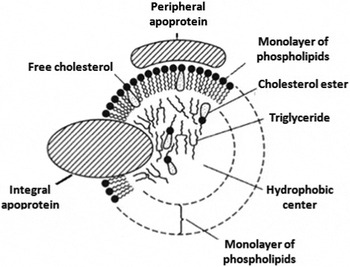
The term lipoprotein refers to a set of complex spherical particles formed from lipids and proteins. These particles circulate in the bloodstream, transporting endogenous and exogenous lipids in the plasma (Figure 1). Lipoproteins are structures similar to micelles, containing an apolar nucleus of glycerol esters (triacylglycerol) and esterified cholesterol, enveloped by a monolayer of phospholipids and free cholesterol, which constitutes the outer limit of the particle and its interface with the aqueous external environment. This monolayer contains various apoproteins that differ depending on the type of particle (Figure 1, Table 1).
Lipoprotein structure.

The main lipids transported by lipoprotein particles are triacylglycerols and cholesterol (free and esterified), and their component fatty acids obtained either from the diet or through de novo synthesis. It should be stressed that different lipoproteins may exchange lipids and apoproteins, making the chemical composition of a class of lipoprotein quite variable.
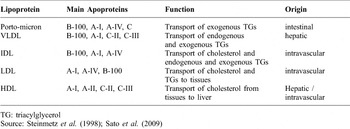
In both mammals and birds, lipoproteins are classified based on density, which varies in relation to the proportions of lipids and proteins that they contain. In birds, portomicrons are lipoproteins produced by enterocytes, and serve to transport lipids from the gastrointestinal tract to the liver via portal circulation. Very low-density lipoprotein (VLDLs) are synthesised in the liver and released into the bloodstream, transporting lipids to other tissues. Intermediate-density lipoproteins (IDLs) are the remainders of VLDLs following their metabolism by tissues, while low-density lipoproteins (LDLs) come from the metabolism of VLDLs and IDLs after lipolysis by both lipoprotein lipase (LPL) and hepatic lipase (HL); and high-density lipoproteins (HDLs), which begin as disc-shaped particles, originate primarily in the liver and presumably the intestines. Among hens in the production phase, a special type of lipoprotein is formed under the influence of oestrogen – vitellogenin, which is synthesised by the liver and exported directly to the ovaries, where it participates in the formation of the egg yolk. Due to its simpler structure, this lipoprotein is believed to be important to the synthesis of specific components of the yolk. Table 1 displays the main characteristics of lipoproteins.
Main characteristics of lipoproteins.

TG: triacylglycerol
Source: Steinmetz et al. (Reference STEINMETZ, HERMANN, NIMPF, AEBERSOLD and SCHNEIDER1998); Sato et al. (Reference SATO, SUZUKI and AKIBA2009)
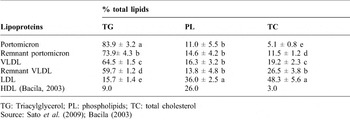
Portomicrons are structures similar to chylomicrons in mammals, with a mean diameter of approximately 150 nm and a lipid composition of 90% triacylglycerol (Griffin et al., Reference GRIFFIN, GRANT and PERRY1982). The difference is that portomicrons are directed primarily towards the liver and not the extra-hepatic tissues. VLDLs have a diameter of 30 to 90 nm and are denser, owing to a greater proportion of proteins. LDLs are even smaller, denser and more concentrated in cholesterol due to the removal of a large portion of the triacylglycerol initially contained in VLDLs and IDLs. The participation of these lipoproteins in the formation of atheromatous plaque or an increase in the risk of acute myocardial infarction, as occurs in mammals, has been reported in birds (Toda et al., Reference TODA, LESZCZYNSKI, NISHIMORI and KUMMEROW1980). HDLs are the smallest lipoproteins (approximately 10 nm), comprised of about 57% protein and with a density of 1.210 g/ml (versus 1.0 mg/ml of water and less than 0.95 g/ml in chylomicrons); these lipoproteins remove free cholesterol from the circulation and conduct this compound toward hepatic reuse or excretion. Table 2 displays the lipid composition of the main lipoproteins in birds.
Lipid composition of main lipoproteins in birds.

TG: Triacylglycerol; PL: phospholipids; TC: total cholesterol
Source: Sato et al. (Reference SATO, SUZUKI and AKIBA2009); Bacila (Reference BACILA2003)
Similar to mammals, remnant VLDLs and LDLs have a lower content of triacylglycerols in relation to the original VLDLs. LDLs also have a greater content of phospholipids, which is similar to findings described for other species. Sato et al. (Reference SATO, SUZUKI and AKIBA2009) reported that remnant VLDLs have a lower apo C content, similar to what occurs in mammals (Havel et al., Reference HAVEL, GOLDSTEIN and BROWN1980), whereas apo A-I and A-IV are present in greater amounts. This indicates that the hydrolysis of triacylglycerol by LPL is dependent on apo C, but not apo A-I or apo A-IV. Following the action of LPL, Windler et al. (Reference WINDLER, GREEVE, DAERR and GRETEN1988) reported that the apo B48 content was unaltered in chylomicrons from rats, which was similar to the findings for Apo B100 reported by Sato et al. (Reference SATO, SUZUKI and AKIBA2009) in broilers, but there was a reduction in apo A-I, A-IV and C. This suggests that there is a difference between mammals and birds in the content and function of apo A-I and A-IV in lipoproteins and that apo B acts only as a lipoprotein ligand for its respective receptors.
In practice, the characterisation of plasma lipoproteins can be based on electrophoretic migration. In birds, however, this subject has been more extensively analysed and should be interpreted with caution, due to the alterations that occur in the quantity and composition of VLDLs in the plasma of hens three weeks prior to egg laying or following the administration of oestrogen to roosters, which seems to influence lipoprotein metabolism. Current advances in molecular biology have contributed significantly to knowledge regarding lipoprotein metabolism in birds, although many aspects remain unclear.
Characteristics of lipid metabolism in birds
The metabolism of lipids in birds has a number of differences compared to mammals. One such difference is the site of the de novo synthesis. It has been estimated that 70% of fatty acid synthesis in birds is performed in the liver and only 5% occurs in the adipose tissue, with the remaining fatty acids coming from the diet (Griffin and Hermier, Reference GRIFFIN and HERMIER1988). This differs from the majority of domesticated mammals, in which the synthesis of fatty acids occurs nearly entirely in the adipose tissue.
The lymphatic system of the gastrointestinal tract is poorly developed in birds in part because intestinal villi lack a central lymphatic vessel (Kiyasu, 1955 cited in Freeman, Reference FREEMAN1984). This lack is compensated by a well-developed capillary network in the interior of the intestinal villi. This structural configuration is considered favourable to the absorption and transport of triacylglycerols through the portal-mesenteric system, which was confirmed by Noyan et al. (Reference NOYAN, LOSSOW, BROT and CHAIKOFF1964) in studies involving radio-isotopes in chickens.
Following intestinal absorption, fatty acids originating from the diet are released into the portal system as triacylglycerol components of portomicrons (Bensadoun and Rothfield, Reference BENSADOUN and ROTHFIELD1972) and carried directly to the liver, where these lipoproteins are recognised by an as-yet undetermined receptor (Sato et al., Reference SATO, SUZUKI and AKIBA2009). This receptor is believed to be LR8 (a protein-related LDL receptor), which is the same receptor that recognizes VLDLs. However, some molecules manage to pass through the hepatic barrier (approximately 90%) and can reach the circulation system, where they undergo the action of LPL, transforming them into remnant portomicrons that are captured by the liver.
As with other species, the fatty acids synthesised in the liver are largely incorporated as triacylglycerols into VLDL and secreted into the plasma. After undergoing the action of LPL on the endothelial surface of the blood vessels, VLDLs are converted into VLDL remnants. The fatty acids liberated from them can then penetrate adipocytes, where they are resynthesised into triacylglycerols and deposited in reserves. In muscle cells, liberated fatty acids can be used in metabolic processes. As previously mentioned, vitellogenin is a lipoprotein synthesised in hens during the production phase as well as in roosters under the influence of oestrogen. This lipoprotein is synthesised in the liver and used by the ovaries for the formation of the yolk.
Synthesis and secretion of lipoproteins in birds
As in mammals, the synthesis of fatty acids in birds depends on the availability of dietary carbohydrates and amino acids. Insulin stimulates the activity of the main enzymes involved in lipogenesis, such as malate dehydrognease, fatty acid synthase and citrate lyase, whereas adrenaline and glucagon have the opposite effect (Tarlow et al., Reference TARLOW, WATKINS, REED, MILLER, ZWERGEL and LANE1977). In egg-laying hens, hepatic lipogenesis is intensified by the action of oestrogen due to the accentuated demand of vitellogenesis. The maximal activity of the de novo synthesis of lipids is believed to occur when insulin and oestrogen are associated, which underscores the importance of a balanced diet, especially in terms of carbohydrates and amino acids. Thus, hormonal control may play an important role in the regulation of the rate of hepatic lipogenesis, and is therefore likely related to genetic selection. Besides fatty acids, the liver is the main site for the synthesis of cholesterol and phospholipids, which, together with proteins, are the main components of surface monolayers of the lipoprotein (Hermier, Reference HERMIER1997).
VLDLs and HDLs are the two main classes of lipoproteins synthesised and secreted by the liver of birds and respectively contain apo B-100 (Siuta-Mangano et al., Reference SIUTA-MANGANO, JANERO and LANE1982) and apo A-I (Banerjee and Redman, Reference BANERJEE and REDMAN1984) as the main apoproteins. According to Hermier (Reference HERMIER1997), the formation of VLDLs is a sequential process similar to that which occurs in mammals, beginning in the endoplasmic reticulum and ending in the Golgi complex for subsequent secretion. As in mammals in the control of lipid secretion, it is not known why triacylglycerols are preferentially associated with VLDL. Researches indicate the presence of a specific protein known as protein microsomal triglyceride transfer (MTP) which has been shown to play a central role in lipoprotein assembly (Wetterau et al., Reference WETTERAU, LIN and JAMIL1997). As for phospholipids, especially those containing fatty acids from the omega 3 family, these are preferentially associated with HDLs (Hermier, Reference HERMIER1997). It is believed that ABC-A1 (ATP-binding cassette transporter) mediates the efflux of cholesterol and phospholipids to lipid-poor apolipoproteins (apo-A1 and apoE), which then form nascent HDL (Mulligan et al., Reference MULLIGAN, FLOWERS, TEBON, BITGOOD, WELLINGTON, HAYDEN and ATTIE2003).
Degradation of lipoproteins and storage of lipids
The transference of triacylglycerols from VLDLs and portomicrons to adipose and muscle tissue is similar to that which occurs in mammals and involves the participation of insulin-activated LPL. This enzyme is mainly synthesised by adipocytes and muscle cells and is anchored to the surface of the capillary wall, where it is activated by insulin (Xu et al., Reference XU, WANG, HAN, JIANG, ZHUO, YE and WANG2010). In mammals, LPL interacts with apo C-II, which is a low-molecular weight apoprotein secreted with HDLs and transferred to VLDLs prior to hydrolysis (Griffin et al., Reference GRIFFIN, GRANT and PERRY1982). In egg-laying hens, however, the catabolism of VLDLs in adipose and muscle tissue is very limited, thereby allowing a greater quantity of lipids to be transported to the oocytes (Walzem, Reference WALZEM1996). In the ovaries, VLDLs are endocyted, ensuring the supply of lipids for the production of the yolk (Hermier, Reference HERMIER1997). VLDL in egg-laying hens contains large amounts of apo VLDL-II (Walzem et al., Reference WALZEM, HANSEN, WILLIANS and HAMILTON1999), which is an apolipoprotein that is only synthesised under the influence of oestrogen and has been shown to be a specific inhibitor of LPL (Schneider et al., Reference SCHNEIDER, CARROLL, SEVERSON and NIMPF1990).
There is little information on the regulation of LPL activity in birds, but it seems that this mechanism in adipose tissue is less sensitive to nutritive status in comparison to mammals (Hermier et al., Reference HERMIER, CHAPMAN and LECLERCQ1984). Borron et al. (Reference BORRON, JENSEN, MCCARTNEY and BRITTON1979) demonstrated that only high concentrations of insulin can stimulate LPL activity in the adipose tissue of chickens, whereas adrenaline-induced AMPc may diminish the synthesis and activity of the enzyme (Bensadoun and Martin Reference BENSADOUN and MARTIN1986).
Extra-hepatic fat deposition and metabolism of lipoproteins
As the de novo synthesis of lipids in the adipose tissue of birds occurs at a much lower proportion than in the liver, the growth of adipose tissue depends mainly on triacylglycerols transported by VLDLs. According to Hermier (Reference HERMIER1997), it theoretically seems possible to alter the metabolism of this lipoprotein on three levels: liver, plasma and adipose tissue.
As the liver is responsible for the majority of lipogenesis in birds, it may be inferred that an increase in the synthesis of hepatic fatty acids leads to a greater secretion of VLDLs. Indeed, Whitehead and Griffin (Reference WHITEHEAD and GRIFFIN1984) demonstrated that, in growing birds, the activity of malate dehydrognease and citrate lyase, which are the main enzymes involved in lipogenesis, demonstrated positive correlations (0.4 to 0.5) with the adiposity of the meat, as assessed by the weight of abdominal fat. Bannister et al. (Reference BANNISTER, LEE, WHITEHEAD and GRIFFIN1984) also found that the activity of hepatic enzymes involved in the synthesis of fatty acids was increased in birds selected for fattening and that animals in this category exhibited higher plasma VLDL values in comparison to those selected for muscle deposition in studies by Leclercq et al. (Reference LECLERCQ, BLUM and BOYER1980; Reference LECLERCQ, HERMIER and GUY1990) These findings suggest that the results of fattening at least partially come from an increase in hepatic lipogenesis. However, no enzyme criterion was obtained in these studies that could be used in selection programs for lesser adiposity in poultry or lesser fat deposition in yolks.
Serum turbidity is another criterion that could be employed in genetic selection programs, as it is a reflection of the concentration of VLDLs and is easily determined in blood samples (Whitehead and Griffin, Reference WHITEHEAD and GRIFFIN1982; Reference WHITEHEAD and GRIFFIN1984). The selection for thinness based on serum turbidity or, more specifically, the plasma concentration of VLDLs could be applicable to other bird species, provided they have the same feeding models, as in the case of turkeys, in which the concentration of VLDL is a good indicator of the degree of adiposity (Griffin and Whitehead, Reference GRIFFIN and WHITEHEAD1985). This is in agreement with the results described by Kouba et al. (Reference KOUBA, HERMIER and BERNARD-GRIFFITHS1995), who demonstrated that turkeys of similar age and body weight exhibited lesser body fat deposition when the concentration of VLDLs in the blood was lower.
With regard to the degree of adipose tissue, LPL is known to be a limiting enzyme in the hydrolysis of triacylglycerol in lipoproteins, especially VLDLs. Despite the positive correlations found between LPL activity and the growth of fat deposits in chickens (Griffin et al., Reference GRIFFIN, BUTTERWITH and GODDARD1987), there is no experimental evidence demonstrating that the activity of this enzyme is a determinant factor in the regulation of fat in birds. According to the Hermier (Reference HERMIER1997), LPL activity increases with the number of adipocytes and reflects the degree of hyperplasia of the tissue more than an increase in the ability of each individual cell to store triacylglycerol. Thus, obese birds selected based on abdominal fat, may exhibit this hyperplasia of adipose tissue. In thin birds, LPL activity has been found to be greater in muscles (including the heart) than in adipose tissue, which is in accordance with the preferential use of VLDL-triacylglycerol for oxidation in the muscles rather than storage in adipocytes (Griffin et al., Reference GRIFFIN, GUO, WINDSOR and BUTTERWITH1992). According to Hermier (Reference HERMIER1997), selection aimed at less fat deposition should result in lineages with a smaller number of adipocytes and the determination of LPL activity may not be an adequate criterion, as the expression of the activity of this enzyme may not routinely be executed and a biopsy sample may not represent the organism as a whole.
Metabolism of lipids and egg formation
The production of a certain amount of eggs requires the deposition of large quantities of lipids in the yolk, especially during the days that precede ovulation. As for proteins, the specific types and molecular compositions of lipids in the yolk are synthesised in the liver through the influence of oestrogen and progesterone, and are transferred through the blood to the ovarian follicles by means of yolk-targeted VLDL and VTG (Walzem, Reference WALZEM1996).
In hens, lipoproteins contribute approximately 95% of the yolk lipids. The liver prepares and secretes triacylglycerols and phospholipids in a special yolk-labelled VLDL known as VLDLy, which has unique structural and biochemical properties (Walzem et al., Reference WALZEM, HANSEN, WILLIANS and HAMILTON1999). This lipoprotein is half the size of a normal VLDL and has an aproprotein VLDL-II on its surface, making it a poor substrate for LPL in the tissues. Consequently, VLDLy triacylglycerols are not well used by skeletal muscle or adipose tissue. Its small size allows it to pass through the granulosa basal lamina of the ovarian follicle and bind to the LR8 receptor in the oolemma (the membrane that covers the yolk); it is then endocyted intact to form yolk. Vitellogenin forms a very high density lipoprotein and is carried to the developing oocyte, where it is broken down to form phosvitin and lipovitellin, which are proteins found in egg yolk (Hermier et al., Reference HERMIER, FOLGEZ, WILLIAMS and CHAPMAN1989).
The sieving action of the basal lamina of the ovarian follicle prevents the passage of portomicrons that arrive carrying dietary lipids. This combination of ultrastructures of the follicle and the size of VLDLy and vitellogenin allows only lipids synthesised by the liver to be incorporated to the yolk, thereby offering control of the lipid characteristics of the yolk. The only influence from the diet is related to polyunsaturated fatty acids, as its deposition in the yolk is positively correlated with the quantity of these fatty acids in the diet (Noblet et al., Reference NOBLET, SPEAKE, McCARTNEY, FOGGIN and DEEMIG1996).
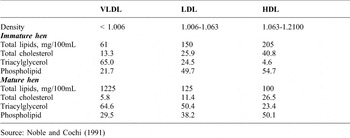
During this production phase, the liver increases in size, as the intensity of synthesis of TGA-rich lipoproteins by the normal liver during the anovulatory phase is not sufficient to meet demand. At the same time, there is a change in the tonality of the organ, which takes on a colouration closer to the yellow of yolk. Moreover, the VLDLy uptake rate by ovarian follicles is not as fast as hepatic release, and circulating triacylglycerol increase twofold during the production of the egg (Walzem, Reference WALZEM1996). Table 3 displays the lipid concentration values in the plasma of egg-laying hens in comparison to immature hens.
Concentration of plasma lipids in immature hens and hens in egg-laying phase.

Source: Noble and Cochi (1991)
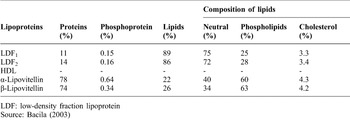
Lipoproteins found in the yolk are classified into two categories: low-density fraction (LDF) and high-density lipoprotein (HDL). These lipoproteins arise from post-endocytic modifications (Mann et al., Reference MANN, OLSENA, MACEKA, GNADA and MANN2008). Table 4 displays the chemical composition of lipoproteins in the yolk.
Lipoproteins in egg yolk.

LDF: low-density fraction lipoprotein
Source: Bacila (Reference BACILA2003)
Lipoprotein metabolism disorders in birds
The liver and adipose tissue have the greatest participation in the metabolism of lipids in animals. However, the adipose tissue in domesticated birds has a much lower capacity for lipogenesis in comparison to other species. Moreover, in contrast to what occurs in the liver, there is no alteration in the levels of the enzymes of lipogenesis in the adipose tissue of birds to allow for a metabolic state where there is an excess of energy nutrients. In many situations, lipid synthesis exceeds the packaging rate of these lipids (lipoprotein production), resulting in the fatty degeneration of the organ (hepatic steatosis).
Two factors compete to alter lipid homeostasis and cause the fatty degeneration of the liver: overfeeding, as occurs in the goose liver for the obtainment of pâté de foie gras, and a deficiency of nutrients that induce the production of lipoproteins (choline, methionine, inositol, vitamin B12 and folic acid). Birds between five and seven weeks of life are more susceptible to this syndrome, when the growth rate is reduced, as are egg-laying hens receiving a high lipid diet. In the latter case, excessive lipids from the diet accumulate directly in the liver.
Conclusions
Lipoproteins are essential components for the formation of yolk and body fat deposition in birds. Understanding the role of plasma lipoproteins and their metabolism is of considerable importance and can assist genetic improvement programs and the development of more productive animals. This would favour an economic return for poultry farmers and improved conditions with regard to human health through the production of poultry meat and eggs of greater nutritional quality. Moreover, advances in molecular biology can help in the choice of the most productive and best quality birds through a more in-depth understanding of basic knowledge on the metabolism of lipoproteins in birds.