Introduction
Nematodes of the order Strongylida, particularly those of the family Trichostrongylidae Leiper, 1912, are the most common parasites in ruminants (Anderson, Reference Anderson2000). They constitute a very diverse group of parasites, among which, both species with narrow and broad host specificity are found. Although separate species have similar morphology, until recently it was claimed that their identification can be made merely on the basis of a few morphological features. However, a more detailed analysis of the issue has indicated that very often their distinction solely by means of morphology is difficult. It became doubtful whether particular features reflect genuine species differences, or only morphological variations within the same species (Hoberg et al., Reference Hoberg, Agosta, Boeger and Brooks2015). Consequently, this forced the enlargement of basic morphological analyses of these nematodes and the use of appropriate molecular techniques.
Actually, among the order Strongylida and the family Trichostrongylidae, along with species whose status is indisputable, there are species with large variability. This is related to the presence of species: (i) morphologically different but lacking genetic differences (polymorphic species); (ii) morphologically very similar but genetically distinct (species complexes of cryptic species); and (iii) emerging as the result of mating between different species (hybrids). In fact, the existence of these phenomena significantly complicates unambiguous species identification. Additionally, a species can be specific to a particular host, or group of hosts.
Overview of polymorphic species
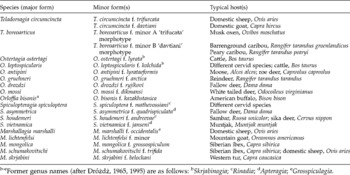
The first definition of polymorphism was proposed by Ford (Reference Ford1953) and has been recognized in three subfamilies of the Trichostrongylidae, i.e. the Ostertagiinae, Cooperiinae and Haemonchinae. Many species of the subfamily Ostertagiinae are characterized by a low intensity of infection, mostly reaching from a few to several specimens, and a high prevalence, often up to 100% (Dróżdż, Reference Dróżdż1995). Dróżdż (Reference Dróżdż1979) described the phenomenon of regular co-occurrence of the rather scarce accompanying species (minor morphs), in pairs with the more numerous ones (major morphs). He ascertained that: (i) species of the genera Rinadia (currently a synonym of Spiculopteragia) and Apteragia ( = Spiculopteragia) always co-exist with the species of Spiculopteragia, which are dominant; (ii) Skrjabinagia ( = Ostertagia) are accompanied by species of the genus Ostertagia; and (iii) the species of Grosspiculagia ( = Marshallagia) co-occur with representatives of Marshallagia. The proportion of minor species (morphs) in populations of major species was, as a rule, constant for each species pair. Additionally, each of the pairs was associated primarily with a specific host (table 1).
Morphotypes of nematode species within five polymorphic genera of the Ostertagiinae Lopez-Neyra, 1947, with typical hosts (after Dróżdż, Reference Dróżdż1995; Hoberg et al., Reference Hoberg, Monsen, Kutz and Blouin1999, Reference Hoberg, Abrams, Pilitt and Kutz2012a, Reference Hoberg, Abrams, Pilitt and Jenkinsb)

aLichtenfels & Pilitt (Reference Lichtenfels and Pilitt1991) synonymized the genus Orloffia with Ostertagia. However, based on the analyses of internal transcribed spacer-2 (ITS-2) rDNA markers, Kuznetsov (Reference Kuznetsov2011) has shown Orloffia to be a distinct genus containing only one valid species O. bisonis/O. kazakhstanica.
b-eFormer genus names (after Dróżdż, Reference Dróżdz1965, Reference Dróżdż1995) are as follows: b Skrjabinagia; c Rinadia; d Apteragia; e Grosspiculagia.
For instance, Dróżdż (Reference Dróżdż1995) has examined many hundreds of thousands of the specimens belonging to Ostertagiinae (collected from almost 500 wild and domestic ruminant hosts) and found for the first time a relation between five species (Ostertagia drozdzi Jancev, 1977, Orloffia bisonis (Cram, 1925), Marshallagia mongolica Schumakovitch, 1950, M. schumakovitschi Kadyrov, 1959 and M. grossospiculum Li, Yn, Kong & Jang, 1987), and their minor morphs.
According to Dróżdż (Reference Dróżdż1979, Reference Dróżdż1995), each pair of co-occurring species (i.e. minor and major morphs) show similarities in some features (e.g. the structure of the oesophagus, the synlophe patterns and the shape of copulatory bursa rays); however, they differ in characters which are recognized as generic features (particularly the structure of the spicules, gubernaculum and genital cone). Because of the differences in some morphological features, such specimens have been divided into different genera, whereas, in fact, they are polymorphic forms of one species (morphotypes). Females in polymorphic species are practically identical (i.e. the construction of the vulva and vulvar flap) (Lancaster & Hong, Reference Lancaster and Hong1990).
Since some of the ostertagiine genera consisted of morphological variants (morphotypes) rather than separate species (Lancaster & Hong, Reference Lancaster and Hong1981; Lichtenfels & Hoberg, Reference Lichtenfels and Hoberg1993; Dróżdż, Reference Dróżdż1995; Zarlenga et al., Reference Zarlenga, Hoberg, Stringfellow and Lichtenfels1998), the objects of many investigations were nematodes belonging to the genus Teladorsagia. For each polymorphic species, only morphologically discrete males were recognized, mainly based on, for example, the structure and shape of the spicules, gubernaculum and genital cone (Dróżdż, Reference Dróżdż1995). Initially T. circumcincta (Stadleman, 1894) was characterized by slender spicules, in comparison with the shorter and stouter spicules of T. trifurcata (Ransom, 1907) and T. davtiani Andreev & Satubaldin, 1954. The latter two species were differentiated by morphological variation of the genital cone (Becklund & Walker, Reference Becklund and Walker1971). Later, some authors (Andrews & Beveridge, Reference Andrews and Beveridge1990; Suarez & Cabaret, Reference Suarez and Cabaret1992; Lichtenfels & Hoberg, Reference Lichtenfels and Hoberg1993; Stevenson et al., Reference Stevenson, Gasser and Chilton1996) suggested that T. trifurcata and T. davtiani are in fact morphotypes of T. circumcincta, because: (i) males of all three morphotypes appeared always to occur together, with T. circumcincta constituting the major proportion of the population (Lancaster & Hong, Reference Lancaster and Hong1981; Lichtenfels & Hoberg, Reference Lichtenfels and Hoberg1993; Craig et al., Reference Craig, Pilkington and Pemberton2006); (ii) no differences in female worm morphology have been identified within populations containing the male morphotypes (Lichtenfels & Hoberg, Reference Lichtenfels and Hoberg1993); and (iii) cross-breeding experiments have produced males of different morphotypes, either from a cross between female T. circumcincta (monomorphic laboratory strain) and male T. trifurcata, or from unknown female Teladorsagia mating with males of one of the morphotypes (Suarez & Cabaret, Reference Suarez and Cabaret1992; Lichtenfels & Hoberg, Reference Lichtenfels and Hoberg1993). These data were consistent with the results of Copland (Reference Copland1965) and Daskalov (Reference Daskalov1974), who did not demonstrate the presence of males with intermediate parental morphological features, obtained by neither natural nor experimental infections.
Hoberg et al. (Reference Hoberg, Monsen, Kutz and Blouin1999), who have focused primarily on the biodiversity among Arctic nematodes, also dealt with the polymorphism in Teladorsagia spp. They suggested that T. boreoarcticus Hoberg, Monsen, Kutz & Blouin, Reference Hoberg, Monsen, Kutz and Blouin1999 is dimorphic, but later the ‘davtiani’ morphotype for T. boreoarcticus was found (Hoberg et al., Reference Hoberg, Abrams, Pilitt and Kutz2012a). Consequently, three morphotypes were recognized: (i) the major morph; (ii) minor morph A; and (iii) minor morph B, with the differences resembling those demonstrated between T. trifurcata and T. davtiani morphotypes of T. circumcincta (table 1).
Among the subfamily Cooperiinae, polymorphism was observed by Isenstein Reference Isenstein(1971a), who concluded that Cooperia oncophora (Railliet, 1898) Ransom, 1907 and C. surnabada (Antipin, 1931) ( = C. mcmasteri Gordon, 1932), are polymorphs of the same species.
The phenomenon of polymorphism also applies to Haemonchinae, but only in relation to female morphology. Daskalov (Reference Daskalov1971) and Le Jambre (Reference Le Jambre1977) have shown that the relative frequency of a smooth, knobbed or linguiform vulvar flap of Haemonchus contortus (Rudolphi, 1803) indicates the presence of different morphological forms of the species. Additionally, Lancaster & Hong (Reference Lancaster and Hong1971), after examining Ostertagia leptospicularis Assadov, 1953 ascertained that, among all females of the Ostertagiinae, differences in flap structure can be observed, which might be merely host-induced changes.
Studies on the morphology of the aforementioned co-occurring species (Lancaster & Hong, Reference Lancaster and Hong1981, Reference Lancaster and Hong1990; Lichtenfels et al., Reference Lichtenfels, Pilitt and Lancaster1988a, Reference Lichtenfels, Pilitt and Lancasterb; Lichtenfels & Pilitt, Reference Lichtenfels and Pilitt1989; Suarez & Cabaret, Reference Suarez and Cabaret1991; Lichtenfels & Hoberg, Reference Lichtenfels and Hoberg1993) have confirmed the earlier suggestions concerning their polymorphic characters. Based on the literature, 5 of the 15 genera within the subfamily Ostertagiinae (i.e. Teladorsagia, Ostertagia, Orloffia, Spiculopteragia, Marshallagia) should be considered as polymorphic (Hoberg et al., Reference Hoberg, Abrams and Pilitt2009).
Current state of polymorphic species
Nowadays, parasitological diagnostic techniques have been complemented by a variety of molecular tools. Thus it is possible to verify the currently described species, and to recognize the occurrence of new species, hitherto incorrectly identified (Blouin, Reference Blouin2002). The implementation of species-specific molecular markers in the analyses has confirmed all the previous suggestions and assumptions proposed by Dróżdż (Reference Dróżdż1995) (table 1).
A great many breeding experiments and advanced morphological observations, together with molecular approaches, have demonstrated that T. circumcincta, T. trifurcata and T. davtiani are conspecific (Cabaret et al., Reference Cabaret, Morales and Gruner1984; Lichtenfels et al., Reference Lichtenfels, Pilitt and Lancaster1988a; Andrews & Beveridge, Reference Andrews and Beveridge1990; Gasnier et al., Reference Gasnier, Cabaret and Suarez1993; Stevenson et al., Reference Stevenson, Gasser and Chilton1996; Dróżdż, Reference Dróżdż2000, Grillo et al., Reference Grillo, Craig, Wimmer and Gilleard2008). Suarez & Cabaret (Reference Suarez and Cabaret1992) not only confirmed the lack of genetic isolation between T. circumcincta, T. trifurcata and T. davtiani, but also found genetic association between Ostertagia ostertagi (Stiles, 1892) and O. ( = Skrjabinagia) lyrata Sjoberg, 1926, as well as between O. leptospicularis and O. ( = S.) kolchida Popova, 1937 (table 1), previously misclassified as different species. Moreover, Humbert & Cabaret (Reference Humbert and Cabaret1995), using a molecular technique (i.e. random amplified polymorphic DNA; RAPD), confirmed that C. surnabada ( = C. mcmasteri) is a morphological form of C. oncophora.
Dallas et al. (Reference Dallas, Irvine and Halvorsen2000) carried out a molecular analysis of Ostertagia gruehneri Skrjabin, 1929 and O. arctica Mitzkewisch, 1929 (derived from reindeer Rangifer tarandus tarandus and caribou Rangifer tarandus caribou) and confirmed the presence of distant morphotype species within Ostertagia. Their distribution extends throughout the range of the host species (Lichtenfels et al., Reference Lichtenfels, Pilitt and Fruetel1990). Formerly, on the basis of morphological analysis of males and evidence for their co-occurrence, it was suspected that O. gruehneri derived from the aforementioned hosts represented one polymorphic species (Lichtenfels et al., Reference Lichtenfels, Pilitt and Fruetel1990; Suarez & Cabaret, Reference Suarez and Cabaret1991; Dróżdż, Reference Dróżdż1995). However, molecular studies which would validate this have never been carried out. Material for such analyses was obtained from endemic Svalbard reindeer Rangifer tarandus platyrhynchus, and Eurasian tundra reindeer R. t. tarandus (Dallas et al., Reference Dallas, Irvine and Halvorsen2000). The relative levels of DNA sequence divergence in the internal transcribed spacers (ITS)-1 and ITS-2 have shown virtually identical sequences between the studied nematode species. The results of Dallas et al. (Reference Dallas, Irvine and Halvorsen2000) strongly suggested that O. gruehneri and O. arctica are dimorphic males (conspecific) of the same species (table 1). Conspecificity was also confirmed for Marshallagia marshalli Ransom, 1907 and M. occidentalis Ransom, 1907, using the same molecular markers (Dallas et al., Reference Dallas, Irvine and Halvorsen2001).
Likewise, Santin-Duran et al. (Reference Santin-Duran, de la Feuente, Alunda, Rosenthal and Hoberg2002) and Lienard et al. (Reference Lienard, Depaquit and Ferte2006) used ITS-1 and ITS-2 regions of the ribosomal RNA gene (rDNA), and the NADH dehydrogenase subunit 4 gene (ND4) of mitochondrial DNA (mtDNA) to study the polymorphic species hypothesis among Spiculopteragia spp. They have shown that S. mathevossiani Ruchliadev, 1948 and S. quadrispiculata (Jansen, 1958) represent minor morphs of S. spiculoptera (Guschanskaia, 1931) and S. asymmetrica (Ware, 1925), respectively (table 1). Additionally, Sultan et al. (Reference Sultan, Omar, Makouloutou, Kaneshiro, Saita, Yokoyama, Suzuki, Hosoi and Sato2014) confirmed (by ITS-2 rDNA and the cytochrome c oxidase subunit I gene (COI) mtDNA analyses) that S. houdemeri (Schwartz, 1926) and S. andreevae (Dróżdż, 1965) belong to a single polymorphic species.
According to the current state of knowledge, the definition proposed by Ford (Reference Ford1953) can be understood as the co-existence of at least two distinct, genetically indistinguishable, morphological forms of a specimen (belonging to a single species) in the same host.
Species complexes and cryptic species
Among parasitic nematode species, particularly from the family Trichostrongylidae Leiper, 1912, there also exist phylogenetically distinct populations (cryptic species) which, until recently, were classified as a single species due to morphological similarity (Bickford et al., Reference Bickford, Lohman, Sodhi, Ng, Meier, Winker, Ingram and Das2006). Several genetic studies conducted within Trichostrongylidae have shown that DNA sequence diversity observed within this family is very high on a species level, compared to most nematodes from other groups (Beech et al., Reference Beech, Prichard and Scott1994; Blouin et al., Reference Blouin, Yowell, Courtney and Dame1995, Reference Blouin, Liu and Berry1999; Leignel & Humbert, Reference Leignel and Humbert2001; Braisher et al., Reference Braisher, Gemmel, Grenfell and Amos2004). This variability can be the result of very large population sizes of these parasites.
The presence of cryptic species is assumed especially within the subfamily Ostertagiinae, which contains many of the gastrointestinal parasites of ruminants. Precise designation of these parasites is based primarily on morphological and morphometric features (Becklund & Walker, Reference Becklund and Walker1971; Gibbons & Khalil, Reference Gibbons and Khalil1982; Lichtenfels et al., Reference Lichtenfels, Pilitt and Lancaster1988a, Reference Lichtenfels, Hoberg and Zarlenga1997; Lichtenfels & Hoberg, Reference Lichtenfels and Hoberg1993; Dróżdż, Reference Dróżdż1995). The increasing use of molecular techniques, sometimes in combination with advanced morphological analysis, have allowed the traditionally regarded species to be examined more closely.
The use of molecular studies revealed a significant intraspecific diversity in the populations of these nematodes. As an example, T. circumcincta – treated so far as a single species occurring mainly in sheep, goats and occasionally in other ruminants – is currently believed to represent the so-called Teladorsagia species complex. Within the Teladorsagia complex, there probably exist particular cryptic species, or strains, typical for any individual host, or group of hosts (Gasnier & Cabaret, Reference Gasnier and Cabaret1996; Hoberg et al., Reference Hoberg, Monsen, Kutz and Blouin1999; Leignel et al., Reference Leignel, Cabaret and Humbert2002; Grillo et al. Reference Grillo, Jackson, Cabaret and Gilleard2007). The most significant studies on T. circumcincta have demonstrated the existence of two distinct strains, irrespective of the morphs. The strains were characterized by morphological differences and malate dehydrogenase allozyme polymorphism (MDH) (Gasnier & Cabaret, Reference Gasnier and Cabaret1996; Gasnier et al., Reference Gasnier, Cabaret and Durette1997). It was also shown that both strains differ in host preferences. The first one (SGL) was found in sheep and goats, and the other (GL) occurred only in goats. Although molecular analysis revealed few heterozygous individuals, which might indicate the possibilities of limited mating among these strains, they were not considered as separate species because GL existed only in co-infections with SGL. The distinctiveness of these two strains was corroborated by sequences of the β-tubulin isotype 1 gene, ITS-2 fragments (rDNA) and the ND4 gene (mtDNA). The results suggested that T. circumcincta is a species complex, which requires further investigations on a wider geographic scale (Leignel et al., Reference Leignel, Cabaret and Humbert2002).
In contrast, Hoberg et al. (Reference Hoberg, Monsen, Kutz and Blouin1999) discovered a distinct nematode species in musk oxen Ovibos moschatus, previously regarded as T. circumcincta. It was named T. boreoarcticus, to emphasize its origin from a geographically isolated region. This conclusion was based on a number of morphological measurements and mtDNA ND4 sequences. Teladorsagia boreoarcticus is distinguishable from T. circumcincta by the sequence divergence of the mtDNA gene ND4 (13%), the constant differences in the synlophe pattern, and the longer oesophageal valve, spicules, gubernaculum and bursa copulatrix. The revision of previously conducted research on the parasite species composition of Arctic ruminants – not only that of musk oxen – proved to be urgently needed (Kutz et al., Reference Kutz, Ducrocq, Verocai, Hoar, Colwell, Beckmen, Polley, Elkin and Hoberg2012).
Nevertheless, the investigations conducted so far have not included other genera of Ostertagiinae, such as Ostertagia, common in cattle and cervids. The lack of knowledge in this area poses serious difficulties in assessment of nematode biodiversity within the subfamily.
Hybrids
The accurate diagnosis of gastrointestinal nematodes of ruminants, regardless of their developmental stage, is essential for the effective control and correct treatment of animal diseases. Hybridization between species can lead to the introgression of genes, including those involved in: (i) pathogenicity, (ii) host specificity and (iii) drug resistance, which, in turn, may hinder the precise diagnosis and control of parasitic infection. The offspring arising from cross-breeding between two different species have intermediate parental morphological features, which further complicates unambiguous species identification. Among the Trichostrongylidae Leiper, 1912, hybridization within three genera, i.e. Cooperia (Isenstein, Reference Isenstein1971b), Haemonchus (Le Jambre, Reference Le Jambre1979) and Ostertagia (Suarez & Cabaret, Reference Suarez and Cabaret1992) have been reported.
Cooperia consists of very common duodenal parasites of ruminants. Isenstein Reference Isenstein(1971b) conducted a series of experiments, involving C. oncophora and C. pectinata Ransom 1907. Each of the species may frequently infect the same host and, additionally, species identification by morphological features of both sexes is relatively easy to perform. During the experiments, fourth-stage larvae of C. oncophora of one sex and C. pectinata of the opposite sex, were injected into the duodenal lumina of parasite-free calves. Infective third-stage larvae, which then grew from the eggs passed in the hosts’ faeces, were used to infect orally other parasite-free calves. It was the first successful hybridization of nematodes, which led in the first generation to the emergence of hybrid parasites, which had morphological characters of both purebred parental species.
A study on interbreeding within the members of Trichostrongylidae, under experimental conditions, was also conducted by Suarez & Cabaret (Reference Suarez and Cabaret1992). They focused on Ostertagiinae, which includes many of the polymorphic species, and mated virgin young females of selected non-polymorphic strains (O. ostertagi, O. lyrata, O. leptospicularis, O. kolchida, T. circumcincta and T. trifurcata) with various ostertagiine males. Fertile offspring that resembled the specimens of one of the parental species have been formed through interbreeding between the following species: (i) O. ostertagi and O. lyrata; (ii) O. leptospicularis and O. kolchida; and (iii) T. circumcincta and T. trifurcata. Nowadays it is known that these nematodes represent different morphological forms of the same species (Dróżdż, Reference Dróżdż1995). Infertile hybrids, intermediate in form (in the distance from apex to cervical papillae and length of oesophagus for males and females; length of spicules for males; and length of vestibule, distance from vulva to the end of tail, and width of tail and anus for females), were only obtained from interbreeding between O. ostertagi and O. leptospicularis (Suarez et al., Reference Suarez, Durette-Desset and Cabaret1993).
There are two compelling examples of hybridization among the trichostrongylid species, between the closely related Haemonchus contortus and H. placei, which used to be treated as one species, generally synonymized by Gibbons (Reference Gibbons1979). The genus Haemonchus includes haematophagous parasitic nematodes, which are the most economically important parasites of ruminants. Haemonchus contortus is most commonly found in sheep and goats (Lichtenfels et al., Reference Lichtenfels, Pilitt and Hoberg1994); however, it can also infect bovids (Hoberg et al., Reference Hoberg, Lichtenfels and Gibbons2004). Haemonchus placei is most commonly found in cattle (Lichtenfels et al., Reference Lichtenfels, Pilitt and Hoberg1994). Additionally, there are a few published reports on: (i) apparently pure infection of H. contortus in cattle (Hogg et al., Reference Hogg, Whitaker, Collins, Holmes, Mitchell, Anscombe, Redman and Gilleard2010; Akkari et al., Reference Akkari, Jebali, Gharbi, Mhadhbi, Awadi and Darghouth2013; Chaudhry et al., Reference Chaudhry, Miller, Yazwinski, Kaplan and Gilleard2014a); (ii) apparently pure infection of H. placei in small ruminants (Akkari et al., Reference Akkari, Jebali, Gharbi, Mhadhbi, Awadi and Darghouth2013); and (iii) H. contortus and H. placei co-infection in sheep, goats, cattle and buffalo (Amarante et al., Reference Amarante, Bagnola, Amarante and Barbosa1997; Jacquiet et al., Reference Jacquiet, Cabaret, Thiam and Cheikh1998; Achi et al., Reference Achi, Zinsstag, Yai, Yeo, Dorchies and Jacquiet2003; Gasbarre et al., Reference Gasbarre, Smith, Hoberg and Pilitt2009a, Reference Gasbarre, Smith, Lichtenfels and Pilittb; Brasil et al., Reference Brasil, Nunes, Bastianetto, Drummond, Carvalho, Leite, Molento and Oliviera2012). Le Jambre & Royal (Reference Le Jambre and Royal1980) discovered that the mating of H. contortus males with H. placei females results in the sterile first-generation male progeny, whereas the first-generation female progeny can produce offspring if backcrossed with males of one of the parental species (Le Jambre, Reference Le Jambre1981). The existence of hybrids between H. contortus and H. placei was also confirmed by means of analyses using different molecular markers (Chaundhry et al., Reference Chaudhry, Redman, Abbas, Raman and Ashraf2014b). Additionally, these studies have shown that the emerging hybrids of these two species may contain the genes for benzimidazole resistance (characteristic of an H. contortus isotype-1 β-tubulin resistance allele), which significantly impedes combat of Haemonchus spp. infection.
Concluding remarks
The variability revealed within the family Trichostrongylidae indicates difficulties in species distinction based merely on morphological features of nematodes. The main source of misidentification may be the presence of cryptic species and hybrids. To gather valid and comparable data on ostertagiine biodiversity, male polymorphism – already well elaborated – should also be considered. Understanding the genetic structure of parasitic nematode populations would help us to appreciate the importance of evolutionary processes, such as: (i) the adaptation of parasites to host defences; (ii) the co-speciation of parasites and hosts in geographically isolated populations; and (iii) the development of drug-resistant nematode strains (Blouin et al., Reference Blouin, Liu and Berry1999; Criscione et al., Reference Criscione, Poulin and Blouin2005).
The probably widespread presence of species complexes and cryptic species within the Ostertagiinae is not sufficiently recognized. The genus Teladorsagia mainly complicates the taxonomy of parasitic nematodes, which indicates the need for further research in this area. Even less is known about the occurrence of cryptic species in other frequently occurring representatives of the Ostertagiinae, especially in M. marshalli due to its presence in several host species (Lichtenfels & Pilitt, Reference Lichtenfels and Pilitt1989; Hoberg et al., Reference Hoberg, Abrams, Pilitt and Kutz2012a, Reference Hoberg, Abrams, Pilitt and Jenkinsb). Similar doubts may also be related to the genus Ostertagia. For example, in some European countries the data on O. leptospicularis indicate its presence only in cervids, whereas in other regions this nematode is often found in cattle. On the contrary, O. ostertagi is common in cattle, but is found much less frequently in cervids (Dróżdż et al., Reference Dróżdż, Lachowicz, Demiaszkiewicz and Sulgostowska1987, Reference Dróżdż, Demiaszkiewicz and Lachowicz1992; Dróżdż & Dudziński, Reference Dróżdż and Dudziński1993). Hence, based on the available data, it may be expected that cryptic species exist not only among the Ostertagiinae, but also in other Strongylida.
Due to the common presence of the aforementioned phenomena, their in-depth investigation becomes necessary and molecular methods should be used routinely. Such an approach will allow us to expand our knowledge of parasitic nematode speciation and parasite–host relationship development. It is also essential from the perspective of parasite control in farm animals and the protection of wild ruminant populations.
Financial support
This research was financed by the Ministry of Science and Higher Education of the Republic of Poland.
Conflict of interest
None.